Fiance Visa in Miami: 2026 Process Guide for Florida
For U.S. citizens in Florida, bringing a foreign fiancé(e) to the U.S. requires navigating the K-1 Fiance Visa process. This guide details the 2026 requirements, step-by-step application, essential documents, and expected timelines. Learn about filing Form I-129F with USCIS, consular interviews, and the crucial Adjustment of Status after marriage. We cover typical fees, common mistakes to avoid, and when to seek legal assistance. Florida Immigration Lawyers offers expert guidance for couples in Miami, Orlando, and across Florida, ensuring a smooth path to uniting with your loved one. Get a free case review today.
A K-1 Fiance Visa allows a U.S. citizen to bring their foreign-citizen fiancé(e) to the United States to marry within 90 days of entry. This process involves filing Form I-129F with USCIS, followed by National Visa Center (NVC) processing and an interview at a U.S. embassy or consulate abroad. Once in Florida, the couple must marry, and the foreign spouse then applies for Adjustment of Status to become a lawful permanent resident. Navigating this can be complex, especially with specific requirements in areas like Miami.
- The K-1 visa is for fiancés of U.S. citizens to enter the U.S. and marry within 90 days.
- The process begins with filing Form I-129F, Petition for Alien Fiance(e), with USCIS.
- Applicants must meet strict eligibility criteria, including a bona fide relationship.
- After marriage in the U.S., the foreign spouse must apply for Adjustment of Status.
- Processing times and fees can vary, making legal guidance crucial.
Finding love across borders is a beautiful journey, but uniting in the United States, especially in a vibrant state like Florida, involves a distinct legal path. If you are a U.S. citizen living in Orlando, Miami, or anywhere in the Sunshine State, and you wish to bring your foreign fiancé(e) to marry and live here, the K-1 Fiance Visa is your primary route. This visa category facilitates the entry of a foreign citizen who intends to marry a U.S. citizen petitioner within 90 days of their arrival.
The K-1 visa process, while straightforward in its intent, is often intricate in its execution, requiring careful attention to detail and adherence to specific immigration regulations. From filing the initial petition with U.S. Citizenship and Immigration Services (USCIS) to navigating consular interviews abroad and ultimately adjusting status within Florida, each step demands precision. Understanding these complexities is vital for a smooth transition for you and your loved one.
This comprehensive guide will walk you through the entire K-1 fiance visa process for Florida residents in 2026, covering eligibility, application steps, required documents, typical timelines, and associated costs. We will also highlight common pitfalls to avoid and explain when seeking professional legal assistance from experienced Florida immigration attorneys can make all the difference. Don't navigate this significant journey alone. Call Florida Immigration Lawyers at 1-844-YO-PELEO for a free case review and let our dedicated team help you unite with your fiancé(e) in Florida.
What is a K-1 Fiance Visa and Who is Eligible in Florida?
The K-1 Fiance Visa is a nonimmigrant visa that allows a foreign citizen fiancé(e) of a U.S. citizen to travel to the United States and marry their petitioner within 90 days of entry. After the marriage, the foreign spouse can apply for Adjustment of Status to become a lawful permanent resident. This visa is specifically designed to facilitate the marriage and subsequent immigration of international couples, ensuring both parties meet specific legal criteria before the foreign fiancé(e) enters the U.S.
To be eligible for a K-1 fiance visa in Florida, both the U.S. citizen petitioner and the foreign national beneficiary must meet several requirements set forth by the Immigration and Nationality Act (INA), particularly under USCIS regulations. The U.S. citizen petitioner must genuinely intend to marry their foreign fiancé(e) within 90 days of the fiancé(e)'s arrival in the U.S. Both individuals must be legally free to marry, meaning any previous marriages must have been legally terminated through divorce, annulment, or death. Furthermore, the couple must have met in person at least once within the two years immediately preceding the filing of the petition, unless a waiver applies due to extreme hardship or cultural/religious customs. This in-person meeting requirement is crucial for establishing the bona fide nature of the relationship, demonstrating that it is not solely for immigration purposes. The K-1 visa, as outlined in INA Section 101(a)(15)(K), requires a legitimate and verifiable relationship. Financial sponsorship is also key, as the U.S. citizen must demonstrate the ability to support their fiancé(e) financially, preventing them from becoming a public charge.
How Do I Apply for a Fiance Visa in Miami: Step-by-Step Process?
Applying for a K-1 Fiance Visa in Miami, or anywhere in Florida, involves a multi-stage process that typically begins with the U.S. citizen petitioner. The initial step is to establish eligibility and prepare the necessary documentation meticulously before filing the first petition. This structured approach helps ensure all requirements are met, minimizing potential delays or denials.
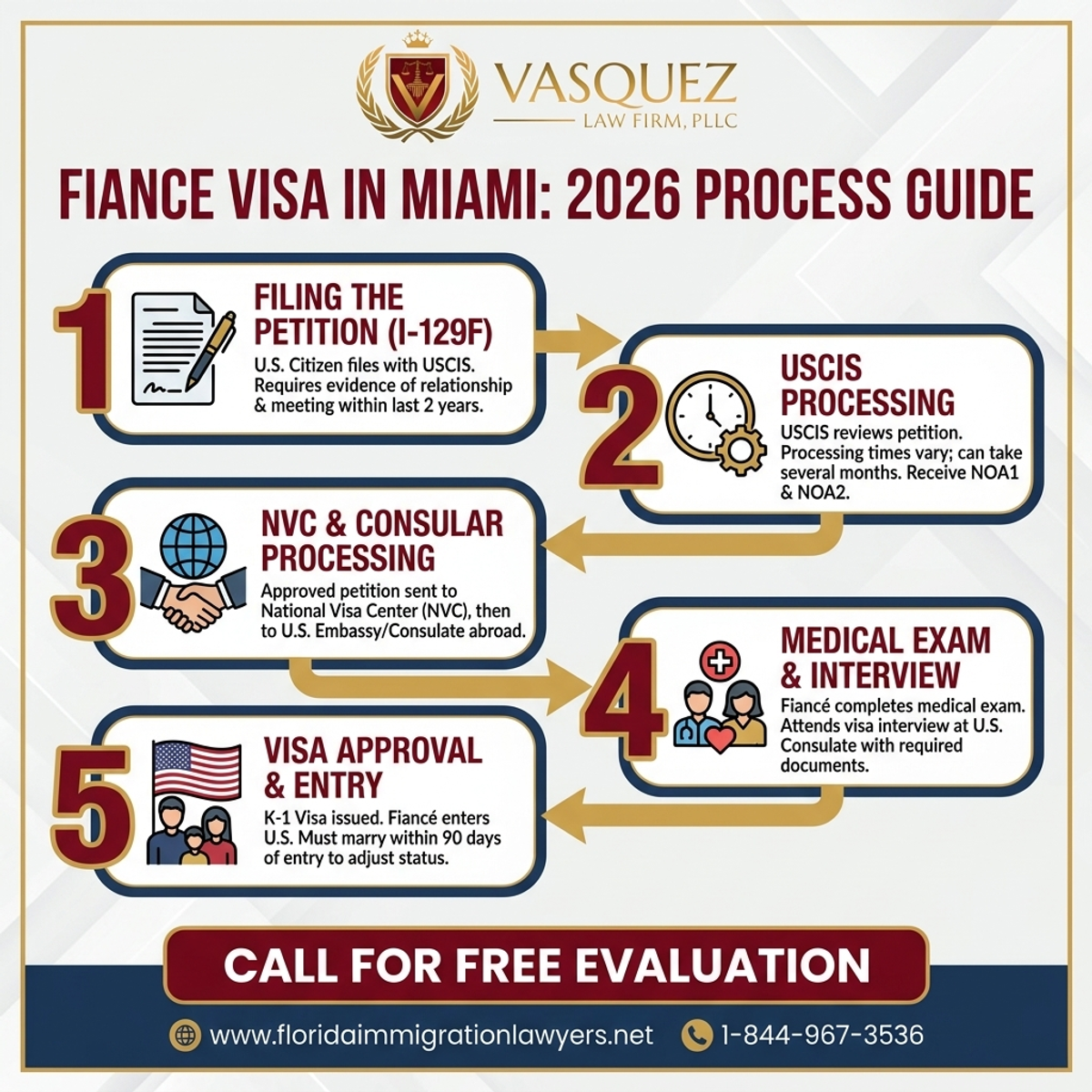
The K-1 visa application process is detailed and requires careful attention to each step. Here is a breakdown of the typical stages:
-
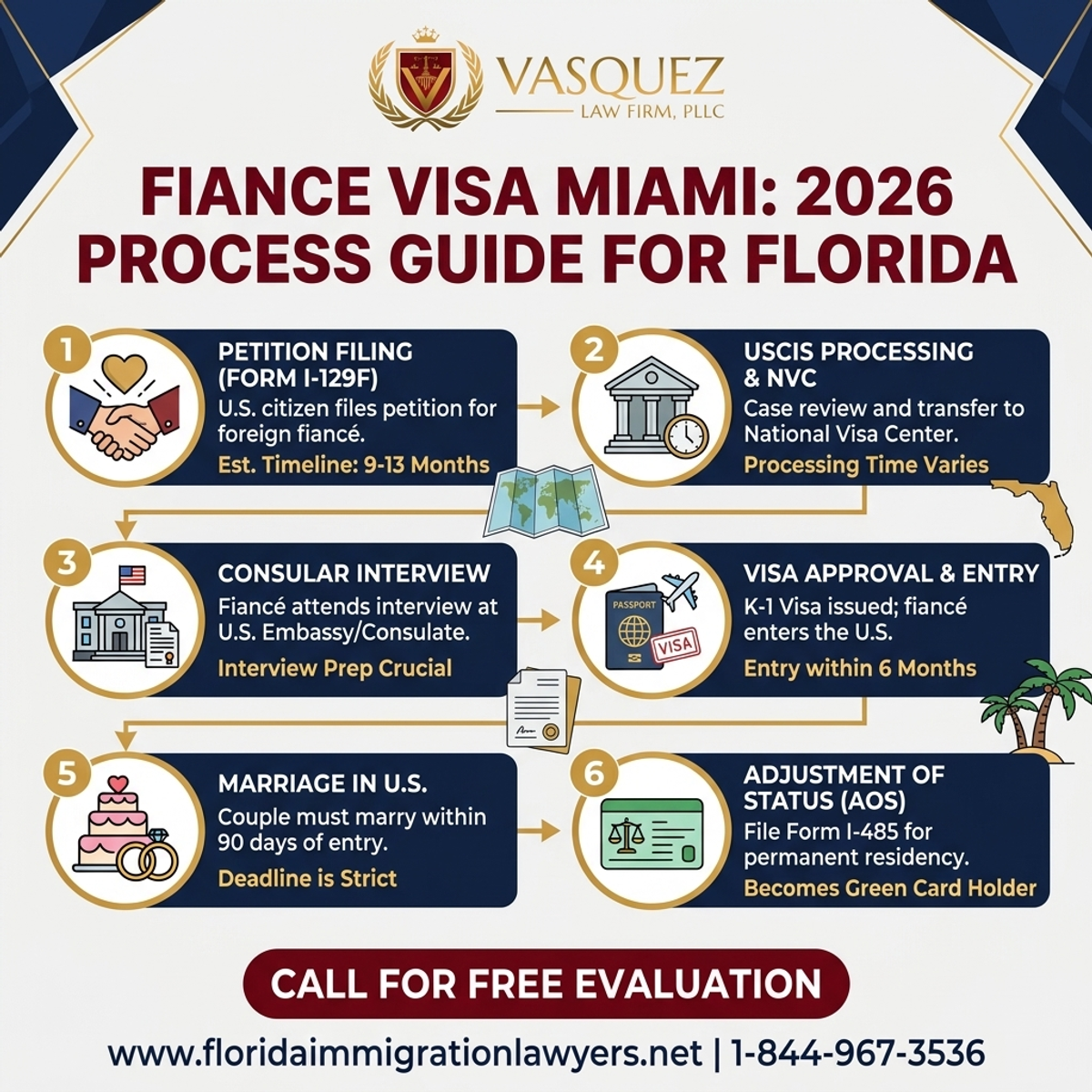
File Form I-129F, Petition for Alien Fiance(e), with USCIS: The U.S. citizen petitioner initiates the process by filing Form I-129F with USCIS. This form establishes the eligibility of both the petitioner and the beneficiary, demonstrating a bona fide relationship and intent to marry. It must be accompanied by supporting evidence, such as proof of U.S. citizenship, evidence of meeting in person, and statements of intent to marry. As of 2026, USCIS generally processes these petitions at specific service centers, not local field offices like those in Miami or Orlando.
-
USCIS Processing and Approval: After filing, USCIS reviews the petition. If approved, USCIS sends an approval notice (Form I-797) to the petitioner and forwards the petition to the National Visa Center (NVC). The NVC then assigns a case number and forwards the approved petition to the U.S. Embassy or Consulate in the foreign fiancé(e)'s home country, where the visa interview will take place. This stage primarily involves administrative review and background checks.
-
National Visa Center (NVC) Processing: The NVC acts as a liaison between USCIS and the U.S. Embassy/Consulate. They ensure that all necessary documents are collected and processed before the interview. While the NVC's involvement in K-1 cases is less extensive than for immigrant visas, they still play a critical role in transmitting the approved petition and any associated documents to the correct embassy or consulate. They will provide instructions to the foreign fiancé(e) regarding upcoming steps.
-
Embassy/Consulate Interview Abroad: The foreign fiancé(e) will attend a visa interview at the designated U.S. Embassy or Consulate. Before the interview, they must complete Form DS-160 (Online Nonimmigrant Visa Application), undergo a medical examination by an authorized physician, and obtain police certificates from all countries where they have lived for certain periods. During the interview, a consular officer will verify the relationship's authenticity and the applicant's eligibility, including reviewing any criminal history or immigration violations. Be prepared to answer questions about your relationship, future plans, and general background.
-
Entry to U.S. and Marriage: If the K-1 visa is approved, the foreign fiancé(e) will receive their visa stamp in their passport. They must enter the U.S. within the visa's validity period. Upon entry, they have 90 days to marry the U.S. citizen petitioner. This marriage must be legally recognized in the state where it occurs, such as Florida. Many couples choose to marry in Florida, given its beautiful venues and the petitioner's residence. This is a critical deadline, as failure to marry within 90 days can lead to severe immigration consequences.
-
Adjustment of Status (Form I-485): After marrying the U.S. citizen within the 90-day period, the now foreign spouse must apply for Adjustment of Status to become a lawful permanent resident (Green Card holder). This involves filing Form I-485, Application to Register Permanent Residence or Adjust Status, along with supporting documents like Form I-864 (Affidavit of Support) and Form I-693 (Report of Medical Examination and Vaccination Record). This application is submitted to USCIS, and the foreign spouse will typically attend an interview at a local USCIS field office, such as the one in Miami or Orlando. Upon approval, they receive a conditional Green Card, valid for two years, and later must file Form I-751 to remove conditions.
Essential Documents for Your K-1 Visa Petition in Florida (Document Checklist)
Gathering the correct and complete documentation is paramount for a successful K-1 fiance visa petition. Any missing or incorrect documents can lead to significant delays or even denial of your application. This checklist outlines the essential documents typically required for both the U.S. citizen petitioner and the foreign fiancé(e).
Ensuring all documents are accurate, translated (if necessary), and properly submitted is crucial. Here's a comprehensive list of what you'll typically need:
- For the U.S. Citizen Petitioner:
- Proof of U.S. Citizenship (e.g., U.S. passport, birth certificate, naturalization certificate).
- Copies of any divorce decrees or death certificates for previous marriages of either party.
- Statement of intent to marry signed by both the petitioner and beneficiary.
- Evidence of meeting in person within the last two years (e.g., dated photos together, passport stamps, flight itineraries, hotel receipts). Waivers for this requirement are rare.
- Form I-129F, Petition for Alien Fiance(e).
- Two passport-style photos of the petitioner.
- For the Foreign National Beneficiary:
- Copy of valid passport.
- Birth certificate.
- Copies of any divorce decrees or death certificates for previous marriages.
- Police certificates from all countries where the beneficiary has lived for six months or more since age 16 (and from any country of previous residence if the total stay was one year or more).
- Medical examination report from a USCIS-approved panel physician. This is usually done in the beneficiary's home country before the interview.
- Form DS-160, Online Nonimmigrant Visa Application confirmation page.
- Two passport-style photos of the beneficiary.
- Evidence of Bona Fide Relationship (for both):
- Shared communication records (emails, chat logs, call records).
- Shared photos, especially with family and friends.
- Affidavits from friends and family testifying to the relationship.
- Evidence of joint financial planning, if applicable.
- Financial Support Documents (for Adjustment of Status):
- Form I-864, Affidavit of Support, from the U.S. citizen petitioner.
- Petitioner's federal income tax returns (most recent three years).
- Proof of income (e.g., pay stubs, employment verification letter).
Step-by-Step Process — Fiance Visa in Miami: 2026 Process Guide for Florida
K-1 Fiance Visa Processing Times and What to Expect in 2026
Understanding the typical processing times for a K-1 Fiance Visa is essential for planning your future together. While these times can fluctuate based on various factors, having a general expectation helps manage anticipation and logistics. As of late 2026, applicants should anticipate a multi-stage process, each with its own timeline.
The K-1 visa process is not instantaneous; it involves several government agencies and can take a considerable amount of time. Factors such as the volume of applications, the specific USCIS service center, the efficiency of the National Visa Center, and the workload of the U.S. Embassy or Consulate abroad can all influence how long your petition takes. It's important to remember that these are estimates, and individual cases may vary based on complexity, completeness of documentation, and any requests for additional evidence (RFEs). For the most current information, always check the USCIS website for processing times.
| Stage | Typical Timeframe (As of 2026) | Notes |
|---|---|---|
| Form I-129F (USCIS) | 10-15 months | Processing times can vary significantly by service center. |
| NVC Processing | 1-2 months | Administrative processing after USCIS approval. |
| Embassy/Consulate Interview Scheduling | 2-4 months | Depends on the specific embassy's backlog and appointment availability. |
| Medical Exam & Police Certificates | Varies (concurrent with interview prep) | Must be completed before the interview. |
| Visa Issuance & Travel | 1-2 weeks post-interview | Visa is typically valid for 6 months from issuance. |
| Adjustment of Status (Form I-485) | 12-24 months (after marriage) | Includes EAD/AP processing and interview scheduling at a local USCIS office in Florida (e.g., Miami, Orlando). |
What Are the Costs Associated with the Fiance Visa Process?
The K-1 Fiance Visa process involves several non-refundable government filing fees that can add up. Understanding these costs upfront is crucial for financial planning, as they are a necessary part of uniting with your loved one in Florida. These fees are subject to change by the government agencies involved.
It's important to budget not only for the mandatory government fees but also for potential ancillary costs such as medical examinations, document translation, travel expenses for the foreign fiancé(e), and legal fees if you choose to hire an attorney. While government fees are standardized, other costs can vary significantly. For the most up-to-date fee information, always refer to the official USCIS website and the Department of State's consular fees page. Remember that these fees are typically non-refundable, regardless of the outcome of your petition.
Key Statistics — Fiance Visa in Miami: 2026 Process Guide for Florida
| Item | Typical Fee (As of 2026) | Notes |
|---|---|---|
| Form I-129F (Petition for Alien Fiance(e)) | $675 | Paid to USCIS by the U.S. citizen petitioner. |
| Form DS-160 (Nonimmigrant Visa Application) | $265 | Paid to the U.S. Embassy/Consulate by the foreign fiancé(e) before the interview. |
| Medical Examination | $200 - $500 | Cost varies by country and clinic; paid to the panel physician. |
| Form I-485 (Adjustment of Status) | $1,440 | Paid to USCIS after marriage in the U.S. (includes biometrics, I-765, I-131). |
| Form I-751 (Petition to Remove Conditions) | $750 | Paid to USCIS for conditional residents (after 2 years of Green Card). |
| Attorney Fees | Varies widely | Highly recommended for complex cases or to ensure proper filing. |
Adjustment of Status After K-1 Entry: What Happens Next?
Once your foreign fiancé(e) enters the U.S. on a K-1 visa, the clock starts ticking. You have a strict 90-day window to get married. This is a critical period that directly impacts their ability to become a lawful permanent resident. After your marriage, the focus shifts to the Adjustment of Status (AOS) process.
The Adjustment of Status process is the final major step in obtaining a Green Card for your spouse. Within the 90-day period after entry, you must legally marry your U.S. citizen petitioner. Following the marriage, your spouse will file Form I-485, Application to Register Permanent Residence or Adjust Status, with USCIS. This application is typically filed concurrently with Form I-864 (Affidavit of Support) and Form I-765 (Application for Employment Authorization) and Form I-131 (Application for Travel Document), if desired. Filing these forms together allows the foreign spouse to receive a work permit and travel authorization while their Green Card application is pending. After filing, USCIS will schedule a biometrics appointment, followed by an interview at a local field office in Florida, such as the one serving Central Florida in Orlando or the one in Miami. During this interview, a USCIS officer will review your application, verify the authenticity of your marriage, and ensure all eligibility requirements are met. Upon approval, the foreign spouse will receive a conditional Green Card, valid for two years. To remove these conditions and obtain a 10-year Green Card, you must jointly file Form I-751, Petition to Remove Conditions on Residence, within the 90-day period before the conditional Green Card expires. This step is crucial to prevent the loss of permanent resident status, as outlined in 8 CFR 216.4.
Do not navigate this process alone. The complexities of immigration law require expert guidance. Contact Florida Immigration Lawyers today for a free consultation and personalized assistance. We are here to help you every step of the way.
Common Mistakes to Avoid in the Fiance Visa Process
The K-1 Fiance Visa process is fraught with potential pitfalls that can lead to significant delays, requests for additional evidence (RFEs), or even outright denials. Avoiding these common mistakes is crucial for a smooth and successful application journey for couples in Florida and beyond.
-
Failing to Meet the In-Person Meeting Requirement: Many couples overlook or misunderstand the requirement that the petitioner and beneficiary must have met in person at least once within the two years prior to filing the I-129F petition. Without strong evidence, or a valid waiver (which is rare), the petition will be denied.
-
Submitting Incomplete or Incorrect Forms: Small errors, missing signatures, or overlooked questions on forms I-129F or DS-160 can lead to an RFE or rejection. Always double-check all forms and ensure they are filled out completely and accurately according to current USCIS guidelines.
-
Insufficient Evidence of a Bona Fide Relationship: Immigration officers are vigilant about detecting fraudulent marriages. Failing to provide ample evidence (photos, communication, travel itineraries, affidavits) proving a genuine, ongoing relationship can lead to intense scrutiny or denial.
-
Not Filing for Adjustment of Status within 90 Days: After entering the U.S. on a K-1 visa, the couple MUST marry within 90 days. Failure to do so means the foreign fiancé(e) falls out of status and faces potential deportation, becoming ineligible for Adjustment of Status.
-
Inadequate Financial Support (Affidavit of Support): The U.S. citizen petitioner must demonstrate they can financially support their fiancé(e) at or above 125% of the federal poverty guidelines. Insufficient income or assets, or improperly filed Form I-864, can lead to denial of the Green Card.
-
Failure to Disclose All Prior Marriages or Criminal History: Any past marriages (even if brief) or criminal records (even minor offenses) for either party must be fully disclosed. Hiding information can be considered misrepresentation and result in permanent bars from immigration benefits.
-
Missing Deadlines or Ignoring RFEs: Immigration processes have strict deadlines. Failing to respond to an RFE by the specified date, or missing an interview appointment, can lead to the abandonment or denial of your case.
-
Traveling Outside the U.S. Before Adjustment of Status Approval: Once the foreign fiancé(e) enters on a K-1 and files for Adjustment of Status, they generally should not leave the U.S. until they receive an Advance Parole document (Form I-131). Traveling without it can be considered abandonment of the AOS application.
-
Poor Interview Preparation: Both the consular interview abroad and the USCIS interview for Adjustment of Status require careful preparation. Inconsistent answers or inability to articulate the relationship's history can raise red flags with immigration officers.
-
Assuming the K-1 Visa Guarantees a Green Card: The K-1 visa is a nonimmigrant visa for entry and marriage. It does not automatically grant permanent residency. A separate, successful Adjustment of Status application is required after marriage.
When to Call a Florida Immigration Lawyer
While the K-1 Fiance Visa process has a defined structure, real-life situations often present unique challenges that can complicate your application. Knowing when to seek professional legal counsel can protect your investment of time and money and significantly improve your chances of a favorable outcome. Florida Immigration Lawyers are here to provide the expert guidance you need.
You should consider contacting a skilled immigration lawyer, especially one with experience in Florida immigration law, if you encounter any of the following scenarios:
- Complex Relationship History: If either you or your fiancé(e) has been married multiple times, has a complicated divorce history, or if there are significant age differences, a lawyer can help present your case clearly and address any potential concerns.
- Criminal History or Prior Immigration Violations: Any past arrests, convictions, or previous immigration issues (such as overstays, previous visa denials, or deportation orders) for either party can severely impact eligibility. A lawyer can assess the situation, determine if waivers are available, and prepare a strong defense.
- Issues with Meeting the Financial Requirements: If the U.S. citizen petitioner does not meet the income requirements for the Affidavit of Support, a lawyer can advise on strategies involving joint sponsors or the use of assets to overcome this hurdle.
- Requests for Evidence (RFEs) or Notices of Intent to Deny (NOID): Receiving an RFE or NOID from USCIS indicates that there are deficiencies in your application. A lawyer can help you understand the request, gather the necessary evidence, and craft a compelling response.
- Previous K-1 Visa Denials: If a prior K-1 petition was denied, understanding the reasons and strategizing for a new application with legal assistance is crucial.
- Concerns About the Interview Process: Preparing for the consular interview abroad or the Adjustment of Status interview at a USCIS field office in Miami or Orlando can be daunting. A lawyer can provide mock interviews and advise on how to respond to difficult questions.
- Desire for Expedited Processing: In rare cases of extreme urgency, a lawyer can help determine if you qualify for expedited processing and assist with submitting the necessary requests.
- General Uncertainty or Overwhelm: The sheer volume of forms, documents, and legal requirements can be overwhelming. A lawyer provides peace of mind and ensures every step is handled correctly.
Florida Immigration Lawyers understands the nuances of U.S. immigration law and the specific challenges faced by couples in Central Florida and throughout the state. We offer comprehensive services for K-1 visas, Adjustment of Status, and related family immigration matters. Let us put our experience to work for you.
About Florida Immigration Lawyers
Florida Immigration Lawyers is a leading law firm dedicated to providing comprehensive and compassionate immigration legal services across the entire state of Florida. Located in Central Florida, our experienced attorneys are deeply committed to helping individuals and families navigate the complex landscape of U.S. immigration law. We understand that every case is unique and often carries profound personal significance, which is why we offer personalized attention and strategic advocacy tailored to your specific needs.
Our firm specializes in a wide range of immigration matters, including family-based petitions like the K-1 Fiance Visa, Adjustment of Status, Green Cards, U.S. Citizenship, and deportation defense. We pride ourselves on our deep knowledge of immigration regulations, our proactive approach, and our unwavering dedication to our clients. We offer free case reviews to assess your situation and explain your options clearly. Our team is available 24/7, ensuring you have access to expert legal advice when you need it most. When you choose Florida Immigration Lawyers, you're choosing a partner committed to achieving the best possible outcome for your immigration journey. Schedule a free consultation today and let us help you achieve your American Dream. Se Habla Español.
Sources and References
- U.S. Citizenship and Immigration Services (USCIS)
- Executive Office for Immigration Review (EOIR)
- U.S. Department of State
- 8 U.S.C. Chapter 12 - Immigration and Nationality Act (INA) Sections 101(a)(15)(K) and 214(d)
- 8 CFR 214.2(k) - Regulations pertaining to K nonimmigrants
- 8 CFR 216.4 - Petition to Remove Conditions by Alien Spouse
- USCIS Policy Manual - Volume 7, Part B, Chapter 2 - Fiancé(e) (K-1) Nonimmigrants
Related services: family petition process, family-based green cards, fiancé visa (K-1).
This article provides general legal information and is not intended as legal advice. Every case is unique, and outcomes depend on specific facts and circumstances. Contact an attorney for advice about your particular situation.
Uniting with your foreign fiancé(e) in Florida is an exciting prospect, and the K-1 visa process is your essential first step. While complex, with the right preparation and legal support, it is an achievable goal. Do not leave your future to chance. Contact Florida Immigration Lawyers today at 1-844-YO-PELEO for your free case review. We are available 24/7 to provide the guidance and advocacy you deserve. Se Habla Espanol - Estamos aqui para ayudarle.
If you need legal assistance, learn more about Florida family immigration legal team, or call us at 1-844-967-3536 for a free case review.
Do Not Navigate This Process Alone
Our experienced immigration attorneys are ready to fight for you. Get a free, confidential case review today.
Se Habla Español
Or leave your details and we’ll call you:
Free Evaluation in 24 Hours
Or talk to us right now

AI voice assistant — available 24/7
FreeFrequently Asked Questions

William J. Vásquez
Founding Attorney · Vasquez Law Firm
U.S. Air Force veteran and immigration attorney with years of hands-on U.S. immigration experience. J.D., NCCU School of Law. AILA member. Admitted to the 4th, 5th, and 11th Circuit Courts.
Available 24/7 - Free Evaluations
Reviewed for legal accuracy by William J. Vásquez
Licensed in North Carolina; U.S. immigration is federal practice.
Related Legal Services
Our Florida immigration attorneys can help you with experienced immigration attorneys, asylum protection and citizenship and naturalization. Call today at 1-844-YO-PELEO for a free case review.
Related Links
Related Topics
Free Legal Case Review
Discuss your case with our experienced attorneys. We're available 24/7.
Se Habla Español - Estamos aquí para ayudarle.
Related Articles
Immigration Lawyer Orlando Free Consultation in Florida
For individuals and families in Orlando, Florida, navigating the complexities of U.S. immigration law requires expert guidance. An immigration lawyer in Orlando offers crucial support for everything from visa applications and green card processes to naturalization and deportation defense. This comprehensive guide details what a free consultation covers, providing a step-by-step overview of immigration pathways, essential document checklists, and expected timelines in 2026. We also highlight common mistakes to avoid, discuss the critical role of legal counsel in deportation and asylum cases, and explain why choosing a local Orlando immigration attorney is beneficial. Florida Immigration Lawyers is dedicated to serving the diverse community of Orlando with compassionate, effective legal solutions, ensuring you receive personalized advice and robust representation for a successful immigration journey.
Immigration Lawyer Services in Orlando, Florida
Explore immigration consultation services in Orlando, Florida, with a qualified immigration lawyer. Learn what to expect and understand your options for family and business immigration needs.
Fraud Prevention and Detection Fee: What to Know in Florida
Explore the fraud prevention and detection fee essential for immigration processes in Florida. Discover how it impacts applications like the I-601 waiver and learn key steps to navigate this requirement effectively.
2026 Diversity Visa Lottery Errors: Avoid Mistakes
Avoid common errors in the 2026 Diversity Visa Lottery. Learn how to apply effectively for the green card lottery in Florida. This comprehensive guide covers the application process, common mistakes, and essential tips to increase your chances of success.