I-864 Affidavit of Support in Florida: 2026 Guide
The I-864 Affidavit of Support is vital for sponsoring family immigrants in Florida. Learn the 2026 requirements, steps to complete the form, and when to seek legal help. Contact Florida Immigration Lawyers for expert guidance.

The I-864 Affidavit of Support is a crucial document for sponsoring an immigrant in the U.S. As of 2026, it remains a key component in family-based immigration processes in Florida. Sponsors must prove sufficient income or assets to support the intending immigrant. Joint sponsors can assist if the primary sponsor lacks sufficient resources.
- Essential for family-based visas
- Requires proof of financial ability
- Joint sponsor option available
- Updated form details on USCIS
Introduction
Moving to the U.S. as a family member of a U.S. citizen or permanent resident involves several important steps, one of which is providing a Form I-864, Affidavit of Support. This form ensures that the intending immigrant will not become a public charge. In Florida, particularly around Orlando, understanding the nuances of the I-864 is crucial for a successful immigration process.
The I-864 is more than just a piece of paper; it's a solemn commitment by the sponsor to the U.S. government, promising financial responsibility for the immigrant. This commitment helps prevent new immigrants from needing to rely on public assistance programs, thereby protecting U.S. taxpayers. For families in Florida, navigating this requirement can seem daunting, but with the right guidance, it's a manageable part of the immigration journey.
This guide will cover everything you need to know about the I-864 Affidavit of Support, including step-by-step instructions, common pitfalls, and when to consult an immigration attorney. We'll delve into the specific financial criteria, the role of joint sponsors, and how to prepare a robust application package. Call Florida Immigration Lawyers at 1-844-967-3536 for a free case review.
What is the I-864 Affidavit of Support?
The I-864 Affidavit of Support is a legally binding contract between a sponsor and the U.S. government, wherein the sponsor agrees to financially support the sponsored immigrant. This document is required for most family-based immigrants and some employment-based immigrants to show that they will not need to rely on government assistance.
This contract obligates the sponsor to reimburse any federal, state, or local agency that provides means-tested public benefits to the sponsored immigrant. It's a significant responsibility that typically lasts until the immigrant becomes a U.S. citizen, has worked 40 quarters (approximately 10 years) in the U.S., departs the U.S. permanently, or passes away. Understanding the long-term nature of this commitment is vital for any prospective sponsor.
As of 2026, the form remains a critical part of the immigration process in Florida, ensuring that immigrants have adequate financial support upon their arrival. Whether you're sponsoring a spouse, child, parent, or other relative, the I-864 serves as the cornerstone of their financial eligibility. Failing to meet the I-864 requirements or submitting an incomplete form can lead to significant delays or even denial of the immigrant visa or adjustment of status application.
How to Complete the I-864 Form?
Completing the I-864 form involves several key steps:
- Gather Financial Documents: Collect tax returns, W-2s, and pay stubs for the past three years.
- Fill Out the Form: Provide your personal details, income information, and details about the intending immigrant.
- Sign and Submit: The sponsor must sign the form and submit it with the immigrant's visa application.
Each section of the form requires careful attention to detail to avoid processing delays. For instance, when gathering financial documents, ensure you have official IRS tax transcripts rather than just copies of your filed returns, as these are often preferred by USCIS or the National Visa Center (NVC). If you are self-employed, include Schedule C, E, or F from your tax returns, along with business licenses or other proof of income.
When filling out the form, pay close attention to the household size calculation, which includes yourself, the intending immigrant, any dependents, and any other individuals you have previously sponsored on an I-864. An incorrect household size can lead to an inaccurate assessment of your income requirements. Always use the most current version of Form I-864 available on the USCIS website. If you're unsure about any section, it's prudent to consult with Florida Immigration Lawyers to ensure accuracy and completeness.
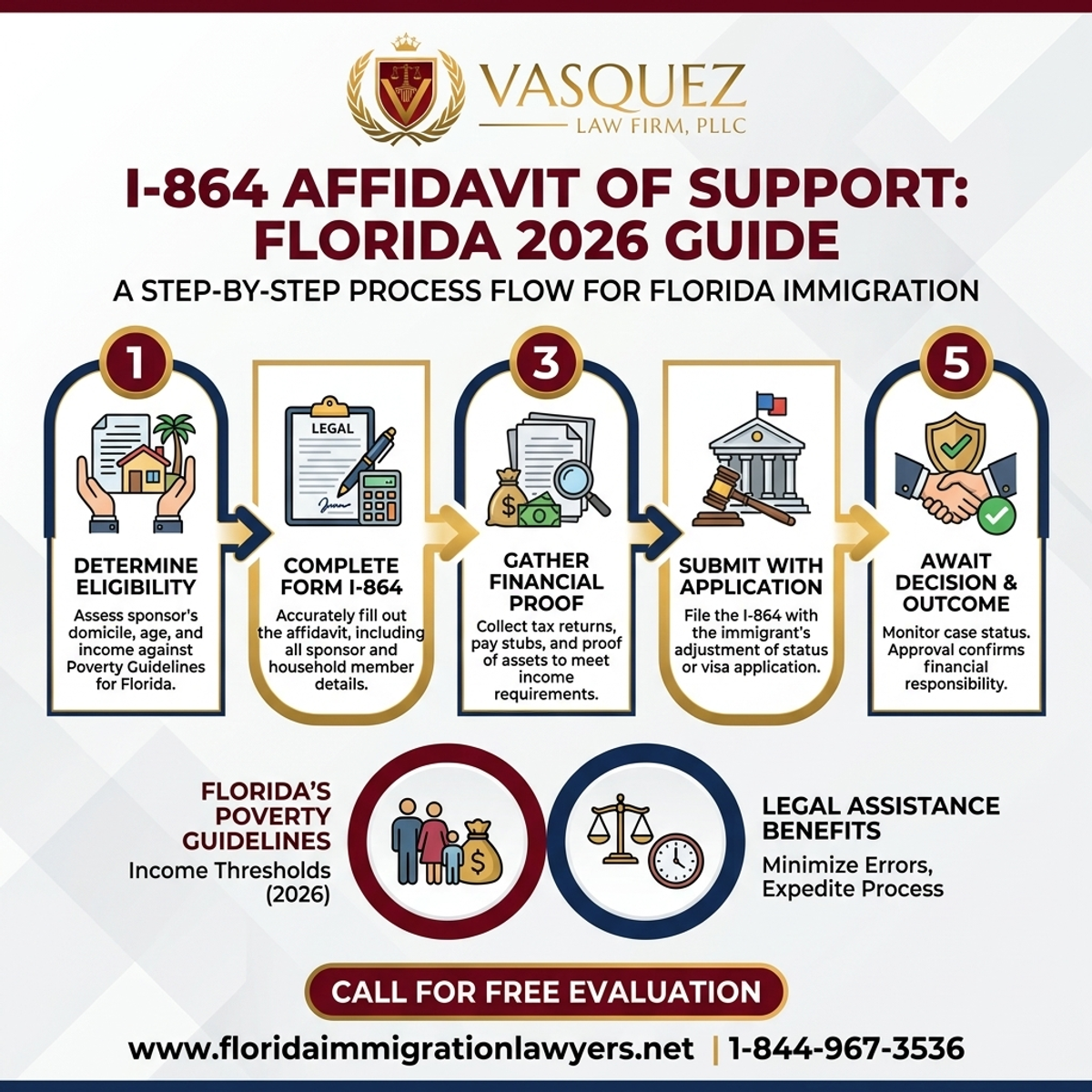
Step-by-Step Process — I-864 Affidavit of Support in Florida: 2026 Guide
What Documents Are Required for the I-864?
To complete the I-864, you must attach several documents:
- Recent tax returns
- Pay stubs or proof of employment
- Proof of U.S. citizenship or legal status
- Joint sponsor documents, if applicable
Having these documents ready can streamline the process significantly. Beyond the basic list, specific supporting documents are crucial. For tax returns, USCIS typically requests your federal income tax returns for the most recent tax year, though sometimes they may ask for the past three years. It's often best to provide IRS tax transcripts directly from the IRS website, as these are considered official and reduce the chance of questions regarding authenticity.
Proof of employment can include recent pay stubs (e.g., for the last six months), a letter from your employer on company letterhead confirming your position, salary, and employment start date, or for self-employed individuals, business licenses, and bank statements showing regular income. For proof of U.S. citizenship or legal status, you can submit a copy of your U.S. passport, birth certificate, naturalization certificate, or green card. If a joint sponsor is involved, they must submit the exact same set of financial and identity documents as the primary sponsor. Any documents not in English must be accompanied by a certified English translation.
Typical Timeline and Processing Expectations
Processing times for the I-864 can vary:
| Stage | Typical Timeframe | Notes |
|---|---|---|
| Form Preparation | 1-2 weeks | Ensure all documents are gathered |
| USCIS Processing | 6-8 weeks | Depends on workload |
| Consulate Processing | Varies by location | Additional 1-2 months |
For the most current processing times, visit the USCIS website. It's important to note that these are typical timeframes, and actual processing can be influenced by various factors, including the completeness of your application, current USCIS caseloads, and whether a Request for Evidence (RFE) is issued. An RFE can add several weeks or even months to the process, as you'll need time to gather and submit additional information, and USCIS will then need to review it.
After USCIS processes the I-864 (if filed with an adjustment of status application) or the National Visa Center (NVC) reviews it (for consular processing), the case moves forward. Consular processing times are highly dependent on the specific U.S. embassy or consulate where the immigrant will have their interview, as well as the visa category and country of origin. Proactive preparation and meticulous attention to detail are your best defense against unnecessary delays. If you encounter unexpected delays or receive an RFE, contacting Florida Immigration Lawyers can provide clarity and strategic assistance.
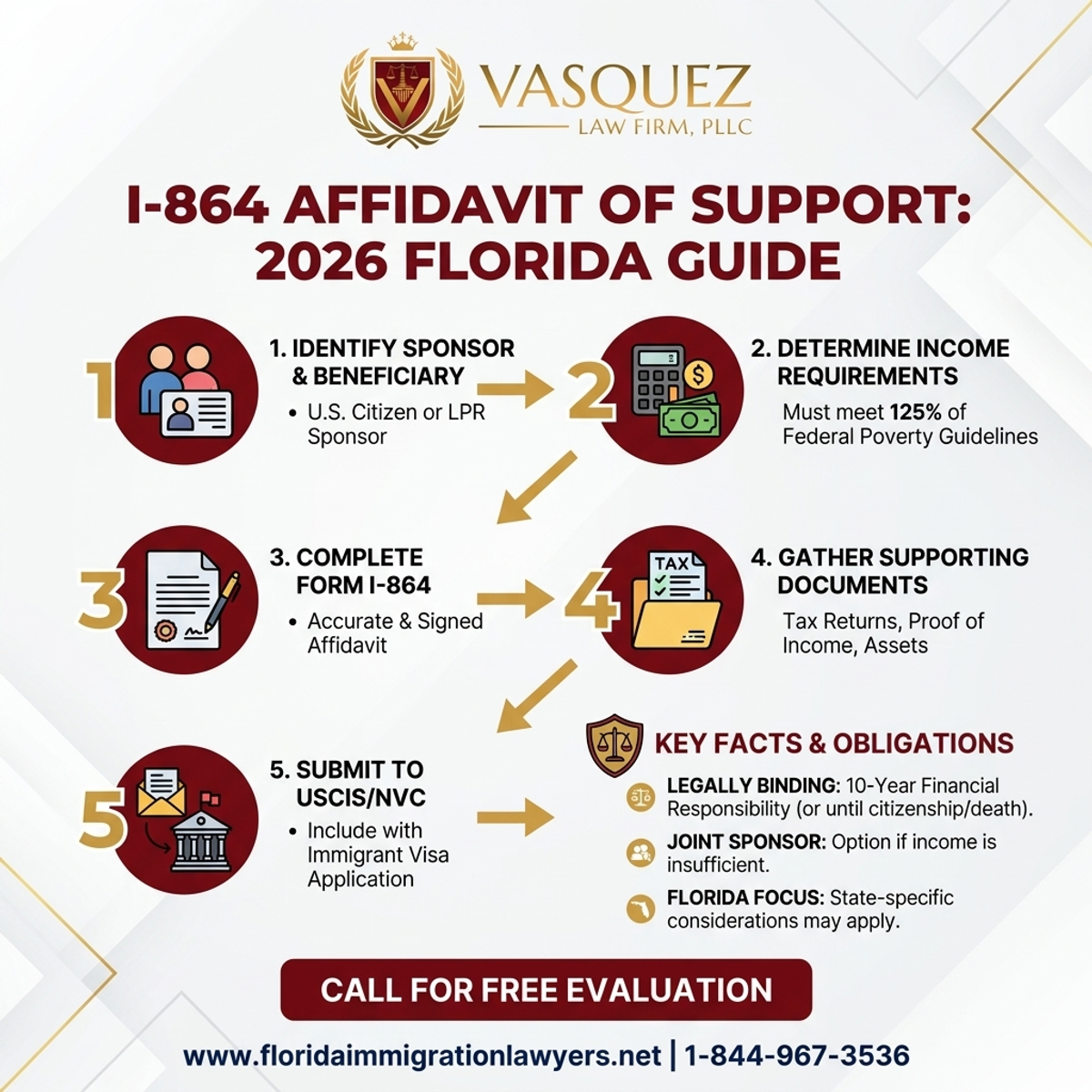
Key Statistics — I-864 Affidavit of Support in Florida: 2026 Guide
Cost Factors and Fee Breakdown
While the I-864 itself does not have a filing fee, associated costs include:
| Item | Typical Fee | Notes |
|---|---|---|
| Document Preparation | Varies | Depends on whether you hire a professional |
| Translation Services | Varies | Necessary if documents are not in English |
Always check the latest fee information on the USCIS website. The cost of document preparation can range significantly. If you opt to prepare the forms yourself, your only cost will be time and perhaps printing. However, many individuals choose to hire an immigration attorney, like those at Florida Immigration Lawyers, to ensure accuracy and avoid common pitfalls. Attorney fees will vary based on the complexity of your case and the services provided, but they often represent a worthwhile investment to ensure a smooth process.
Translation services are essential if any supporting documents (e.g., birth certificates, marriage certificates, police records) are not in English. These translations must be certified, meaning the translator must attest in writing that they are competent to translate and that the translation is accurate. Costs for these services can vary based on the length and language of the documents. Additionally, while not directly tied to the I-864 form, other associated costs in the immigration process can include USCIS filing fees for the underlying visa petition or adjustment of status application, biometric service fees, and medical examination fees. Budgeting for these various expenses is crucial for a successful immigration journey.
Do not navigate this process alone. Contact Florida Immigration Lawyers today.
Common Mistakes to Avoid
The I-864 Affidavit of Support is a document that demands precision. Even minor errors or oversights can lead to significant delays, including Requests for Evidence (RFEs), or even denial of the immigrant's application. Being aware of these common pitfalls can save you time, stress, and potential financial setbacks.
- Underestimating Financial Requirements: Ensure your income meets the poverty guidelines. Remember that the required income is 125% of the Federal Poverty Guidelines for your household size, or 100% if you are an active duty military member sponsoring a spouse or child.
- Incomplete Documentation: Missing documents can delay the process. Always double-check that every required piece of evidence, from tax transcripts to employment letters, is included and properly organized.
- Incorrect Income Reporting: Ensure all income is accurately reported. Only verifiable, lawful income counts. Do not inflate income, and be prepared to provide proof for all sources.
- Forgetting to Sign: Unsigned forms are invalid. This seems obvious, but it's a surprisingly common error. Ensure all required signatures are present, and that they are original 'wet' signatures.
- Misunderstanding Joint Sponsor Role: Joint sponsors must meet the same financial criteria. They are not merely supplemental; they assume full financial responsibility alongside the primary sponsor, and must submit their own complete I-864 package.
- Outdated Tax Returns: Use the most recent tax information. Always provide the most recently filed federal income tax return, along with W-2s and 1099s.
- Overlooking Household Size: Include all dependents in your calculations. This includes yourself, the intending immigrant(s), your spouse, any children, and anyone else you claim as a dependent on your tax returns, or anyone you have previously sponsored.
- Not Updating Address: Notify USCIS if your address changes. Failure to do so can result in missed communications and delays.
Avoiding these common errors requires meticulous attention to detail and a thorough understanding of the I-864 instructions. If you find yourself unsure about any aspect of the form or your eligibility, seeking professional legal advice from Florida Immigration Lawyers can provide invaluable assistance and peace of mind.
When to Call a Lawyer
Consider calling a lawyer if:
- You have complex financial situations.
- You need assistance with a joint sponsor.
- There are concerns about meeting income requirements.
Florida Immigration Lawyers can guide you through these complexities. For detailed assistance, explore our family immigration services. Beyond the scenarios listed, legal counsel becomes particularly beneficial if your income is borderline, you're relying heavily on assets to meet the requirement, or if you've received a Request for Evidence (RFE) from USCIS or the NVC. An attorney can help you strategize the best way to present your financial information or respond to an RFE effectively, minimizing further delays.
Furthermore, if there are any past immigration issues for either the sponsor or the intending immigrant, or if the case involves unique circumstances such as self-employment, income from abroad, or a sponsor living overseas, an experienced immigration lawyer can provide tailored advice. They can help navigate the specific requirements and potential pitfalls, ensuring that your I-864 submission is as strong and compliant as possible. Don't hesitate to reach out to Florida Immigration Lawyers for a comprehensive review of your situation.
About Florida Immigration Lawyers
Florida Immigration Lawyers is a dedicated firm serving all of Florida with expertise in immigration law. Our experienced attorneys provide comprehensive legal support across a range of immigration matters. We offer free case reviews and are available 24/7. Schedule a free consultation with us today.
Our commitment extends beyond just filling out forms; we provide strategic advice, represent clients in interviews, and advocate fiercely for their rights throughout the immigration process. Whether you're dealing with family-based visas, employment immigration, deportation defense, or naturalization, our team is equipped with the knowledge and experience to guide you. We understand the profound impact immigration has on individuals and families, and we are dedicated to helping you achieve your American dream.
With offices conveniently located to serve communities across Florida, including Orlando, we pride ourselves on personalized attention and clear communication. Our goal is to make the complex immigration system understandable and manageable for our clients. For any questions regarding your I-864 or other immigration needs, remember that expert help is just a phone call away at 1-844-967-3536.
Sources and References
- U.S. Citizenship and Immigration Services (USCIS) - I-864
- Executive Office for Immigration Review (EOIR)
- 8 U.S.C. Chapter 12 - Immigration and Nationality Act
FAQs About the I-864 Affidavit of Support
Here are some frequently asked questions about the I-864 Affidavit of Support, with practical advice for each.
This article provides general legal information and is not intended as legal advice. Every case is unique, and outcomes depend on specific facts and circumstances. Contact an attorney for advice about your particular situation.
Se Habla Espanol - Estamos aqui para ayudarle. Call 1-844-967-3536 for a free consultation.
If you need legal assistance, learn more about Florida immigration legal team, or call us at 1-844-967-3536 for a free case review.
Do Not Navigate This Process Alone
Our experienced immigration attorneys are ready to fight for you. Get a free, confidential case review today.
Se Habla Español
Or leave your details and we’ll call you:
Free Evaluation in 24 Hours
Or talk to us right now

AI voice assistant — available 24/7
FreeFrequently Asked Questions

William J. Vásquez
Founding Attorney · Vasquez Law Firm
U.S. Air Force veteran and immigration attorney with years of hands-on U.S. immigration experience. J.D., NCCU School of Law. AILA member. Admitted to the 4th, 5th, and 11th Circuit Courts.
Available 24/7 - Free Evaluations
Reviewed for legal accuracy by William J. Vásquez
Licensed in North Carolina; U.S. immigration is federal practice.
Related Legal Services
Our Florida immigration attorneys can help you with asylum protection, citizenship and naturalization and immigration practice areas. Call today at 1-844-967-3536 for a free case review.
Related Links
Related Topics
Free Legal Case Review
Discuss your case with our experienced attorneys. We're available 24/7.
Se Habla Español - Estamos aquí para ayudarle.
Related Articles
Immigration Lawyer Orlando Free Consultation in Florida
For individuals and families in Orlando, Florida, navigating the complexities of U.S. immigration law requires expert guidance. An immigration lawyer in Orlando offers crucial support for everything from visa applications and green card processes to naturalization and deportation defense. This comprehensive guide details what a free consultation covers, providing a step-by-step overview of immigration pathways, essential document checklists, and expected timelines in 2026. We also highlight common mistakes to avoid, discuss the critical role of legal counsel in deportation and asylum cases, and explain why choosing a local Orlando immigration attorney is beneficial. Florida Immigration Lawyers is dedicated to serving the diverse community of Orlando with compassionate, effective legal solutions, ensuring you receive personalized advice and robust representation for a successful immigration journey.
Derived Citizen Status: Your Guide in Florida 2026
Derived citizenship offers a pathway for children to automatically become U.S. citizens through their parents, a crucial process for many families in Florida. This comprehensive guide details the eligibility requirements under INA Section 320, emphasizing that children must be under 18, lawful permanent residents, and in the legal and physical custody of a U.S. citizen parent. We provide a step-by-step application process for Form N-600, including a document checklist, typical timelines, and cost factors as of 2026. The article also addresses complex scenarios like adoptions and out-of-wedlock births, highlighting common mistakes to avoid. Florida Immigration Lawyers serves as a vital resource for families navigating these intricate laws, offering expert guidance to ensure a smooth and successful application. Understanding these nuances is key to securing a Certificate of Citizenship and confirming your child's place in the United States.
Immigration Documents Checklist for Florida Applicants
Navigating the immigration process in Florida requires a comprehensive checklist of documents. This guide outlines the essential paperwork needed for various immigration applications, providing detailed steps and tips to ensure a complete and accurate submission.
E-2 Visa Investors in Gulfport, Florida: A 2026 Guide
Discover how to apply for an E-2 investor visa in Gulfport, Florida. This comprehensive guide covers eligibility, documentation, application steps, timelines, and costs. Whether you're an entrepreneur looking to invest in a Florida business or need guidance on immigration procedures, this article provides actionable insights. Consult with Florida Immigration Lawyers to ensure your application process is smooth and successful.