EAD Advance Parole Combo Card: A Guide for Military
For military families in Florida, the EAD Advance Parole Combo Card is a pivotal document, combining work authorization and travel permission for non-citizen family members applying for a green card. This guide from Florida Immigration Lawyers explores how Parole in Place (PIP) paves the way for this card, detailing eligibility, required documents, and processing timelines. We cover the financial aspects, including potential fee waivers for military families, and highlight the critical importance of avoiding common mistakes like traveling without approved advance parole. Understanding these complex immigration benefits is crucial for maintaining family unity and stability while a loved one serves our nation. Our firm is dedicated to providing expert legal assistance to ensure a smooth and successful immigration journey for military families across Florida, from Orlando to every corner of the state. Learn how this essential card can provide peace of mind and flexibility during the adjustment of status process.

An EAD Advance Parole Combo Card is a crucial document for eligible non-citizen family members of U.S. military personnel, including those in Florida, who are applying for adjustment of status. This single card combines employment authorization (EAD) and advance parole (AP), allowing the holder to work legally in the U.S. and travel internationally while their green card application (Form I-485) is pending. For military families, especially those who have benefited from Parole in Place (PIP), this card provides stability and flexibility, enabling them to maintain employment and attend to family emergencies abroad without jeopardizing their immigration process. Obtaining this card is a vital step towards permanent residency.
- Combines work authorization and international travel permission.
- Essential for non-citizen military family members adjusting status.
- Allows legal employment and travel while green card application is pending.
- Often obtained after a successful Parole in Place (PIP) application.
- Crucial for stability and flexibility for military families in Florida.
Life as a military family often comes with unique challenges, from frequent relocations to the stresses of deployment. When these complexities are compounded by immigration hurdles, the situation can become overwhelming. For non-citizen family members of active-duty service members, veterans, or those in the National Guard and Ready Reserve, securing an immigration pathway in the United States is not just a legal matter—it's about family unity and stability. In Florida, a state with a significant military presence and diverse immigrant communities, understanding specific immigration benefits is paramount.
One such critical benefit that often emerges after a successful application for Parole in Place (PIP) for military families is the EAD Advance Parole Combo Card. This powerful document offers both the ability to work legally in the U.S. (Employment Authorization Document, or EAD) and the permission to travel abroad and return without abandoning a pending application for adjustment of status (Advance Parole, or AP). For many military families in Florida, this card is a beacon of hope, providing essential flexibility during the often lengthy green card process.
This comprehensive guide from Florida Immigration Lawyers will walk you through what the EAD Advance Parole Combo Card entails, its significance for military families, the process of obtaining it, and common pitfalls to avoid. We understand the sacrifices military families make, and our goal is to simplify complex immigration laws so you can focus on what matters most. If you are a military family in Florida navigating this intricate process, do not hesitate to call Florida Immigration Lawyers at 1-844-967-3536 for a free case review and dedicated legal support.
What is an EAD Advance Parole Combo Card and How Does it Benefit Military Families in Florida?
An EAD Advance Parole Combo Card is a single document issued by U.S. Citizenship and Immigration Services (USCIS) that serves two purposes: it acts as an Employment Authorization Document (EAD) and an Advance Parole (AP) travel document. This card is typically granted to individuals who have applied for adjustment of status to become lawful permanent residents (green card holders) and whose applications are still pending. For military families in Florida, this card is particularly beneficial as it provides immediate relief and flexibility.
The EAD component of the card allows the non-citizen family member to legally work in the United States while their green card application is being processed. This means they can seek employment, contribute to the family's income, and gain financial independence without waiting for their permanent residency to be approved. This is crucial for many families, as the adjustment of status process can take a significant amount of time. The Advance Parole component grants permission to travel outside the U.S. and re-enter without abandoning their pending adjustment of status application. This is especially important for military families who might need to travel internationally for emergencies, family visits, or even for deployment-related reasons. Without Advance Parole, leaving the U.S. while an adjustment of status application is pending can result in the abandonment of that application, forcing the individual to restart the entire process or face significant delays and complications. The authority for Advance Parole is found in USCIS regulations, specifically 8 CFR 212.5, which outlines humanitarian or public benefit reasons for parole.
For military families in Florida, the EAD Advance Parole Combo Card is often the culmination of a successful Parole in Place (PIP) application. PIP, authorized under INA 212(d)(5)(A), allows certain non-citizen family members of U.S. military personnel to be 'paroled' into the United States, even if they originally entered without inspection. This grants them a lawful entry, which is a prerequisite for adjusting status from within the U.S. Once PIP is granted, these individuals can then apply for adjustment of status (Form I-485), and concurrently, apply for the EAD Advance Parole Combo Card (Forms I-765 and I-131). This pathway provides immense relief and stability for families who have dedicated their lives to serving our nation, allowing them to pursue their American dream without unnecessary separation or legal limbo.
Understanding Parole in Place (PIP) for Military Families in Florida: Eligibility and Process
Parole in Place (PIP) is a critical immigration benefit specifically designed for certain non-citizen family members of U.S. military personnel. If you are a military family in Florida, understanding PIP is often the first step towards obtaining an EAD Advance Parole Combo Card and eventually a green card. PIP allows eligible individuals who entered the U.S. without inspection or overstayed a visa to be 'paroled' into the country. This 'parole' is considered a lawful admission, which is a prerequisite for applying for adjustment of status (Form I-485) from within the United States, rather than having to leave the country and apply through consular processing, which can trigger lengthy bars to re-entry.
To be eligible for Parole in Place, the non-citizen must be the spouse, widow(er), parent, son, or daughter of a U.S. citizen or lawful permanent resident who is serving or has served in the U.S. armed forces. This includes individuals who are currently on active duty, in the Selected Reserve, or were honorably discharged. The process typically involves filing Form I-131, Application for Travel Document, along with extensive supporting documentation to USCIS. For military families residing in Central Florida, an application might be processed through the USCIS field office that serves the region, such as the Orlando Field Office, though initial filing is usually with a service center. This benefit is a recognition of the sacrifices made by military families and aims to keep them united. Without PIP, many of these individuals would face the daunting prospect of leaving the U.S. for consular processing, potentially incurring a 3-year or 10-year bar due to unlawful presence, which would separate families for extended periods.
Step-by-Step Guide to Applying for Parole in Place in Florida
- Gather Eligibility Documents: Collect proof of your relationship to the qualifying military member (e.g., marriage certificate, birth certificate), the military member's service (e.g., DD-214, current orders, military ID), and your identity and nationality.
- Complete Form I-131, Application for Travel Document: While typically for Advance Parole, this form is adapted for PIP requests. Clearly indicate in the application that you are requesting Parole in Place under the military family policy.
- Prepare Supporting Statement: Include a letter from the military service member or a family member explaining why parole in place is being requested, highlighting any humanitarian reasons or the impact of separation.
- Include Evidence of Good Moral Character: Provide police clearances, affidavits, and other documents to demonstrate good moral character. Any criminal history, no matter how minor, must be disclosed and addressed.
- Submit to USCIS: Mail the complete application package to the appropriate USCIS Lockbox facility. The specific address will depend on the filing location and form instructions.
- Attend Biometrics Appointment (if required): USCIS may require you to attend a biometrics appointment at an Application Support Center (ASC) in Florida, such as the one in Orlando or Jacksonville, to capture fingerprints and photos.
- Await Decision: USCIS will review your application. If approved, you will receive an I-94 record indicating your parole. This officially grants you a lawful admission and makes you eligible to apply for adjustment of status.
Successfully navigating the PIP process is crucial for many military families. Once PIP is granted, the path opens to apply for adjustment of status and, subsequently, the EAD Advance Parole Combo Card. Our family immigration attorneys at Florida Immigration Lawyers are here to guide you through each step, ensuring accuracy and compliance.
What Documents Are Required for an EAD Advance Parole Combo Card Application in 2026?
To apply for an EAD Advance Parole Combo Card, you will need to submit specific forms and a comprehensive set of supporting documents to USCIS. As of 2026, the requirements remain largely consistent, focusing on proving your identity, your eligibility for adjustment of status, and the necessity for work and travel authorization. Accuracy and completeness are paramount to avoid delays or requests for evidence (RFEs).
The primary forms required are Form I-765, Application for Employment Authorization, and Form I-131, Application for Travel Document. These are typically filed concurrently with or after Form I-485, Application to Register Permanent Residence or Adjust Status. The EAD and AP are usually combined into one card if applied for together while the I-485 is pending. For military family members in Florida, this usually follows a successful Parole in Place application. It is crucial to ensure all forms are the most current versions available on the USCIS website and that all sections are filled out truthfully and completely. Any discrepancies or missing information can lead to significant processing delays or even denial, requiring a re-filing and additional fees. The fees for these forms can be found in the USCIS Fee Schedule, though in many cases, if filed with Form I-485, the I-765 and I-131 fees are waived.
Document Checklist for EAD Advance Parole Combo Card
- Form I-765, Application for Employment Authorization: Properly completed and signed.
- Form I-131, Application for Travel Document: Properly completed and signed, indicating a request for Advance Parole.
- Two passport-style photos: Taken within 30 days of filing.
- Copy of government-issued photo identification: Such as a passport identity page or driver's license.
- Copy of your most recent I-94 Arrival/Departure Record: If applicable, particularly if you received Parole in Place.
- Copy of your birth certificate.
- Copy of any previous EAD cards (if applicable).
- Proof of pending I-485 application: A copy of the I-485 filing receipt (Form I-797C) if the I-485 was filed previously. If filed concurrently, include the I-485 forms and supporting documents.
- Proof of relationship to the qualifying military member: Marriage certificate, birth certificate, etc.
- Proof of military service: DD-214, military ID, official orders, or a letter from the commanding officer.
- Biometrics appointment notice (if available from previous filings).
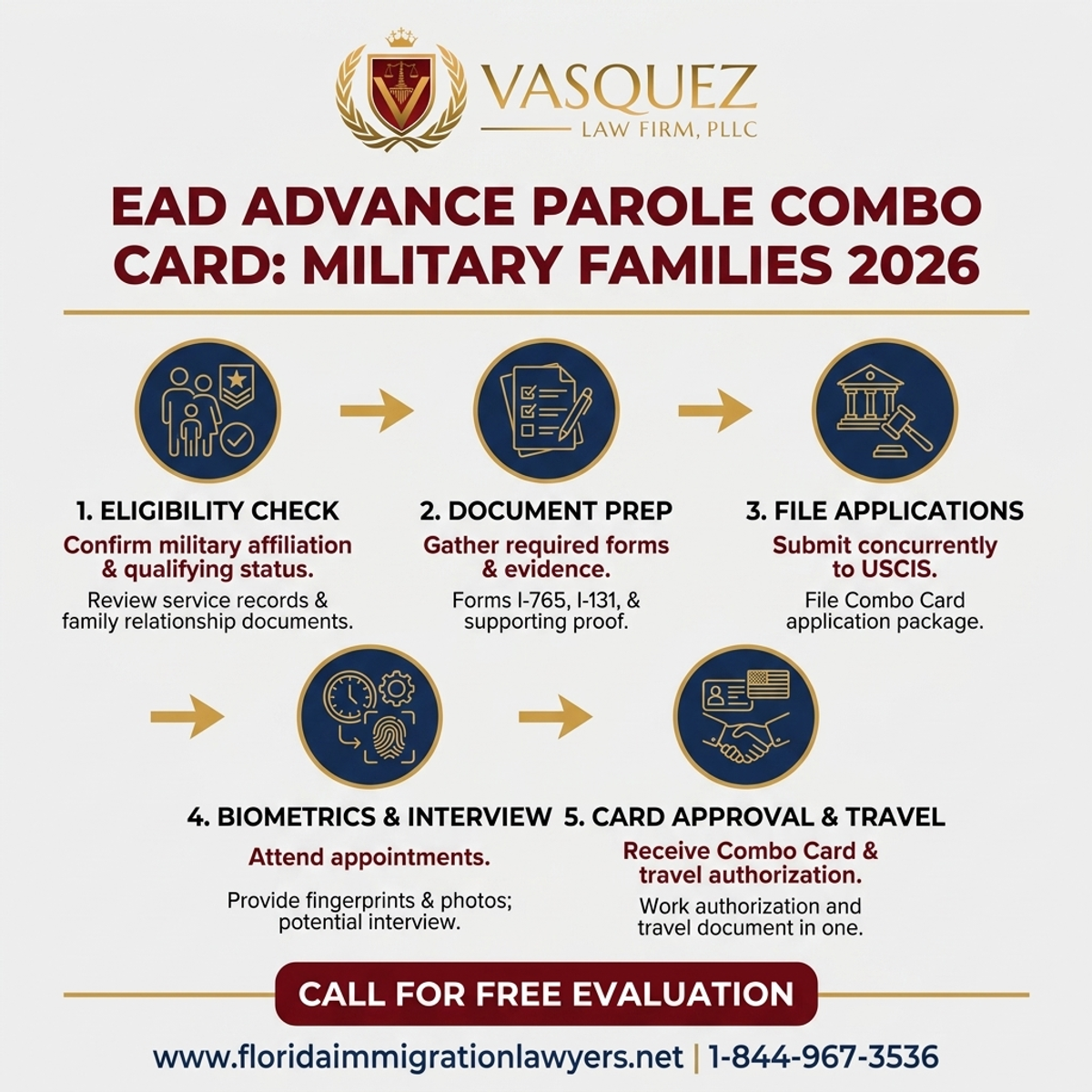
Step-by-Step Process — EAD Advance Parole Combo Card: A Guide for Military Families in 2026
This checklist is a general guide. Depending on your specific circumstances, additional documents may be required. Consulting with an experienced immigration attorney in Florida can help ensure you submit a complete and robust application package, minimizing the risk of errors and delays.
How Long Does it Take to Get an EAD Advance Parole Combo Card Approved in 2026?
As of 2026, the processing times for an EAD Advance Parole Combo Card can vary significantly, typically ranging from 8 to 14 months, and in some complex cases, even longer. These estimates are subject to change based on the volume of applications, the specific USCIS service center handling your case, and the complexity of your individual application. While USCIS strives to process applications efficiently, applicants in Florida should prepare for potential delays and plan accordingly, especially if international travel or immediate employment is critical.
Several factors influence the processing timeline. The specific USCIS service center (e.g., National Benefits Center, Nebraska Service Center, Texas Service Center) that receives and processes your application can have different backlogs. The completeness and accuracy of your initial submission also play a significant role; any requests for evidence (RFEs) for missing documents or clarification can add several months to the process. Furthermore, if you have a complex immigration history, prior arrests, or other issues, your case may require additional scrutiny, extending the processing time. For military families in Central Florida, while local USCIS field offices like Orlando handle interviews for adjustment of status, the initial processing of EAD/AP applications often occurs at regional service centers. It is always advisable to check the official USCIS website for the most current processing times for Forms I-765 and I-131, as these are updated regularly. You can also contact Florida Immigration Lawyers to help monitor your case status and provide updates.
Typical Processing Timeline for EAD Advance Parole Combo Card
| Stage | Typical Timeframe (As of 2026) | Notes |
|---|---|---|
| Application Submission to Receipt | 1-3 weeks | You will receive a Form I-797C, Notice of Action. |
| Biometrics Appointment Scheduling | 3-8 weeks after receipt | Appointment at a local Application Support Center (ASC) in Florida (e.g., Orlando, Tampa). |
| Case Review and Initial Processing | 4-10 months | Varies by service center and case complexity. RFEs can prolong this stage. |
| Card Production and Mailing | 1-2 weeks after approval | Once approved, the card is printed and mailed. |
| Total Estimated Time | 8-14 months (or longer) | This is an average; individual cases may differ significantly. |
While waiting for your combo card, it is crucial not to travel outside the U.S. without an approved Advance Parole document, as this could lead to the abandonment of your pending adjustment of status application. Similarly, do not begin employment until you have received your EAD. Patience and careful planning are key throughout this process. For personalized advice on managing your timeline, reach out to our immigration services team.
What Are the Costs and Fees Associated with an EAD Advance Parole Combo Card Application?
Understanding the costs and fees associated with an EAD Advance Parole Combo Card application is essential for proper financial planning. As of 2026, USCIS filing fees are subject to change, but generally, there are specific fees for Form I-765 (Application for Employment Authorization) and Form I-131 (Application for Travel Document). However, for many military family members applying for adjustment of status (Form I-485) after receiving Parole in Place, the fees for Forms I-765 and I-131 are often waived if filed concurrently with or after the I-485. This fee waiver is a significant benefit, reducing the financial burden on families already facing various costs related to their immigration journey.
It is important to note that while the government fees for the I-765 and I-131 may be waived when filed with an I-485, the fee for the I-485 itself is substantial. Additionally, there are other potential costs beyond the USCIS filing fees. These can include fees for medical examinations, which are mandatory for adjustment of status applicants and must be performed by a USCIS-approved civil surgeon in Florida. There might also be costs for obtaining supporting documents such as birth certificates, marriage certificates, and police clearances, especially if these need to be translated or apostilled. Furthermore, if you choose to work with an experienced immigration attorney, which is highly recommended for such complex cases, legal fees will be an additional expense. These legal fees cover expert guidance, preparation of forms, review of documents, and representation, ensuring your application is accurate and complete, thereby minimizing the risk of delays or denials. Always consult the official USCIS website for the most up-to-date fee schedule, as fees can change without prior notice.
Cost Factors and Fee Breakdown for EAD Advance Parole Combo Card
| Item | Typical Fee (As of 2026, subject to change) | Notes |
|---|---|---|
| Form I-485 (Adjustment of Status) | Varies (e.g., $1,225 for adults) | Required for the underlying green card application. Includes biometrics fee. |
| Form I-765 (Employment Authorization) | Often $0 if filed with I-485 | If filed separately, typically around $410 + biometrics. |
| Form I-131 (Advance Parole) | Often $0 if filed with I-485 | If filed separately, typically around $575. |
| Biometrics Services Fee | Included in I-485 fee; otherwise ~$85 | Required for identity verification and background checks. |
| Medical Examination | $200-$500+ (varies by civil surgeon) | Mandatory for adjustment of status. Not covered by USCIS fees. |
| Attorney Fees | Varies widely based on complexity | Covers legal advice, document preparation, representation. Highly recommended. |
| Document Translation/Preparation | Varies | Costs for certified translations, obtaining records. |
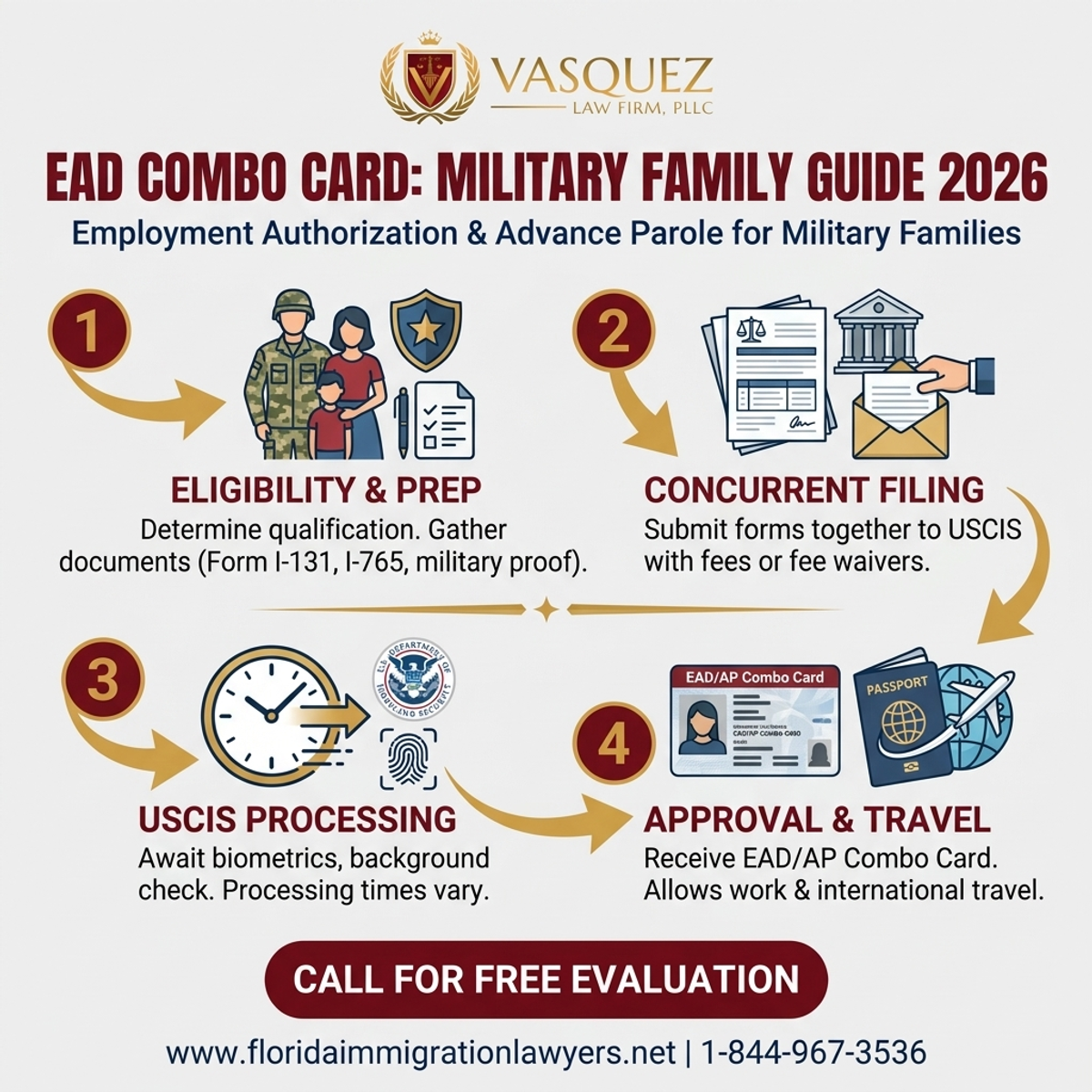
Key Statistics — EAD Advance Parole Combo Card: A Guide for Military Families in 2026
It is crucial to budget for all these potential costs. While the fee waiver for the EAD/AP forms is a significant relief, other expenses can quickly add up. Understanding the full financial picture upfront can help you plan effectively for your immigration journey in Florida. For a clear breakdown of potential costs specific to your case, a consultation with Florida Immigration Lawyers is invaluable.
Navigating Adjustment of Status After Parole in Place in Florida
Once Parole in Place (PIP) has been granted to an eligible military family member in Florida, the next critical step is typically to apply for adjustment of status. This is the process of applying for lawful permanent resident status (a green card) without having to leave the United States. PIP is vital because it remedies the issue of unlawful entry, which would otherwise prevent many individuals from adjusting status domestically. With PIP, the individual is considered to have been lawfully admitted, thereby meeting a key eligibility requirement for Form I-485, Application to Register Permanent Residence or Adjust Status.
The adjustment of status process involves filing Form I-485 along with extensive supporting documentation, including a medical examination report (Form I-693) from a USCIS-approved civil surgeon in Florida. This application requires proof of your relationship to the qualifying U.S. citizen or lawful permanent resident military member, evidence of the military member's service, and a demonstration of your eligibility for an immigrant visa (e.g., through an approved Form I-130, Petition for Alien Relative). During the pendency of the I-485, applicants can concurrently file for the EAD Advance Parole Combo Card using Forms I-765 and I-131, as discussed previously. For residents of Central Florida, the USCIS Orlando Field Office may schedule an interview for the adjustment of status application, while individuals in South Florida would typically attend an interview at the USCIS Miami Field Office. These interviews are crucial for verifying information and ensuring eligibility, and having legal representation can significantly improve the outcome. Understanding the intricacies of this process, including potential waivers for certain inadmissibilities under INA 212(a), is essential for a successful outcome. Our citizenship and adjustment of status attorneys are ready to assist you.
Challenges and Special Considerations for Military Families in Florida
Military families in Florida often face unique challenges that can complicate the immigration process, even with benefits like Parole in Place and the EAD Advance Parole Combo Card. Frequent deployments, transfers, and the transient nature of military life can make it difficult to maintain consistent addresses, gather documents, and attend appointments. For instance, a service member's deployment overseas might make it challenging to obtain a required letter or attend an interview. It is critical for military families to maintain clear communication with USCIS regarding address changes, ensuring all correspondence is received promptly. Failure to do so can result in missed notices, leading to delays or even denial of an application. The emotional toll of potential separation due to immigration issues, especially when one parent is serving the country, adds another layer of stress.
Moreover, while Parole in Place is a powerful tool, it is not a blanket solution for all military family immigration challenges. Some family members might have complex immigration histories, such as previous deportations, criminal records, or misrepresentations, which could make them inadmissible even after PIP is granted. In such cases, waivers of inadmissibility may be required, adding further complexity and time to the process. Understanding the distinction between Parole in Place and other forms of humanitarian parole is also important; PIP is specifically for immediate relatives of military personnel, while other humanitarian parole requests are for urgent humanitarian reasons or significant public benefit. For military families navigating these intricate scenarios, particularly those who might face challenges with immigration court proceedings or complex waivers, legal guidance from professionals familiar with EOIR (Executive Office for Immigration Review) procedures is invaluable. Our attorneys are adept at handling these nuances and advocating for military families in every stage of their immigration journey.
Do not navigate this process alone. Contact Florida Immigration Lawyers today.
Common Mistakes to Avoid When Applying for an EAD Advance Parole Combo Card
- Failing to Understand PIP Eligibility: Many military families mistakenly believe PIP applies to all relatives or situations. Incorrectly assuming eligibility can lead to wasted time and resources on applications that will be denied. Ensure you meet all criteria for the military member and the non-citizen relative.
- Submitting Incomplete or Inaccurate Forms: Even a minor error or missing signature on Form I-765 or I-131 can trigger a Request for Evidence (RFE) or outright denial, significantly delaying the process. Always double-check all fields and ensure the most current forms are used.
- Traveling Internationally Without Approved Advance Parole: This is one of the most critical mistakes. Leaving the U.S. while your adjustment of status application is pending, but before receiving your EAD Advance Parole Combo Card, will almost certainly lead to the abandonment of your I-485 application.
- Not Disclosing All Immigration History: Attempting to hide previous immigration violations, arrests, or encounters with immigration authorities can lead to findings of misrepresentation, which are severe and can result in permanent bars to immigration benefits. Transparency is crucial.
- Missing Biometrics Appointments: Failing to attend your scheduled biometrics appointment at a local ASC in Florida without proper rescheduling can lead to your application being denied for abandonment. Always respond to USCIS notices promptly.
- Not Responding to Requests for Evidence (RFEs) Promptly or Adequately: If USCIS sends an RFE, it means they need more information. Failing to respond by the deadline or providing insufficient evidence will result in a denial. Seek legal help to craft a comprehensive response.
- Incorrectly Calculating Fees or Forgetting Fee Waivers: USCIS fees change, and sometimes waivers apply (especially for EAD/AP when filed with I-485). Sending the wrong fee amount or missing an eligible waiver can cause delays.
- Not Updating Your Address with USCIS: Military families often move. Failing to file Form AR-11, Alien's Change of Address Card, within 10 days of moving can result in missed important notices, leading to application delays or denials.
When to Call a Lawyer for Your EAD Advance Parole Combo Card Application
While the EAD Advance Parole Combo Card seems straightforward, the underlying immigration processes, especially Parole in Place and adjustment of status, are complex and fraught with potential pitfalls. Knowing when to seek professional legal help can make a critical difference in the success of your application. You should strongly consider contacting an experienced immigration attorney at Florida Immigration Lawyers if you encounter any of the following scenarios or warning signs:
If you have a complicated immigration history, such as previous visa overstays, prior deportations, or any criminal record, navigating the EAD Advance Parole Combo Card process becomes significantly more challenging. These factors can introduce inadmissibility issues that require specialized waivers and intricate legal arguments. Similarly, if your initial Parole in Place application was denied, or if you receive a Request for Evidence (RFE) from USCIS for your EAD/AP or I-485 application, it indicates that there are concerns with your case that need expert attention. An attorney can help you understand why the RFE was issued and assist in preparing a strong, well-documented response. Furthermore, if you are unsure about your eligibility for Parole in Place, or if you need to travel internationally urgently but haven't received your Advance Parole, legal counsel is essential to assess your options and avoid jeopardizing your pending application. Our experienced attorneys at Florida Immigration Lawyers specialize in military family immigration and understand the nuances of these cases. We can provide peace of mind by ensuring your application is meticulously prepared, correctly filed, and vigorously advocated for, allowing you to focus on your family and military service.
About Florida Immigration Lawyers
Florida Immigration Lawyers is a leading immigration law firm dedicated to serving military families and individuals across all of Florida. With a deep understanding of the unique challenges faced by those who serve our nation, we provide compassionate, expert legal guidance for a wide range of immigration matters, including Parole in Place, EAD Advance Parole Combo Cards, adjustment of status, and naturalization. Our team is committed to upholding family unity and helping our clients achieve their American dream.
We pride ourselves on offering personalized attention and strategic solutions tailored to each client's specific needs. Our attorneys are available 24/7 to answer your questions and provide support. We offer free case reviews, making it easier for you to understand your options without financial obligation. Whether you are in Orlando, Central Florida, or anywhere else in the state, our firm is here to assist you with dedicated and knowledgeable legal representation. Let us be your trusted partner in navigating the complexities of U.S. immigration law. Schedule a free consultation with Florida Immigration Lawyers today!
Phone: 1-844-967-3536
Sources and References
- U.S. Citizenship and Immigration Services (USCIS)
- Executive Office for Immigration Review (EOIR)
- U.S. Department of State
- 8 U.S.C. Chapter 12 - Immigration and Nationality Act (INA)
- 8 CFR 212.5 - Parole of aliens into the United States
- 8 CFR 274a.12(c)(9) - Classes of aliens authorized to be employed
- USCIS Policy Manual, Volume 7 - Adjustment of Status
Related services: immigration practice areas, deportation defense, asylum protection, business immigration.
This article provides general legal information and is not intended as legal advice. Every case is unique, and outcomes depend on specific facts and circumstances. Contact an attorney for advice about your particular situation.
Navigating the immigration system can be a daunting journey, but you don't have to face it alone. For military families in Florida seeking assistance with an EAD Advance Parole Combo Card, Parole in Place, or any other immigration matter, Florida Immigration Lawyers is here to help. Our experienced team is ready to provide the guidance and representation you deserve. Call us today at 1-844-967-3536 for a free case review. Se Habla Espanol - Estamos aqui para ayudarle.
Do Not Navigate This Process Alone
Our experienced immigration attorneys are ready to fight for you. Get a free, confidential case review today.
Se Habla Español
Or leave your details and we’ll call you:
Free Evaluation in 24 Hours
Or talk to us right now

AI voice assistant — available 24/7
FreeFrequently Asked Questions

William J. Vásquez
Founding Attorney · Vasquez Law Firm
U.S. Air Force veteran and immigration attorney with years of hands-on U.S. immigration experience. J.D., NCCU School of Law. AILA member. Admitted to the 4th, 5th, and 11th Circuit Courts.
Available 24/7 - Free Evaluations
Reviewed for legal accuracy by William J. Vásquez
Licensed in North Carolina; U.S. immigration is federal practice.
Related Legal Services
Our Florida immigration attorneys can help you with business immigration, deportation defense and family immigration services. Call today at 1-844-967-3536 for a free case review.
Related Links
Related Topics
Free Legal Case Review
Discuss your case with our experienced attorneys. We're available 24/7.
Se Habla Español - Estamos aquí para ayudarle.
Related Articles
Immigration Lawyer Orlando Free Consultation in Florida
For individuals and families in Orlando, Florida, navigating the complexities of U.S. immigration law requires expert guidance. An immigration lawyer in Orlando offers crucial support for everything from visa applications and green card processes to naturalization and deportation defense. This comprehensive guide details what a free consultation covers, providing a step-by-step overview of immigration pathways, essential document checklists, and expected timelines in 2026. We also highlight common mistakes to avoid, discuss the critical role of legal counsel in deportation and asylum cases, and explain why choosing a local Orlando immigration attorney is beneficial. Florida Immigration Lawyers is dedicated to serving the diverse community of Orlando with compassionate, effective legal solutions, ensuring you receive personalized advice and robust representation for a successful immigration journey.
Good Moral Character for Naturalization in Florida
Exploring the role of good moral character in the Florida naturalization process, this guide provides insights into how criminal history and personal integrity affect your N-400 application. Learn the steps to demonstrate good moral character and avoid common pitfalls.
J-1 Physician Waiver for Florida Placement: Key Insights
Discover how J-1 physicians can secure waivers for placement in Florida's underserved areas. Learn about the Conrad 30 program, necessary documents, and timelines. Understand the common mistakes to avoid and when to seek legal assistance. Florida Immigration Lawyers are here to guide you through every step.
Immigration Medical Exam in Florida: What to Expect
Learn about the immigration medical exam process in Florida, including the role of civil surgeons and necessary documents. Understand your options with the help of Florida Immigration Lawyers.