Student Visa Attorney Florida: Your 2026 Guide to Study
Dreaming of studying in Florida? The student visa process can be challenging, but with the right guidance, your academic future in the Sunshine State is achievable. This comprehensive guide, updated for 2026, details the F-1 visa application steps, essential documents, financial requirements, and work limitations for international students. Learn about the crucial role a student visa attorney in Florida plays in navigating complex immigration laws, ensuring your application is meticulously prepared, and helping you avoid common pitfalls. From obtaining your I-20 to successfully clearing your consular interview, understanding each stage is vital. Discover when to seek legal counsel, especially for complex cases, previous denials, or maintaining your student status. Florida Immigration Lawyers are here to provide immigration help, offering free case reviews and dedicated support across Florida. Secure your educational journey with professional legal assistance.
Securing a student visa for Florida in 2026 involves a multi-step process, typically requiring an I-20 from a SEVP-approved school, payment of the SEVIS I-901 fee, completion of the DS-160 form, and a consular interview. An experienced student visa attorney Florida can provide invaluable assistance, ensuring all documentation is accurate, deadlines are met, and potential challenges are addressed. They help navigate complex regulations, prepare you for interviews, and advocate on your behalf, significantly increasing your chances of approval and helping you achieve your academic goals in the Sunshine State.
- Obtain an I-20 from a Student and Exchange Visitor Program (SEVP) approved institution.
- Pay the SEVIS I-901 fee and complete the DS-160 online nonimmigrant visa application.
- Schedule and attend a visa interview at a U.S. Embassy or Consulate in your home country.
- Gather comprehensive documentation, including financial proof and academic records.
- Consult a Florida immigration lawyer to streamline the process and avoid common pitfalls.
Florida, with its vibrant culture, diverse population, and world-class educational institutions, attracts thousands of international students each year. The dream of pursuing higher education or specialized training in the Sunshine State is a powerful motivator. However, the path to obtaining a student visa can be intricate, filled with strict requirements, detailed paperwork, and critical deadlines. Whether you aspire to study at the University of Central Florida in Orlando, the University of Florida in Gainesville, or a vocational school in Miami, understanding the specific visa categories and application procedures is paramount.
Navigating the complex landscape of U.S. immigration law, particularly for student visas, often requires guidance. This comprehensive guide, updated for 2026, will demystify the process, outlining the various student visa types, application steps, required documents, and associated costs. We will also highlight common pitfalls to avoid and explain when seeking assistance from a dedicated student visa attorney Florida is not just helpful, but essential. Our goal is to equip you with the knowledge needed to confidently pursue your academic aspirations in Florida.
Do not let the complexities of immigration law deter your educational journey. For personalized guidance and a clear path forward, call Florida Immigration Lawyers at 1-844-YO-PELEO for a free case review today. We are here to help you turn your dream of studying in Florida into a reality.
What is an F-1 Student Visa and Who Qualifies in Florida?
The F-1 visa is the most common nonimmigrant visa for individuals wishing to pursue academic studies in the United States, including at educational institutions across Florida. As of 2026, an F-1 visa allows international students to enroll in full-time academic programs at Student and Exchange Visitor Program (SEVP)-approved colleges, universities, seminaries, conservatories, academic high schools, elementary schools, or other academic institutions, including language training programs. Other student visa categories include the M-1 visa for vocational or non-academic studies and the J-1 visa for exchange visitors, which can include students.
To qualify for an F-1 student visa in Florida, applicants must first be accepted by an SEVP-approved school, such as the University of Central Florida, Florida International University, or the University of South Florida. Upon acceptance, the school will issue a Form I-20, Certificate of Eligibility for Nonimmigrant Student Status. Prospective students must demonstrate sufficient financial resources to cover their tuition, living expenses, and transportation for their entire period of study. They must also prove their intent to return to their home country upon completion of their studies, showing strong ties abroad. This is a critical aspect, often assessed during the visa interview. An experienced Florida immigration lawyer can help you gather the necessary evidence to demonstrate these ties effectively. The legal framework for these visas is found in the Immigration and Nationality Act (INA), specifically INA 101(a)(15)(F) for F-1 visas, and detailed regulations in 8 CFR 214.2(f).
Florida boasts a diverse array of SEVP-certified institutions, from major public universities to specialized private colleges and language institutes. Whether you are aiming for a STEM degree in Orlando, a hospitality program in Miami, or an arts curriculum in Sarasota, the F-1 visa is your gateway. Understanding the nuances of eligibility, especially regarding financial stability and non-immigrant intent, is crucial. A seasoned immigration attorney can review your specific circumstances, helping you identify the most suitable visa type and prepare a robust application that highlights your qualifications and commitment to academic excellence in Florida.
How Do I Apply for a Student Visa in Florida for 2026?
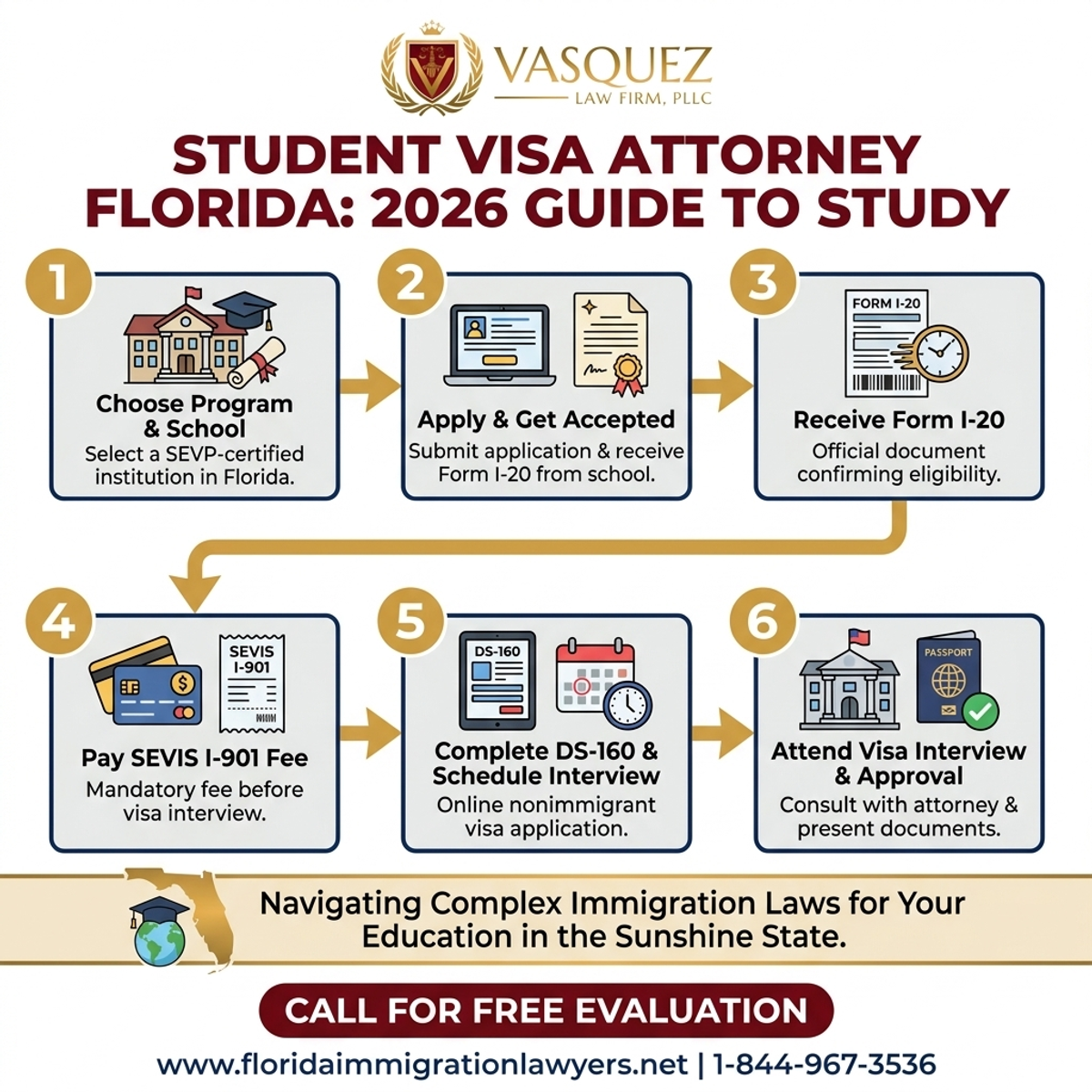
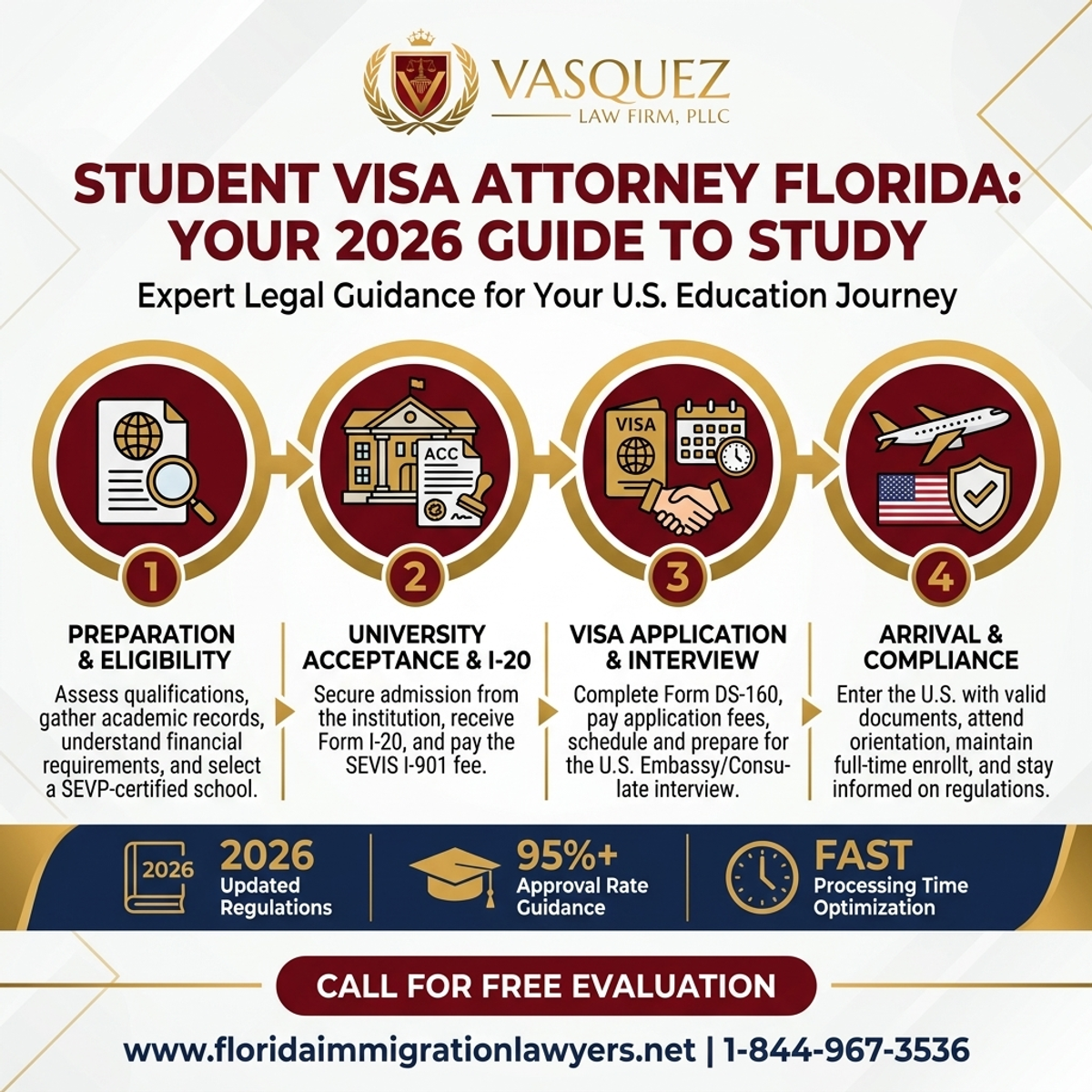
Applying for a student visa to study in Florida in 2026 involves a structured process, starting with school admission and culminating in a consular interview. The key steps include obtaining an I-20, paying the SEVIS fee, completing the DS-160, and attending a visa interview. Successfully navigating these steps requires meticulous attention to detail and adherence to deadlines.
The application process for a student visa, particularly an F-1, involves several critical stages. First, you must apply to and be accepted by an academic institution approved by the Student and Exchange Visitor Program (SEVP). Once accepted, the school will issue you a Form I-20, Certificate of Eligibility for Nonimmigrant Student Status. This form is essential as it confirms your enrollment and provides details about your program of study. Next, you must pay the SEVIS I-901 fee. This fee supports the Student and Exchange Visitor Information System (SEVIS) database, which tracks F, M, and J nonimmigrants. You then complete the Online Nonimmigrant Visa Application, Form DS-160, and print the confirmation page. The final step is to schedule and attend a visa interview at a U.S. Embassy or Consulate in your home country. During this interview, a consular officer will review your application, documents, and assess your intent to return home after your studies. For those already in the U.S. seeking to change status to F-1, the process involves filing Form I-539 with USCIS, often through the USCIS field offices located in Florida, such as the one in Orlando. A skilled immigration attorney can guide you through each step, ensuring accuracy and timeliness.
Student Visa Application Timeline and Processing Expectations (2026)
As of 2026, student visa processing times can vary significantly based on the country of application, the specific U.S. Embassy or Consulate, and the time of year. It is highly recommended to apply well in advance of your program start date, ideally 3-5 months prior.
| Stage | Typical Timeframe | Notes |
|---|---|---|
| School Application & I-20 Issuance | 1-3 months | Varies by institution; crucial first step. |
| SEVIS I-901 Fee Payment | Immediate (online) | Must be paid before DS-160 submission. |
| DS-160 Completion | 1-2 days | Online form; requires careful data entry. |
| Visa Interview Scheduling | Days to several weeks | Depends on embassy/consulate availability. |
| Visa Interview & Decision | Same day to 1 week | Consular officer usually makes a decision quickly. |
| Visa Issuance & Passport Return | 3-10 business days | Time for visa printing and passport delivery. |
Essential Documents for Your Florida Student Visa Application
A successful student visa application hinges on presenting a complete and accurate set of documents. Missing or incorrect paperwork is a common reason for delays or denials. As of 2026, ensuring you have all required materials organized and readily accessible is crucial for your interview and overall application success. This meticulous preparation is where a knowledgeable student visa attorney Florida can prove invaluable.
When applying for a student visa to study in Florida, you will need to prepare a comprehensive dossier of documents. This typically includes your valid passport, which must be valid for at least six months beyond your period of stay in the United States. You will also need your original Form I-20, Certificate of Eligibility for Nonimmigrant Student Status, issued by your SEVP-approved school. The DS-160 confirmation page and your SEVIS I-901 fee receipt are also mandatory. Two passport-style photographs, meeting specific U.S. Department of State requirements, are required. Crucially, you must provide substantial evidence of your financial ability to cover your tuition and living expenses for the entire duration of your studies. This can include bank statements, scholarship letters, or affidavits of support from sponsors. Academic transcripts, diplomas, and standardized test scores (e.g., TOEFL, IELTS, SAT, GRE) are also necessary to demonstrate your academic qualifications. Finally, proof of your ties to your home country, such as property deeds, family certificates, or job offers, is vital to overcome the presumption of immigrant intent. The U.S. Department of State provides detailed guidelines on document requirements for nonimmigrant visas. A Florida immigration lawyer can help you compile and organize these documents, ensuring everything is in order.
Step-by-Step Process — Student Visa Attorney Florida: Your 2026 Guide to Study
Student Visa Document Checklist
- Valid passport (valid for at least six months beyond your intended stay).
- Form I-20, Certificate of Eligibility for Nonimmigrant Student Status.
- DS-160 confirmation page.
- SEVIS I-901 fee payment receipt.
- Two U.S. visa-compliant passport-style photographs.
- Evidence of financial support (e.g., bank statements, scholarship letters, affidavits of support, financial aid awards).
- Academic transcripts, diplomas, and degrees from previous institutions.
- Standardized test scores (e.g., TOEFL, IELTS, SAT, GRE, GMAT, etc., as required by your school).
- Proof of ties to your home country (e.g., property deeds, family ties, job prospects upon return).
- Visa interview appointment confirmation.
- Any additional documents requested by the embassy or consulate.
Understanding Student Visa Costs and Financial Requirements in 2026
The financial aspect of obtaining a student visa for Florida in 2026 extends beyond tuition fees, encompassing various application charges and the critical requirement to demonstrate sufficient funds. Understanding these costs upfront is essential for budgeting and preparing a successful application. These fees are subject to change, so always check official government websites for the most current information.
As of 2026, several non-refundable fees are associated with the student visa application process. The first is the SEVIS I-901 fee, which supports the Student and Exchange Visitor Information System and must be paid before your visa interview. The second significant cost is the nonimmigrant visa application fee, often referred to as the MRV fee, for the DS-160 form. This fee is paid directly to the U.S. Embassy or Consulate. Beyond these government fees, applicants must also account for potential costs such as passport photos, travel expenses to the embassy for the interview, and courier services for passport return. Crucially, applicants must demonstrate that they have sufficient funds to cover their tuition, living expenses, and other educational costs for their entire stay in the U.S. The amount required is specified on your Form I-20. This financial proof is a cornerstone of the application, and inadequate evidence is a frequent cause for denial. While there is no specific government fee for legal representation, retaining a dedicated immigration help professional, like a Florida immigration lawyer, involves their service fees, which can vary based on the complexity of your case. These legal fees are an investment in ensuring your application is robust and compliant. The regulations regarding financial solvency are detailed in 8 CFR 214.2(f)(1)(iv).
Student Visa Cost Factors and Fee Breakdown (2026)
| Item | Typical Fee (USD) | Notes |
|---|---|---|
| SEVIS I-901 Fee | $350 | Mandatory for F-1 and M-1 applicants. |
| DS-160 (MRV) Application Fee | $185 | Paid to the U.S. Embassy/Consulate. |
| Passport Photos | $10-$20 | Varies by provider. |
| Attorney Fees | Varies widely | Cost for professional legal guidance and representation. |
| Travel to Embassy/Consulate | Varies | Airfare, accommodation, local transport. |
| Courier Service (Passport Return) | Varies | Optional, but often recommended for secure delivery. |
Do not navigate this complex process alone. The stakes are high when your academic future is on the line. Contact Florida Immigration Lawyers today at 1-844-YO-PELEO for a free, confidential case review. Our dedicated team is ready to provide the guidance you need to secure your student visa.
Working on a Student Visa in Florida: Rules and Restrictions
While a primary purpose of a student visa is academic study, certain work opportunities are available to F-1 and M-1 visa holders in Florida, subject to strict regulations. Understanding these rules is crucial to maintain your legal status and avoid severe immigration consequences. Unauthorized employment is a significant violation that can lead to deportation and future visa ineligibility.
For F-1 students in Florida, on-campus employment is generally permitted for up to 20 hours per week while school is in session and full-time during breaks, without needing specific USCIS authorization. Off-campus employment, however, is much more restricted. It typically requires authorization from USCIS and falls into categories such as Curricular Practical Training (CPT) or Optional Practical Training (OPT). CPT is temporary employment directly related to an F-1 student's major area of study, often part of an academic curriculum, and requires authorization from the Designated School Official (DSO) and an updated I-20. OPT allows F-1 students to gain practical experience directly related to their major area of study, either before or after graduation. Post-completion OPT is usually for 12 months, with a potential 24-month STEM OPT extension for eligible science, technology, engineering, and mathematics degrees. For M-1 vocational students, practical training is generally available only after completing their course of study and requires USCIS approval, with strict limitations on duration. J-1 exchange visitors have work authorization specific to their program. Any work outside these authorized categories, including self-employment or working for an employer without proper authorization, constitutes unauthorized employment. This can lead to the termination of your student status, denial of future immigration benefits, and even removal proceedings through the Executive Office for Immigration Review (EOIR). Consulting a Florida immigration lawyer is highly advisable before engaging in any form of employment to ensure compliance with all regulations.
Key Statistics — Student Visa Attorney Florida: Your 2026 Guide to Study
It is important for students in Florida, including those in Alachua County attending institutions like the University of Florida, to be acutely aware of employment limitations. The rules are complex, and even seemingly minor deviations can have profound impacts on your immigration status. For example, working more hours than permitted on-campus or engaging in off-campus work without proper authorization can immediately jeopardize your F-1 visa. Moreover, the type of work must be directly related to your field of study for CPT and OPT. Seeking guidance from an experienced immigration attorney can help you navigate these restrictions, understand your options for legal employment, and ensure you remain in good standing with U.S. immigration laws throughout your academic journey in Florida.
Common Mistakes to Avoid in Your Student Visa Application
Navigating the student visa application process can be challenging, and even small errors can lead to significant delays or outright denials. Avoiding these common mistakes is crucial for a successful outcome. A knowledgeable student visa attorney Florida can help you sidestep these pitfalls.
- Submitting an Incomplete Application: Failing to provide all required documents or leaving sections blank on forms like the DS-160 will almost certainly result in delays or denial.
- Inadequate Proof of Financial Support: Not demonstrating sufficient funds to cover tuition and living expenses for your entire program is a leading cause of denial. Bank statements must be current and clearly show available funds.
- Lack of Demonstrated Non-Immigrant Intent: Consular officers are trained to identify individuals who may intend to stay permanently. Failing to provide strong evidence of ties to your home country (family, property, job prospects) can lead to denial.
- Providing Inconsistent Information: Discrepancies between your application forms, supporting documents, and interview answers can raise red flags and lead to suspicions of misrepresentation.
- Poor Interview Preparation: Appearing unprepared, unable to articulate your academic goals, or answering questions vaguely can create a negative impression and result in denial.
- Missing Deadlines: Failing to pay the SEVIS fee, submit forms, or attend your interview by the specified dates can cause your application to be rejected or significantly delayed.
- Engaging in Unauthorized Employment: Working off-campus without proper authorization (CPT, OPT, or economic hardship) is a severe violation of your F-1 status and can lead to immediate visa revocation and deportation.
- Not Maintaining Full-Time Enrollment: F-1 students must maintain full-time enrollment as defined by their institution. Dropping below this threshold without DSO approval is a status violation.
- Incorrect Visa Type Application: Applying for an F-1 when an M-1 or J-1 is more appropriate for your program of study (e.g., vocational training vs. academic degree) can lead to denial.
- Misrepresenting Facts or Submitting Fraudulent Documents: Any form of misrepresentation or fraud will result in a permanent bar from entering the U.S. and severe legal consequences.
- Overstaying a Previous Visa: If you have previously overstayed a U.S. visa, even for a short period, it can significantly complicate or lead to denial of a new student visa application.
- Ignoring Request for Evidence (RFE): If USCIS issues an RFE, failing to respond comprehensively and on time will almost certainly lead to a denial.
When to Call a Student Visa Attorney in Florida
While some student visa applications are straightforward, many situations warrant the expertise of a qualified Florida immigration lawyer. The U.S. immigration system is notoriously complex, and even minor errors can have long-lasting consequences. Knowing when to seek professional legal assistance can be the difference between achieving your academic dreams and facing a denial or even deportation.
You should consider calling Florida Immigration Lawyers if you:
- Have a previous visa denial or a history of immigration issues.
- Possess a criminal record, even a minor one, which could impact your eligibility.
- Are seeking to change your nonimmigrant status to F-1 while already in the U.S., which involves complex USCIS procedures and forms like I-539.
- Received a Request for Evidence (RFE) from USCIS or a 221(g) refusal from a consular officer, requiring a detailed and timely response.
- Are unsure about demonstrating sufficient financial resources or proving your non-immigrant intent.
- Need to understand the intricacies of CPT, OPT, or other work authorizations for F-1 students.
- Are facing potential violations of your student status, such as unauthorized employment or issues with maintaining full-time enrollment.
- Require assistance with a J-1 visa waiver or other specialized student visa matters.
- Are from a country with high visa refusal rates or specific security concerns.
- Simply want peace of mind that your application is meticulously prepared and compliant with all current laws and regulations.
Our attorneys regularly assist students from across the globe, including those planning to attend institutions in Orlando, Tampa, Gainesville, and other Florida cities. We understand the specific requirements of the USCIS Orlando Field Office and other relevant agencies. Do not risk your academic future by navigating these waters alone. Let our firm provide the immigration help you need.
About Florida Immigration Lawyers
Florida Immigration Lawyers is a leading law firm dedicated to providing comprehensive and compassionate immigration services to individuals and families across the entire state of Florida. With our office conveniently located in Central Florida, we are committed to helping clients achieve their immigration goals, from securing student visas to navigating complex deportation defense cases. Our team of experienced attorneys possesses a deep understanding of U.S. immigration law and its ever-evolving landscape. We pride ourselves on offering personalized strategies, meticulous attention to detail, and zealous advocacy for every client.
We understand the profound impact immigration matters have on people's lives and approach each case with empathy and dedication. Whether you are an aspiring student, a family seeking reunification, or an individual facing removal, our firm is equipped to provide the legal counsel you need. We offer a wide array of services, including family immigration, business immigration, asylum claims, citizenship applications, and visa assistance. Our commitment to our clients is unwavering. We are available 24/7, offer free case reviews, and proudly provide bilingual services (English and Spanish) to ensure clear communication and understanding. Choose Florida Immigration Lawyers for trusted legal support throughout your immigration journey.
Visit our contact page to schedule your free consultation, or call us directly at 1-844-YO-PELEO. We serve all of Florida, from Alachua County to Miami-Dade, providing legal assistance wherever you are in the state.
Sources and References
- U.S. Citizenship and Immigration Services (USCIS)
- U.S. Department of State
- Executive Office for Immigration Review (EOIR)
- 8 U.S.C. Chapter 12 - Immigration and Nationality Act (INA)
- 8 CFR 214.2(f) - Regulations for F-1 Academic Students
- 8 CFR 214.2(m) - Regulations for M-1 Vocational Students
Related services: immigration practice areas, family immigration services.
This article provides general legal information and is not intended as legal advice. Every case is unique, and outcomes depend on specific facts and circumstances. Contact an attorney for advice about your particular situation.
Your academic aspirations in Florida are within reach with the right legal support. Do not let the complexities of the student visa process overwhelm you. Contact Florida Immigration Lawyers today for a free case review and let us help you build a strong application. Call us now at 1-844-YO-PELEO. Se Habla Espanol - Estamos aqui para ayudarle.
If you need legal assistance, learn more about Florida immigration legal team, or call us at 1-844-967-3536 for a free case review.
Do Not Navigate This Process Alone
Our experienced immigration attorneys are ready to fight for you. Get a free, confidential case review today.
Se Habla Español
Or leave your details and we’ll call you:
Free Evaluation in 24 Hours
Or talk to us right now

AI voice assistant — available 24/7
FreeFrequently Asked Questions

William J. Vásquez
Founding Attorney · Vasquez Law Firm
U.S. Air Force veteran and immigration attorney with years of hands-on U.S. immigration experience. J.D., NCCU School of Law. AILA member. Admitted to the 4th, 5th, and 11th Circuit Courts.
Available 24/7 - Free Evaluations
Reviewed for legal accuracy by William J. Vásquez
Licensed in North Carolina; U.S. immigration is federal practice.
Related Legal Services
Our Florida immigration attorneys can help you with free immigration consultation, business immigration and deportation defense. Call today at 1-844-YO-PELEO for a free case review.
Related Links
Related Topics
Free Legal Case Review
Discuss your case with our experienced attorneys. We're available 24/7.
Se Habla Español - Estamos aquí para ayudarle.
Related Articles
Certificate of Eligibility for Expungement in Florida 2026
For non-U.S. citizens in Florida, understanding how a state expungement impacts immigration status is critical. A certificate of eligibility for expungement in Florida allows a criminal record to be sealed or expunged under state law. However, federal immigration agencies often disregard such state-level relief, still considering the original criminal offense as a conviction for immigration purposes. This can have severe implications for visa applications, green card eligibility, naturalization, and even lead to deportation. This guide clarifies the Florida expungement process, its limited effect on federal immigration law, and key steps to protect your status in 2026. Learn about common mistakes, required documents, timelines, and when to seek expert legal counsel from Florida Immigration Lawyers to navigate these complex issues effectively.
Immigration Lawyer Orlando Free Consultation in Florida
For individuals and families in Orlando, Florida, navigating the complexities of U.S. immigration law requires expert guidance. An immigration lawyer in Orlando offers crucial support for everything from visa applications and green card processes to naturalization and deportation defense. This comprehensive guide details what a free consultation covers, providing a step-by-step overview of immigration pathways, essential document checklists, and expected timelines in 2026. We also highlight common mistakes to avoid, discuss the critical role of legal counsel in deportation and asylum cases, and explain why choosing a local Orlando immigration attorney is beneficial. Florida Immigration Lawyers is dedicated to serving the diverse community of Orlando with compassionate, effective legal solutions, ensuring you receive personalized advice and robust representation for a successful immigration journey.
Work Permit EAD Application Process in Florida 2026
Applying for a work permit, or Employment Authorization Document (EAD), in Florida is a crucial step for many non-citizens seeking to work legally in the U.S. This comprehensive guide from Florida Immigration Lawyers details the 2026 application process, including eligibility criteria, necessary documentation for Form I-765, typical processing times, and associated costs. We highlight the importance of accurate submission and offer insights into common pitfalls to avoid. Our firm, based in Orlando, Florida, provides expert legal assistance for asylum seekers, adjustment of status applicants, and other eligible individuals. Learn how to prepare for your EAD application and understand when professional legal counsel can make a significant difference in achieving a successful outcome. Secure your right to work with knowledgeable support.
Change of Status B-2 to F-1 in Florida: Key Steps
Changing your status from a B-2 tourist visa to an F-1 student visa in Florida involves several crucial steps. This guide provides a comprehensive overview, including the 2026 I-539 processing times, document requirements, and common pitfalls to avoid. Learn how to navigate the process effectively with help from Florida Immigration Lawyers.