Immigration Attorney for CR-1 Visa Orlando: Your Guide
Navigating the CR-1 and IR-1 visa process can be challenging. Learn how to apply, what documents are needed, and the typical processing timeline. Contact Florida Immigration Lawyers in Orlando for guidance.
Finding an immigration attorney for a CR-1 visa in Orlando involves understanding what a CR-1 visa is, which allows spouses of U.S. citizens to immigrate. The process includes NVC processing and consular interviews. Consulting an attorney can help navigate complexities and ensure a smooth application process.
- CR-1 visas are for spouses of U.S. citizens.
- IR-1 visas are similar but for longer marriages.
- Orlando has specific resources and legal support for these visas.
- NVC processing is a key step in the application.
- Consulting a lawyer ensures compliance and efficiency.
Introduction
Are you seeking to bring your spouse to the United States through a CR-1 or IR-1 visa? Navigating the complexities of immigration law can be daunting, especially when dealing with the National Visa Center (NVC) and consular processing. Whether you're an Orlando resident or anywhere in Central Florida, understanding the process and requirements is crucial for a successful application. This guide will walk you through the steps and provide valuable insights to ensure a smooth immigration journey.
The journey to reunite with your spouse in the U.S. is deeply personal and often filled with anticipation and questions. From gathering intricate documentation to preparing for crucial interviews, each stage demands precision and an understanding of ever-evolving immigration policies. Our goal is to demystify this path, offering clear guidance and practical advice to help you avoid common pitfalls.
For families in Orlando and across Central Florida, having local, legal support can make a significant difference. Florida Immigration Lawyers focuses on family-based immigration, offering tailored assistance that considers your unique circumstances and the specific requirements of U.S. Citizenship and Immigration Services (USCIS) and the Department of State. We are committed to helping you achieve your dream of family reunification.
Call Florida Immigration Lawyers at 1-844-YO-PELEO for a free case review and personalized assistance with your CR-1 or IR-1 visa application.
What Are CR-1 and IR-1 Visas?
CR-1 and IR-1 visas are types of spouse immigrant visas that allow the foreign spouse of a U.S. citizen to immigrate to the United States. The CR-1 visa is issued to spouses who have been married for less than two years, while the IR-1 visa is for those who have been married for longer than two years.
These visas provide a path to permanent residency for spouses of U.S. citizens, allowing them to live and work in the United States legally. The CR-1 visa grants conditional residency, which can later be adjusted to permanent residency. As of 2026, the requirements and procedures for these visas remain stringent, necessitating careful preparation and documentation.
The primary distinction between the CR-1 (Conditional Resident) and IR-1 (Immediate Relative) visas lies in the duration of the marriage at the time the visa is issued. If your marriage is less than two years old when your spouse enters the U.S. with the visa, they receive a CR-1 visa, granting conditional permanent residency for two years. This condition is imposed to help USCIS verify the authenticity of the marriage and prevent immigration fraud. After two years, you and your spouse must jointly file Form I-751, Petition to Remove Conditions on Residence, to convert the conditional status to full permanent residency.
Conversely, if your marriage has lasted two years or more by the time the visa is issued, your spouse will receive an IR-1 visa, granting immediate, unconditional permanent residency. This means they will receive a 10-year green card directly, bypassing the need to file Form I-751. Both visa types offer the same rights and privileges to live and work in the U.S., but the IR-1 provides a more direct path to unconditional residency, saving time and an additional filing process in the future.
How to Apply for a CR-1 Visa?
The application process for a CR-1 visa involves several steps, including filing a petition, gathering documentation, and attending an interview. Here's a step-by-step guide to help you navigate the application process:
- File Form I-130: The U.S. citizen spouse must file Form I-130, Petition for Alien Relative, with the USCIS.
- NVC Processing: Once the petition is approved, it is sent to the National Visa Center (NVC) for further processing.
- Prepare Documentation: Gather necessary documents such as marriage certificates, proof of U.S. citizenship, and financial support evidence.
- Attend Consular Interview: The foreign spouse will attend an interview at a U.S. consulate in their home country.
- Receive Visa Approval: If approved, the visa will be issued, allowing the spouse to enter the U.S.
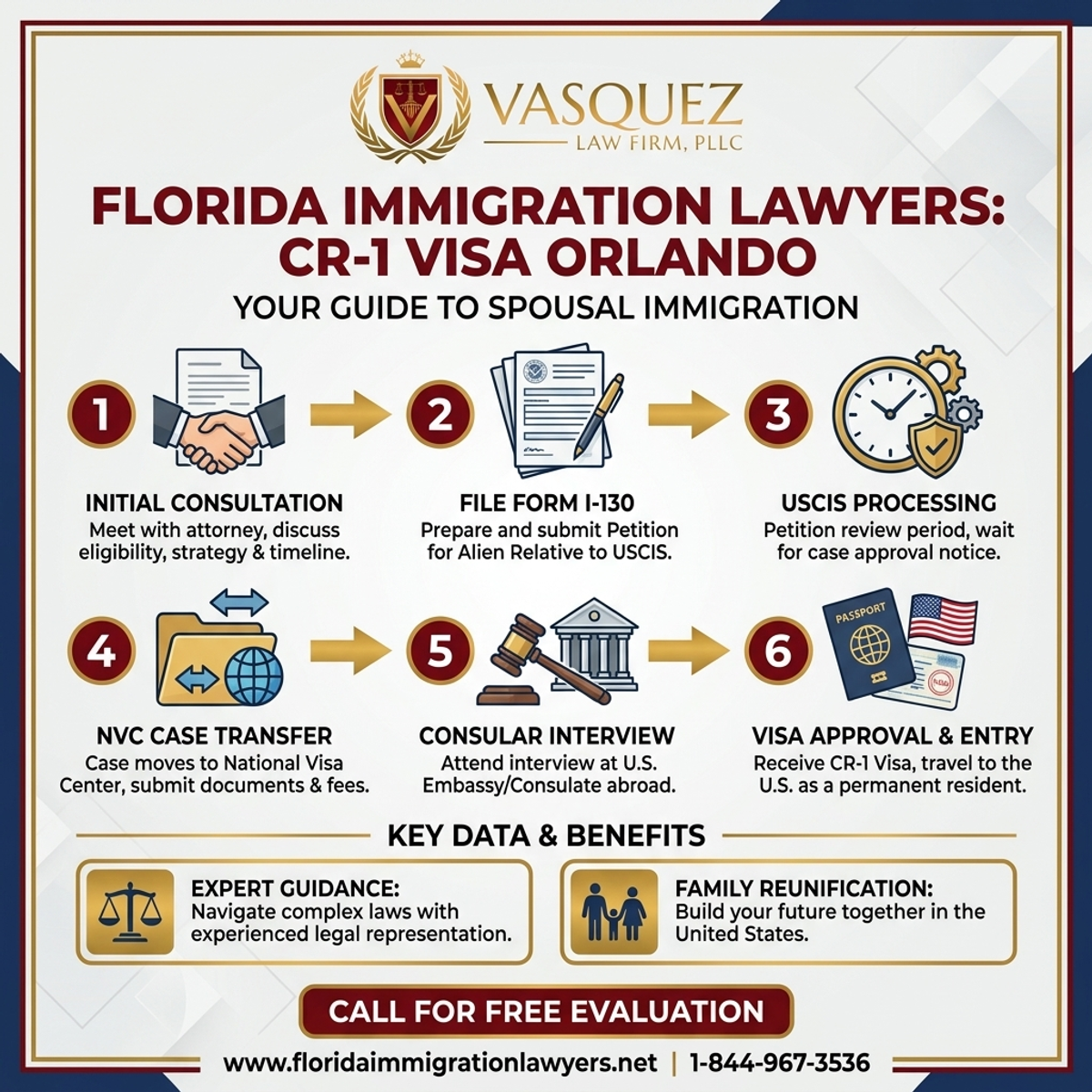
Step-by-Step Process — Immigration Attorney for CR-1 Visa Orlando: Your Guide
Each step in the CR-1 visa application process requires meticulous attention to detail. Filing Form I-130 is the foundational step, where the U.S. citizen petitioner establishes a legitimate marital relationship with their foreign spouse. This involves submitting not only the form itself but also extensive evidence of a bona fide marriage, such as shared financial accounts, joint leases, photographs, and affidavits from friends and family. The more compelling the evidence, the smoother the initial approval process tends to be.
After USCIS approves the I-130 petition, the case transitions to the National Visa Center (NVC). This phase, known as NVC processing, involves paying various fees, submitting the Affidavit of Support (Form I-864) from the U.S. citizen petitioner, and uploading all required civil documents for the foreign spouse. The NVC acts as a central hub for document collection before the case is forwarded to the appropriate U.S. embassy or consulate abroad for the interview. Ensuring all documents are correctly formatted, translated, and submitted promptly is crucial to avoid delays.
The consular interview is the final, critical step in the visa process. During this interview, a consular officer will assess the applicant's eligibility and verify the authenticity of the marriage. The foreign spouse must be prepared to answer questions about their relationship, background, and intentions. Having a clear understanding of the entire application and a consistent narrative with your spouse's initial petition is vital. Florida Immigration Lawyers can help you prepare thoroughly for this interview, providing mock interviews and guidance on what to expect to boost your confidence.
What Documents Are Required for a CR-1 Visa?
Ensuring you have all the required documents is critical to avoid delays in your CR-1 visa application. Here's a checklist of necessary documents:
- Completed Form I-130
- Marriage certificate
- Proof of U.S. citizenship of the petitioner
- Proof of termination of any prior marriages
- Passport-style photographs
- Form I-864, Affidavit of Support
- Financial documents to prove income
- Medical examination and vaccination records
Beyond simply having these documents, understanding their purpose is key to presenting a strong application. For instance, the marriage certificate is fundamental, but proof of termination of prior marriages (divorce decrees or death certificates) is equally vital to establish the legality of your current marriage. USCIS and the NVC require these documents to ensure there are no legal impediments to the marriage or the visa issuance.
The Form I-864, Affidavit of Support, is particularly crucial as it demonstrates that the U.S. citizen petitioner can financially support their foreign spouse, preventing them from becoming a public charge in the U.S. This typically requires proving an income at or above 125% of the federal poverty guidelines for your household size. If the petitioner's income is insufficient, a joint sponsor may be required, adding another layer of complexity to the documentation process. Collecting all financial documents, including tax returns, pay stubs, and employment verification letters, is essential.
Practical tip: Begin collecting these documents as early as possible. Many require original copies or certified translations, which can take time to obtain. Organize everything meticulously in a binder or digital folders, clearly labeled, to ensure nothing is missed. When working with Florida Immigration Lawyers, we provide comprehensive checklists and guidance to help you gather and prepare every necessary piece of documentation efficiently and accurately.
What Is the Timeline for CR-1 Visa Processing?
The processing time for a CR-1 visa can vary based on several factors, including caseload at the USCIS and NVC. As of 2026, the typical timeline includes:
| Stage | Typical Timeframe | Notes |
|---|---|---|
| USCIS Petition Approval | 8-12 months | Initial approval of Form I-130 |
| NVC Processing | 3-5 months | Document collection and fee payment |
| Consular Interview | 1-2 months | Scheduling and attending the interview |
| Visa Issuance | 2-4 weeks | After approval at the interview |
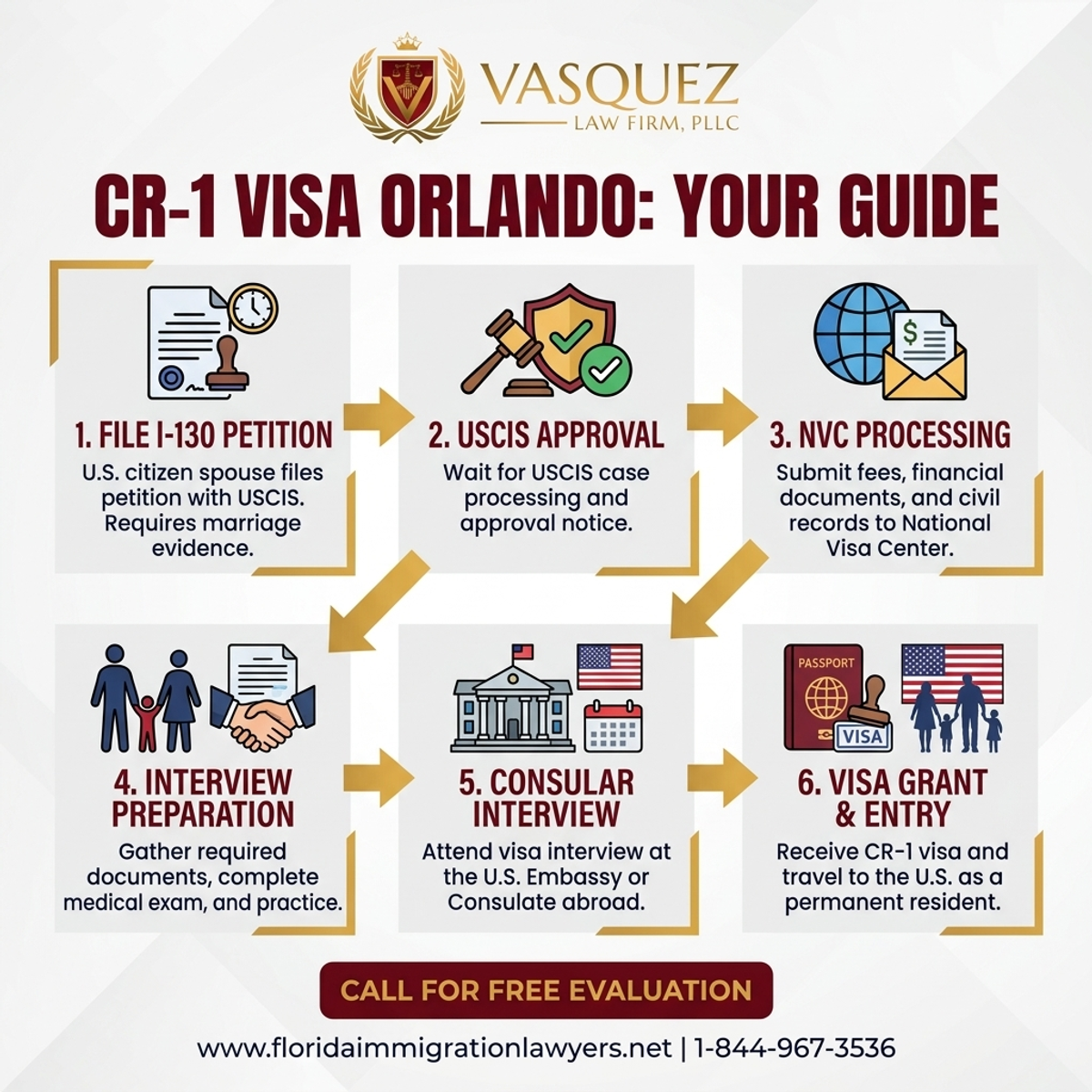
Key Statistics — Immigration Attorney for CR-1 Visa Orlando: Your Guide
It's important to understand that these timelines are estimates and can fluctuate significantly based on various factors. The country where the foreign spouse resides, the specific U.S. embassy or consulate's workload, and any requests for additional evidence (RFEs) can all impact the overall processing duration. For example, some consulates in high-demand regions might have longer interview wait times than others. Proactive preparation and quick responses to any government requests are paramount to keeping your case on track.
Managing expectations during this period is essential. While the average total processing time can range from 12 to 24 months, some cases may take longer. Regularly checking your case status online through the USCIS and NVC portals is a good practice. However, simply monitoring isn't enough; understanding what each status update means and when to take action is where legal guidance becomes invaluable. Florida Immigration Lawyers can help interpret these updates and advise on the best course of action, ensuring you don't miss any critical deadlines or opportunities to expedite your case where possible.
A common scenario involves unexpected delays at the NVC due to missing documents or incorrect fee payments. A seasoned immigration attorney can help you preemptively address these issues, ensuring your document package is complete and correctly submitted the first time. This meticulous approach can shave months off the overall timeline, bringing your spouse to Orlando sooner.
How Much Does a CR-1 Visa Cost?
The cost of obtaining a CR-1 visa can include several fees associated with filing forms and the consular process. Here's a breakdown of typical fees:
| Item | Typical Fee | Notes |
|---|---|---|
| Form I-130 Filing Fee | Varies | Paid to USCIS |
| NVC Processing Fee | Varies | Includes affidavit of support |
| Medical Examination Fee | Varies | Paid to the physician |
| Immigrant Visa Fee | Varies | Paid at the consulate |
While the table provides a general overview, it's crucial to understand that these fees are subject to change by government agencies and can vary based on the specific services required. For instance, the Form I-130 filing fee is typically a fixed amount set by USCIS, but the NVC processing fees are broken down into an Affidavit of Support fee and an Immigrant Visa Application Processing Fee. These are non-refundable and must be paid before NVC processing can proceed.
Beyond the direct government fees, applicants should budget for additional expenses. The medical examination fee, paid directly to an authorized panel physician in the foreign spouse's country, can vary significantly depending on the country and the required vaccinations. Other potential costs include obtaining civil documents (birth certificates, marriage certificates, police clearances), certified translations of documents not in English, passport fees, and travel expenses for the consular interview. These ancillary costs can add up, so a comprehensive financial plan is advisable.
Furthermore, while not mandatory, legal fees for retaining an experienced immigration attorney like Florida Immigration Lawyers represent a significant investment in the success and efficiency of your application. An attorney can help avoid costly mistakes, prepare all documentation accurately, and navigate complex issues, potentially saving you more in the long run by preventing denials or extensive delays that might incur additional government fees or travel expenses. We offer transparent fee structures and free case reviews to help you understand the full financial scope.
Do not navigate this process alone. Contact Florida Immigration Lawyers today.
Common Mistakes to Avoid
The CR-1 visa process is complex, and even minor errors can lead to significant delays or even denial. Understanding and proactively avoiding common pitfalls is crucial for a successful outcome. Many applicants underestimate the stringent requirements and the need for absolute accuracy at every stage.
- Incomplete Documentation: Missing documents can delay processing.
- Incorrect Form Filling: Errors can lead to rejections or delays.
- Not Meeting Financial Requirements: Failing to prove financial support can result in denial.
- Ignoring Interview Preparation: Poor preparation can adversely affect the outcome.
- Missing Deadlines: Late submissions can lead to case closure.
- Overlooking Medical Exam: Not completing medical exams can delay visa issuance.
- Failure to Update Address: Can cause critical communication delays.
- Using Incorrect Photo Format: Non-compliant photos can lead to rejections.
- Lack of Proper Legal Guidance: Not consulting an attorney can lead to preventable mistakes.
- Failure to Track Case Status: Not monitoring your case can result in missed actions.
These mistakes often stem from a lack of familiarity with immigration law or an underestimation of the government's strict requirements. For instance, an incomplete Form I-130 or missing evidence of a bona fide marriage can result in a Request for Evidence (RFE), adding months to your processing time. Similarly, failing to meet the income threshold for the Affidavit of Support is a common reason for denial, requiring the petitioner to find a joint sponsor or provide additional assets, which further complicates the case.
By being aware of these potential pitfalls and taking proactive steps, such as meticulously reviewing all forms and documents, seeking professional advice, and preparing thoroughly for the interview, you can significantly increase your chances of a smooth and successful CR-1 visa application. Florida Immigration Lawyers are adept at identifying and mitigating these risks, guiding you away from common errors.
When to Call a Lawyer
Engaging an immigration attorney can be invaluable in navigating the CR-1 or IR-1 visa process. Consider consulting a lawyer if you encounter any of the following situations:
- Your application has been denied or delayed.
- You have a complex immigration history.
- You need assistance with NVC processing.
- You require guidance through consular interviews.
Beyond these specific scenarios, proactive legal consultation from the very beginning can prevent many issues before they arise. For example, if you or your spouse has a prior criminal record, a history of overstaying a visa, or previous immigration applications that were denied, these complexities can significantly impact your current application. An attorney can assess your unique situation, identify potential roadblocks, and advise on necessary waivers or alternative strategies, saving you immense stress and potential heartbreak down the line.
Furthermore, an immigration lawyer provides more than just legal advice; they offer peace of mind. The sheer volume of forms, documents, and deadlines can be overwhelming. A dedicated legal team, like Florida Immigration Lawyers, can manage the entire process, from preparing and filing petitions to communicating with USCIS and the NVC on your behalf. This ensures that every detail is handled with precision, reducing the likelihood of errors and expediting your case as much as possible.
Florida Immigration Lawyers are here to assist with every step of your immigration journey. Our experience in CR-1 visa applications ensures that you can move forward with confidence. Don't hesitate to reach out to us at 1-844-YO-PELEO for a comprehensive review of your case.
About Florida Immigration Lawyers
Florida Immigration Lawyers is a dedicated law firm in Orlando, providing comprehensive immigration services across Central Florida. Our team of experienced attorneys offers personalized guidance for CR-1 and IR-1 visa applications, ensuring compliance and efficiency. We are available 24/7 to support your immigration needs with free case reviews.
Our commitment extends beyond just processing paperwork; we understand the profound impact immigration has on families. We pride ourselves on offering compassionate, client-centered service, treating each case with the individualized attention it deserves. Our local presence in Orlando means we are uniquely attuned to the needs of Central Florida residents, offering convenient access to legal counsel.
With experience in family reunification cases, Florida Immigration Lawyers leverages deep knowledge of U.S. immigration law and procedural intricacies. We strive to make the complex process as straightforward and stress-free as possible for our clients, providing clear communication and proactive solutions. When you choose us, you're choosing a partner dedicated to achieving the strongest possible outcome for your family.
Contact us today at 1-844-YO-PELEO, or explore our immigration practice areas for more information.
Frequently Asked Questions About CR-1/IR-1 Visas
What is the difference between a CR-1 and an IR-1 visa?
The main difference lies in the duration of your marriage when the visa is issued. If you've been married for less than two years, you receive a CR-1 (Conditional Resident) visa, granting a two-year conditional green card. If married for two years or more, you get an IR-1 (Immediate Relative) visa, leading to a 10-year unconditional green card directly. The CR-1 requires an additional step (Form I-751) to remove conditions later.
Can I apply for a CR-1 visa if my spouse is already in the U.S.?
Yes, but the process changes. If your spouse entered legally and is eligible, they might be able to adjust their status to permanent resident within the U.S. (Form I-485) instead of going through consular processing. This is called Adjustment of Status. However, if they entered without inspection or have certain immigration violations, they may need to depart the U.S. and apply for the CR-1 visa abroad, potentially requiring a waiver. Consult Florida Immigration Lawyers to determine the best path.
What if my marriage is less than two years old, but the process takes longer than two years?
This is a common and beneficial scenario. If your marriage crosses the two-year mark *before* your foreign spouse's visa interview, USCIS will automatically convert the CR-1 petition to an IR-1. This means your spouse will receive an unconditional 10-year green card upon entry, bypassing the need to file Form I-751 later. It's a welcome outcome for many couples experiencing longer processing times.
How important is the Affidavit of Support (Form I-864)?
The Affidavit of Support is critically important. It's a legally binding contract where the U.S. citizen petitioner promises to financially support their foreign spouse, ensuring they won't become a public charge. You must demonstrate income at or above 125% of the federal poverty guidelines for your household size. Without a sufficient I-864, or if you need a joint sponsor, the visa application will be denied. Florida Immigration Lawyers can help ensure you meet these crucial financial requirements.
What happens after the visa is approved and I enter the U.S.?
Upon approval, your spouse will receive a visa packet to present at the U.S. port of entry. The Customs and Border Protection (CBP) officer will review it, and if all is in order, they will be admitted as a permanent resident. Their physical green card will then be mailed to the U.S. address provided. For CR-1 visa holders, remember to track your two-year conditional residency and file Form I-751 within 90 days before it expires to remove conditions.
Sources and References
- U.S. Citizenship and Immigration Services (USCIS)
- Executive Office for Immigration Review (EOIR)
- U.S. Department of State
- 8 U.S.C. Chapter 12 - Immigration and Nationality Act
Related services: family petition process, family-based green cards, fiancé visa (K-1), marriage-based immigration.
This article provides general legal information and is not intended as legal advice. Every case is unique, and outcomes depend on specific facts and circumstances. Contact an attorney for advice about your particular situation.
Seize the opportunity to bring your loved one closer. Call 1-844-YO-PELEO for a free consultation with Florida Immigration Lawyers. Se Habla Español - Estamos aquí para ayudarle.
If you need legal assistance, learn more about get family immigration help today, or call us at 1-844-967-3536 for a free case review.
Do Not Navigate This Process Alone
Our experienced immigration attorneys are ready to fight for you. Get a free, confidential case review today.
Se Habla Español
Or leave your details and we’ll call you:
Free Evaluation in 24 Hours
Or talk to us right now

AI voice assistant — available 24/7
FreeFrequently Asked Questions

William J. Vásquez
Founding Attorney · Vasquez Law Firm
U.S. Air Force veteran and immigration attorney with years of hands-on U.S. immigration experience. J.D., NCCU School of Law. AILA member. Admitted to the 4th, 5th, and 11th Circuit Courts.
Available 24/7 - Free Evaluations
Reviewed for legal accuracy by William J. Vásquez
Licensed in North Carolina; U.S. immigration is federal practice.
Related Legal Services
Our Florida immigration attorneys can help you with free immigration consultation, business immigration and deportation defense. Call today at 1-844-YO-PELEO for a free case review.
Related Links
Related Topics
Free Legal Case Review
Discuss your case with our experienced attorneys. We're available 24/7.
Se Habla Español - Estamos aquí para ayudarle.
Related Articles
Certificate of Eligibility for Expungement in Florida 2026
For non-U.S. citizens in Florida, understanding how a state expungement impacts immigration status is critical. A certificate of eligibility for expungement in Florida allows a criminal record to be sealed or expunged under state law. However, federal immigration agencies often disregard such state-level relief, still considering the original criminal offense as a conviction for immigration purposes. This can have severe implications for visa applications, green card eligibility, naturalization, and even lead to deportation. This guide clarifies the Florida expungement process, its limited effect on federal immigration law, and key steps to protect your status in 2026. Learn about common mistakes, required documents, timelines, and when to seek expert legal counsel from Florida Immigration Lawyers to navigate these complex issues effectively.
Immigration Lawyer Orlando Free Consultation in Florida
For individuals and families in Orlando, Florida, navigating the complexities of U.S. immigration law requires expert guidance. An immigration lawyer in Orlando offers crucial support for everything from visa applications and green card processes to naturalization and deportation defense. This comprehensive guide details what a free consultation covers, providing a step-by-step overview of immigration pathways, essential document checklists, and expected timelines in 2026. We also highlight common mistakes to avoid, discuss the critical role of legal counsel in deportation and asylum cases, and explain why choosing a local Orlando immigration attorney is beneficial. Florida Immigration Lawyers is dedicated to serving the diverse community of Orlando with compassionate, effective legal solutions, ensuring you receive personalized advice and robust representation for a successful immigration journey.
Work Permit EAD Application Process in Florida 2026
Applying for a work permit, or Employment Authorization Document (EAD), in Florida is a crucial step for many non-citizens seeking to work legally in the U.S. This comprehensive guide from Florida Immigration Lawyers details the 2026 application process, including eligibility criteria, necessary documentation for Form I-765, typical processing times, and associated costs. We highlight the importance of accurate submission and offer insights into common pitfalls to avoid. Our firm, based in Orlando, Florida, provides expert legal assistance for asylum seekers, adjustment of status applicants, and other eligible individuals. Learn how to prepare for your EAD application and understand when professional legal counsel can make a significant difference in achieving a successful outcome. Secure your right to work with knowledgeable support.
Change of Status B-2 to F-1 in Florida: Key Steps
Changing your status from a B-2 tourist visa to an F-1 student visa in Florida involves several crucial steps. This guide provides a comprehensive overview, including the 2026 I-539 processing times, document requirements, and common pitfalls to avoid. Learn how to navigate the process effectively with help from Florida Immigration Lawyers.