2026 I-539 H-4 Change of Status Processing Time: Months
Navigating the complexities of U.S. immigration, especially the I-539 H-4 change of status processing time, requires precise information and strategic planning. As of 2026, H-4 dependents and individuals seeking F-1 student status in Florida face processing times ranging from 6 to 18 months, influenced by USCIS service centers, application completeness, and potential requests for evidence. This comprehensive guide details the Form I-539 application process, eligibility criteria, essential document checklists, and associated costs. We also explore common pitfalls, such as late filing or unauthorized employment, and discuss critical considerations for Florida applicants, including interaction with local USCIS field offices. Understanding these elements is vital to maintaining lawful status and achieving your immigration goals. Florida Immigration Lawyers offers guidance to help you navigate these challenges successfully.
Quick Answer: I-539 H-4 Change of Status Processing Times in 2026
As of 2026, the processing time for Form I-539, Application to Extend/Change Nonimmigrant Status, particularly for H-4 dependents, typically ranges from 6 to 18 months, though some complex cases may take longer. These estimates are highly variable and depend on the specific USCIS service center handling your application, current caseloads, the completeness of your submission, and whether a Request for Evidence (RFE) is issued. It is crucial for applicants in Florida and nationwide to regularly check the official USCIS processing times page for the most current data, as these timelines are subject to frequent changes.
- Variable Timelines: Expect 6-18 months, influenced by service center and application specifics.
- Check USCIS: Always refer to the official USCIS website for up-to-date processing information.
- Accuracy is Key: Complete and accurate applications can help prevent delays like RFEs.
- Maintain Status: Ensure you maintain lawful nonimmigrant status throughout the processing period.
- Legal Guidance: Consulting an immigration attorney is highly recommended for complex cases or concerns.
2026 I-539 H-4 Change of Status Processing Time: What to Expect in Florida
Navigating the intricate landscape of U.S. immigration law can feel overwhelming, especially when your future in Florida depends on understanding complex processes like a change of status. For many nonimmigrants, including H-4 dependents and those seeking an F-1 student visa, Form I-539, Application to Extend/Change Nonimmigrant Status, is a critical document. The thought of long processing times, particularly for an I-539 H-4 change of status processing time, can add significant stress and uncertainty to your plans.
As of 2026, understanding the current processing landscape, potential delays, and the specific requirements for applicants in Florida is more important than ever. Whether you are an H-4 dependent looking to extend your stay, or you are considering a change of status to pursue educational opportunities as an F-1 student, this comprehensive guide will walk you through the essential information. We will delve into the factors influencing processing times, outline the application steps, discuss associated costs, and highlight common pitfalls to avoid. Our goal is to empower you with the knowledge needed to make informed decisions about your immigration journey in the Sunshine State.
Do not let the complexities of immigration law deter you. For personalized guidance and a clear path forward, call Florida Immigration Lawyers at 1-844-YO-PELEO for a free case review today. Our dedicated team is here to help you understand your options and achieve your immigration goals.
What are the 2026 I-539 H-4 Change of Status Processing Times in Months?
As of 2026, current processing times for Form I-539, Application to Extend/Change Nonimmigrant Status, particularly for H-4 dependents, vary significantly. Typically, you can expect processing to take anywhere from 6 to 18 months, or even longer in complex cases. These estimates depend on the specific USCIS service center handling your application, current caseloads, and the accuracy of your submission. It is crucial to check the official USCIS website for the most up-to-date information.
The processing duration for an I-539 H-4 change of status processing time is not static and can fluctuate based on several factors. USCIS operates multiple service centers across the country, and each center may have different backlogs and processing efficiencies. For instance, applications filed from Florida might be processed by the California Service Center or the Vermont Service Center, depending on USCIS's internal workload distribution. A Request for Evidence (RFE) can significantly prolong processing, potentially adding several months to the timeline. Furthermore, any discrepancies or missing information in your initial submission will inevitably lead to delays.
H-4 status is granted to the spouse and unmarried children (under 21 years old) of H-1B, H-2A, H-2B, H-3, L-1, O-1, P-1, P-2, P-3, or R-1 nonimmigrants. Many H-4 dependents seek to change their status to pursue employment or educational opportunities, making the processing time a critical concern. It is vital to file your I-539 application well in advance of your current status's expiration date to avoid falling out of status. If your current nonimmigrant status expires while your I-539 is pending, you are generally allowed to remain in the U.S. during this period, but you must strictly adhere to all immigration regulations.
Timeline and Processing Expectations for I-539 Applications (2026)
Understanding the typical stages and expected timeframes can help manage expectations for your change of status application in 2026:
| Stage | Typical Timeframe | Notes |
|---|---|---|
| Application Preparation & Filing | 2-4 weeks | Gathering documents, completing forms, obtaining legal review. |
| USCIS Receipt Notice (I-797C) | 1-3 weeks after filing | Confirms receipt of your application. Establishes priority date. |
| Biometrics Appointment Notice | 3-8 weeks after receipt | Scheduled at an Application Support Center (ASC), e.g., in Orlando or Miami. |
| Biometrics Appointment | Within 2-4 weeks of notice | Mandatory fingerprinting and photo. Do not miss this appointment. |
| Request for Evidence (RFE) (if applicable) | 3-12 months into processing | USCIS requests more information. Responding promptly is crucial. |
| Final Decision | 6-18 months (or more) from filing | Approval (I-797A) or Denial. |
Understanding Form I-539: Purpose and Eligibility for Florida Residents
Form I-539, Application to Extend/Change Nonimmigrant Status, is a crucial document for many individuals residing in Florida who wish to adjust their temporary immigration status or extend their stay in the United States. Its primary purpose is to allow nonimmigrants to request either an extension of their current nonimmigrant stay or a change from one nonimmigrant category to another. This includes common scenarios such as a B-2 visitor seeking to extend their tourist stay, an H-4 dependent applying for an extension, or an individual on a different nonimmigrant visa desiring to change to an F-1 student status.
Eligibility for filing Form I-539 hinges on several key criteria. First, you must have been lawfully admitted into the U.S. in a nonimmigrant status. Second, you must have maintained that status and not violated any of its terms, such as engaging in unauthorized employment. Third, your nonimmigrant status must not have expired before you file the I-539 application. Filing after your I-94 expiration date is generally not permitted, except in rare, extraordinary circumstances. Additionally, you must not have committed any crimes or been subject to removal proceedings. Certain visa categories, such as those on the Visa Waiver Program (VWP), are typically ineligible to change or extend their status from within the U.S.
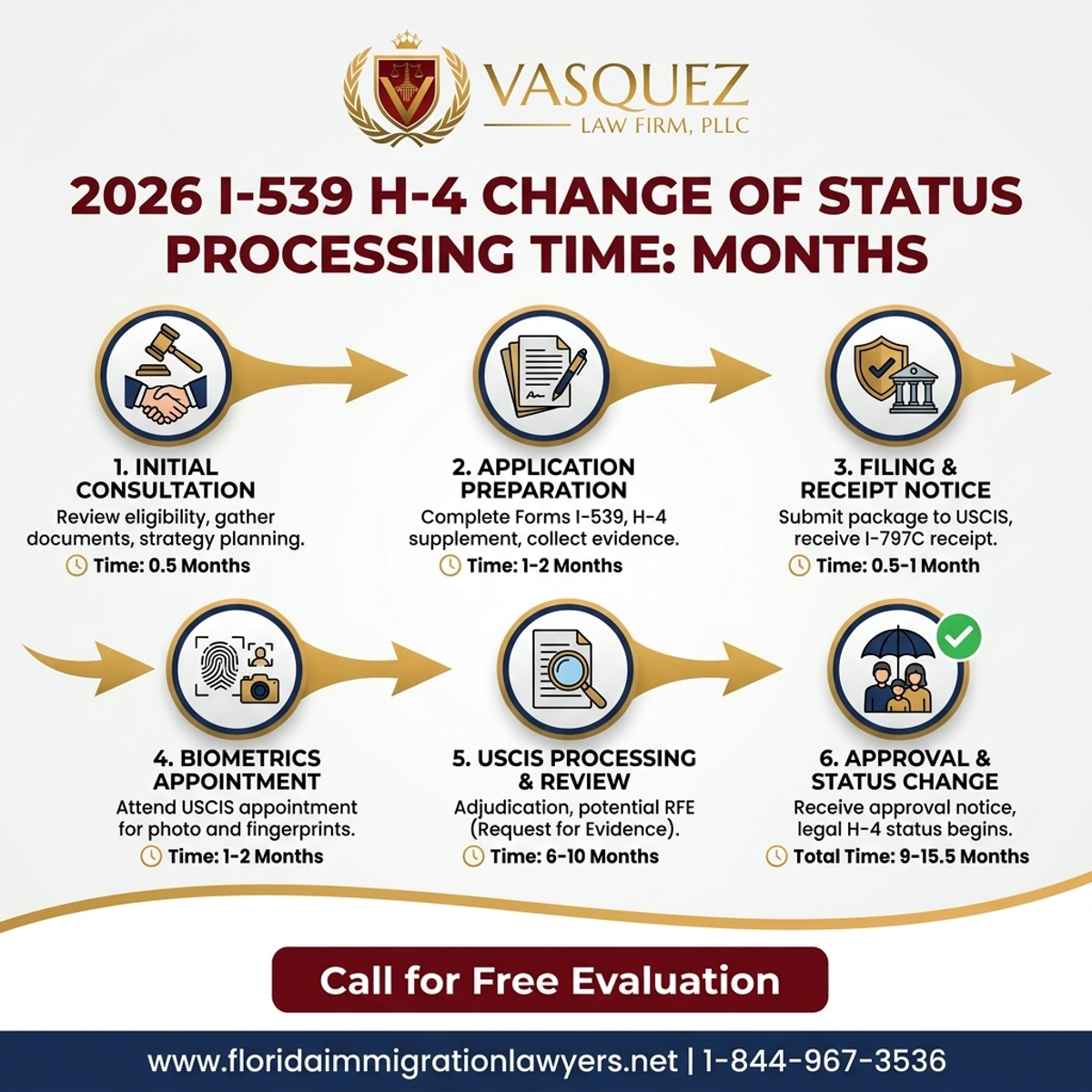
Step-by-Step Process — 2026 I-539 H-4 Change of Status Processing Time: Months
The Immigration and Nationality Act (INA) Section 248, codified at 8 U.S.C. § 1258, governs the change of nonimmigrant status. This section outlines the general requirements and limitations for such changes. For Florida residents, understanding these federal regulations is paramount to a successful application. Failure to meet eligibility criteria or a violation of your current status can lead to a denial of your application and potentially severe immigration consequences, including accumulating unlawful presence, which can trigger future bars to re-entry into the U.S. Therefore, a thorough review of your eligibility before filing is essential.
How to Change Your Status to F-1 Student in Florida
Changing your nonimmigrant status to F-1 student in Florida involves filing Form I-539, Application to Extend/Change Nonimmigrant Status, along with supporting documents demonstrating your intent to study full-time and financial capability. You must first be admitted to a SEVP-approved school and obtain a Form I-20, Certificate of Eligibility for Nonimmigrant Student Status. This process requires meticulous preparation and adherence to strict deadlines to avoid jeopardizing your immigration standing.
For many individuals in Florida, the opportunity to pursue higher education or specialized training leads to considering a change of status to F-1 student. This pathway allows you to lawfully enroll in a Student and Exchange Visitor Program (SEVP)-approved school, college, university, conservatory, or other academic institution. The process is detailed and requires careful attention to each step to ensure compliance with U.S. immigration laws. Florida boasts numerous SEVP-approved institutions, from major universities in Orlando, Gainesville, and Miami to specialized vocational schools, offering diverse educational opportunities.
Step-by-Step Guide to Changing Status to F-1 Student
Follow these steps to successfully change your nonimmigrant status to an F-1 student in Florida:
- Gain Admission to an SEVP-Approved School: You must first apply to and be accepted by a school certified by the Student and Exchange Visitor Program (SEVP). Once accepted, the Designated School Official (DSO) at your chosen institution will issue you a Form I-20, Certificate of Eligibility for Nonimmigrant Student Status. This document is crucial as it confirms your enrollment and the school's approval to host international students.
- Pay the SEVIS I-901 Fee: Before filing your I-539, you must pay the SEVIS I-901 fee. This fee supports the Student and Exchange Visitor Information System (SEVIS), which tracks F-1 and M-1 students and J-1 exchange visitors. Keep your payment receipt, as you will need to include a copy with your application.
- Gather All Required Documents: Compile a comprehensive set of supporting documents. This includes your original Form I-20, proof of financial resources sufficient to cover your tuition and living expenses, copies of your passport, visa, and I-94 Arrival/Departure Record. You will also need a personal statement explaining your reasons for changing status and your educational goals.
- Complete and File Form I-539: Fill out Form I-539 accurately and completely. Ensure you indicate that you are applying for a change of status to F-1. Attach all supporting documentation, including your I-20 and SEVIS fee receipt. Sign the form and mail it to the appropriate USCIS service center with the correct filing fee.
- Attend Your Biometrics Appointment: After USCIS accepts your application, you will receive a notice scheduling a biometrics appointment at a local Application Support Center (ASC). For Florida residents, these centers are located in cities like Orlando, Miami, and Tampa. It is mandatory to attend this appointment for fingerprinting and photographs.
- Wait for a Decision: Processing times can vary significantly, as discussed. During this period, you must maintain your current nonimmigrant status (e.g., B-2 visitor) and avoid unauthorized employment. Once approved, USCIS will send you an I-797A Approval Notice, which will include a new I-94 showing your F-1 status and its validity period.
Essential Documents for Your Change of Status Application in Florida
A successful change of status application, whether for an H-4 dependent or an F-1 student, hinges on submitting a complete and accurate package of supporting documents. Any missing or incorrect information can lead to significant delays, including Requests for Evidence (RFEs), or even outright denial. For Florida applicants, meticulously preparing this documentation is a critical step in navigating the change of status Florida process effectively.
Document Checklist for I-539 Change of Status
While specific requirements may vary slightly depending on your current status and the status you are seeking, the following is a general checklist of essential documents:
- Completed Form I-539: Ensure all sections are filled out accurately and signed by the applicant.
- Filing Fee: A check or money order for the correct USCIS filing fee. (Do not send cash).
- Biometrics Fee: The separate fee for biometrics services, if applicable.
- Form I-94, Arrival/Departure Record: Copies of your most recent I-94, which can be printed from the CBP website.
- Passport and Visa Copies: Copies of your valid passport biographical page and the page containing your current U.S. visa stamp.
- Previous Immigration Documents: Copies of any prior I-797 approval notices, EAD cards, or other relevant immigration documents.
- Proof of Maintaining Status: Documents demonstrating you have continually maintained your lawful nonimmigrant status since your last admission to the U.S. This might include pay stubs (if authorized to work), school transcripts, or letters from your current employer/school.
- Financial Evidence: Bank statements, affidavits of support (Form I-134), scholarship letters, or other proof that you have sufficient funds to support yourself and your dependents during your stay without resorting to unauthorized employment. For F-1 applicants, this is critical to cover tuition and living expenses.
- For H-4 Applicants:
- Copies of the principal H-1B (or other relevant visa holder's) I-797 Approval Notice.
- Copies of the principal's most recent pay stubs and employment verification letter.
- Marriage certificate (for spouse) or birth certificate (for child) to prove relationship.
- For F-1 Student Applicants:
- Original Form I-20, Certificate of Eligibility for Nonimmigrant Student Status, issued by an SEVP-approved school.
- Proof of SEVIS I-901 fee payment.
- A personal statement explaining your reasons for seeking F-1 status, your academic goals, and how you will maintain your nonimmigrant intent (i.e., you intend to return home after completing your studies).
- Academic transcripts from previous institutions (if applicable).
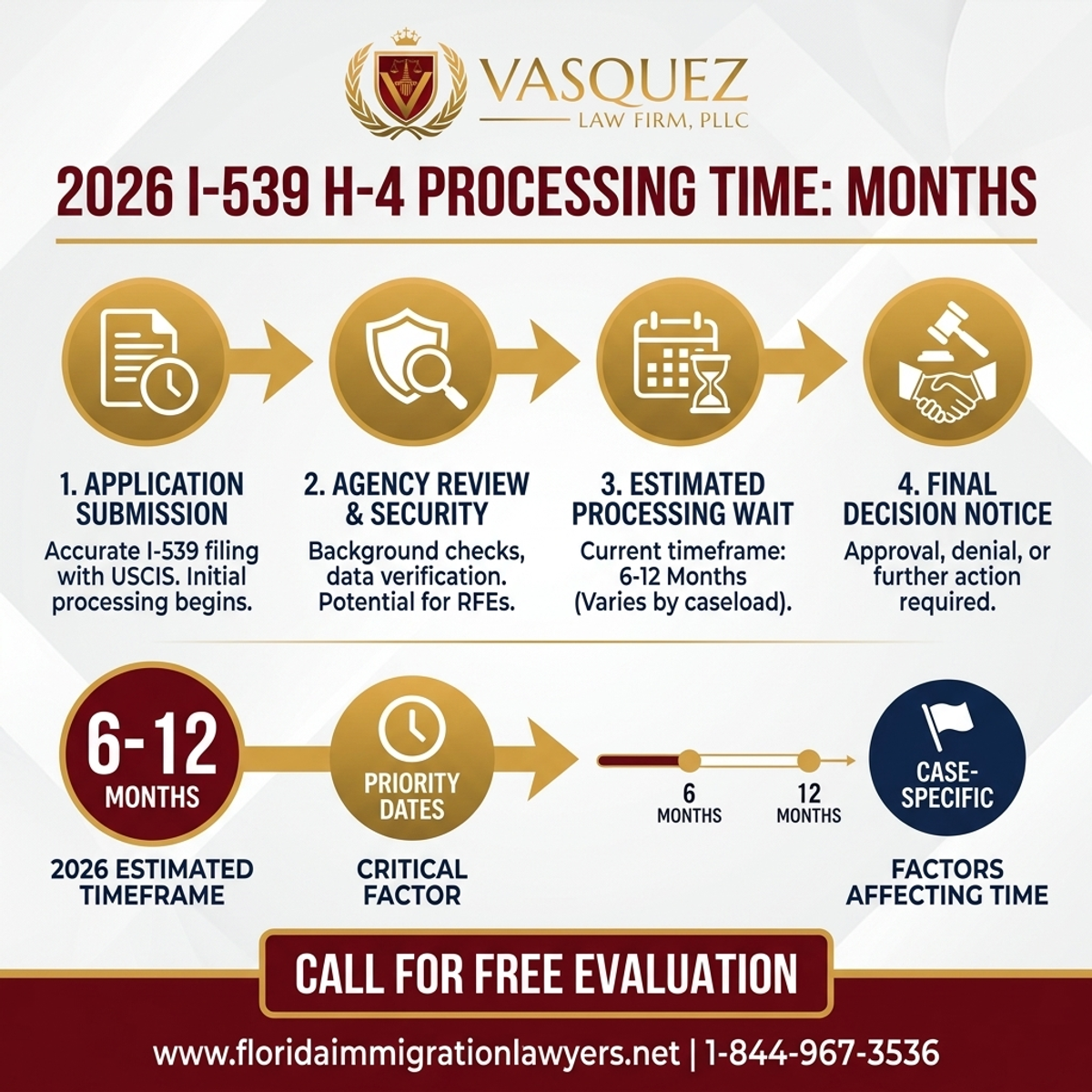
Key Statistics — 2026 I-539 H-4 Change of Status Processing Time: Months
Ensuring every document is correctly filled out, signed, and submitted with legible copies is paramount. Organize your application package clearly, perhaps with cover letters and tabs, to assist the USCIS officer reviewing your case. A well-prepared application minimizes the chances of an RFE, which can significantly delay your I-539 H-4 change of status processing time or F-1 change of status.
What are the Costs Associated with an I-539 Change of Status?
The costs for an I-539 change of status application include the USCIS filing fee, which is subject to change but is generally several hundred dollars as of 2026. Additionally, applicants may incur SEVIS I-901 fees for F-1 status changes, biometrics fees, and potential legal fees if they choose to retain an immigration attorney. These fees are non-refundable, regardless of the application outcome.
When planning for an immigration Orlando or Florida-based change of status, it is essential to budget for the various fees involved. These costs can add up, and understanding each component will help you prepare financially. USCIS fees are periodically updated, so always verify the current amounts on the official USCIS website before submitting your application. Remember that all government fees are non-refundable, even if your application is denied or withdrawn.
Cost Factors and Fee Breakdown for I-539 Applications (2026)
Here's a breakdown of typical costs you might encounter for an I-539 change of status application in 2026:
| Item | Typical Fee (Approx. 2026) | Notes |
|---|---|---|
| Form I-539 Filing Fee | Varies (e.g., $420-$470) | This is the base fee for filing the application itself. |
| Biometrics Services Fee | Varies (e.g., $30-$85) | Required for fingerprinting and photo at an ASC. |
| SEVIS I-901 Fee (for F-1 only) | Varies (e.g., $220-$350) | Mandatory for F-1 immigration applicants. |
| Immigration Attorney Fees | Highly variable | Covers legal consultation, document preparation, and representation. |
| Document Translation Fees | Variable | If any supporting documents are not in English, certified translations are needed. |
| Postage/Courier Fees | Minimal | For mailing your application package to USCIS. |
While attorney fees represent an additional cost, the value of professional legal guidance cannot be overstated. An experienced immigration lawyer can help you prepare a thorough and accurate application, minimizing the risk of errors, RFEs, or denials. This can ultimately save you time, stress, and potentially greater costs associated with correcting mistakes or refiling. For those in Central Florida, an attorney can provide localized insight into USCIS procedures and expectations, particularly for those interacting with the Orlando Field Office for other immigration matters.
Navigating Potential Challenges and Delays for Florida Applicants
Even with meticulous preparation, challenges and delays can arise during the change of status process. For Florida applicants, understanding these potential hurdles is crucial for managing expectations and responding effectively. These issues can impact your I-539 H-4 change of status processing time or an F-1 change of status, potentially disrupting your plans for education or family life in the U.S.
One of the most common challenges is receiving a Request for Evidence (RFE). An RFE occurs when USCIS determines that your application is missing critical information or requires further clarification. Responding to an RFE promptly and comprehensively is vital, as a delayed or inadequate response can lead to a denial. Another significant concern is maintaining your lawful nonimmigrant status while your I-539 application is pending. According to 8 CFR 214.1, you must continue to abide by the terms and conditions of your current visa category. For example, if you are a B-2 visitor, you cannot enroll in classes or engage in unauthorized employment while your F-1 change of status is pending. Violating your status can result in a denial and potentially make you inadmissible in the future.
Travel outside the U.S. while an I-539 change of status application is pending is generally not advisable. If you depart the U.S., USCIS will consider your I-539 application abandoned, and you will need to apply for a new visa at a U.S. consulate abroad to re-enter in the desired status. This can be a complex and time-consuming process, with no guarantee of approval. Recent shifts in immigration policy, such as increased scrutiny at airports for arrests or expanded deportations of non-criminals, as seen in news reports, underscore the importance of strict compliance with immigration laws and avoiding any actions that could jeopardize your status. The USCIS Field Offices in Florida, including Orlando, Miami, and Tampa, handle biometrics appointments and sometimes interviews, so being aware of their procedures is also beneficial.
Do not navigate this complex process alone. Contact Florida Immigration Lawyers today for guidance and support through your change of status application.
Common Mistakes to Avoid in Your Change of Status Application
Applying for a change of status is a detailed process where even minor errors can lead to significant delays or outright denial. For those in Florida pursuing an I-539 H-4 change of status processing time or an F-1 student visa, avoiding common pitfalls is crucial to a successful outcome. Here are some frequent mistakes and their potential consequences:
- Filing Too Late: A primary mistake is submitting Form I-539 after your current nonimmigrant status has expired. This generally makes you ineligible for a change of status and can lead to accumulating unlawful presence, which has severe future immigration consequences, including re-entry bars.
- Incomplete Forms or Missing Documents: Failing to fill out all required sections of Form I-539 or omitting essential supporting documents (e.g., I-20, financial proof, I-94) is a common error. This will almost certainly result in an RFE, significantly delaying your application and potentially leading to denial if not adequately addressed.
- Insufficient Financial Proof: Especially for F-1 student applicants, not providing clear and sufficient evidence of funds to cover tuition and living expenses is a frequent reason for denial. USCIS needs assurance that you will not become a public charge or engage in unauthorized work.
- Violating Current Status While Pending: Engaging in activities inconsistent with your current nonimmigrant status (e.g., working without authorization while on a B-2 visa, or enrolling in classes before F-1 status is approved) will lead to a denial of your I-539 and can result in deportation defense issues.
- Incorrect Fee Payment: Submitting the wrong filing fee or biometrics fee, or using an expired payment method, will cause USCIS to reject your application. Always verify current fees on the USCIS website.
- Traveling Outside the U.S. While I-539 is Pending: As mentioned, departing the U.S. generally constitutes an abandonment of your pending I-539 application. This can lead to complications upon re-entry and a need to restart the entire process, often requiring a new visa application at a U.S. consulate abroad.
- Failure to Respond to RFEs: If USCIS issues an RFE, you have a specific deadline to respond. Missing this deadline or providing an inadequate response will almost certainly lead to a denial of your application.
- Misrepresenting Facts or Providing False Information: Any attempt to provide false or misleading information on your application can result in severe penalties, including a permanent bar from future immigration benefits.
- Not Keeping Copies of Everything: Failing to retain copies of your submitted application and all supporting documents can make it difficult to respond to RFEs or to prove your case if issues arise later.
- Lack of Nonimmigrant Intent (for F-1): F-1 student applicants must demonstrate nonimmigrant intent, meaning they intend to return to their home country after completing their studies. Failing to articulate this or presenting conflicting information can lead to denial.
When to Call a Florida Immigration Lawyer for Your Change of Status
While this guide provides comprehensive information, the complexities of immigration law often necessitate professional legal assistance. Deciding when to call a Florida immigration lawyer can be crucial for the success of your change of status application, especially given the variable I-539 H-4 change of status processing time and nuanced requirements. Florida Immigration Lawyers can provide invaluable support and representation throughout the entire process.
You should consider contacting an attorney if any of the following scenarios apply to your situation:
- Complex Case History: If you have a prior immigration violation, a criminal record, previous visa denials, or have overstayed a previous visa, your case is inherently complex and requires expert review.
- Uncertain Eligibility: If you are unsure whether you meet all the eligibility requirements for a change of status to H-4 or F-1, an attorney can assess your specific circumstances and advise you on the best course of action.
- Received a Request for Evidence (RFE): An RFE indicates that USCIS needs more information or clarification. Responding correctly and comprehensively to an RFE is critical, and an attorney can help you gather and present the necessary evidence effectively.
- Potential for Status Violation: If you are concerned about maintaining your lawful status during the processing period, or if your current status is expiring soon, an attorney can provide guidance to prevent any violations.
- Expedited Processing Needs: While rare, if you have a compelling reason for expedited processing, an attorney can help you understand the criteria and prepare a strong request.
- Applying for F-1 from a Difficult Status: Changing from certain nonimmigrant statuses (e.g., B-2 visitor who spent a long time in the U.S.) to F-1 can be challenging due to the presumption of immigrant intent. An attorney can help you demonstrate genuine nonimmigrant intent.
- Any Concerns About Denial: If you believe your application might be denied or if you have already received a denial, an attorney can help you understand the reasons and explore options for appeal or refiling.
Florida Immigration Lawyers has extensive experience assisting individuals across Florida with various immigration matters, including family-based immigration and nonimmigrant visa changes. Our team understands the local nuances, including procedures at the Orlando, Miami, and Tampa USCIS Field Offices. We are committed to providing personalized and compassionate legal services to protect your rights and help you achieve your immigration goals.
About Florida Immigration Lawyers
Florida Immigration Lawyers is an immigration law firm dedicated to serving individuals and families across the entire state of Florida. With a deep understanding of U.S. immigration laws and policies, our experienced attorneys provide comprehensive legal services tailored to meet your unique needs. We are committed to offering compassionate and effective representation, ensuring that you receive the highest quality legal counsel for your immigration journey.
Our firm focuses on a wide range of immigration practice areas, including family-based petitions, employment visas, deportation defense, asylum claims, naturalization, and various nonimmigrant visa applications and adjustments. We pride ourselves on our client-centered approach, offering personalized attention and strategic advice to navigate the complexities of the immigration system. Our attorneys are available 24/7 to address your concerns and provide peace of mind. We offer free case reviews, allowing you to discuss your situation with an expert without any initial financial commitment. Whether you are in Orlando, Central Florida, or anywhere else in the state, our bilingual team is ready to assist you.
Choose Florida Immigration Lawyers for dedicated advocacy and a steadfast commitment to your success. Schedule a free consultation today and let us help you achieve your American dream. You can reach us directly at 1-844-YO-PELEO.
Sources and References
- U.S. Citizenship and Immigration Services (USCIS)
- USCIS Check Case Processing Times
- Executive Office for Immigration Review (EOIR)
- U.S. Department of State
- Immigration and Nationality Act (INA) Section 248 (8 U.S.C. § 1258) - Change of Nonimmigrant Status
- 8 Code of Federal Regulations (CFR) § 214.1 - Requirements for admission, extension, and maintenance of status
- Form I-539, Application to Extend/Change Nonimmigrant Status
- Form I-20, Certificate of Eligibility for Nonimmigrant Student Status
- SEVIS I-901 Fee Information
Related services: citizenship and naturalization, asylum protection, business immigration.
This article provides general legal information and is not intended as legal advice. Every case is unique, and outcomes depend on specific facts and circumstances. Contact an attorney for advice about your particular situation. Immigration laws are subject to frequent change.
Take control of your immigration future. Contact Florida Immigration Lawyers today for a free, confidential case review. Call us at 1-844-YO-PELEO. Se Habla Español - Estamos aquí para ayudarle.
Do Not Navigate This Process Alone
Our experienced immigration attorneys are ready to fight for you. Get a free, confidential case review today.
Se Habla Español
Or leave your details and we’ll call you:
Free Evaluation in 24 Hours
Or talk to us right now

AI voice assistant — available 24/7
FreeFrequently Asked Questions

William J. Vásquez
Founding Attorney · Vasquez Law Firm
U.S. Air Force veteran and immigration attorney with years of hands-on U.S. immigration experience. J.D., NCCU School of Law. AILA member. Admitted to the 4th, 5th, and 11th Circuit Courts.
Available 24/7 - Free Evaluations
Reviewed for legal accuracy by William J. Vásquez
Licensed in North Carolina; U.S. immigration is federal practice.
Related Legal Services
Our Florida immigration attorneys can help you with family immigration services, immigration lawyer cost in Florida and experienced immigration attorneys. Call today at 1-844-YO-PELEO for a free case review.
Related Links
Related Topics
Free Legal Case Review
Discuss your case with our experienced attorneys. We're available 24/7.
Se Habla Español - Estamos aquí para ayudarle.
Related Articles
Certificate of Eligibility for Expungement in Florida 2026
For non-U.S. citizens in Florida, understanding how a state expungement impacts immigration status is critical. A certificate of eligibility for expungement in Florida allows a criminal record to be sealed or expunged under state law. However, federal immigration agencies often disregard such state-level relief, still considering the original criminal offense as a conviction for immigration purposes. This can have severe implications for visa applications, green card eligibility, naturalization, and even lead to deportation. This guide clarifies the Florida expungement process, its limited effect on federal immigration law, and key steps to protect your status in 2026. Learn about common mistakes, required documents, timelines, and when to seek expert legal counsel from Florida Immigration Lawyers to navigate these complex issues effectively.
Immigration Lawyer Orlando Free Consultation in Florida
For individuals and families in Orlando, Florida, navigating the complexities of U.S. immigration law requires expert guidance. An immigration lawyer in Orlando offers crucial support for everything from visa applications and green card processes to naturalization and deportation defense. This comprehensive guide details what a free consultation covers, providing a step-by-step overview of immigration pathways, essential document checklists, and expected timelines in 2026. We also highlight common mistakes to avoid, discuss the critical role of legal counsel in deportation and asylum cases, and explain why choosing a local Orlando immigration attorney is beneficial. Florida Immigration Lawyers is dedicated to serving the diverse community of Orlando with compassionate, effective legal solutions, ensuring you receive personalized advice and robust representation for a successful immigration journey.
Citizenship Test Preparation in Florida: Key Steps
Applying for U.S. citizenship in Florida? Discover essential steps for preparing for the citizenship test, including what documents you'll need, typical timelines, and common mistakes to avoid. Whether you're in Orlando or other parts of the state, understanding this process can ease your path to becoming a naturalized citizen. Contact Florida Immigration Lawyers for personalized assistance.
Immigration Lawyer in Southwest Florida: 2026 Guide
Navigating immigration law in Southwest Florida, including Fort Myers and Lee County, requires expert legal guidance. This guide from Florida Immigration Lawyers details the services an immigration lawyer provides, from visa applications and green cards to naturalization and deportation defense. Learn how to choose the right attorney, understand the steps for family-based immigration, and get insights into processing times and costs in 2026. We also cover common mistakes to avoid and crucial moments to seek legal help. Our firm, though based in Orlando, proudly serves all of Florida, offering comprehensive support and free case reviews 24/7. Understand your options and secure your future with trusted legal expertise.