H-2B Visa for Seasonal Workers in Florida Hospitality 2026
Florida's dynamic hospitality industry, particularly in regions like Orlando, often relies on seasonal workers to meet peak demands. The H-2B visa program offers a vital solution for U.S. employers to bring foreign nationals for temporary non-agricultural jobs when domestic labor is insufficient. This comprehensive guide details the H-2B visa process for seasonal workers in Florida hospitality for 2026. We cover eligibility, the multi-stage application involving the Department of Labor and USCIS, required documentation, and critical timelines and costs. Learn about potential cap exemptions and the unique challenges Florida businesses face. We also highlight common mistakes to avoid, such as late filings or inadequate recruitment efforts, which can lead to denials. Understanding when to consult an experienced immigration lawyer, especially for complex cases, is emphasized. Florida Immigration Lawyers offers expert guidance to both employers and prospective workers, ensuring a smooth and compliant application process.
The H-2B visa program allows U.S. employers to bring foreign nationals to the United States to fill temporary non-agricultural jobs. This visa is crucial for Florida's vibrant hospitality sector, which often experiences seasonal peaks in demand, particularly in areas like Orlando. Employers must demonstrate a temporary need and that there are insufficient U.S. workers available, willing, qualified, and able to perform the work. The process involves multiple steps, including obtaining a temporary labor certification from the Department of Labor and filing a petition with USCIS. Navigating these requirements can be complex, making legal assistance invaluable for both employers and prospective workers.
- The H-2B visa is for temporary, non-agricultural work.
- It's vital for Florida hospitality during peak seasons.
- Employers must prove temporary need and lack of U.S. workers.
- The application involves Department of Labor and USCIS.
- Legal guidance is highly recommended for a successful process.
Florida's economy thrives on its tourism and hospitality industries, attracting millions of visitors each year to iconic destinations like Orlando's theme parks, pristine beaches, and bustling resorts. This constant influx of tourists creates a significant demand for seasonal workers in hotels, restaurants, event venues, and other service-oriented businesses. However, finding sufficient domestic labor to meet these fluctuating seasonal needs can be a persistent challenge for many employers. This is where the H-2B visa program becomes an indispensable tool, allowing businesses to bridge labor gaps with qualified foreign nationals.
For individuals seeking temporary employment and employers striving to maintain operational excellence during peak seasons, understanding the H-2B visa process is paramount. This comprehensive guide, updated for 2026, will delve into the intricacies of the H-2B visa, focusing specifically on its application within Florida's dynamic hospitality sector. We will cover everything from eligibility requirements and the detailed application steps to expected timelines, associated costs, and common pitfalls to avoid. Our goal is to equip you with the knowledge needed to navigate this complex immigration pathway successfully, whether you are an employer in Central Florida looking to hire or a prospective seasonal worker hoping to contribute your skills.
Do not attempt to navigate the complex H-2B visa process alone. The stakes are high, and the regulations are constantly evolving. For personalized guidance and a clear path forward, call Florida Immigration Lawyers at 1-844-YO-PELEO for a free case review today. Our experienced team is ready to assist you.
What is the H-2B Visa Program for Seasonal Workers in Florida Hospitality?
The H-2B visa is a nonimmigrant visa specifically designed for foreign nationals coming to the United States to perform temporary non-agricultural labor or services. This program is critical for industries that experience seasonal, peak load, intermittent, or one-time needs for workers, and where U.S. workers are either unavailable or unwilling to fill these positions. In Florida, the hospitality sector — encompassing hotels, resorts, restaurants, event management, and various tourism-related services — heavily relies on the H-2B program to manage its fluctuating workforce demands, especially during high-tourism seasons like winter and spring breaks.
Employers seeking to utilize the H-2B program must first demonstrate to the U.S. Department of Labor (DOL) that their need for workers is truly temporary, generally lasting no more than one year. They must also prove that there are not enough qualified U.S. workers available to perform the temporary work and that employing H-2B workers will not adversely affect the wages and working conditions of similarly employed U.S. workers. This dual requirement ensures that the program serves its intended purpose of supplementing, not supplanting, the domestic workforce. The statutory authority for the H-2B program is found in the Immigration and Nationality Act (INA) at 8 U.S.C. § 1101(a)(15)(H)(ii)(b), with detailed regulations outlined in 8 CFR Part 214.2(h).
For many businesses in Central Florida, particularly those in Orlando's thriving entertainment and resort districts, the H-2B visa is a lifeline for maintaining high service standards and operational capacity during their busiest periods. These roles often include housekeepers, cooks, waitstaff, lifeguards, and landscaping workers, all crucial to the guest experience. The program allows these businesses to plan their staffing needs effectively, ensuring they can continue to contribute significantly to Florida's economy. Understanding the specific nature of your temporary need and accurately documenting it is the first critical step in a successful H-2B application. Our firm specializes in business immigration matters, helping Florida employers navigate these initial complexities.
How Does the H-2B Visa Application Process Work in 2026?
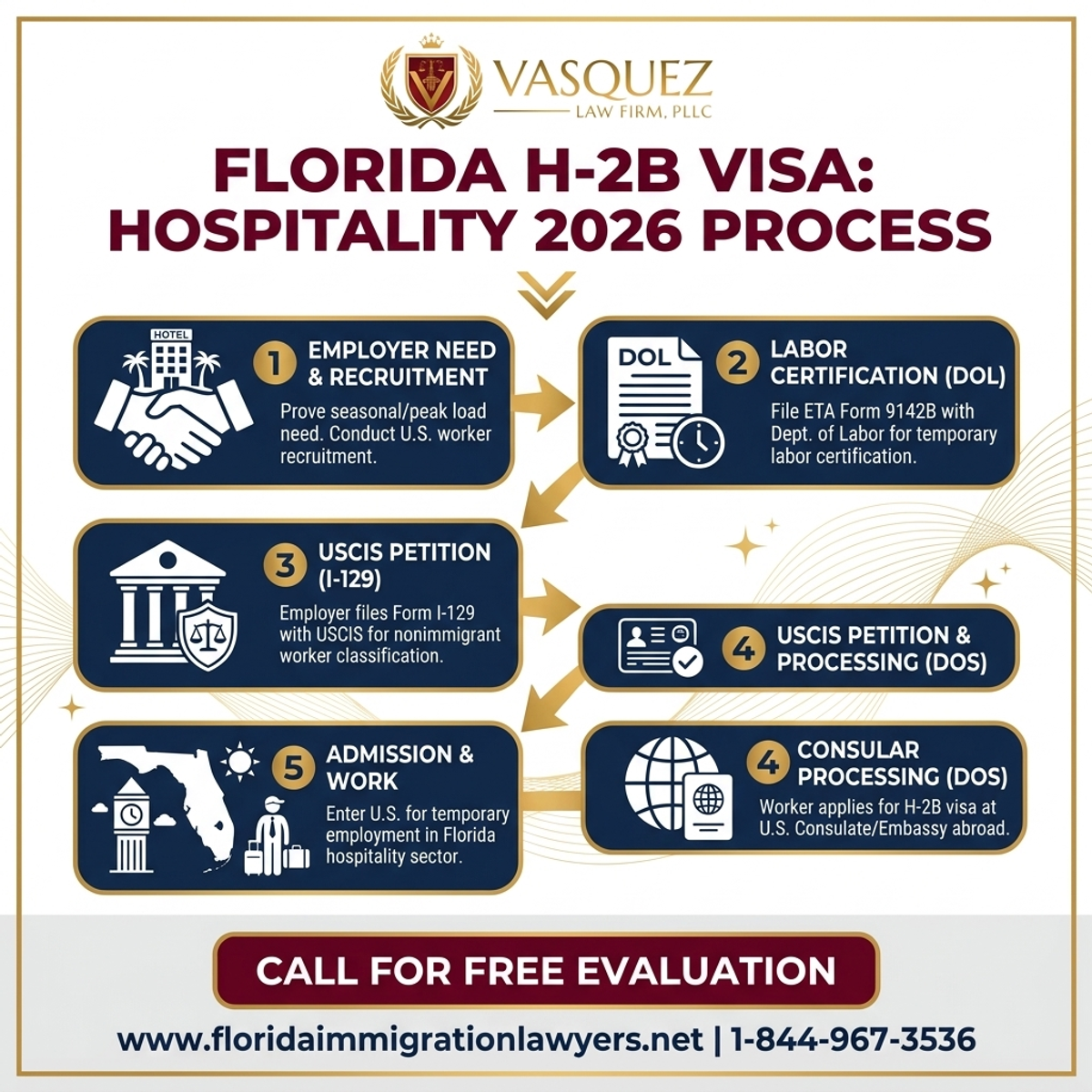
The H-2B visa application process is a multi-stage undertaking that primarily involves the U.S. Department of Labor (DOL) and U.S. Citizenship and Immigration Services (USCIS), and potentially the Department of State for consular processing. As of 2026, employers must meticulously follow each step to ensure compliance and increase the likelihood of approval. The process begins long before the actual start date of employment, often requiring several months of preparation and waiting.
The H-2B process is initiated by the employer and typically follows these key steps:
-
Step 1: Temporary Labor Certification (TLC) Application to DOL. The employer must first apply for a Temporary Labor Certification from the Department of Labor. This involves submitting Form ETA-9142B, Application for Temporary Employment Certification, to the Office of Foreign Labor Certification (OFLC). This application details the job offer, wage, working conditions, and the employer's temporary need. The employer must define whether the need is seasonal, peak load, intermittent, or a one-time occurrence. This stage, including recruitment, typically takes 2-3 months.
-
Step 2: Recruitment of U.S. Workers. After the TLC application is accepted, the employer must conduct a rigorous recruitment process to test the U.S. labor market. This includes advertising the job in local newspapers, posting job orders with the state workforce agency (like the Florida Department of Economic Opportunity for employers in Central Florida), and engaging in other recruitment efforts as directed by the DOL. The goal is to demonstrate that there are no qualified U.S. workers available for the temporary positions. All recruitment efforts and results must be meticulously documented.
-
Step 3: Filing Form I-129 with USCIS. Once the DOL certifies the temporary labor application, the employer files Form I-129, Petition for a Nonimmigrant Worker, with USCIS. This petition requests H-2B classification for the prospective foreign workers. It must include the certified TLC, a temporary need statement, and other supporting documentation. USCIS reviews the petition to determine if the employer meets all H-2B requirements, including the cap limits. This stage can take 3-6 months, though premium processing is available for an additional fee to expedite review.
-
Step 4: Consular Processing or Adjustment of Status. If the Form I-129 petition is approved, foreign workers located outside the U.S. must apply for an H-2B visa at a U.S. embassy or consulate in their home country. This involves completing the DS-160 online application, paying the visa fee, and attending an interview. For workers already in the U.S. in a different nonimmigrant status, they may be eligible to apply for an adjustment of status or change of status without leaving the country, if eligible. Consular processing typically takes 2-4 weeks, varying by location.
-
Step 5: Visa Issuance and Entry to the U.S. Upon successful interview and background checks, the H-2B visa is affixed to the applicant's passport. Workers can then travel to the U.S. and begin their temporary employment in Florida. It is crucial for workers to understand the terms of their visa and adhere to them strictly. Employers should also be prepared for the arrival of their H-2B workers, ensuring proper onboarding and compliance with all labor laws. For assistance with any stage of this process, contact Florida Immigration Lawyers.
What Documents are Required for an H-2B Visa Application?
A successful H-2B visa application hinges on the submission of a comprehensive and accurate set of documents from both the employer and the prospective seasonal worker. Errors or omissions in documentation are common reasons for delays or denials. Employers in Florida's hospitality sector, from large resorts in Orlando to smaller coastal restaurants, must be prepared to gather extensive evidence to support their petition. Similarly, the foreign national must provide personal and professional documents to prove eligibility and intent.
Here is a general checklist of essential documents:
-
Employer-Specific Documents:
- Approved Form ETA-9142B, Application for Temporary Employment Certification, from the Department of Labor.
- Form I-129, Petition for a Nonimmigrant Worker, with all required supplements and fees.
- A detailed letter from the employer explaining the temporary nature of the job offer (seasonal, peak load, intermittent, or one-time occurrence) and why U.S. workers are unavailable.
- Evidence of recruitment efforts, including copies of advertisements, job orders, and detailed documentation of all applicants and reasons for non-selection of U.S. workers.
- Proof of the employer's ability to pay the offered wages, such as financial statements, tax returns, or bank records.
- Copies of any prior H-2B approvals or other relevant immigration documents for the employer.
- Employer's Federal Employer Identification Number (FEIN).
-
Employee-Specific Documents (for Consular Processing):
Step-by-Step Process — H-2B Visa for Seasonal Workers in Florida Hospitality 2026
- Valid passport, with a validity date extending at least six months beyond the period of intended stay in the U.S.
- Nonimmigrant Visa Application, Form DS-160 confirmation page.
- Visa interview appointment confirmation page.
- One 2x2 inch color photograph meeting U.S. visa requirements.
- Receipt for visa application fees.
- Form I-797, Notice of Action, showing approval of the Form I-129 petition.
- Copies of educational certificates, diplomas, or professional licenses relevant to the job.
- Letters of experience from previous employers demonstrating qualifications for the H-2B position (e.g., experience as a cook, housekeeper, or resort staff).
- Evidence of ties to the home country to prove intent to return after the temporary employment (e.g., property deeds, family ties, bank statements, job offers in the home country).
- Any other documents requested by the consular officer during the interview.
Organizing these documents carefully and ensuring their accuracy is a critical step in avoiding delays. It is highly advisable for both employers and workers to retain copies of all submitted materials for their records. A well-prepared application package significantly streamlines the review process for both the DOL and USCIS, helping to secure the necessary approvals for Florida's vital hospitality workforce.
What are the H-2B Visa Processing Times and Costs in 2026?
Understanding the typical processing times and associated costs for the H-2B visa program is essential for effective planning, particularly for Florida hospitality businesses that operate on tight seasonal schedules. As of 2026, these factors can vary based on government workload, policy changes, and the specific circumstances of each case. Employers should budget both time and financial resources accordingly, recognizing that unexpected delays or additional fees can arise.
H-2B Visa Processing Timelines (as of 2026):
The entire H-2B process, from initial labor certification to visa issuance, can take several months. Here’s a general breakdown:
| Stage | Typical Timeframe | Notes |
|---|---|---|
| Temporary Labor Certification (DOL) | 2-3 months | Includes recruitment period and DOL review. Must be initiated well in advance of the start date. |
| Form I-129 Petition (USCIS) | 3-6 months | Standard processing. Times can fluctuate significantly. Premium Processing (additional fee) guarantees 15-day processing. |
| Consular Processing (Department of State) | 2-4 weeks | Varies widely by embassy/consulate location and interview availability. |
| Total Estimated Time | 5-10 months | This is a general estimate; individual cases may vary. |
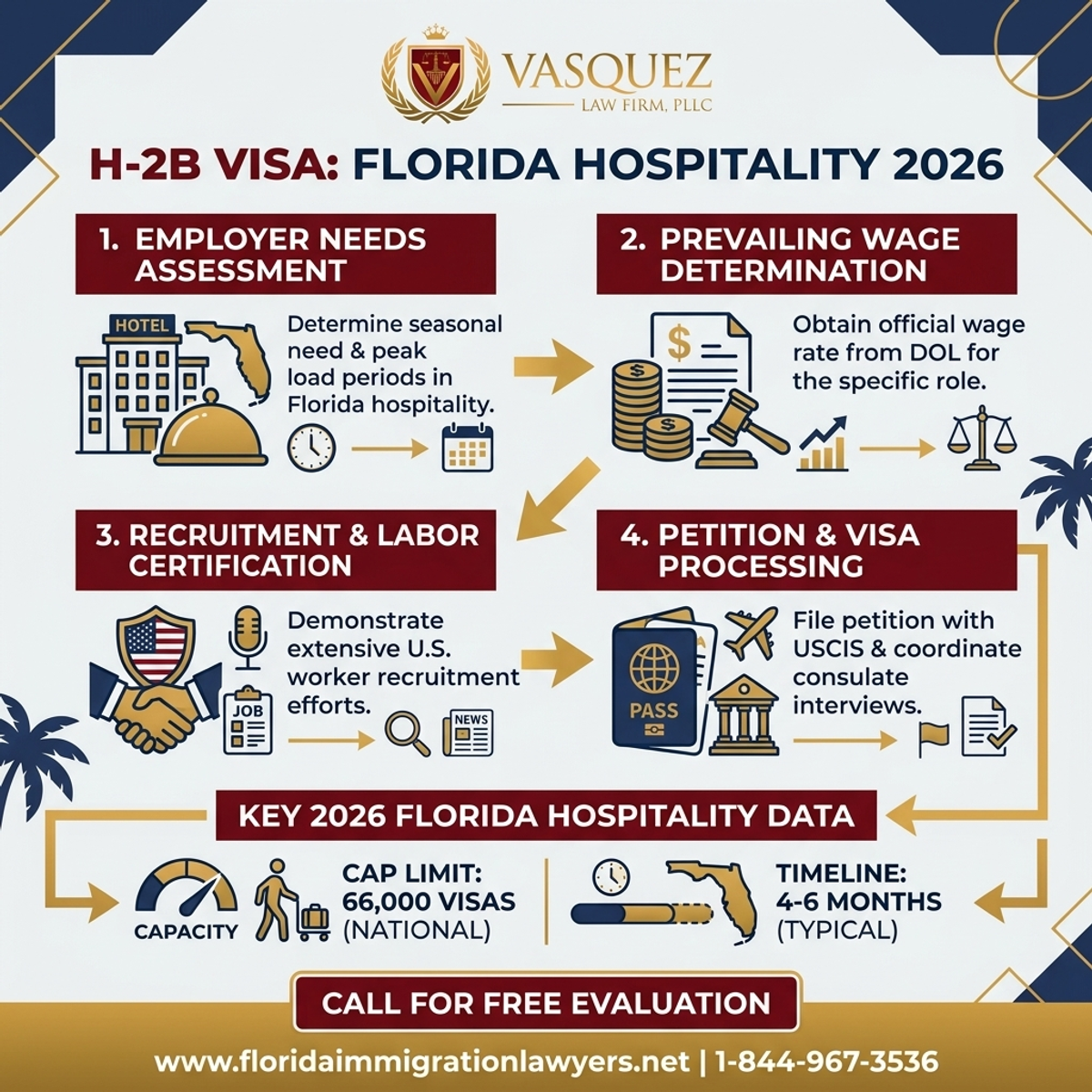
Employers in Florida aiming to bring in H-2B workers for specific seasonal needs, such as the winter tourist season in Orlando or spring break, should begin the application process at least 8-10 months in advance to account for potential delays and cap issues. The H-2B program has a statutory numerical cap of 66,000 visas per fiscal year, divided into two halves, which can be reached quickly, further impacting processing times and availability.
H-2B Visa Cost Factors and Fee Breakdown (as of 2026):
The costs associated with the H-2B visa are borne primarily by the employer, though some fees are paid by the applicant during consular processing. These fees are subject to change, so it's vital to check the latest fee schedules on official government websites like USCIS Filing Fees. Here's an overview of typical costs:
| Item | Typical Fee (as of 2026) | Notes |
|---|---|---|
| DOL Temporary Labor Certification | $0 | No filing fee, but employers incur costs for mandatory recruitment efforts (advertising, job fairs). |
| Form I-129 Petition for a Nonimmigrant Worker (USCIS) | Varies (e.g., $460 for small employers) | This fee is paid by the employer to USCIS. Fee structure can vary based on employer size and other factors, check current USCIS fee schedule. |
| American Competitiveness and Workforce Improvement Act (ACWIA) Fee | $0 (not applicable for H-2B) | This fee applies to H-1B visas, not H-2B. |
| Fraud Prevention and Detection Fee | $150 | Paid by the employer to USCIS with Form I-129. |
| Public Law 114-113 Fee | $4,000 | Required for employers with 50 or more employees, where 50% or more are H-1B or L-1 nonimmigrants. |
| Premium Processing Fee (Optional) | $2,805 | Paid to USCIS for expedited 15-day processing of Form I-129. |
| Consular Processing Fee (DS-160) | $205 | Paid by the H-2B applicant to the U.S. Department of State for the visa interview. |
| Legal Fees | Varies significantly | For attorney assistance with the entire process, including DOL certification, USCIS petition, and consular guidance. |
| Travel Costs | Varies | Airfare, accommodation, and other travel-related expenses for the worker. |
It is crucial for employers to accurately calculate these costs and factor them into their operational budgets. Given the complexity and potential for changes in fees, consulting with an experienced immigration attorney is highly recommended to get the most current and precise cost estimates for your specific situation in Florida.
H-2B Cap Exemptions and Challenges for Florida Businesses
The H-2B visa program, while invaluable for Florida's seasonal industries, operates under a significant limitation: a statutory numerical cap. Currently, Congress sets the H-2B cap at 66,000 visas per fiscal year, divided into two halves. This means 33,000 visas are available for workers starting employment in the first half of the fiscal year (October 1 to March 31), and another 33,000 for those starting in the second half (April 1 to September 30). This cap is often reached quickly, especially during periods of high economic demand, creating substantial challenges for businesses reliant on seasonal labor, including many in Florida's hospitality sector.
However, it is important to note that certain H-2B workers are exempt from this cap. These exemptions can provide a crucial pathway for some employers to secure their needed workforce even after the cap has been met. Cap-exempt workers generally include those who are currently in H-2B status in the U.S. and are extending their stay, changing employers, or changing the terms of their employment. Additionally, certain workers performing specific roles may be exempt, such as those performing labor or services in the Commonwealth of Northern Mariana Islands and Guam. Periodically, Congress or the Department of Homeland Security (DHS) may also authorize supplemental H-2B visas beyond the statutory cap to meet urgent labor needs, as seen in recent years. Employers must stay informed about these potential cap increases, which are often announced close to the cap being reached.
Florida businesses face unique challenges due to the H-2B cap. The state's robust tourism industry means that many hospitality employers, from hotels in South Florida to resorts in Central Florida, experience simultaneous peak seasons. This can lead to intense competition for the limited number of H-2B visas available each half-year. Businesses must meticulously plan their hiring timelines, often submitting petitions on the very first day the filing window opens to have a chance at securing visas. Furthermore, proving a legitimate temporary need and demonstrating unsuccessful U.S. worker recruitment can be complex, especially in a diverse labor market like Florida's. Employers also need to ensure compliance with all wage and working condition requirements to avoid potential audits or penalties from the DOL or USCIS. Navigating these complexities and understanding potential deportation defense implications for workers if rules are broken, requires expert legal counsel.
Key Statistics — H-2B Visa for Seasonal Workers in Florida Hospitality 2026
Do not navigate this complex process alone. Contact Florida Immigration Lawyers today for expert guidance tailored to your specific H-2B visa needs. We are here to help.
Common Mistakes to Avoid in the H-2B Visa Process
The H-2B visa process is intricate, and even minor errors can lead to significant delays, requests for evidence (RFEs), or outright denials. For Florida employers and prospective seasonal workers, avoiding these common pitfalls is crucial for a successful outcome. Being aware of these mistakes can save considerable time, money, and frustration.
-
Late Filing of Petitions: The H-2B cap is often reached rapidly, especially for the second half of the fiscal year. Filing your Temporary Labor Certification (TLC) and I-129 petition too late can result in your application being denied simply because no visas are available. Employers must plan months in advance and adhere strictly to filing windows.
-
Inadequate Recruitment Efforts: Employers must genuinely test the U.S. labor market. Failing to conduct thorough, good-faith recruitment as required by the DOL, or not properly documenting these efforts, will lead to a denial of the TLC. This includes not advertising widely enough or not contacting all qualified U.S. applicants.
-
Failing to Prove Temporary Need: One of the foundational requirements of the H-2B visa is demonstrating a temporary need for workers. Employers who cannot clearly articulate and document why their need is seasonal, peak load, intermittent, or a one-time occurrence will face scrutiny from the DOL and USCIS. An ongoing, permanent need does not qualify.
-
Incomplete or Inaccurate Documentation: Submitting an I-129 petition or consular application with missing forms, incorrect information, or insufficient supporting evidence is a primary cause of RFEs and denials. Every form, letter, and piece of evidence must be meticulously prepared and cross-referenced.
-
Not Responding to Requests for Evidence (RFEs) Promptly: If USCIS issues an RFE, it means they need more information to make a decision. Failing to respond by the deadline, or submitting an incomplete response, will almost certainly lead to a denial. Responding effectively requires a clear understanding of the request and submitting compelling evidence.
-
Misrepresenting Job Duties or Wages: Any misrepresentation of the job duties, required qualifications, or offered wages can lead to severe penalties, including debarment from the program. All details must accurately reflect the actual employment terms and comply with prevailing wage determinations.
-
Lack of Communication with Workers: For foreign nationals, failing to understand the terms of their visa, including its duration and permitted activities, can lead to violations of immigration status. Employers should ensure workers are fully informed about their rights and responsibilities.
-
Ignoring Compliance Requirements Post-Approval: The employer's obligations do not end once the visa is approved. Ongoing compliance with wage, working condition, and record-keeping requirements is essential. Failure to comply can result in audits, fines, and future ineligibility for the program.
When to Call a Lawyer for Your H-2B Visa Case
Given the complexities, strict deadlines, and evolving regulations of the H-2B visa program, knowing when to seek professional legal assistance is crucial for both employers and individual workers. While some basic information is readily available, the nuances of immigration law often require an expert touch. Florida Immigration Lawyers are here to provide that specialized support, ensuring your H-2B process is as smooth and successful as possible.
You should strongly consider calling an immigration lawyer if:
-
You are an employer new to the H-2B program: The initial learning curve for the Temporary Labor Certification and USCIS petition processes can be steep. An attorney can guide you through every step, ensuring compliance from the outset.
-
You have previously had an H-2B petition denied or received an RFE: A denial or RFE indicates a problem with your application. An experienced lawyer can analyze the reasons for the issue and help you formulate a strong response or re-application strategy.
-
Your business has unique or complex temporary needs: If your need doesn't fit neatly into the typical seasonal category, or if you have specific operational challenges, an attorney can help articulate your case effectively to the DOL and USCIS.
-
You are concerned about meeting recruitment requirements: Proving that no qualified U.S. workers are available can be challenging. A lawyer can advise on robust recruitment strategies and proper documentation.
-
You are a foreign national with questions about your rights or status: While employers initiate the process, workers may have questions about their visa terms, employment conditions, or potential pathways for citizenship or permanent residency. An attorney can provide clear answers and protect your interests.
-
You are facing an audit or investigation: If the DOL or USCIS initiates an audit of your H-2B program, immediate legal counsel is essential to protect your business from penalties.
Our team at Florida Immigration Lawyers has extensive experience with H-2B visas for the hospitality industry throughout Florida, including Orlando and Central Florida. We understand the specific demands of your business and the aspirations of seasonal workers. We offer comprehensive services, from initial eligibility assessments to preparing and filing all necessary forms, responding to government inquiries, and providing representation. Don't leave your H-2B future to chance.
About Florida Immigration Lawyers
Florida Immigration Lawyers is a leading immigration law firm dedicated to serving individuals and businesses across the entire state of Florida. With our primary office located in Orlando, we are deeply familiar with the unique immigration needs of Central Florida's vibrant communities and its thriving hospitality sector. Our mission is to provide compassionate, effective, and results-driven legal representation in all areas of immigration law.
Our team of highly skilled and experienced attorneys specializes in a wide range of immigration services, including family-based immigration, business immigration such as H-2B visas, asylum, deportation defense, and naturalization. We understand that every immigration journey is unique and often fraught with anxiety. That's why we approach each case with personalized attention, meticulously crafting strategies tailored to your specific circumstances and goals.
Choosing Florida Immigration Lawyers means partnering with a firm that values integrity, transparency, and unwavering client advocacy. We are available 24/7 to address your urgent concerns and offer free case reviews to help you understand your options without financial commitment. Our bilingual staff is fluent in English and Spanish, ensuring that language barriers never impede effective communication. Let us be your trusted guide through the complexities of U.S. immigration law. Schedule a free consultation with us today and discover the difference expert legal representation can make.
Sources and References
- U.S. Citizenship and Immigration Services (USCIS)
- U.S. Department of State
- Executive Office for Immigration Review (EOIR)
- 8 U.S.C. § 1101(a)(15)(H)(ii)(b) - Immigration and Nationality Act (INA) definition of H-2B nonimmigrant.
- 8 CFR Part 214.2(h) - Regulations governing H nonimmigrant classifications.
- 20 CFR Part 655, Subpart A - Temporary Employment of H-2B Foreign Workers in Non-Agricultural Occupations.
Related services: immigration practice areas, experienced immigration attorneys, immigration lawyer cost in Florida.
This article provides general legal information and is not intended as legal advice. Every case is unique, and outcomes depend on specific facts and circumstances. Contact an attorney for advice about your particular situation.
Navigating the H-2B visa process can be challenging, but you don't have to face it alone. Whether you are a Florida employer seeking to bolster your seasonal workforce or an individual hoping to work in the vibrant U.S. hospitality sector, Florida Immigration Lawyers is here to help. Our dedicated team provides expert legal guidance and robust representation to ensure your success. Call us today at 1-844-YO-PELEO for a free, no-obligation case review. Se Habla Espanol - Estamos aqui para ayudarle.
Do Not Navigate This Process Alone
Our experienced immigration attorneys are ready to fight for you. Get a free, confidential case review today.
Se Habla Español
Or leave your details and we’ll call you:
Free Evaluation in 24 Hours
Or talk to us right now

AI voice assistant — available 24/7
FreeFrequently Asked Questions

William J. Vásquez
Founding Attorney · Vasquez Law Firm
U.S. Air Force veteran and immigration attorney with years of hands-on U.S. immigration experience. J.D., NCCU School of Law. AILA member. Admitted to the 4th, 5th, and 11th Circuit Courts.
Available 24/7 - Free Evaluations
Reviewed for legal accuracy by William J. Vásquez
Licensed in North Carolina; U.S. immigration is federal practice.
Related Legal Services
Our Florida immigration attorneys can help you with free immigration consultation, business immigration and deportation defense. Call today at 1-844-YO-PELEO for a free case review.
Related Links
Related Topics
Free Legal Case Review
Discuss your case with our experienced attorneys. We're available 24/7.
Se Habla Español - Estamos aquí para ayudarle.
Related Articles
DUI Immigration Consequences in Florida 2026
A DUI conviction in Florida can have severe immigration consequences, potentially leading to inadmissibility, deportation, or denial of immigration benefits. For non-citizens, a DUI is not just a traffic offense but a serious criminal matter that federal immigration law scrutinizes closely. Factors like multiple offenses, injury, or property damage can escalate a simple DUI to a Crime Involving Moral Turpitude (CIMT) or even an aggravated felony, triggering mandatory detention and removal proceedings. Understanding the specific nature of your Florida conviction and its interpretation under the Immigration and Nationality Act (INA) is crucial. This article outlines how DUIs impact immigration status, the grounds for inadmissibility and deportation, a step-by-step guide to navigating the process, essential documentation, and expected timelines for 2026. We also highlight common mistakes to avoid and when to seek legal counsel from an experienced immigration attorney. Florida Immigration Lawyers offers comprehensive support for individuals facing these challenging situations, providing expert guidance through complex legal landscapes.
Immigration Lawyer Orlando Free Consultation in Florida
For individuals and families in Orlando, Florida, navigating the complexities of U.S. immigration law requires expert guidance. An immigration lawyer in Orlando offers crucial support for everything from visa applications and green card processes to naturalization and deportation defense. This comprehensive guide details what a free consultation covers, providing a step-by-step overview of immigration pathways, essential document checklists, and expected timelines in 2026. We also highlight common mistakes to avoid, discuss the critical role of legal counsel in deportation and asylum cases, and explain why choosing a local Orlando immigration attorney is beneficial. Florida Immigration Lawyers is dedicated to serving the diverse community of Orlando with compassionate, effective legal solutions, ensuring you receive personalized advice and robust representation for a successful immigration journey.
EAD Advance Parole Combo Card in Florida: What You Need
An EAD advance parole combo card allows individuals with pending adjustment applications to both work and travel abroad without jeopardizing their green card application. Learn how to apply in Florida, what documents you need, and common mistakes to avoid.
Dual Citizenship Lawyer in Florida: What You Need to Know
For Florida residents, the concept of dual citizenship, or holding two passports, offers a compelling blend of opportunities and challenges. While the U.S. generally permits dual nationality, the path to achieving this status requires a meticulous understanding of both U.S. immigration laws and the citizenship policies of your country of origin. This guide explores the definition of dual citizenship, the detailed step-by-step process for U.S. naturalization, and the significant benefits and potential pitfalls involved. We cover essential documentation, typical timelines, and cost considerations for 2026, providing crucial insights for anyone in Orlando, Miami, or across Florida considering this important legal step. Learn about common mistakes to avoid and understand when to seek professional legal counsel to navigate this complex process successfully. Florida Immigration Lawyers is here to provide expert, bilingual support for your dual citizenship journey.