H-2B Visa for Seasonal Workers in Florida Hospitality
Explore the H-2B visa process for seasonal workers in Florida's hospitality industry. Understand the application steps, required documents, and common pitfalls to avoid. Call Florida Immigration Lawyers for a free case review.

- Designed for non-agricultural work
- Requires a job offer from a U.S. employer
- Subject to annual cap limits
- Important for Florida's hospitality industry
Introduction
Florida's hospitality industry relies heavily on seasonal workers, particularly in bustling cities like Orlando. These workers often come from abroad on H-2B visas, designed specifically for non-agricultural temporary labor. If you're a business owner in the hospitality sector or a worker seeking opportunities in Florida, understanding the H-2B visa process is crucial. Call Florida Immigration Lawyers at 1-844-YO-PELEO for a free case review.
The Sunshine State's vibrant tourism sector, encompassing everything from world-renowned theme parks and pristine beaches to luxury resorts and bustling restaurants, experiences significant fluctuations in demand throughout the year. During peak seasons, the need for additional staff in roles such as hotel housekeepers, resort maintenance workers, lifeguards, cooks, and event staff skyrockets. Without a reliable source of temporary labor, many businesses would struggle to meet customer expectations and maintain their high service standards, potentially impacting Florida's economic engine.
The H-2B visa program provides a vital lifeline for these businesses, allowing them to legally bring in foreign workers to fill temporary, non-agricultural positions when qualified U.S. workers are unavailable. This ensures that Florida's hospitality sector can continue to thrive, supporting local economies and preserving the state's reputation as a premier tourist destination. For workers, it represents an invaluable opportunity to gain international work experience, earn competitive wages, and contribute to a dynamic industry.
Navigating the intricacies of U.S. immigration law, however, can be challenging for both employers and prospective employees. Understanding the requirements, deadlines, and potential pitfalls of the H-2B visa application is paramount to a successful outcome. This comprehensive guide aims to demystify the process, offering insights and practical advice to help you secure the necessary approvals. For personalized guidance and to ensure compliance with all regulations, don't hesitate to contact Florida Immigration Lawyers at 1-844-YO-PELEO for expert assistance.
What is the H-2B Visa?
The H-2B visa is a non-immigrant visa that allows U.S. employers to hire foreign nationals for temporary non-agricultural jobs. As of 2026, it remains vital for sectors like hospitality, where seasonal demand fluctuates. The visa is capped annually, meaning only a limited number are available each fiscal year.
Employers must prove that there are not enough U.S. workers to fill the positions and that employing H-2B workers will not negatively affect the wages and working conditions of U.S. workers.
The core principle behind the H-2B visa program is to address legitimate temporary labor shortages without displacing U.S. workers. This "temporary" need can fall into several categories: a one-time occurrence, a seasonal need (such as tourist season), a peakload need (when regular staff cannot handle increased demand), or an intermittent need. For Florida's hospitality industry, seasonal and peakload needs are the most common justifications, aligning perfectly with the influx of tourists during specific times of the year.
A significant aspect of the H-2B program is its annual cap. Congress sets a numerical limit for H-2B visas each fiscal year, currently 66,000, split evenly between the first and second halves of the fiscal year. This cap often leads to a high demand for visas, particularly in popular industries like hospitality, making timely and accurate application crucial. When demand exceeds the available visas, USCIS may conduct a lottery, underscoring the competitive nature of the program and the need for a meticulously prepared application.
Employers seeking H-2B workers must undertake a rigorous recruitment process to demonstrate that they have first attempted to hire qualified U.S. workers for the positions. This includes advertising the jobs, collaborating with state workforce agencies, and documenting all recruitment efforts. Furthermore, they must commit to paying H-2B workers the prevailing wage for their occupation and geographic area, ensuring that the employment of foreign workers does not adversely affect the wages or working conditions of similarly employed U.S. workers. This multi-layered requirement ensures the program's integrity and its intended purpose.
How to Apply for an H-2B Visa?
- Employers must first file a temporary labor certification application with the Department of Labor.
- Once certified, the employer can submit Form I-129 to USCIS.
- After USCIS approval, workers can apply for their visas at a U.S. consulate.
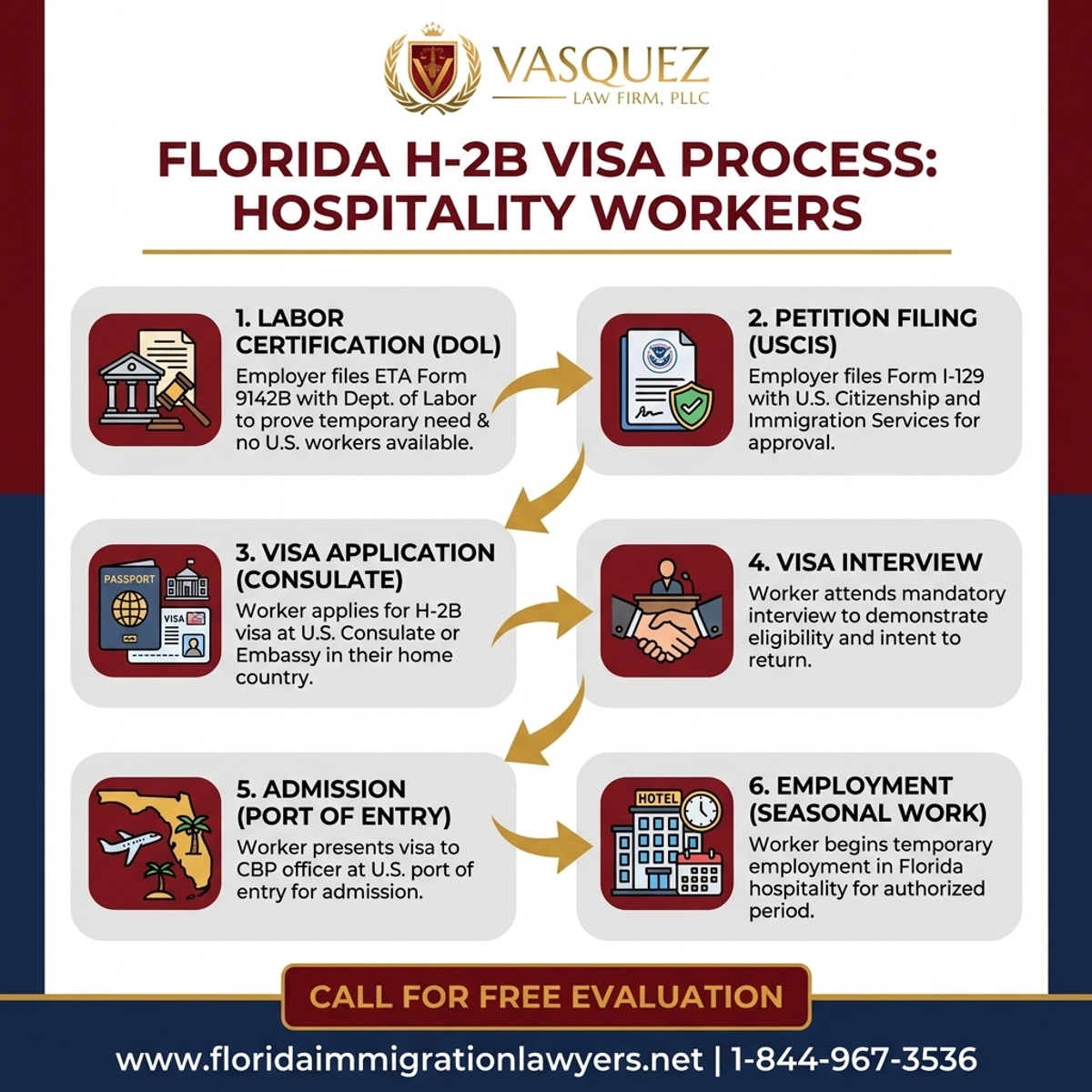
Step-by-Step Process — H-2B Visa for Seasonal Workers in Florida Hospitality
The journey to securing an H-2B visa begins with the employer's diligent efforts to obtain a Temporary Labor Certification from the U.S. Department of Labor (DOL). This critical first step involves demonstrating a genuine temporary need for foreign workers and proving that there are insufficient U.S. workers who are able, willing, qualified, and available to perform the temporary work. The employer must also agree to pay the prevailing wage determined by the DOL, which involves extensive documentation of job duties, qualifications, and a detailed recruitment report outlining all efforts to hire U.S. workers. This stage is highly scrutinized and often requires expert guidance to navigate successfully.
Following a successful labor certification, the employer then files Form I-129, Petition for a Nonimmigrant Worker, with U.S. Citizenship and Immigration Services (USCIS). This petition specifically requests H-2B classification for the prospective foreign workers. During this stage, USCIS reviews the employer's eligibility, the temporary nature of the job, and the approved labor certification. Employers have the option to request premium processing for Form I-129, which can significantly expedite the USCIS decision, a valuable consideration when facing tight seasonal deadlines in Florida's fast-paced hospitality industry.
The final stage involves the foreign national workers themselves applying for the H-2B visa at a U.S. embassy or consulate in their home country. This typically includes completing the DS-160 Nonimmigrant Visa Application, attending an interview with a consular officer, and providing all necessary supporting documentation, such as a valid passport, the approved I-129 petition receipt number, and proof of the job offer. Consular officers assess the applicant's eligibility, ensuring they meet all visa requirements and intend to return to their home country after their temporary employment. The process can be complex, and it's advisable to consult with legal experts like Florida Immigration Lawyers to ensure compliance and increase chances of approval.
Document Checklist for H-2B Visa Application
Ensuring a complete and accurate set of documents is paramount for a smooth H-2B visa application process. Any missing or incorrect information can lead to significant delays or even outright denial. Beyond the essential items listed, applicants should also be prepared to provide additional supporting documents that may be requested by consular officers, such as evidence of ties to their home country to demonstrate non-immigrant intent, or specific educational and professional certifications relevant to the job in Florida's hospitality sector.
- Valid passport
- Nonimmigrant Visa Application (DS-160) confirmation page
- Receipt number from Form I-129
- Proof of job offer
- Labor certification approval
Timeline and Processing Expectations
While the table above provides general timeframes, it's crucial to understand that these are estimates and actual processing times can fluctuate based on government workload, policy changes, and the specific details of each case. For instance, the Department of Labor's processing times for labor certifications can vary significantly depending on the time of year and the volume of applications. Similarly, USCIS processing times for Form I-129 can be influenced by the service center handling the petition and whether premium processing is utilized. Planning well in advance and staying informed about current processing times through official government websites is essential for employers in Florida's hospitality industry.
| Stage | Typical Timeframe | Notes |
|---|---|---|
| Labor Certification | 90 - 120 days | Department of Labor requirement |
| USCIS Processing | 2 - 8 weeks | Depends on service center |
| Consular Processing | 1 - 2 weeks | Varies by consulate |
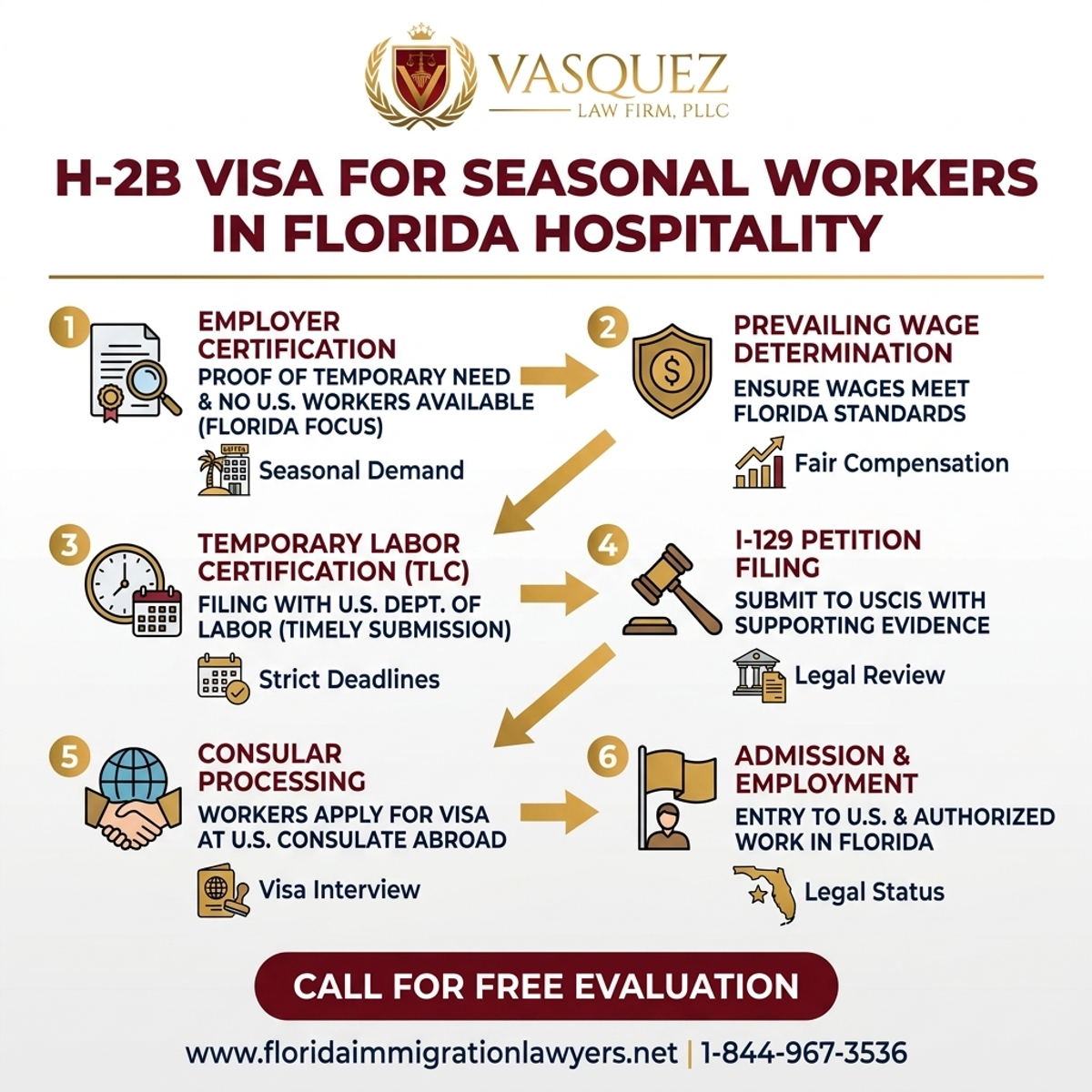
Key Statistics — H-2B Visa for Seasonal Workers in Florida Hospitality
Cost Factors and Fee Breakdown
The financial investment in the H-2B visa process goes beyond just government filing fees. Employers should budget for potential costs associated with the mandatory recruitment efforts, such as advertising expenses, and, importantly, the legal fees for experienced immigration counsel. While attorney fees are an additional expense, the expertise provided by firms like Florida Immigration Lawyers can be invaluable, helping to avoid costly mistakes, expedite processing, and significantly increase the likelihood of a successful outcome. This investment ensures compliance and protects the employer from potential legal liabilities, making it a wise allocation of resources.
| Item | Typical Fee | Notes |
|---|---|---|
| Form I-129 Filing Fee | Varies | Check USCIS for current fees |
| Visa Application Fee | Varies | Paid to U.S. consulate |
| Attorney Fees | Varies | Optional but recommended |
Do not navigate this process alone. Contact Florida Immigration Lawyers today.
Common Mistakes to Avoid
Navigating the H-2B visa process is intricate, and even minor errors can lead to significant setbacks, including delays, requests for evidence, or outright denials. One of the most critical aspects is accurately demonstrating the temporary nature of the job; a common pitfall is failing to clearly articulate why the need is seasonal or intermittent rather than permanent. Employers must also meticulously document all recruitment efforts to prove that no qualified U.S. workers were available. Consulting with an experienced legal team, such as Florida Immigration Lawyers, can provide a crucial layer of protection against these common missteps, ensuring your application is robust and compliant from the outset.
- Not verifying the job's seasonal nature; leads to denial.
- Missing deadlines; can result in application rejection.
- Incomplete documentation; causes delays.
- Ignoring annual cap limits; plan applications accordingly.
- Filing incorrect forms; consult an attorney.
- Overlooking local labor laws; affects eligibility.
- Using outdated fee information; check current rates.
- Not seeking legal advice; reduces approval chances.
- Mistakes in DS-160 form; leads to consulate issues.
- Failing to prove temporary need; crucial for approval.
When to Call a Lawyer
Legal assistance is crucial when navigating the H-2B visa process. A lawyer can help ensure all forms are correctly filed and deadlines met. If your application is denied, or if you're unsure about the documentation, it's best to consult Florida Immigration Lawyers. We offer comprehensive services tailored to your needs.
While the H-2B visa process is outlined in steps, the reality involves complex regulations, frequent policy updates, and nuanced interpretations that can overwhelm even seasoned business owners. Engaging an immigration attorney, particularly one with specific expertise in H-2B visas for Florida's hospitality sector, offers a strategic advantage. A lawyer can proactively identify potential issues before they become problems, streamline the documentation process, and represent your interests effectively before the Department of Labor, USCIS, and consular offices.
Consider seeking legal counsel immediately if you are an employer contemplating your first H-2B petition, if you've experienced previous denials, or if you anticipate challenges in demonstrating a temporary need or recruiting U.S. workers. For foreign nationals, understanding your rights and responsibilities during the consular interview and beyond is equally vital. Florida Immigration Lawyers possess the in-depth knowledge and practical experience to guide you through every phase, from initial temporary labor certification to visa issuance, providing peace of mind and significantly enhancing your chances of success. Don't leave your seasonal staffing needs or your employment opportunities to chance.
About Florida Immigration Lawyers
Florida Immigration Lawyers is a trusted firm dedicated to assisting clients with their immigration needs. We specialize in various areas, including H-2B visas, asylum, deportation defense, and family immigration. Our team provides 24/7 support and free case reviews. Schedule a free consultation with us today.
At Florida Immigration Lawyers, we understand the unique demands and challenges faced by both employers and workers within the state's thriving hospitality industry. Our attorneys are not just legal practitioners; they are strategic partners who possess a deep understanding of the H-2B program's specific requirements and its application within the Florida context. We pride ourselves on offering personalized, client-focused representation, ensuring that each case receives the meticulous attention it deserves, whether it involves a single seasonal worker or a large-scale recruitment effort for a major resort.
Our commitment extends beyond just filing forms; we provide comprehensive support, including advising on compliance issues, assisting with recruitment strategies to meet DOL requirements, and preparing clients for interviews. We leverage our extensive experience to anticipate potential hurdles and develop robust legal strategies designed for favorable outcomes. With our dedicated team and unwavering commitment to justice, Florida Immigration Lawyers is your premier resource for navigating the complexities of H-2B visas and all other immigration matters. Remember, for a free case review, you can always reach us at 1-844-YO-PELEO.
Frequently Asked Questions About H-2B Visas
What types of jobs qualify for an H-2B visa in Florida's hospitality sector?
The H-2B visa is specifically for temporary, non-agricultural jobs. In Florida's hospitality sector, this commonly includes roles such as hotel housekeepers, resort maintenance workers, lifeguards, cooks, servers, front desk staff, landscapers, and amusement park attendants. The key is that the employer's need for these positions must be seasonal, peakload, intermittent, or a one-time occurrence, not a permanent staffing requirement. For example, a resort needing extra staff only during the busy winter tourist season would be a strong candidate for H-2B workers. Florida Immigration Lawyers can help determine if your specific job needs qualify.
How does the H-2B annual cap affect employers and workers?
The H-2B visa program has an annual cap, currently 66,000 visas, split between two halves of the fiscal year. This cap means that demand often exceeds supply, making the application process highly competitive. Employers must apply early, often months in advance of their projected need, to secure a spot. If the cap is reached, USCIS may conduct a lottery, and applications received after the cap is met are generally rejected. This emphasizes the critical importance of timely and accurate filing, often with the assistance of an experienced firm like Florida Immigration Lawyers, to maximize approval chances.
Can an H-2B visa be extended?
Yes, an H-2B visa can generally be extended in increments, typically for up to one year per extension, provided the employer's temporary need continues and the total period of stay does not exceed three years. Each extension requires the employer to file a new Form I-129 petition with USCIS and obtain a new temporary labor certification from the Department of Labor. The process for extension is similar to the initial application, requiring proof of ongoing temporary need and compliance with all program regulations. Consulting with Florida Immigration Lawyers is recommended to manage extensions effectively.
What are the employer's responsibilities to H-2B workers?
Employers of H-2B workers have significant responsibilities, including paying the prevailing wage, providing safe working conditions, and adhering to all federal and state labor laws. They must also provide housing and transportation if it's customary in the industry or region, or if it's required for the job. Employers cannot charge H-2B workers recruitment fees and must reimburse reasonable transportation and subsistence costs from their home country to the place of employment. These obligations are strictly enforced to protect foreign workers. Florida Immigration Lawyers can help employers understand and meet these crucial compliance requirements.
What happens if an H-2B application is denied?
A denial of an H-2B application can be disheartening, but it's not always the end of the road. The reason for denial is crucial. It could be due to incomplete documentation, failure to prove temporary need, issues with recruitment efforts, or reaching the annual cap. Depending on the reason, an employer may have options such as filing a motion to reconsider or appeal the decision, or reapplying with a strengthened petition. Promptly consulting with Florida Immigration Lawyers after a denial is essential to assess the situation, understand the specific grounds for denial, and determine the best course of action for a potential reapplication or appeal.
Sources and References
- U.S. Citizenship and Immigration Services (USCIS)
- Executive Office for Immigration Review (EOIR)
- 8 U.S.C. Chapter 12 - Immigration and Nationality Act
Related services: immigration practice areas, family immigration services.
This article provides general legal information and is not intended as legal advice. Every case is unique, and outcomes depend on specific facts and circumstances. Contact an attorney for advice about your particular situation.
Se Habla Espanol - Estamos aqui para ayudarle.
If you need legal assistance, learn more about experienced immigration attorneys in Orlando, or call us at 1-844-967-3536 for a free case review.
Do Not Navigate This Process Alone
Our experienced immigration attorneys are ready to fight for you. Get a free, confidential case review today.
Se Habla Español
Or leave your details and we’ll call you:
Free Evaluation in 24 Hours
Or talk to us right now

AI voice assistant — available 24/7
FreeFrequently Asked Questions

William J. Vásquez
Founding Attorney · Vasquez Law Firm
U.S. Air Force veteran and immigration attorney with years of hands-on U.S. immigration experience. J.D., NCCU School of Law. AILA member. Admitted to the 4th, 5th, and 11th Circuit Courts.
Available 24/7 - Free Evaluations
Reviewed for legal accuracy by William J. Vásquez
Licensed in North Carolina; U.S. immigration is federal practice.
Related Legal Services
Our Florida immigration attorneys can help you with citizenship and naturalization, immigration practice areas and free immigration consultation. Call today at 1-844-YO-PELEO for a free case review.
Related Links
Related Topics
Free Legal Case Review
Discuss your case with our experienced attorneys. We're available 24/7.
Se Habla Español - Estamos aquí para ayudarle.
Related Articles
EAD Advance Parole Combo Card in Florida 2026
For individuals with a pending Form I-485, Application to Register Permanent Residence or Adjust Status, the EAD Advance Parole Combo Card is an essential document. This single card combines the authorization to work legally in the U.S. (Employment Authorization Document - EAD) with permission to travel internationally and re-enter without abandoning your green card application (Advance Parole). This guide from Florida Immigration Lawyers provides a comprehensive overview for applicants in Florida in 2026, covering eligibility, the step-by-step application process, required documents, expected processing times, and associated costs. We also highlight common mistakes to avoid and when to seek legal counsel to ensure a smooth and successful immigration journey. Understanding this vital card is key to maintaining stability while awaiting your permanent residency approval.
Immigration Lawyer Orlando Free Consultation in Florida
For individuals and families in Orlando, Florida, navigating the complexities of U.S. immigration law requires expert guidance. An immigration lawyer in Orlando offers crucial support for everything from visa applications and green card processes to naturalization and deportation defense. This comprehensive guide details what a free consultation covers, providing a step-by-step overview of immigration pathways, essential document checklists, and expected timelines in 2026. We also highlight common mistakes to avoid, discuss the critical role of legal counsel in deportation and asylum cases, and explain why choosing a local Orlando immigration attorney is beneficial. Florida Immigration Lawyers is dedicated to serving the diverse community of Orlando with compassionate, effective legal solutions, ensuring you receive personalized advice and robust representation for a successful immigration journey.
Annual Asylum Fee: Preparation for Florida Interviews
As of 2026, there is no annual asylum fee in the U.S. Preparing for your asylum interview in Florida is crucial for success. Learn more about the process, necessary documentation, and common mistakes to avoid. Florida Immigration Lawyers are here to help.
Immediate Relative Petition in Florida: Key Steps
Learn about the immediate relative petition process in Florida, including filing steps, required documents, and common pitfalls. Discover how to successfully sponsor family members for a green card and navigate the complexities of U.S. immigration law.