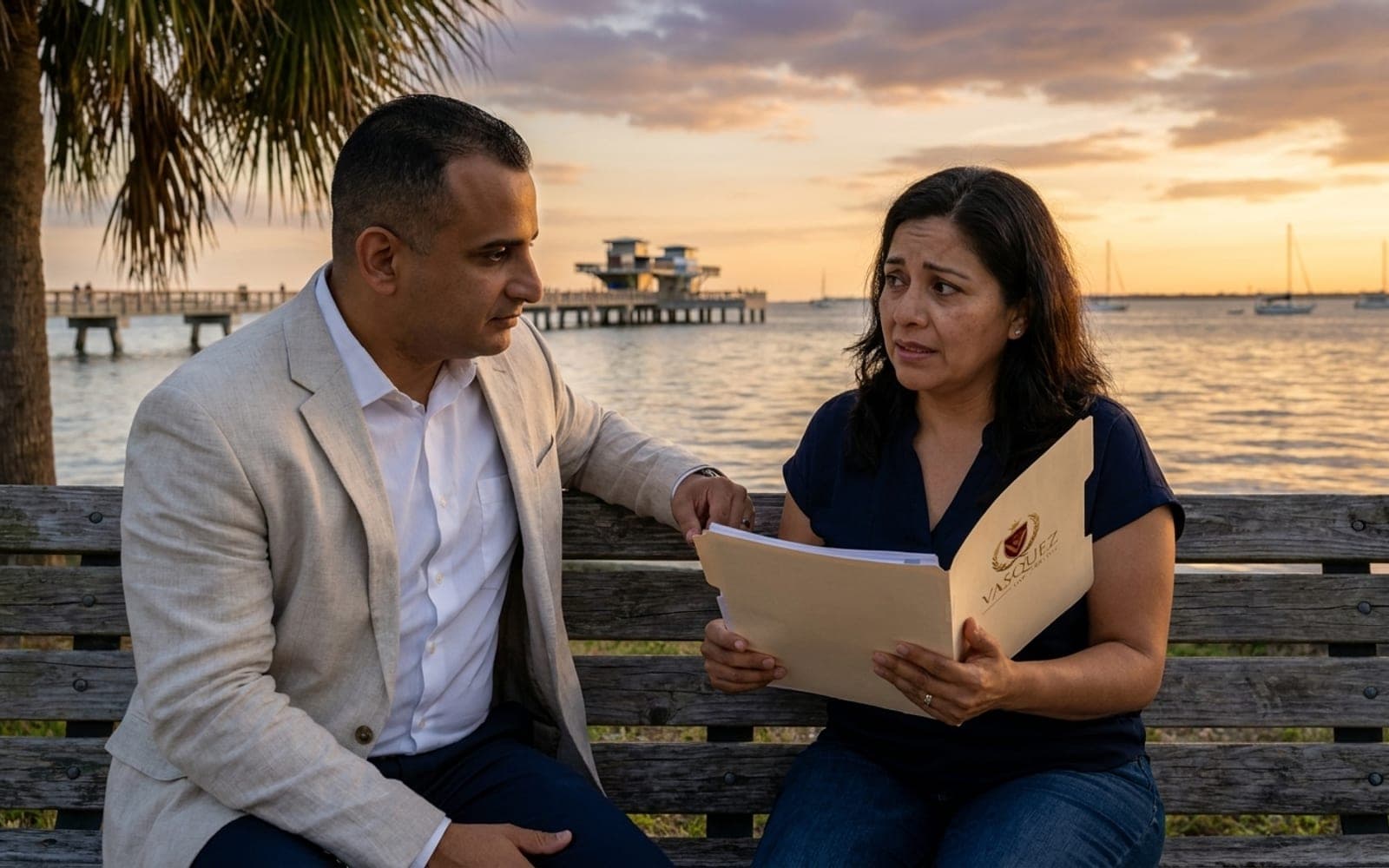
People who search for a visa lawyer in Clearwater are often really asking which visa, if any, fits their situation, and the answer depends on the purpose of the stay. This guide for Pinellas County covers family green cards, marriage and K-1 cases, citizenship for permanent residents and asylum. We have no office in Pinellas County; we serve the area by video and phone and meet in person at our only office in Orlando.
- The right visa depends on the purpose of the stay.
- The guide covers family, K-1, citizenship and asylum matters.
- We have no Pinellas County office, only our office in Orlando.
- Meetings are by video, phone or in Orlando.
Introduction
Families in St. Petersburg, Clearwater and the rest of Pinellas County can get help with visas, green cards, fiancé and spouse cases, citizenship and asylum without driving across the state for every conversation. Vasquez Law Firm serves Pinellas clients by secure video and phone, and meets clients in person at our only office, in Orlando. To ask about your case, call 1-844-YO-PELEO or contact us.
We do not have an office in Pinellas County. Below is a practical guide to the matters we see most from the area and how each one generally works, written for individuals, families and employers who want to understand the options before they pick a lawyer.
This article is general information, not legal advice. Forms, fees and rules change, so check current requirements with the agencies and speak with a lawyer about your own facts.
Immigration Help for Clearwater and St. Petersburg Residents
People who search for a visa lawyer in Clearwater are often asking a bigger question: which visa, if any, fits my situation? The answer depends on the purpose of the stay. Temporary work visas such as H-1B, L-1, TN and O-1 require a U.S. employer or a specific qualifying background, and each has its own eligibility rules. Our page on employment-based work visas outlines those categories.
Family-based visas, by contrast, start with a petition from a U.S. citizen or permanent resident relative. A lawyer reviews your history, your goals and any past immigration problems before recommending a path, because choosing the wrong category can cost time and create a record that follows you. Employers in the area who want to sponsor a worker should also bring the job description, the worksite address and basic company information to the first meeting, so the lawyer can compare categories such as H-1B, L-1, TN and O-1 against the actual job.
Green Cards Through Family
A green card based on family usually begins with Form I-130, filed by the U.S. citizen or permanent resident relative. If the person being sponsored is in the United States and eligible, they may apply to adjust status with Form I-485; if not, the case moves to a U.S. consulate abroad. A lawyer is mainly checking three things: whether the relationship qualifies, whether the sponsor can meet the financial support requirement, and whether anything in the applicant's past, such as an unlawful entry, a long overstay or a criminal record, creates a bar or requires a waiver.
When you meet with a lawyer about a green card, bring proof of the relationship, the sponsor's status documents and tax returns, and every immigration document the applicant has ever received. See our overview of family-based green cards for more background.
Beyond spouses and fiancés, U.S. citizens can petition for children, parents and siblings, and permanent residents can petition for spouses and unmarried children. Many of these categories are subject to annual limits, so waits vary by category and country. A lawyer explains which category applies and what the wait generally looks like for that category, without promising a date, and watches for life changes, such as a child turning 21 or marrying, that can change the category. Our family immigration page covers these petitions in more detail.
Spouse and Marriage-Based Cases
Marriage to a U.S. citizen is one of the most common routes to permanent residence, and it receives close review. USCIS looks for evidence that the marriage is genuine: shared residence, joint finances, photos over time and knowledge of each other's lives. A lawyer prepares that evidence, gets both spouses ready for the interview and flags issues such as a prior marriage that was not legally ended. If the marriage was less than two years old when residence was granted, the green card is conditional, and the couple generally must file jointly to remove conditions before it expires.
Spouse cases also arise when the spouse is abroad. Those cases go through a petition approval, the National Visa Center and an interview at a U.S. embassy or consulate.
How the Fiancé (K-1) Visa Process Works
A U.S. citizen engaged to someone abroad can file Form I-129F for a K-1 visa. Generally the couple must have met in person within the two years before filing, unless a narrow exception applies, and they must marry within 90 days after the fiancé enters the United States. The process runs in order:
- The citizen files Form I-129F with evidence of the relationship and the in-person meeting.
- USCIS approves the petition and the case moves to the consulate abroad.
- The fiancé completes the visa application, medical exam and interview.
- The fiancé enters the United States on the K-1 visa.
- The couple marries within 90 days of entry.
- After the wedding, the foreign spouse applies to adjust status.
A lawyer helps decide whether a K-1 or a spouse petition after marriage makes more sense, since each has trade-offs in travel, work authorization and paperwork. Ask how the lawyer will document the in-person meeting and the relationship, how they prepare the fiancé for the consular interview, and what happens if the wedding does not take place within the 90 days. See our fiancé visa page for an overview.
Citizenship for Pinellas Permanent Residents
Permanent residents can generally apply for naturalization with Form N-400 after five years of residence, or three years if they have been married to and living with the same U.S. citizen during that time, provided they meet continuous residence, physical presence and good moral character requirements and pass the English and civics tests. A lawyer reviews travel history, tax filings, child support obligations and any arrest record before filing, because the naturalization interview reopens your whole immigration history. Be especially careful if you have long trips abroad or any past criminal issue. Some applicants qualify for exceptions to the English or civics requirements because of age, time as a resident or a medical condition, and a lawyer can explain whether an exception may apply and what paperwork it requires. Applicants should also be ready to answer questions about their whole history, so it helps to review old applications, tax filings and any court records before the interview is scheduled.
Asylum for Pinellas Residents
Asylum protects people who fear persecution in their home country based on race, religion, nationality, political opinion or membership in a particular social group. In general, the application must be filed within one year of arrival, with limited exceptions. A lawyer helps build a detailed declaration, gathers country evidence and supporting documents, and prepares the applicant for either an asylum office interview or an immigration court hearing. Contact a lawyer early; the one-year deadline is one of the most common reasons claims fail. Some people can also seek related protection, such as withholding of removal or protection under the Convention Against Torture, which have different standards, and a lawyer can explain how they compare.
Document Checklist for Visa, Family and Citizenship Cases
- Passports, visas, I-94 records and every prior immigration notice or application.
- Birth certificates and, if anyone was married before, divorce or death records.
- Marriage certificate or proof of engagement for spouse and K-1 cases.
- The sponsor's proof of status, recent tax returns and pay records.
- Evidence of a genuine relationship: lease, joint accounts, photographs and travel records.
- For citizenship: green card, travel history, tax records and any court or arrest documents.
- For asylum: identity documents, any evidence of harm or threats, and a timeline of events.
- Job offer, résumé and diplomas for work-based cases.
Bring what you have and make a list of what is missing. A lawyer can explain how to request records from agencies or courts and which documents need translations.
Timeline and Processing Expectations
Timing depends on the type of case. Immediate relatives of citizens do not wait for an annual visa number, while other family categories wait according to category and country, naturalization depends on the local USCIS office, and asylum depends on whether the case is before an asylum office or an immigration court. USCIS and the courts publish current processing information, and we do not quote numbers here because they change.
The part you control is preparation. A complete first filing, a consistent story and timely responses to notices usually reduce delays. If your case involves a deadline, such as the one-year asylum rule or a conditional green card, calendar it as soon as you know about it.
| Stage | What happens | Who acts |
|---|
| Consultation | Goals, history and options are reviewed | Client and lawyer |
| Filing | Petition, application or declaration is filed with USCIS or the court | Client, with lawyer |
| Biometrics and review | Fingerprints, evidence review and possible requests for evidence | USCIS |
| Interview or hearing | Officer or judge asks questions; the lawyer prepares the client beforehand | USCIS, consulate or court |
| Decision and next steps | Approval, denial or referral; later filings are planned | Agency, then client and lawyer |
How We Work With Pinellas Clients
We do not have an office in Pinellas County. Clients in St. Petersburg, Clearwater, Largo, Pinellas Park and Dunedin meet with us by secure video or phone, and many prefer it because it avoids time off work. Anyone who wants to meet in person is welcome at 1111 E Amelia Street in Orlando.
Interviews and biometrics appointments are scheduled at the USCIS office assigned to your address, and court hearings are held at the immigration court that has your case; we explain where to go and prepare you beforehand. Consultations are available in English and Spanish.
In practice, a remote case runs smoothly when documents are shared securely, questions are answered in writing or by video, and appointments are planned around your work schedule. We send clear instructions for what to bring to a biometrics appointment or an interview, we review the forms with you line by line before anything is signed, and we explain what each notice means when it arrives. If you would like a family member to join the call, for example a spouse or an adult child who helps with English, we can arrange that with your permission.
Cost Factors and Fee Breakdown
The table lists typical cost categories for these cases. No amounts are shown because fees depend on the form and change over time.
| Item | Amount | Notes |
|---|
| Form I-130, I-129F or I-485 filing fees | Check USCIS for the current fee | Depend on the form and the applicant's situation |
| Form N-400 naturalization fee | Check USCIS for the current fee | Reduced-fee and waiver rules, if any, are on the current form page |
| Asylum application (Form I-589) | Check USCIS for the current fee | Confirm current rules for filing and any annual fee |
| Consular and medical exam costs | Check the State Department for the current fee | Apply to cases processed abroad |
| Attorney fees | Varies by case | Depend on the type of case and the written scope of work |
Government filing fees change, and they differ by form and sometimes by the applicant's circumstances. Always check the agency's current fee schedule before you send any payment, because a filing submitted with the wrong fee can be rejected and the delay can matter. Ask your lawyer to explain which steps are covered by the agreement and which later filings, such as removing conditions, would be separate.
Attorney fees are separate from government fees and depend on how complex the matter is. Ask for the scope of work in a written agreement, including whether responses to requests for evidence, interview preparation and later filings are included. Be cautious about any lawyer who guarantees an outcome, because the agency or consulate makes the final decision.
Common Mistakes to Avoid
- Choosing a visa category because it seems fastest instead of because it fits the facts.
- Filing a marriage case without enough evidence of a shared life.
- Missing the one-year asylum deadline without asking about exceptions.
- Applying for citizenship without reviewing long trips, taxes or arrests.
- Failing to disclose an unlawful entry, a prior removal order or an earlier application.
- Using a notario or consultant who is not a lawyer.
- Signing documents you have not read.
When to Call a Lawyer
Call a lawyer when you are not sure which visa fits, before you file a family petition with any history of overstay or arrest, before applying for citizenship if you have long trips abroad or a criminal issue, and as soon as possible if you fear returning to your country. Call also when you receive a notice, a request for evidence or a hearing date. Early advice helps you choose the right path and avoid a record that is hard to repair.
About Vasquez Law Firm
Vasquez Law Firm practices immigration law only. Our only office is at 1111 E Amelia Street in Orlando, and we serve clients across Florida by phone and secure video, with in-person meetings in Orlando. William J. Vásquez is the founding attorney, and consultations are available in English and Spanish. We have no office in Pinellas County, and clients there are served by video and phone with the option to meet in Orlando. To talk about your case, call 1-844-YO-PELEO or contact us.
Sources and References
Related services: work visa services, immigration lawyers in Florida
Other ways people search for this
People look for this help under different names. Related searches include family immigration attorney orlando; citizenship lawyer st. petersburg; green card lawyers clearwater; immigration lawyer for green card clearwater; immigration lawyer for spouse visa clearwater; immigration marriage lawyer clearwater; fiance visa lawyer clearwater; immigration lawyer for k1 visa clearwater; k1 visa lawyer clearwater fl; family visa lawyer clearwater; family based immigration lawyer clearwater; family immigration lawyer clearwater; st. petersburg citizenship attorney; immigration lawyer for citizenship clearwater; asylum immigration lawyer clearwater; asylum attorney st. petersburg.
This article is general information, not legal advice. Every case is different; speak with an immigration lawyer about your situation.