Green Card Renewal Florida: Your 2026 Guide
Renewing your Green Card in Florida is a critical step for permanent residents. This comprehensive 2026 guide explains the Form I-90 application process, essential documents, expected processing times, and associated costs. Learn how to avoid common mistakes and when to seek legal assistance from Florida Immigration Lawyers to ensure a smooth Green Card renewal. We cover everything from eligibility to obtaining your new card, with specific insights for Florida residents in Miami, Orlando, and Tampa. Protect your permanent resident status by understanding these vital steps and getting help when needed.
Renewing your Green Card, also known as a Permanent Resident Card, in Florida involves filing Form I-90 with USCIS. This process is crucial for maintaining your legal permanent resident status, especially if your card is expiring or has expired. Understanding the requirements, gathering the right documents, and knowing what to expect in terms of processing times and fees are key steps for Florida residents.
- File Form I-90 Application to Replace Permanent Resident Card.
- Gather necessary supporting documents like your expired Green Card.
- Be prepared for biometric appointments, though interviews are rare.
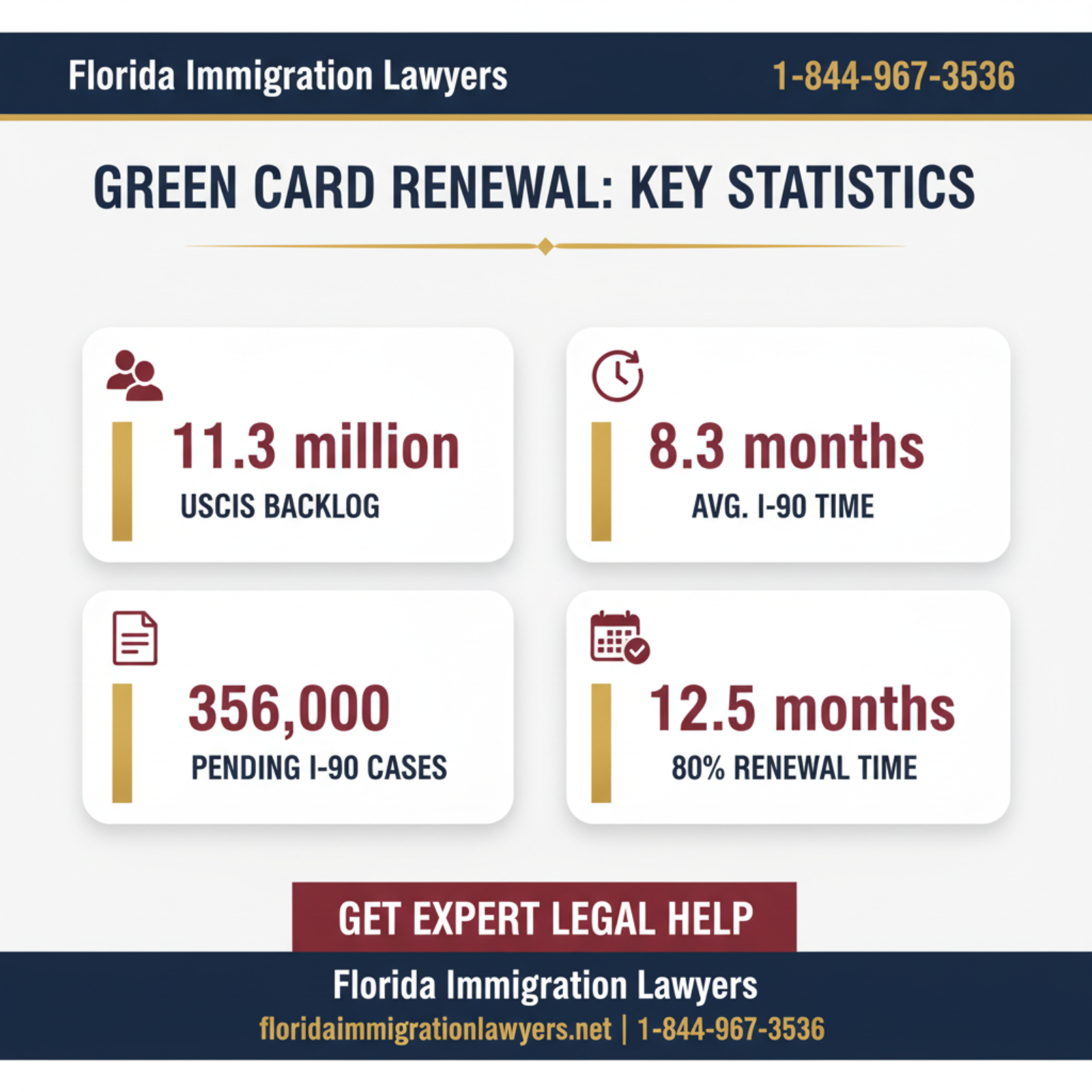
- Processing times can vary, typically ranging from 6-18 months.
- Seek legal counsel if your case has complexities or you need guidance.
Green Card Renewal Florida: Your 2026 Guide for Permanent Residents
Living as a permanent resident in Florida offers many opportunities, but maintaining your immigration status is paramount. If your Green Card is nearing its expiration date, or has already expired, understanding the Green Card renewal Florida process is essential. This guide provides comprehensive information for permanent residents throughout Florida, from Miami to Jacksonville, on how to navigate the Form I-90 application in 2026.
The thought of renewing your Green Card might seem daunting, but with the right information and support, you can ensure a smooth transition. We will walk you through the steps, required documents, timelines, and costs involved. For personalized assistance with your Green Card renewal, do not hesitate to call Florida Immigration Lawyers at 1-844-YO-PELEO for a free consultation. Our team is dedicated to helping Florida's immigrant community.
Understanding Green Card Renewal in Florida for Permanent Residents
Your Green Card, officially known as Form I-551 Permanent Resident Card, serves as proof of your authorization to live and work permanently in the United States. For most permanent residents, this card is valid for 10 years. Renewing your Green Card is typically required when your existing card is expiring within six months, has already expired, or if you received a 2-year conditional Green Card and have not yet filed to remove the conditions.
The Green Card renewal process specifically involves filing Form I-90, Application to Replace Permanent Resident Card, with U.S. Citizenship and Immigration Services (USCIS). This application is crucial for maintaining your legal status. Failing to renew your Green Card can lead to significant complications, including issues with employment, travel, and even re-entry into the U.S.
For Florida permanent residents, understanding the nuances of this process is particularly important due to the state's large and diverse immigrant population. Whether you reside in Miami, Orlando, Tampa, or any other part of Florida, the federal requirements for Green Card renewal are consistent. However, local USCIS field offices may have specific procedures for biometric appointments, which are a standard part of the process.
It is important to note that renewing your Green Card is different from removing conditions on a conditional Green Card. If you have a 2-year conditional Green Card obtained through marriage or investment, you must file Form I-751 (Petition to Remove Conditions on Residence) or Form I-829 (Petition by Investor to Remove Conditions on Permanent Resident Status) respectively, not Form I-90. This guide focuses on the 10-year Green Card renewal process.
Step-by-Step Guide to Renewing Your Green Card (I-90 Process)
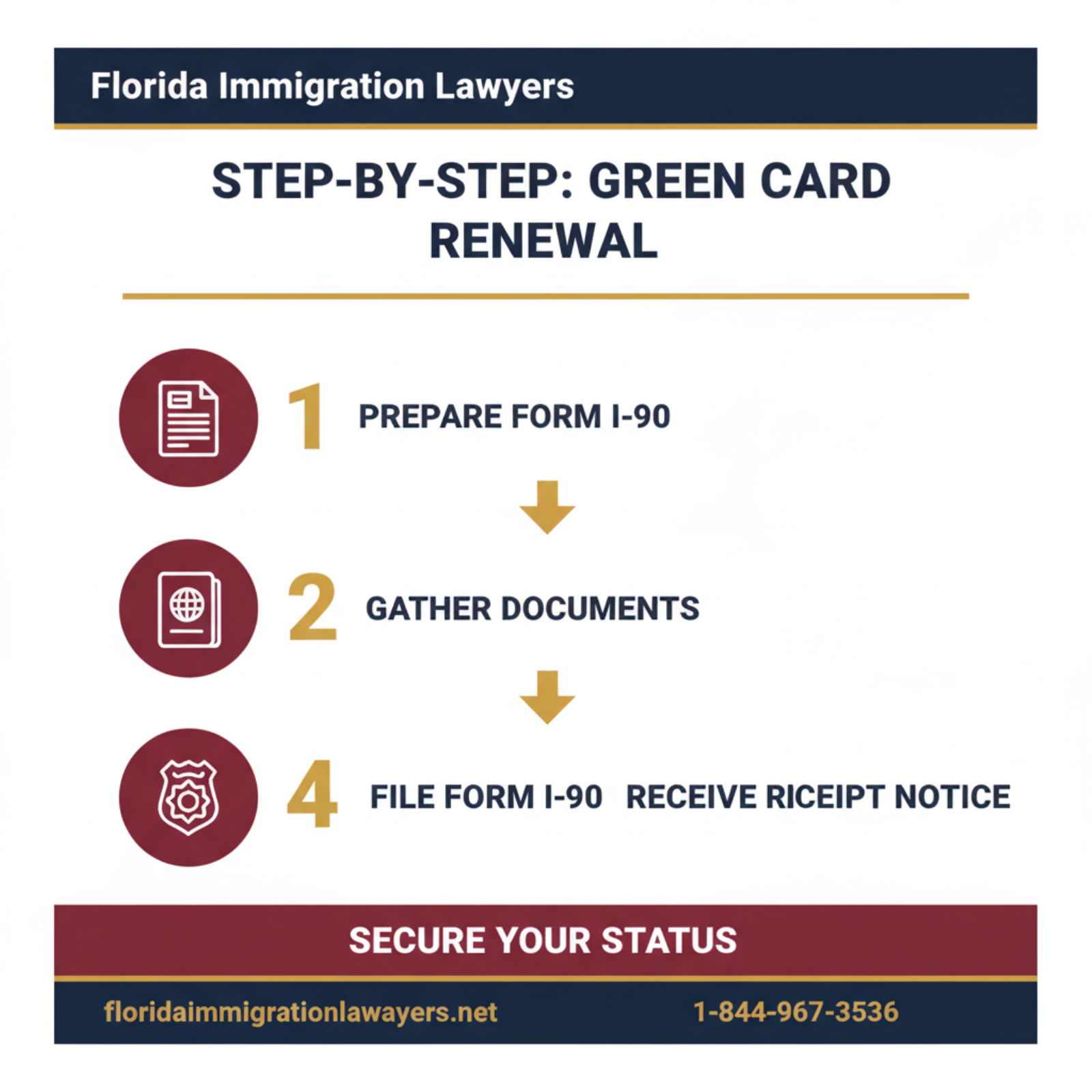
The Green Card renewal process for Florida permanent residents primarily revolves around Form I-90. Here is a detailed, numbered guide to help you through each stage:
-
Determine Your Eligibility for Green Card Renewal
Before you begin, confirm that you need to file Form I-90. You typically need to renew if your 10-year Green Card is expiring within six months or has already expired. You also need to replace it if your card was lost, stolen, damaged, or if you have legally changed your name or other biographical data. Ensure you are not a conditional permanent resident who needs to file Form I-751 or I-829.
-
Gather Necessary Documents for Your I-90 Application
Collect all required supporting documentation. This generally includes your current or expired Green Card. For name changes, you will need legal documentation such as a marriage certificate or court order. A comprehensive list of documents is provided in the next section.
-
Complete Form I-90, Application to Replace Permanent Resident Card
You can file Form I-90 online through the USCIS website or by mail. Filing online is often preferred for its convenience and immediate confirmation. Carefully read all instructions and answer every question truthfully and accurately. Any errors can cause delays in your Green Card renewal.
When completing the form, specify the reason for your application. This could be 'My card is expiring within 6 months or has already expired' or 'My card was lost, stolen, mutilated, or destroyed.' This detail is critical for USCIS to process your application correctly.
-
Pay the Required Filing Fees
The I-90 application requires a filing fee and, in most cases, a biometric services fee. These fees are subject to change, so always check the most current amounts on the official USCIS website before submitting your application. You can pay online if filing electronically or by money order/check if filing by mail.
Certain waivers for the filing fee may be available for eligible applicants experiencing financial hardship. It is important to explore these options if you believe you qualify, as they can significantly reduce the cost of your Green Card renewal.
-
Submit Your Form I-90 Application to USCIS
If filing online, submit electronically. If filing by mail, send your completed Form I-90 and all supporting documents to the USCIS Lockbox facility specified in the Form I-90 instructions. Ensure you send it to the correct address to avoid processing delays. Consider using certified mail with a return receipt for proof of delivery.
-
Attend Your Biometrics Appointment
After USCIS accepts your application, you will receive an appointment notice for biometrics collection at an Application Support Center (ASC). This appointment is mandatory. During this visit, your fingerprints, photograph, and signature will be taken. These biometrics are used for background checks.
It is crucial to attend your scheduled biometrics appointment in Florida. Failure to do so without rescheduling can lead to delays or even denial of your Green Card renewal application. Make sure to bring your appointment notice and a valid photo ID.
-
Receive Your New Green Card
Once your application is approved and your background checks are cleared, USCIS will mail your new Green Card to your address. The processing time can vary significantly. You can check the status of your case online using the receipt number provided by USCIS.
If your Green Card expires while your application is pending, USCIS typically provides an extension stamp (I-551 stamp) in your passport. This stamp serves as temporary proof of your permanent resident status and allows you to travel and work while awaiting your new card. You may need to schedule an InfoPass appointment at a local USCIS office in Florida to obtain this stamp.
Essential Documents for Your Green Card Renewal Application
Gathering the correct documents is a critical step in the Green Card renewal process. Missing or incorrect documentation can cause significant delays. Here is a checklist of documents typically required for your Form I-90 application:
- Your Current Permanent Resident Card: Even if it's expired or about to expire, you generally need to provide a copy of your existing Green Card. If your card was lost or stolen, you will need to explain this in your application.
- Government-Issued Identification: A copy of your driver's license or state ID, especially if you are in Florida, can be helpful for identification purposes during your biometrics appointment.
- Evidence of Name Change (if applicable): If you have legally changed your name since your last Green Card was issued, you must include a copy of the legal document verifying the change. This could be a marriage certificate, divorce decree, or court order.
- Proof of Identity: While not always explicitly requested for a simple renewal, having a copy of your birth certificate or passport can be beneficial for proving identity if USCIS has questions.
- Prior Application Documents: In some cases, USCIS might request copies of previous immigration documents, such as your original immigrant visa or adjustment of status approval notice.
- Photographs: While USCIS typically takes your photo at the biometrics appointment, it is wise to confirm current requirements. Sometimes, two passport-style photos might be requested if filing by mail.
Always refer to the official USCIS instructions for Form I-90 for the most up-to-date and specific document requirements for your particular situation. Preparing these documents in advance will streamline your Green Card renewal application.
Do not navigate this process alone. The complexities of Green Card renewal can be significant. Contact Florida Immigration Lawyers today for reliable legal guidance and support. We are here to assist permanent residents across Florida.
Green Card Renewal Timeline and Processing Expectations in 2026
Many Florida permanent residents ask, "How long does it take to renew a Green Card in Florida?" The processing time for a Green Card renewal application (Form I-90) can vary significantly. While USCIS provides estimated processing times, these are subject to change based on caseloads, policy updates, and the specific USCIS service center handling your case. In 2026, applicants can generally expect the process to take anywhere from 6 to 18 months, or sometimes longer.
Factors Influencing Processing Times for I-90 Applications
- Volume of Applications: Higher volumes of I-90 submissions can naturally extend processing times.
- Accuracy of Application: Errors or missing information in your Form I-90 can lead to requests for evidence (RFEs) or delays.
- Background Checks: The time it takes to complete security and background checks can vary for each individual.
- USCIS Service Center: Different service centers may have varying backlogs and processing speeds. While your physical location in Florida (e.g., Miami, Orlando) doesn't directly impact which service center processes your application, it does affect where you attend biometrics.
What to Expect During the Processing Period
After filing your Form I-90, you will receive a receipt notice from USCIS. This notice confirms that your application has been received and provides a receipt number you can use to track your case online. Shortly after, you will receive an appointment notice for your biometrics at a local Application Support Center in Florida. These appointments are typically scheduled within a few weeks to a few months of filing.
"Do I need an interview to renew my Green Card?" For most Green Card renewal applications, an interview is not required. USCIS generally only schedules an interview if there are specific concerns or complexities in your case, such as issues with your eligibility or past immigration history. However, it is always best to be prepared for any possibility.
If your current Green Card expires while your I-90 application is pending, you can usually obtain a temporary extension of your status. This often involves scheduling an InfoPass appointment at a local USCIS office in Florida, such as the one in Miami, to get an I-551 stamp in your passport. This stamp proves your permanent resident status for up to 12 or 24 months, allowing you to continue working and traveling.
Cost Factors and USCIS Fee Breakdown for I-90
"How much does it cost to renew your Green Card in Florida?" The cost of Green Card renewal is primarily composed of two fees: the USCIS filing fee for Form I-90 and the biometric services fee. These fees are set by USCIS and are subject to change, so it is crucial to verify the current amounts directly on the USCIS website (www.uscis.gov) before submitting your application in 2026.
Understanding the Fees for Form I-90
- Form I-90 Filing Fee: This is the primary fee for processing your application to replace your Permanent Resident Card.
- Biometric Services Fee: This fee covers the cost of collecting your fingerprints, photograph, and signature at an Application Support Center. This fee is typically required for most I-90 applicants.
It is important to note that certain categories of applicants may be exempt from one or both of these fees. For instance, if you are replacing a Green Card that was issued with incorrect information due to a USCIS error, you may not need to pay the filing fee. Always consult the official Form I-90 instructions for specific exemption criteria.
Payment Methods and Fee Waivers
When filing online, you can pay the fees using a credit card, debit card, or U.S. bank account. If filing by mail, you must pay by money order, personal check, or cashier's check. Do not send cash through the mail. Make sure to make checks payable to "U.S. Department of Homeland Security."
USCIS offers fee waivers for certain applicants who demonstrate an inability to pay. To apply for a fee waiver, you must submit Form I-912, Request for Fee Waiver, along with your Form I-90 application. Eligibility for a fee waiver typically depends on your income being at or below 150% of the Federal Poverty Guidelines, receiving a means-tested benefit, or experiencing financial hardship. Discussing your eligibility for a fee waiver with an attorney is always a good idea.
Common Mistakes to Avoid During Green Card Renewal
Renewing your Green Card can be a straightforward process, but many permanent residents make avoidable mistakes that can lead to delays or even denial. Be vigilant and avoid these common pitfalls:
- Filing the Wrong Form: One of the most common errors is filing Form I-90 when you should be filing Form I-751 (to remove conditions on a 2-year Green Card) or vice versa. Filing the wrong form will result in rejection and wasted time and money.
- Missing the Renewal Deadline: Waiting until your Green Card has expired can create unnecessary stress and potential issues with employment or travel. It is advisable to file for Green Card renewal within six months of your card's expiration date.
- Incomplete or Inaccurate Information: Failing to fill out all sections of Form I-90 or providing incorrect information can lead to Requests for Evidence (RFEs) or outright denial. Double-check every entry.
- Forgetting to Sign the Form: A surprisingly frequent mistake is submitting an unsigned Form I-90. An unsigned application is considered incomplete and will be rejected by USCIS.
- Incorrect Fee Payment: Submitting an incorrect fee amount, an expired check, or an improperly made out payment can cause your application to be returned. Always verify current fees on the USCIS website.
- Not Attending Biometrics Appointment: Missing your scheduled biometrics appointment without proper rescheduling can lead to the denial of your Green Card renewal application. This is a mandatory step.
- Failure to Update Address with USCIS: If you move while your application is pending, and fail to update your address with USCIS, you may miss important notices, including your biometrics appointment or approval notice. This is particularly relevant for highly mobile Florida residents.
- Submitting Insufficient Supporting Documents: While I-90 is generally simpler than other applications, if you're replacing a damaged card or correcting an error, ensure all necessary evidence is included. Lack of proof can cause delays.
- Ignoring RFEs: If USCIS sends a Request for Evidence, respond promptly and thoroughly. Ignoring an RFE will almost certainly lead to a denial.
- Assuming Automatic Extensions: While USCIS often provides an I-551 stamp for pending applications, it is not automatic. You may need to proactively schedule an InfoPass appointment to get this temporary proof of status.
When to Call a Florida Immigration Lawyer for Green Card Renewal
While the Green Card renewal process for a 10-year card may seem straightforward for many, certain situations warrant the expertise of a Florida immigration lawyer. Florida Immigration Lawyers can provide invaluable assistance, ensuring your application is accurate and complete, and addressing any potential complexities.
You should consider contacting an attorney if:
- Your Green Card was lost or stolen, and you are concerned about identity theft or have difficulty providing proof.
- You have a criminal record, even minor offenses, which could potentially impact your eligibility or lead to questions from USCIS.
- You have been out of the U.S. for extended periods, potentially raising questions about abandoning your permanent resident status.
- You have received a Notice to Appear (NTA) in immigration court or are facing deportation defense proceedings.
- You have previously been denied a Green Card renewal or had other immigration applications rejected.
- You are a conditional permanent resident, and you are unsure whether to file Form I-90 or Form I-751/I-829.
- You have changed your name multiple times or have discrepancies in your personal information across different documents.
- You are applying for a fee waiver and need assistance preparing the necessary documentation.
- You wish to apply for U.S. Citizenship but are unsure if Green Card renewal or naturalization is the best next step.
Our experienced attorneys at Florida Immigration Lawyers understand the specific challenges faced by immigrants in Florida. We offer comprehensive services for Green Card renewal, family immigration, and other complex immigration matters. We can help you prepare your Form I-90, gather supporting documents, and represent you if any issues arise. Our goal is to protect your status as a florida permanent resident.
About Florida Immigration Lawyers
Florida Immigration Lawyers is a leading law firm dedicated to providing exceptional legal representation to individuals and families throughout Florida. With a deep understanding of U.S. immigration law, our experienced attorneys are committed to helping you navigate the complexities of the immigration system with confidence and peace of mind.
We offer a wide range of services, including assistance with Green Card renewal, asylum applications, deportation defense, business immigration, and citizenship applications. Our firm prides itself on its empathetic approach, personalized attention, and unwavering dedication to achieving the strongest possible outcomes for our clients. We serve all of Florida, including major cities like Orlando.
Your immigration journey is our priority. We are available 24/7 to answer your questions and provide support. For a free consultation, call us at 1-844-YO-PELEO or visit our website at Vasquez Law Firm. Let us be your trusted partner in Florida immigration law.
Sources and References
- U.S. Citizenship and Immigration Services (USCIS) - Form I-90
- U.S. Citizenship and Immigration Services (USCIS) - Form I-912, Request for Fee Waiver
- U.S. Department of Justice - Executive Office for Immigration Review (EOIR)
- 8 U.S.C. § 1304 - Certificates of alien registration or alien registration receipt cards; penalties for failure to carry; content and issuance
- 8 CFR § 264.5 - Application for a new card
- Immigration and Nationality Act (INA) Section 264(d)
This article provides general legal information and is not intended as legal advice. Every case is unique, and outcomes depend on specific facts and circumstances. Contact an attorney for advice about your particular situation.
Securing your future as a permanent resident in Florida starts with a properly renewed Green Card. Don't leave your immigration status to chance. For legal assistance with your Green Card renewal or any other immigration matter, contact Florida Immigration Lawyers today. Call us at 1-844-YO-PELEO for a free consultation. Se Habla Español - Estamos aquí para ayudarle.
Do Not Navigate This Process Alone
Our experienced immigration attorneys are ready to fight for you. Get a free, confidential case review today.
Se Habla Español
Or leave your details and we’ll call you:
Free Evaluation in 24 Hours
Or talk to us right now

AI voice assistant — available 24/7
FreeFrequently Asked Questions

William J. Vásquez
Founding Attorney · Vasquez Law Firm
U.S. Air Force veteran and immigration attorney with years of hands-on U.S. immigration experience. J.D., NCCU School of Law. AILA member. Admitted to the 4th, 5th, and 11th Circuit Courts.
Available 24/7 - Free Evaluations
Reviewed for legal accuracy by William J. Vásquez
Licensed in North Carolina; U.S. immigration is federal practice.
Related Legal Services
Our Florida immigration attorneys can help you with family immigration services, immigration lawyer cost in Florida and experienced immigration attorneys. Call today at 1-844-YO-PELEO for a free case review.
Related Links
Related Topics
Free Legal Case Review
Discuss your case with our experienced attorneys. We're available 24/7.
Se Habla Español - Estamos aquí para ayudarle.
Related Articles
EAD Advance Parole Combo Card in Florida: What You Need
An EAD advance parole combo card allows individuals with pending adjustment applications to both work and travel abroad without jeopardizing their green card application. Learn how to apply in Florida, what documents you need, and common mistakes to avoid.
PERM Labor Certification in Florida: A 2026 Guide
Learn all about the PERM labor certification process in Florida, essential for employers sponsoring green card applicants. Understand the steps, document requirements, and common mistakes to avoid in this 2026 guide.
Dual Citizenship Lawyer in Florida: What You Need to Know
For Florida residents, the concept of dual citizenship, or holding two passports, offers a compelling blend of opportunities and challenges. While the U.S. generally permits dual nationality, the path to achieving this status requires a meticulous understanding of both U.S. immigration laws and the citizenship policies of your country of origin. This guide explores the definition of dual citizenship, the detailed step-by-step process for U.S. naturalization, and the significant benefits and potential pitfalls involved. We cover essential documentation, typical timelines, and cost considerations for 2026, providing crucial insights for anyone in Orlando, Miami, or across Florida considering this important legal step. Learn about common mistakes to avoid and understand when to seek professional legal counsel to navigate this complex process successfully. Florida Immigration Lawyers is here to provide expert, bilingual support for your dual citizenship journey.
Immigration Lawyer Orlando Free Consultation in Florida
For individuals and families in Orlando, Florida, navigating the complexities of U.S. immigration law requires expert guidance. An immigration lawyer in Orlando offers crucial support for everything from visa applications and green card processes to naturalization and deportation defense. This comprehensive guide details what a free consultation covers, providing a step-by-step overview of immigration pathways, essential document checklists, and expected timelines in 2026. We also highlight common mistakes to avoid, discuss the critical role of legal counsel in deportation and asylum cases, and explain why choosing a local Orlando immigration attorney is beneficial. Florida Immigration Lawyers is dedicated to serving the diverse community of Orlando with compassionate, effective legal solutions, ensuring you receive personalized advice and robust representation for a successful immigration journey.