I-601A Provisional Waiver in Florida: What You Need to Know
Navigating the I-601A provisional waiver process in Florida can be complex. Learn how to prove extreme hardship and what steps to take for successful application. Contact Florida Immigration Lawyers for expert guidance.

The I-601A provisional waiver is a crucial step for certain immigrants in the U.S., particularly in Florida, looking to adjust their status without leaving the country. This waiver allows eligible individuals to request a waiver of their unlawful presence before leaving the U.S. for consular processing. Key considerations include proving extreme hardship to a U.S. citizen or permanent resident relative, ensuring all eligibility criteria are met, and understanding the process specific to Florida. Consult with a legal expert to navigate this complex process effectively.
- Focus on proving extreme hardship to qualifying relatives.
- Available to those with unlawful presence issues.
- Processing occurs stateside, beneficial for Florida residents.
- Requires thorough documentation and legal guidance.
Introduction
In the heart of Pembroke Pines, Florida, many families face the challenging decision of dealing with immigration issues while maintaining their lives in the U.S. The I-601A provisional waiver offers hope to those who have accrued unlawful presence but wish to adjust their status without leaving the country. This blog post will guide you through the intricacies of the I-601A waiver, focusing on eligibility, the process, and how Florida Immigration Lawyers can assist you. Call us at 1-844-967-3536 for a free consultation.
For countless individuals and families across Florida, particularly in vibrant communities like Pembroke Pines, the dream of a secure future in the U.S. is often complicated by past immigration challenges. The I-601A provisional waiver stands as a beacon of hope for those who have accrued unlawful presence, offering a pathway to adjust their status and obtain a green card without the daunting prospect of prolonged separation from their loved ones. This crucial mechanism allows eligible individuals to seek a waiver for certain inadmissibility grounds before departing the U.S. for their immigrant visa interview abroad.
The emotional and financial strain of leaving the U.S. for an unknown period can be immense, disrupting lives, careers, and family stability. The I-601A waiver directly addresses this by permitting applicants to remain stateside with their families while their waiver application is processed. This blog post will demystify the intricacies of the I-601A waiver, delving into the precise eligibility requirements, the step-by-step application process, and, most critically, how Florida Immigration Lawyers can provide invaluable assistance every step of the way. Our dedicated team understands the unique challenges faced by Florida residents and is committed to guiding you through this complex journey. Call us today at 1-844-967-3536 for a free, confidential consultation to explore your options and secure your future.
Understanding the I-601A Provisional Waiver
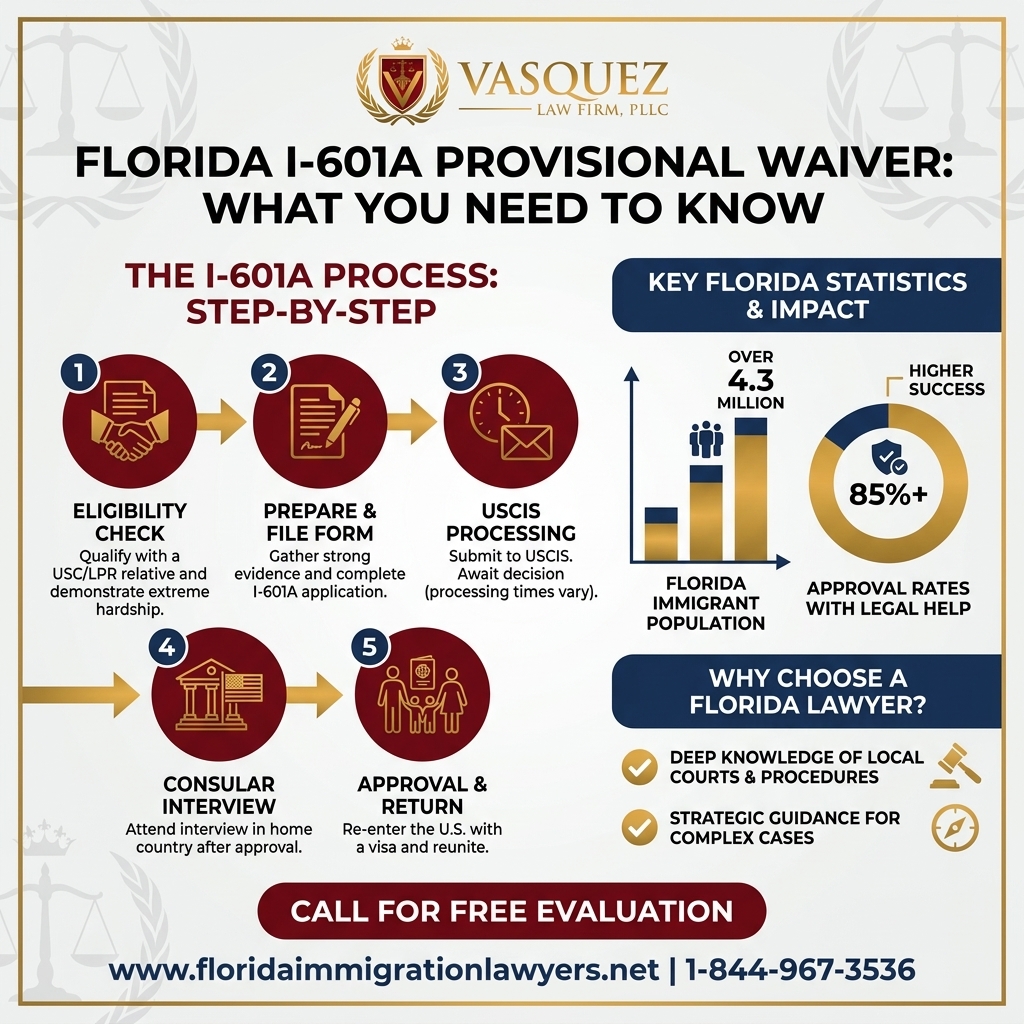
The I-601A provisional waiver is designed for immigrants who are inadmissible due to unlawful presence. This waiver allows you to remain in the U.S. while your application is processed, avoiding the need to return to your home country immediately. For Floridians, navigating this process locally provides a significant advantage, reducing the time and stress associated with international travel for consular processing. The waiver specifically addresses the need to prove 'extreme hardship' to a U.S. citizen or lawful permanent resident spouse or parent.
The I-601A provisional waiver was specifically designed to mitigate the harsh consequences of the 3-year and 10-year bars to re-entry, which are triggered when an individual accrues more than 180 days or one year of unlawful presence, respectively, and then departs the U.S. Prior to this waiver's implementation, individuals facing these bars had to leave the country and apply for a traditional I-601 waiver from abroad, often resulting in prolonged separations from their U.S. citizen or lawful permanent resident (LPR) family members, sometimes for years.
This provisional waiver allows eligible individuals to seek forgiveness for their unlawful presence before they leave the United States for their consular interview. For residents of Florida, this means maintaining continuity in their lives – continuing employment, schooling, and family responsibilities – while their application is under review. It significantly reduces the anxiety and uncertainty associated with international travel and the potential for a lengthy separation, offering a more humane and practical approach to immigration processing. The core of this waiver hinges on demonstrating 'extreme hardship' to a qualifying U.S. citizen or LPR spouse or parent, a standard that requires compelling evidence and a nuanced legal strategy.
It’s important to distinguish the I-601A from the standard I-601 waiver. While both address inadmissibility, the I-601A is provisional and processed stateside before departure, specifically for unlawful presence. The I-601, on the other hand, is filed from abroad and can cover a broader range of inadmissibility grounds, not just unlawful presence. This distinction is vital, as applying for the wrong waiver can lead to significant delays or even denial. Our team at Florida Immigration Lawyers can help you determine which waiver is appropriate for your unique circumstances, ensuring you pursue the correct legal pathway.
Eligibility Criteria
Navigating the eligibility requirements for the I-601A provisional waiver demands meticulous attention to detail. These criteria are stringent, and even a minor oversight can jeopardize your application. It's not enough to simply meet the points; you must prove them with comprehensive and compelling evidence. Understanding each criterion deeply is the first step toward a successful waiver application.
- Be physically present in the U.S. when filing the waiver.
- Have an approved immigrant visa petition and a case pending with the Department of State.
- Prove extreme hardship to a qualifying U.S. citizen or LPR relative.
- Not have a scheduled immigrant visa interview before filing the waiver.
- Meet all other requirements as specified by the USCIS.
This means you must be physically within the geographical borders of the United States on the day your I-601A application is properly filed with USCIS. There are no exceptions for individuals currently outside the U.S. This requirement ensures that the provisional nature of the waiver—allowing stateside processing—is upheld. You will also need to demonstrate continuous physical presence, often through utility bills, leases, school records, and employment history.
This typically means you have an approved Form I-130, Petition for Alien Relative, filed by a U.S. citizen or LPR spouse or parent. Your case must be current for immigrant visa processing, and you must be the principal beneficiary of that approved petition. This step confirms that you have an underlying basis for an immigrant visa, making the waiver a necessary bridge to obtaining your green card.
This is arguably the most challenging and critical component of the I-601A waiver. 'Extreme hardship' is not merely inconvenience or normal difficulty; it requires demonstrating a level of suffering significantly greater than what would typically be experienced by a qualifying relative if you were denied the waiver or forced to remain outside the U.S. Qualifying relatives are limited to U.S. citizen or lawful permanent resident spouses or parents. Hardship to the applicant themselves, or to U.S. citizen children, is considered indirectly as it impacts the qualifying relative. Evidence must cover various aspects: medical conditions (of the qualifying relative or the applicant, impacting the relative), financial burdens, psychological distress, educational disruption, and special needs of family members. For example, if a U.S. citizen spouse relies on the applicant's income for critical medical treatments or if their mental health would severely deteriorate due to separation, this could constitute extreme hardship. Documenting this requires comprehensive medical records, psychological evaluations, financial statements, and detailed affidavits.
This is a strict deadline. If your immigrant visa interview has already been scheduled by the Department of State, you are generally ineligible to file the I-601A waiver. It’s crucial to monitor your immigrant visa petition status closely and file the waiver proactively. Missing this window can force you to pursue the more challenging and time-consuming traditional I-601 waiver from abroad.
This includes not having certain criminal records, previous deportation orders, or other grounds of inadmissibility beyond unlawful presence. The I-601A only waives unlawful presence; it does not waive other grounds of inadmissibility. A thorough review of your entire immigration history is essential to identify any other potential issues. The eligibility criteria are stringent, and failing to meet any of these points can result in denial. It is crucial to ensure all documentation is accurate and complete, and to work with an experienced legal team like Florida Immigration Lawyers to meticulously prepare your application and address any potential red flags. We can help you identify all applicable criteria and gather the necessary evidence to present a strong case.
The eligibility criteria are stringent, and failing to meet any of these points can result in denial. It is crucial to ensure all documentation is accurate and complete.
Document Checklist
A meticulously prepared document package is the backbone of a successful I-601A provisional waiver application. USCIS relies entirely on the evidence you submit to make a decision, so completeness, accuracy, and clarity are paramount. Think of each document as a piece of your story, carefully selected to prove your eligibility and the extreme hardship faced by your qualifying relative.
- Approved immigrant visa petition.
- Evidence of extreme hardship to a U.S. citizen or LPR relative.
- Medical Hardship: Detailed medical records, diagnoses, prognoses, treatment plans, and letters from doctors or specialists for the qualifying relative (or for the applicant if their condition directly impacts the qualifying relative). Include evidence of specialized care, financial burden of medical costs, and availability of care abroad.
- Financial Hardship: Tax returns, employment records, bank statements, mortgage/rent agreements, utility bills, loan documents, and evidence of significant debts. Demonstrate how the qualifying relative's financial stability would be severely impacted by your absence, especially if you are a primary or significant income earner.
- Psychological Hardship: Psychological evaluations, letters from licensed therapists or counselors detailing the qualifying relative's mental health conditions (e.g., depression, anxiety, PTSD) and how your absence would exacerbate them. Include evidence of ongoing therapy and medication.
- Educational Hardship: School records, enrollment information, and letters from school officials if the qualifying relative is a student whose education would be severely disrupted.
- Special Needs: Documentation for children or other dependents with special needs, and how your presence is essential for their care and well-being.
- Country Conditions: Evidence of adverse conditions in your home country that would contribute to the qualifying relative's hardship if they were forced to relocate there (e.g., lack of medical care, safety concerns, economic instability).
- Affidavits: Detailed, notarized letters from the qualifying relative, family members, friends, and community leaders explaining the hardship they would face. These should be specific, personal, and consistent with other evidence.
- Proof of physical presence in the U.S.
- Documents showing ties to the U.S., such as family relationships and employment records.
- Any additional documents requested by the USCIS.
This includes the Form I-797 approval notice for your underlying petition (e.g., I-130). Ensure it clearly states the beneficiary and petitioner information, and that the petition is current.
This is where the bulk of your documentation will lie. It requires a compelling narrative supported by objective evidence. Examples include:
Documents demonstrating your continuous presence in the U.S. since your last lawful entry or over a specific period. This can include leases, utility bills in your name, employment records (pay stubs, W-2s, employment verification letters), school transcripts, medical records, and bank statements. The more varied and consistent the evidence, the stronger your proof.
Beyond proving hardship, these documents reinforce your strong connections to the U.S. This includes marriage certificates, birth certificates of U.S. citizen children, property deeds, tax returns (jointly filed if applicable), and letters from community organizations. These ties help paint a picture of why your continued presence in the U.S. is vital to your family and community.
Be prepared to respond promptly and thoroughly to any Request for Evidence (RFE). An RFE indicates that USCIS needs more information or clarification to make a decision. Failing to respond adequately can lead to denial. Florida Immigration Lawyers can assist in compiling all necessary documents and responding effectively to any USCIS inquiries, ensuring your application is robust and complete.
Timeline and Processing Expectations
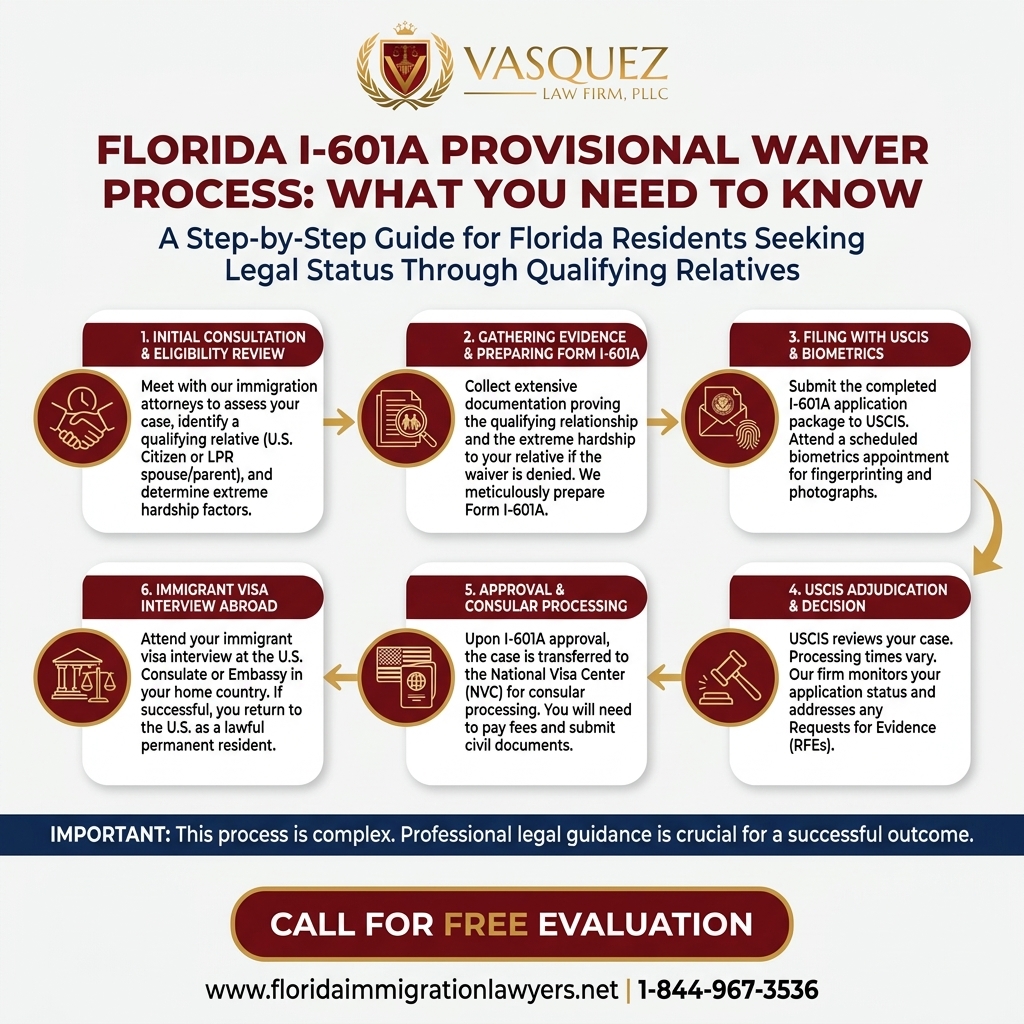
Processing times for the I-601A waiver can vary but generally take several months. The USCIS office in Florida, particularly in Pembroke Pines, handles many of these cases, and understanding their procedures can expedite the process. Once approved, you will proceed to consular processing in your home country, but with the assurance that your unlawful presence has been waived. It is essential to stay informed about your application status and any additional requirements that may arise.
The I-601A provisional waiver process, while stateside, does involve varying processing times that can test an applicant's patience. While generally taking several months, these timelines are subject to fluctuations based on USCIS workload, policy changes, and the complexity of individual cases. It's crucial for applicants in Florida to manage expectations and understand the typical stages involved.
After filing your Form I-601A, you will typically receive a receipt notice from USCIS. The next step usually involves attending a biometrics appointment at a local Application Support Center (ASC), where your fingerprints and photograph are taken. These biometrics are used for background checks. Following this, your case will enter a waiting period during which USCIS reviews your application and supporting evidence, particularly focusing on the extreme hardship claim. During this time, USCIS may issue a Request for Evidence (RFE) if they require additional documentation or clarification. Prompt and thorough responses to RFEs are critical to avoid delays or denials.
Once your I-601A waiver is approved, USCIS will notify both you and the Department of State (DOS). This approval means that your unlawful presence has been waived, and you can proceed with confidence to your immigrant visa interview abroad. The National Visa Center (NVC), a part of DOS, will then schedule your interview at the U.S. Embassy or Consulate in your home country. This final step typically involves a brief interview to confirm your eligibility and ensure no new inadmissibility issues have arisen. While the I-601A approval significantly de-risks this final interview, it is still essential to be prepared. Florida Immigration Lawyers can help you understand the current processing trends and prepare you for every stage, from filing to the consular interview, ensuring a smooth transition to your permanent residency.
Cost Factors and Fee Breakdown
The costs associated with the I-601A waiver can vary based on individual circumstances. While we cannot provide exact amounts as fees are subject to change, applicants should budget for application fees, attorney fees, and potential travel expenses for consular processing. Consulting with Florida Immigration Lawyers can provide a detailed breakdown tailored to your situation, ensuring transparency and preparedness.
Understanding the financial aspects of the I-601A provisional waiver is essential for proper planning. While the exact total cost can vary significantly based on individual circumstances and the complexity of your case, applicants should be prepared for several categories of expenses beyond just the government filing fee. Transparency in these costs helps alleviate stress and ensures you are fully prepared for the journey ahead.
The primary cost is the USCIS filing fee for Form I-601A, which is subject to change, so always check the most current fee on the USCIS website. Beyond this, a substantial portion of the cost will typically be attorney fees. While it might seem like an added expense, the expertise of an experienced immigration lawyer, especially one familiar with I-601A cases in Florida, is invaluable. They assist with meticulous document preparation, compelling hardship arguments, and navigating complex legal nuances, which can ultimately save you time, stress, and the higher cost of a denial. Other potential costs include fees for medical examinations required for the immigrant visa, translation services for foreign documents, and travel expenses for your consular interview abroad. There might also be costs associated with obtaining various supporting documents, such as certified copies of records or psychological evaluations.
At Florida Immigration Lawyers, we believe in clear and upfront communication regarding all costs. During your free consultation at 1-844-967-3536, we can provide a detailed breakdown tailored to your specific situation, helping you budget effectively. We understand that legal fees can be a concern, and we strive to offer practical solutions and transparent pricing, ensuring you can access the expert legal guidance you need without unexpected financial burdens. Investing in quality legal representation is an investment in your future and the stability of your family.
Common Mistakes to Avoid
The I-601A provisional waiver process is fraught with potential pitfalls, and even seemingly minor errors can lead to significant delays or outright denial. Being aware of these common mistakes and taking proactive steps to avoid them is crucial for a successful outcome. Many of these errors stem from a lack of understanding of the stringent requirements or an underestimation of the complexity involved.
- Failing to prove extreme hardship convincingly can lead to denial.
- Not submitting the waiver before the consular interview is scheduled.
- Providing incomplete or inaccurate documentation.
- Not consulting with an immigration attorney for guidance.
- Missing important deadlines or failing to respond to USCIS requests promptly.
- Assuming eligibility without verifying all criteria thoroughly.
- Ignoring changes in immigration law that may affect eligibility.
- U.S. Citizenship and Immigration Services (USCIS)
- Executive Office for Immigration Review (EOIR)
- U.S. Department of State - Bureau of Consular Affairs
- Immigration and Nationality Act (INA), 8 U.S.C. Chapter 12
This is the most frequent reason for denial. Applicants often submit insufficient evidence, provide generic hardship letters, or fail to articulate why the hardship is 'extreme' and not just typical. USCIS requires objective evidence, not just subjective claims. You must demonstrate how your qualifying relative would suffer beyond what is normally expected during separation.
As mentioned, this is a strict eligibility criterion. If your interview is scheduled, you've missed the window for the I-601A. Always monitor your case status and consult with Florida Immigration Lawyers early to ensure timely filing.
Missing documents, outdated forms, inconsistent information, or poorly organized submissions can lead to RFEs or denials. Every piece of evidence must be relevant, legible, and properly translated if not in English.
Attempting to navigate the I-601A process alone is a common, and often costly, mistake. An experienced attorney can identify potential issues, strategize the best approach for proving hardship, and ensure all documentation meets USCIS standards.
USCIS operates on strict timelines. Ignoring notices, failing to respond to an RFE, or submitting late responses can result in your application being abandoned or denied.
Many individuals wrongly believe they qualify without a deep understanding of the specific requirements, especially regarding the 'qualifying relative' and 'extreme hardship' definitions. A preliminary assessment by an attorney is vital.
Immigration laws and policies are dynamic. What was true yesterday might not be true today. Staying informed,
Sources and References
Do Not Navigate This Process Alone
Our experienced immigration attorneys are ready to fight for you. Get a free, confidential consultation today.
Se Habla Español
Frequently Asked Questions
Florida Immigration Lawyers
Immigration Attorney | Founder, Vasquez Law Firm
U.S. Air Force veteran and immigration attorney with thousands of cases resolved. J.D., NCCU School of Law. AILA member. Admitted to the 4th, 5th, and 11th Circuit Courts.
Available 24/7 - Free Evaluations
Related Legal Services
Our Florida immigration attorneys can help you with experienced immigration attorneys, business immigration and asylum protection. Call today at 1-844-967-3536 for a free consultation.
Related Links
Related Topics
Free Legal Consultation
Discuss your case with our experienced attorneys. We're available 24/7.
Se Habla Español - Estamos aquí para ayudarle.
Related Articles
Family Petition Immigration Lawyer Miami: Your Florida Guide
For families in Miami, Kissimmee, and across Florida, securing a family petition is often the first step towards reuniting with loved ones in the U.S. This process, which typically begins with filing Form I-130, Petition for Alien Relative, requires meticulous attention to detail and a thorough understanding of U.S. immigration law. From proving a legitimate family relationship to navigating extensive documentation and often lengthy processing times, the journey can be complex. An experienced family petition immigration lawyer can provide invaluable guidance, helping to avoid common pitfalls, respond to USCIS requests, and ensure a smooth application process. Florida Immigration Lawyers offers dedicated legal support to families statewide, helping them achieve their dreams of reunification.
Immigration Interview Preparation Florida: Your Guide
Preparing for your immigration interview in Florida is a pivotal step towards securing your future. This comprehensive guide provides essential tips, a detailed step-by-step preparation plan, and a crucial document checklist to ensure you are fully ready for your USCIS interview. Learn about common mistakes to avoid, understand processing timelines, and identify when legal assistance from experienced Florida immigration lawyers is vital. Whether you are in Hialeah, Miami, or Orlando, navigating your green card, naturalization, or asylum interview requires meticulous attention to detail and professional guidance. Florida Immigration Lawyers offers free consultations to help you prepare effectively and confidently.
DACA Renewal Florida 2026 Guide for Dreamers | VLF Florida
For DACA recipients in Florida, understanding the DACA renewal process for 2026 is vital. This comprehensive guide details eligibility, step-by-step procedures, essential documents, timelines, and costs. Learn how to file your Form I-821D and I-765, avoid common mistakes, and ensure continuous residence. We cover specific considerations for Dreamers in St. Petersburg and across Florida, emphasizing the importance of timely and accurate submissions to USCIS. Discover when legal assistance from Florida Immigration Lawyers can be crucial, especially for complex cases involving criminal history or travel outside the U.S. Get expert advice to protect your deferred action status and employment authorization.
DACA Renewal Florida 2026 Guide for Dreamers | VLF Florida
Learn how to renew your DACA in Florida for 2026. This guide provides essential steps, common pitfalls, and resources available to Dreamers in Hialeah and beyond. Call Florida Immigration Lawyers at 1-844-967-3536 for a free consultation.