BIA Remand Florida Immigration Appeal Guide
A BIA remand means the Board of Immigration Appeals has sent your case back to an Immigration Judge for further review, often due to a legal or factual error, or to consider new evidence. For individuals in Florida, this is a crucial opportunity to strengthen your immigration appeal and potentially secure a favorable outcome. Navigating the complexities of a BIA remand, from understanding the BIA's specific instructions to gathering compelling evidence and preparing for new hearings, requires meticulous attention to detail and a deep understanding of immigration law. Florida Immigration Lawyers specializes in guiding clients through this intricate process, offering expert legal counsel to address all aspects of your remanded case and protect your rights. Contact us for a free consultation to discuss your options and strategize effectively.

A BIA remand in Florida occurs when the Board of Immigration Appeals (BIA) sends an immigration case back to an Immigration Judge for further proceedings. This often happens if the BIA finds a legal or factual error in the original decision, or if new evidence needs to be considered. For individuals in Florida, a remand offers a critical opportunity to present a stronger case, potentially leading to a favorable outcome. It is a complex legal process that demands thorough preparation and often benefits significantly from experienced legal representation.
- A BIA remand means your case returns to an Immigration Judge.
- It typically involves legal errors, factual disputes, or new evidence.
- This is a crucial opportunity to strengthen your immigration case.
- Skilled legal counsel is highly recommended to navigate the complexities.
Facing an immigration appeal can be one of the most stressful experiences for individuals and families in Florida. The uncertainty of your future, coupled with the complex legal jargon, can feel overwhelming. When the Board of Immigration Appeals (BIA) issues a BIA remand, it means your case is sent back to the Immigration Court for additional review. This is not necessarily a final denial, but rather a second chance to present your case more effectively.
Understanding what a BIA remand entails and how to navigate this critical stage is paramount for anyone seeking to secure their immigration status in the Sunshine State. Whether you are in Pembroke Pines, Miami, Orlando, or anywhere else in Florida, the intricacies of the immigration system require precise attention to detail. This comprehensive guide will illuminate the BIA remand process, common pitfalls, and how expert legal assistance can make a significant difference.
Do not face this complex legal challenge alone. If you have received a BIA remand notice, it is crucial to act swiftly and strategically. Call Florida Immigration Lawyers at 1-844-967-3536 for a free consultation. Our experienced team is ready to help you understand your options and develop a robust strategy.
Understanding a BIA Remand in Florida Immigration Appeals
The Board of Immigration Appeals (BIA) serves as the highest administrative body for interpreting and applying immigration laws. It reviews decisions made by Immigration Judges. When the BIA issues a BIA remand, it signifies that the Board has identified an issue with the Immigration Judge's initial decision and requires further action at the lower court level. This action is usually to correct an error, consider new evidence, or apply a different legal standard. For individuals in Florida, this can occur in cases involving asylum, deportation defense, or other forms of relief.
Common reasons for a BIA remand include an Immigration Judge's legal error, such as misinterpreting a statute or regulation, or a factual error, where the judge overlooked or misweighed crucial evidence. Sometimes, a case is remanded to allow for the introduction of new evidence that was not available or properly presented during the initial hearing. The BIA might also remand a case to allow the Immigration Judge to consider a new form of relief that has become available or relevant since the initial decision. This process is governed by regulations found in 8 CFR Part 1003.
For immigrants in Florida, particularly those with cases heard at the Miami Immigration Court or Orlando Immigration Court, a remand can feel like a setback. However, it is truly an opportunity. It allows you to address the specific concerns raised by the BIA and present a stronger, more complete case. This is your chance to correct past deficiencies or introduce compelling new information that could change the outcome. Understanding the exact reasons for the remand is the first critical step, as it dictates the strategy for the subsequent proceedings.
The Executive Office for Immigration Review (EOIR), which oversees the BIA and Immigration Courts, outlines the procedures for these remands. The BIA's instructions in the remand order are legally binding and must be strictly followed by the Immigration Judge and the parties involved. Failure to adhere to these instructions can lead to further complications or even a dismissal of the relief sought. This highlights the absolute necessity of experienced legal counsel to navigate these complex directives effectively.
The BIA Remand Process: A Step-by-Step Guide for Florida Residents
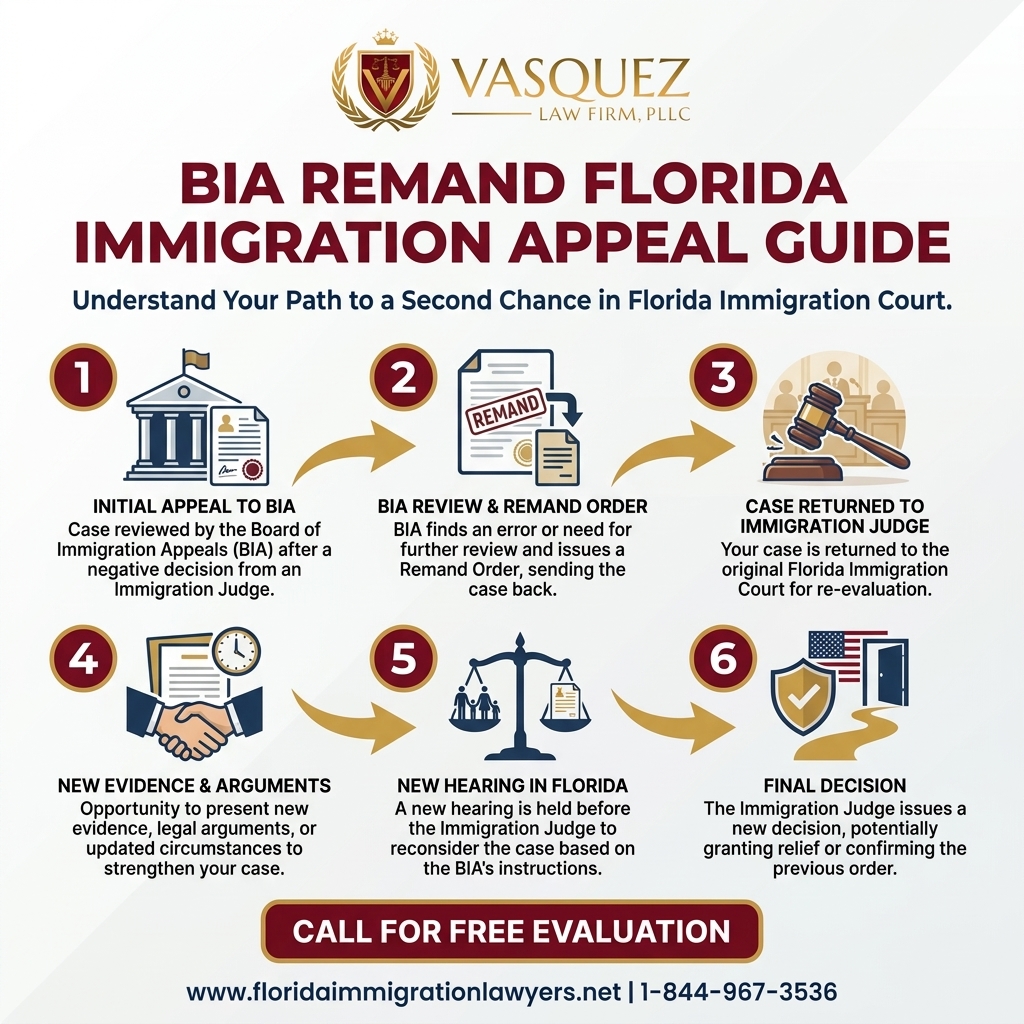
Receiving a BIA remand notice can be confusing, but understanding the steps involved can help you prepare. This process typically unfolds over several stages, bringing your case back to the Immigration Court for reconsideration. Each step requires careful attention and strategic action to maximize your chances of a favorable outcome in Florida.
-
Step 1: Notice of Remand and Case Reassignment. After the BIA issues its decision to remand, the case is sent back to the appropriate Immigration Court. You will receive a notice informing you of the remand and that your case has been reassigned to an Immigration Judge. This notice will often include the specific instructions from the BIA regarding what needs to be addressed. It's crucial to review this document carefully to understand the BIA's directives. The case might return to the same judge or be assigned to a new one, depending on court availability and the nature of the remand.
-
Step 2: Supplemental Briefing and Evidence Submission. The Immigration Judge will typically set a schedule for the submission of supplemental briefs and any new evidence. This is your chance to directly address the BIA's concerns. For example, if the BIA remanded due to a legal error, your attorney will submit a brief arguing the correct application of the law. If new evidence is required, you will need to gather and present it in a compelling and admissible format. This could involve affidavits, expert testimony, or updated country condition reports, all tailored to meet the BIA's specific instructions. Adhering to the deadlines set by the court is critical.
-
Step 3: New Hearing or Status Conference. In many BIA remand cases, the Immigration Judge will schedule a new hearing or a status conference. This hearing allows both parties, you and the government's attorney, to present arguments and evidence related to the remand. The judge will focus specifically on the issues identified by the BIA. This is not usually a full retrial of your entire case, but a focused examination of the remanded issues. Your attorney will prepare you thoroughly for any questions or testimony required, ensuring your presentation is clear and persuasive.
-
Step 4: New Decision by the Immigration Judge. After considering all arguments and evidence, the Immigration Judge will issue a new decision. This decision will directly respond to the BIA's remand order. The outcome could be a grant of the relief you sought, a denial, or even a different form of relief altogether, depending on the specifics of the remand and the evidence presented. It is important to remember that this new decision can also be appealed, either by you or the government, if either party believes there is still an error or disagreement with the outcome.
-
Step 5: Potential Further Appeal. If you or the government are not satisfied with the Immigration Judge's new decision, there may be an opportunity for further appeal. This could be another appeal to the BIA, especially if the judge did not follow the BIA's instructions or made new errors. In certain circumstances, the case could be eligible for review by the U.S. Court of Appeals for the Eleventh Circuit, which covers Florida. This higher level of appeal, known as a circuit court review, involves a different legal standard and process, requiring specialized appellate expertise.
Key Documentation and Evidence for Your Remanded Case
When your case is subject to a BIA remand, the evidence you present can be the deciding factor. The BIA's remand order will often specify the types of evidence or legal arguments that need to be further developed. Gathering and presenting this documentation effectively is crucial for a successful outcome, especially for individuals in Florida aiming to strengthen their immigration appeal.
A comprehensive approach to evidence collection is essential. Here's a general checklist of documents and evidence commonly required, though specific needs will vary based on your case and the BIA's instructions:
- Personal Affidavits: Detailed statements from you and supporting witnesses regarding the facts of your case, hardship, or fear of persecution.
- Expert Witness Statements: Reports or testimony from psychologists, country conditions experts, medical professionals, or financial analysts to substantiate claims.
- Country Conditions Reports: Updated and relevant reports from reputable human rights organizations, government agencies, or academic institutions, particularly for asylum or withholding of removal cases.
- Medical Records: Documentation of physical or psychological conditions, especially if related to persecution, hardship, or eligibility for certain relief.
- Financial Records: Proof of income, assets, and liabilities, which can be critical for establishing economic hardship or the ability to support oneself.
- Family Ties Documentation: Birth certificates, marriage certificates, and other records proving relationships to U.S. citizens or lawful permanent residents in Florida.
- Police Reports/Court Records: Evidence of any criminal history, or lack thereof, and documentation related to rehabilitation or mitigating circumstances.
- Employment Records: Proof of employment history, income, and contributions to the community, demonstrating ties to the U.S. and Florida.
- Educational Records: Diplomas, transcripts, and certificates, highlighting educational achievements and integration into U.S. society.
- Tax Returns: Evidence of consistent tax payments and financial responsibility.
- Updated Legal Briefs: Carefully prepared legal arguments addressing the specific points raised by the BIA in its remand order, citing relevant statutes, regulations, and precedent decisions.
It is vital that all documents are properly organized, translated (if not in English), and submitted according to the Immigration Court's deadlines and formatting requirements. An experienced immigration attorney in Florida can help you identify, gather, and present the most persuasive evidence for your specific remanded case, ensuring compliance with all legal standards. This meticulous preparation can significantly impact the Immigration Judge's new decision.
Timelines and Processing Expectations for BIA Remand Cases
The timeline for a BIA remand case can be highly variable, and managing expectations is key for individuals in Florida awaiting a resolution. While some cases may be resolved relatively quickly, others can stretch on for months or even years, depending on various factors. Understanding these processing expectations is crucial for planning your future and maintaining peace of mind.
Several elements influence the duration of a remanded case. The complexity of the issues the BIA has instructed the Immigration Judge to review is a major factor. Simple legal errors might be corrected with a brief and no new hearing, leading to a quicker resolution. However, if the remand requires extensive fact-finding, the introduction of new witnesses, or multiple rounds of evidence submission, the process will naturally take longer. For example, cases requiring updated country conditions reports or expert psychological evaluations can add significant time.
The caseload and backlog at the specific Immigration Court in Florida also play a significant role. Courts in high-population areas like Miami and Orlando often face heavy dockets, which can delay scheduling new hearings or receiving a decision. The availability of the assigned Immigration Judge, the government attorney, and your own legal counsel can also impact scheduling. Furthermore, the BIA itself may take several months to issue the remand order after the initial appeal, adding to the overall timeline.
Typically, once a case is remanded to the Immigration Court, it may take anywhere from a few months to over a year for a new decision to be rendered. This includes time for notice, scheduling, briefing, hearings, and the judge's deliberation. If either party decides to appeal the new decision, the process extends further, potentially leading to another BIA appeal or even a circuit court review, which can add another one to two years to the overall timeline. While there are no strict statutory deadlines for Immigration Judges to issue decisions on remanded cases, the courts generally strive for efficiency.
Staying informed about your case status and promptly responding to all court notices are essential. Your immigration attorney in Florida will monitor your case closely, providing updates and advising you on the best course of action at each stage. Patience and persistence are vital throughout this often-protracted process.
Cost Factors and Legal Fees in a BIA Remand
Navigating a BIA remand involves various costs, and understanding these financial considerations is important for anyone in Florida pursuing an immigration appeal. While some fees are fixed, legal fees can vary significantly based on the complexity of your case and the attorney you choose. Investing in experienced legal representation is crucial, as it can significantly impact the outcome of your remanded case.
The primary cost associated with a BIA remand is attorney fees. Immigration attorneys in Florida typically charge either an hourly rate or a flat fee for specific stages of the remand process. A flat fee might cover all work related to the remand up to the Immigration Judge's new decision, including preparing briefs, gathering evidence, and attending hearings. Hourly rates are common for more unpredictable or complex cases where the exact amount of work cannot be determined upfront. The specific fee structure will be discussed during your initial consultation with Florida Immigration Lawyers.
Beyond attorney fees, other potential costs include:
- Filing Fees: While there is typically no separate fee for the remand itself, if the BIA's order necessitates filing a new application for relief (e.g., an updated application for adjustment of status or asylum), you may incur associated USCIS filing fees. These fees are subject to change, so it's important to check the USCIS website for the most current amounts.
- Expert Witness Fees: If your case requires testimony or reports from expert witnesses (e.g., psychologists, country condition experts, medical doctors), their professional fees can be substantial.
- Translation Costs: Any documents not in English must be translated by a certified translator, which incurs additional costs.
- Copying and Postage: While seemingly minor, these administrative costs can add up, especially for cases requiring extensive documentation.
- Travel Expenses: If you need to travel to the Immigration Court for hearings, especially from distant parts of Florida, these costs should be factored in.
It is essential to have a clear understanding of all potential costs upfront. During your free consultation with Florida Immigration Lawyers, we will discuss our fee structure transparently and provide an estimate of other anticipated expenses. While legal fees can be a significant investment, the cost of not having effective representation in a critical BIA remand can be far greater, potentially leading to deportation or removal from the U.S. We believe in providing clear, accessible legal services to all our clients in Florida.
Do not navigate this process alone. Contact Florida Immigration Lawyers today at 1-844-967-3536 for a free consultation. Our dedicated team is here to provide the expert legal guidance you need during this crucial stage of your immigration journey.
Navigating Circuit Court Review After a BIA Decision in Florida
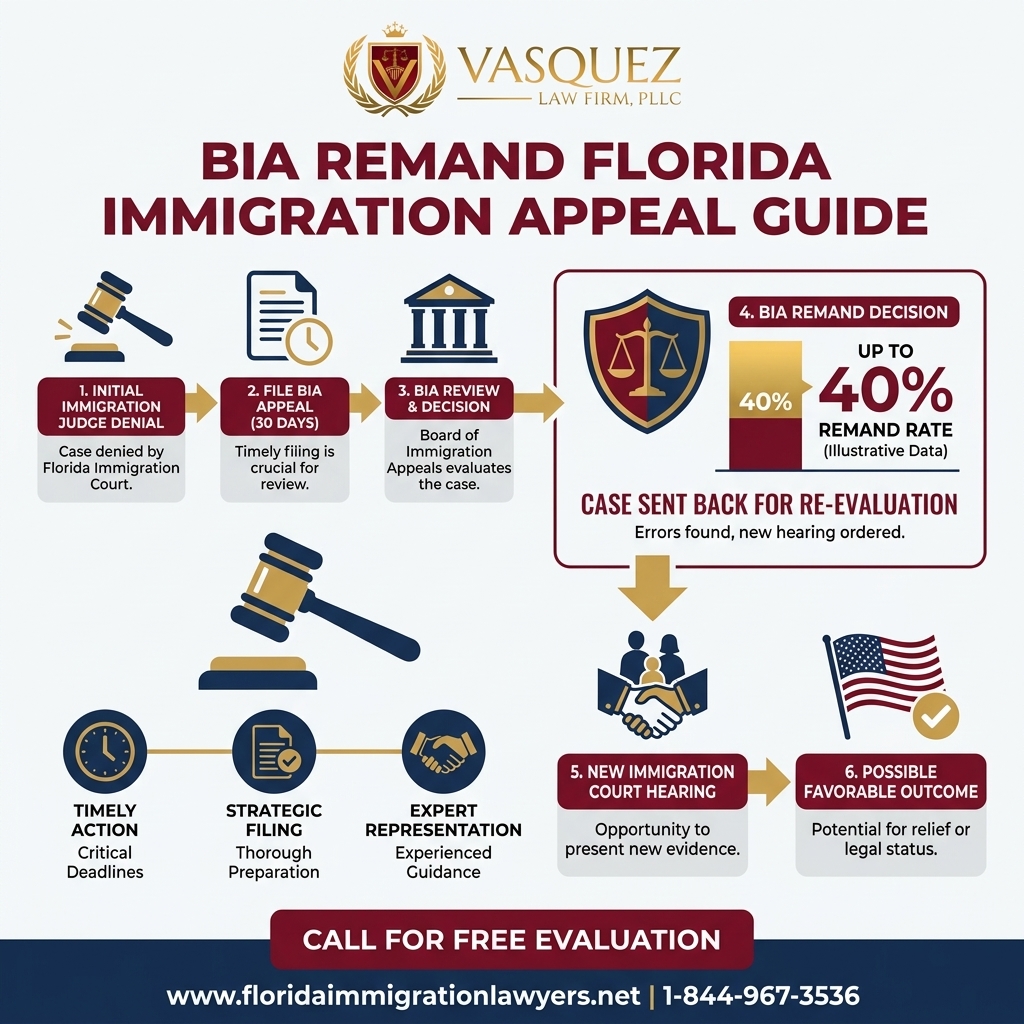
Even after a BIA remand and a subsequent decision from the Immigration Judge, the legal journey may not be over. If you or the government are dissatisfied with the BIA's final decision or the Immigration Judge's decision after remand, the next step may involve seeking review from the U.S. Court of Appeals for the Eleventh Circuit. This process, known as circuit court review, is a highly specialized and complex area of immigration law that requires distinct legal expertise, particularly for residents of Florida.
The Eleventh Circuit Court of Appeals has jurisdiction over federal cases originating in Florida, Georgia, and Alabama. When appealing an adverse BIA decision to the Circuit Court, you are essentially asking a federal appellate court to review the BIA's legal conclusions. This is not a re-evaluation of the facts of your case, but rather a review to determine if the BIA made a legal error, abused its discretion, or if its findings were not supported by substantial evidence. The standard of review is very specific and typically does not allow for the introduction of new evidence.
The timeline for filing a petition for review with the Circuit Court is extremely strict: you generally have only 30 days from the date of the BIA's final decision to file. Missing this deadline is almost always fatal to the appeal. The process involves filing a formal petition, submitting detailed legal briefs, and potentially oral arguments before a panel of federal judges. This level of litigation demands an attorney with extensive experience in federal appellate practice and a deep understanding of the procedural and substantive nuances of immigration law.
Success in circuit court review is challenging. Statistics show that a relatively small percentage of immigration appeals are granted by the Circuit Courts. However, for cases involving clear legal errors by the BIA, or where the BIA's decision fundamentally conflicts with established legal precedent, a petition for review can be a powerful tool. It is crucial to have an attorney who can meticulously analyze the BIA's decision, identify potential grounds for appeal, and articulate compelling legal arguments to the federal court. Florida Immigration Lawyers has experience in handling complex appellate matters and can assess the viability of a circuit court appeal for your specific situation. This final stage of appeal is often the last opportunity to challenge an unfavorable immigration decision in the federal judicial system.
Common Mistakes to Avoid in a BIA Remand Case
Navigating a BIA remand in Florida is fraught with potential pitfalls. Avoiding common mistakes can significantly improve your chances of a successful outcome and prevent further delays or adverse decisions. Be vigilant and proactive in addressing these issues.
-
Missing Critical Deadlines: Immigration proceedings operate under strict deadlines for filing briefs, submitting evidence, and appearing in court. Missing even one deadline can lead to your case being dismissed or relief being denied without further consideration, effectively ending your immigration appeal.
-
Failing to Understand the BIA's Remand Order: The BIA's order will specify the exact reasons for the remand and the issues the Immigration Judge needs to address. Misinterpreting these instructions can lead to presenting irrelevant arguments or evidence, wasting time and resources, and failing to meet the BIA's directives.
-
Submitting Insufficient or Irrelevant Evidence: Simply submitting more documents is not enough. The evidence must be directly relevant to the issues raised by the BIA and presented in a clear, compelling, and admissible manner. Generic or poorly organized evidence will not sway the Immigration Judge.
-
Lack of Legal Representation: Attempting to handle a BIA remand without an experienced immigration attorney is a significant risk. The legal complexities, procedural requirements, and the need for persuasive legal arguments are often too challenging for non-lawyers, even those fluent in English, to manage effectively.
-
Ignoring Changes in Immigration Law or Policy: Immigration law is constantly evolving. A BIA remand might occur years after your initial hearing, and new laws, regulations, or precedent decisions could impact your case. Failing to incorporate these changes into your strategy can weaken your appeal.
-
Not Preparing Adequately for the New Hearing: If a new hearing is scheduled, it is not a mere formality. You and any witnesses must be thoroughly prepared for testimony, cross-examination, and to address the specific issues of the remand. Poor preparation can undermine even a strong case.
-
Failing to Preserve Issues for Further Appeal: If the Immigration Judge makes new errors after the remand, you must ensure these errors are properly objected to and documented. This preserves your right to a subsequent appeal to the BIA or a circuit court review, should it become necessary.
-
Not Informing the Court of Address Changes: All court notices are sent to your last known address. Failing to update the Immigration Court and the BIA with any change of address can result in missed notices, missed hearings, and potentially an order of removal in absentia.
When to Call a Lawyer for Your BIA Remand Case
A BIA remand is a critical juncture in your immigration journey, and knowing when to seek legal counsel can be the difference between success and failure. While it may seem tempting to handle the process yourself, the complexities of immigration law, especially at the appellate level, often demand the expertise of an experienced attorney. If you are in Florida and have received a remand notice, contacting Florida Immigration Lawyers promptly is highly advisable.
You should call an attorney immediately if:
- You receive a BIA remand order: The moment you receive this notice, it's time to consult with an attorney. They can help you understand the specific instructions from the BIA and begin planning your strategy.
- The BIA's instructions are unclear or complex: Remand orders can be dense with legal terminology. An attorney can translate these into actionable steps and ensure you fully comply with the BIA's directives.
- New evidence needs to be presented: Gathering, authenticating, and properly submitting new evidence requires legal skill to ensure it is admissible and persuasive.
- There have been changes in immigration law: Laws and policies can change rapidly. An attorney stays current with these developments and knows how they might impact your case.
- You face potential deportation or removal: If your immigration status is at risk, the stakes are incredibly high. An attorney provides the best defense against removal proceedings.
- You are considering a circuit court review: Appealing to a federal Circuit Court is an entirely different legal arena, requiring specialized federal appellate experience.
- You have a complicated personal history: Past criminal issues, multiple immigration applications, or other complex personal circumstances make legal representation indispensable.
Florida Immigration Lawyers has a proven track record of assisting clients throughout Florida, including Pembroke Pines and surrounding communities, with complex immigration appeals and BIA remands. Our attorneys understand the local courts, the specific challenges faced by immigrants in Florida, and the nuances of federal immigration law. We offer comprehensive services, from preparing detailed legal briefs to representing you at new hearings and, if necessary, pursuing circuit court review.
About Florida Immigration Lawyers
Florida Immigration Lawyers is a leading law firm dedicated to providing comprehensive and compassionate immigration legal services across the entire state of Florida. With years of specialized experience, our attorneys are committed to guiding individuals and families through the intricate processes of U.S. immigration law. From initial consultations to complex appeals, we stand as a beacon of hope and advocacy for our clients.
We understand that immigration matters can be life-changing, which is why we offer personalized attention and strategic legal solutions tailored to each client's unique circumstances. Our practice areas include general immigration, asylum, deportation defense, citizenship, and family and business immigration. We pride ourselves on our deep knowledge of immigration law and our unwavering commitment to achieving the best possible outcomes.
At Florida Immigration Lawyers, we are available 24/7 to address your urgent needs and offer free consultations to help you understand your options without financial pressure. We serve clients in all Florida cities, including Pembroke Pines, Miami, Orlando, Tampa, and Jacksonville. Our bilingual team is ready to assist you. Visit our attorneys page to learn more about our dedicated legal professionals, or contact us directly.
Sources and References
- U.S. Citizenship and Immigration Services (USCIS)
- Executive Office for Immigration Review (EOIR)
- 8 U.S.C. Chapter 12 - Immigration and Nationality Act (INA)
- 8 CFR Part 1003 - Executive Office for Immigration Review
- U.S. Court of Appeals for the Eleventh Circuit - Rules and Precedent
Related services: immigration waivers, humanitarian protection programs, DACA renewal and applications, temporary protected status (TPS).
This article provides general legal information and is not intended as legal advice. Every case is unique, and outcomes depend on specific facts and circumstances. Contact an attorney for advice about your particular situation.
A BIA remand is a critical opportunity to protect your future in Florida. Do not let the complexity of the process deter you from seeking the justice you deserve. The experienced team at Florida Immigration Lawyers is here to provide the dedicated and knowledgeable representation you need. Call us today for a free consultation at 1-844-967-3536. Se Habla Español - Estamos aquí para ayudarle.
Do Not Navigate This Process Alone
Our experienced immigration attorneys are ready to fight for you. Get a free, confidential consultation today.
Se Habla Español
Frequently Asked Questions
Florida Immigration Lawyers
Immigration Attorney | Founder, Vasquez Law Firm
U.S. Air Force veteran and immigration attorney with thousands of cases resolved. J.D., NCCU School of Law. AILA member. Admitted to the 4th, 5th, and 11th Circuit Courts.
Available 24/7 - Free Evaluations
Related Legal Services
Our Florida immigration attorneys can help you with immigration practice areas, free immigration consultation and experienced immigration attorneys. Call today at 1-844-967-3536 for a free consultation.
Related Links
Related Topics
Free Legal Consultation
Discuss your case with our experienced attorneys. We're available 24/7.
Se Habla Español - Estamos aquí para ayudarle.
Related Articles
Understanding H-4 EAD Spouse Work Permit Rules in Florida
Discover the essential rules for obtaining an H-4 EAD spouse work permit in Florida. Learn about eligibility, application steps, and common pitfalls. Contact Florida Immigration Lawyers for a free consultation.
Immigration Medical Exam: Tampa, Florida Guide | VLF Florida
Navigate the immigration medical exam process in Tampa, Florida with ease. Learn about requirements, steps, and common mistakes. Contact Florida Immigration Lawyers for a free consultation.
Deportation Defense Lawyer in Orlando: Your Guide | VLF Florida
Facing deportation in Orlando? Learn how a deportation defense lawyer can help you navigate removal proceedings and protect your rights. Call now for a free consultation.
Prepare for Credible Fear Interview in Florida | VLF Florida
Preparing for a credible fear interview in Florida is crucial for those facing expedited removal. Learn key steps to take and mistakes to avoid. Call Florida Immigration Lawyers for guidance.
