Understanding H-4 EAD Spouse Work Permit Rules in Florida
Discover the essential rules for obtaining an H-4 EAD spouse work permit in Florida. Learn about eligibility, application steps, and common pitfalls. Contact Florida Immigration Lawyers for a free consultation.

- Eligibility criteria based on H-1B status
- Application process and required documentation
- Common mistakes to avoid
Introduction
If you're an H-4 visa holder living in Kissimmee, Florida, and seeking to work legally, the H-4 EAD is essential. This blog post will guide you through the rules, application process, and common pitfalls. Call Florida Immigration Lawyers at 1-844-967-3536 for a free consultation.
The H-4 EAD represents a significant opportunity for many families, transforming the lives of H-1B spouses by allowing them to pursue careers, contribute to household income, and achieve greater financial independence. For individuals and families in Kissimmee, this authorization can mean the difference between merely residing in the U.S. and actively participating in its vibrant economy and community.
Beyond the immediate financial benefits, the H-4 EAD fosters a sense of stability and belonging. It enables spouses to utilize their skills and education, reducing the stress often associated with dependent visa statuses. Understanding every detail of this process is paramount, as even minor errors can lead to substantial delays or outright denials, impacting your family's plans and well-being. Our team at Florida Immigration Lawyers is here to ensure a smooth application.
Understanding the H-4 EAD
The H-4 EAD allows spouses of H-1B visa holders to work in the U.S. This work authorization is critical for families looking to contribute financially. Notably, the H-4 EAD is contingent on the H-1B visa holder maintaining their status and having an approved Form I-140.
For families in Florida, especially in areas like Kissimmee, understanding local USCIS office procedures can streamline the process. The H-4 EAD not only provides employment opportunities but also helps integrate families into the community.
Introduced in 2015, the H-4 EAD rule was a landmark change designed to alleviate the challenges faced by H-1B families, particularly those stuck in lengthy green card backlogs. Before this rule, H-4 spouses were largely unable to work, leading to significant personal and financial strain. The EAD has since empowered thousands to pursue professional goals, start businesses, and contribute their talents to the U.S. economy.
This authorization offers flexibility, allowing H-4 spouses to work for any employer, start their own business, or even pursue higher education while working. This freedom contrasts sharply with the H-1B visa, which is employer-specific. For families settling in Kissimmee, this means greater economic stability and the ability to plan for a long-term future in the United States, knowing both partners can pursue their career aspirations. It truly makes the U.S. a more welcoming place for skilled immigrant families.
Eligibility Criteria for H-4 EAD
Eligibility for the H-4 EAD hinges on two main factors: the H-1B holder's status and the approval of Form I-140 (Immigrant Petition for Alien Worker). Additionally, the H-1B visa holder must be in the process of seeking lawful permanent resident status.
It's essential for applicants in Florida to ensure all eligibility criteria are met before applying. Any discrepancies can lead to delays or denials, impacting your ability to work legally in the U.S.
The requirement for an approved Form I-140 signifies that the H-1B visa holder has taken a significant step towards obtaining lawful permanent residency (a green card). This condition ensures that the H-4 EAD is primarily granted to spouses of H-1B workers who are on a clear path to permanent residency, rather than those whose stay might be temporary. Without an approved I-140, an H-4 spouse typically cannot apply for an EAD, even if the H-1B holder has an approved PERM labor certification.
Furthermore, the H-1B visa holder must consistently maintain their valid H-1B nonimmigrant status throughout the EAD application and validity period. Any lapse in their H-1B status, such as unauthorized employment or a significant period out of status, could jeopardize the H-4 EAD application or lead to its revocation. Practical tip for Kissimmee residents: regularly verify your H-1B spouse’s status and I-140 approval through official USCIS channels or with Florida Immigration Lawyers to prevent any unpleasant surprises.
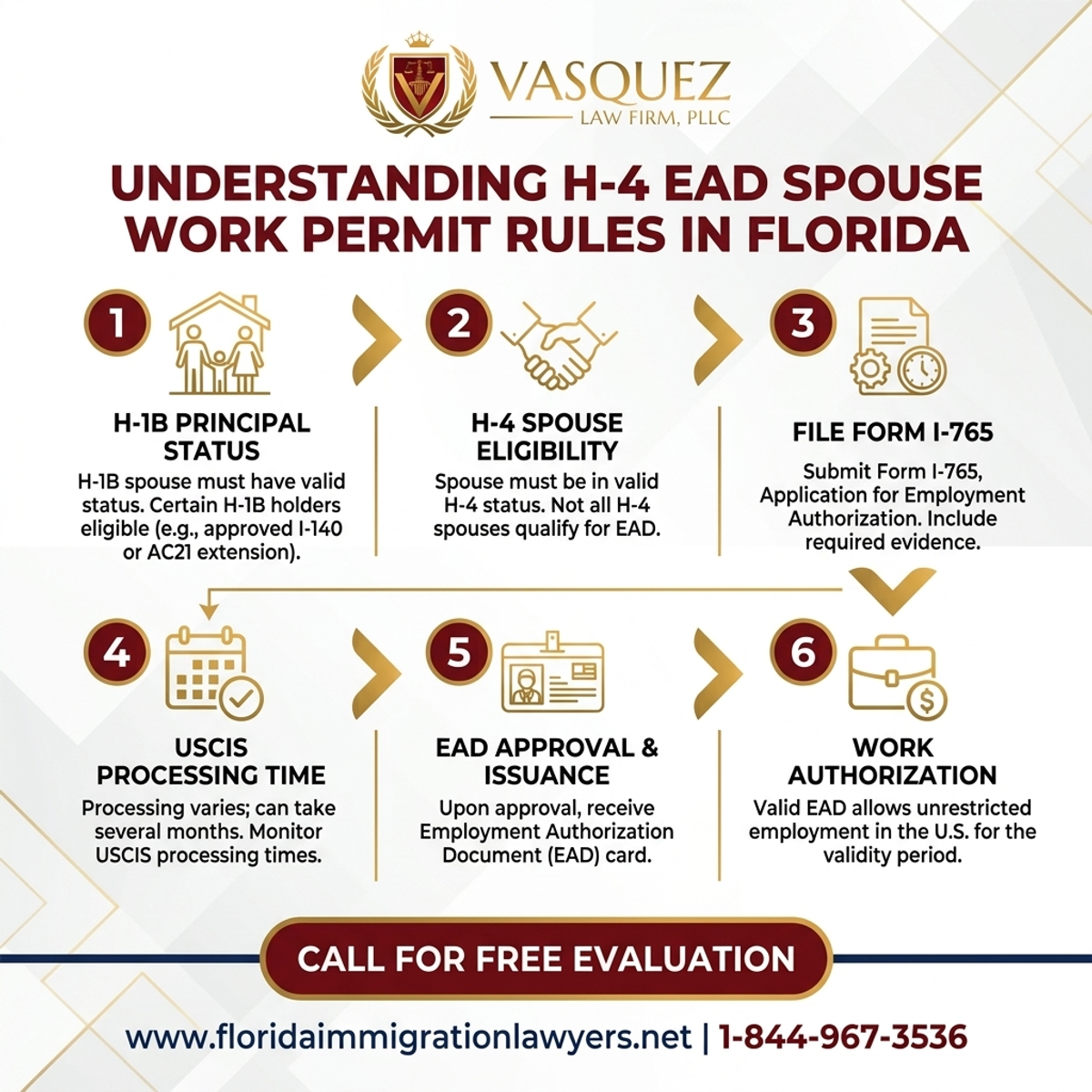
Step-by-Step Process — Understanding H-4 EAD Spouse Work Permit Rules in Florida
Step-by-Step Guide to Applying for H-4 EAD
Navigating the H-4 EAD application process requires meticulous attention to detail. A structured approach can significantly reduce the chances of errors and delays. Here’s a comprehensive step-by-step guide to help you through the journey:
- Gather Required Documents: Prepare documents such as your marriage certificate, H-1B visa holder's Form I-140 approval, and current H-4 visa. This step is foundational; ensure all documents are current, legible, and properly translated if not in English. For instance, a marriage certificate from outside the U.S. might need a certified translation.
- Complete Form I-765: This is the application for employment authorization. Make sure to fill it accurately to avoid delays. Pay close attention to question 27, where you must enter the correct eligibility category (c)(26) for H-4 EAD. Inaccurate information here is a common reason for RFEs or denials.
- Submit Application: Mail your completed application to the designated USCIS office. Ensure all documents are included. It's highly recommended to send your application via certified mail with a return receipt to track delivery and confirm USCIS receives it. Keep copies of everything you send.
- Await Processing: Processing times vary; monitor your application status through the USCIS website. After submission, you will receive a receipt notice (Form I-797C) which contains your case number. Use this number to track your application online.
- Receive EAD: Once approved, you'll receive the EAD card, allowing you to seek employment. This card is your proof of work authorization. Always carry it with you when seeking employment and present it to your employer for I-9 verification.
Following these steps diligently is crucial for a successful application. Many applicants find that seeking professional assistance from immigration attorneys, such as Florida Immigration Lawyers, can provide peace of mind and significantly improve the application's accuracy and completeness, especially for those in Kissimmee unfamiliar with the nuances of federal immigration procedures.
Document Checklist for H-4 EAD Application
A thorough and accurate document checklist is your best defense against processing delays. Double-checking each item before submission can save you weeks or even months of waiting.
- Completed Form I-765
- Copy of marriage certificate
- Copy of H-1B visa holder's Form I-140 approval notice
- Copy of your H-4 visa
- Two passport-sized photos
- Applicable filing fee
Beyond this core list, consider including copies of your H-4 I-94 record, your H-4 approval notice (I-797), and the H-1B holder's most recent I-797 approval notice. These additional documents can provide a more complete picture to USCIS and preempt potential requests for evidence. Always ensure your photos meet USCIS specifications, as incorrect photos are a frequent cause of application rejection. For residents of Kissimmee, Florida Immigration Lawyers can help compile and review your documents to ensure everything is in order.
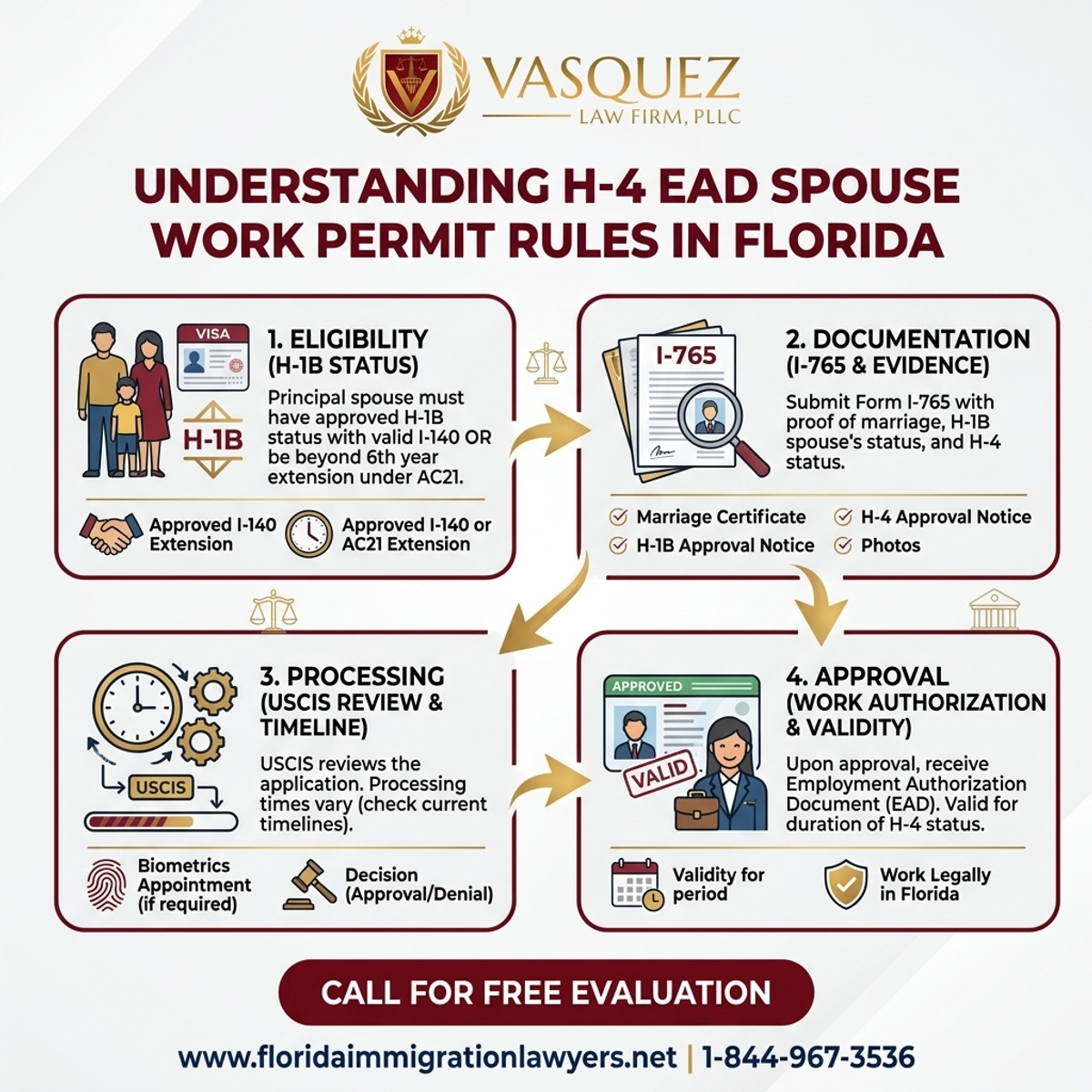
Key Statistics — Understanding H-4 EAD Spouse Work Permit Rules in Florida
Timeline and Processing Expectations
Processing times for H-4 EAD applications can vary based on USCIS workload and specific circumstances. Typically, applicants in Florida can expect a processing time of 3 to 5 months. It's crucial to apply well in advance of any planned employment start date.
Several factors can influence the processing timeline, including the specific USCIS service center handling your application, the volume of applications they are receiving, and whether your application triggers a Request for Evidence (RFE). An RFE can add several weeks or even months to the process, making it essential to submit a complete and error-free application initially.
While premium processing is available for some visa categories, it is generally not available for H-4 EAD applications themselves. However, if your H-1B spouse's I-140 petition was filed under premium processing, its faster approval might expedite your eligibility. It is always wise to check the most current processing times on the USCIS website for the specific service center handling your case. For personalized advice on managing expectations and planning your application timeline in Kissimmee, consult with Florida Immigration Lawyers.
Cost Factors and Fee Breakdown
While specific filing fees for the H-4 EAD can change, applicants should budget for the standard USCIS filing fee. Additional costs may include document preparation and mailing expenses. Consider consulting with an attorney to ensure all fees are correctly accounted for.
The USCIS filing fee for Form I-765 is a non-refundable expense and is subject to change, so always verify the current fee on the official USCIS website before submitting your application. Payment must be made by check or money order payable to "U.S. Department of Homeland Security." Incorrect payment amounts or methods are common reasons for application rejection.
Beyond the USCIS fee, applicants should anticipate other potential costs. These might include professional passport photo services, certified translation fees for foreign documents, and secure mailing services (e.g., USPS Certified Mail with Return Receipt). If you opt for legal assistance, attorney fees will also be a factor. While these additional costs can add up, investing in a properly prepared application can save you significant time and money in the long run by avoiding delays or denials. Florida Immigration Lawyers can provide a clear breakdown of all anticipated costs for Kissimmee residents.
Middle CTA
Do not navigate this process alone. Contact Florida Immigration Lawyers today for expert guidance and assistance.
Common Mistakes to Avoid
The path to securing an H-4 EAD can be complex, and even minor missteps can lead to significant setbacks. Being aware of common pitfalls can help you navigate the process more smoothly.
- Incorrect Form Completion: Mistakes on Form I-765 can lead to rejection. Double-check all entries. Even a single unchecked box or an outdated address can result in an RFE or outright denial, forcing you to restart the process.
- Missing Documents: Ensure all required documents are included to avoid delays. Forgetting a copy of your marriage certificate or the H-1B holder's I-140 approval notice will inevitably lead to an RFE, extending your wait time considerably.
- Not Checking Eligibility: Verify eligibility before applying to prevent wasted time and resources. Applying without an approved I-140 for the H-1B spouse, for example, will result in an automatic denial.
- Delaying Application: Start the process early to account for processing times. Waiting until your H-4 status is about to expire or until you have a job offer can leave you in a precarious position due to USCIS processing backlogs.
- Incorrect Filing Fee: Confirm the current fee to avoid application rejection. USCIS fees change periodically. Always verify the exact amount on the official website and ensure your payment method is correct.
- Ignoring Status Changes: Keep track of any changes in H-1B status that might affect your eligibility. If the H-1B holder changes employers or their I-140 is revoked, your EAD eligibility could be compromised.
- Not Consulting an Attorney: Professional guidance can prevent costly mistakes. An experienced immigration lawyer, like those at Florida Immigration Lawyers, can identify potential issues before they become problems, ensuring your application is robust.
Avoiding these common errors is crucial for a timely and successful H-4 EAD application. Proactive preparation and, when in doubt, seeking expert advice can make all the difference for families in Kissimmee.
When to Call a Lawyer
Consider contacting an attorney if you're unsure about eligibility, need help with document preparation, or face complex family or employment situations. Florida Immigration Lawyers offer expert support, ensuring your application is handled correctly.
While the H-4 EAD application might seem straightforward for some, specific circumstances can introduce significant complexity, making legal counsel invaluable. For example, if you or your H-1B spouse have a history of immigration violations, criminal convictions, or previous denials, an attorney can help assess the impact on your eligibility and strategize the best approach.
Furthermore, if your family situation is complex—such as a recent divorce and remarriage, or if the H-1B holder has recently changed employers—an attorney can ensure all necessary documentation and explanations are provided to USCIS. Receiving a Request for Evidence (RFE) from USCIS is another critical juncture where legal expertise becomes essential. An attorney can help you understand the RFE, gather the necessary evidence, and craft a compelling response to avoid denial. Don't hesitate to call Florida Immigration Lawyers at 1-844-967-3536 for guidance.
About Florida Immigration Lawyers
Florida Immigration Lawyers, based in Kissimmee, offers comprehensive services for H-4 EAD applicants. Our team is dedicated to helping families navigate the immigration process seamlessly. Call us at 1-844-967-3536 or visit our website for a free consultation. Available 24/7.
Sources and References
- U.S. Citizenship and Immigration Services (USCIS)
- Executive Office for Immigration Review (EOIR)
- 8 U.S.C. Chapter 12 - Immigration and Nationality Act
Related services: family petition process, family-based green cards, fiancé visa (K-1), marriage-based immigration.
This article provides general legal information and is not intended as legal advice. Every case is unique, and outcomes depend on specific facts and circumstances. Contact an attorney for advice about your particular situation.
Final CTA
For personalized assistance with your H-4 EAD application in Kissimmee, contact Florida Immigration Lawyers at 1-844-967-3536. Se Habla Espanol - Estamos aqui para ayudarle.
If you need legal assistance, learn more about family immigration consultation, or call us at 1-844-967-3536 for a free consultation.
Do Not Navigate This Process Alone
Our experienced immigration attorneys are ready to fight for you. Get a free, confidential consultation today.
Se Habla Español
Frequently Asked Questions
Florida Immigration Lawyers
Immigration Attorney | Founder, Vasquez Law Firm
U.S. Air Force veteran and immigration attorney with thousands of cases resolved. J.D., NCCU School of Law. AILA member. Admitted to the 4th, 5th, and 11th Circuit Courts.
Available 24/7 - Free Evaluations
Related Legal Services
Our Florida immigration attorneys can help you with asylum protection, deportation defense and citizenship and naturalization. Call today at 1-844-967-3536 for a free consultation.
Related Links
Related Topics
Free Legal Consultation
Discuss your case with our experienced attorneys. We're available 24/7.
Se Habla Español - Estamos aquí para ayudarle.
Related Articles
Immigration Medical Exam: Tampa, Florida Guide | VLF Florida
Navigate the immigration medical exam process in Tampa, Florida with ease. Learn about requirements, steps, and common mistakes. Contact Florida Immigration Lawyers for a free consultation.
Deportation Defense Lawyer in Orlando: Your Guide | VLF Florida
Facing deportation in Orlando? Learn how a deportation defense lawyer can help you navigate removal proceedings and protect your rights. Call now for a free consultation.
Prepare for Credible Fear Interview in Florida | VLF Florida
Preparing for a credible fear interview in Florida is crucial for those facing expedited removal. Learn key steps to take and mistakes to avoid. Call Florida Immigration Lawyers for guidance.
E-2 Visa for Investors in Florida Business | VLF Florida
Explore how the E-2 visa can help you invest in a business in Hollywood, Florida. Learn about eligibility, processing times, and common mistakes. Contact Florida Immigration Lawyers for a free consultation.