K-3 Visa Florida: Spousal Visa Timeline 2026 Guide
For U.S. citizens in Florida hoping to reunite with their foreign spouses, the K-3 visa offers a crucial pathway. This nonimmigrant spouse visa allows your loved one to enter the U.S. while their permanent residency petition (Form I-130) is still pending, significantly reducing separation times. This comprehensive guide from Florida Immigration Lawyers details the K-3 visa timeline for 2026, including the step-by-step process, essential document checklists, and expected processing times. We cover the filing of Form I-130 and Form I-129F, consular processing, and the final adjustment of status. Learn how to avoid common mistakes and when to seek professional legal assistance to ensure a smooth journey for your family. Contact us for a free consultation.

The K-3 visa is a nonimmigrant spouse visa designed to shorten the separation period for U.S. citizens and their foreign spouses while the immigrant visa (IR-1/CR-1) petition (Form I-130) is pending. For Florida residents, the process involves filing Form I-130, followed by Form I-129F, petitioning for a nonimmigrant spouse. While K-3 processing times can vary significantly, typically ranging from 12 to 24 months in 2026, it offers a pathway for spouses to enter the U.S. sooner. It is crucial to meet all eligibility requirements and meticulously prepare documents to navigate this complex journey successfully.
- K-3 visa bridges the gap for spouses awaiting I-130 approval.
- Requires both I-130 and I-129F petitions.
- Processing times for 2026 are estimated between 12-24 months.
- Allows the foreign spouse to enter the U.S. and apply for adjustment of status.
- Legal guidance from Florida Immigration Lawyers is highly recommended.
Moving to Florida to be with your U.S. citizen spouse is a dream for many, but the journey through immigration can often feel like a maze of forms, waiting periods, and complex legal requirements. Specifically, understanding the K-3 visa timeline for 2026 can be daunting. You might be wondering how long it will take for your loved one to join you in Tampa, Miami, or anywhere across the Sunshine State. The K-3 nonimmigrant spouse visa was created precisely to alleviate the long separation that often accompanies the traditional immigrant visa process, allowing spouses to reunite in the U.S. while their permanent residency application is still pending.
This comprehensive guide from Florida Immigration Lawyers will demystify the K-3 visa process, offering a clear timeline for 2026, detailing essential requirements, and highlighting common pitfalls. We understand the emotional toll that immigration delays can take on families. Our goal is to equip you with the knowledge needed to navigate this path with confidence. Whether you are sponsoring a spouse from Latin America, Europe, or Asia, the principles of the K-3 visa remain consistent, though specific regional processing times may vary.
We will cover everything from the initial filing of Form I-130 and Form I-129F to the final adjustment of status. By the end of this article, you will have a thorough understanding of what to expect, how to prepare, and when to seek expert legal assistance. Do not navigate this complex journey alone. For personalized guidance on your K-3 visa application in Florida, call Florida Immigration Lawyers at 1-844-967-3536 for a free consultation today. We are here to help you reunite with your family.
Understanding the K-3 Visa: Bridging the Gap for Spouses in Florida
The K-3 nonimmigrant spouse visa serves a vital purpose in U.S. immigration law: it allows the foreign national spouse of a U.S. citizen to enter the United States as a nonimmigrant while their Form I-130, Petition for Alien Relative, is still pending with USCIS. This visa was established by the Legal Immigration Family Equity (LIFE) Act of 2000 to reduce the lengthy periods of separation that U.S. citizens often faced while waiting for their spouses' immigrant visas to be processed. Without the K-3, spouses often had to wait abroad for several years, a situation that caused significant emotional and financial strain on families, particularly those in Florida seeking to bring loved ones from diverse backgrounds.
While the K-3 visa was designed to expedite reunification, its utility has somewhat diminished over time as processing times for Form I-130 have occasionally become comparable to, or even shorter than, the K-3 process itself. However, for many, especially those experiencing prolonged I-130 delays, the K-3 remains a valuable option. It allows the foreign spouse to reside legally in Florida, obtain work authorization, and even travel internationally while waiting for their permanent resident status through adjustment of status. This means they can begin building a life together in a vibrant community like Tampa without the uncertainty of a prolonged separation.
Eligibility for the K-3 visa is specific. The U.S. citizen must have filed a Form I-130 petition on behalf of their foreign spouse, and this petition must still be pending. The foreign spouse must be legally married to the U.S. citizen, and the marriage must be bona fide. Furthermore, the foreign spouse must be admissible to the United States. It is important to note that the K-3 visa is a nonimmigrant visa, meaning it does not grant permanent residency directly. Instead, it provides a temporary status that allows the spouse to enter the U.S. and then apply for adjustment of status to become a lawful permanent resident, typically through an adjustment of status application filed from within Florida.
This visa is not a substitute for the immigrant visa process but rather a bridge. It acknowledges the fundamental right of U.S. citizens to live with their spouses. Understanding these nuances is critical for families in Florida planning their immigration strategy. Our firm sees many cases where individuals are unsure which path is best, and a K-3 visa can be a strategic choice depending on current USCIS processing times and the specific circumstances of the couple. Consulting with an experienced Florida immigration lawyer can help you determine if the K-3 visa is the right option for your family in 2026.
Step-by-Step Guide to the K-3 Visa Process in Florida (2026)
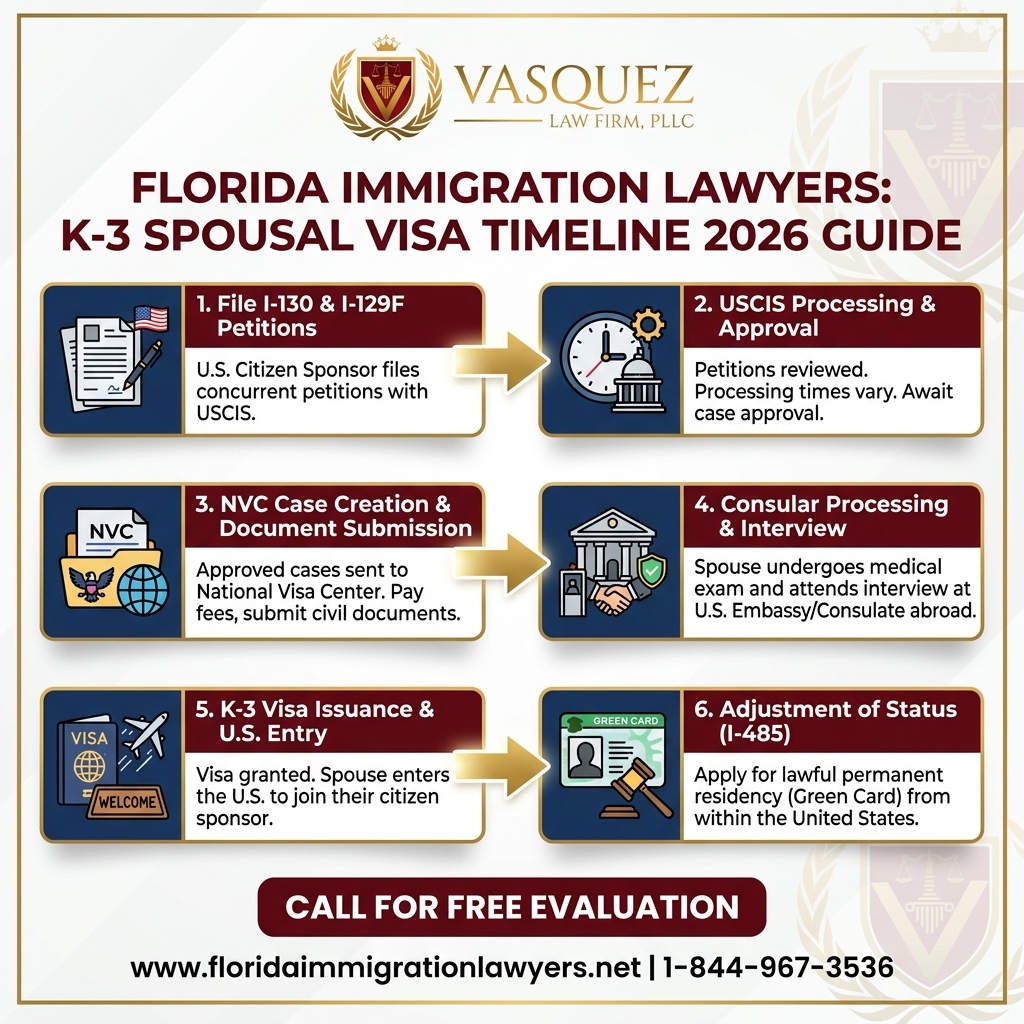
Navigating the K-3 visa process involves several distinct stages, each with its own requirements and potential complexities. Understanding this step-by-step guide is crucial for families in Florida aiming for a smooth reunification. While timelines can fluctuate, this outline reflects the typical progression for 2026.
-
File Form I-130, Petition for Alien Relative: The U.S. citizen spouse must first file Form I-130 with USCIS. This petition establishes the bona fide nature of your marriage and your relationship. USCIS will send a receipt notice (Form I-797C) acknowledging receipt of your petition. This initial step is foundational, and without an approved or pending I-130, you cannot proceed with the K-3. Processing times for I-130 can vary greatly, from several months to over a year, depending on the service center and current backlogs. [USCIS Form I-130]
-
File Form I-129F, Petition for Nonimmigrant Spouse: Once USCIS has received your I-130 petition and you have the receipt notice, you can then file Form I-129F, Petition for Nonimmigrant Spouse, specifically for the K-3 visa. This form should be filed with the USCIS Dallas Lockbox facility. It is imperative to include proof that an I-130 has already been filed on behalf of the same spouse. This petition requests that your spouse be classified as a K-3 nonimmigrant. The purpose here is to request the K-3 visa, which is separate from the immigrant visa requested by the I-130. [USCIS Form I-129F]
-
USCIS Processing of Form I-129F: After filing, USCIS will process your I-129F. This involves reviewing the petition and conducting background checks. If approved, USCIS will send an approval notice (Form I-797) and forward the approved petition to the National Visa Center (NVC). The NVC then sends the petition to the appropriate U.S. Embassy or Consulate in the foreign spouse's country of residence. This stage can take several months, and it's where many families in Florida anxiously await updates.
-
NVC Processing and Interview Scheduling: The NVC will create a case file and provide instructions to the foreign spouse for submitting required civil documents and forms, such as Form DS-160, Online Nonimmigrant Visa Application. Once all documents are submitted and reviewed, the NVC will schedule an interview at the U.S. Embassy or Consulate. The interview is a critical step, often taking place in the spouse's home country. This phase requires diligent attention to detail, as any missing documents can cause significant delays.
-
K-3 Visa Interview: The foreign spouse attends an interview with a consular officer at the U.S. Embassy or Consulate. During the interview, the officer will verify the authenticity of the marriage and the spouse's eligibility for the K-3 visa. They will review all submitted documents and ask questions about the relationship. It is essential to be prepared, honest, and bring all original supporting documents. If approved, the K-3 visa will be stamped in the spouse's passport.
-
Entry into the U.S. and Adjustment of Status: Upon approval, the foreign spouse can travel to Florida. Once in the U.S., the K-3 visa holder can immediately file Form I-485, Application to Register Permanent Residence or Adjust Status, along with Form I-765 for work authorization and Form I-131 for travel authorization. This is the final step towards obtaining a green card and becoming a lawful permanent resident. Many K-3 recipients in Florida choose to file these applications with the USCIS Tampa Field Office or other local offices.
Essential Document Checklist for Your K-3 Visa Application
A meticulously prepared application package is critical for the success of your K-3 visa petition. Missing or incorrectly submitted documents can lead to significant delays, requests for evidence (RFEs), or even denial. For families in Florida, ensuring every piece of documentation is perfect is paramount. This checklist covers the core documents typically required for both the U.S. citizen petitioner and the foreign national spouse. Remember, original documents may be requested at various stages, especially during the consular interview.
- For the U.S. Citizen Petitioner:
- Proof of U.S. Citizenship (e.g., birth certificate, U.S. passport, naturalization certificate).
- Copy of the filed Form I-130 Petition for Alien Relative receipt notice (Form I-797C).
- Copy of the marriage certificate.
- Proof of bona fide marriage (e.g., joint bank statements, leases, utility bills, photos, affidavits from friends/family).
- Form I-129F, Petition for Nonimmigrant Spouse, completed and signed.
- Passport-style photos of the U.S. citizen.
- Form I-864, Affidavit of Support (submitted with the I-485, but planning for it early is wise).
- For the Foreign National Spouse:
- Valid passport with at least six months validity beyond the intended period of stay.
- Copy of the marriage certificate.
- Birth certificate.
- Police certificates from all countries where the spouse has lived for six months or more since age 16.
- Medical examination results from an authorized panel physician.
- Form DS-160, Online Nonimmigrant Visa Application confirmation page.
- Two passport-style photos.
- Evidence of bona fide marriage (e.g., joint photos, communication records, shared finances).
- Proof of previous divorces or death certificates for any prior spouses (for both parties, if applicable).
This list is not exhaustive, and additional documents may be requested based on specific circumstances or the discretion of the consular officer. For instance, if either spouse has children, their birth certificates and custody documents may be required. Providing comprehensive and organized documentation from the outset can significantly streamline the process. Florida Immigration Lawyers can help you meticulously compile your application package, ensuring no critical document is overlooked, which is especially important given the detailed scrutiny immigration applications face today.
Do not navigate this complex process alone. Contact Florida Immigration Lawyers today for expert assistance with your K-3 visa application. Call us at 1-844-967-3536 for a free consultation.
K-3 Visa Timeline and Processing Expectations for Florida Residents (2026)
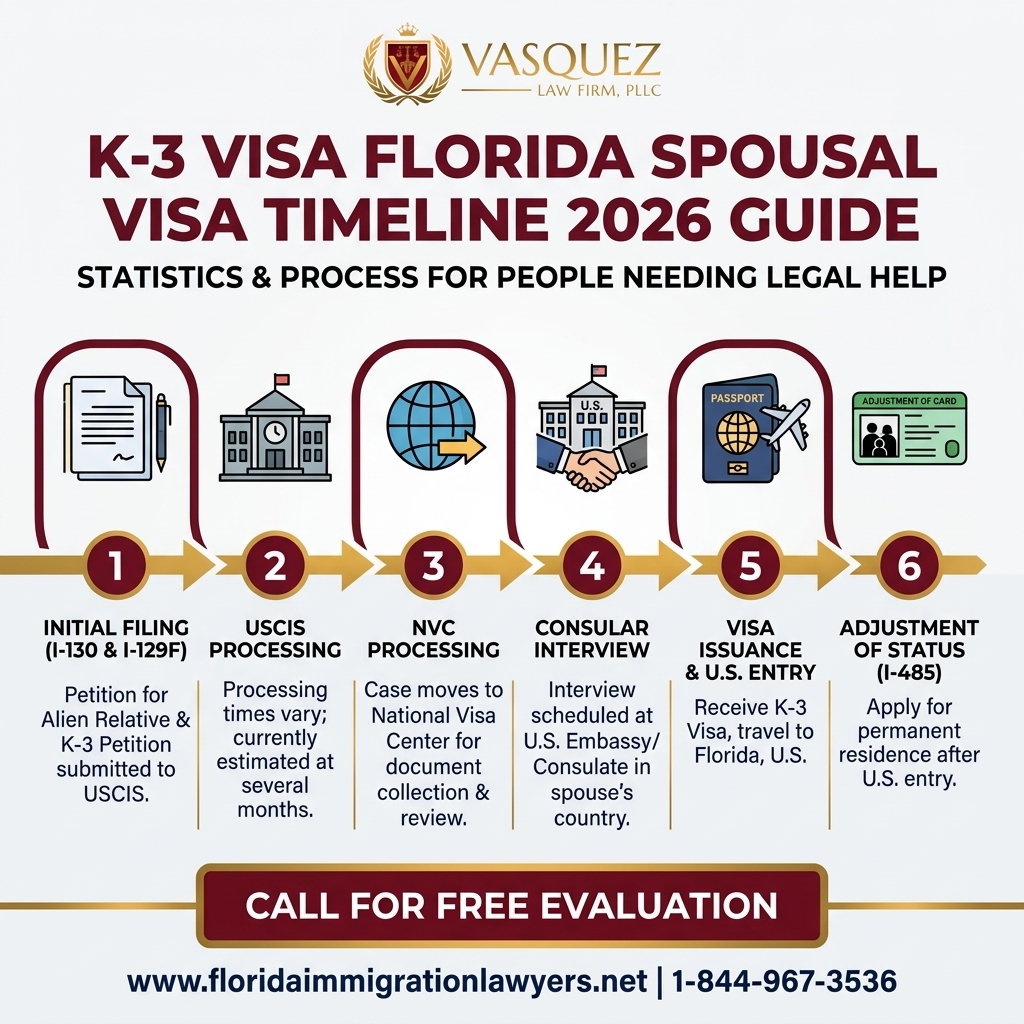
Understanding the K-3 visa timeline is often the most pressing concern for couples in Florida separated by international borders. While the K-3 visa was created to shorten wait times, current processing speeds for 2026 still require patience. It is crucial to manage expectations, as various factors can influence how quickly your application moves through the system. Generally, the entire K-3 process, from filing the initial I-130 to the foreign spouse's entry into the U.S. with a K-3 visa, can range from 12 to 24 months, sometimes longer.
Initial Petitions (I-130 and I-129F)
The first significant waiting period comes with the I-130 petition. USCIS processing times for Form I-130 can vary widely depending on the service center. As of early 2026, these times might range from 10-18 months. Once the I-130 receipt is obtained, the I-129F petition for the K-3 visa can be filed. USCIS typically processes I-129F petitions faster than I-130s, often within 6-12 months. However, it's not uncommon for the I-130 to be approved before the I-129F, rendering the K-3 path less useful in some cases. You can always check the USCIS Processing Times tool for the most up-to-date estimates for your specific service center.
National Visa Center (NVC) and Consular Processing
After I-129F approval, the case moves to the National Visa Center (NVC). NVC processing involves document collection and review, which can take 1-3 months, depending on how quickly the applicant submits the required paperwork. Following NVC completion, the case is sent to the U.S. Embassy or Consulate abroad for interview scheduling. Interview wait times vary significantly by country; some embassies may schedule interviews within weeks, while others could take several months due to high demand or local operational constraints. This stage often adds another 2-6 months to the overall timeline.
Adjustment of Status in Florida
Once the K-3 visa holder enters Florida, they will typically file for adjustment of status (Form I-485) to become a lawful permanent resident. Along with the I-485, they can apply for employment authorization (EAD) and advance parole (travel document). Processing for EADs and advance parole can take 6-12 months, allowing the spouse to work and travel while the I-485 is pending. The I-485 itself can take another 8-18 months to process at a USCIS field office, such as the one in Tampa or Orlando, often including an interview. Overall, the journey from initial I-130 filing to green card approval can span 2-3 years, with the K-3 visa providing a crucial interim period of reunification.
It's important to remember that these are general estimates. Factors such as the completeness of your application, responses to Requests for Evidence (RFEs), geopolitical events, and changes in immigration policy can all impact your specific timeline. For instance, recent policy shifts have sometimes increased scrutiny and processing burdens on various immigration applications, potentially extending these periods. [Executive Office for Immigration Review (EOIR)] Staying informed and having experienced legal counsel is invaluable.
Cost Factors and Fee Breakdown for the K-3 Visa
Understanding the financial commitment involved in pursuing a K-3 visa is essential for families in Florida planning their immigration journey. While we cannot provide specific dollar amounts for government fees, as they are subject to change, we can outline the various cost factors you should anticipate. These fees are non-refundable, regardless of the outcome of your petition, making careful preparation even more critical.
USCIS Filing Fees
The primary costs begin with the U.S. Citizenship and Immigration Services (USCIS) filing fees. You will incur a fee for filing Form I-130, Petition for Alien Relative. Subsequently, there is a separate fee for filing Form I-129F, Petition for Nonimmigrant Spouse, which initiates the K-3 process. Later, when the foreign spouse applies for adjustment of status within Florida, there will be a fee for Form I-485, Application to Register Permanent Residence or Adjust Status, which often includes the biometric services fee. Additionally, if you file for employment authorization (Form I-765) and advance parole (Form I-131) concurrently with Form I-485, those fees are typically bundled. These fees are set by the government and can be found on the official USCIS website.
National Visa Center and Consular Fees
Once the I-129F is approved and the case moves to the National Visa Center (NVC) and then to the U.S. Embassy or Consulate abroad, additional fees will apply. These typically include the processing fee for the DS-160 Online Nonimmigrant Visa Application. This fee covers the consular services involved in reviewing the application and conducting the interview. It is paid directly to the Department of State or its authorized payment processor. These fees are standard for nonimmigrant visa applications and are separate from the USCIS fees.
Other Potential Expenses
Beyond government fees, several other expenses should be factored into your budget. These include: translation costs for any foreign-language documents, as all documents must be submitted in English or with certified English translations; medical examination fees, as the foreign spouse must undergo a medical exam by a USCIS-approved panel physician; travel expenses for the foreign spouse to attend the visa interview at the U.S. Embassy or Consulate and then to travel to Florida; and potentially, costs for obtaining police certificates and other civil documents. Legal fees for an experienced immigration attorney are also a significant, but often invaluable, investment, providing peace of mind and increasing the likelihood of a successful outcome.
While the overall cost can seem substantial, viewing it as an investment in your family's future in Florida can help. It's crucial to budget carefully and understand that these costs are part of the legal process. Florida Immigration Lawyers offers transparent fee structures and can help you understand the financial aspects of your K-3 visa application, ensuring there are no surprises as you progress through each stage. We aim to provide clear guidance, allowing you to focus on reuniting with your spouse.
Common Mistakes to Avoid in Your K-3 Visa Application
The K-3 visa process is intricate, and even minor errors can lead to significant delays or even denial. For families in Florida, avoiding these common pitfalls is crucial to ensure a smoother and faster reunification. Here are some critical mistakes to watch out for:
-
Failing to File Form I-130 First: The K-3 visa is only available if a Form I-130 has already been filed on behalf of the spouse and is still pending. Filing Form I-129F without a pending I-130 will result in rejection. Always ensure the I-130 is submitted and you have the receipt notice before filing the I-129F.
-
Incomplete or Inaccurate Forms: Any missing information, incorrect dates, or unanswered questions on forms I-130 or I-129F can lead to a Request for Evidence (RFE) or outright denial. Double-check every field for accuracy and completeness. This is a common issue that causes unnecessary delays.
-
Insufficient Proof of Bona Fide Marriage: USCIS and consular officers scrutinize marriages closely to prevent fraud. Failing to provide substantial evidence of a legitimate, ongoing relationship (e.g., joint bank accounts, shared leases, extensive communication, photos together over time) can jeopardize your application. Be thorough and comprehensive in demonstrating your relationship's authenticity.
-
Not Disclosing All Previous Marriages: Both the U.S. citizen and the foreign spouse must disclose all prior marriages, even if they were brief. Provide divorce decrees or death certificates for every previous spouse. Failure to do so is considered misrepresentation and can lead to severe consequences, including a permanent bar from the U.S.
-
Missing or Incorrect Supporting Documents: Forgetting to include required civil documents, such as birth certificates, police certificates, or passport copies, or submitting them without certified English translations, will cause delays. Ensure all supporting documents are present and correctly formatted.
-
Failure to Update Contact Information: Moving to a new address in Florida or changing phone numbers without updating USCIS can result in missed notices, RFEs, or interview appointments. Always inform USCIS of any address changes promptly using Form AR-11.
-
Not Preparing for the Consular Interview: The interview is a critical step. Failing to review your application, understand your own history, and prepare answers about your relationship can lead to suspicions of fraud. Both spouses should be able to articulate details of their relationship consistently.
-
Assuming the K-3 is a Green Card: The K-3 is a nonimmigrant visa; it allows entry but not permanent residency. Many applicants mistakenly believe it's the final step. The foreign spouse must still file for adjustment of status (Form I-485) after entering the U.S. to obtain their green card.
-
Ignoring Inadmissibility Issues: Certain criminal convictions, prior immigration violations, or health issues can make a foreign spouse inadmissible to the U.S. Failing to address these issues, possibly through a waiver, will lead to denial. It's crucial to disclose any potential inadmissibility factors early on.
-
Not Seeking Legal Counsel: Immigration law is complex and constantly changing. Attempting to navigate the K-3 visa process without experienced legal guidance can lead to costly errors and protracted delays. A Florida immigration lawyer can identify potential issues, ensure proper documentation, and represent your interests effectively.
When to Call a Florida Immigration Lawyer for Your K-3 Visa
While this guide provides a comprehensive overview, the nuances of immigration law often require personalized attention. Deciding when to consult a Florida immigration lawyer for your K-3 visa application can significantly impact the success and speed of your case. Florida Immigration Lawyers are here to provide expert guidance, especially in the following scenarios:
You should consider calling an attorney if your case involves any complexities beyond a straightforward application. For example, if either spouse has a criminal record, previous immigration violations (such as overstays or prior deportations), or has been denied a visa in the past, these issues can trigger inadmissibility concerns. An experienced lawyer can assess these issues, advise on potential waivers, and help prepare a strong argument to overcome such obstacles. Navigating inadmissibility without legal expertise can be incredibly challenging and often leads to denial.
Furthermore, if your marriage has any unique circumstances, such as a significant age difference, cultural differences that might be misunderstood, or if you married shortly after a previous divorce, consular officers might scrutinize your relationship more intensely. A lawyer can help you gather compelling evidence of a bona fide marriage and prepare you for the interview to address potential skepticism. We can help you anticipate questions and ensure your documentation clearly supports your claims, whether you are in Orlando, Tampa, or elsewhere in Florida.
You should also seek legal counsel if you receive a Request for Evidence (RFE) from USCIS or if your case experiences unexplained delays. RFEs indicate that USCIS requires more information or clarification, and a precise, timely response is critical. Delays can signal underlying issues that an attorney can investigate and address. Moreover, if you are unsure about which forms to file, how to answer specific questions, or what documents are truly necessary, a lawyer can provide clarity and ensure your application is complete and accurate from the outset. Don't risk your family's future by making avoidable mistakes. Our team at Florida Immigration Lawyers is ready to assist you. [Meet Our Attorneys]
About Florida Immigration Lawyers
Florida Immigration Lawyers is a leading immigration law firm dedicated to serving individuals and families across the entire state of Florida. With a deep understanding of U.S. immigration laws and a passion for helping people achieve their American dream, we provide comprehensive legal services for a wide range of immigration matters, including K-3 visa applications, family immigration, asylum, deportation defense, and citizenship. Our firm prides itself on offering personalized, compassionate, and effective legal representation.
We understand that immigration processes can be stressful and overwhelming. Our experienced attorneys are committed to providing clear, honest advice and zealous advocacy for every client. Whether you are seeking to reunite with your spouse in Tampa, obtain a green card in Miami, or navigate complex business immigration challenges in Orlando, our team is equipped to guide you through every step. We are available 24/7 to address your concerns and offer free consultations to discuss your unique situation.
At Florida Immigration Lawyers, we believe everyone deserves access to high-quality legal representation. We are proud to offer bilingual services, with a dedicated team ready to assist clients in both English and Spanish, ensuring effective communication and understanding. Our commitment is to your success and the swift, secure reunification of your family. Visit us at https://www.floridaimmigrationlawyers.net to learn more about how we can help you.
Sources and References
- U.S. Citizenship and Immigration Services (USCIS)
- Executive Office for Immigration Review (EOIR)
- U.S. Department of State - Family-Based Immigrant Visas
- 8 U.S.C. § 1101(a)(15)(K) - Definition of nonimmigrant K visa
- 8 U.S.C. § 1184(d) - Admission of K-3 nonimmigrants
- Immigration and Nationality Act (INA) Section 214(d)
- 8 Code of Federal Regulations (CFR) § 214.2(k)
Related services: family petition process, family-based green cards, fiancé visa (K-1), marriage-based immigration.
This article provides general legal information and is not intended as legal advice. Every case is unique, and outcomes depend on specific facts and circumstances. Contact an attorney for advice about your particular situation.
Reuniting with your spouse in Florida is a significant life event that deserves expert legal guidance. The K-3 visa process, while a valuable tool, requires careful navigation. Do not leave your family's future to chance. Contact Florida Immigration Lawyers today for a free consultation and let our experienced team help you through every step. Call us now at 1-844-967-3536. Se Habla Español - Estamos aqui para ayudarle.
Do Not Navigate This Process Alone
Our experienced immigration attorneys are ready to fight for you. Get a free, confidential consultation today.
Se Habla Español
Or leave your details and we’ll call you:
Free Evaluation in 24 Hours
Or talk to us right now
AI voice assistant — available 24/7
FreeFrequently Asked Questions

William J. Vásquez
Founding Attorney · Vasquez Law Firm
U.S. Air Force veteran and immigration attorney with years of hands-on U.S. immigration experience. J.D., NCCU School of Law. AILA member. Admitted to the 4th, 5th, and 11th Circuit Courts.
Available 24/7 - Free Evaluations
Reviewed for legal accuracy by William J. Vásquez
Licensed in North Carolina; U.S. immigration is federal practice.
Related Legal Services
Our Florida immigration attorneys can help you with business immigration, asylum protection and deportation defense. Call today at 1-844-967-3536 for a free consultation.
Related Links
Related Topics
Free Legal Consultation
Discuss your case with our experienced attorneys. We're available 24/7.
Se Habla Español - Estamos aquí para ayudarle.
Related Articles
Military Naturalization Expedited in Florida Bases
Explore military naturalization options for families at Florida bases, including parole in place benefits in Miami. Learn how to expedite your application with expert guidance from Florida Immigration Lawyers.
Immigration Lawyer Orlando Free Consultation 2026
Explore the cost of an immigration lawyer in Orlando in 2026. Understand attorney fees, what to expect during a consultation, and how to make the best choice for your immigration needs.
Credible Fear Interview Lawyer: Your Guide in Florida 2026
For asylum seekers in Florida facing expedited removal, the credible fear interview is a critical step towards protection. This comprehensive guide from Florida Immigration Lawyers explains the process, including what to expect, essential documents, and typical timelines as of 2026. Learn why a credible fear interview lawyer is indispensable for preparing your testimony, gathering evidence, and navigating the complexities of immigration law. We cover common mistakes to avoid and when to seek legal counsel, emphasizing the urgency and importance of expert representation to ensure your rights are protected and your voice is heard. Understand the potential outcomes and the crucial role an attorney plays in securing a positive determination for your asylum claim.
F-1 to H-4 Change of Status Processing Time 2026
For international students in Florida, understanding the F-1 to H-4 change of status is vital. This guide details the I-539 processing times, particularly for the Texas Service Center in 2026, which can range from 8 to 18 months or more. We cover the step-by-step application process, required documents, associated costs, and critical implications for your academic and work authorization. Learn how to avoid common mistakes, such as traveling while your application is pending or failing to maintain F-1 status. Florida Immigration Lawyers offers expert guidance for students in Fort Lauderdale and across the state, ensuring a smooth transition and protecting your immigration journey. Contact us for a free consultation.