RFE Florida Response: Guide to USCIS Request for Evidence
Receiving a Request for Evidence (RFE) from USCIS can be a critical moment in your immigration journey. This comprehensive guide from Florida Immigration Lawyers explains what an RFE means, common reasons for its issuance, and provides a detailed, step-by-step approach to crafting an effective RFE Florida response. Learn about essential documents, processing timelines, and crucial mistakes to avoid. Whether you're in St. Petersburg, Tampa, or elsewhere in Florida, understanding how to address a USCIS RFE is vital. Our expert team is here to help you navigate this process, ensuring your immigration application has the best chance of approval. Contact us for a free consultation.

Quick Answer: Responding to a USCIS RFE in Florida
Receiving a Request for Evidence (RFE) from USCIS means your immigration application requires additional information or documentation to prove eligibility. A timely and comprehensive RFE Florida response is critical. Failure to respond adequately or by the deadline can lead to denial of your petition. It is essential to understand the specific evidence requested, gather all necessary documents, and submit a well-organized package. Seeking guidance from an experienced Florida immigration lawyer can significantly improve your chances of a favorable outcome, especially for complex cases or if you're unsure about the requested evidence.
- An RFE requires additional evidence to support your immigration application.
- Respond comprehensively and by the deadline to avoid denial.
- Carefully review the RFE to understand what specific evidence USCIS needs.
- Organize all requested documents meticulously before submission.
- Consulting a Florida immigration lawyer is highly recommended for complex RFEs.
RFE Florida Response: Guide to USCIS Request for Evidence
Navigating the complex world of U.S. immigration can be challenging. Many applicants hope for a straightforward process, but sometimes, an unexpected hurdle arises: a Request for Evidence (RFE) from U.S. Citizenship and Immigration Services (USCIS). Receiving an RFE can feel daunting, especially when your future in Florida depends on the outcome.
An RFE is not a denial. Instead, it is an opportunity to provide USCIS with the necessary information to approve your application. However, it requires a precise and thorough RFE Florida response. Understanding why you received an RFE and how to address it effectively is paramount to your immigration success.
At Florida Immigration Lawyers, we understand the anxieties that come with an RFE. Our firm serves individuals and families across Florida, including St. Petersburg, Tampa, Orlando, and Miami. We are dedicated to guiding you through every step of the response process.
This comprehensive guide will explain what an RFE is, common reasons for its issuance, and provide a step-by-step approach to crafting a strong response. We will cover document checklists, timelines, cost factors, and crucial mistakes to avoid. Our goal is to empower you with the knowledge needed to face this challenge head-on.
Do not let an RFE derail your immigration dreams. For personalized advice and expert representation regarding your USCIS immigration response, call Florida Immigration Lawyers at 1-844-967-3536 for a free consultation. We are here to help you secure your future in Florida.
Understanding Your RFE: What is a Request for Evidence?
A Request for Evidence (RFE) is an official notice issued by USCIS when they determine that the initial evidence submitted with your immigration application or petition is insufficient. USCIS needs more information to make a final decision on your case. This does not mean your application will be denied. It simply indicates that USCIS requires clarification or additional proof to establish your eligibility for the requested immigration benefit.
RFEs are common across various immigration categories, including family-based petitions (e.g., I-130), employment-based petitions (e.g., I-140), adjustment of status applications (e.g., I-485), and naturalization applications (e.g., N-400). The RFE notice itself will specifically outline the missing or inadequate evidence. It will also provide a deadline, typically ranging from 30 to 87 days, by which you must submit your complete RFE Florida response. Missing this deadline will almost certainly lead to a denial of your application.
The RFE is a critical stage in the immigration process. It demands careful attention to detail and a strategic approach. Ignoring an RFE or submitting an incomplete response is a common pitfall that can have severe consequences. USCIS officers are bound by the Immigration and Nationality Act (INA) and Code of Federal Regulations (CFR) to ensure all eligibility requirements are met. An RFE is their way of ensuring compliance before making a final decision.
It is important to remember that USCIS is not trying to deny your case with an RFE. They are seeking the necessary information to approve it. Your response is your opportunity to provide that information clearly and comprehensively. Understanding the specific requirements outlined in your RFE is the first crucial step towards a successful outcome.
Common Reasons for a USCIS Request for Evidence
RFEs are issued for a variety of reasons, and understanding the common triggers can help applicants in Florida prepare more thoroughly. Often, the initial application may lack specific documentation, or the submitted evidence might not fully satisfy legal requirements. For instance, in family-based petitions, USCIS might question the bona fides of a marriage or the relationship between the petitioner and beneficiary. They may request additional joint financial documents, photos, or affidavits from friends and family.
For employment-based petitions, RFEs frequently arise concerning the petitioner's ability to pay the proffered wage, the beneficiary's qualifications for the position, or the legitimacy of the employer's business operations. USCIS might ask for tax returns, payroll records, or detailed job descriptions to confirm the information initially provided. In adjustment of status cases (Form I-485), RFEs often relate to an applicant's financial solvency (public charge concerns), medical examination results, or a lack of proof of lawful entry and continuous presence in the U.S. These are particularly relevant in Florida, given its diverse immigrant population.
Another common reason for an RFE is inconsistent information across different forms or documents. Even minor discrepancies can raise red flags for immigration officers. Sometimes, an RFE is issued due to a change in law or policy that occurred after your initial filing, requiring new types of evidence. For example, recent policy shifts regarding public charge rules have led to more detailed requests for financial information in many applications. Furthermore, a poorly organized or incomplete initial submission can almost guarantee an RFE, as officers struggle to piece together the necessary evidence.
Receiving an RFE is a sign that USCIS needs more clarity. It is not necessarily a negative sign, but it does mean you must act decisively and accurately. Identifying the exact reason for your RFE is the first step in formulating an effective USCIS immigration response. This often requires a careful reading of the RFE notice and an understanding of the underlying immigration laws, such as sections of the 8 U.S.C. Chapter 12 - Immigration and Nationality Act.
Step-by-Step: Crafting Your RFE Response in Florida
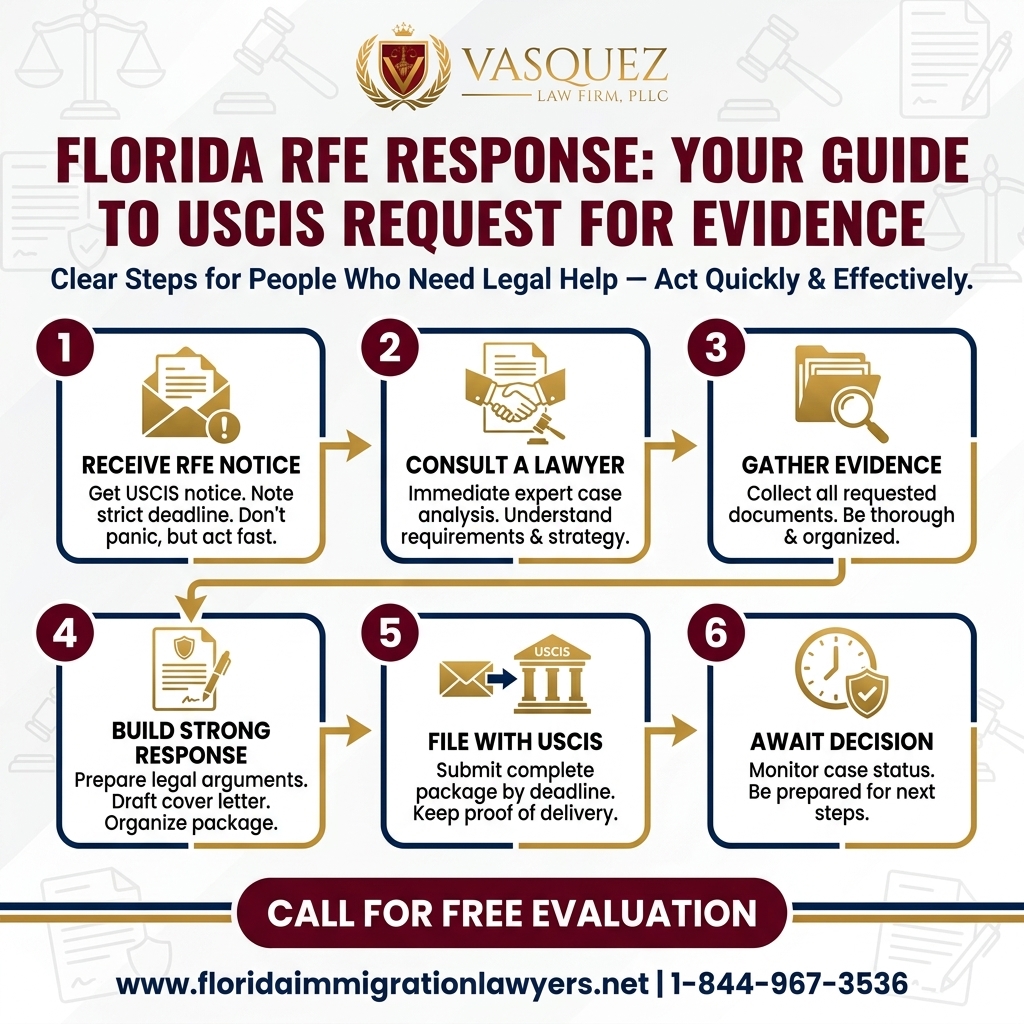
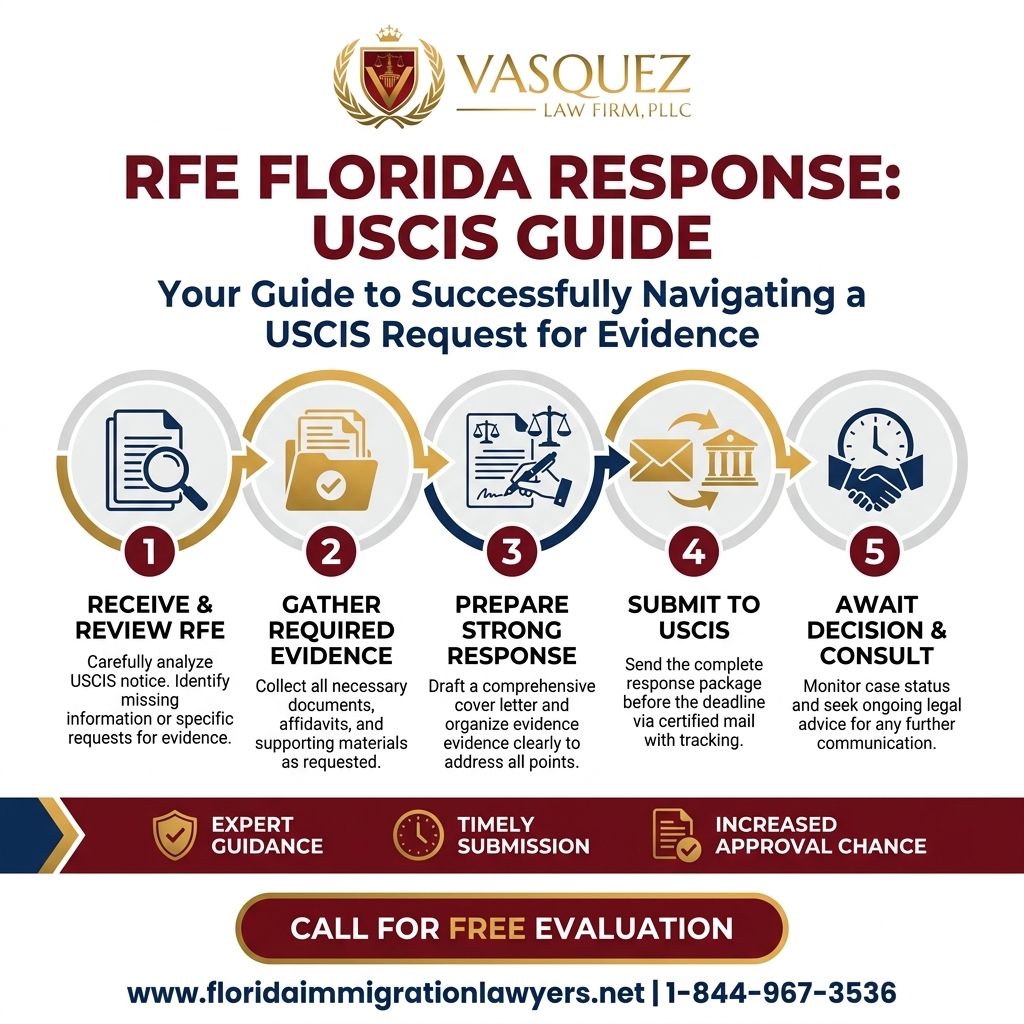
Responding to an RFE requires a methodical and thorough approach. Here is a step-by-step guide to help you prepare your RFE Florida response effectively:
-
Understand the RFE Completely: The first and most critical step is to read the RFE notice carefully, multiple times. Do not skim it. Identify precisely what evidence USCIS is requesting and why. Note the deadline for submission. If anything is unclear, do not guess. Consult with an experienced Florida immigration lawyer immediately. Understanding the RFE is crucial for a successful immigration application.
-
Gather ALL Requested Documents: Systematically collect every document mentioned in the RFE. If a document does not exist or cannot be obtained, you must explain why and provide alternative evidence or a sworn statement. For example, if an original birth certificate is requested and you only have a copy, explain the circumstances and provide an official copy with an explanation letter. Remember to include your original RFE notice on top of your response package.
-
Organize Your Response Meticulously: USCIS officers review thousands of applications. Make their job easier. Organize your documents exactly as requested in the RFE. Use cover sheets for each category of evidence. Create a detailed table of contents if you are submitting a large volume of documents. Use tabs or dividers to separate sections. This professional presentation can prevent further delays or misunderstandings.
-
Write a Detailed Cover Letter: A well-drafted cover letter should accompany your RFE response. This letter should clearly list all the documents you are submitting and explain how each piece of evidence addresses the specific points raised in the RFE. Reference the receipt number of your application and the RFE notice number. This letter serves as a roadmap for the USCIS officer.
-
Make Copies of Everything: Before mailing your RFE response, make a complete copy of the entire package for your records. This includes the RFE notice, your cover letter, and all submitted evidence. This is vital in case of loss, dispute, or future reference. Keep these copies in a safe place.
-
Submit Your Response On Time: Mail your completed RFE response well before the deadline. USCIS considers the response received on the date it arrives at their office, not the postmark date. Use a reliable mailing service that provides tracking and delivery confirmation. This ensures you have proof of timely submission. Sending your response to the correct address is also critical; this will be specified on the RFE notice itself.
Essential Documents for Your RFE Response Checklist
The specific documents required for an RFE response vary significantly based on the type of application and the nature of the RFE. However, this general checklist covers common categories of evidence USCIS often requests. Always refer to your specific RFE notice for precise requirements.
- Original RFE Notice: Always include the original RFE notice on top of your submission.
- Comprehensive Cover Letter: Detail all enclosed documents and how they address the RFE points.
- Proof of Relationship: For family petitions (e.g., I-130), this might include marriage certificates, birth certificates, joint bank accounts, joint leases, utility bills in both names, photos, affidavits from friends/family, and other evidence of a bona fide relationship.
- Financial Documents: Tax returns (IRS transcripts), W-2s, pay stubs, employment verification letters, bank statements, asset statements, and Form I-864 (Affidavit of Support) and its supporting documents.
- Employment Evidence: Offer letters, employment contracts, detailed job descriptions, company organizational charts, business licenses, tax returns for the petitioning employer, and beneficiary's diplomas/transcripts/professional licenses.
- Identity and Status Documents: Birth certificates, passports, visa stamps, I-94 records, previous approval notices (I-797), and any other documents proving identity and lawful status.
- Medical Records: Updated Form I-693 (Report of Medical Examination and Vaccination Record), if expired or requested.
- Criminal Records: Certified court dispositions for any arrests or convictions, even if minor.
- Affidavits/Sworn Statements: From individuals with personal knowledge of facts pertinent to your case, notarized and detailed.
- Translations: Any document not in English must be accompanied by a certified English translation.
- Photos: Clear, dated photographs, especially for marriage-based petitions, showing the couple with family and friends over time.
Ensure that all copies of documents are clear and legible. If a document is in color and the color is material to the evidence, submit a color copy. Providing certified copies where required is also crucial. For example, court documents or vital records often need to be certified copies. Carefully cross-reference your submitted evidence with the RFE's specific requests to ensure nothing is missed.
RFE Processing Timelines and What to Expect
Understanding the processing timelines for an RFE response can help manage expectations and reduce anxiety. Once USCIS issues an RFE, they will provide a specific deadline for your response, typically between 30 and 87 days. This period is crucial for gathering and submitting all requested evidence. It is vital to submit your complete RFE Florida response well before this deadline to avoid any last-minute issues or mailing delays.
After USCIS receives your response, they will issue a receipt notice (Form I-797C) confirming its arrival. The processing of your application then resumes from the point where it was paused. The time it takes for USCIS to make a decision after receiving an RFE response can vary significantly. It depends on the caseload at the specific service center or field office handling your case, the complexity of the evidence submitted, and the type of application.
Typically, USCIS aims to make a decision within 60 days of receiving an RFE response, but this is not a guaranteed timeframe. Some cases might be resolved sooner, while others could take several months. You can monitor the general processing times on the USCIS website using your receipt number. However, these are estimates and do not guarantee your specific case will fall within that range.
During this waiting period, USCIS may issue another RFE if they find the additional evidence still insufficient, or they may issue a Notice of Intent to Deny (NOID). A NOID is more serious and indicates USCIS plans to deny your application unless you provide compelling reasons otherwise. In most cases, if your RFE response is complete and addresses all concerns, you should receive an approval notice or a notice for an interview, if applicable. Patience is key, but proactive monitoring of your case status online is always recommended. For residents in St. Petersburg and across Florida, staying informed is crucial.
Navigating the Costs and Fees of an RFE Response
While USCIS does not charge an additional fee specifically for submitting an RFE response, there are indirect costs associated with preparing and sending the required evidence. These costs can accumulate and should be factored into your overall immigration planning. Understanding these potential expenses is important for applicants throughout Florida.
One primary cost is obtaining new or updated documents. This might include fees for certified copies of birth certificates, marriage licenses, police records, or court dispositions. If your medical examination (Form I-693) has expired, you will need to undergo another exam and pay the associated doctor's fees. Obtaining IRS tax transcripts also incurs a cost. For documents not in English, certified translations are mandatory, and professional translation services charge per page or per word, which can add up quickly.
Another significant cost factor is legal representation. While not mandatory, hiring an experienced Florida immigration lawyer, especially for a complex USCIS immigration response, is a wise investment. Attorneys charge fees for their time and expertise in reviewing the RFE, advising on necessary evidence, helping to gather and organize documents, drafting cover letters and legal arguments, and preparing the final submission. These fees vary based on the complexity of the case and the attorney's experience, but they often represent a worthwhile expenditure to avoid denial.
Additionally, there are shipping costs. It is highly recommended to use a reputable courier service that provides tracking and delivery confirmation for your RFE response. This ensures proof of submission and delivery, but it comes with a higher price tag than standard mail. Photocopying and printing expenses for the multiple copies you should keep for your records also add to the total. While these costs are not direct USCIS fees, they are essential expenses in ensuring a robust and timely RFE response. Budgeting for these potential expenditures is a critical part of the immigration process.
Common Mistakes to Avoid When Responding to an RFE
Responding to an RFE correctly is crucial. Avoiding these common mistakes can significantly improve your chances of approval:
-
Ignoring the Deadline: Failing to submit your RFE response by the specified deadline is perhaps the most critical error. USCIS strictly adheres to these deadlines. Missing it will almost certainly result in a denial of your application without further consideration. Always mark your calendar and aim to send your response well in advance.
-
Not Fully Understanding the RFE: Many applicants rush to gather documents without fully grasping what USCIS is asking for. Misinterpreting the RFE can lead to submitting irrelevant evidence or failing to provide the exact proof needed. Read the RFE carefully, line by line, and seek clarification if unsure.
-
Submitting Incomplete Evidence: Providing only some of the requested documents or omitting crucial pieces of evidence is a common mistake. Each item requested in the RFE must be addressed. If a document is truly unavailable, provide a thorough explanation and alternative evidence.
-
Sending Irrelevant Documents: While it's important to be thorough, sending a large volume of documents that are not relevant to the specific RFE requests can overwhelm the USCIS officer and obscure the pertinent evidence. Focus on directly addressing each point raised in the RFE.
-
Lack of Organization: A disorganized RFE response package can be frustrating for USCIS officers. Documents scattered without labels, cover sheets, or a clear table of contents can lead to delays or even a determination that evidence is missing. Organize your submission logically.
-
Failing to Provide Certified Translations: Any document not in English must be accompanied by a complete, word-for-word certified English translation. Failing to provide this can result in the evidence being disregarded or another RFE/NOID being issued. This is a common pitfall for many applicants in diverse Florida communities like St. Petersburg.
-
Not Keeping Copies: Sending your original RFE response without making a complete copy for your records is a serious oversight. In case of lost mail, disputes, or future immigration applications, having a copy of everything you submitted is essential.
-
Assuming USCIS Has the Information: Do not assume USCIS has access to documents you submitted previously or to other government agencies' records. If the RFE asks for something, provide it again, even if you think they already have it. USCIS operates on a case-by-case basis.
-
Providing Fraudulent Information: Never submit false documents or make misleading statements. Immigration fraud has severe consequences, including permanent bars from immigration benefits, criminal charges, and deportation defense issues.
-
Not Seeking Legal Counsel: Attempting to respond to a complex RFE without legal guidance can be a costly mistake. An experienced Florida immigration lawyer can identify potential issues, ensure all requirements are met, and present your case in the most favorable light.
When to Call a Florida Immigration Lawyer for Your RFE
While some straightforward RFEs might be manageable for applicants, many situations strongly warrant the expertise of a Florida immigration lawyer. An RFE is a critical juncture in your immigration journey, and professional guidance can make all the difference between approval and denial. If you are in St. Petersburg, Tampa, or anywhere else in Florida, consider seeking legal help if any of these scenarios apply to you.
You should call an attorney if the RFE is complex, lengthy, or requests highly specialized evidence that you are unsure how to obtain or present. This often includes RFEs related to public charge rules, national interest waivers, or unusual family relationships. If the RFE suggests a potential issue with your eligibility, such as questions about your lawful entry, past immigration violations, or criminal history, immediate legal counsel is essential. These issues can have severe consequences and require careful legal strategy.
Furthermore, if you are struggling to understand the RFE's language or specific legal references, an attorney can translate the legal jargon into plain English and clarify the requirements. An attorney can also help if you are unable to obtain a requested document and need to provide alternative evidence or a compelling explanation. They can guide you on what constitutes acceptable alternative proof and how to present it effectively. For family immigration cases, an RFE questioning the bona fides of a marriage or parent-child relationship can be particularly sensitive and requires skilled legal advocacy.
An experienced Florida Immigration Lawyer will review your entire application, analyze the RFE, identify potential weaknesses, and strategically prepare your USCIS immigration response. They can draft robust cover letters, organize your evidence, and ensure compliance with all legal requirements. This significantly reduces the risk of denial and increases your chances of a successful outcome. Do not take chances with your immigration future; contact Florida Immigration Lawyers for a free consultation.
About Florida Immigration Lawyers
Florida Immigration Lawyers is a leading immigration law firm dedicated to serving individuals, families, and businesses across the entire state of Florida. With offices and services reaching communities from St. Petersburg to Miami, Orlando, and beyond, we pride ourselves on providing compassionate, effective, and results-driven legal representation.
Our team of highly skilled and experienced attorneys specializes in a comprehensive range of immigration services. This includes family-based visas, employment-based visas, adjustment of status, naturalization and citizenship, asylum, deportation defense, and responses to complex challenges like Requests for Evidence (RFEs) and Notices of Intent to Deny (NOIDs). We are committed to helping our clients navigate the intricate U.S. immigration system with confidence and peace of mind.
We understand that every immigration case is unique and deeply personal. That is why we offer personalized attention, clear communication, and strategic legal advice tailored to your specific circumstances. Our firm is available 24/7 to address your urgent concerns, and we offer free, no-obligation consultations to discuss your case and outline your best legal options. We are proud to offer bilingual services, with a team fluent in both English and Spanish, ensuring that language is never a barrier to receiving top-tier legal support.
When you choose Florida Immigration Lawyers, you gain a dedicated advocate who will fight tirelessly for your rights and your future in the United States. Let us put our expertise to work for you. Contact us today at 1-844-967-3536 or visit our website at https://www.floridaimmigrationlawyers.net to learn how we can assist you with your immigration needs.
Sources and References
- U.S. Citizenship and Immigration Services (USCIS)
- Executive Office for Immigration Review (EOIR)
- U.S. Department of State - Bureau of Consular Affairs
- 8 U.S.C. Chapter 12 - Immigration and Nationality Act (INA)
- 8 CFR (Code of Federal Regulations) - Aliens and Nationality
- USCIS Policy Manual
Related services: immigration practice areas, asylum protection, business immigration, experienced immigration attorneys.
This article provides general legal information and is not intended as legal advice. Every case is unique, and outcomes depend on specific facts and circumstances. Contact an attorney for advice about your particular situation. Immigration laws are subject to change, and it is crucial to consult with a qualified legal professional for the most current and accurate guidance.
Secure Your Future: Contact Florida Immigration Lawyers Today
Don't let a Request for Evidence create uncertainty about your immigration journey in Florida. A well-prepared and timely RFE Florida response is essential for the success of your application. The experienced attorneys at Florida Immigration Lawyers are ready to provide the comprehensive legal support you need.
We offer free consultations and are available 24/7 to discuss your case. Let us help you navigate the complexities of USCIS requirements and ensure your response is robust and complete. Call us now at 1-844-967-3536 to schedule your free consultation. Se Habla Español - Estamos aquí para ayudarle.
Do Not Navigate This Process Alone
Our experienced immigration attorneys are ready to fight for you. Get a free, confidential consultation today.
Se Habla Español
Frequently Asked Questions
Florida Immigration Lawyers
Immigration Attorney | Founder, Vasquez Law Firm
U.S. Air Force veteran and immigration attorney with thousands of cases resolved. J.D., NCCU School of Law. AILA member. Admitted to the 4th, 5th, and 11th Circuit Courts.
Available 24/7 - Free Evaluations
Related Legal Services
Our Florida immigration attorneys can help you with deportation defense, citizenship and naturalization and family immigration services. Call today at 1-844-967-3536 for a free consultation.
Related Links
Related Topics
Free Legal Consultation
Discuss your case with our experienced attorneys. We're available 24/7.
Se Habla Español - Estamos aquí para ayudarle.
Related Articles
Family Petition Immigration Lawyer Miami: Your Florida Guide
For families in Miami, Kissimmee, and across Florida, securing a family petition is often the first step towards reuniting with loved ones in the U.S. This process, which typically begins with filing Form I-130, Petition for Alien Relative, requires meticulous attention to detail and a thorough understanding of U.S. immigration law. From proving a legitimate family relationship to navigating extensive documentation and often lengthy processing times, the journey can be complex. An experienced family petition immigration lawyer can provide invaluable guidance, helping to avoid common pitfalls, respond to USCIS requests, and ensure a smooth application process. Florida Immigration Lawyers offers dedicated legal support to families statewide, helping them achieve their dreams of reunification.
Immigration Interview Preparation Florida: Your Guide
Preparing for your immigration interview in Florida is a pivotal step towards securing your future. This comprehensive guide provides essential tips, a detailed step-by-step preparation plan, and a crucial document checklist to ensure you are fully ready for your USCIS interview. Learn about common mistakes to avoid, understand processing timelines, and identify when legal assistance from experienced Florida immigration lawyers is vital. Whether you are in Hialeah, Miami, or Orlando, navigating your green card, naturalization, or asylum interview requires meticulous attention to detail and professional guidance. Florida Immigration Lawyers offers free consultations to help you prepare effectively and confidently.
DACA Renewal Florida 2026 Guide for Dreamers | VLF Florida
For DACA recipients in Florida, understanding the DACA renewal process for 2026 is vital. This comprehensive guide details eligibility, step-by-step procedures, essential documents, timelines, and costs. Learn how to file your Form I-821D and I-765, avoid common mistakes, and ensure continuous residence. We cover specific considerations for Dreamers in St. Petersburg and across Florida, emphasizing the importance of timely and accurate submissions to USCIS. Discover when legal assistance from Florida Immigration Lawyers can be crucial, especially for complex cases involving criminal history or travel outside the U.S. Get expert advice to protect your deferred action status and employment authorization.
DACA Renewal Florida 2026 Guide for Dreamers | VLF Florida
Learn how to renew your DACA in Florida for 2026. This guide provides essential steps, common pitfalls, and resources available to Dreamers in Hialeah and beyond. Call Florida Immigration Lawyers at 1-844-967-3536 for a free consultation.