Immigration Court Proceedings Florida: Your Guide to EOIR
Navigating immigration court proceedings in Florida can be incredibly complex and stressful. This comprehensive guide from Florida Immigration Lawyers breaks down the entire process, from receiving a Notice to Appear (NTA) to understanding Master Calendar Hearings and Individual Hearings. Learn about essential documents, typical timelines, and the costs involved in removal proceedings. We also highlight common mistakes to avoid and explain when seeking professional legal help is absolutely critical. With offices serving Tallahassee, Miami, Orlando, and all of Florida, our experienced attorneys are ready to provide the dedicated defense you need to protect your rights and future. Contact us for a free consultation today.

Immigration court proceedings in Florida are formal legal processes overseen by an Immigration Judge within the Executive Office for Immigration Review (EOIR). These proceedings, often called removal proceedings, determine whether a non-citizen may remain in the United States or will be deported. If you face an Notice to Appear (NTA), it is crucial to understand your rights and the complex legal steps involved. These cases can be incredibly stressful and have life-altering consequences, making experienced legal representation essential for a strong defense.
- Immigration court cases are formal legal proceedings under the EOIR.
- A Notice to Appear (NTA) initiates removal proceedings in Florida.
- An Immigration Judge presides over these cases, not a criminal court judge.
- Seeking legal counsel from an experienced immigration attorney is highly recommended.
- Various forms of relief from removal may be available depending on your specific situation.
Facing immigration court proceedings in Florida can be one of the most daunting experiences of your life. The thought of deportation, separation from family, and an uncertain future can be overwhelming. Whether you received a Notice to Appear (NTA), are seeking asylum, or are fighting a removal order, understanding the process is your first step toward a strong defense. The U.S. immigration system is notoriously complex, with ever-changing laws and strict deadlines that can easily lead to missteps if you are not properly advised.
At Florida Immigration Lawyers, we understand the immense pressure you are under. Our firm is dedicated to providing compassionate, skilled legal representation to individuals and families across Florida navigating these critical legal battles. We serve clients in Tallahassee, Miami, Orlando, Bradenton, Jacksonville, and throughout the state, ensuring that no matter where you are, expert legal help is within reach. This comprehensive guide will demystify immigration court proceedings in Florida, outlining the stages, potential outcomes, and how a dedicated legal team can make a significant difference in your case.
Do not face the U.S. immigration system alone. Your future, and the future of your family, may depend on how effectively your case is presented. Call Florida Immigration Lawyers at 1-844-967-3536 for a free consultation today. We are here to help you understand your options and vigorously defend your rights.
Understanding Immigration Court Proceedings and Removal in Florida
Immigration court proceedings in Florida fall under the jurisdiction of the Executive Office for Immigration Review (EOIR), an agency within the Department of Justice. Unlike criminal courts, immigration courts are administrative courts. They determine whether non-citizens, including lawful permanent residents, asylum seekers, and undocumented immigrants, are removable from the United States under the Immigration and Nationality Act (INA). The process begins when the Department of Homeland Security (DHS) issues a Notice to Appear (NTA), which formally charges an individual with being removable and initiates proceedings before an Immigration Judge.
Florida hosts several key immigration courts, including those in Miami, Orlando, and Bradenton, with cases often originating from various regions, including Tallahassee and surrounding areas. These courts handle a significant volume of cases, reflecting Florida's diverse immigrant population. The legal landscape is constantly evolving, with recent developments, such as appellate court rulings on asylum bans, directly impacting how cases are heard and decided. It is essential to remember that even if you have DACA status, recent changes have made it easier for the Justice Department to initiate removal proceedings, underscoring the need for vigilant legal counsel. Understanding the specific grounds for removal, such as visa overstays, criminal convictions, or unlawful entry, is the first step in formulating an effective defense strategy. Your attorney will analyze the NTA, identify potential defenses, and explore all available forms of relief.
The stakes in these proceedings are incredibly high. A final order of removal means deportation from the U.S., potentially barring future re-entry. However, many forms of relief exist, such as asylum, cancellation of removal, adjustment of status, or waivers. The eligibility for these reliefs depends heavily on your unique circumstances, including your immigration history, family ties, length of residency, and any criminal record. A skilled attorney can help you determine which forms of relief apply to your situation and guide you through the complex application process. Navigating the legal complexities of immigration court requires a deep understanding of federal immigration law and the specific procedures of the EOIR. For more information on immigration court and the EOIR, you can visit the official EOIR website.
Step-by-Step Guide to Florida Immigration Court Proceedings
Navigating immigration court proceedings in Florida involves several distinct stages, each with its own procedures and critical deadlines. Understanding this progression is vital for anyone facing removal. Our firm guides clients through every step, ensuring they are prepared and their rights are protected.
-
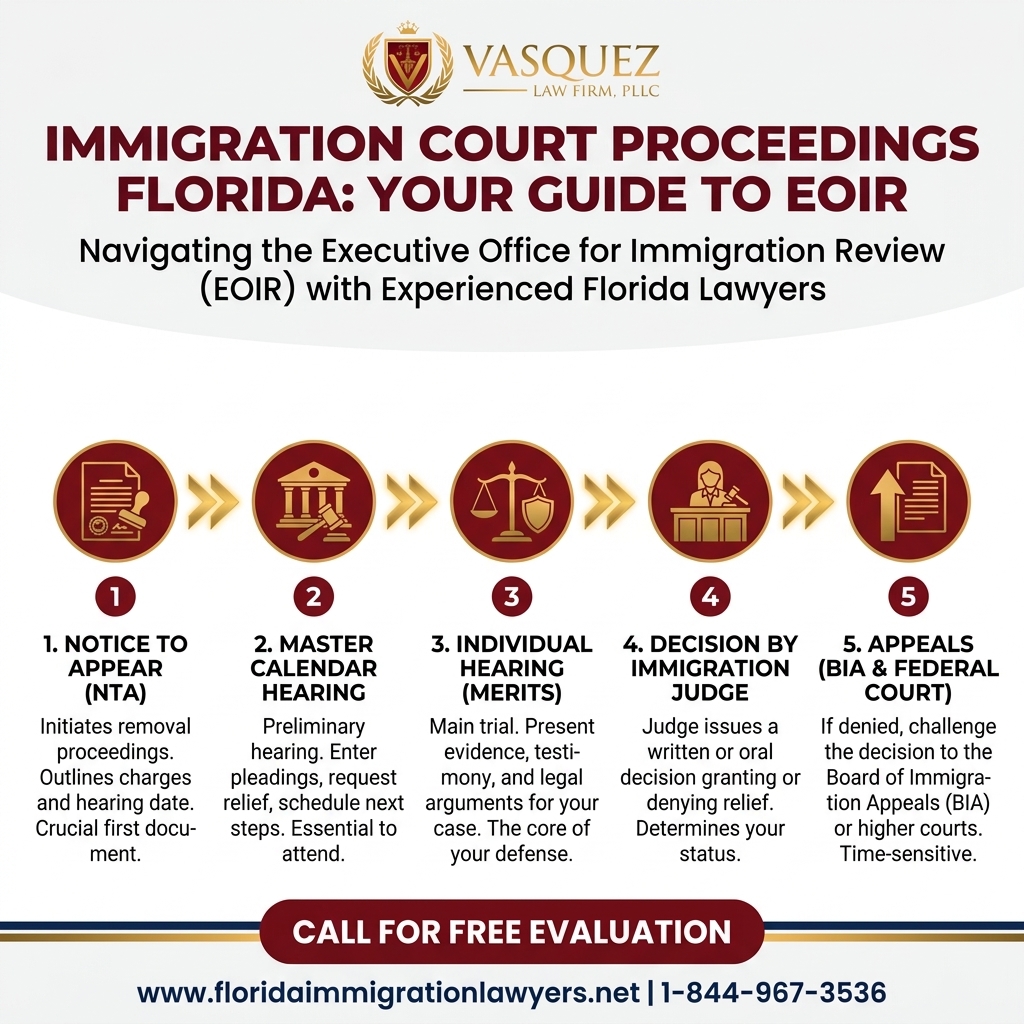
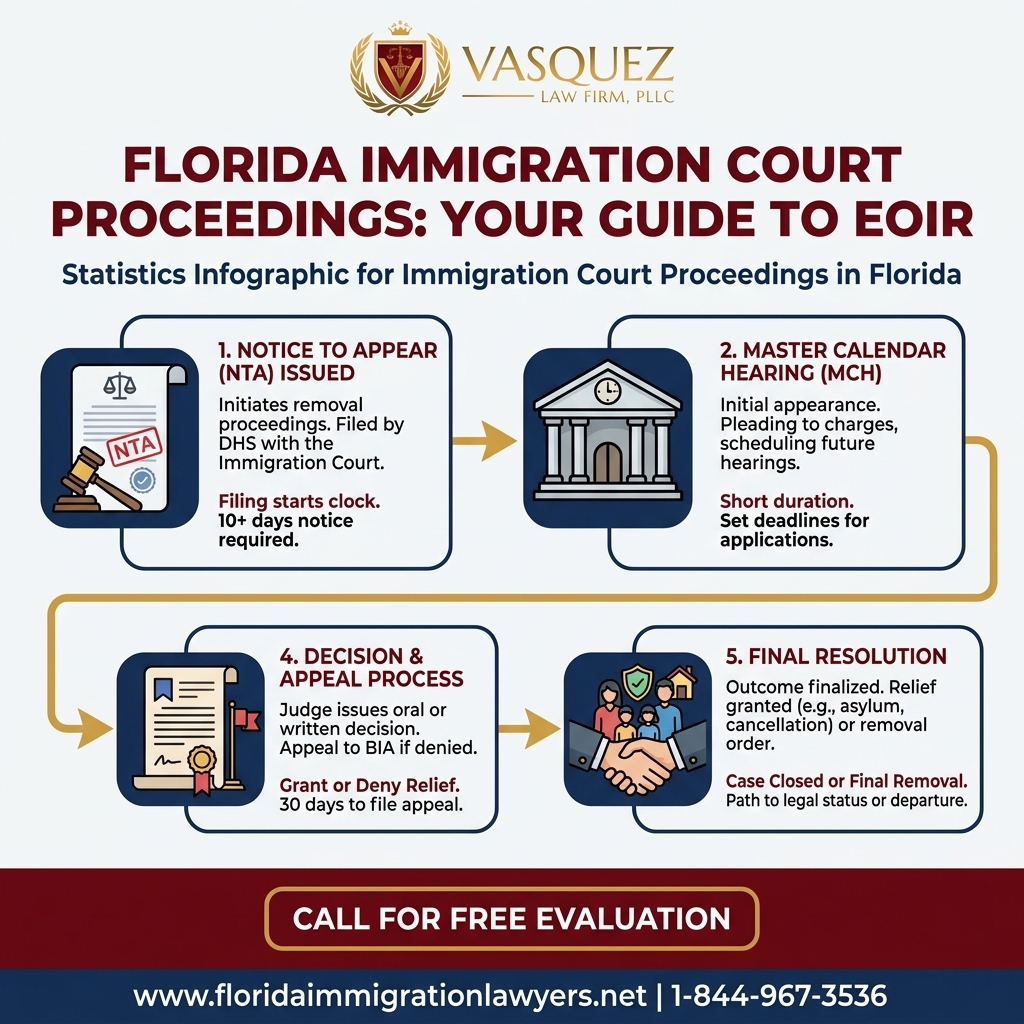
Notice to Appear (NTA): The process officially begins when the Department of Homeland Security (DHS) issues and serves you a Form I-862, Notice to Appear. This document outlines the specific charges against you, stating why the government believes you are removable from the U.S. It also provides the initial date and location for your first court hearing, known as the Master Calendar Hearing. It is crucial to immediately seek legal advice upon receiving an NTA, as delays can compromise your defense. The NTA is the foundation of the government's case against you.
-
Master Calendar Hearing (MCH): This is your initial appearance before an Immigration Judge. During the MCH, the judge will confirm your identity, ensure you understand the charges in the NTA, and ask you to admit or deny those charges. You will also be asked to designate a country for removal if ordered. Crucially, this is where you can request a continuance to find an attorney or for your attorney to file preliminary motions. Your attorney will enter an appearance, plead on your behalf, and inform the court of any applications for relief you intend to file. This hearing sets the stage for the entire proceeding.
-
Filing Applications for Relief: If you are eligible for any form of relief from removal, such as asylum, cancellation of removal, adjustment of status, or a waiver, your attorney will prepare and file the necessary applications and supporting documentation. This stage often involves extensive evidence gathering, including affidavits, expert reports, and country conditions documentation. The deadlines for filing these applications are strict and must be adhered to precisely, as outlined in 8 CFR Part 1240. Missing a deadline can severely jeopardize your case.
-
Individual Hearing (Merits Hearing): This is the main evidentiary hearing where the Immigration Judge will hear testimony, review evidence, and make a decision on your case. Both you and the government's attorney (DHS counsel) will have the opportunity to present arguments, call witnesses, and cross-examine. Your attorney will present your case for relief, highlighting why you should be allowed to remain in the U.S. This hearing can last several hours or even days, depending on the complexity of the case. The judge will then issue an oral or written decision.
-
Decision and Appeals: After the Individual Hearing, the Immigration Judge will issue a decision. If the judge grants your application for relief, the removal proceedings are terminated, and you may be granted legal status. If the judge denies your application and orders you removed, you typically have 30 days to file an appeal with the Board of Immigration Appeals (BIA). If the BIA denies your appeal, you may have further options to appeal to a federal circuit court. Each appeal stage requires specific legal arguments and adherence to strict filing deadlines. Our attorneys are experienced in representing clients at all levels of appeal.
Essential Document Checklist for Immigration Court
Preparing for immigration court proceedings in Florida requires meticulous organization and the timely submission of crucial documents. A comprehensive document checklist helps ensure you have all necessary evidence to support your case and respond to government charges. Gathering these materials early can significantly strengthen your defense and streamline the legal process.
Here is a general checklist of documents you may need. Please note that the exact documents required will vary based on your specific case, the charges against you, and the type of relief you are seeking:
- Your Notice to Appear (NTA): The Form I-862 is the foundational document initiating your case.
- Identity Documents: Passport, birth certificate, national identity card, driver's license, or any government-issued ID.
- Proof of Entry and Immigration History: I-94 arrival/departure records, visa stamps, prior petitions (I-130, I-140, etc.), asylum applications (I-589), or any other USCIS correspondence.
- Criminal Records: Certified copies of all arrest records, court dispositions, sentencing documents, and probation records, even for minor offenses. This includes records from Florida state courts and any other jurisdiction.
- Proof of Residency in the U.S.: Leases, utility bills, tax returns, employment records, school records, bank statements, or any documents showing continuous physical presence in the U.S., especially if seeking cancellation of removal.
- Family Relationship Documents: Marriage certificates, birth certificates of U.S. citizen or lawful permanent resident relatives (spouse, children, parents), divorce decrees, adoption papers.
- Financial Documents: Tax returns (W-2s, 1099s), pay stubs, bank statements, proof of assets or debts.
- Affidavits/Declarations: Sworn statements from family members, friends, employers, religious leaders, or other individuals who can attest to your good moral character, hardship, or fear of persecution.
- Medical Records: If applicable, documentation of any medical conditions, psychological evaluations, or treatment records, especially for asylum or humanitarian relief cases.
- Country Conditions Reports: For asylum or withholding of removal cases, detailed reports on human rights, political situations, and persecution risks in your home country. These are often from reputable organizations or the State Department.
- Proof of Good Moral Character: Letters of recommendation, community service records, religious involvement, or any other evidence demonstrating positive contributions to society.
- Any Previous Immigration Filings: Copies of all past applications, petitions, and decisions from USCIS or other immigration agencies.
It is crucial to provide original documents when requested and to have certified translations for any documents not in English. Your attorney at Florida Immigration Lawyers will help you compile a precise list tailored to your case and assist in obtaining any missing records. Do not underestimate the importance of thorough documentation in immigration court proceedings.
Do not navigate this process alone. Contact Florida Immigration Lawyers today for expert guidance and dedicated representation. We offer free consultations to discuss your specific situation.
Timelines and Processing Expectations in Florida Immigration Courts
Understanding the timelines involved in immigration court proceedings in Florida is crucial for managing expectations and preparing for the long road ahead. Immigration cases are rarely quick, and delays are common due to heavy court dockets, administrative backlogs, and the complex nature of the legal issues. The average duration of a removal case can vary significantly, often spanning several months to several years, particularly in busy courts like those in Miami and Orlando.
Initial Hearings and Continuances
After receiving your Notice to Appear (NTA), your first Master Calendar Hearing (MCH) might be scheduled anywhere from a few weeks to several months later, depending on the court's calendar. In Florida, courts are particularly busy. During the MCH, it is common for cases to be continued to allow respondents time to secure legal representation, gather documents, or file applications for relief. Each continuance can add weeks or months to the overall timeline. The number of Master Calendar Hearings before an Individual Hearing (Merits Hearing) is set can vary from one to several, depending on the complexity of the case and the judge's schedule. The current average wait time for an initial Master Calendar Hearing in some Florida courts can be several months, with Individual Hearings often scheduled a year or more after the first MCH.
Individual Hearings and Decisions
Once an Individual Hearing is scheduled, the wait can still be substantial. These hearings are often lengthy, involving testimony and extensive evidence review. After the hearing, the Immigration Judge may issue an immediate oral decision or reserve the decision for a later date, which can add additional weeks. The overall duration is also influenced by the type of relief sought. For instance, asylum cases often involve detailed country conditions reports and can take longer to adjudicate than simpler administrative closures. Furthermore, if you are detained, your case may be placed on an expedited docket, potentially shortening the timeline but increasing the pressure.
Appeals Process
If the Immigration Judge's decision is unfavorable, you have 30 days to file an appeal with the Board of Immigration Appeals (BIA). The BIA process itself can take anywhere from six months to over a year to render a decision. If the BIA denies your appeal, you may have the option to appeal to a U.S. Circuit Court of Appeals, which can add another year or more to the process. Each level of appeal requires careful legal strategy and adherence to strict deadlines, as outlined in 8 U.S.C. § 1252. Throughout these stages, your Florida Immigration Lawyers attorney will keep you informed of your case's progress and any potential delays. While the waiting can be frustrating, patience and persistent legal advocacy are key.
Cost Factors and Fee Breakdown for Immigration Court Cases
Understanding the financial implications of immigration court proceedings in Florida is an important part of preparing for your case. Legal fees, government filing fees, and other associated costs can accumulate, making it essential to have a clear picture of potential expenses. While Florida Immigration Lawyers offers free initial consultations, the subsequent costs for representation will depend on the complexity and specific needs of your case.
Legal Representation Fees
The primary cost factor will be the legal fees for your attorney. These fees can vary widely based on several elements:
- Case Complexity: A straightforward administrative closure or bond hearing will typically cost less than a complex asylum claim or a cancellation of removal case involving extensive evidence and multiple hearings.
- Attorney Experience: Highly experienced immigration attorneys, particularly those specializing in removal defense, may charge higher fees reflective of their expertise and success rates.
- Number of Hearings: Cases requiring multiple Master Calendar Hearings, an Individual Hearing, and potential appeals will naturally incur higher costs due to the increased time and effort involved.
- Type of Relief Sought: Different forms of relief require varying amounts of legal work. For example, preparing an I-589 application for asylum is generally more labor-intensive than a simple motion to terminate.
At Florida Immigration Lawyers, we believe in transparent fee structures. During your free consultation, we will discuss our fees and payment options tailored to your situation. We understand that legal costs can be a burden, and we work with clients to find suitable arrangements. Our goal is to provide exceptional legal services without unexpected financial surprises.
Government Filing Fees and Other Expenses
In addition to legal fees, you will likely encounter various government filing fees. These fees are paid directly to agencies like USCIS or EOIR for processing applications for relief or other motions. Examples include fees for Form I-589 (Application for Asylum), Form I-485 (Application to Register Permanent Residence), or motions to reopen. It is important to note that these fees are subject to change by the government. Certain applicants, particularly those with low incomes or receiving public assistance, may be eligible for fee waivers, which your attorney can help you determine and apply for. Beyond filing fees, other potential costs include:
- Translation Services: For any documents not in English.
- Expert Witness Fees: If your case requires testimony from medical professionals, country conditions experts, or psychologists.
- Document Retrieval Fees: For obtaining certified court records, police reports, or other official documents.
- Travel Expenses: If you need to travel for interviews or hearings outside your immediate area.
Your attorney will provide a detailed breakdown of all anticipated costs. While the financial investment in legal representation for immigration court proceedings can be substantial, it is an investment in your future and your ability to remain in the United States. Attempting to navigate these complex cases without legal counsel often leads to higher costs in the long run, including the ultimate cost of removal.
Common Mistakes to Avoid in Immigration Court Proceedings
Navigating immigration court proceedings in Florida is fraught with potential pitfalls. Even minor errors can have severe, lasting consequences, leading to delays, denials, or even a final order of removal. Being aware of these common mistakes can help you protect your case and improve your chances of a favorable outcome. Always consult with an experienced attorney to avoid these critical errors.
-
Missing Court Hearings: Failing to appear for any scheduled Master Calendar or Individual Hearing is one of the most serious mistakes. An Immigration Judge can issue an in absentia order of removal against you, making it extremely difficult to reopen your case and potentially leading to a 10-year bar from re-entry. Always confirm dates and times.
-
Ignoring the Notice to Appear (NTA): Receiving an NTA can be frightening, but ignoring it will not make it go away. It is a formal legal document requiring a response. Failure to appear after receiving an NTA can lead to an in absentia removal order, even if you never received the physical NTA due to an address change.
-
Failing to Update Your Address with EOIR: If you move, you must notify the immigration court (EOIR) and USCIS of your new address using Form EOIR-33 within five days. Failure to do so means you might not receive crucial hearing notices, leading to missed hearings and an in absentia removal order.
-
Misrepresenting Facts or Lying: Providing false information, either orally or in writing, to an immigration officer or judge can be considered a material misrepresentation or fraud. This can lead to a denial of all immigration benefits, a permanent bar from the U.S., and potentially criminal charges. Honesty is paramount.
-
Missing Deadlines for Filing Applications or Evidence: Immigration court operates on strict deadlines for filing applications for relief, motions, and supporting evidence. Missing these deadlines, even by a day, can result in your application being rejected or your case being denied without review of your merits. Your attorney will help manage these critical dates.
-
Not Understanding the Charges Against You: Many individuals facing removal proceedings do not fully comprehend the specific legal grounds for their removability as stated in the NTA. Without this understanding, it is impossible to mount an effective defense or identify applicable forms of relief. Your attorney will explain everything clearly.
-
Not Gathering Sufficient Supporting Documentation: A strong case relies on compelling evidence. Failing to provide comprehensive supporting documents, such as birth certificates, marriage licenses, tax records, medical reports, or affidavits, weakens your claims and makes it harder for the judge to rule in your favor.
-
Going to Court Without Legal Representation: While you have the right to represent yourself, navigating the complexities of immigration law, court procedures, and legal arguments without an attorney is highly risky. Studies show that individuals with legal representation have significantly higher success rates in immigration court. An attorney is your best advocate.
-
Discussing Your Case with Others (Especially ICE/DHS): Be very cautious about what you say and to whom. Any statements you make to immigration officials (ICE or DHS) can be used against you in court. It is always best to politely state that you wish to speak with your attorney before answering questions. Do not sign anything without legal review.
-
Failing to Disclose All Criminal History: Even minor offenses or arrests that did not lead to conviction can have immigration consequences. Failing to disclose your full criminal history to your attorney or the court can undermine your credibility and lead to unexpected complications or denials based on undisclosed grounds of inadmissibility/removability.
When to Call a Lawyer for Immigration Court Proceedings
The decision to hire an attorney for immigration court proceedings in Florida is one of the most critical choices you will make. While you have the right to represent yourself, the complexity of immigration law, the high stakes involved, and the formal nature of court procedures make legal representation almost indispensable. You should contact an experienced immigration lawyer as soon as you receive any notification from immigration authorities, especially a Notice to Appear (NTA).
Here are specific scenarios and warning signs that strongly indicate you need immediate legal assistance:
- You Received a Notice to Appear (NTA): This is the official start of your removal proceedings. Do not delay. An attorney can help you understand the charges, prepare for your first hearing, and explore all possible defenses and forms of relief.
- You Are Detained by ICE: If you or a family member is in immigration detention, an attorney can work to secure a bond hearing, argue for release, and begin building a defense while ensuring your rights are protected in detention facilities across Florida.
- You Have a Criminal Record: Even minor criminal offenses can have severe immigration consequences, potentially making you inadmissible or deportable. An attorney can assess the impact of your criminal history on your immigration case and advise on potential waivers or defense strategies.
- You Are Seeking Asylum or Withholding of Removal: These cases are highly complex, requiring extensive documentation, detailed testimony about persecution, and a deep understanding of U.S. and international asylum law. An attorney is crucial for navigating these sensitive claims.
- You Believe You Are Eligible for Relief (e.g., Cancellation of Removal, Adjustment of Status): Determining eligibility for various forms of relief is intricate and requires a thorough review of your immigration history, family ties, and other factors. An attorney can identify your options and prepare compelling applications.
- You Have Been Previously Deported or Have Prior Immigration Violations: Past immigration issues significantly complicate new proceedings. An attorney can analyze your history and advise on the feasibility of re-entry or relief.
- You Do Not Understand the Court Process or Legal Terminology: The language and procedures of immigration court are challenging. An attorney acts as your advocate, explaining everything clearly and representing your interests effectively before the Immigration Judge.
At Florida Immigration Lawyers, we are ready to stand by your side. Our attorneys have extensive experience in all aspects of immigration court proceedings in Florida, from bond hearings to appeals. We offer free consultations to help you understand your situation and determine the best course of action. Do not risk your future by going it alone.
About Florida Immigration Lawyers
Florida Immigration Lawyers is a leading immigration law firm dedicated to serving individuals and families across the entire state of Florida. With a deep understanding of the complexities of U.S. immigration law and a compassionate approach, we are committed to providing exceptional legal representation and personalized service. Our team of experienced attorneys is passionate about protecting the rights and futures of immigrants in Florida, from Tallahassee to Miami and everywhere in between.
We specialize in a comprehensive range of immigration services, including but not limited to, deportation defense, asylum claims, family-based immigration, business immigration, citizenship, and visa applications. Our firm prides itself on its client-focused approach, ensuring that every individual receives the attention, respect, and strategic legal counsel they deserve. We understand that each immigration case is unique and often comes with significant emotional and personal challenges. That's why we offer free, confidential consultations to discuss your specific situation and outline your best legal options.
Choosing Florida Immigration Lawyers means choosing a firm that is available 24/7 to address your urgent needs, provides transparent communication, and fights tirelessly on your behalf. We are a bilingual firm, and our team is proficient in both English and Spanish, ensuring that language is never a barrier to quality legal representation. When your future in the United States is at stake, trust the dedicated advocates at Florida Immigration Lawyers to guide you through the process with expertise and empathy. Call us today at 1-844-967-3536 or visit our website at https://www.floridaimmigrationlawyers.net.
Sources and References
- U.S. Citizenship and Immigration Services (USCIS): Official source for immigration forms, policies, and case status.
- Executive Office for Immigration Review (EOIR): Official site for immigration courts, Board of Immigration Appeals, and Immigration Judges.
- U.S. Department of State - Bureau of Consular Affairs: Information on visas, travel, and country specific details.
- 8 U.S.C. Chapter 12 - Immigration and Nationality Act (INA): The primary body of law governing immigration in the United States.
- 8 CFR (Code of Federal Regulations): Rules and regulations promulgated by DHS, DOJ, and other agencies to implement the INA.
- USCIS Policy Manual: Provides guidance to USCIS officers on adjudicating immigration benefits.
Related services: asylum and refugee protection, immigration waivers, humanitarian protection programs, DACA renewal and applications.
This article provides general legal information and is not intended as legal advice. Every case is unique, and outcomes depend on specific facts and circumstances. Contact an attorney for advice about your particular situation. Immigration laws are subject to change.
Do not face immigration court proceedings in Florida without experienced legal counsel. Your future and your ability to remain in the United States are too important to leave to chance. Contact Florida Immigration Lawyers today for a free consultation at 1-844-967-3536. Se Habla Espanol - Estamos aqui para ayudarle.
If you need legal assistance, learn more about our deportation defense services, or call us at 1-844-967-3536 for a free consultation.
Do Not Navigate This Process Alone
Our experienced immigration attorneys are ready to fight for you. Get a free, confidential consultation today.
Se Habla Español
Or leave your details and we’ll call you:
Free Evaluation in 24 Hours
Or talk to us right now

AI voice assistant — available 24/7
FreeFrequently Asked Questions

William J. Vásquez
Founding Attorney · Vasquez Law Firm
U.S. Air Force veteran and immigration attorney with years of hands-on U.S. immigration experience. J.D., NCCU School of Law. AILA member. Admitted to the 4th, 5th, and 11th Circuit Courts.
Available 24/7 - Free Evaluations
Reviewed for legal accuracy by William J. Vásquez
Licensed in North Carolina; U.S. immigration is federal practice.
Related Legal Services
Our Florida immigration attorneys can help you with citizenship and naturalization, family immigration services and immigration practice areas. Call today at 1-844-967-3536 for a free consultation.
Related Links
Related Topics
Free Legal Consultation
Discuss your case with our experienced attorneys. We're available 24/7.
Se Habla Español - Estamos aquí para ayudarle.
Related Articles
Military Naturalization Expedited in Florida Bases
Explore military naturalization options for families at Florida bases, including parole in place benefits in Miami. Learn how to expedite your application with expert guidance from Florida Immigration Lawyers.
Immigration Lawyer Orlando Free Consultation 2026
Explore the cost of an immigration lawyer in Orlando in 2026. Understand attorney fees, what to expect during a consultation, and how to make the best choice for your immigration needs.
Unlawful Presence Waiver Florida: A 2026 Guide
Navigating the I-601A Provisional Unlawful Presence Waiver in Florida is a critical step for many seeking lawful permanent residency. This comprehensive guide for 2026 explains who is eligible, the detailed application process, required documentation, and what to expect regarding timelines and costs. We delve into the crucial concept of 'extreme hardship' and highlight common mistakes to avoid. Whether you're in Jacksonville, Miami, or anywhere in Florida, understanding this waiver is essential. Florida Immigration Lawyers provides expert legal assistance to help you overcome inadmissibility due to unlawful presence and reunite your family.
TPS Honduras Latest News 2026: Florida Eligibility
Discover the latest 2026 updates on TPS for Honduras and other eligible countries in Florida. Get insights on eligibility, application steps, and common pitfalls. Stay informed and secure your status with guidance from Florida Immigration Lawyers.