Deportation Attorney St. Petersburg: Florida Defense in 2026
Facing deportation in St. Petersburg or anywhere in Florida can be a terrifying experience. The U.S. government's initiation of removal proceedings demands immediate and expert legal intervention to protect your right to remain in the country. This comprehensive guide from Florida Immigration Lawyers explains the entire deportation process, from receiving a Notice to Appear (NTA) to navigating complex immigration court hearings. We detail the crucial role an experienced deportation defense lawyer plays, outlining how they can identify potential forms of relief, prepare essential documentation, and represent you effectively before an Immigration Judge. Learn about the step-by-step process, critical documents needed, typical timelines in Florida, and the costs involved. We also highlight common mistakes to avoid that could jeopardize your case and emphasize when it's absolutely vital to seek legal counsel. Florida Immigration Lawyers serves clients across the entire state, offering compassionate, dedicated, and strategic advocacy to fight for your future. Contact us for a free case review and let us help you understand your options and build a strong defense.
Deportation defense, also known as removal defense, involves legal strategies and actions taken to prevent a non-citizen from being removed from the United States by the U.S. government. This complex process typically begins with a Notice to Appear (NTA) issued by the Department of Homeland Security (DHS), initiating proceedings in immigration court. A skilled deportation attorney, such as those at Florida Immigration Lawyers, is crucial for analyzing your case, identifying potential forms of relief, preparing necessary documentation, and representing you before an Immigration Judge, significantly improving your chances of remaining in the U.S.
- Deportation proceedings are serious and require immediate legal attention.
- Various forms of relief from removal may be available, depending on your specific circumstances.
- Legal representation is vital for navigating complex immigration laws and court procedures.
- Deadlines are strict; missing them can have severe consequences.
- Florida Immigration Lawyers serves clients across Florida, including those in St. Petersburg facing removal.
The fear of deportation can be overwhelming, casting a long shadow over your life and the lives of your loved ones in Florida. When the U.S. government initiates removal proceedings, it signals a critical moment that demands immediate and expert legal intervention. Whether you reside in St. Petersburg, Orlando, or any other part of the Sunshine State, understanding your rights and options is the first step toward building a robust defense. The immigration legal landscape is constantly evolving, with new policies and interpretations emerging regularly, making it incredibly challenging for individuals to navigate alone.
This comprehensive guide from Florida Immigration Lawyers is designed to demystify the deportation process, offering clarity on how removal proceedings begin, the types of defense available, and the critical role an experienced immigration attorney plays. We will delve into common reasons for deportation, explore various forms of relief, and provide practical advice for those facing this daunting challenge. Our goal is to empower you with the knowledge needed to make informed decisions and fight for your right to remain in the United States. We understand the unique pressures faced by immigrant communities across Florida, and our commitment is to provide compassionate, effective legal advocacy.
Don't face the complexities of immigration court alone. The stakes are too high, and the legal nuances are too intricate to leave to chance. With Florida Immigration Lawyers, you gain a dedicated partner committed to protecting your future. If you or a loved one has received a Notice to Appear (NTA) or fears deportation, time is of the essence. Call Florida Immigration Lawyers at 1-844-YO-PELEO for a free case review and let our experienced team provide the guidance and representation you deserve.
What are Removal Proceedings and How Do They Start in Florida?
Removal proceedings, commonly known as deportation, are legal processes initiated by the U.S. government to formally remove a non-citizen from the United States. These proceedings typically begin when the Department of Homeland Security (DHS) issues a Notice to Appear (NTA), alleging that an individual is deportable under U.S. immigration law. In Florida, individuals receive NTAs from various sources, including during encounters with immigration enforcement, after visa overstays, or following certain criminal convictions.
The issuance of an NTA is the formal start of the deportation process. An NTA is a document that charges a non-citizen with being removable from the U.S. and orders them to appear before an Immigration Judge. Reasons for receiving an NTA are diverse and can include overstaying a visa, entering the U.S. without inspection, violating terms of admission, or committing certain crimes. For instance, a person in St. Petersburg might receive an NTA after being detained by Immigration and Customs Enforcement (ICE) following a traffic stop or a workplace raid. It is crucial to understand that an NTA is not a final deportation order but rather an invitation to a legal battle where you have the right to present your defense.
Once an NTA is issued, it is filed with an Immigration Court, such as the ones located in Orlando or Miami, which are part of the Executive Office for Immigration Review (EOIR). The NTA will specify the alleged violations of immigration law and the date and time of your first hearing, known as a Master Calendar Hearing. Failure to appear at this hearing can result in an in absentia removal order, making it even more challenging to fight your case. Understanding the specific charges against you, as outlined in the NTA, is paramount for developing an effective deportation defense strategy. An attorney can help you decipher these charges and explain their implications under the Immigration and Nationality Act (INA), particularly Section 240 (8 U.S.C. § 1229a), which governs removal proceedings.
How Can a Deportation Defense Lawyer in Orlando Help My Case?
An Orlando deportation defense lawyer provides crucial legal representation throughout removal proceedings, helping individuals understand complex immigration laws, identify potential forms of relief, and prepare a robust defense. They navigate the intricate immigration court system, negotiate with ICE attorneys, and present compelling arguments to an Immigration Judge, significantly increasing the chances of a favorable outcome. Their expertise is invaluable for protecting your rights and future in the U.S.
Hiring an experienced immigration attorney in Central Florida, such as those at Florida Immigration Lawyers, is one of the most critical decisions you can make when facing deportation. Our attorneys, based in Orlando but serving clients across the entire state, can analyze the specific allegations in your NTA and evaluate all possible defenses and forms of relief. This might include applying for asylum, seeking cancellation of removal, adjusting status to a lawful permanent resident, or obtaining a waiver of inadmissibility. For example, if you have long-standing ties to the U.S. and a U.S. citizen spouse or child, you might be eligible for cancellation of removal, a complex form of relief that requires demonstrating exceptional and extremely unusual hardship.
Beyond identifying relief options, your lawyer will meticulously prepare your case. This involves gathering extensive documentation, coaching you for testimony, and drafting legal briefs to support your arguments. They will represent you at every hearing, from the initial Master Calendar Hearing to the final Individual Hearing, ensuring your rights are protected and that all legal procedures are followed. In many cases, an attorney can also negotiate with the ICE prosecutor for a favorable outcome, such as administrative closure or voluntary departure, which can avoid a formal removal order. Our team understands the nuances of the Orlando and Miami Immigration Courts and can tailor strategies specific to the judges and prosecutors involved in your case, providing a significant advantage in a system designed to favor the government.
Navigating the Immigration Court: A Step-by-Step Guide for Florida Residents
Navigating removal proceedings in Florida involves a structured legal process, typically starting with a Notice to Appear (NTA) and moving through master calendar hearings, individual hearings, and potentially appeals. Each stage requires careful preparation and adherence to strict deadlines.
The journey through immigration court can feel like an arduous trek, but understanding each phase can help you prepare. Here is a step-by-step guide to what you can expect:
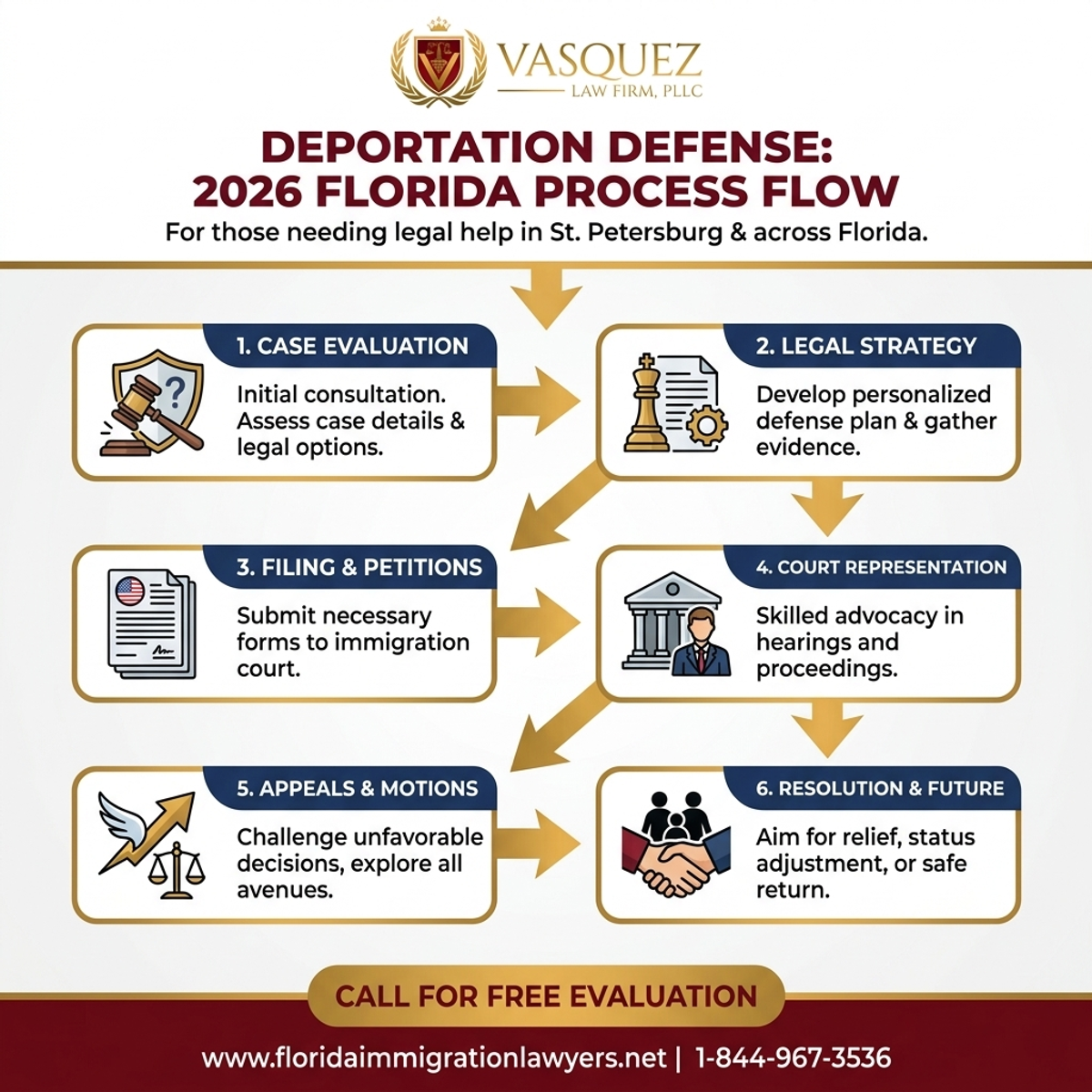
Step-by-Step Process — Deportation Attorney St. Petersburg: Florida Defense in 2026
- Receipt of the Notice to Appear (NTA): This is the official document from DHS initiating your removal proceedings. It outlines the legal grounds for your removal and schedules your first court appearance. It's vital to review this document carefully and seek legal advice immediately upon receipt.
- Retaining Legal Counsel: This is arguably the most crucial step. An immigration attorney will help you understand the charges, explore potential defenses, and represent you throughout the process. They will file an appearance with the court and begin preparing your case.
- Master Calendar Hearing (MCH): This is your initial appearance before an Immigration Judge. During the MCH, you or your attorney will acknowledge receipt of the NTA, admit or deny the factual allegations and legal charges, and inform the judge of your intentions regarding relief from removal. The judge will set deadlines for filing applications and schedule future hearings.
- Filing Applications for Relief: If you are eligible for a form of relief (e.g., asylum, cancellation of removal, adjustment of status), your attorney will prepare and submit the necessary applications and supporting documentation to the Immigration Court and/or USCIS, adhering to strict deadlines set by the judge.
- Individual Hearing (Merits Hearing): This is the evidentiary hearing where you present your case for relief from removal. You and your witnesses will testify, and your attorney will present evidence and legal arguments to the Immigration Judge. The ICE attorney will also present their case and may cross-examine you and your witnesses. This hearing is often the longest and most critical part of the process.
- Decision by the Immigration Judge: After the Individual Hearing, the Immigration Judge will issue a decision, either verbally in court or in writing. The judge will determine whether you are removable and, if so, whether you are granted any form of relief, allowing you to remain in the U.S.
- Appeals: If either you or the government disagrees with the Immigration Judge's decision, an appeal can be filed with the Board of Immigration Appeals (BIA). Further appeals can be made to the federal circuit courts. This process can add significant time to your case but provides an opportunity to challenge unfavorable decisions. For more information on the court system, visit the Executive Office for Immigration Review (EOIR) website.
Essential Documents for Your Deportation Defense Checklist
Preparing for a deportation defense case requires a comprehensive collection of personal, financial, and immigration-related documents to support your eligibility for various forms of relief. A thorough document checklist is essential for presenting a strong case to the Immigration Judge.
The success of your deportation defense often hinges on the strength and completeness of your supporting documentation. Organizing these documents early can significantly streamline your case and prevent delays. While the exact documents needed will vary based on your specific situation and the type of relief you are seeking, this general checklist provides a solid starting point for individuals in Florida facing removal proceedings:
- Notice to Appear (NTA): The original document initiating your removal proceedings.
- Identity and Nationality Documents: Passport, birth certificate, national ID card, and any previous visas or entry stamps.
- Proof of U.S. Presence and Residence: Leases, utility bills, bank statements, school records, employment records, and other documents demonstrating continuous presence in the U.S. over time.
- Family Relationship Documents: Marriage certificates, birth certificates of U.S. citizen or lawful permanent resident spouses, children, or parents, and divorce decrees if applicable.
- Financial Documents: Tax returns (current and past years), pay stubs, employment verification letters, and any evidence of financial support for dependents.
- Medical Records: Especially relevant for asylum cases or humanitarian relief, detailing any physical or psychological conditions.
- Affidavits and Character Letters: Sworn statements from family, friends, employers, or community leaders attesting to your good moral character, contributions to the community, and the hardship they would face if you were deported.
- Police and Court Records: Certified copies of any criminal records, even if charges were dismissed or expunged, as immigration law treats criminal history differently.
- Evidence for Specific Relief: Depending on the type of relief you are seeking, you will need additional documents. For example, asylum seekers will need evidence of persecution, while those seeking VAWA relief will need proof of abuse.
- Previous Immigration Filings: Copies of any prior applications, petitions, or correspondence with USCIS, DHS, or the Immigration Court.
Maintaining an organized file of these documents is crucial. Your attorney from Florida Immigration Lawyers will guide you through this process, ensuring all necessary evidence is gathered and properly presented to the court, strengthening your overall family immigration or other defense claims.
What to Expect: Timelines for Deportation Cases in Florida in 2026
As of 2026, the timeline for deportation defense cases in Florida can vary significantly based on factors like court backlog, case complexity, and the specific relief sought. While some cases may conclude within months, others can extend for several years, particularly if appeals are involved.
Immigration court proceedings are notorious for their lengthy timelines, and Florida's courts, including those in Orlando and Miami, are no exception. The U.S. immigration system faces significant backlogs, which can both be a source of frustration and, in some cases, provide more time for a robust defense to be built. Understanding these general timelines can help manage expectations:
| Stage | Typical Timeframe (As of 2026) | Notes |
|---|---|---|
| NTA to First Master Calendar Hearing | 3-12 months | Varies greatly depending on the court's docket and current backlog. |
| Master Calendar Hearing to Individual Hearing | 1-3 years | This is often the longest gap due to the volume of cases. Complex cases may take longer. |
| Immigration Judge's Decision | Immediate to 6 months | Often rendered verbally at the end of the Individual Hearing; written decisions can take longer. |
| Appeal to Board of Immigration Appeals (BIA) | 1-2 years | If either party appeals the Immigration Judge's decision. |
| Appeal to Federal Circuit Court | 2-4 years | Only after a BIA decision; reserved for complex legal questions. |
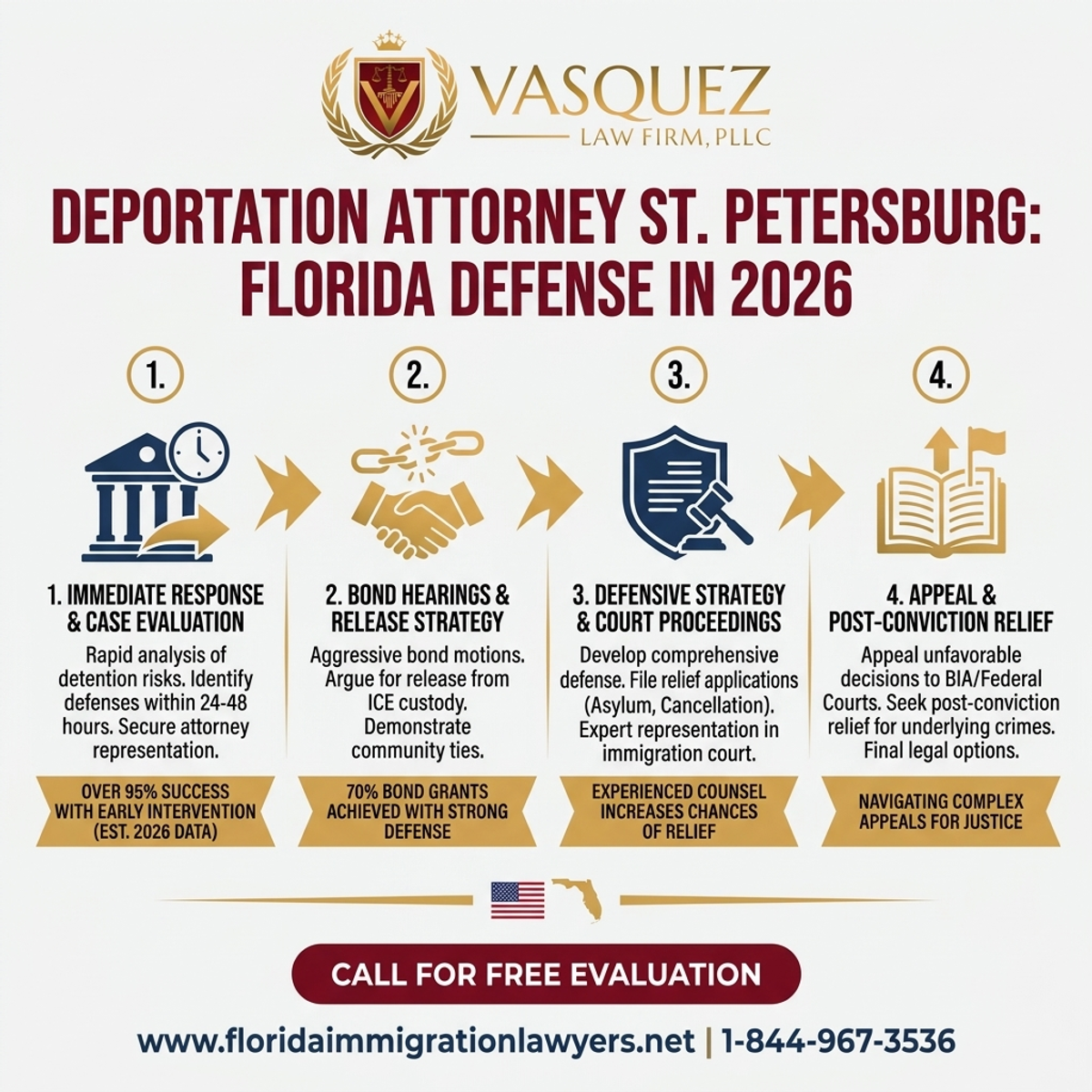
Key Statistics — Deportation Attorney St. Petersburg: Florida Defense in 2026
These timeframes are estimates and can be influenced by many factors, including changes in immigration policy, the availability of judges, and the complexity of your particular case. For instance, a case involving criminal charges or national security concerns may face expedited processing, while a complex asylum claim might take longer to adjudicate. It is important to stay informed about your case status, which can sometimes be tracked through the U.S. Citizenship and Immigration Services (USCIS) website for certain applications, or through the EOIR automated case status hotline. Your attorney will keep you updated on all developments and help you understand how these timelines apply to your unique situation.
How Much Does Deportation Defense Cost in Florida?
The costs associated with deportation defense in Florida can range widely, encompassing legal fees, filing fees for relief applications, and potential expert witness fees. While legal fees are the most substantial component, investing in a skilled attorney often proves more cost-effective in the long run than facing removal alone.
Understanding the financial implications of deportation defense is a critical part of preparing for your case. Legal fees for deportation defense in Florida can vary significantly based on the complexity of the case, the specific forms of relief sought, the experience of the attorney, and the duration of the proceedings. It's important to remember that these costs are an investment in your future and your ability to remain in the United States.
| Item | Typical Fee (Estimate) | Notes |
|---|---|---|
| Initial Consultation | $0-$300 | Many firms, including Florida Immigration Lawyers, offer free initial case reviews. |
| Legal Fees (Retainer) | $5,000 - $15,000+ | This is the primary cost, covering attorney time, case preparation, court appearances, and communication. Fees vary greatly by case complexity (e.g., simple bond hearing vs. complex asylum trial). |
| Application Filing Fees | $0-$1,225+ per application | These are government fees for specific applications for relief (e.g., I-485 for adjustment of status, I-601/I-601A waivers). Fees are set by USCIS and are subject to change. Some waivers or applications (like asylum) may have no filing fee. |
| Expert Witness Fees | Varies (potentially $500 - $3,000+) | If your case requires testimony from psychologists, country condition experts, or other specialists, their fees will be additional. |
| Translation and Evaluation Fees | Varies ($50 - $500+) | For translating foreign documents into English or obtaining credential evaluations. |
| Travel Costs | Varies | If you or your attorney need to travel to a different court or for evidence gathering. |
Most immigration law firms structure their fees as a flat fee for the entire case or a specific stage of the proceedings, providing predictability. Some may offer payment plans. It's crucial to have a clear understanding of the fee structure upfront. While the costs may seem substantial, the investment in a skilled deportation defense attorney can prevent removal, allowing you to maintain your life and family in the U.S. Florida Immigration Lawyers offers transparent fee structures and will discuss all costs with you during your free initial consultation. We believe that everyone deserves quality legal representation, regardless of their financial situation.
Do not navigate this process alone. The complexities of immigration law and the high stakes of removal proceedings demand professional expertise. Contact Florida Immigration Lawyers today for a free case review and let our dedicated team fight for your rights and your future in Florida.
Common Mistakes to Avoid in Deportation Proceedings
Navigating deportation proceedings is fraught with potential pitfalls that can severely jeopardize your case. Avoiding these common mistakes is as crucial as building a strong defense.
- Missing Deadlines: Immigration court operates on strict deadlines for filing documents and applications. Missing a deadline, even by a day, can lead to the denial of your case, or even an in absentia removal order, without any further opportunity to present your defense.
- Not Seeking Legal Counsel: Attempting to represent yourself in immigration court is a significant risk. Immigration law is incredibly complex, and a non-attorney is unlikely to know all available forms of relief, understand court procedures, or effectively argue legal points before a judge. Studies consistently show that individuals with legal representation have a significantly higher success rate.
- Lying or Providing Inconsistent Information: Any false statements or inconsistencies in your testimony or applications can be used against you. Credibility is paramount in immigration court. Even minor discrepancies can lead an Immigration Judge to disbelieve your entire testimony and deny your case.
- Failing to Gather All Required Documents: A strong defense relies on comprehensive evidence. Failing to collect and present all necessary supporting documents for your applications can weaken your claim for relief and result in a denial. This includes personal documents, financial records, and evidence specific to your relief request.
- Not Understanding the Charges in the NTA: Many individuals facing deportation do not fully comprehend the specific legal charges against them in the Notice to Appear. Without this understanding, it's impossible to formulate an effective defense or identify appropriate forms of relief.
- Traveling Outside the U.S. During Proceedings: Leaving the country while in removal proceedings can be interpreted as self-deportation or abandonment of your case, potentially leading to an automatic removal order and a bar from re-entering the U.S. for many years.
- Failing to Update Address with EOIR/USCIS: It is your responsibility to keep the Immigration Court (EOIR) and USCIS updated with your current mailing address. Failure to do so means you might miss critical notices, hearing dates, or decisions, leading to an in absentia order or other adverse outcomes.
- Not Disclosing Criminal History: Attempting to conceal past criminal convictions, even minor ones, can have severe negative consequences. Immigration law has specific rules regarding criminal offenses, and non-disclosure can lead to findings of lack of good moral character or even permanent bars to relief. Always be honest with your attorney.
- Giving Up Without Exploring All Options: The deportation process can be emotionally and financially draining, leading some individuals to give up prematurely. However, there may be viable defense strategies or forms of relief you are unaware of. An experienced attorney will explore every possible avenue to fight your removal.
When to Call a Lawyer for Deportation Defense in Florida
The moment you suspect you might be facing deportation, or if you have already received a Notice to Appear (NTA), is the moment to seek legal counsel. Delaying can severely limit your options and complicate your defense. An attorney from Florida Immigration Lawyers can provide crucial assistance in a variety of scenarios.
You should immediately schedule a consultation if any of the following situations apply to you:
- You Received a Notice to Appear (NTA): This is the most direct signal that removal proceedings have begun. Do not try to interpret or respond to it without legal guidance.
- You Were Arrested by ICE or Other Law Enforcement: If you are detained by immigration authorities or arrested for any reason, especially if you are not a U.S. citizen, contact an attorney immediately.
- You Have a Criminal Conviction: Certain criminal offenses, even seemingly minor ones, can trigger deportation proceedings or make you inadmissible to the U.S. An attorney can assess the immigration consequences of your criminal history.
- You are Seeking Asylum: Asylum cases are highly complex and require strong legal arguments and extensive documentation. An attorney can help you prepare and present a compelling case.
- You Have a Previous Deportation Order: If you were previously ordered removed or deported, re-entering the U.S. can lead to immediate reinstatement of that order. An attorney can explore limited options for relief.
- Your Case is Complex: If your situation involves multiple immigration issues, a lengthy history with immigration authorities, or unique family circumstances, a lawyer is essential to navigate the intricacies.
- You Don't Understand the Documents or Process: If you have a language barrier or find the legal jargon and court procedures confusing, an attorney can explain everything clearly and ensure you understand each step.
Facing deportation is a life-altering event. The attorneys at Florida Immigration Lawyers are here to provide compassionate, knowledgeable, and aggressive representation. We serve clients across Florida, including those in St. Petersburg and the greater Orlando area, offering personalized strategies tailored to your unique circumstances. Don't wait until it's too late; proactive legal defense is your best course of action.
About Florida Immigration Lawyers
Florida Immigration Lawyers is an immigration law firm dedicated to serving individuals and families across the entire state of Florida. With a deep understanding of U.S. immigration law and a commitment to protecting the rights of our clients, we provide comprehensive legal services ranging from family-based petitions and business immigration to complex deportation defense and asylum claims. Our experienced attorneys are passionate advocates for the immigrant community, offering personalized attention and strategic guidance through every step of the legal process.
We pride ourselves on our client-centered approach, ensuring that each individual receives compassionate and effective representation. Our team is available 24/7, understanding that immigration emergencies don't adhere to business hours. We offer free case reviews to help you understand your options without financial commitment. Located in Central Florida, our firm is uniquely positioned to assist clients throughout the state, from St. Petersburg to Jacksonville, Miami to Pensacola, ensuring accessible and high-quality legal support. When your future in the United States is at stake, choose Florida Immigration Lawyers for dedicated advocacy and proven results.
For immediate assistance or to discuss your immigration needs, call us at 1-844-YO-PELEO or schedule a free consultation through our website today. We are here to help you navigate the complexities of immigration law with confidence.
Sources and References
- U.S. Citizenship and Immigration Services (USCIS)
- Executive Office for Immigration Review (EOIR)
- U.S. Department of State
- 8 U.S.C. Chapter 12 - Immigration and Nationality Act (INA)
- 8 U.S.C. § 1229a - Removal Proceedings
- 8 CFR (Code of Federal Regulations)
Related services: immigration waivers, humanitarian protection programs, DACA renewal and applications, temporary protected status (TPS).
This article provides general legal information and is not intended as legal advice. Every case is unique, and outcomes depend on specific facts and circumstances. Contact an attorney for advice about your particular situation.
Navigating the complex world of immigration law, especially when facing deportation, requires experienced and dedicated legal representation. At Florida Immigration Lawyers, we are committed to providing robust defense strategies and compassionate support to individuals and families across Florida. Your future in the U.S. is worth fighting for, and we are ready to stand by your side. Don't delay; every moment counts in these critical situations. Call Florida Immigration Lawyers today at 1-844-YO-PELEO for a free, confidential case review. Se Habla Espanol - Estamos aqui para ayudarle.
Do Not Navigate This Process Alone
Our experienced immigration attorneys are ready to fight for you. Get a free, confidential case review today.
Se Habla Español
Or leave your details and we’ll call you:
Free Evaluation in 24 Hours
Or talk to us right now

AI voice assistant — available 24/7
FreeFrequently Asked Questions

William J. Vásquez
Founding Attorney · Vasquez Law Firm
U.S. Air Force veteran and immigration attorney with years of hands-on U.S. immigration experience. J.D., NCCU School of Law. AILA member. Admitted to the 4th, 5th, and 11th Circuit Courts.
Available 24/7 - Free Evaluations
Reviewed for legal accuracy by William J. Vásquez
Licensed in North Carolina; U.S. immigration is federal practice.
Related Legal Services
Our Florida immigration attorneys can help you with free immigration consultation, business immigration and deportation defense. Call today at 1-844-YO-PELEO for a free case review.
Related Links
Related Topics
Free Legal Case Review
Discuss your case with our experienced attorneys. We're available 24/7.
Se Habla Español - Estamos aquí para ayudarle.
Related Articles
PERM Labor Certification in Florida: A 2026 Guide
Learn all about the PERM labor certification process in Florida, essential for employers sponsoring green card applicants. Understand the steps, document requirements, and common mistakes to avoid in this 2026 guide.
Dual Citizenship Lawyer in Florida: What You Need to Know
For Florida residents, the concept of dual citizenship, or holding two passports, offers a compelling blend of opportunities and challenges. While the U.S. generally permits dual nationality, the path to achieving this status requires a meticulous understanding of both U.S. immigration laws and the citizenship policies of your country of origin. This guide explores the definition of dual citizenship, the detailed step-by-step process for U.S. naturalization, and the significant benefits and potential pitfalls involved. We cover essential documentation, typical timelines, and cost considerations for 2026, providing crucial insights for anyone in Orlando, Miami, or across Florida considering this important legal step. Learn about common mistakes to avoid and understand when to seek professional legal counsel to navigate this complex process successfully. Florida Immigration Lawyers is here to provide expert, bilingual support for your dual citizenship journey.
EAD Advance Parole Combo Card in Florida: What You Need
An EAD advance parole combo card allows individuals with pending adjustment applications to both work and travel abroad without jeopardizing their green card application. Learn how to apply in Florida, what documents you need, and common mistakes to avoid.
Immigration Lawyer Orlando Free Consultation in Florida
For individuals and families in Orlando, Florida, navigating the complexities of U.S. immigration law requires expert guidance. An immigration lawyer in Orlando offers crucial support for everything from visa applications and green card processes to naturalization and deportation defense. This comprehensive guide details what a free consultation covers, providing a step-by-step overview of immigration pathways, essential document checklists, and expected timelines in 2026. We also highlight common mistakes to avoid, discuss the critical role of legal counsel in deportation and asylum cases, and explain why choosing a local Orlando immigration attorney is beneficial. Florida Immigration Lawyers is dedicated to serving the diverse community of Orlando with compassionate, effective legal solutions, ensuring you receive personalized advice and robust representation for a successful immigration journey.