Family Petitions for Citizenship in Florida: 2026 Guide
Securing a family petition and navigating the path to U.S. citizenship in Florida requires a thorough understanding of immigration laws and procedures. This comprehensive guide, updated for 2026, details the Form I-130 petition process, eligibility requirements for various family categories, and the critical documents needed. We explore the typical timelines and associated costs, highlighting the differences between immediate relative and family preference categories. Learn about the unique considerations for immigrants in Florida, including interactions with USCIS field offices in Tampa and Miami, and the role of immigration courts. This article also outlines common mistakes to avoid that can delay or jeopardize your case, such as incomplete documentation or failing to disclose vital information. Discover when it is essential to consult an experienced Florida immigration lawyer to ensure a smooth and successful journey for your loved ones. Florida Immigration Lawyers are dedicated to providing legal support for families across the state, offering free consultations to discuss your specific needs.

What are the Steps to File a Family Petition in Florida?
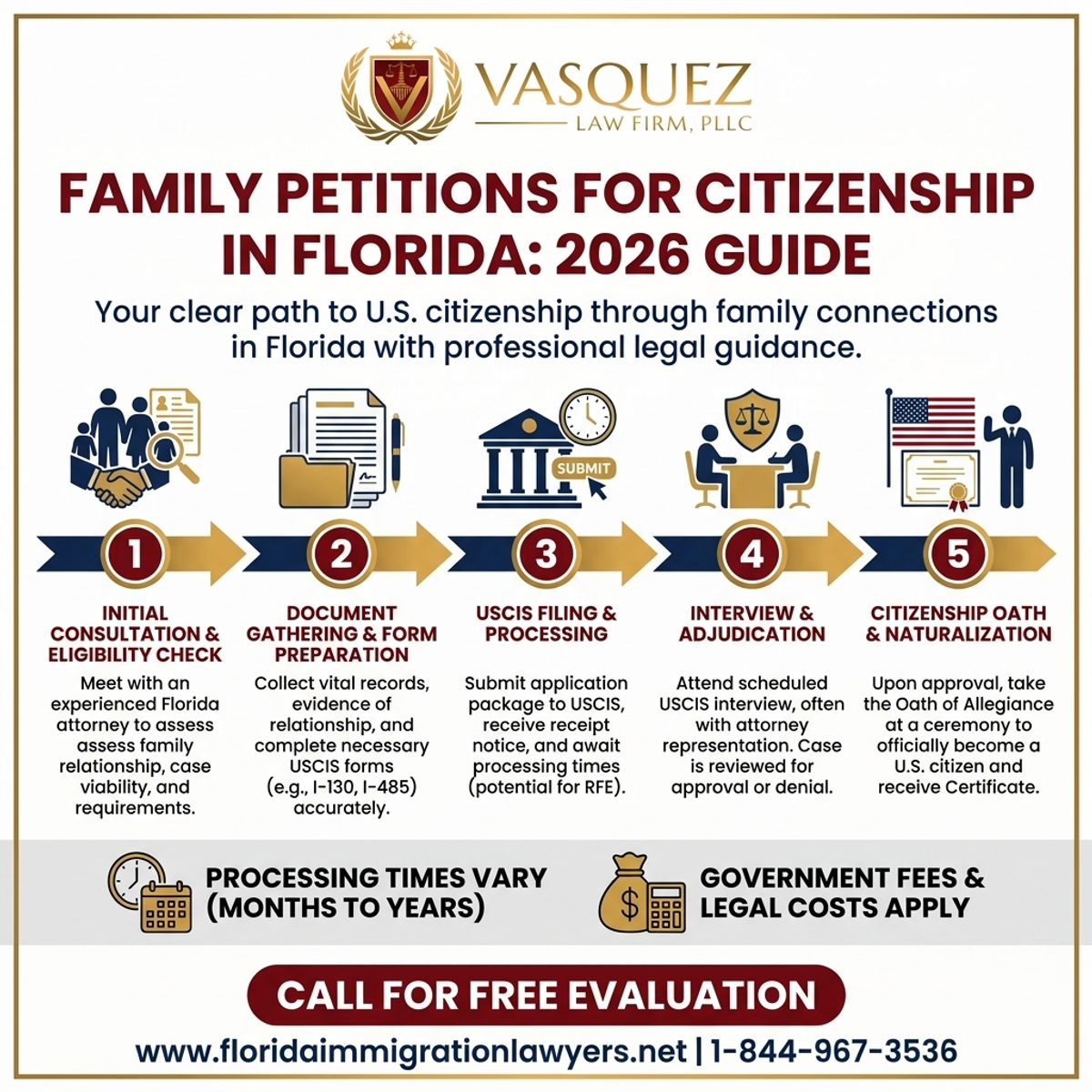
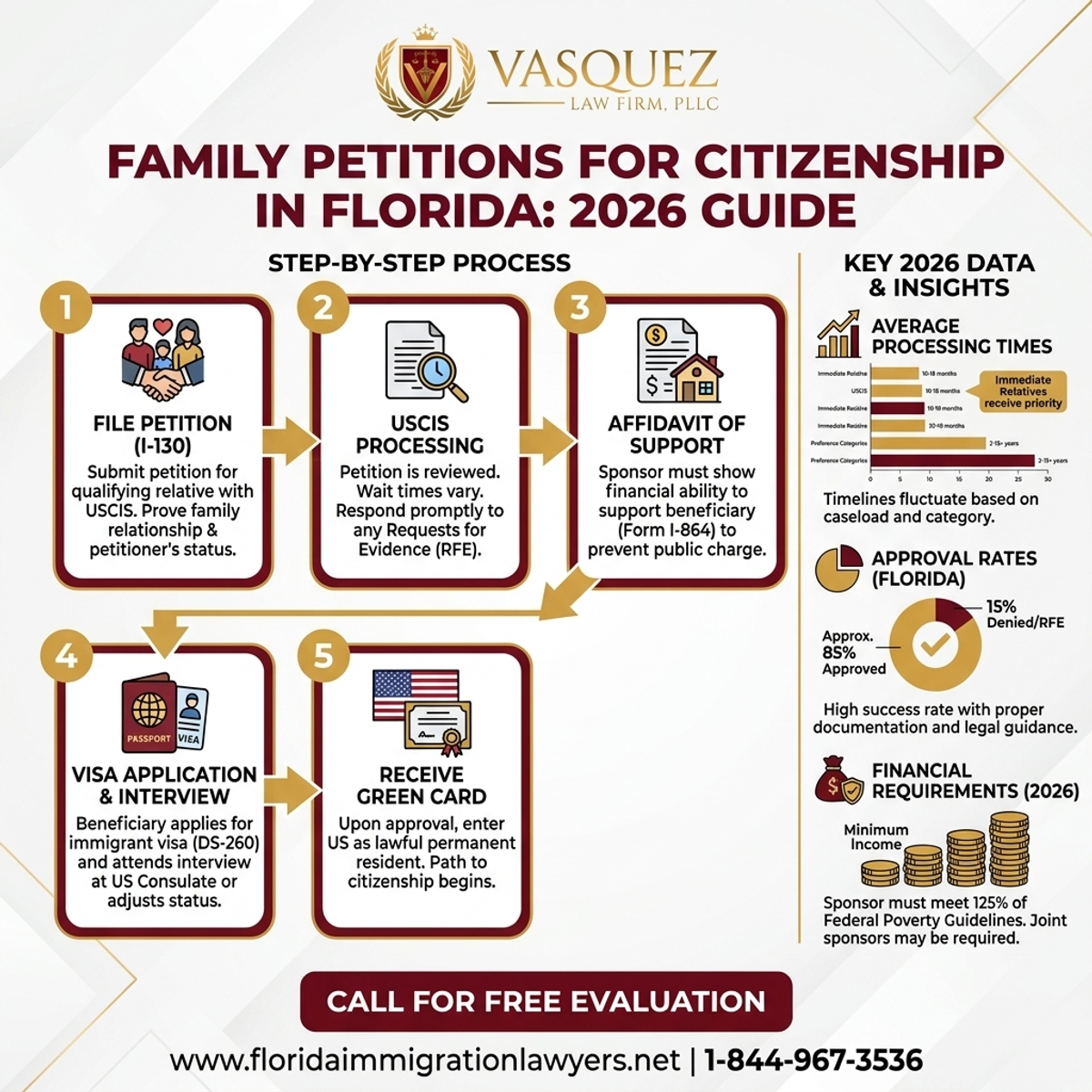
Filing a family petition in Florida, like anywhere else in the U.S., follows a structured process overseen by USCIS. The journey begins with establishing the family relationship and concludes, if successful, with the beneficiary obtaining lawful permanent resident status. Here are the typical steps involved:
- Step 1: File Form I-130, Petition for Alien Relative. The U.S. citizen or LPR petitioner files this form with USCIS, along with supporting documents proving the relationship (e.g., birth certificates, marriage certificates, divorce decrees, adoption papers) and proof of the petitioner's U.S. citizenship or LPR status. This package is usually sent to a USCIS Lockbox facility. As of 2026, ensure all forms are the latest version available on the USCIS website.
- Step 2: USCIS Processes the I-130 Petition. USCIS reviews the petition and supporting evidence. If approved, USCIS sends an approval notice (Form I-797, Notice of Action). If more information is needed, they may issue a Request for Evidence (RFE).
- Step 3: Visa Availability. For immediate relatives of U.S. citizens, an immigrant visa is immediately available upon I-130 approval. For other preference categories, the beneficiary must wait for a visa number to become available according to the Visa Bulletin. This can take several years, depending on the category and country of chargeability.
- Step 4: Adjustment of Status or Consular Processing.
- Adjustment of Status (AOS): If the beneficiary is already in the U.S. and is eligible, they can file Form I-485, Application to Register Permanent Residence or Adjust Status, concurrently with or after the I-130 approval. This is typically done at the local USCIS field office, such as the one in Tampa or Miami.
- Consular Processing: If the beneficiary is outside the U.S., their case will be forwarded to the National Visa Center (NVC) for consular processing. The NVC collects necessary documents and fees, then schedules an interview at a U.S. Embassy or Consulate in the beneficiary's home country.
- Step 5: Interview and Decision. For AOS, an interview is conducted at a USCIS field office. For consular processing, the interview takes place at an embassy/consulate. The immigration officer reviews the application, asks questions, and makes a decision.
- Step 6: Green Card Issuance. Upon approval, the beneficiary receives their green card, officially becoming a lawful permanent resident.
- Step 7: Path to Citizenship (Naturalization). After holding a green card for a specified period (typically 3 or 5 years), meeting physical presence requirements, demonstrating good moral character, and passing English and civics tests, the LPR may be eligible to apply for U.S. citizenship through naturalization by filing Form N-400.
What Documents Do I Need for a Family Petition (I-130) in 2026?
Gathering the correct and complete documentation is paramount for a successful family petition. Missing or incorrect documents are a leading cause of delays and Requests for Evidence (RFEs) from USCIS. Ensure all foreign-language documents are accompanied by certified English translations.
Required Documents for the Petitioner (U.S. Citizen or LPR):
- Proof of U.S. Citizenship (U.S. birth certificate, U.S. passport, Certificate of Naturalization, or Certificate of Citizenship) OR Proof of Lawful Permanent Resident Status (copy of green card, front and back).
- Copy of the petitioner's government-issued identification (e.g., driver's license).
- Two passport-style photos.
Required Documents for the Beneficiary (Foreign National Relative):
- Copy of the beneficiary's birth certificate.
- Copy of the beneficiary's passport identity page.
- Two passport-style photos.
- If applicable, copies of any previous marriage certificates and divorce decrees for both petitioner and beneficiary.
- If applicable, copy of adoption decrees (for adopted children).
- If applicable, evidence of name changes (e.g., marriage certificates, court orders).
Step-by-Step Process — Family Petitions for Citizenship in Florida: 2026 Guide
Evidence of Relationship (Crucial for I-130):
- For Spouses: Marriage certificate, joint bank accounts, joint leases/mortgages, utility bills in both names, birth certificates of common children, photos, affidavits from friends/family attesting to the bona fide marriage.
- For Children: Child's birth certificate showing petitioner as parent. If step-child, marriage certificate between petitioner and biological parent, showing marriage occurred before child's 18th birthday.
- For Parents: Petitioner's birth certificate showing parent's name.
- For Siblings: Petitioner's and sibling's birth certificates showing at least one common parent.
It is always advisable to submit copies of documents, keeping the originals safe. USCIS may request originals at a later stage or during an interview. An experienced immigration lawyer in Florida, particularly one familiar with the specific requirements of the USCIS Florida Field Offices, can help you compile a comprehensive and accurate document package, minimizing potential issues.
How Long Do Family Petitions Take and What Are the Associated Costs in 2026?
The duration and cost of a family petition can vary significantly based on several factors, including the type of family relationship, the beneficiary's country of origin, and the specific USCIS workload. Understanding these variables is key to managing expectations.
Typical Timeframes for Family Petitions (as of 2026):
These timeframes are estimates and can fluctuate. USCIS publishes processing times online, which should be checked regularly.
| Stage | Typical Timeframe | Notes |
|---|---|---|
| I-130 Processing (Immediate Relatives) | 6 - 12 months | U.S. citizen filing for spouse, unmarried child under 21, or parent. No visa quota wait. |
| I-130 Processing (Preference Categories) | 6 - 18 months | For LPRs filing or U.S. citizens filing for married children or siblings. Visa quota wait applies AFTER I-130 approval. |
| National Visa Center (NVC) Processing | 2 - 6 months | For consular processing cases after I-130 approval and visa availability. |
| Consular Interview & Visa Issuance | 1 - 3 months | After NVC processing, depends on embassy/consulate availability. |
| Adjustment of Status (I-485) | 10 - 24 months | If beneficiary is in the U.S. and eligible. Includes biometrics, interview. |
| Naturalization (N-400) | 8 - 18 months | After meeting green card residency requirements (3 or 5 years). |
Cost Factors and Fee Breakdown (as of 2026, subject to change):
USCIS fees are subject to change, so always verify the current amounts on the official USCIS website before filing. These fees are non-refundable.
| Item | Typical Fee | Notes |
|---|---|---|
| Form I-130 Filing Fee | $535 - $675 | Varies slightly based on filing method (online vs. paper). Always check current fee. |
| Form I-485 Filing Fee (Adjustment of Status) | $1,140 - $1,440 | Includes biometrics fee. Varies by age. Check current fee. |
| Form DS-260 (Immigrant Visa Application Processing Fee) | $325 | For consular processing, paid to the Department of State. |
| Form I-864 (Affidavit of Support) | No USCIS fee | Required in most family-based cases to show financial support. |
| Medical Examination | $200 - $500+ | Required for I-485 and consular processing, paid to an authorized civil surgeon. |
| Form N-400 (Application for Naturalization) | $725 - $760 | Includes biometrics fee. Check current fee. |
| Attorney Fees | Varies widely | Depends on case complexity, lawyer's experience, and services provided. |
Navigating Family Petitions in Florida: Tampa, Miami, and Beyond
Florida is a state with a rich tapestry of cultures and a significant immigrant population, making family petitions a common occurrence. Whether you are in Tampa, Miami, Orlando, or any other part of the state, understanding the local context of immigration services is beneficial. USCIS maintains several field offices in Florida, including those in Miami, Orlando, Tampa, and Jacksonville, which handle interviews for adjustment of status applications and other local services. The presence of these offices means that many Florida residents will interact directly with USCIS personnel for their interviews.
Immigration Courts, part of the Executive Office for Immigration Review (EOIR) under the U.S. Department of Justice, are also present in Florida, specifically in Miami, Orlando, and Pompano Beach. While family petitions (I-130) are handled by USCIS, an individual's immigration journey may intersect with these courts, especially if there are past immigration violations or if the beneficiary is in removal proceedings. For example, if a family member is in deportation proceedings, an approved I-130 might be a crucial step towards seeking relief from removal. The legal landscape in Florida can be particularly complex due to the diverse immigrant communities and the volume of cases. An immigration lawyer in Miami or Tampa often has specific experience with the local USCIS offices and immigration courts, which can be invaluable.
Key Statistics — Family Petitions for Citizenship in Florida: 2026 Guide
Furthermore, Florida's unique demographics mean that specific challenges or considerations may arise. For instance, a high volume of petitions from certain countries may impact processing times at the local level. Staying informed about local policy changes and processing nuances is a significant advantage. Florida Immigration Lawyers are deeply familiar with the intricacies of the Florida immigration system, from the initial filing of an I-130 family petition to the final stages of naturalization. We provide strategic advice tailored to the specific circumstances of families residing throughout Florida.
Common Mistakes to Avoid in Family Petition Immigration Cases
The family petition process is fraught with potential pitfalls that can lead to significant delays, Requests for Evidence (RFEs), or even outright denials. Avoiding these common mistakes is crucial for a smooth and successful application.
- Submitting Incomplete or Incorrect Forms: Failing to fill out all required sections of Form I-130 or other associated forms, or providing inaccurate information, is a common error. This often results in USCIS returning the petition or issuing an RFE, significantly delaying the process.
- Insufficient Evidence of Relationship: The most critical aspect of an I-130 petition is proving a bona fide relationship. Many applicants provide minimal evidence, especially for marriage-based petitions. Lack of joint documents, commingled finances, or shared life experiences can raise red flags for USCIS.
- Failure to Disclose All Marriages/Divorces: Petitioners and beneficiaries must disclose all previous marriages and provide valid divorce decrees or death certificates for all prior spouses. Failure to do so can lead to accusations of misrepresentation and potentially severe immigration consequences.
- Inadequate Financial Sponsorship (Affidavit of Support): The petitioner must demonstrate the ability to financially support the beneficiary by filing Form I-864, Affidavit of Support. If the petitioner's income is insufficient, a joint sponsor is required. Overlooking this or providing insufficient evidence of income can lead to a denial.
- Ignoring Eligibility Issues: Not all family members are eligible for immigration, and not all beneficiaries are eligible for adjustment of status. Issues like unlawful presence, criminal history, or previous immigration violations can render a beneficiary inadmissible. Failing to address these early can be fatal to a case.
- Missing Deadlines: USCIS and the NVC impose strict deadlines for responding to RFEs, submitting documents, or attending interviews. Missing these deadlines can lead to case abandonment or denial.
- Not Notifying USCIS of Address Changes: Immigrants are required by law to inform USCIS of any change of address within 10 days by filing Form AR-11. Failure to do so can result in missed notices, interview appointments, and even legal complications, especially in a transient state like Florida.
- Failure to Seek Legal Advice for Complex Cases: While some straightforward cases might be manageable, situations involving prior deportations, criminal records, or complex family structures absolutely require legal expertise. Attempting to handle such cases without an attorney significantly increases the risk of denial.
- Providing Misleading or False Information: Any attempt to deceive USCIS with false documents or statements can lead to a finding of misrepresentation, a lifetime ban from the U.S., and even criminal charges under 8 U.S.C. § 1325.
- Not Preparing for the Interview: Whether it's an adjustment of status interview at the USCIS Miami Field Office or a consular interview abroad, applicants must be prepared to answer questions about their relationship and immigration history truthfully and consistently. Lack of preparation can create doubt.
When to Call a Florida Immigration Lawyer for Your Family Petition
While the prospect of filing a family petition might seem straightforward, the reality of U.S. immigration law is often far more intricate. Engaging a knowledgeable Florida immigration lawyer can make a critical difference in the success and efficiency of your case. You should consider contacting Florida Immigration Lawyers if you encounter any of the following scenarios:
- Complex Family Situations: If you have step-children, adopted children, or a family history involving prior marriages, divorces, or name changes, an attorney can help ensure all relationships are properly documented and meet legal definitions.
- Beneficiary with Prior Immigration Issues: If the foreign national relative has overstayed a visa, entered without inspection, has a criminal record, or has previously been denied a visa or deported, their case will be significantly more complicated. An attorney can assess inadmissibility issues and explore potential waivers or relief options.
- Petitioner with Financial Concerns: If the U.S. citizen or LPR petitioner does not meet the income requirements for the Affidavit of Support (Form I-864), an attorney can guide you on finding a suitable joint sponsor or addressing other financial concerns.
- Receiving a Request for Evidence (RFE) or Notice of Intent to Deny (NOID): These notices indicate that USCIS requires more information or intends to deny your petition. Responding correctly and comprehensively within the strict deadlines is crucial, and a lawyer's expertise is invaluable.
- Seeking Expedited Processing: While rare, in certain humanitarian or emergency situations, it may be possible to request expedited processing. An attorney can help determine eligibility and prepare a compelling request.
- Navigating Consular Processing: If the beneficiary is outside the U.S., dealing with the National Visa Center (NVC) and a U.S. Embassy or Consulate can be challenging, especially with varying country-specific requirements.
- Desire for Peace of Mind: Even in seemingly straightforward cases, the emotional and financial investment is substantial. Having an expert manage the paperwork, deadlines, and communications with USCIS provides invaluable peace of mind.
At Florida Immigration Lawyers, we focus on all aspects of immigration law, providing dedicated representation for families across Florida. Our attorneys are adept at handling complex family petitions, adjustment of status, consular processing, and naturalization applications. We are committed to protecting your family's future.
About Florida Immigration Lawyers: Family Petitions for Citizenship in Florida
Florida Immigration Lawyers is a leading law firm dedicated to providing exceptional immigration legal services to individuals and families throughout Florida. With a deep understanding of U.S. immigration law and a compassionate approach, our team is committed to guiding clients through every step of their immigration journey. We pride ourselves on our client-focused service, clear communication, and unwavering dedication to achieving positive outcomes. Our attorneys have extensive experience with USCIS procedures, the Executive Office for Immigration Review (EOIR), and consular processing worldwide. We handle a wide range of cases, from family-based petitions and employment visas to asylum claims and deportation defense. We are available 24/7 to answer your questions and offer free consultations to help you understand your options.
Sources and References: Family Petitions for Citizenship in Florida
- U.S. Citizenship and Immigration Services (USCIS)
- U.S. Department of State - Bureau of Consular Affairs
- Executive Office for Immigration Review (EOIR)
- 8 U.S.C. Chapter 12 - Immigration and Nationality Act (INA)
- 8 CFR (Code of Federal Regulations)
- USCIS Policy Manual
Related services: family-based green cards, fiancé visa (K-1), marriage-based immigration.
This article provides general legal information and is not intended as legal advice. Every case is unique, and outcomes depend on specific facts and circumstances. Contact an attorney for advice about your particular situation.
Your family's future in the United States is too important to leave to chance. Whether you are initiating a family petition or navigating the path to citizenship, legal guidance is invaluable. Do not hesitate to seek professional assistance. Contact Florida Immigration Lawyers today at 1-844-YO-PELEO for a free consultation. Se Habla Español - Estamos aquí para ayudarle.
Do Not Navigate This Process Alone
Our experienced immigration attorneys are ready to fight for you. Get a free, confidential case review today.
Se Habla Español
Or leave your details and we’ll call you:
Free Evaluation in 24 Hours
Or talk to us right now

AI voice assistant — available 24/7
FreeFrequently Asked Questions

William J. Vásquez
Founding Attorney · Vasquez Law Firm
U.S. Air Force veteran and immigration attorney with years of hands-on U.S. immigration experience. J.D., NCCU School of Law. AILA member. Admitted to the 4th, 5th, and 11th Circuit Courts.
Available 24/7 - Free Evaluations
Reviewed for legal accuracy by William J. Vásquez
Licensed in North Carolina; U.S. immigration is federal practice.
Related Legal Services
Our Florida immigration attorneys can help you with immigration lawyer cost in Florida, experienced immigration attorneys and asylum protection. Call today at 1-844-YO-PELEO for a free case review.
Related Links
Related Topics
Free Legal Case Review
Discuss your case with our experienced attorneys. We're available 24/7.
Se Habla Español - Estamos aquí para ayudarle.
Related Articles
EB-5 Investor Green Card in Florida: A 2026 Guide
Explore how to obtain an EB-5 investor green card in Florida. Learn about the investment requirements, processes, and benefits of participating in this program. Discover how Florida's economic landscape can be an ideal setting for your investment. Contact Florida Immigration Lawyers for a free case review.
Certificate of Eligibility for Expungement in Florida 2026
For non-U.S. citizens in Florida, understanding how a state expungement impacts immigration status is critical. A certificate of eligibility for expungement in Florida allows a criminal record to be sealed or expunged under state law. However, federal immigration agencies often disregard such state-level relief, still considering the original criminal offense as a conviction for immigration purposes. This can have severe implications for visa applications, green card eligibility, naturalization, and even lead to deportation. This guide clarifies the Florida expungement process, its limited effect on federal immigration law, and key steps to protect your status in 2026. Learn about common mistakes, required documents, timelines, and when to seek expert legal counsel from Florida Immigration Lawyers to navigate these complex issues effectively.
Immigration Lawyer Orlando Free Consultation in Florida
For individuals and families in Orlando, Florida, navigating the complexities of U.S. immigration law requires expert guidance. An immigration lawyer in Orlando offers crucial support for everything from visa applications and green card processes to naturalization and deportation defense. This comprehensive guide details what a free consultation covers, providing a step-by-step overview of immigration pathways, essential document checklists, and expected timelines in 2026. We also highlight common mistakes to avoid, discuss the critical role of legal counsel in deportation and asylum cases, and explain why choosing a local Orlando immigration attorney is beneficial. Florida Immigration Lawyers is dedicated to serving the diverse community of Orlando with compassionate, effective legal solutions, ensuring you receive personalized advice and robust representation for a successful immigration journey.
I-140 Processing Time Premium: What to Expect in Orlando
Discover the processing time for I-140 premium processing in Florida. Learn about the benefits, steps involved, and how to avoid common mistakes. Florida Immigration Lawyers can assist you with your case. Call 1-844-YO-PELEO for a consultation.