Green Card Holders Issued New Warning in Florida
Green card holders face new warnings in Florida. Learn about marriage-based green cards, spouse visas, and avoid common pitfalls. Contact Florida Immigration Lawyers for guidance.
- Understanding the impact of recent federal policies on green card holders
- Steps to obtain a green card through marriage in Florida
- Common pitfalls to avoid during the process
- Importance of legal guidance for complex cases
As of 2026, green card holders in Florida are facing new warnings that may impact their residency. If you're seeking a green card through marriage, understanding the process and potential challenges is crucial. This article will guide you through obtaining a green card via marriage in Florida, highlighting important considerations and potential pitfalls. For personalized guidance, call Florida Immigration Lawyers at 1-844-YO-PELEO for a free case review.
The landscape of immigration law is constantly evolving, and recent federal policy shifts, particularly those anticipated for 2026, necessitate increased vigilance for all green card holders. While the specifics of these warnings may vary, they generally underscore the importance of maintaining strict compliance with immigration regulations and understanding how changes in federal directives can ripple down to impact state-level residency. This proactive approach is vital for safeguarding your status and ensuring a stable future in the U.S.
For those navigating the path to permanent residency through marriage in the Sunshine State, these warnings add another layer of complexity. A marriage-based green card is a common and legitimate route, but it demands meticulous attention to detail and a thorough understanding of both federal and state requirements. This comprehensive guide aims to demystify the process, from initial eligibility to the final interview, providing you with the knowledge to proceed confidently. Remember, securing your future in Florida requires not just diligence but also informed decision-making, often best achieved with expert legal support.
What Is the New Warning for Green Card Holders?
Green card holders in Florida are being advised to pay close attention to changes in immigration policies, as these can significantly affect their residency status. It's essential to stay informed about any updates from USCIS and consult with an immigration attorney if you have concerns.
The "new warning" for green card holders, particularly those residing in Florida, stems from anticipated shifts in federal immigration enforcement and policy interpretation. While specific details are often subject to ongoing legislative and administrative developments, the general thrust is towards increased scrutiny of residency requirements, public charge considerations, and the timely renewal of green cards. These changes could potentially impact eligibility for certain benefits, the process of naturalization, and even the criteria for maintaining permanent resident status. Staying updated directly through official USCIS channels and reputable legal counsel is paramount to avoid unforeseen complications.
For individuals, this means actively reviewing their current immigration status, understanding the conditions of their green card, and being prepared for potential changes in documentation requirements or interview processes. For instance, there might be renewed emphasis on demonstrating continuous residency or stricter interpretations of what constitutes an "abandonment" of permanent resident status. Green card holders should proactively verify their travel history, ensure all tax obligations are met, and keep meticulous records of their time spent inside and outside the U.S. Consulting with experienced professionals like Florida Immigration Lawyers can provide clarity on how these broader policy changes might specifically affect your unique situation in Florida, offering tailored advice and peace of mind.
Furthermore, these warnings often highlight the critical importance of avoiding even minor infractions that could be misconstrued as grounds for inadmissibility or deportability. This includes understanding the implications of certain criminal convictions, even minor ones, or misrepresentations made on previous immigration applications. The evolving legal landscape means that what might have been a minor issue in the past could carry more severe consequences under new interpretations. Therefore, a comprehensive review of your personal history and immigration records with a qualified attorney is a wise preventative measure to ensure your residency remains secure.
How to Obtain a Green Card Through Marriage in Florida?
Obtaining a green card through marriage involves several steps. First, ensure your marriage is valid and legally recognized. Then, file Form I-130, Petition for Alien Relative, with the USCIS. Once approved, you can apply for adjustment of status using Form I-485 if you're in the U.S., or pursue consular processing if you're abroad. It's crucial to follow all instructions carefully and provide accurate information.
- Verify marriage validity
- File Form I-130
- Receive USCIS approval
- File Form I-485 or pursue consular processing
- Attend biometrics appointment
- Prepare for the interview
- Receive decision
Step 1: Verify Marriage Validity
Before embarking on the green card application process, the foundational step is to ensure your marriage is legally valid in the jurisdiction where it occurred. In Florida, this means obtaining a marriage license and having the ceremony performed by an authorized officiant. It's not enough to simply be married; the U.S. government requires evidence that the marriage is "bona fide," meaning it was entered into in good faith, not solely for immigration purposes. This involves demonstrating shared life, joint responsibilities, and a genuine marital relationship. Any prior marriages for either spouse must have been legally terminated through divorce, annulment, or death, with official documentation provided.
Step 2: File Form I-130, Petition for Alien Relative
The U.S. citizen or lawful permanent resident spouse (the petitioner) initiates the process by filing Form I-130, Petition for Alien Relative, with U.S. Citizenship and Immigration Services (USCIS). This petition establishes the qualifying relationship between the petitioner and the beneficiary (the foreign national spouse). Along with the form, you'll need to submit supporting documents such as proof of the petitioner's citizenship or green card status, the marriage certificate, and evidence of any previous marriage terminations. Accuracy is key here, as errors can lead to delays or Requests for Evidence (RFEs).
Step 3: Receive USCIS Approval for Form I-130
After submitting Form I-130, USCIS will review the petition. If all documentation is in order and the relationship is established, USCIS will issue an approval notice. This approval signifies that the government recognizes the marital relationship as legitimate for immigration purposes. However, approval of the I-130 does not automatically grant the green card; it's just the first major hurdle. The next steps depend on whether the foreign national spouse is currently in the U.S. or abroad.
Step 4: File Form I-485 (Adjustment of Status) or Pursue Consular Processing
If the foreign national spouse is physically present in the U.S. and entered legally, they may be eligible to "adjust status" by filing Form I-485, Application to Register Permanent Residence or Adjust Status. This allows them to obtain a green card without leaving the country. Often, the I-130 and I-485 can be filed concurrently, especially if the petitioner is a U.S. citizen. If the foreign national spouse is outside the U.S. or is ineligible for adjustment of status, they will undergo "consular processing." This involves the National Visa Center (NVC) and an interview at a U.S. embassy or consulate in their home country. Each path has its own set of requirements and timelines, making it crucial to determine the most appropriate route with legal guidance from Florida Immigration Lawyers.
Step 5: Attend Biometrics Appointment
Regardless of whether you adjust status or go through consular processing, a biometrics appointment is a mandatory step. USCIS will send an appointment notice to the foreign national spouse, instructing them to visit an Application Support Center (ASC) for fingerprinting, photographs, and a signature. These biometrics are used for background checks and identity verification. Missing this appointment without proper rescheduling can significantly delay your application or even lead to its denial, so punctuality and attention to detail are vital.
Step 6: Prepare for the Interview
Both adjustment of status and consular processing typically culminate in an interview. For adjustment of status, the interview usually takes place at a local USCIS office, with both spouses present. For consular processing, the foreign national spouse attends an interview at a U.S. embassy or consulate abroad. The primary purpose of this interview is to confirm the authenticity of your marriage and verify the information provided in your applications. Officers will ask questions about your relationship, daily life, and future plans. It's essential to present compelling evidence of your bona fide marriage and answer truthfully and consistently. Preparing thoroughly with an attorney can significantly alleviate stress and increase the likelihood of a positive outcome.
Step 7: Receive Decision
Following a successful interview, USCIS or the consular officer will make a decision on your application. If approved, the foreign national spouse will receive a green card. If the marriage is less than two years old at the time of approval, a "conditional" green card will be issued, valid for two years. Before this conditional green card expires, both spouses must file Form I-751, Petition to Remove Conditions on Residence, to prove the marriage is still bona fide and obtain a permanent 10-year green card. If the marriage is already two years old or more at the time of approval, a permanent 10-year green card is issued directly. Understanding these distinctions is critical for long-term planning.
What Documents Are Needed for a Marriage-Based Green Card?
- Proof of U.S. citizenship or permanent residence of the sponsoring spouse
- Marriage certificate
- Proof of legal termination of prior marriages, if any
- Affidavit of support (Form I-864)
- Evidence of bona fide marriage (joint leases, financial documents, etc.)
- Passport-sized photos
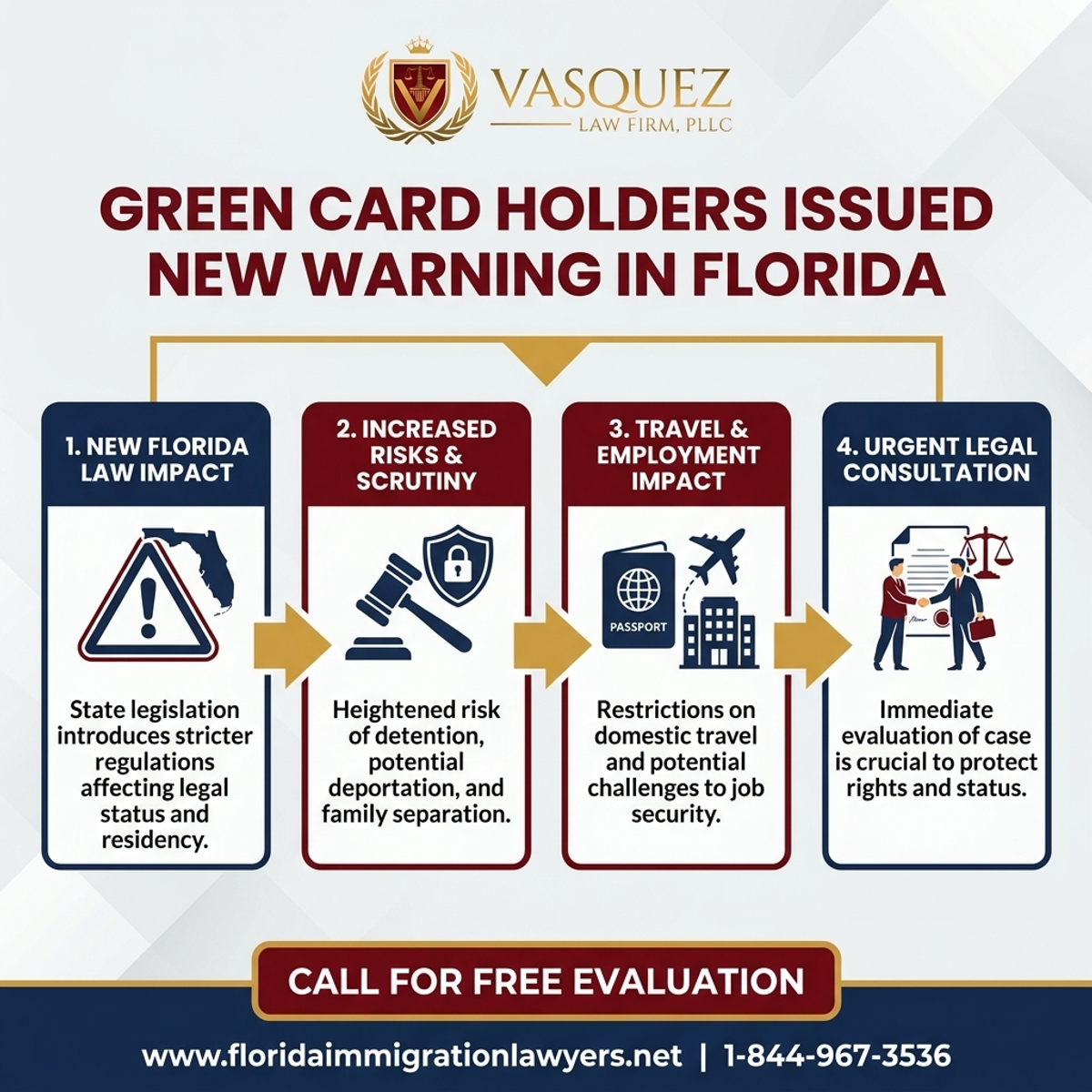
Step-by-Step Process — Green Card Holders Issued New Warning in Florida
The success of your marriage-based green card application hinges significantly on the comprehensive and accurate submission of required documentation. Each document serves a specific purpose in proving your eligibility and the authenticity of your marriage. Missing or incorrect documents are among the most common reasons for delays or denials. Therefore, it's crucial to gather and organize all necessary paperwork meticulously before filing.
Proof of U.S. Citizenship or Permanent Residence of the Sponsoring Spouse
The petitioner must demonstrate their legal status in the U.S. Acceptable documents include a copy of a U.S. birth certificate, a U.S. passport, a Certificate of Naturalization, or a copy of a valid Permanent Resident Card (green card). It's essential that these documents are current and clearly legible. This evidence establishes the petitioner's ability to sponsor their spouse for immigration benefits.
Marriage Certificate
A certified copy of your marriage certificate, issued by the state or county where the marriage took place, is fundamental. This document officially proves that your marriage is legally recognized. If the marriage occurred outside the U.S., you'll need an official foreign marriage certificate along with a certified English translation if the original is not in English. The validity of the marriage is the cornerstone of the entire application.
Proof of Legal Termination of Prior Marriages, If Any
If either spouse has been previously married, you must provide official documentation proving that all prior marriages were legally terminated. This includes certified copies of divorce decrees, annulment certificates, or death certificates. Failure to provide this evidence will lead to the assumption that a prior marriage is still valid, rendering your current marriage invalid for immigration purposes and leading to denial.
Affidavit of Support (Form I-864)
The U.S. citizen or permanent resident spouse must file Form I-864, Affidavit of Support, promising to financially support the immigrant spouse if necessary. This form demonstrates that the immigrant will not become a "public charge" in the U.S. The petitioner must meet specific income requirements, typically 125% of the federal poverty guidelines for their household size. If the petitioner's income is insufficient, a joint sponsor who meets the requirements may be needed. This is a critical component, as financial stability is a key factor in green card approvals.
Evidence of Bona Fide Marriage
This is arguably the most crucial category of documents, as it directly addresses whether your marriage is genuine and not solely for immigration purposes. USCIS requires substantial evidence to prove you share a life together. Examples include:
- Joint bank accounts, credit card statements, or investment accounts.
- Joint leases or mortgages, utility bills in both names, property deeds.
- Birth certificates of children born to both spouses.
- Affidavits from friends and family who can attest to the bona fide nature of your marriage.
- Life insurance policies, wills, or retirement accounts listing each other as beneficiaries.
- Photos of the couple together over time, including wedding photos, family gatherings, and vacations.
- Travel itineraries, flight tickets, and hotel bookings showing joint trips.
- Correspondence (emails, texts, cards) demonstrating an ongoing relationship.
The more diverse and compelling the evidence, the stronger your case. USCIS seeks to understand the depth and reality of your shared life, so gathering a wide array of documents is highly recommended. Florida Immigration Lawyers can help you identify the strongest evidence for your specific situation.
Passport-Sized Photos
Both the petitioner and the beneficiary will need to provide recent, unmounted, passport-style color photographs. These photos must meet specific USCIS requirements regarding size, background, and facial expression. Typically, two photos are required for each applicant, but always check the latest form instructions for precise numbers and specifications.
Timeline and Processing Expectations
| Stage | Typical Timeframe | Notes |
|---|---|---|
| Petition (I-130) | 6-12 months | Varies by case and service center |
| Adjustment of Status (I-485) | 8-14 months | Includes biometrics and interview |
| Consular Processing | 12-18 months | Dependent on consulate workload |
Understanding the timeline for a marriage-based green card application is crucial for managing expectations and planning your future. The processing times provided are estimates and can fluctuate significantly based on several factors, including the specific USCIS service center or consulate handling your case, the volume of applications, current immigration policies, and the completeness of your submission. It's not uncommon for cases to take longer than the typical timeframe, especially if a Request for Evidence (RFE) is issued or if there are complexities in your personal history.
For instance, an I-130 petition might be processed faster if the petitioner is a U.S. citizen compared to a lawful permanent resident, due to visa bulletin implications for the latter. Similarly, some USCIS field offices are known for faster interview scheduling than others in Florida. Consular processing timelines are heavily influenced by the specific U.S. embassy or consulate's workload and local conditions. While these waiting periods can be frustrating, continuous monitoring of your case status through the USCIS website and maintaining open communication with your legal team at Florida Immigration Lawyers can help you stay informed and prepared for each upcoming stage. Proactive preparation of all documents can help minimize delays.
Cost Factors and Fee Breakdown
| Item | Typical Fee | Notes |
|---|---|---|
| Form I-130 | Varies | Filing fee subject to change |
| Form I-485 | Varies | Includes biometrics fee |
| Medical Exam | Varies | Cost of required medical examination |
Do not navigate this process alone. Contact Florida Immigration Lawyers today.
Do Not Navigate This Process Alone
Our experienced immigration attorneys are ready to fight for you. Get a free, confidential case review today.
Se Habla Español
Or leave your details and we’ll call you:
Free Evaluation in 24 Hours
Or talk to us right now

AI voice assistant — available 24/7
FreeFrequently Asked Questions

William J. Vásquez
Founding Attorney · Vasquez Law Firm
U.S. Air Force veteran and immigration attorney with years of hands-on U.S. immigration experience. J.D., NCCU School of Law. AILA member. Admitted to the 4th, 5th, and 11th Circuit Courts.
Available 24/7 - Free Evaluations
Reviewed for legal accuracy by William J. Vásquez
Licensed in North Carolina; U.S. immigration is federal practice.
Related Legal Services
Our Florida immigration attorneys can help you with immigration practice areas, free immigration consultation and business immigration. Call today at 1-844-YO-PELEO for a free case review.
Related Links
Related Topics
Free Legal Case Review
Discuss your case with our experienced attorneys. We're available 24/7.
Se Habla Español - Estamos aquí para ayudarle.
Related Articles
EAD Advance Parole Combo Card in Florida 2026
For individuals with a pending Form I-485, Application to Register Permanent Residence or Adjust Status, the EAD Advance Parole Combo Card is an essential document. This single card combines the authorization to work legally in the U.S. (Employment Authorization Document - EAD) with permission to travel internationally and re-enter without abandoning your green card application (Advance Parole). This guide from Florida Immigration Lawyers provides a comprehensive overview for applicants in Florida in 2026, covering eligibility, the step-by-step application process, required documents, expected processing times, and associated costs. We also highlight common mistakes to avoid and when to seek legal counsel to ensure a smooth and successful immigration journey. Understanding this vital card is key to maintaining stability while awaiting your permanent residency approval.
Immigration Lawyer Orlando Free Consultation in Florida
For individuals and families in Orlando, Florida, navigating the complexities of U.S. immigration law requires expert guidance. An immigration lawyer in Orlando offers crucial support for everything from visa applications and green card processes to naturalization and deportation defense. This comprehensive guide details what a free consultation covers, providing a step-by-step overview of immigration pathways, essential document checklists, and expected timelines in 2026. We also highlight common mistakes to avoid, discuss the critical role of legal counsel in deportation and asylum cases, and explain why choosing a local Orlando immigration attorney is beneficial. Florida Immigration Lawyers is dedicated to serving the diverse community of Orlando with compassionate, effective legal solutions, ensuring you receive personalized advice and robust representation for a successful immigration journey.
STEM OPT Extension Immigration Lawyer: Florida 2026 Guide
For F-1 students in Florida with STEM degrees, the 24-month Optional Practical Training (OPT) extension is a critical step towards building a career in the U.S. This comprehensive guide covers everything from eligibility requirements and the step-by-step application process to essential documentation, processing timelines, and associated costs as of 2026. We delve into specific challenges faced by Florida graduates, such as navigating E-Verify employers and understanding evolving federal policies. Learn how to avoid common mistakes that can jeopardize your application, like late filing or incomplete paperwork. Discover when it's crucial to consult an experienced STEM OPT extension immigration lawyer to ensure your application is robust and compliant, protecting your F-1 status and future in Florida. Florida Immigration Lawyers offers expert guidance and free case reviews to help you succeed.
Citizenship Delay in Florida: N-400 Processing Times 2026
Deciding to apply for U.S. citizenship is a significant milestone for many in Florida, often for family reasons. However, the path to naturalization can sometimes be hindered by unexpected delays in N-400 processing. Factors such as increased USCIS caseloads, administrative processing requirements, and individual application complexities contribute to these citizenship delays. As of 2026, applicants in Florida's busy field offices, including Orlando and Miami, may experience varying processing times. This comprehensive guide from Florida Immigration Lawyers explores the common causes of these delays, provides insight into current N-400 processing times, and outlines actionable steps to address prolonged waits. We cover essential documentation, potential costs, and crucial mistakes to avoid, all designed to help you navigate the system effectively. If you are facing a citizenship delay or have questions about your naturalization application, our experienced attorneys are available 24/7 for a free case review.