RFE Response in Florida 2026: Urgent Help for Your Case
Receiving a Request for Evidence (RFE) from USCIS can be a stressful and urgent matter, especially if your current legal firm has become unresponsive. An RFE indicates that USCIS requires additional information or clarification to process your immigration application or petition. This is not a denial, but a critical opportunity to provide the necessary evidence within a strict 60-90 day deadline. Failure to respond comprehensively and on time can lead to a denial, jeopardizing your immigration future. This guide provides a detailed overview of what an RFE entails, a step-by-step approach to crafting a robust response, essential document checklists, and insights into timelines and costs. We also highlight common mistakes to avoid and crucial scenarios where immediate legal intervention is necessary. If you are in Florida and need urgent assistance with an RFE for a family or corporate immigration case, Florida Immigration Lawyers offers experienced and responsive legal counsel, ready to take over your case and help you navigate this challenging process effectively.

Receiving a Request for Evidence (RFE) from USCIS means your immigration application requires additional information or documentation to prove eligibility. It is not a denial, but a critical request that demands a precise and timely response. If your current legal representation has become unresponsive, or if you are navigating a complex RFE for a family or corporate immigration petition, it is imperative to seek experienced counsel immediately. A well-prepared RFE response, often within a strict 60-90 day deadline, can be the difference between approval and denial, safeguarding your immigration journey in Florida.
- An RFE requires a timely, comprehensive response to avoid denial.
- Deadlines are strict, typically 60-90 days, with no extensions.
- Seek new legal counsel promptly if your current firm is unresponsive.
- Florida Immigration Lawyers can take over complex RFE cases for both family and corporate petitions.
- A strong response is crucial for your immigration future.
Received an RFE in Florida? Get Urgent Help for Your Immigration Case
The news of a Request for Evidence (RFE) from U.S. Citizenship and Immigration Services (USCIS) can be unsettling, especially when your immigration future hangs in the balance. Perhaps you have just received an RFE for your family-based petition, an employment-based visa, or an adjustment of status application, and your current legal team has gone quiet, leaving you feeling lost and anxious about the strict deadline. This scenario, unfortunately, is not uncommon, and it underscores the urgent need for reliable, proactive legal representation. An RFE is a formal notification from USCIS indicating that the evidence initially submitted with your immigration application or petition is insufficient, or that you need to clarify certain aspects of your eligibility. It is a critical juncture in your immigration journey, and how you respond can determine the outcome of your case.
Navigating the complexities of an RFE response, particularly under time pressure and with uncommunicative counsel, requires immediate action and expert guidance. This comprehensive guide will illuminate the RFE process, detail the essential steps for a successful response, outline common pitfalls to avoid, and explain why securing experienced legal assistance is paramount for applicants in Florida. Whether you are facing an RFE for a corporate immigration matter or a family petition, understanding the requirements and acting decisively are key. Do not let an RFE become a roadblock to your American dream. If you find yourself in this challenging situation, know that you do not have to face it alone. Call Florida Immigration Lawyers at 1-844-YO-PELEO for a free case review and let us help you respond effectively.
What is a Request for Evidence (RFE) from USCIS and Why Did I Get One?
A Request for Evidence (RFE) is an official notice issued by USCIS when they determine that the evidence submitted with your immigration petition or application is insufficient, missing, or requires further clarification to establish your eligibility. This notice is a standard part of the immigration process and does not necessarily mean your case will be denied. Instead, it offers you a crucial opportunity to provide the necessary information within a specified timeframe, typically 60 to 90 days. Understanding the reason for your RFE is the first step toward crafting a successful response, and a skilled immigration lawyer can help decipher its complexities.
USCIS issues RFEs for various reasons, reflecting the meticulous scrutiny applied to all immigration petitions. Common grounds for an RFE include missing initial evidence, such as birth certificates or marriage licenses; inconsistencies in information provided across different forms or previous submissions; insufficient financial documentation for affidavits of support (Form I-864); or questions regarding the bona fides of a marriage or employment offer. For corporate immigration cases, an RFE might query the specialized nature of a position for an H-1B visa, the qualifying relationship between entities for an L-1 visa, or the beneficiary’s credentials. USCIS operates several service centers and field offices, including those serving Florida in Orlando and Miami, each processing different types of petitions and often having their own nuanced requirements, as outlined in 8 CFR 103.2(b)(8). A detailed RFE will specify exactly what evidence is needed, often with reference to the relevant sections of the Immigration and Nationality Act (INA) or federal regulations. It is vital to address every point raised in the RFE comprehensively.
How to Respond to an RFE: A Step-by-Step Guide for Florida Applicants
Responding to an RFE requires meticulous attention to detail and a strategic approach to ensure all requested information is provided accurately and persuasively. The process can be daunting, but following a structured plan, especially for applicants in Florida, can significantly improve your chances of a favorable outcome. As of 2026, USCIS emphasizes clear, organized submissions to expedite processing. If you have received an RFE, here is a step-by-step guide to help you formulate a robust response.
- Thoroughly Review the RFE Notice: The very first step is to carefully read the RFE notice in its entirety. Understand precisely what USCIS is asking for. Highlight or make notes on each specific request, paying close attention to any legal citations or policy manual references. Do not make assumptions; if a request is unclear, consult with an attorney to interpret it correctly. Missing even one requested item can lead to a denial.
- Gather All Requested Evidence: Once you understand the RFE, begin collecting every document and piece of evidence specified. This might include official government documents, financial records, employment letters, expert opinions, affidavits from witnesses, or additional forms. For family-based petitions, this could mean more photos, joint financial statements, or letters from friends and family. For employment-based petitions, it might involve detailed job descriptions, organizational charts, or evidence of specific skills.
- Organize and Label Your Submission: USCIS processes thousands of documents daily, so clear organization is paramount. Create a cover letter that addresses each point of the RFE in the order it was presented. Use tabs or dividers to separate different categories of evidence and clearly label each section. Include a copy of the original RFE notice on top of your response package. This helps the USCIS officer quickly locate the information they need and demonstrates your thoroughness.
- Draft a Compelling Legal Argument (If Necessary): Sometimes, an RFE requires more than just submitting documents; it may require a legal argument explaining why the evidence provided, or perhaps the unique circumstances of your case, meets the eligibility criteria. This is particularly true for complex issues, such as demonstrating specialized knowledge for an L-1B visa or extraordinary ability for an O-1 visa. An experienced immigration attorney can draft persuasive legal briefs, citing relevant laws and precedents (e.g., INA 212(a) for inadmissibility waivers or BIA decisions), to support your case.
- Submit Your Response Before the Deadline: The RFE deadline is non-negotiable, typically 60 to 90 days from the date the RFE was issued. There are generally no extensions for RFE deadlines. Mail your response well in advance of the deadline using a method that provides proof of delivery, such as certified mail with a return receipt or a reputable courier service like FedEx or UPS. Keep a complete copy of your entire submission for your records. The USCIS Lockbox Facility or Service Center handling your case, not a local Florida field office, will usually be the recipient.
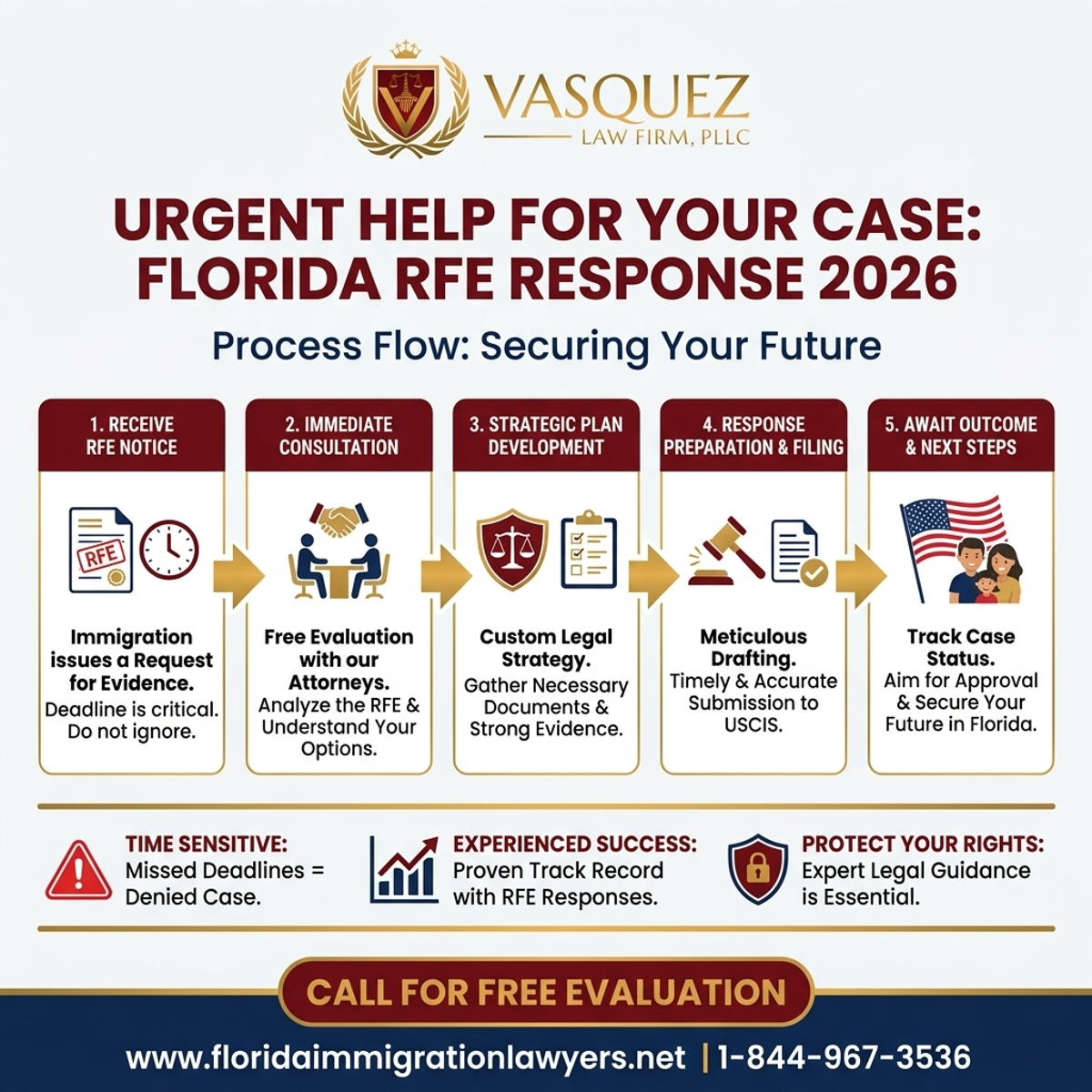
Step-by-Step Process — RFE Response in Florida 2026: Urgent Help for Your Case
Essential Documents and Evidence for Your RFE Response
The specific documents requested in an RFE will vary significantly depending on the type of immigration petition or application you have filed and the particular concerns of USCIS. However, certain categories of evidence are commonly requested across different case types. Preparing a comprehensive document checklist is crucial to ensure you address every point in your RFE. This list should be tailored to your specific RFE and immigration category, whether it's for a family-based visa or a complex employment petition in Florida.
- Original RFE Notice: Always include a copy of the RFE notice on top of your response package. This helps USCIS quickly identify your case and the specific requests.
- Proof of Identity and Nationality: This may include birth certificates, passports, national identity cards, or other official government-issued identification. Ensure all documents are current and valid.
- Proof of Relationship (Family-Based Petitions): For marriage-based RFEs, this often involves joint bank statements, utility bills, leases, mortgage documents, insurance policies, photos, affidavits from friends and family, and children's birth certificates. For other family petitions, it could be additional birth records or adoption decrees.
- Financial Evidence (Affidavit of Support, I-864): Tax transcripts (IRS Form 1722), W-2s, employment verification letters, pay stubs, bank statements, and evidence of assets are commonly requested to prove the sponsor's ability to support the applicant above the poverty line, as required by INA 213A.
- Educational and Professional Credentials (Employment-Based Petitions): For H-1B, L-1, O-1, or EB-2/EB-3 petitions, RFEs often request diplomas, transcripts, letters from previous employers, professional licenses, certifications, and expert opinion letters to validate specialized skills or degrees.
- Employment Verification: Detailed letters from employers, organizational charts, job descriptions, and evidence of company projects can be requested to confirm the nature of employment and the beneficiary's role. For corporate transfers (L-1), evidence of a qualifying relationship between entities is critical.
- Medical Examination Results: If your initial medical exam report expired or had issues, a new Form I-693 (Report of Medical Examination and Vaccination Record) might be requested.
- Police Clearance Certificates: Updated or additional police certificates from countries where you have lived may be requested, especially if there were gaps or inconsistencies in your travel history.
- Certified Translations: Any document not in English must be accompanied by a complete and accurate English translation certified by a competent translator.
What is the Typical RFE Response Timeline and What Happens Next in 2026?
When you receive an RFE, understanding the timeline for response and subsequent processing is crucial for managing expectations and planning your next steps. As of 2026, USCIS processing times remain variable, influenced by the specific service center, case type, and current caseload. However, the initial RFE response window is consistently strict. Typically, applicants are given 60 to 90 days from the RFE issuance date to submit their complete response. This deadline is non-negotiable, and failure to respond within this period will almost certainly lead to a denial of your application or petition. It is important to note that the date stamp on the RFE notice is the official start of your response window, not the date you receive it.
After you submit your RFE response, the waiting period for a decision can vary significantly. USCIS aims to review responses promptly, but current processing times can range from a few weeks to several months. You can monitor the general processing times for your specific form and service center on the official USCIS website. Once your response is received, USCIS will update your case status online. The officer who issued the RFE will typically review your submission. If the additional evidence satisfies their concerns, your application will proceed towards a final decision, which could be an approval, a request for an interview (especially for adjustment of status cases processed at local field offices like Orlando or Miami), or, in some instances, a denial if the concerns are not adequately addressed. It is rare for USCIS to issue a second RFE; usually, a decision is made after the first RFE response. Therefore, your initial response must be as thorough and complete as possible.
| Stage | Typical Timeframe | Notes |
|---|---|---|
| RFE Issued | 60-90 days | Strict deadline from issuance date; no extensions. |
| Response Submitted | Acknowledgement within 1-2 weeks | USCIS updates case status online. |
| USCIS Review of Response | 1-6 months post-response | Varies by service center and case complexity. |
| Final Decision (Approval/Denial/Interview) | Following RFE review | Can be immediate or after further processing/interview. |
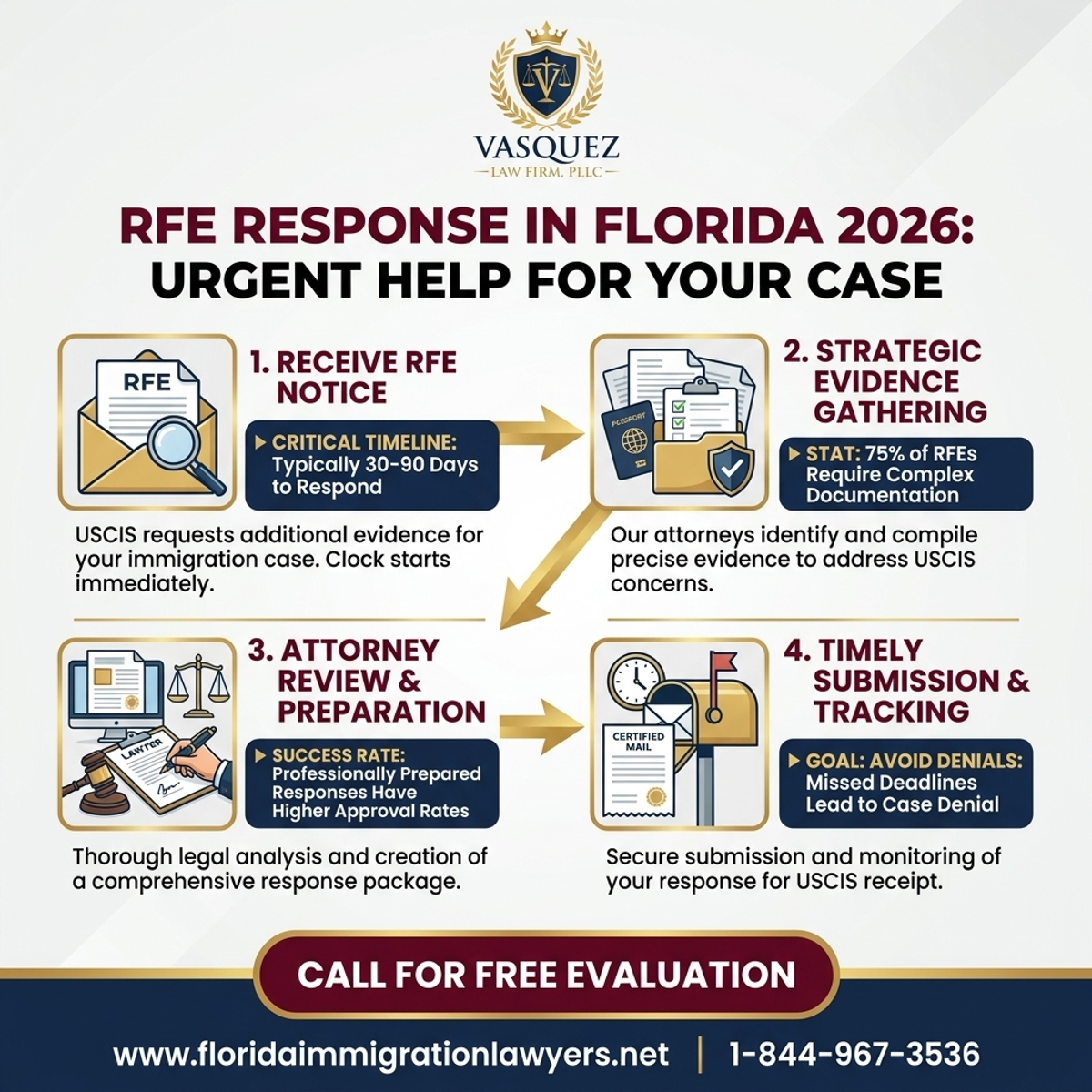
Key Statistics — RFE Response in Florida 2026: Urgent Help for Your Case
Cost Factors and Attorney Fees for RFE Responses in Florida
Understanding the potential costs associated with responding to an RFE is an important part of preparing your case. While an RFE itself does not typically incur new USCIS filing fees, there are various other expenses that may arise, especially when seeking professional legal assistance to ensure a robust and timely response. These costs can vary based on the complexity of your RFE, the type of evidence required, and the specific services you engage, particularly in a diverse legal market like Florida. As of 2026, it is always advisable to factor these potential expenses into your immigration planning.
The primary cost categories include USCIS-related fees for additional forms, if any, and third-party expenses for obtaining documentation. For instance, if your RFE requires a new medical examination (Form I-693) because the previous one expired, you will incur the fee charged by the civil surgeon. Similarly, if documents are not in English, you will need to pay for certified translations. Obtaining official government records, such as birth certificates or police clearances, might also involve nominal fees. However, the most significant variable cost is often legal representation. While some firms may offer a flat fee for RFE responses, others might charge an hourly rate. The total cost will depend on the RFE's complexity, the amount of evidence to be gathered, and the attorney's experience. Investing in expert legal counsel from Florida Immigration Lawyers can often prevent costly mistakes that could lead to a denial and subsequent re-filing fees, saving you time and money in the long run.
| Item | Typical Fee | Notes |
|---|---|---|
| USCIS Filing Fees (if new forms needed) | Varies by form (e.g., I-485, I-130) | Check USCIS website for current fees. |
| Medical Examination (Form I-693) | $200-$500 | Required if initial exam expired or was deficient. |
| Document Translation | $20-$50 per page | Certified translations required for non-English documents. |
| Obtaining Official Records | Varies ($10-$100+) | Birth certificates, police clearances, academic transcripts. |
| Attorney Fees for RFE Response | Varies significantly ($1,000-$5,000+) | Depends on complexity, firm's expertise, and time involved. |
Navigating Complex RFE Scenarios: When to Seek New Counsel
While some RFEs are straightforward requests for missing documents, many involve complex legal questions, allegations of misrepresentation, or require intricate arguments to establish eligibility. These scenarios demand a higher level of legal expertise and strategic thinking. If your RFE delves into issues such as proving the bona fide nature of a marriage despite significant age differences or cultural gaps, demonstrating the specialized knowledge for an L-1B visa, or overcoming inadmissibility grounds (e.g., criminal history, previous immigration violations as per INA 212(a)), the stakes are considerably higher. Such RFEs are not merely about submitting documents; they require a nuanced understanding of immigration law, case precedents (including BIA decisions), and USCIS policy to construct a winning argument.
Furthermore, the situation becomes even more critical if you find your current legal representation has become unresponsive or uncommunicative after an RFE has been issued. This is a red flag that requires immediate attention. An RFE deadline is unforgiving, and a delay in response due to a lack of communication can lead to the denial of your petition, potentially jeopardizing your entire immigration future. In such cases, seeking new counsel experienced in taking over RFE cases is not just advisable, it is essential. Florida Immigration Lawyers are adept at stepping in to assess your RFE, quickly understand the case history, and formulate a robust response within the remaining timeframe. We are prepared to handle the intricacies of complex RFEs, whether for individuals in Orlando facing family immigration challenges or businesses in Central Florida navigating corporate immigration hurdles, ensuring that your case receives the diligent attention it deserves.
Do not navigate this process alone. Contact Florida Immigration Lawyers today for a free case review.
Common Mistakes to Avoid When Responding to an RFE
Responding to an RFE is a critical task, and even minor errors can have significant consequences, potentially leading to a denial of your immigration petition. Being aware of these common mistakes, particularly for applicants in Florida, can help you avoid pitfalls and strengthen your response.
- Ignoring the Deadline: The RFE notice provides a strict deadline, typically 60 to 90 days. Missing this deadline is one of the most common reasons for denial. USCIS does not grant extensions for RFEs. Mark your calendar and prioritize your response.
- Submitting Incomplete Evidence: Failing to provide all requested documents or information is a direct path to denial. Read each point of the RFE carefully and ensure every item is addressed.
- Failing to Provide Certified Translations: Any document not in English must be accompanied by a complete and accurate English translation, certified by a competent translator. Without this, USCIS will not consider the document.
- Not Addressing All RFE Requests: Some RFEs have multiple requests. You must respond to every single point, even if you believe some are redundant or irrelevant. A partial response is often treated as an insufficient one.
- Sending Original Documents When Copies Suffice: Unless specifically requested, never send original documents that are irreplaceable (e.g., birth certificates, marriage licenses). Always send certified copies and keep your originals.
- Providing Inconsistent or False Information: Any discrepancies with previous submissions or false statements can lead to a denial, accusations of misrepresentation, and severe long-term immigration consequences.
- Failing to Consult an Attorney for Complex Issues: If the RFE involves complex legal questions, inadmissibility, or a change in circumstances, attempting to respond without legal counsel can be detrimental.
- Not Keeping Copies of the Response: Always make a complete copy of your entire RFE response package, including the cover letter and all supporting evidence, before mailing it. This is your proof of submission.
- Assuming USCIS Has Information Already on File: Even if you submitted certain documents with a previous application, USCIS may request them again. Do not assume they can access information from other files; provide everything they ask for.
- Using an Unreliable Mail Service: Always use a mail service that provides tracking and proof of delivery (e.g., USPS Certified Mail, FedEx, UPS) to ensure your response reaches USCIS and you have evidence of submission.
- Not Providing a Detailed Cover Letter: A well-structured cover letter that clearly lists and explains each piece of evidence provided, correlating it to the RFE's requests, is crucial for the USCIS officer.
- Over-Submitting Irrelevant Documents: While a comprehensive response is vital, sending excessive, irrelevant documents can confuse the officer and potentially delay your case. Stick to what is requested or directly relevant.
When to Call a Lawyer for Your RFE Response in Florida
While some RFEs might appear straightforward, the stakes in immigration cases are always high. Knowing when to seek professional legal assistance is crucial, especially when facing a Request for Evidence in Florida. If any of the following scenarios apply to your situation, it is highly recommended to contact an experienced immigration attorney immediately:
- Complex Legal Issues: Your RFE delves into complex legal questions, such as inadmissibility grounds (e.g., criminal history, fraud allegations, unlawful presence), or requires a detailed legal argument based on INA sections or BIA precedents.
- Unresponsive Current Counsel: If your current immigration lawyer or firm has become unresponsive, quiet, or uncommunicative after your RFE was issued, you need to find new representation urgently to ensure your deadline is met. Florida Immigration Lawyers are adept at taking over cases mid-process.
- Tight Deadlines: With RFE deadlines being unforgiving, if you have limited time to gather extensive evidence or formulate a complex response, an attorney can expedite the process.
- Unclear RFE Requests: If you are unsure what USCIS is precisely asking for, or if the language in the RFE is ambiguous, an attorney can interpret the request and guide you on the necessary evidence.
- Previous Denials or Immigration Issues: If you have a history of immigration application denials, deportations, or other issues, your RFE response needs expert handling to avoid further complications.
- Employment-Based RFEs: Corporate immigration RFEs (e.g., H-1B, L-1, PERM, EB-2/EB-3) often require specialized knowledge to prove professional qualifications, business relationships, or job specialty.
- Changes in Circumstances: If there have been significant changes in your life since you filed your initial application (e.g., change in employment, marital status, address), an attorney can help explain these to USCIS.
Florida Immigration Lawyers offer comprehensive services for RFE responses, ensuring your case receives the diligent attention it deserves. We serve clients across all of Florida, including those in Orlando and the Central Florida region, providing strategic guidance and robust representation.
About Florida Immigration Lawyers
Florida Immigration Lawyers is a leading immigration law firm dedicated to serving individuals, families, and businesses across the entire state of Florida. With a deep understanding of U.S. immigration law and a compassionate approach, our experienced attorneys are committed to providing exceptional legal representation. We understand the complexities and emotional toll that immigration processes can entail, especially when facing critical challenges like a Request for Evidence (RFE).
Our firm specializes in a broad spectrum of immigration services, including family immigration, business immigration, asylum, deportation defense, and citizenship. We pride ourselves on offering personalized strategies tailored to each client's unique situation, ensuring that every case receives the meticulous attention it deserves. Our attorneys are available 24/7, providing free case reviews to help you understand your options and develop a strong legal strategy. We are here to guide you through every step of your immigration journey, from initial application to complex RFE responses and appeals. Serving all of Florida, including our Central Florida office in Orlando, we are your trusted partners in navigating U.S. immigration law. Schedule a free consultation with our dedicated team today.
Sources and References
- U.S. Citizenship and Immigration Services (USCIS)
- Executive Office for Immigration Review (EOIR)
- U.S. Department of State
- 8 U.S. Code § 1154 - Procedure for granting immigrant status
- 8 U.S. Code § 1182 - Inadmissible aliens (INA 212(a))
- 8 Code of Federal Regulations (CFR) § 103.2(b)(8) - Requests for evidence and additional information
- 8 Code of Federal Regulations (CFR) § 213a - Affidavits of Support
- USCIS Policy Manual
Related services: immigration practice areas, experienced immigration attorneys, immigration lawyer cost in Florida.
This article provides general legal information and is not intended as legal advice. Every case is unique, and outcomes depend on specific facts and circumstances. Contact an attorney for advice about your particular situation.
Do not let an RFE derail your immigration dreams. Take action today and secure the experienced legal representation you need. Contact Florida Immigration Lawyers for a free, confidential case review. We are available 24/7 to assist you. Call us at 1-844-YO-PELEO. Se Habla Español - Estamos aquí para ayudarle.
Do Not Navigate This Process Alone
Our experienced immigration attorneys are ready to fight for you. Get a free, confidential case review today.
Se Habla Español
Or leave your details and we’ll call you:
Free Evaluation in 24 Hours
Or talk to us right now

AI voice assistant — available 24/7
FreeFrequently Asked Questions

William J. Vásquez
Founding Attorney · Vasquez Law Firm
U.S. Air Force veteran and immigration attorney with years of hands-on U.S. immigration experience. J.D., NCCU School of Law. AILA member. Admitted to the 4th, 5th, and 11th Circuit Courts.
Available 24/7 - Free Evaluations
Reviewed for legal accuracy by William J. Vásquez
Licensed in North Carolina; U.S. immigration is federal practice.
Related Legal Services
Our Florida immigration attorneys can help you with immigration lawyer cost in Florida, experienced immigration attorneys and asylum protection. Call today at 1-844-YO-PELEO for a free case review.
Related Links
Related Topics
Free Legal Case Review
Discuss your case with our experienced attorneys. We're available 24/7.
Se Habla Español - Estamos aquí para ayudarle.
Related Articles
EAD Advance Parole Combo Card in Florida 2026
For individuals with a pending Form I-485, Application to Register Permanent Residence or Adjust Status, the EAD Advance Parole Combo Card is an essential document. This single card combines the authorization to work legally in the U.S. (Employment Authorization Document - EAD) with permission to travel internationally and re-enter without abandoning your green card application (Advance Parole). This guide from Florida Immigration Lawyers provides a comprehensive overview for applicants in Florida in 2026, covering eligibility, the step-by-step application process, required documents, expected processing times, and associated costs. We also highlight common mistakes to avoid and when to seek legal counsel to ensure a smooth and successful immigration journey. Understanding this vital card is key to maintaining stability while awaiting your permanent residency approval.
Immigration Lawyer Orlando Free Consultation in Florida
For individuals and families in Orlando, Florida, navigating the complexities of U.S. immigration law requires expert guidance. An immigration lawyer in Orlando offers crucial support for everything from visa applications and green card processes to naturalization and deportation defense. This comprehensive guide details what a free consultation covers, providing a step-by-step overview of immigration pathways, essential document checklists, and expected timelines in 2026. We also highlight common mistakes to avoid, discuss the critical role of legal counsel in deportation and asylum cases, and explain why choosing a local Orlando immigration attorney is beneficial. Florida Immigration Lawyers is dedicated to serving the diverse community of Orlando with compassionate, effective legal solutions, ensuring you receive personalized advice and robust representation for a successful immigration journey.
Citizenship Delay in Florida: N-400 Processing Times 2026
Deciding to apply for U.S. citizenship is a significant milestone for many in Florida, often for family reasons. However, the path to naturalization can sometimes be hindered by unexpected delays in N-400 processing. Factors such as increased USCIS caseloads, administrative processing requirements, and individual application complexities contribute to these citizenship delays. As of 2026, applicants in Florida's busy field offices, including Orlando and Miami, may experience varying processing times. This comprehensive guide from Florida Immigration Lawyers explores the common causes of these delays, provides insight into current N-400 processing times, and outlines actionable steps to address prolonged waits. We cover essential documentation, potential costs, and crucial mistakes to avoid, all designed to help you navigate the system effectively. If you are facing a citizenship delay or have questions about your naturalization application, our experienced attorneys are available 24/7 for a free case review.
Fraud Prevention and Detection Fee in Florida
Understand the fraud prevention and detection fee in Florida, crucial for maintaining immigration integrity. Learn about the fee's purpose, who needs to pay it, and how to navigate the payment process effectively. Stay informed about the latest changes and avoid common mistakes by seeking expert legal advice.