VAWA Self-Petition for Abused Spouse in Florida | VLF Florid
Learn how to file a VAWA self-petition in Florida as an abused spouse. Discover eligibility requirements, process steps, and when to seek legal help. Call Florida Immigration Lawyers for a free consultation.

VAWA Self-Petition for Abused Spouse in Florida | VLF Florida
For individuals in Florida who have endured abuse at the hands of a U.S. citizen or lawful permanent resident spouse, parent, or adult child, the Violence Against Women Act (VAWA) offers a critical pathway to immigration relief. This federal law allows victims of domestic violence to self-petition for lawful permanent residency without the knowledge or cooperation of their abuser, providing a lifeline to safety and independence. At VLF Florida, our compassionate and experienced immigration attorneys are dedicated to helping survivors navigate this complex process, ensuring their voices are heard and their rights protected.
Navigating the complex landscape of U.S. immigration law can be daunting, especially when compounded by the trauma of abuse. Our firm understands the unique challenges faced by VAWA self-petitioners and provides comprehensive legal support tailored to your specific situation. We are committed to empowering you to build a new life free from violence and fear.
What is a VAWA Self-Petition?
The Violence Against Women Act (VAWA), enacted in 1994, includes provisions that allow certain victims of domestic violence or extreme cruelty to file an immigration petition on their own behalf, without the abuser's involvement. This is known as a VAWA self-petition, filed using Form I-360, Petition for Amerasian, Widow(er), or Special Immigrant. The purpose of this provision is to prevent abusers from using their immigration status as a tool for control and coercion, trapping their victims in abusive relationships.
VAWA offers protection to abused spouses, children, and parents. For abused spouses in Florida, this means you can seek a green card independently, even if your abusive spouse refuses to cooperate or threatens to withdraw their support for your immigration petition. This independence is crucial for survivors seeking to escape dangerous situations and establish a secure future in the United States.
Eligibility Requirements for Abused Spouses
To qualify for a VAWA self-petition as an abused spouse, you must meet several specific criteria. It's important to understand these requirements thoroughly, as they form the foundation of your case. Our attorneys can help you assess your eligibility and gather the necessary documentation.
- Abuse or Extreme Cruelty: You must have been subjected to battery or extreme cruelty by your U.S. citizen or lawful permanent resident spouse. This can include physical abuse, but also encompasses severe psychological, emotional, sexual, or financial abuse. USCIS recognizes that abuse takes many forms, and we can help you articulate the full extent of your experience.
- Qualifying Relationship: You must be or have been married to a U.S. citizen or lawful permanent resident. This includes individuals who are currently married, those whose marriage ended through divorce or death within the two years prior to filing (provided the divorce was related to the abuse), or those who believed they were legally married but the marriage was not valid solely due to the abuser's bigamy.
- Good Faith Marriage: You must demonstrate that you entered into the marriage in good faith, meaning you married for love and companionship, not solely to obtain an immigration benefit. Evidence of a shared life, such as joint bank accounts, leases, photos, and testimonies, can help establish this.
- Co-residence: You must have resided with your abusive spouse at some point during the marriage. This does not require continuous co-habitation, but rather that you lived together in a marital union.
- Good Moral Character: You must demonstrate good moral character. This generally means you have not committed certain crimes or engaged in activities that would make you inadmissible to the U.S. Our legal team can help you identify and address any potential issues related to your moral character.
- Connection to the U.S.: You must show that the abuse occurred in the United States, or that the abuser is a U.S. citizen or lawful permanent resident, and you resided in the U.S. with the abuser.
Evidence Needed for Your VAWA Petition
Building a strong VAWA self-petition requires compelling evidence to support each eligibility criterion. While the thought of gathering evidence of abuse can be overwhelming, especially when reliving traumatic experiences, our team will guide you through every step with sensitivity and expertise. USCIS understands that victims of abuse may not have traditional forms of documentation.
Types of Evidence to Consider:
- Proof of Relationship: Marriage certificate, birth certificates of shared children, joint tax returns, joint bank statements, property deeds, leases, utility bills in both names, photographs of the couple together, affidavits from friends and family who witnessed the relationship.
- Proof of Abuse: Police reports, medical records, psychological evaluations, affidavits from witnesses (friends, family, counselors, clergy), protective orders, court documents related to domestic violence, personal declarations detailing the abuse, emails, text messages, or voicemails from the abuser.
- Proof of Co-residence: Leases, utility bills, mail addressed to both parties at the same address, affidavits from landlords or neighbors.
- Proof of Good Moral Character: Criminal background checks, personal statements, and affidavits from community members.
- Proof of Abuser's Status: Copy of abuser's U.S. passport, birth certificate, green card, or naturalization certificate.
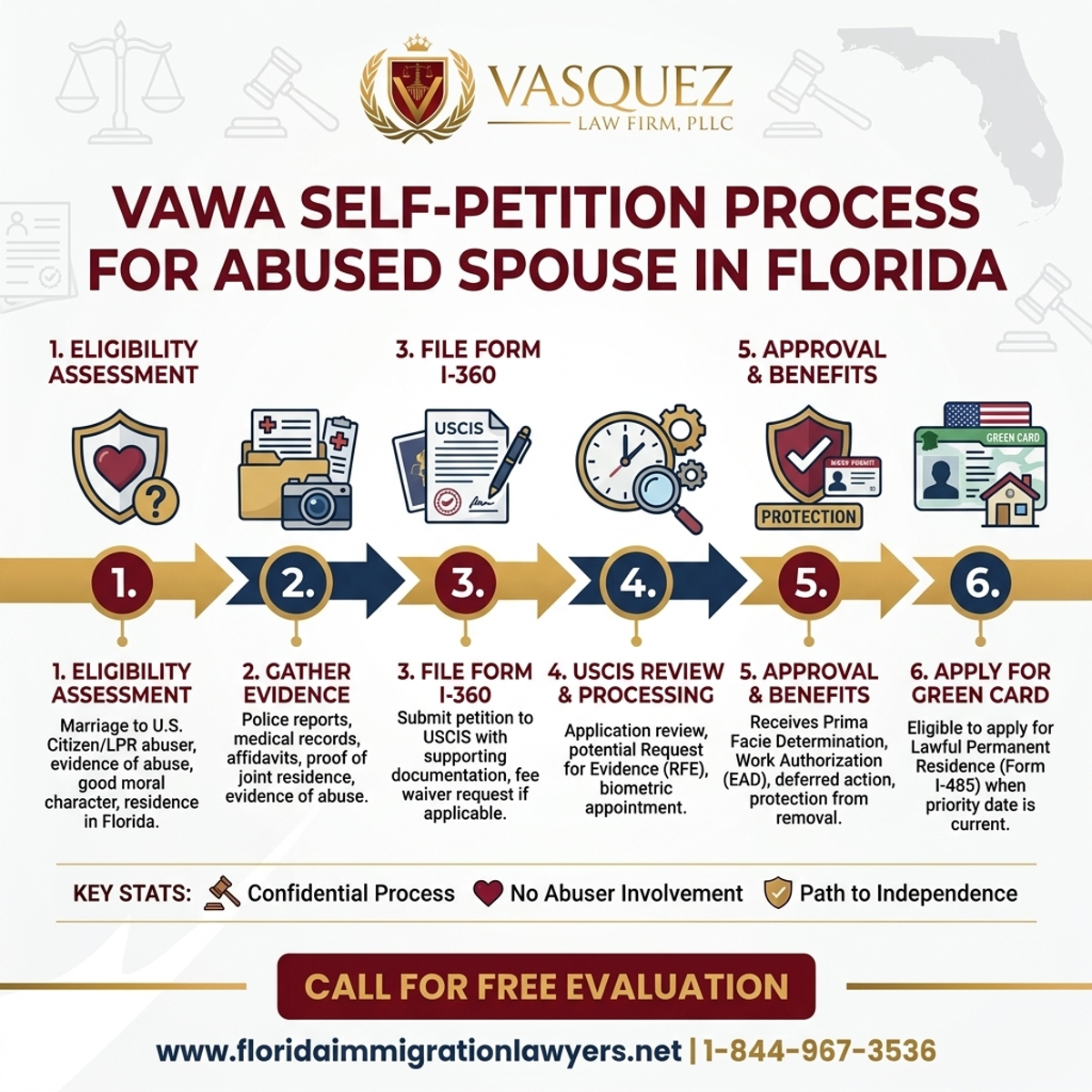
Step-by-Step Process — VAWA Self-Petition for Abused Spouse in Florida | VLF Florida
It's crucial to remember that your personal declaration, detailing your experiences of abuse and your good faith marriage, is often the most vital piece of evidence. Our attorneys are skilled in helping clients articulate their stories clearly and persuasively, ensuring all necessary details are included while respecting your comfort and privacy.
The VAWA Application Process (Form I-360)
The VAWA self-petition process involves several key stages, each requiring careful attention to detail. Understanding these steps can help alleviate some of the anxiety associated with filing.
- Filing Form I-360: The first step is to prepare and submit Form I-360, Petition for Amerasian, Widow(er), or Special Immigrant, along with all supporting documentation and the required filing fee (though a fee waiver is often available for VAWA petitioners). This package is sent to the USCIS Vermont Service Center.
- Prima Facie Determination: Once USCIS receives your petition, they will review it to determine if it establishes a “prima facie” case. If it does, meaning it appears to meet all eligibility requirements on its face, you will receive a Prima Facie Determination notice. This notice can provide certain benefits, such as eligibility for public assistance in some states.
- Request for Evidence (RFE): USCIS may issue a Request for Evidence (RFE) if they need more information or clarification on any aspect of your petition. Responding to an RFE accurately and promptly is critical, and our attorneys are adept at preparing comprehensive responses.
- Interview (Rare but Possible): While most VAWA self-petitioners are not required to attend an interview, USCIS reserves the right to request one. If an interview is scheduled, our attorneys will meticulously prepare you for it and can often accompany you.
- Decision: After reviewing all evidence, USCIS will make a decision on your I-360 petition. If approved, you will receive an I-360 approval notice, which is a significant step towards obtaining your green card.
Benefits of a VAWA Self-Petition
An approved VAWA self-petition offers numerous crucial benefits that can transform a survivor's life:
- Independent Path to a Green Card: The most significant benefit is the ability to self-petition for lawful permanent residency without the abuser's knowledge or cooperation. This removes the abuser's power over your immigration status.
- Work Authorization: Upon filing your I-360 petition and in some cases, receiving a prima facie determination, you may be eligible to apply for an Employment Authorization Document (EAD), allowing you to work legally in the U.S.
- Confidentiality: VAWA petitions are handled with strict confidentiality. USCIS will not notify the abuser of your petition.
- Protection from Deportation: For those facing deportation or removal proceedings, a VAWA petition can offer crucial protection, allowing you to apply for a stay of removal or termination of proceedings.
- Eligibility for Public Benefits: An approved VAWA petition can make you eligible for certain public assistance programs, providing a safety net as you rebuild your life.
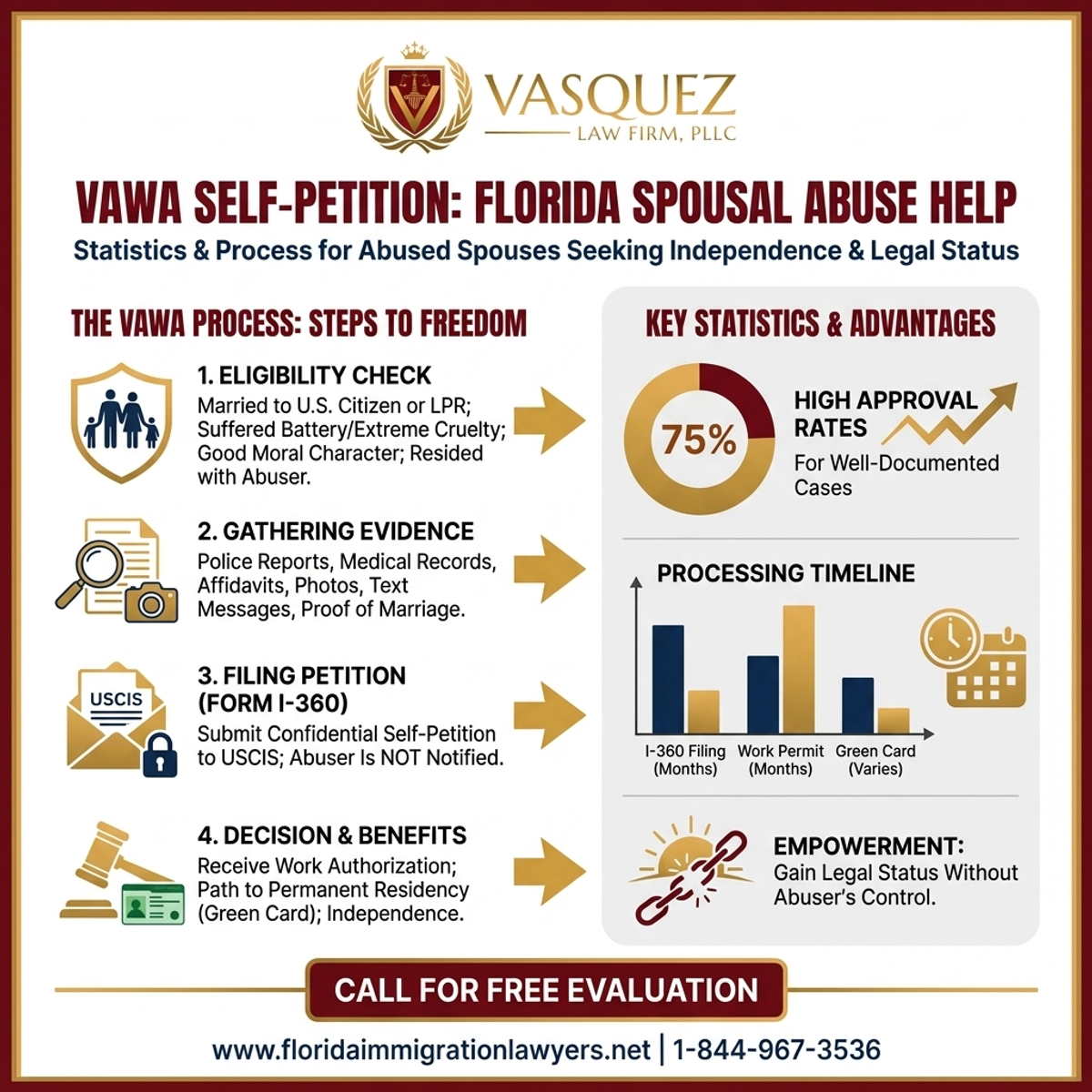
Key Statistics — VAWA Self-Petition for Abused Spouse in Florida | VLF Florida
Common Challenges and How to Overcome Them in Your VAWA Petition
While VAWA offers a vital pathway to safety, the application process can present several challenges for survivors. Understanding these potential hurdles and knowing how to address them is key to a successful outcome. Our experienced immigration attorneys at VLF Florida are well-versed in navigating these complexities and will provide unwavering support.
Lack of Strong Evidence:
Survivors often face the challenge of not having traditional forms of evidence like police reports or medical records, especially if the abuse was primarily emotional or psychological, or if they feared reporting it. To overcome this, focus on gathering alternative evidence: detailed personal declarations, affidavits from friends, family, counselors, or clergy who witnessed changes in your behavior or heard about the abuse, emails, text messages, or voicemails from the abuser, and even dated journal entries. USCIS understands these limitations and considers the totality of circumstances.
Fear of Abuser and Retaliation:
The fear of the abuser discovering the petition or retaliating can be paralyzing. VAWA includes strict confidentiality provisions, meaning USCIS will not inform the abuser of your filing. Your attorney will also take precautions to protect your privacy throughout the process. It's crucial to prioritize your safety and discuss any concerns with your legal team, who can help you develop a safety plan.
Complex Legal Jargon and Procedures:
Immigration law is notoriously complex, filled with specific terms, forms, and procedures. Attempting to navigate this alone, especially while dealing with trauma, can lead to errors and delays. Hiring an attorney who specializes in VAWA cases is invaluable. They can explain the process in clear terms, ensure all forms are correctly filled, and gather the appropriate evidence, significantly increasing your chances of approval.
Proving Good Faith Marriage After Separation or Divorce:
If you are no longer married to your abuser, you still need to prove that the marriage was entered into in good faith. This can be challenging if the relationship ended due to the abuse. Focus on evidence from the time you were together that demonstrates a genuine marital relationship, such as joint accounts, shared responsibilities, and mutual affection, even if the relationship later deteriorated due to the abuse. Your personal statement should clearly explain how the abuse led to the separation or divorce.
Dealing with Prior Immigration Violations:
Many VAWA self-petitioners may have entered the U.S. without inspection, overstayed a visa, or had other immigration violations. VAWA provides waivers for many of these inadmissibility grounds, recognizing that victims of abuse may have been unable to regularize their status due to the abuser's control. It's critical to disclose all prior immigration history to your attorney so they can properly address any potential issues and apply for necessary waivers.
Overcoming these challenges requires not only legal expertise but also a compassionate approach. Our team at VLF Florida is committed to providing both, ensuring you feel supported and empowered throughout your journey to safety and legal status.
What Happens After VAWA Approval? (Adjustment of Status)
An approved I-360 VAWA self-petition is a monumental achievement, but it's often not the final step in obtaining lawful permanent residency. Most VAWA self-petitioners will then need to apply for adjustment of status to become a lawful permanent resident (get a green card).
- Filing Form I-485: Once your I-360 is approved, you can typically file Form I-485, Application to Register Permanent Residence or Adjust Status, along with supporting documents such as medical examination results, affidavits of support, and proof of your approved I-360.
- Biometrics Appointment: You will be scheduled for a biometrics appointment to provide fingerprints and photographs for background checks.
- Interview: While the I-360 typically doesn't require an interview, an interview for the I-485 adjustment of status is common. This interview will focus on your eligibility for permanent residency and your good moral character. Our attorneys will prepare you thoroughly for this interview.
- Green Card Issuance: If your I-485 is approved, you will receive your green card, officially granting you lawful permanent resident status in the United States.
The path to a green card through VAWA can be complex, but with dedicated legal representation, you don't have to face it alone. Our firm is also equipped to assist individuals who may have other complex immigration needs, including those seeking asylum due to persecution in their home country, ensuring a holistic approach to your safety and legal status.
Why Choose VLF Florida for Your VAWA Self-Petition?
At VLF Florida, we understand the immense courage it takes to come forward and seek help. Our firm is built on a foundation of compassion, expertise, and unwavering advocacy for survivors of abuse. When you choose us, you benefit from:
- Specialized VAWA Expertise: Our attorneys have extensive experience specifically with VAWA cases, understanding the nuances of the law and the unique challenges faced by self-petitioners.
- Client-Centered Approach: We prioritize your safety, privacy, and emotional well-being throughout the entire process. We listen with empathy and tailor our strategies to your individual needs.
- Comprehensive Support: From gathering evidence to preparing for interviews and filing all necessary forms, we provide end-to-end legal support, ensuring no detail is overlooked.
- Fluent in Multiple Languages: Our team is equipped to assist clients from diverse backgrounds, ensuring clear communication and understanding.
- Proven Track Record: We have a history of successfully helping survivors achieve their immigration goals and build new, safer lives.
Contact VLF Florida Today
If you are an abused spouse in Florida and believe you may be eligible for a VAWA self-petition, do not hesitate to seek legal assistance. Your safety and future are paramount. Our team at VLF Florida is here to provide confidential, compassionate, and effective legal representation.
Call us today at (844) 967-3536 for a free, confidential consultation, or contact us online to schedule an appointment. Let us help you take the first step towards a life free from abuse and with secure legal status in the United States.
Sources and References
- U.S. Citizenship and Immigration Services (USCIS)
- Executive Office for Immigration Review (EOIR)
- U.S. Department of State - Bureau of Consular Affairs
- Immigration and Nationality Act (INA), 8 U.S.C. Chapter 12
Do Not Navigate This Process Alone
Our experienced immigration attorneys are ready to fight for you. Get a free, confidential consultation today.
Se Habla Español
Frequently Asked Questions
Florida Immigration Lawyers
Immigration Attorney | Founder, Vasquez Law Firm
U.S. Air Force veteran and immigration attorney with thousands of cases resolved. J.D., NCCU School of Law. AILA member. Admitted to the 4th, 5th, and 11th Circuit Courts.
Available 24/7 - Free Evaluations
Related Legal Services
Our Florida immigration attorneys can help you with asylum protection, deportation defense and citizenship and naturalization. Call today at 1-844-967-3536 for a free consultation.
Related Links
Related Topics
Free Legal Consultation
Discuss your case with our experienced attorneys. We're available 24/7.
Se Habla Español - Estamos aquí para ayudarle.
Related Articles
Navigating the Unlawful Presence Waiver in Florida
Learn about the I-601A provisional waiver for unlawful presence in Florida. This guide covers eligibility, application steps, common mistakes, and why consulting an attorney is crucial. Contact Florida Immigration Lawyers for a free consultation.
Protecting Against Immigration Scams in Florida | VLF Florida
Learn how to protect yourself from immigration scams in Florida, including notario fraud. Discover actionable steps and legal resources. Call Florida Immigration Lawyers at 1-844-967-3536.
L-1 Visa Transfer for Florida Companies | VLF Florida
Learn about L-1 visa intracompany transfers for Florida companies. Ensure a smooth transition for your employees to Tampa. Call 1-844-967-3536 for expert advice.
H-2A Visa Opportunities for Florida Agricultural Workers
Explore opportunities for Florida agricultural workers under the H-2A visa program. Learn about application steps, costs, and common mistakes.