Navigating the Unlawful Presence Waiver in Florida
Learn about the I-601A provisional waiver for unlawful presence in Florida. This guide covers eligibility, application steps, common mistakes, and why consulting an attorney is crucial. Contact Florida Immigration Lawyers for a free consultation.

The unlawful presence waiver, also known as the I-601A provisional waiver, allows certain immigrants in Florida to request forgiveness for periods of unlawful presence in the U.S., enabling them to apply for legal status. Key takeaways include:
- Eligibility depends on specific criteria.
- Requires proof of extreme hardship to a U.S. citizen or lawful permanent resident relative.
- Filing and approval processes are complex and time-consuming.
- Legal assistance can improve chances of success.
Dealing with immigration issues can be overwhelming, especially if you're facing unlawful presence concerns in Naples, Florida. The I-601A provisional waiver offers a potential path to address unlawful presence, allowing eligible individuals to apply for legal status without leaving the U.S. This article will explore the waiver process, eligibility, and common pitfalls to avoid. Call Florida Immigration Lawyers at 1-844-967-3536 for a free consultation.
Understanding the Unlawful Presence Waiver
The I-601A provisional waiver is designed for individuals who have accrued unlawful presence in the U.S. and are eligible for an immigrant visa but require a waiver to avoid a three- or ten-year bar from re-entering the country. This waiver is particularly relevant for residents in Florida, where many immigrants reside, including areas like Naples.
To qualify, applicants must demonstrate that their refusal of admission would cause extreme hardship to a qualifying U.S. citizen or lawful permanent resident relative. This waiver does not forgive other grounds of inadmissibility such as criminal conduct.
The three- and ten-year bars are significant consequences for individuals who have overstayed their visas or entered the U.S. without inspection. Specifically, if you have accrued more than 180 days but less than one year of unlawful presence and depart the U.S., you face a three-year bar to re-entry. If you have accrued one year or more of unlawful presence and depart, you face a ten-year bar. The I-601A provisional waiver was created to allow eligible individuals to seek forgiveness for this unlawful presence before they leave the U.S. for their immigrant visa interview, thus mitigating the risk and uncertainty associated with the bars. This is a crucial distinction, as it allows applicants to remain in the U.S. with their families while their waiver is being processed.
This waiver is a critical tool for family unity, particularly for those with U.S. citizen or lawful permanent resident spouses or parents. It addresses inadmissibility under Section 212(a)(9)(B) of the Immigration and Nationality Act (INA), which deals specifically with unlawful presence. However, it is vital to understand its limitations. The I-601A only waives unlawful presence; it does not cover other grounds of inadmissibility, such as misrepresentation, fraud, or certain criminal convictions. For these separate issues, different waivers (like the I-601 waiver) may be necessary, often requiring a more complex and potentially lengthier process. Therefore, a thorough assessment of all potential grounds of inadmissibility is essential before proceeding with an I-601A application. Consulting with Florida Immigration Lawyers can help you determine all applicable waivers for your specific situation.
Step-by-Step Guide to Applying for the I-601A Waiver
- Determine Eligibility: Confirm that you meet all requirements for the waiver, including having an approved immigrant visa petition and a qualifying relative.
- Prepare Necessary Documentation: Gather evidence of extreme hardship, such as medical records, financial statements, and affidavits from family members.
- File Form I-601A: Submit the completed form along with the required fees and supporting documentation to the USCIS.
- Attend Biometrics Appointment: USCIS will schedule an appointment to collect your fingerprints and photograph.
- Await Decision: After submission, await the USCIS decision. Processing times can vary, so it's crucial to monitor your application status.
Each step in the I-601A provisional waiver process requires meticulous attention to detail. For instance, "Determining Eligibility" goes beyond merely having a qualifying relative; it involves ensuring that an immigrant visa petition (such as an I-130 filed by a U.S. citizen spouse or parent) has been approved and that you are otherwise eligible for an immigrant visa through consular processing. This means you must not have any other grounds of inadmissibility that the I-601A does not cover, such as past criminal convictions or prior orders of deportation. It's also crucial that your qualifying relative is a U.S. citizen or lawful permanent resident spouse or parent; hardship to a U.S. citizen child, while emotionally compelling, does not meet the legal standard for a qualifying relative for this specific waiver.
"Preparing Necessary Documentation" is arguably the most critical phase, as the success of your waiver hinges on demonstrating "extreme hardship." This legal standard is high and requires comprehensive evidence. Beyond basic medical and financial records, you should consider psychological evaluations, educational records, evidence of country conditions in your home country (if relevant to your relative's well-being), and detailed affidavits from your qualifying relative and others who can attest to the profound impact your absence would have. For example, if your U.S. citizen spouse relies on you for care due to a chronic illness, detailed medical records, doctor's letters, and proof of your caregiving role are essential. Florida Immigration Lawyers can help you identify and gather the strongest evidence to support your claim.
After "Filing Form I-601A" with USCIS, the "Biometrics Appointment" is a mandatory step for identity verification and background checks. Missing this appointment without rescheduling can lead to delays or even denial of your application. Once biometrics are completed, the "Awaiting Decision" phase begins. While you wait, it's prudent to prepare for your eventual immigrant visa interview abroad, should your waiver be approved. This includes gathering all necessary civil documents and undergoing a medical examination. If USCIS issues a Request for Evidence (RFE), respond promptly and thoroughly to avoid further delays.
Document Checklist for the I-601A Waiver
A meticulously organized and complete document submission is paramount for the I-601A waiver. This checklist serves as a foundational guide, but applicants should be prepared to provide a robust portfolio of evidence that paints a clear and compelling picture of their case. Every piece of documentation should directly support the claims made in the waiver application, particularly regarding the extreme hardship faced by the qualifying U.S. citizen or lawful permanent resident relative.
- Completed Form I-601A
- Proof of qualifying relationship (e.g., marriage certificates, birth certificates, adoption decrees)
- Evidence of extreme hardship (e.g., medical records, psychological evaluations, financial statements, tax returns, property deeds, letters from employers, school records, country condition reports, detailed affidavits from the qualifying relative and others)
- Copy of approved immigrant visa petition (e.g., Form I-130 approval notice)
- Fee payment receipt
- Proof of U.S. citizenship or lawful permanent residency of the qualifying relative (e.g., U.S. passport, birth certificate, naturalization certificate, green card)
- Evidence of unlawful presence (e.g., I-94 records, entry/exit stamps, affidavits)
Beyond the core items, consider including a detailed cover letter that outlines the contents of your submission and highlights the key arguments for extreme hardship. Organizing your documents with tabs and a table of contents can significantly aid the USCIS officer reviewing your case. Remember, the goal is to make it as easy as possible for the adjudicator to understand your situation and approve your waiver. Florida Immigration Lawyers can assist in compiling a comprehensive and persuasive application package tailored to your unique circumstances.
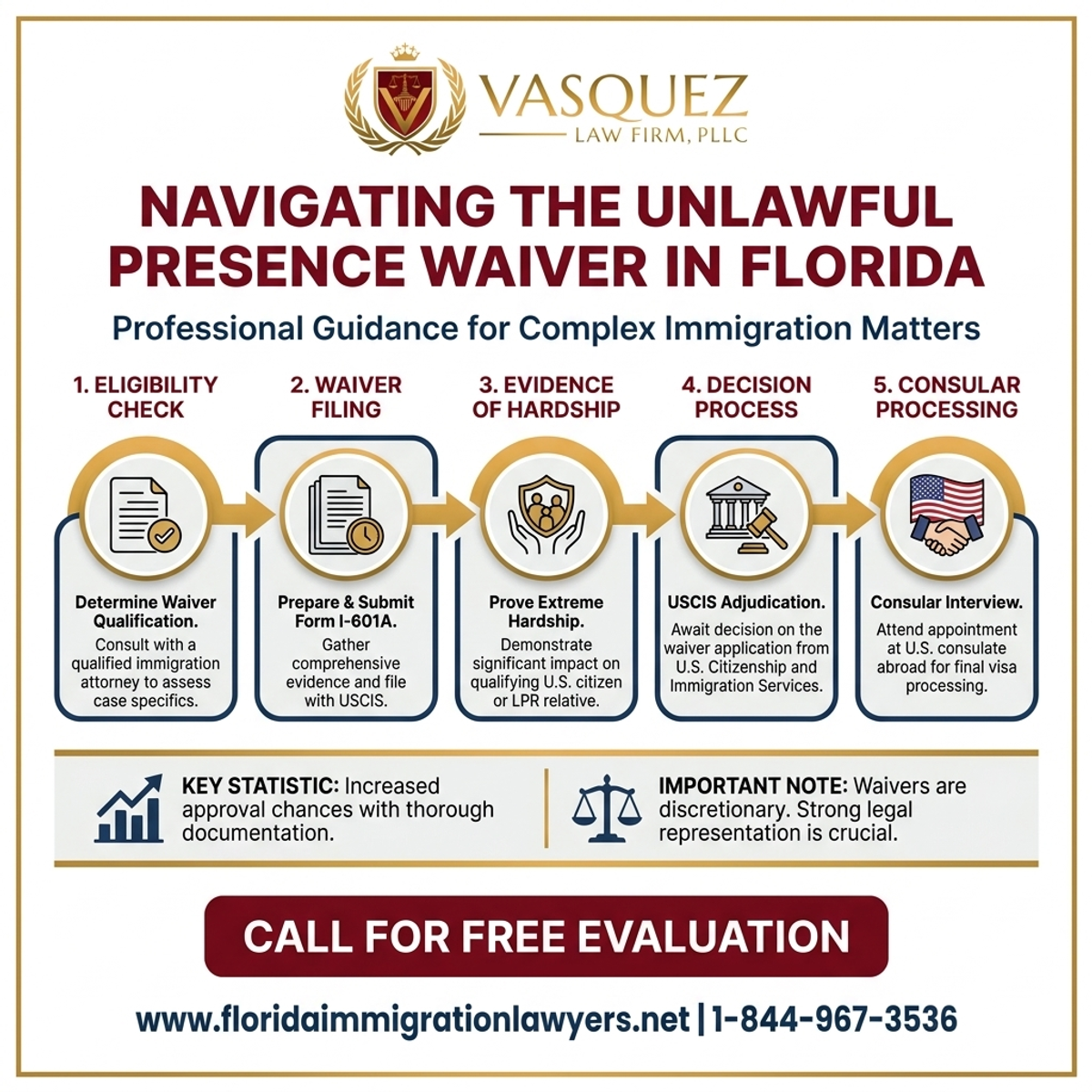
Step-by-Step Process — Navigating the Unlawful Presence Waiver in Florida
Timeline and Processing Expectations
Processing times for the I-601A waiver can vary, but it generally takes several months from submission to receive a decision. Applicants should be prepared for possible delays due to high demand or additional requests for evidence.
In Florida, particularly in areas like Naples, the proximity to USCIS offices can influence timelines. It's essential to stay informed about your application's progress and respond promptly to any USCIS requests.
While USCIS provides estimated processing times online, these are subject to change and should only be used as a general guide. Several factors can influence how long it takes to receive a decision on your I-601A waiver. The volume of applications received by USCIS, the complexity of your individual case, and whether a Request for Evidence (RFE) is issued can all extend the timeline. For instance, if your initial submission lacks crucial evidence or clarity, an RFE will add several weeks or even months to the process, as you'll need time to gather and submit the requested information, and USCIS will then need time to review it.
It's also important to understand that the I-601A provisional waiver is just one step in a multi-stage process. Even after waiver approval, you still need to attend your immigrant visa interview at a U.S. consulate or embassy abroad. This means that the overall journey to obtaining lawful permanent residency will span beyond the I-601A processing time. Maintaining open communication with your legal counsel, such as Florida Immigration Lawyers, is vital throughout this period. They can help you track your application status, interpret any communications from USCIS, and advise on the next steps, ensuring you remain proactive and prepared for each phase of your immigration journey.
Cost Factors and Fee Breakdown
The cost of applying for the I-601A waiver includes filing fees, which can change, and potential legal fees if you choose to hire an attorney. While the initial fee for the waiver itself is fixed, other costs may arise, such as those for gathering required documentation or obtaining expert opinions to support your case.
Do not navigate this process alone. Contact Florida Immigration Lawyers today at 1-844-967-3536.
Understanding the financial commitment involved in the I-601A waiver process is crucial for proper planning. The primary cost is the USCIS filing fee for Form I-601A, which is subject to periodic adjustments by the agency. Beyond this mandatory fee, applicants should budget for a range of additional expenses. These can include fees for obtaining certified copies of documents, translation services for any non-English documents, and potentially fees for expert consultations such as psychological evaluations or medical opinions, which can significantly strengthen an extreme hardship claim.
Perhaps the most significant variable cost is legal representation. While not legally required, retaining an experienced immigration attorney, like those at Florida Immigration Lawyers, can dramatically improve your chances of success. Legal fees can vary based on the complexity of your case and the attorney's experience. Some firms offer flat fees for waiver applications, while others charge hourly. These fees cover not only the preparation and submission of the waiver but also crucial guidance in strategizing your case, compiling compelling evidence, and responding to USCIS requests. Considering the high stakes involved, viewing legal fees as an investment in your future and family's stability is often advisable. Remember, Florida Immigration Lawyers offers free consultations at 1-844-967-3536 to discuss your case and provide a transparent breakdown of potential costs.
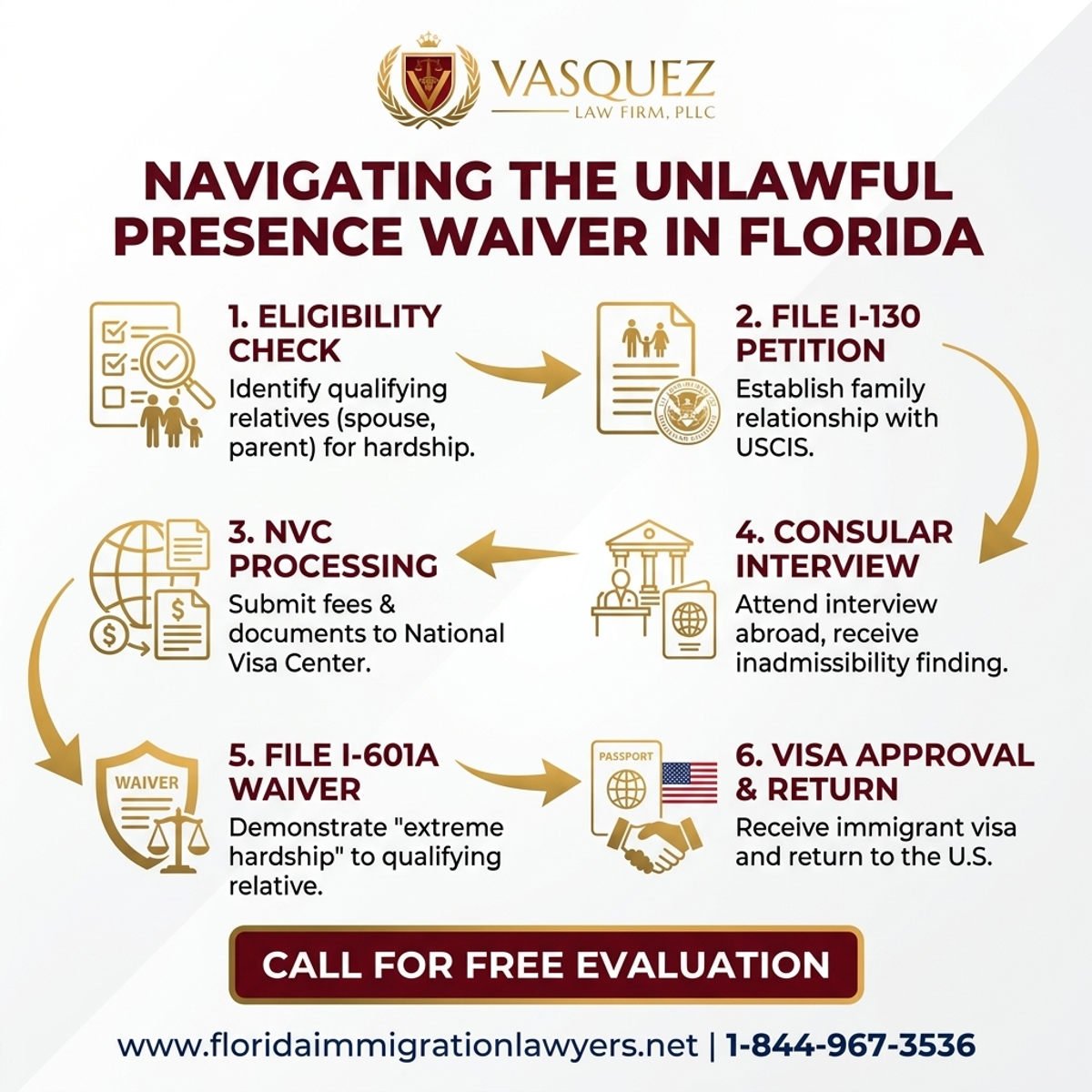
Key Statistics — Navigating the Unlawful Presence Waiver in Florida
Common Mistakes to Avoid
Navigating the I-601A provisional waiver process is fraught with potential pitfalls that can lead to significant delays or outright denial. Being aware of these common mistakes can help applicants avoid unnecessary setbacks and improve their chances of a successful outcome.
- **Incomplete Applications:** Missing documents, incorrect forms, or failure to sign required sections are frequent errors. USCIS has strict requirements, and even minor omissions can result in a Request for Evidence (RFE) or, worse, a denial. Always double-check every item on the checklist and ensure all forms are filled out accurately and completely.
- **Failing to Demonstrate Extreme Hardship:** This is arguably the most critical and often misunderstood aspect of the waiver. "Extreme hardship" is a high legal standard, meaning more than just the normal difficulties associated with separation or relocation. Applicants must provide compelling evidence that their U.S. citizen or LPR spouse or parent would suffer hardship far beyond what would ordinarily be expected if the applicant were not granted the waiver. This requires a strong narrative supported by detailed medical, psychological, financial, and social evidence.
- **Ignoring Deadlines:** USCIS provides specific deadlines for responding to RFEs or other notices. Failing to meet these deadlines, even by a day, can lead to the automatic abandonment or denial of your application. Keep track of all correspondence and respond promptly.
- **Assuming All Waivers Are the Same:** The I-601A specifically addresses unlawful presence. It does not cover other grounds of inadmissibility, such as criminal history, fraud, or misrepresentation. Applying for the wrong waiver or failing to address all applicable grounds of inadmissibility will lead to denial. An immigration attorney can help identify all necessary waivers.
- **Not Seeking Legal Advice:** The complexity of immigration law, particularly waivers, makes professional guidance invaluable. An experienced attorney can identify potential issues, help gather strong evidence, articulate the extreme hardship argument effectively, and ensure compliance with all legal requirements. This significantly improves your chances of approval.
- **Overlooking the Importance of Biometrics:** Your biometrics appointment is mandatory for background checks. Failing to attend or reschedule properly can cause your application to be considered abandoned. Ensure you receive and attend this appointment.
- **Submitting Inaccurate Information:** Any false or misleading information, whether intentional or accidental, can have severe consequences, including denial, future inadmissibility, or even accusations of immigration fraud. Always be truthful and provide accurate documentation.
- **Not Understanding Eligibility Requirements:** Before even starting the application, it's crucial to confirm you meet all fundamental eligibility criteria. This includes having an approved immigrant visa petition and a qualifying relative. Applying without meeting these can waste significant time and money.
- **Failing to Respond to USCIS Requests:** If USCIS sends a Request for Evidence (RFE) or a Notice of Intent to Deny (NOID), it is critical to respond comprehensively and within the specified timeframe. Ignoring these requests will almost certainly lead to denial.
- **Misunderstanding the Role of Qualifying Relatives:** Only U.S. citizen or lawful permanent resident spouses or parents can serve as qualifying relatives for the I-601A waiver. Hardship to a U.S. citizen child, while a factor in other types of waivers, does not meet the specific legal standard for the I-601A.
Avoiding these common mistakes requires diligence and a thorough understanding of immigration law. When in doubt, consulting with Florida Immigration Lawyers at 1-844-967-3536 can provide the clarity and expertise needed to navigate this intricate process successfully.
When to Call a Lawyer
If you encounter any complexities in your application process or have concerns about meeting eligibility criteria, it is crucial to consult with an immigration attorney. Florida Immigration Lawyers can provide personalized guidance and representation to ensure your waiver application is as strong as possible.
Additionally, if you have past immigration violations, criminal history, or any other potential grounds for inadmissibility, professional legal advice is essential.
The decision to seek legal counsel for an I-601A provisional waiver is often a pivotal one. Beyond obvious complexities like a criminal record or previous immigration violations, there are many scenarios where an attorney's expertise becomes indispensable. For instance, if your case involves multiple entries and exits from the U.S., previous deportation orders (even if not executed), or a history of misrepresentation, these factors introduce layers of complexity that can easily overwhelm an unrepresented applicant. An attorney can meticulously review your entire immigration history to identify all potential grounds of inadmissibility and strategize the most effective way to address them.
Furthermore, demonstrating "extreme hardship" is a subjective and challenging legal standard. An experienced immigration lawyer understands what constitutes compelling evidence and how to present it persuasively to USCIS. They can help you gather the right documents, draft powerful affidavits, and even recommend expert evaluations (like psychological assessments) to strengthen your case. If you receive a Request for Evidence (RFE) or a Notice of Intent to Deny (NOID), a lawyer can formulate a comprehensive and timely response, significantly improving your chances of approval. Don't leave your future to chance; contacting Florida Immigration Lawyers at 1-844-967-3536 for a free consultation can provide the peace of mind and expert guidance you need.
About Florida Immigration Lawyers
Florida Immigration Lawyers is a dedicated law firm offering comprehensive immigration services across Florida. Our experienced attorneys provide personalized support for all immigration matters, including waivers, asylum, deportation defense, and more. We are available 24/7 and offer free consultations to discuss your case. Call us at 1-844-967-3536 or visit our website at https://www.floridaimmigrationlawyers.net.
Sources and References
- U.S. Citizenship and Immigration Services (USCIS)
- Executive Office for Immigration Review (EOIR)
- 8 U.S.C. Chapter 12 - Immigration and Nationality Act
- Code of Federal Regulations (CFR) Title 8
Related services: immigration practice areas,
Do Not Navigate This Process Alone
Our experienced immigration attorneys are ready to fight for you. Get a free, confidential consultation today.
Se Habla Español
Or leave your details and we’ll call you:
Free Evaluation in 24 Hours
Or talk to us right now

AI voice assistant — available 24/7
FreeFrequently Asked Questions

William J. Vásquez
Founding Attorney · Vasquez Law Firm
U.S. Air Force veteran and immigration attorney with years of hands-on U.S. immigration experience. J.D., NCCU School of Law. AILA member. Admitted to the 4th, 5th, and 11th Circuit Courts.
Available 24/7 - Free Evaluations
Reviewed for legal accuracy by William J. Vásquez
Licensed in North Carolina; U.S. immigration is federal practice.
Related Legal Services
Our Florida immigration attorneys can help you with deportation defense, citizenship and naturalization and family immigration services. Call today at 1-844-967-3536 for a free consultation.
Related Links
Related Topics
Free Legal Consultation
Discuss your case with our experienced attorneys. We're available 24/7.
Se Habla Español - Estamos aquí para ayudarle.
Related Articles
I-601 Waiver Lawyer Florida: Comprehensive Guide 2026
For many immigrants in Florida, overcoming grounds of inadmissibility is a critical step towards securing their future in the U.S. An I-601 waiver provides a pathway to address issues like unlawful presence, certain criminal convictions, or immigration fraud. This comprehensive guide, relevant for 2026, explains who needs an I-601 waiver, how to prove "extreme hardship" to a qualifying U.S. citizen or lawful permanent resident relative, and the step-by-step application process. We also cover typical timelines, cost factors, and crucial mistakes to avoid. Florida Immigration Lawyers offers expert guidance for I-601 waiver applications across the state, ensuring you build the strongest possible case and navigate the complex legal requirements effectively. Contact us for a free consultation to discuss your specific situation.
Immigration Lawyer Orlando Free Consultation in 2026
Navigating the complexities of U.S. immigration law requires expert guidance. For those in Orlando and across Florida, a free consultation with an immigration lawyer can provide crucial insights into your legal options without financial commitment. This comprehensive guide from Florida Immigration Lawyers details why an initial consultation is essential, what services immigration attorneys offer, the step-by-step process, typical timelines, and associated costs. We also highlight common mistakes to avoid and when it's critical to seek professional legal assistance. Our firm serves all of Florida, including Naples and Collier County, ensuring accessible, high-quality representation for families, businesses, asylum seekers, and individuals facing deportation. Understand your rights and build a strong case with trusted legal partners.
Stem OPT Immigration Lawyer: 2026 Florida Guide
For F-1 students in Florida, the STEM OPT extension offers a vital 24-month work authorization after their initial OPT. This guide, updated for 2026, covers eligibility, the step-by-step application process, required documents, and critical timelines. Graduates from Florida universities in STEM fields must navigate strict USCIS regulations, including the E-Verify employer requirement. Learn how to avoid common mistakes and when to seek professional legal assistance from a dedicated stem OPT immigration lawyer to ensure a successful application and continued career growth in the U.S. Florida Immigration Lawyers offers expert guidance for students across the state.
Dual Citizenship Lawyer: Navigating Delays in Florida
Facing citizenship delays in Florida can be challenging, but understanding the process and knowing your options is key. Learn how a dual citizenship lawyer can assist you in navigating N-400 processing and USCIS backlogs in Hialeah.