I-601 Waiver Lawyer Florida: Comprehensive Guide 2026
For many immigrants in Florida, overcoming grounds of inadmissibility is a critical step towards securing their future in the U.S. An I-601 waiver provides a pathway to address issues like unlawful presence, certain criminal convictions, or immigration fraud. This comprehensive guide, relevant for 2026, explains who needs an I-601 waiver, how to prove "extreme hardship" to a qualifying U.S. citizen or lawful permanent resident relative, and the step-by-step application process. We also cover typical timelines, cost factors, and crucial mistakes to avoid. Florida Immigration Lawyers offers expert guidance for I-601 waiver applications across the state, ensuring you build the strongest possible case and navigate the complex legal requirements effectively. Contact us for a free consultation to discuss your specific situation.

An I-601 waiver, also known as an Application for Waiver of Grounds of Inadmissibility, allows certain non-citizens to overcome specific bars to entering or remaining in the United States. This waiver is often necessary when an individual has committed certain immigration violations or crimes, or has accrued unlawful presence. To qualify, applicants must typically demonstrate that their U.S. citizen or lawful permanent resident spouse or parent would suffer "extreme hardship" if the waiver is not granted. Navigating this complex process, especially in Florida, requires meticulous preparation and a deep understanding of immigration law. Consulting with an experienced I-601 waiver lawyer in Florida is crucial for a successful application.
- The I-601 waiver addresses various grounds of inadmissibility, including unlawful presence and certain criminal offenses.
- Applicants must prove "extreme hardship" to a qualifying U.S. citizen or lawful permanent resident relative.
- The process involves extensive documentation and a detailed legal argument.
- Processing times can vary significantly based on the specific USCIS service center.
- Legal guidance from a Florida immigration attorney is highly recommended to avoid common pitfalls.
I-601 Waiver Lawyer Florida: Comprehensive Guide 2026
Navigating the complex landscape of U.S. immigration law can be daunting, especially when facing grounds of inadmissibility. For many individuals in Florida hoping to secure their immigration future, an I-601 waiver becomes a critical pathway. This application offers a chance to overcome specific legal barriers that would otherwise prevent you from obtaining a visa, adjusting your status, or re-entering the United States. Whether you are in Coral Springs, Miami, Orlando, or anywhere else in the Sunshine State, understanding the intricacies of this waiver is essential.
An I-601 waiver is not a simple form; it is a comprehensive legal argument designed to prove that the U.S. government should overlook certain past issues due to the extreme hardship it would cause a qualifying U.S. citizen or lawful permanent resident relative. These issues can range from unlawful presence to certain criminal convictions or immigration fraud. The success of your application hinges on presenting compelling evidence and a well-articulated case. Given the high stakes, seeking assistance from an experienced I-601 waiver lawyer in Florida is not just beneficial, it is often indispensable.
At Florida Immigration Lawyers, we understand the profound impact immigration decisions have on families. Our dedicated team is committed to guiding you through every step of the I-601 waiver process, helping you build the strongest possible case. Do not face the complexities of inadmissibility alone. Call Florida Immigration Lawyers at 1-844-967-3536 for a free consultation and take the first step towards securing your future in the United States.
What is an I-601 Waiver and Who Needs One in Florida?
An I-601 waiver, formally known as an Application for Waiver of Grounds of Inadmissibility, is a crucial legal tool for individuals seeking to overcome specific barriers to immigration. These barriers, or "grounds of inadmissibility," are outlined in the Immigration and Nationality Act (INA) and can prevent an individual from obtaining a green card, a nonimmigrant visa, or even from re-entering the U.S. after travel abroad. In Florida, with its diverse immigrant population, many residents find themselves in situations where an I-601 waiver is their only path forward.
Generally, an I-601 waiver is needed if you are found inadmissible for reasons such as unlawful presence (INA § 212(a)(9)(B)), certain criminal offenses (INA § 212(a)(2)), misrepresentation or fraud (INA § 212(a)(6)(C)), or health-related grounds (INA § 212(a)(1)). The specific grounds of inadmissibility determine which waiver form is appropriate; the I-601 is primarily for those applying for immigrant visas or adjustment of status who are inadmissible based on certain criminal acts, health issues, or misrepresentation. If your inadmissibility is solely due to unlawful presence, you might also consider an I-601A provisional waiver, which is filed from within the U.S. before departing for a consular interview. Our firm can help you determine the correct waiver for your unique circumstances.
For individuals residing in Florida, whether in bustling cities like Miami or Tampa, or smaller communities like Coral Springs, understanding your specific grounds of inadmissibility is the first step. For example, if you have accrued more than 180 days of unlawful presence in the U.S. and then departed, you could be subject to a 3-year or 10-year bar. An I-601 waiver could potentially overcome this. Similarly, certain criminal convictions, even minor ones, can trigger inadmissibility. An experienced I-601 waiver lawyer in Florida can assess your immigration history, identify all applicable grounds of inadmissibility, and advise on the most suitable waiver strategy. This detailed analysis is vital for a successful application and to avoid unnecessary delays or denials.
How Do I Prove "Extreme Hardship" for an I-601 Waiver?
Proving "extreme hardship" is the cornerstone of a successful I-601 waiver application. This is often the most challenging aspect, as the legal definition of "extreme hardship" is not explicitly defined in the INA but has been developed through case law, notably by the Board of Immigration Appeals (BIA). As of 2026, USCIS adjudicators consider a wide range of factors when evaluating hardship claims, focusing on how a qualifying U.S. citizen (USC) or Lawful Permanent Resident (LPR) spouse or parent would suffer if the applicant were denied the waiver and forced to remain outside the U.S.
To demonstrate extreme hardship, you must provide comprehensive documentation and a compelling narrative detailing the unique and severe difficulties your qualifying relative would face. This goes beyond the normal separation or economic inconvenience that any family would experience. Examples of factors considered include: the qualifying relative's health issues (physical or mental) requiring the applicant's care; significant financial losses if the qualifying relative were forced to relocate or remain in the U.S. without the applicant; educational disruption for children; psychological distress, depression, or anxiety of the qualifying relative due to separation; and cultural or linguistic barriers if the qualifying relative were to move to the applicant's home country. The cumulative effect of these factors is often more persuasive than any single factor.
In Florida, where many families have deep roots and established lives, proving extreme hardship often involves highlighting specific ties to the community, employment, and support networks. For instance, if a qualifying USC parent in Coral Springs relies on the applicant for daily care due to a chronic illness, or if an LPR spouse would lose their established career and support system by moving abroad, these are strong arguments. Gathering affidavits from doctors, therapists, employers, and community leaders, along with financial records, medical reports, and expert psychological evaluations, is crucial. An I-601 waiver lawyer in Florida can help you identify and collect the most relevant evidence, craft a persuasive legal brief, and articulate the extreme hardship argument effectively to USCIS, referencing relevant BIA decisions and policy guidance.
What Documentation is Essential for an I-601 Waiver Application?
The success of an I-601 waiver application heavily relies on the quality and quantity of supporting documentation. Meticulous preparation is key to building a strong case for extreme hardship. Here’s a general checklist of documents you will typically need to gather:
- Form I-601: The official application form, completed accurately and thoroughly.
- Proof of Relationship: Birth certificates, marriage certificates, and other documents establishing your relationship to the qualifying U.S. citizen or Lawful Permanent Resident spouse or parent.
- Evidence of Qualifying Relative's U.S. Status: Copy of birth certificate, U.S. passport, Certificate of Naturalization, or green card (Form I-551).
- Hardship Declaration: A detailed, heartfelt statement from the qualifying relative explaining in their own words the extreme hardship they would face.
- Applicant's Declaration: A statement from the applicant explaining their circumstances and commitment to compliance.
- Medical Records: If hardship is health-related, provide comprehensive medical records, diagnoses, prognoses, and statements from U.S. doctors detailing treatment and prognosis.
- Psychological Evaluations: Reports from licensed U.S. psychologists or psychiatrists assessing the psychological impact of separation on the qualifying relative.
- Financial Documents: Tax returns, pay stubs, bank statements, mortgage statements, utility bills, and evidence of debts or financial obligations to show financial reliance or burden.
- Employment Records: Letters from employers, job offer letters, and evidence of career stability for the qualifying relative.
- Educational Records: School transcripts, enrollment verification, and letters from school officials, especially for minor children.
- Country Conditions Reports: Information on conditions in the applicant’s home country if the qualifying relative would be forced to relocate, highlighting lack of medical care, safety concerns, or economic instability.
- Letters of Support: Affidavits from friends, family, community leaders, and employers attesting to the qualifying relative’s dependence on the applicant and the hardship they would face.
- Police Clearances: From all jurisdictions where the applicant has resided.
- Court Records: Certified copies of any criminal records, disposition, and sentencing.
- Proof of Rehabilitation: Evidence of community service, counseling, or other steps taken to address past issues.
This list is not exhaustive, and the specific documents required will vary based on the grounds of inadmissibility and the unique circumstances of your case. An I-601 waiver lawyer in Florida can help you compile a comprehensive and compelling package of evidence, ensuring no critical document is overlooked.
What is the Step-by-Step Process for Filing an I-601 Waiver in 2026?
The process of filing an I-601 waiver, while intricate, follows a structured path. As of 2026, understanding each step is vital for a smooth application. This guide outlines the typical stages involved for individuals seeking an I-601 waiver in Florida, whether they are pursuing an immigrant visa through consular processing or adjusting their status within the U.S. The exact sequence can vary slightly depending on whether you are overseas or in the U.S., but the core requirements remain consistent.
- Identify Grounds of Inadmissibility: The first and most critical step is to accurately identify all grounds of inadmissibility that apply to your case. This typically occurs after an initial visa interview at a U.S. Consulate abroad or during the adjustment of status process with USCIS. A qualified immigration attorney can help you review your history and determine the specific INA sections that trigger inadmissibility.
- Determine Eligibility for Waiver: Once grounds are identified, you must confirm that an I-601 waiver is the appropriate mechanism to overcome them. Not all grounds of inadmissibility can be waived, and some require different waiver forms (e.g., I-212 for prior deportation). You must also have a "qualifying relative" (U.S. citizen or lawful permanent resident spouse or parent) who would suffer "extreme hardship."
- Gather Comprehensive Evidence of Extreme Hardship: This is the most time-consuming and crucial phase. You will collect extensive documentation as detailed in the previous section, including medical records, financial statements, psychological evaluations, and declarations from the qualifying relative and applicant. The goal is to build a compelling case that goes beyond typical inconvenience.
- Complete Form I-601: Fill out the Application for Waiver of Grounds of Inadmissibility (Form I-601) accurately and completely. Ensure all questions are answered, and no sections are left blank without proper notation. Attach the correct filing fee, which, as of 2026, can be found on the official USCIS website.
- Prepare Legal Brief: A persuasive legal brief drafted by an attorney is often included. This brief summarizes the facts of the case, cites relevant immigration law (e.g., 8 U.S.C. § 1182 for inadmissibility grounds), explains how the evidence demonstrates extreme hardship, and argues for the favorable exercise of discretion by USCIS.
- File the Application: The I-601 waiver is typically filed with the USCIS Lockbox facility designated for your specific type of application or with the U.S. Embassy/Consulate abroad if instructed to do so. For adjustment of status cases within the U.S., it might be filed concurrently with Form I-485 or later. Ensure you keep copies of everything submitted.
- Await Decision or Request for Evidence (RFE): After filing, USCIS will send a receipt notice. They may then issue an RFE if they need additional information or clarification. Responding to an RFE promptly and thoroughly is critical. In some cases, an interview may be scheduled, though this is less common for I-601 waivers filed domestically.
- Receive Decision: Once USCIS reviews all evidence, they will issue a decision. If approved, the waiver removes the specific grounds of inadmissibility, allowing the immigration process to proceed. If denied, you may have options to appeal or refile, depending on the specific reasons for denial.
Throughout this complex process, particularly for residents of Florida, having an experienced I-601 waiver lawyer in Florida from Florida Immigration Lawyers can make a significant difference. We can help you navigate each stage, ensuring compliance with all requirements and presenting the strongest possible case.
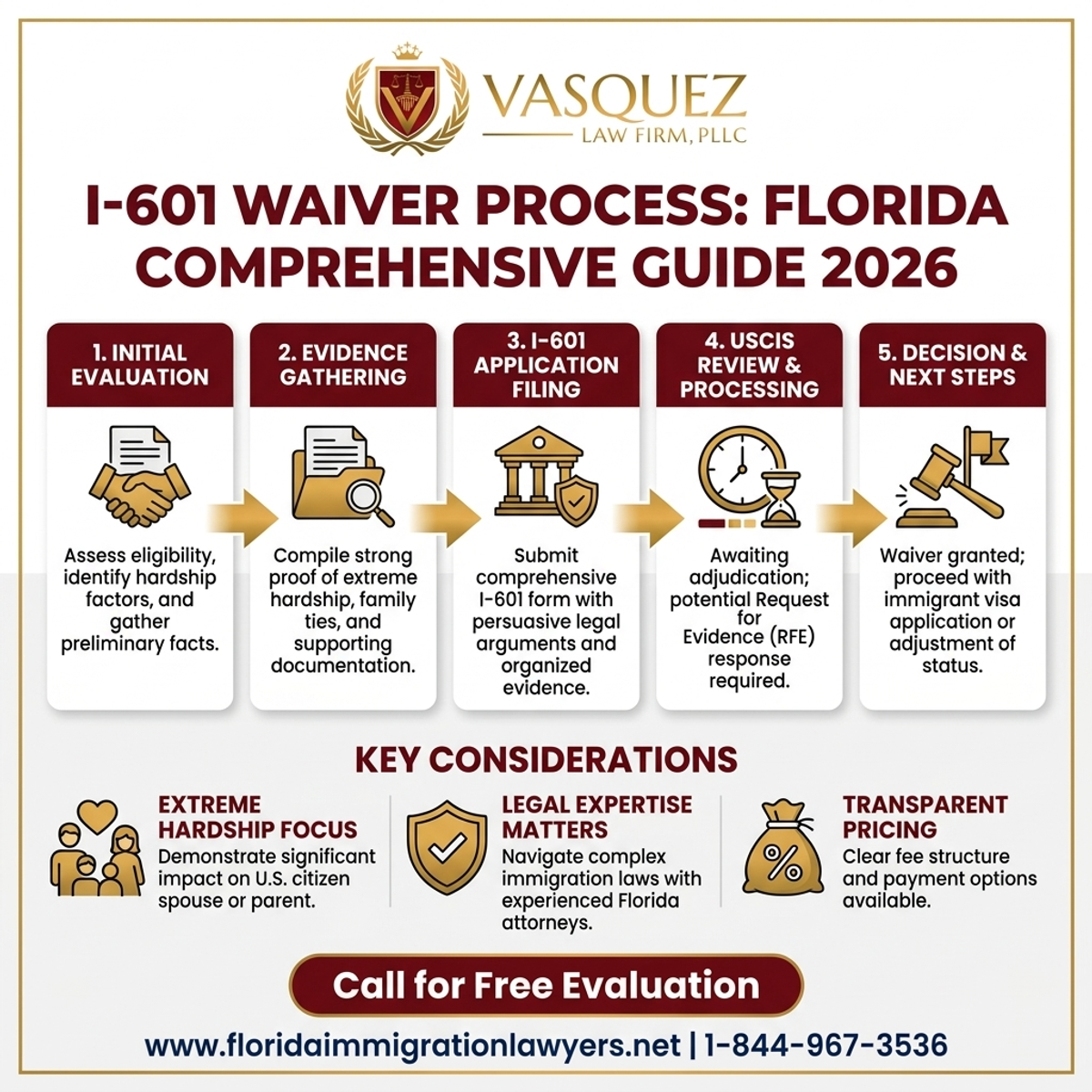
Step-by-Step Process — I-601 Waiver Lawyer Florida: Comprehensive Guide 2026
Do not navigate this process alone. Contact Florida Immigration Lawyers today at 1-844-967-3536 for a free consultation. Our team is ready to provide the dedicated legal support you need for your I-601 waiver application.
What are the Typical Timelines and Costs for an I-601 Waiver in 2026?
Understanding the timelines and financial commitments for an I-601 waiver is crucial for planning your immigration journey. As of 2026, both processing times and costs can vary significantly based on several factors, including the specific USCIS service center or consular post, the complexity of your case, and the quality of your application. While we cannot provide exact figures due to constant changes, we can offer typical ranges and guidance for individuals in Florida.
I-601 Waiver Processing Timelines
Processing times for I-601 waivers can be unpredictable. USCIS regularly updates its processing timeframes on its website, which are often reported in months. For applicants in Florida, these times apply regardless of your specific city, as applications are processed centrally by USCIS. Consular processing waivers can sometimes have different timelines depending on the specific embassy or consulate. It is important to remember that these are estimates, and individual cases may take longer, especially if a Request for Evidence (RFE) is issued.
| Stage | Typical Timeframe (As of 2026) | Notes |
|---|---|---|
| Application Preparation | 2-6 months | Gathering extensive documentation, drafting declarations, and preparing legal brief. Highly dependent on applicant's responsiveness and complexity of hardship evidence. |
| USCIS Initial Review / Receipt Notice | 1-3 weeks | Receipt of Form I-797C, Notice of Action, confirming USCIS received your application. |
| USCIS Processing Time | 6-24 months (or more) | Varies significantly by service center. Check the USCIS processing times page for current estimates. Some complex cases can take longer. |
| Request for Evidence (RFE) Response | 60-90 days (applicant's response window) | If an RFE is issued, USCIS provides a deadline to submit additional information. The sooner you respond, the sooner processing resumes. |
| Decision Issuance | 1-3 months after RFE response or initial processing | Final approval or denial notice. |
I-601 Waiver Cost Factors
The total cost of an I-601 waiver application involves several components. The primary costs are the USCIS filing fee and legal fees for professional assistance. Beyond these, there may be additional expenses for supporting documents, which can add up. It is always wise to budget realistically for the entire process.
| Item | Typical Fee (As of 2026, subject to change) | Notes |
|---|---|---|
| USCIS Form I-601 Filing Fee | Refer to USCIS website | This fee is non-refundable and must accompany your application. Check the USCIS website for the most current fee schedule. |
| Legal Fees | Varies widely based on complexity and attorney experience | This covers attorney consultation, case analysis, document preparation, legal brief writing, and communication with USCIS. An experienced I-601 waiver lawyer in Florida will provide a fee structure. |
| Psychological Evaluations | $500 - $2,000+ | Often crucial for extreme hardship claims. Costs vary by provider and depth of evaluation. |
| Medical Examinations/Records | Varies | Costs for obtaining medical records, doctor's letters, or specific health evaluations. |
| Document Translation | Varies by volume | If any supporting documents are not in English, certified translations are required. |
| Postage/Courier Fees | Minor | Costs for sending certified mail or courier services for your application. |
Florida Immigration Lawyers offers transparent fee structures and can discuss the potential costs involved during your free consultation. We understand that financial planning is a significant part of this journey, and we strive to provide clear information to our clients across Florida, from Coral Springs to Fort Lauderdale, about what to expect.
Common Mistakes to Avoid in Your I-601 Waiver Application
The I-601 waiver process is unforgiving, and even minor errors can lead to significant delays or outright denial. Being aware of common pitfalls can greatly improve your chances of success. Here are some critical mistakes to avoid when preparing your application:
- Failing to Identify All Grounds of Inadmissibility: Many applicants focus on one known issue and overlook others. If USCIS discovers an unaddressed ground of inadmissibility, your waiver will be denied, and your immigration process halted. A thorough review of your entire history by a legal professional is vital.
- Not Proving "Extreme Hardship" Adequately: This is the most frequent reason for denial. Simply stating that your U.S. relative will miss you is not enough. You must provide detailed, compelling evidence that demonstrates hardship beyond typical separation. Generic letters or insufficient medical/financial proof will weaken your case.
- Missing a Qualifying Relative: The I-601 waiver typically requires a U.S. citizen or Lawful Permanent Resident spouse or parent to be the qualifying relative. If you only have U.S. citizen children, they generally cannot be the sole qualifying relative for this waiver, unless specific circumstances apply (e.g., I-601A provisional waiver for unlawful presence, which has different rules).
- Submitting Insufficient or Unorganized Documentation: USCIS adjudicators review hundreds of applications. A disorganized submission, missing documents, or uncertified translations can lead to an RFE or denial. Your package must be clear, well-indexed, and complete.
- Failing to Provide a Legal Brief: While not strictly required, a well-crafted legal brief from an attorney synthesizes your evidence, applies it to legal standards, and makes a persuasive argument. Without it, the adjudicator is left to piece together your complex case.
- Inaccurate Information on Forms: Any inconsistencies, errors, or omissions on Form I-601 or other submitted documents can raise red flags, leading to RFEs, delays, or even accusations of misrepresentation, which can create new grounds of inadmissibility.
- Ignoring Past Criminal or Immigration History: Attempting to hide or downplay past issues is a grave mistake. USCIS has access to various databases. Full disclosure, along with evidence of rehabilitation and remorse, is always the best approach, especially for applicants in Florida with varied backgrounds.
- Not Consulting an Experienced Immigration Lawyer: The I-601 waiver is one of the most complex immigration applications. Attempting it without legal counsel often results in errors, missed opportunities to present strong evidence, and ultimately, denial. An experienced I-601 waiver lawyer in Florida can prevent these costly mistakes.
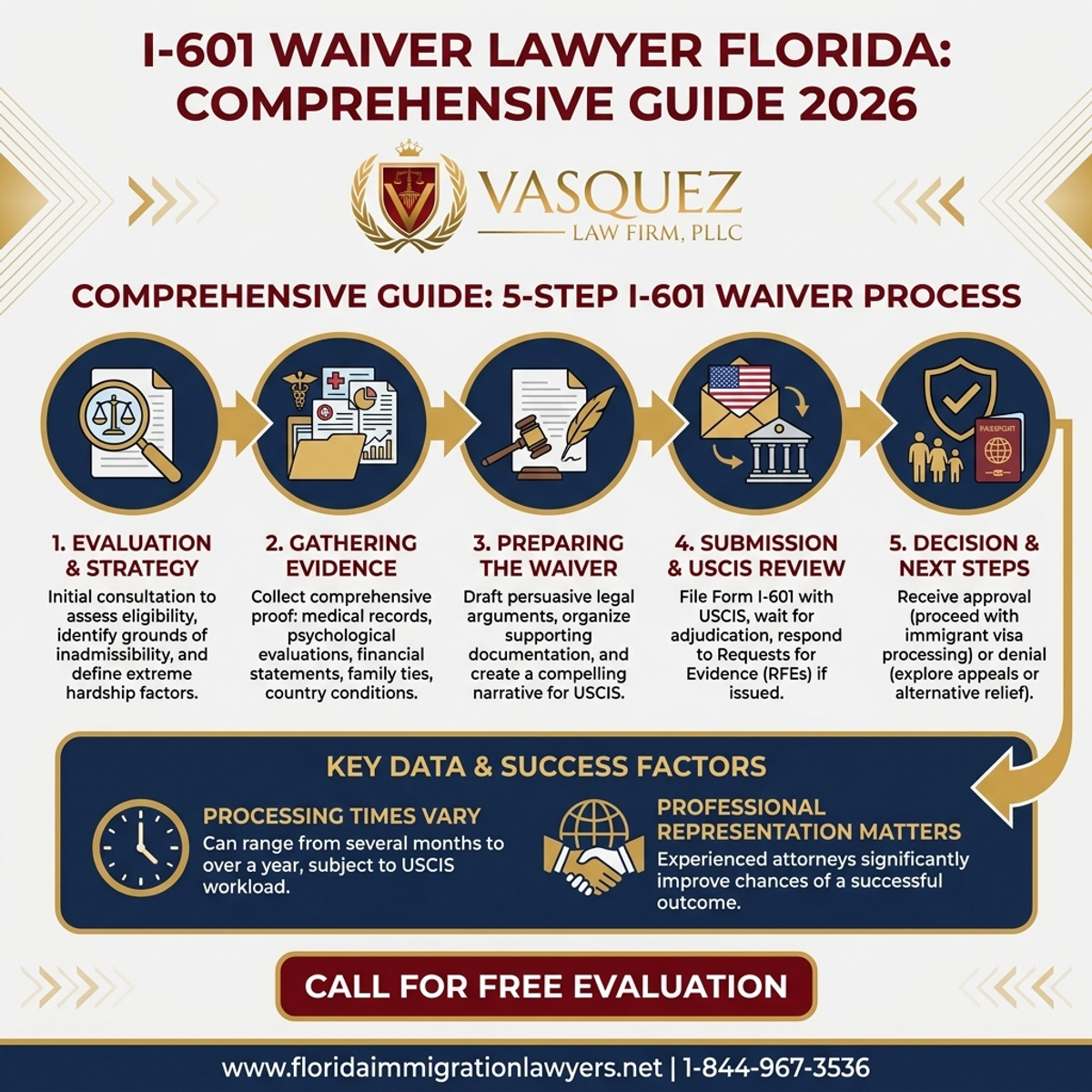
Key Statistics — I-601 Waiver Lawyer Florida: Comprehensive Guide 2026
When to Call an I-601 Waiver Lawyer in Florida
The decision to seek legal counsel for an I-601 waiver is a critical one, and for many, it should be one of the first steps. Given the complexity and high stakes involved, navigating this process without expert guidance can lead to costly errors and devastating outcomes. You should call an I-601 waiver lawyer in Florida immediately if you find yourself in any of the following scenarios:
- You Have Been Found Inadmissible: If you received a notice from USCIS or a U.S. Consulate stating you are inadmissible, or if you were advised during an interview that you need a waiver, it's time to call a lawyer.
- You Have a Complex Immigration History: This includes prior deportations, multiple entries without inspection, past criminal convictions (even minor ones), or any history of misrepresentation to immigration authorities. These cases require nuanced legal analysis.
- You Are Unsure if You Qualify for "Extreme Hardship": Defining and proving extreme hardship is subjective and requires strong evidence. An attorney can assess your situation and advise on the strength of your hardship claim.
- You Need to Understand Which Waiver to File: There are various waivers (I-601, I-601A, I-212, etc.). An attorney can help determine the correct form and strategy for your specific grounds of inadmissibility.
- You Received a Request for Evidence (RFE): An RFE indicates that USCIS needs more information or finds your current evidence insufficient. Responding effectively to an RFE is crucial, and legal assistance can significantly improve your chances.
- You Are Considering Self-Representation: While technically possible, preparing an I-601 waiver is highly challenging for non-lawyers. The legal arguments, evidence collection, and procedural requirements are extensive.
- You Reside in Florida and Need Local Expertise: An I-601 waiver lawyer in Florida understands the specific challenges and resources available in the state, including local USCIS field offices and community support networks. For example, our firm is well-versed in the nuances of cases involving families in Coral Springs, Miami, Orlando, and other Florida communities.
Florida Immigration Lawyers has extensive experience with I-601 waivers and related immigration challenges. We offer personalized legal strategies tailored to your unique situation, helping you navigate the complexities of U.S. immigration law with confidence. Our team is dedicated to protecting your rights and helping you achieve your immigration goals.
About Florida Immigration Lawyers
Florida Immigration Lawyers is a leading immigration law firm dedicated to serving individuals and families across the entire state of Florida. With a deep understanding of the ever-evolving immigration landscape, our experienced attorneys provide comprehensive legal services tailored to meet the unique needs of our diverse clientele. We are committed to delivering compassionate, effective, and results-driven representation in all areas of immigration law, from family-based petitions and employment visas to complex deportation defense cases and waivers of inadmissibility like the I-601.
Our firm prides itself on its client-centered approach, ensuring that every individual receives personalized attention and strategic advice. We understand the anxieties and uncertainties that often accompany immigration processes, and we strive to be a steadfast advocate for our clients. Whether you are seeking to unite with family, pursue professional opportunities, or defend your right to remain in the U.S., Florida Immigration Lawyers is here to help. We offer free consultations to assess your case and explain your options, making quality legal assistance accessible to everyone in Florida, including Coral Springs, Orlando, and Tampa.
Choose Florida Immigration Lawyers for unparalleled expertise and a commitment to your success. We are available 24/7 and offer services in both English and Spanish to better serve our community. Contact us today at 1-844-967-3536 or visit our website at floridaimmigrationlawyers.net to learn more about how we can assist you with your immigration needs, including general immigration matters, family immigration petitions, and deportation defense.
Sources and References
- U.S. Citizenship and Immigration Services (USCIS)
- U.S. Department of State (Travel.State.Gov)
- Executive Office for Immigration Review (EOIR)
- 8 U.S.C. Chapter 12 - Immigration and Nationality Act (INA)
- INA § 212(a) - General Classes of Aliens Ineligible for Visas and Admission; Grounds of Inadmissibility
- INA § 212(a)(9)(B) - Unlawful Presence Bars
- INA § 212(h) - Waiver of Certain Criminal Grounds of Inadmissibility
- INA § 212(i) - Waiver of Fraud or Misrepresentation
- 8 CFR Part 212 - Documentary Requirements: Nonimmigrants; Waivers; Admission of Certain Inadmissible Aliens; Parole
- Board of Immigration Appeals (BIA) Precedent Decisions (e.g., Matter of Cervantes-Gonzalez, 22 I&N Dec. 560 (BIA 1999))
Related services: immigration practice areas, citizenship and naturalization, asylum protection, business immigration.
This article provides general legal information and is not intended as legal advice. Every case is unique, and outcomes depend on specific facts and circumstances. Contact an attorney for advice about your particular situation.
Your immigration journey is too important to leave to chance. Let the experienced team at Florida Immigration Lawyers provide the guidance and representation you need for your I-601 waiver or any other immigration matter. We are here to help you navigate the complexities and work towards a positive outcome. Call us today at 1-844-967-3536 for a free, confidential consultation. Se Habla Espanol - Estamos aqui para ayudarle.
Do Not Navigate This Process Alone
Our experienced immigration attorneys are ready to fight for you. Get a free, confidential consultation today.
Se Habla Español
Or leave your details and we’ll call you:
Free Evaluation in 24 Hours
Or talk to us right now

AI voice assistant — available 24/7
FreeFrequently Asked Questions

William J. Vásquez
Founding Attorney · Vasquez Law Firm
U.S. Air Force veteran and immigration attorney with years of hands-on U.S. immigration experience. J.D., NCCU School of Law. AILA member. Admitted to the 4th, 5th, and 11th Circuit Courts.
Available 24/7 - Free Evaluations
Reviewed for legal accuracy by William J. Vásquez
Licensed in North Carolina; U.S. immigration is federal practice.
Related Legal Services
Our Florida immigration attorneys can help you with experienced immigration attorneys, business immigration and asylum protection. Call today at 1-844-967-3536 for a free consultation.
Related Links
Related Topics
Free Legal Consultation
Discuss your case with our experienced attorneys. We're available 24/7.
Se Habla Español - Estamos aquí para ayudarle.
Related Articles
Immigration Lawyer Orlando Free Consultation in 2026
Navigating the complexities of U.S. immigration law requires expert guidance. For those in Orlando and across Florida, a free consultation with an immigration lawyer can provide crucial insights into your legal options without financial commitment. This comprehensive guide from Florida Immigration Lawyers details why an initial consultation is essential, what services immigration attorneys offer, the step-by-step process, typical timelines, and associated costs. We also highlight common mistakes to avoid and when it's critical to seek professional legal assistance. Our firm serves all of Florida, including Naples and Collier County, ensuring accessible, high-quality representation for families, businesses, asylum seekers, and individuals facing deportation. Understand your rights and build a strong case with trusted legal partners.
Stem OPT Immigration Lawyer: 2026 Florida Guide
For F-1 students in Florida, the STEM OPT extension offers a vital 24-month work authorization after their initial OPT. This guide, updated for 2026, covers eligibility, the step-by-step application process, required documents, and critical timelines. Graduates from Florida universities in STEM fields must navigate strict USCIS regulations, including the E-Verify employer requirement. Learn how to avoid common mistakes and when to seek professional legal assistance from a dedicated stem OPT immigration lawyer to ensure a successful application and continued career growth in the U.S. Florida Immigration Lawyers offers expert guidance for students across the state.
Dual Citizenship Lawyer: Navigating Delays in Florida
Facing citizenship delays in Florida can be challenging, but understanding the process and knowing your options is key. Learn how a dual citizenship lawyer can assist you in navigating N-400 processing and USCIS backlogs in Hialeah.
"ina § 208(a)(2)" One-Year Filing Deadline: Florida Asylum
Discover the importance of the "ina § 208(a)(2)" one-year filing deadline for asylum seekers in Florida. Learn about the steps, documents needed, and common mistakes to avoid in your asylum application process.