H-2A Visa Opportunities for Florida Agricultural Workers
Explore opportunities for Florida agricultural workers under the H-2A visa program. Learn about application steps, costs, and common mistakes.

H-2A Visa Opportunities for Florida Agricultural Workers
Florida's vibrant agricultural industry relies heavily on a dedicated workforce to cultivate and harvest its diverse range of crops. From citrus groves to vegetable farms, the demand for seasonal labor is constant and critical. The H-2A visa program serves as a vital lifeline for many Florida growers, enabling them to address temporary labor shortages by legally bringing in foreign agricultural workers. This program not only supports the economic backbone of the state but also offers essential opportunities for workers seeking employment.
Navigating the complexities of the H-2A visa process can be challenging for both employers and prospective workers. Understanding the regulations, requirements, and responsibilities is paramount to ensuring a successful and compliant experience. Our firm specializes in immigration law, providing expert guidance to help Florida's agricultural sector thrive while upholding the rights and welfare of all involved.
Understanding the H-2A Visa Program
The H-2A temporary agricultural program allows agricultural employers who anticipate a shortage of domestic workers to bring nonimmigrant foreign workers to the U.S. to perform agricultural labor or services of a temporary or seasonal nature. This program is critical for industries like Florida's agriculture, where labor needs fluctuate significantly with planting and harvesting seasons.
Eligibility for Employers
To qualify for the H-2A program, an employer must demonstrate two key points: first, that there are not enough U.S. workers who are able, willing, qualified, and available to perform the temporary agricultural labor; and second, that employing H-2A workers will not adversely affect the wages and working conditions of similarly employed U.S. workers. Employers must also prove that the need for the workers is temporary or seasonal, typically lasting no longer than one year.
Eligibility for Workers
For workers, the primary requirement is to be a foreign national from a country designated by the Department of Homeland Security (DHS) as eligible for the H-2A program. They must have a job offer from a U.S. employer that meets all H-2A requirements. Crucially, H-2A visas are for temporary work, and workers are expected to return to their home countries upon the completion of their authorized period of stay.
Benefits for Florida's Agriculture
For Florida growers, the H-2A program offers a reliable and legal solution to labor shortages, ensuring that crops are planted, tended, and harvested efficiently. This stability helps maintain the productivity and profitability of farms, contributing significantly to the state's economy. For workers, it provides legal employment with guaranteed wages and protections, offering a valuable opportunity to earn income and support their families.
The Application Process for Florida Growers
The H-2A application process is multi-faceted and involves several government agencies, primarily the Department of Labor (DOL) and U.S. Citizenship and Immigration Services (USCIS). Understanding each step is crucial for a successful petition.
Step 1: Temporary Labor Certification from DOL
The process begins with the employer filing Form ETA-9142A, Application for Temporary Employment Certification, with the DOL. This application requires the employer to detail the job opportunity, including wages, working conditions, and housing arrangements. The DOL reviews the application to ensure compliance with wage and hour laws, housing standards, and recruitment efforts designed to test the U.S. labor market. Employers must conduct extensive recruitment efforts to demonstrate that no qualified U.S. workers are available for the positions.
Step 2: Petition to USCIS
Once the DOL issues a Temporary Labor Certification, the employer must file Form I-129, Petition for a Nonimmigrant Worker, with USCIS. This petition requests approval for the H-2A workers to come to the U.S. USCIS reviews the petition to ensure the employer meets all eligibility criteria and that the DOL certification is valid. This step can often involve Requests for Evidence (RFEs) if USCIS requires additional information.
Step 3: Visa Interview and Entry
After USCIS approves the I-129 petition, prospective H-2A workers apply for their visas at a U.S. embassy or consulate in their home country. This typically involves an interview to verify their eligibility and intent to return home after their temporary work. Upon visa approval, workers can then travel to the U.S. and present their visa and other required documents at a port of entry. It is vital for both employers and workers to understand the specific requirements at each stage to avoid delays or denials.
Protecting H-2A Workers' Rights
Ensuring the fair treatment and protection of H-2A workers is a cornerstone of the program. The U.S. government has established specific regulations to safeguard these workers, covering wages, housing, transportation, and working conditions. Employers participating in the H-2A program are legally obligated to adhere to these standards, and non-compliance can lead to severe penalties, including debarment from the program.
One of the most critical protections is the requirement for employers to pay H-2A workers at least the Adverse Effect Wage Rate (AEWR), the prevailing wage, or the federal or state minimum wage, whichever is highest. This ensures that H-2A workers do not depress the wages of U.S. workers and receive fair compensation for their labor. Additionally, employers must provide free, safe, and sanitary housing for workers who cannot reasonably return to their permanent residence each day. This housing must meet specific health and safety standards. Transportation from the housing to the worksite must also be provided at no cost to the worker.
Beyond wages and housing, H-2A workers are protected by various labor laws, including those related to working hours, rest periods, and occupational safety and health. Employers must provide workers' compensation insurance coverage and disclose all terms and conditions of employment in a language understood by the worker. Any deductions from wages must be lawful and clearly explained. Workers also have the right to organize, join a union, or engage in concerted activities for the purpose of collective bargaining or other mutual aid or protection.
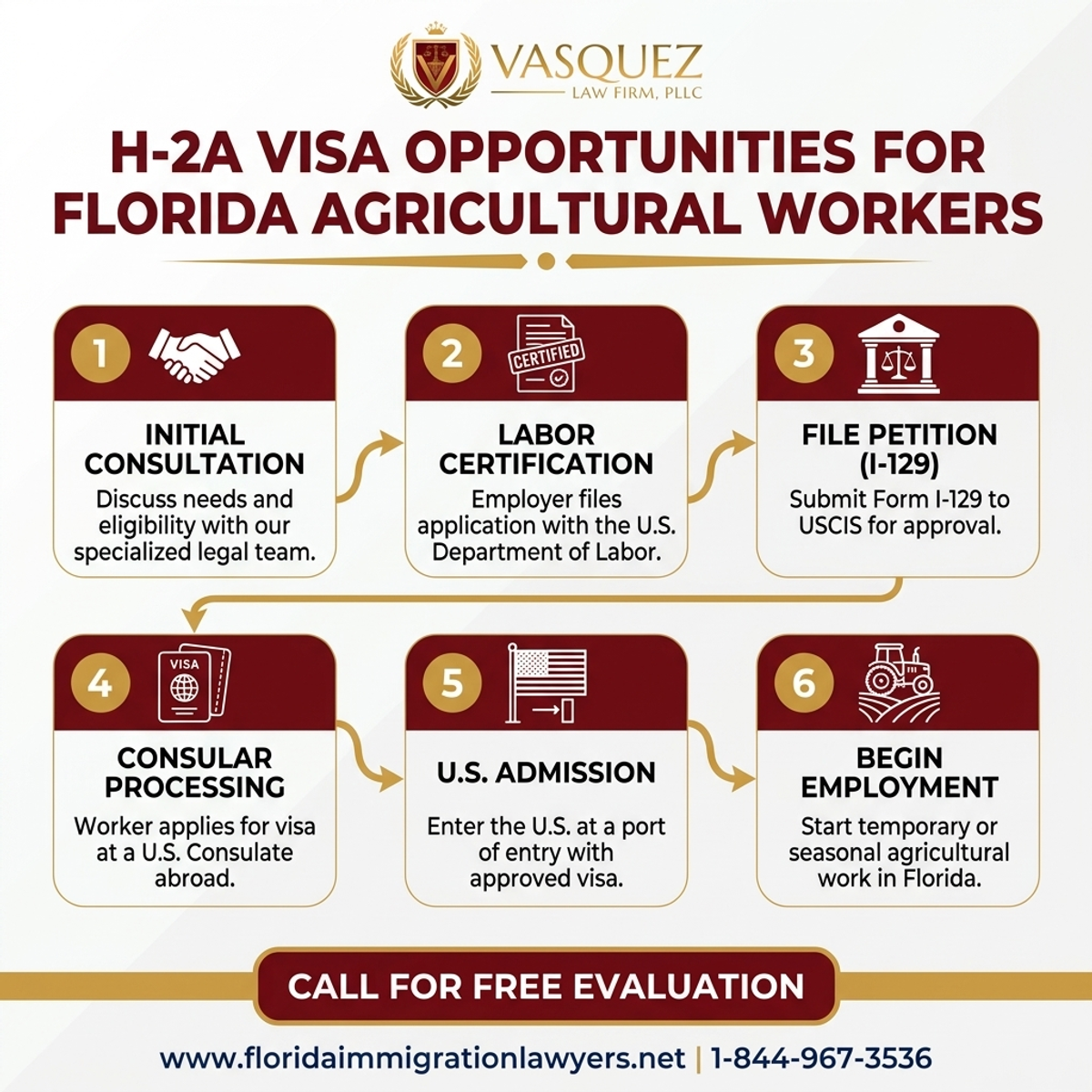
Step-by-Step Process — H-2A Visa Opportunities for Florida Agricultural Workers
Despite these protections, H-2A workers can sometimes face exploitation or misunderstanding of their rights. It is crucial for workers to know their entitlements and for employers to strictly adhere to all regulations. Legal assistance plays a vital role in both educating workers about their rights and helping employers maintain compliance. If a worker believes their rights have been violated, or if an employer needs guidance on complex compliance issues, seeking experienced legal counsel is highly recommended. Our firm is dedicated to upholding the integrity of the H-2A program and ensuring justice for all parties involved, including providing support for broader immigration challenges that may arise.
Challenges and Solutions in Florida's Agricultural Sector
Florida's agricultural sector faces unique challenges, from unpredictable weather patterns and pest outbreaks to fluctuating market demands. However, one of the most persistent issues remains the availability of a consistent and reliable labor force. Many domestic workers are increasingly less willing to perform the physically demanding tasks associated with agricultural labor, leading to significant shortages during peak seasons.
The H-2A program offers a structured solution to these labor gaps, allowing growers to plan their workforce needs with greater certainty. By providing a legal pathway for temporary foreign workers, the program helps prevent crop loss due to insufficient labor, thereby safeguarding the economic viability of farms. However, the program itself is not without its challenges. The application process can be lengthy and complex, requiring meticulous record-keeping and strict adherence to deadlines. Changes in regulations or economic conditions can also impact the program's effectiveness.
Working with experienced legal professionals can mitigate many of these challenges. Our firm assists growers in navigating the intricate application process, ensuring all documentation is accurate and submitted on time. We also provide ongoing advice on compliance, helping employers avoid potential pitfalls and maintain a positive standing with regulatory bodies. This proactive approach ensures that Florida's agricultural businesses can continue to thrive, leveraging the H-2A program effectively to meet their labor demands.
Beyond H-2A: Other Immigration Pathways and Considerations
While the H-2A visa is specifically designed for temporary agricultural work, it's important to recognize that individuals involved in this sector, whether employers or workers, may encounter broader immigration needs or challenges. For workers, while the H-2A visa is temporary, unforeseen circumstances can sometimes lead to a need for different legal considerations. For example, if a worker faces severe exploitation or a credible threat upon return to their home country, they might explore options like asylum. Similarly, any legal infractions or overstaying a visa could lead to deportation defense needs.
For agricultural businesses, understanding the full spectrum of immigration law can be beneficial. While H-2A addresses temporary labor, some farms might consider other visa categories for more permanent or specialized roles, or they might need assistance with compliance issues that could have broader immigration implications for their business. A comprehensive understanding of immigration law is crucial for long-term planning and risk management.
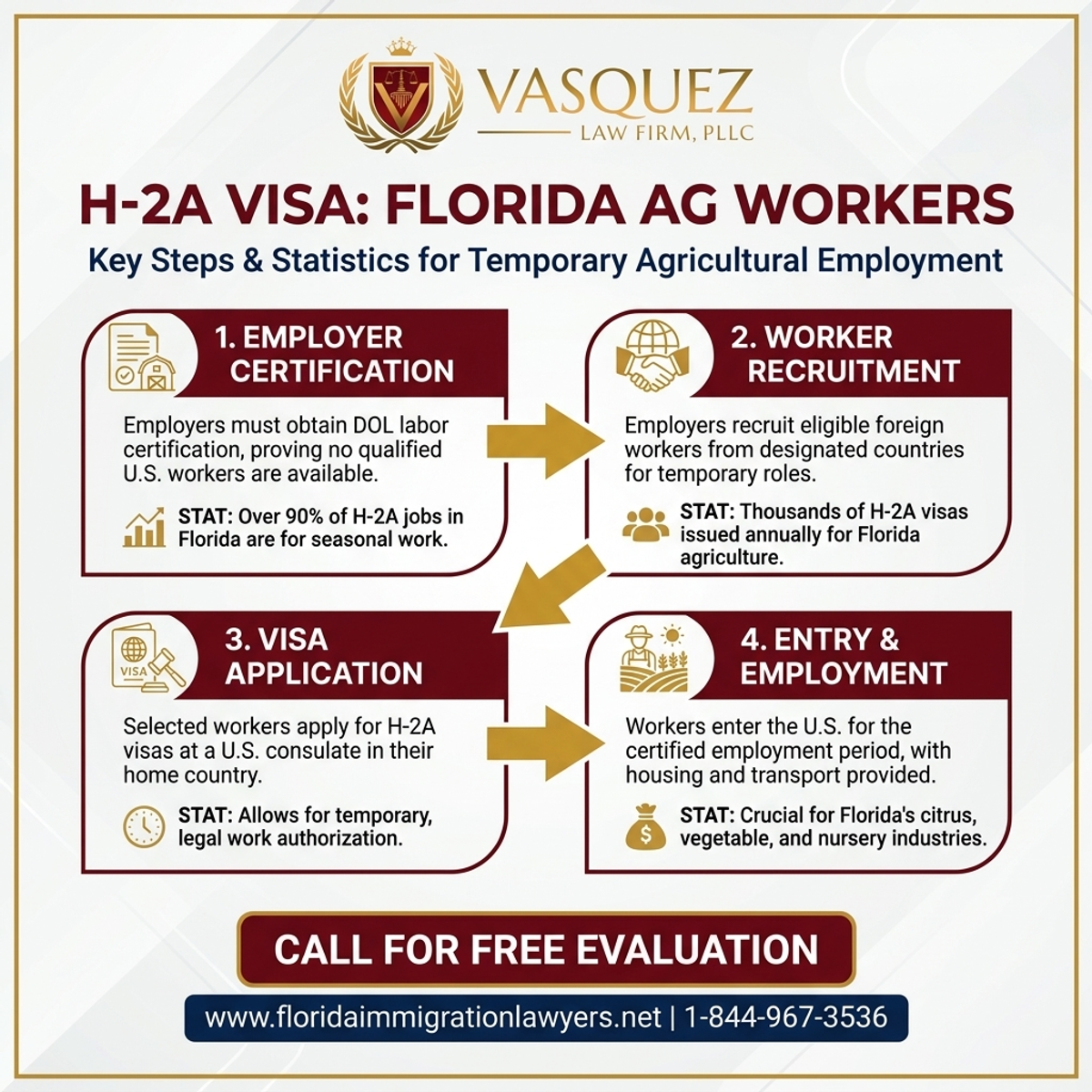
Key Statistics — H-2A Visa Opportunities for Florida Agricultural Workers
Our firm provides a wide range of immigration services, extending beyond just H-2A. We offer counsel on various visa types, green card processes, and citizenship applications. Our goal is to provide holistic support, ensuring that all aspects of your immigration needs, whether for your business or for individual workers, are addressed with expertise and care. We believe in empowering our clients with the knowledge and legal representation necessary to navigate the complex U.S. immigration system successfully.
Why Choose Our Firm for Your H-2A Needs?
When dealing with the intricacies of H-2A visas and broader immigration law, having a knowledgeable and dedicated legal partner is indispensable. Our firm brings a wealth of experience and a deep understanding of both agricultural labor needs and the U.S. immigration system, making us the ideal choice for Florida growers and agricultural workers alike.
Expertise in Immigration Law
Our team of highly skilled attorneys specializes in immigration law, with a particular focus on the H-2A program. We stay abreast of the latest regulatory changes and policy updates, ensuring that our advice is always current and accurate. Whether you are a grower seeking to secure your workforce or a worker needing to understand your rights, our expertise provides a clear path forward.
Client-Focused Approach
We understand that each client's situation is unique. We take the time to listen, understand your specific needs, and tailor our strategies accordingly. Our commitment is to provide personalized attention, transparent communication, and proactive solutions that anticipate challenges before they arise. Your success and peace of mind are our top priorities.
Proven Track Record
Our firm has a strong history of successfully guiding clients through the H-2A application process and resolving complex immigration matters. We pride ourselves on achieving favorable outcomes for our clients, helping Florida's agricultural businesses maintain their operations and ensuring fair treatment for workers.
Comprehensive Support
From initial consultation and application preparation to addressing compliance issues and representing clients in appeals or audits, we offer end-to-end support. We are here to answer your questions, alleviate your concerns, and provide robust legal representation every step of the way. We also offer guidance on related areas such as asylum and deportation defense, ensuring comprehensive legal coverage.
Conclusion
The H-2A visa program is an indispensable tool for Florida's agricultural industry, bridging the gap between labor demand and supply. While it offers significant opportunities, its complexity necessitates expert legal guidance. Our firm is committed to empowering growers with the workforce they need and protecting the rights of agricultural workers, fostering a fair and productive environment for all.
Don't let the complexities of immigration law hinder your agricultural operations or compromise your rights. Contact us today for a free consultation to discuss your H-2A visa needs or any other immigration concerns. Let our experienced attorneys provide the clarity and support you deserve.
Sources and References
- U.S. Citizenship and Immigration Services (USCIS)
- Executive Office for Immigration Review (EOIR)
- U.S. Department of State - Bureau of Consular Affairs
- Immigration and Nationality Act (INA), 8 U.S.C. Chapter 12
Do Not Navigate This Process Alone
Our experienced immigration attorneys are ready to fight for you. Get a free, confidential consultation today.
Se Habla Español
Or leave your details and we’ll call you:
Free Evaluation in 24 Hours
Or talk to us right now

AI voice assistant — available 24/7
FreeFrequently Asked Questions

William J. Vásquez
Founding Attorney · Vasquez Law Firm
U.S. Air Force veteran and immigration attorney with years of hands-on U.S. immigration experience. J.D., NCCU School of Law. AILA member. Admitted to the 4th, 5th, and 11th Circuit Courts.
Available 24/7 - Free Evaluations
Reviewed for legal accuracy by William J. Vásquez
Licensed in North Carolina; U.S. immigration is federal practice.
Related Legal Services
Our Florida immigration attorneys can help you with deportation defense, citizenship and naturalization and family immigration services. Call today at 1-844-967-3536 for a free consultation.
Related Links
Related Topics
Free Legal Consultation
Discuss your case with our experienced attorneys. We're available 24/7.
Se Habla Español - Estamos aquí para ayudarle.
Related Articles
Stem OPT Immigration Lawyer: 2026 Florida Guide
For F-1 students in Florida, the STEM OPT extension offers a vital 24-month work authorization after their initial OPT. This guide, updated for 2026, covers eligibility, the step-by-step application process, required documents, and critical timelines. Graduates from Florida universities in STEM fields must navigate strict USCIS regulations, including the E-Verify employer requirement. Learn how to avoid common mistakes and when to seek professional legal assistance from a dedicated stem OPT immigration lawyer to ensure a successful application and continued career growth in the U.S. Florida Immigration Lawyers offers expert guidance for students across the state.
Dual Citizenship Lawyer: Navigating Delays in Florida
Facing citizenship delays in Florida can be challenging, but understanding the process and knowing your options is key. Learn how a dual citizenship lawyer can assist you in navigating N-400 processing and USCIS backlogs in Hialeah.
"ina § 208(a)(2)" One-Year Filing Deadline: Florida Asylum
Discover the importance of the "ina § 208(a)(2)" one-year filing deadline for asylum seekers in Florida. Learn about the steps, documents needed, and common mistakes to avoid in your asylum application process.
DV-2027 Registration Period: Your Green Card Lottery Guide
The DV-2027 Diversity Visa (DV) lottery offers a unique pathway to permanent residency for individuals from countries with historically low immigration rates to the U.S. Expected to open in Fall 2025, the registration period requires strict adherence to eligibility criteria, including country of birth and specific education or work experience. This guide from Florida Immigration Lawyers covers the step-by-step application process, essential documents, critical timelines, and associated costs. We highlight common mistakes to avoid and explain when legal counsel is indispensable, especially for residents in Florida. Understanding the nuances of the green card lottery is vital for a successful application. Contact us for expert guidance on your DV-2027 journey.