L-1 Visa Transfer for Florida Companies
Learn about L-1 visa intracompany transfers for Florida companies. Ensure a smooth transition for your employees to Tampa. Call 1-844-967-3536 for expert advice.

L-1 Visa Transfer for Florida Companies | VLF Florida
For multinational companies looking to transfer key employees to their U.S. operations, particularly within the dynamic business landscape of Florida, the L-1 intracompany transfer visa is an invaluable tool. This non-immigrant visa category facilitates the temporary relocation of managers, executives, and employees with specialized knowledge from a foreign affiliated company to a U.S. parent, subsidiary, affiliate, or branch office. At VLF Florida, we specialize in guiding businesses through the intricate process of securing L-1 visas, ensuring a smooth transition for your most valuable talent and seamless expansion of your enterprise in the Sunshine State. Understanding the nuances of L-1 visa requirements, the application process, and potential challenges is critical for success, and our experienced immigration law team is here to provide comprehensive support.
What is an L-1 Visa?
The L-1 visa is specifically designed for international companies to transfer employees from their foreign offices to their U.S. offices. It allows foreign nationals who have worked for a qualifying organization abroad for at least one continuous year within the past three years to be transferred to the U.S. to work in an executive, managerial, or specialized knowledge capacity. This visa is particularly beneficial for companies establishing new offices in the U.S. or strengthening existing operations with experienced personnel who possess unique insights into the company's global operations and culture.
The L-1 visa category is divided into two primary classifications:
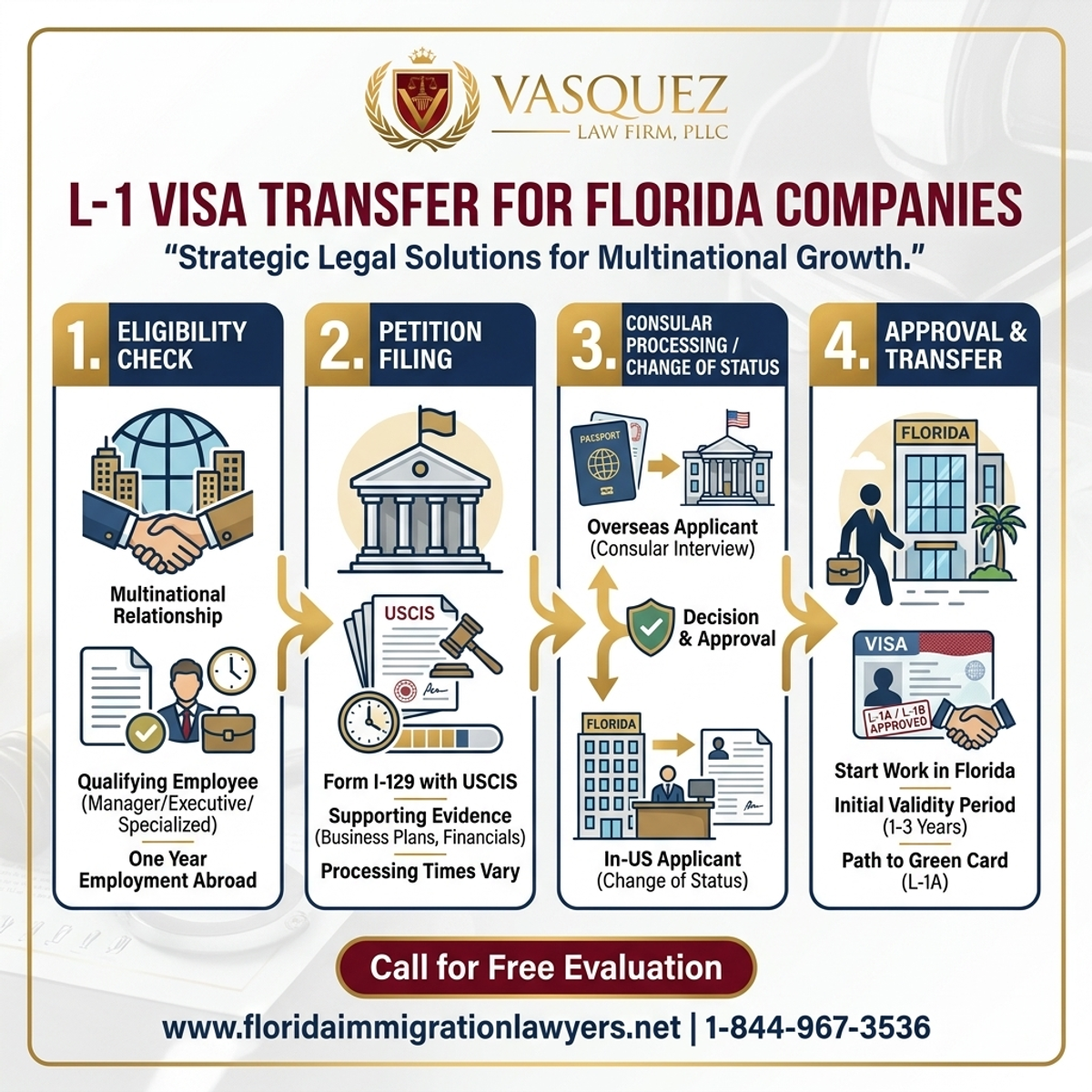
- L-1A Visa (Executives and Managers): This category is for individuals who will be employed in the U.S. in a managerial or executive capacity. An executive capacity generally refers to the ability to make decisions of wide latitude without much oversight, while a managerial capacity involves supervising other professional employees or a key function, department, or subdivision of the organization. L-1A visas are initially granted for up to three years and can be extended for a maximum total stay of seven years. A significant advantage of the L-1A visa is that it offers a direct path to permanent residency through the EB-1C multinational executive or manager green card category, which often has favorable processing times.
- L-1B Visa (Specialized Knowledge): This category is for individuals who possess specialized knowledge pertaining to the organization's product, service, research, systems, proprietary interest, or management. This knowledge must be unique and not readily available in the U.S. labor market. The L-1B visa is initially granted for up to three years and can be extended for a maximum total stay of five years. Proving 'specialized knowledge' can sometimes be more challenging than proving managerial or executive capacity, requiring detailed documentation and compelling arguments regarding the employee's unique skills and their critical importance to the U.S. operations.
Both L-1A and L-1B visas allow the employee's spouse and unmarried children under 21 to accompany them to the U.S. on L-2 visas. L-2 spouses are eligible to apply for an Employment Authorization Document (EAD), allowing them to work in the U.S., which is a significant benefit for families relocating to Florida.
Eligibility Criteria for L-1 Visas
To qualify for an L-1 visa, both the petitioning U.S. employer and the foreign national employee must meet specific criteria established by U.S. Citizenship and Immigration Services (USCIS). Understanding these requirements is fundamental to a successful petition.
Qualifying Organizations
The U.S. employer must be a parent, subsidiary, affiliate, or branch of the foreign employer. This 'qualifying relationship' must exist both at the time of filing the petition and throughout the period of the employee's L-1 status. USCIS scrutinizes the ownership and control structures to ensure a legitimate relationship. The U.S. entity must also be actively doing business, or if it's a 'new office' petition, it must demonstrate a clear plan and financial capability to commence doing business.
Employee Requirements
The foreign national must have been employed abroad by the qualifying organization for at least one continuous year within the three years preceding the filing of the L-1 petition. This employment must have been in a managerial, executive, or specialized knowledge capacity. The employee must also be coming to the U.S. to work in one of these capacities.
- Managerial Capacity: This involves managing the organization, a department, subdivision, function, or component of the organization; supervising and controlling the work of other supervisory, professional, or managerial employees, or managing an essential function within the organization, or a department or subdivision of the organization; and having the authority to hire and fire or recommend personnel actions, or, if no other employee is directly supervised, functioning at a senior level within the organizational hierarchy or with respect to the function managed.
- Executive Capacity: This involves directing the management of the organization or a major component or function; establishing goals and policies; exercising wide latitude in discretionary decision-making; and receiving only general supervision or direction from higher-level executives, the board of directors, or stockholders.
- Specialized Knowledge: This refers to knowledge possessed by an individual of the petitioning organization's product, service, research, equipment, techniques, management, or other interests and its application in international markets, or an advanced level of knowledge of processes and procedures of the organization. This is often the most challenging aspect to prove, requiring detailed evidence of the employee's unique expertise and its direct relevance to the U.S. entity's operations.
The L-1 Visa Application Process
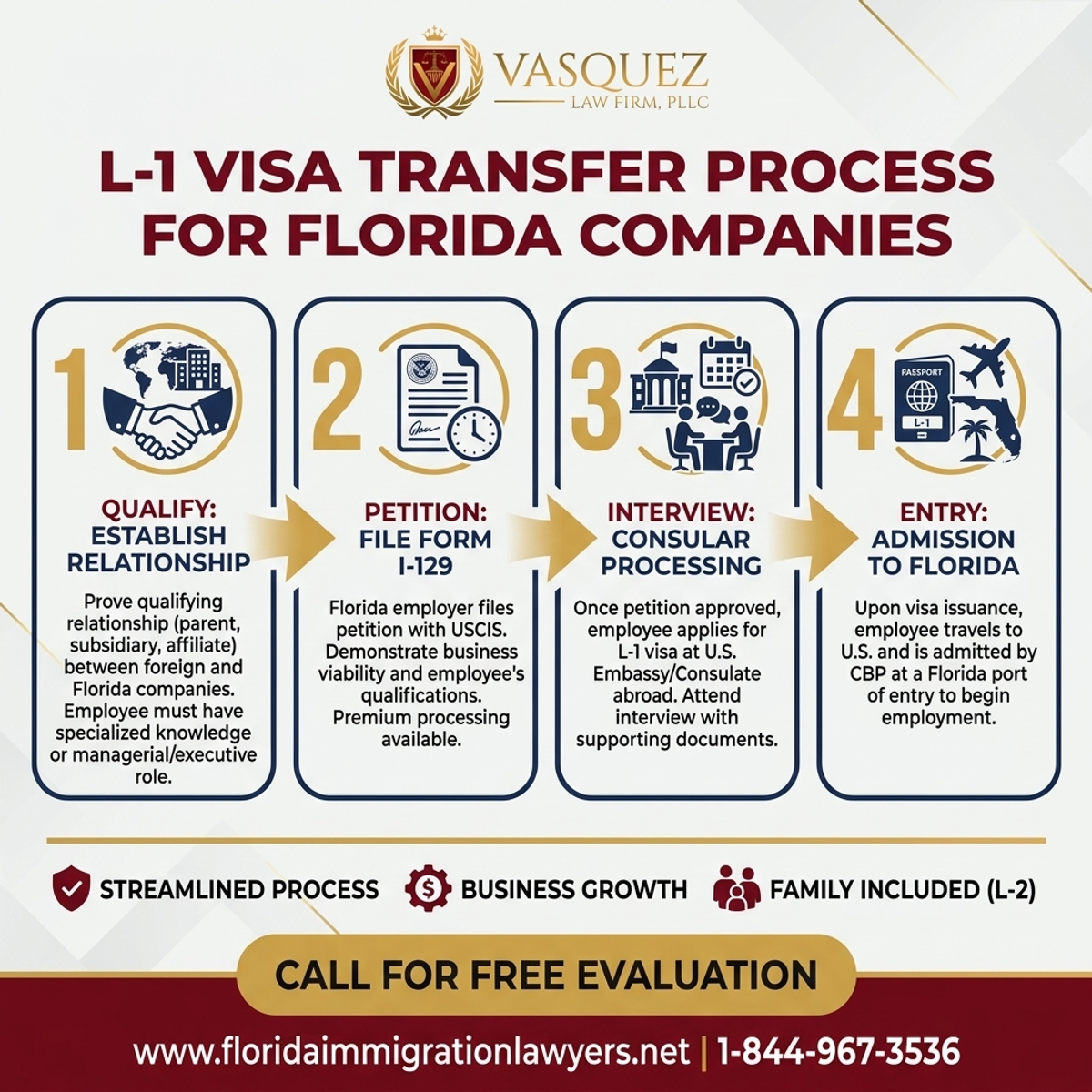
The L-1 visa application process typically involves several stages, beginning with the U.S. employer filing a petition with USCIS. Our team at VLF Florida meticulously prepares each petition to maximize the chances of approval.
- Form I-129, Petition for a Nonimmigrant Worker: The U.S. employer files Form I-129, along with the L Supplement, with USCIS. This petition must include extensive documentation proving the qualifying relationship between the U.S. and foreign entities, the employee's eligibility, and the nature of the proposed U.S. employment.
- Required Documentation: This includes corporate documents (articles of incorporation, business licenses, tax returns, financial statements), organizational charts for both U.S. and foreign entities, detailed job descriptions for both foreign and U.S. positions, evidence of the employee's qualifications (resumes, diplomas, letters of experience), and proof of the employee's one-year foreign employment. For 'new office' petitions, a detailed business plan is crucial.
- Premium Processing Option: Employers can opt for premium processing by filing Form I-907, which guarantees USCIS will take action on the petition within 15 calendar days for an additional fee. This can significantly expedite the process, which is often critical for business needs.
- Petition Approval: If the petition is approved, USCIS sends an I-797 Approval Notice.
- Consular Processing vs. Change of Status:
- Consular Processing: If the employee is outside the U.S., they will attend an interview at a U.S. embassy or consulate in their home country. Upon approval, the L-1 visa stamp is affixed in their passport.
- Change of Status: If the employee is already in the U.S. in another valid nonimmigrant status (e.g., B-1/B-2, H-1B), the I-129 petition can request a change of status to L-1. If approved, the employee does not need to leave the U.S. for an interview.
Step-by-Step Process — L-1 Visa Transfer for Florida Companies | VLF Florida
- Entry into the U.S.: Once the visa is issued (or status changed), the employee can enter the U.S. and begin their L-1 employment.
Key Considerations for L-1 Visa Holders and Sponsoring Companies in Florida
Holding an L-1 visa or sponsoring an L-1 employee in Florida comes with specific responsibilities and opportunities. Beyond the initial approval, both the employee and the company must adhere to U.S. immigration laws and regulations to maintain valid status and ensure long-term success. Our firm provides ongoing support to navigate these critical aspects.
Compliance and Maintaining Status: The L-1 visa is tied to the specific employer and the position outlined in the petition. Any significant changes in job duties, employer, or even the U.S. entity's corporate structure must be carefully evaluated and, in many cases, require an amended petition with USCIS. Failure to maintain compliance can lead to revocation of status or difficulties with future extensions or green card applications. It's crucial for companies to have robust internal processes to monitor and report such changes to their legal counsel.
Impact of Business Changes: Mergers, acquisitions, divestitures, or even significant changes in ownership can impact the 'qualifying relationship' requirement for L-1 visas. These corporate actions necessitate immediate review by an experienced immigration attorney to determine if new petitions or amendments are required to ensure the continued validity of L-1 status for transferred employees. Proactive planning is key to avoiding disruptions to key personnel.
Dependents (L-2 Visas): As mentioned, L-1 visa holders can bring their spouse and unmarried children under 21 to the U.S. on L-2 visas. L-2 spouses are eligible to apply for an Employment Authorization Document (EAD), which allows them to work for any employer in the U.S. without restriction. This is a significant advantage, offering families greater financial flexibility and integration into the U.S. workforce. Our team assists L-2 dependents with their EAD applications, ensuring all family members can thrive in their new Florida home.
Working in Florida: State-Specific Nuances: While L-1 visas are federal immigration benefits, companies operating in Florida must also comply with state-specific business regulations. This includes state tax laws, business licensing requirements, and employment laws that may differ from other states. While the L-1 visa itself is a federal matter, the operational context in Florida requires attention to local legal frameworks. Our comprehensive approach considers both federal immigration requirements and the practicalities of doing business in Florida.
Tax Implications: L-1 visa holders are generally considered U.S. residents for tax purposes if they meet the substantial presence test, meaning they will be subject to U.S. income tax on their worldwide income. Understanding these implications and potentially seeking advice from a tax professional is an important step for any L-1 visa holder and their sponsoring company.
Advantages of the L-1 Visa
The L-1 visa offers numerous benefits for both multinational companies and their employees, making it a highly attractive option for global talent mobility.
- Path to Green Card (EB-1C): For L-1A visa holders, there is a clear and often expedited path to U.S. permanent residency through the EB-1C Multinational Executive or Manager category. This category does not require a PERM labor certification, significantly streamlining the green card process and making it one of the most desirable routes for executives and managers.
- Flexibility for Multinational Companies: The L-1 visa allows companies to transfer essential personnel who possess institutional knowledge, specialized skills, or leadership capabilities, ensuring business continuity and strategic growth in their U.S. operations. It's particularly useful for establishing new U.S. offices or expanding existing ones with trusted talent.
- Spouse Employment (L-2 EAD): As noted, L-2 spouses are eligible for work authorization, providing families with greater financial stability and the opportunity for both partners to pursue career goals in the U.S. This makes the L-1 visa a more appealing option for families considering relocation.
- No Cap or Lottery: Unlike some other popular work visas (like the H-1B), the L-1 visa is not subject to an annual cap or a lottery system, meaning petitions can be filed at any time of the year.
Key Statistics — L-1 Visa Transfer for Florida Companies | VLF Florida
Challenges and Common Pitfalls
Despite its advantages, the L-1 visa process can be complex and challenging. Common pitfalls often lead to Requests for Evidence (RFEs) or even denials if not properly addressed.
- Proving "Specialized Knowledge" or "Managerial/Executive" Capacity: This is often the most scrutinized aspect of an L-1 petition. USCIS requires detailed evidence that the employee's role meets the strict definitions. Generic job titles are insufficient; specific duties, organizational charts, and descriptions of supervision or unique expertise are vital.
- Small Office/New Office Petitions: For companies establishing a new U.S. office, proving the financial viability of the U.S. entity and its capacity to support a managerial or executive position within one year can be difficult. A robust business plan and evidence of sufficient capitalization are critical.
- RFEs (Requests for Evidence): USCIS frequently issues RFEs when they require more information or clarification on specific aspects of the petition. Responding to an RFE effectively requires a deep understanding of immigration law and careful preparation of additional evidence.
- Visa Denials: Denials can occur due to insufficient evidence, failure to meet eligibility criteria, or misinterpretation of regulations. A denial can delay business plans and cause significant inconvenience.
Working with an experienced immigration attorney is crucial to anticipate and mitigate these challenges, ensuring your petition is as strong and comprehensive as possible.
L-1 Visa Extensions and Pathways to Permanent Residency
Understanding the long-term implications and opportunities associated with the L-1 visa is essential for both employees and sponsoring companies.
Maximum Stay Limits
L-1A visa holders (executives and managers) can typically stay in the U.S. for a maximum of seven years, while L-1B visa holders (specialized knowledge) are limited to five years. These limits include any time spent in H-1B status, as both are considered 'dual intent' visas. Careful tracking of an employee's time in the U.S. is necessary to plan for extensions or transitions to permanent residency.
Extension Process
Extensions for L-1 visas are generally filed using Form I-129, similar to the initial petition. The employer must demonstrate continued eligibility, including the qualifying relationship, the employee's ongoing role, and the U.S. entity's continued operation. For 'new office' petitions, the first extension (after the initial one-year approval) requires demonstrating that the U.S. office has been doing business for at least one year and is able to support the managerial or executive position.
Transitioning to an EB-1C Green Card
As highlighted, the L-1A visa provides a direct and often preferred pathway to a U.S. green card through the EB-1C Multinational Executive or Manager category. This category is highly advantageous because it does not require a labor certification (PERM), which is a time-consuming and complex process for many other employment-based green card categories. The primary requirements for an EB-1C petition are similar to those for an L-1A: the U.S. employer must have a qualifying relationship with a foreign entity, and the foreign national must have been employed abroad in a managerial or executive capacity for at least one year within the past three years prior to coming to the U.S. (or prior to filing the EB-1C petition if already in L-1A status). The employee must also be coming to the U.S. to work in a managerial or executive capacity.
Our firm has extensive experience assisting L-1A visa holders and their employers in transitioning to permanent residency via the EB-1C category, navigating the detailed documentation and strategic planning required for a successful outcome.
Other Green Card Options
While the EB-1C is the most common and direct path for L-1A holders, L-1B holders and, in some cases, L-1A holders who do not qualify for EB-1C may explore other employment-based green card options, such as EB-2 (Professionals with Advanced Degrees or Exceptional Ability) or EB-3 (Skilled Workers, Professionals, or Other Workers). These categories typically require a PERM labor certification, which involves testing the U.S. labor market. Our attorneys can assess the best green card strategy based on an individual's qualifications and the company's needs.
Why Choose VLF Florida for Your L-1 Visa Needs?
Navigating the complexities of U.S. immigration law requires specialized knowledge and meticulous attention to detail. At VLF Florida, we pride ourselves on providing exceptional legal services tailored to the unique needs of Florida businesses and their international employees.
- Expertise in Complex Cases: Our team possesses deep expertise in L-1 visa petitions, including challenging 'new office' cases and those requiring extensive evidence of specialized knowledge or managerial capacity. We stay abreast of the latest USCIS policies and trends to provide up-to-date and effective strategies.
- Personalized Legal Strategy: We understand that every company and employee situation is unique. We don't offer one-size-fits-all solutions. Instead, we develop personalized legal strategies designed to meet your specific business objectives and the employee's career goals.
- Comprehensive Support: From initial consultation and document gathering to petition filing, RFE responses, and consular processing support, we guide you through every step of the L-1 visa journey. Our support extends to L-2 dependent applications and planning for future green card pathways.
- Beyond L-1: Other Immigration Services: Our firm offers a full spectrum of immigration services. Whether you are facing challenges like deportation defense, seeking asylum, or exploring other work visa options, our dedicated attorneys are equipped to assist. We are committed to providing holistic legal solutions for all your immigration needs.
Contact Us Today
The success of your L-1 visa transfer is paramount to your business growth and the career development of your international talent. Don't navigate this complex process alone. Partner with VLF Florida, your trusted immigration law experts in Florida. Contact us today for a comprehensive consultation to discuss your L-1 visa needs and how we can help you achieve your goals. Call us at 1-844-967-3536 for a free consultation. Let us put our expertise to work for you.
Sources and References
- U.S. Citizenship and Immigration Services (USCIS)
- Executive Office for Immigration Review (EOIR)
- U.S. Department of State - Bureau of Consular Affairs
- Immigration and Nationality Act (INA), 8 U.S.C. Chapter 12
Do Not Navigate This Process Alone
Our experienced immigration attorneys are ready to fight for you. Get a free, confidential consultation today.
Se Habla Español
Or leave your details and we’ll call you:
Free Evaluation in 24 Hours
Or talk to us right now

AI voice assistant — available 24/7
FreeFrequently Asked Questions

William J. Vásquez
Founding Attorney · Vasquez Law Firm
U.S. Air Force veteran and immigration attorney with years of hands-on U.S. immigration experience. J.D., NCCU School of Law. AILA member. Admitted to the 4th, 5th, and 11th Circuit Courts.
Available 24/7 - Free Evaluations
Reviewed for legal accuracy by William J. Vásquez
Licensed in North Carolina; U.S. immigration is federal practice.
Related Legal Services
Our Florida immigration attorneys can help you with family immigration services, immigration practice areas and free immigration consultation. Call today at 1-844-967-3536 for a free consultation.
Related Links
Related Topics
Free Legal Consultation
Discuss your case with our experienced attorneys. We're available 24/7.
Se Habla Español - Estamos aquí para ayudarle.
Related Articles
Immigration Lawyer Orlando Free Consultation in 2026
Navigating the complexities of U.S. immigration law requires expert guidance. For those in Orlando and across Florida, a free consultation with an immigration lawyer can provide crucial insights into your legal options without financial commitment. This comprehensive guide from Florida Immigration Lawyers details why an initial consultation is essential, what services immigration attorneys offer, the step-by-step process, typical timelines, and associated costs. We also highlight common mistakes to avoid and when it's critical to seek professional legal assistance. Our firm serves all of Florida, including Naples and Collier County, ensuring accessible, high-quality representation for families, businesses, asylum seekers, and individuals facing deportation. Understand your rights and build a strong case with trusted legal partners.
Stem OPT Immigration Lawyer: 2026 Florida Guide
For F-1 students in Florida, the STEM OPT extension offers a vital 24-month work authorization after their initial OPT. This guide, updated for 2026, covers eligibility, the step-by-step application process, required documents, and critical timelines. Graduates from Florida universities in STEM fields must navigate strict USCIS regulations, including the E-Verify employer requirement. Learn how to avoid common mistakes and when to seek professional legal assistance from a dedicated stem OPT immigration lawyer to ensure a successful application and continued career growth in the U.S. Florida Immigration Lawyers offers expert guidance for students across the state.
Dual Citizenship Lawyer: Navigating Delays in Florida
Facing citizenship delays in Florida can be challenging, but understanding the process and knowing your options is key. Learn how a dual citizenship lawyer can assist you in navigating N-400 processing and USCIS backlogs in Hialeah.
"ina § 208(a)(2)" One-Year Filing Deadline: Florida Asylum
Discover the importance of the "ina § 208(a)(2)" one-year filing deadline for asylum seekers in Florida. Learn about the steps, documents needed, and common mistakes to avoid in your asylum application process.