Derived Citizenship Through Parents in Florida
Discover how children born abroad can obtain derived citizenship through their parents. This guide explains the eligibility criteria, application process, and common pitfalls in Florida. If you believe you or your child may be eligible, contact Florida Immigration Lawyers for a free consultation.
Derived citizenship allows children born abroad to become U.S. citizens automatically if their parents are U.S. citizens and meet specific criteria. Key takeaways include:
- Eligibility depends on parents' citizenship status.
- Residency requirements must be met.
- Legal advice can help navigate complex cases.
Obtaining Derived Citizenship Through Parents in Florida
Many individuals born abroad wonder if they are eligible for U.S. citizenship through their parents. This process, known as derived citizenship, is an important pathway for children whose parents are U.S. citizens. Understanding the requirements and process is crucial for those living in Florida, particularly in Orlando where legal resources are accessible.
This article details the eligibility criteria, application process, and common challenges associated with derived citizenship. If you or your child may qualify, call Florida Immigration Lawyers at 1-844-YO-PELEO for a free case review.
What is Derived Citizenship?
Derived citizenship refers to the automatic acquisition of U.S. citizenship by children born abroad when their parents meet certain legal conditions. As of 2026, children may derive citizenship if one or both parents are U.S. citizens, and specific residency requirements are fulfilled.
Understanding derived citizenship is essential for families who have moved or lived internationally and wish to secure U.S. citizenship for their children. The process involves proving the parents' citizenship status and satisfying residency criteria.
Unlike naturalization, which requires an application and interview for the individual seeking citizenship, derived citizenship is often automatic. This means that once all legal conditions are met, the child is considered a U.S. citizen by law, even if they don't yet possess a Certificate of Citizenship or a U.S. passport. The N-600 application (Application for Certificate of Citizenship) is primarily for obtaining official documentation of this status, not for acquiring it.
This pathway reflects the principle of family unity within U.S. immigration law, ensuring that children of U.S. citizens born abroad are not left without a clear path to their parents' nationality. It's a critical provision for military families, expatriates, and anyone who has lived outside the U.S. while maintaining their American citizenship.
How Do You Qualify for Derived Citizenship?
To qualify for derived citizenship, a child must meet several criteria. As of 2026, these include having at least one U.S. citizen parent and residing in the U.S. under the legal and physical custody of that parent.
The child must be under 18, and the parent must have lived in the U.S. for at least five years, two of which after the age of 14. These requirements can be complex, and each case is unique, making legal guidance crucial.
Specifically, the child must be a lawful permanent resident (LPR) at the time all other conditions are met, meaning they must have a green card. The U.S. citizen parent must have either been a U.S. citizen at the time of the child's birth or naturalized before the child turned 18. This distinction is vital, as a child cannot derive citizenship through a parent who naturalized after the child's 18th birthday.
Consider a scenario: Maria, a U.S. citizen, lived in Spain for 10 years and had a child, Sofia, there. When Sofia was 10, Maria moved back to Florida with Sofia, who obtained a green card. Maria had lived in the U.S. for 15 years before moving to Spain, including years after age 14. Because Sofia is under 18, has a U.S. citizen parent, is a lawful permanent resident, and resides in Maria's legal and physical custody in the U.S., she automatically derives citizenship. Understanding these precise conditions is where Florida Immigration Lawyers can provide invaluable assistance.
What Documents Are Required for Derived Citizenship?
A comprehensive document checklist is essential for filing a derived citizenship claim. Required documents typically include:
- Parents' proof of U.S. citizenship
- Child's birth certificate
- Proof of parental relationship
- Evidence of parent's U.S. residency
- Proof of legal and physical custody
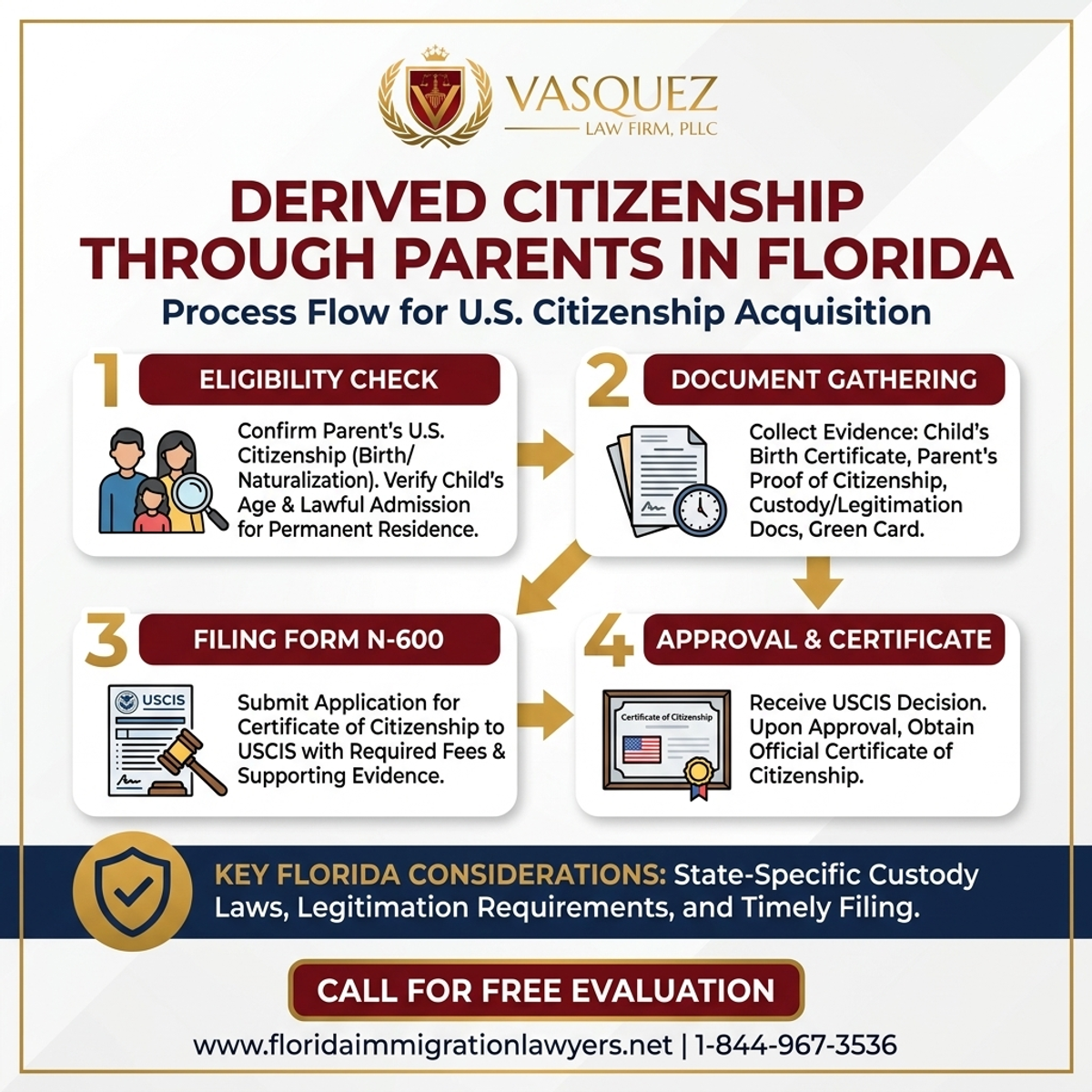
Step-by-Step Process — Derived Citizenship Through Parents in Florida
Gathering these documents can be challenging, especially if records are held abroad. Consulting with an immigration lawyer can streamline this process.
For proof of parental U.S. citizenship, acceptable documents include a U.S. birth certificate, Certificate of Naturalization, Certificate of Citizenship, or a valid U.S. passport. The child's birth certificate must clearly establish the biological or legal parent-child relationship. For adopted children, the adoption decree is crucial. Proof of the parent's U.S. residency can include school records, tax transcripts, employment records, or utility bills spanning the required period.
Demonstrating legal and physical custody often requires court orders, divorce decrees, or notarized affidavits, especially in cases of divorce or separation. All foreign language documents must be accompanied by a certified English translation. A common pitfall is submitting incomplete or uncertified documents, which can lead to Requests for Evidence (RFEs) and significant delays. Florida Immigration Lawyers can meticulously review your documentation to ensure everything is in order before submission.
Processing Times and Expectations
Processing times for derived citizenship can vary. As of 2026, applicants can expect the following timelines:
| Stage | Typical Timeframe | Notes |
|---|---|---|
| Initial Application Review | 3-6 months | Dependent on USCIS workload |
| Interview and Decision | 2-4 months after review | May require additional documentation |
| Oath Ceremony | 1-2 months after approval | Final step in the process |
Delays are possible, particularly if additional evidence is requested. Staying informed and prepared can help mitigate these delays.
Several factors can influence the overall processing time, including the specific USCIS service center handling your case, the volume of applications, and the complexity of your individual circumstances. For instance, if there are discrepancies in documents or if the parent's prior residency history is difficult to verify, USCIS may issue a Request for Evidence (RFE), which adds time to the process. Responding promptly and thoroughly to any RFE is critical to avoid further delays.
While waiting, it's advisable to regularly check the USCIS online case status tool using your receipt number. This will provide the most up-to-date information on your application's progress. If your case experiences significant delays beyond the published processing times, or if you receive an RFE that you're unsure how to address, contacting Florida Immigration Lawyers at 1-844-YO-PELEO for guidance can help expedite resolution and prevent potential issues.
Cost Factors and Fees for Citizenship Applications
Understanding the cost of applying for derived citizenship is important. While exact fees can fluctuate, typical expenses include application fees and legal consultation charges.
| Item | Typical Fee | Notes |
|---|---|---|
| Application Fee | Varies | Check USCIS for current rates |
| Legal Consultation | Varies | Depends on case complexity |
| Document Procurement | Varies | May include translation costs |
For up-to-date fee information, refer to the USCIS website.
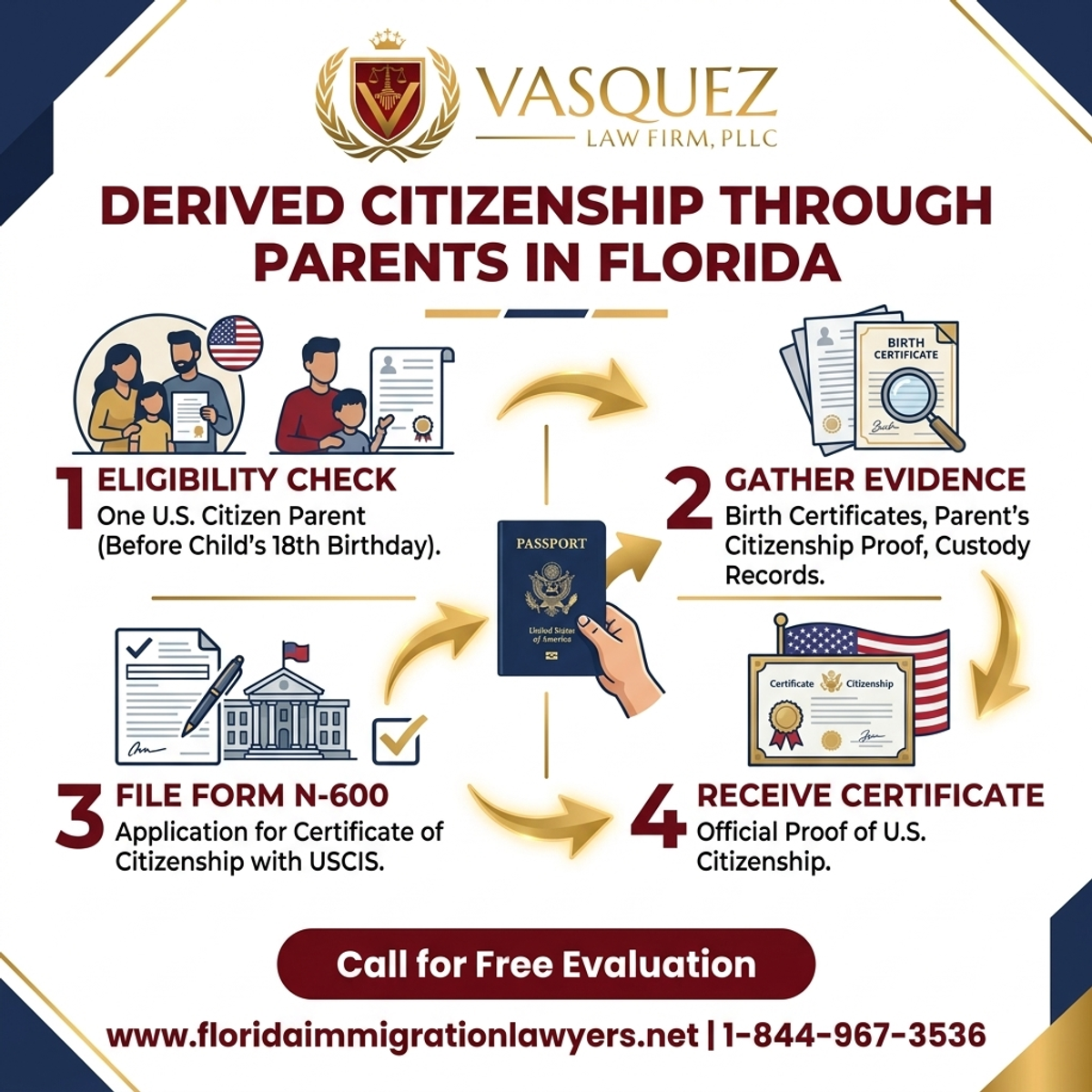
Key Statistics — Derived Citizenship Through Parents in Florida
Do not navigate this process alone. Contact Florida Immigration Lawyers today.
The primary fee for documenting derived citizenship is the USCIS filing fee for Form N-600, Application for Certificate of Citizenship. This fee can change, so always verify the current amount on the USCIS website before filing. Beyond the N-600 fee, applicants should budget for additional expenses such as obtaining certified copies of birth certificates, marriage certificates, divorce decrees, and any other supporting documents. If any of these documents are in a foreign language, certified translations will be required, incurring additional costs.
Legal consultation fees vary widely depending on the attorney's experience, location, and the complexity of your case. While some cases may be straightforward, others involving unusual custody arrangements, adopted children, or complex residency histories might require more extensive legal work. Many firms, including Florida Immigration Lawyers, offer free initial consultations to help you understand the potential costs involved and whether you qualify for a fee waiver (Form I-912) based on your income or receipt of public benefits.
Common Mistakes to Avoid
Navigating the derived citizenship process can be intricate, and even minor errors can lead to significant setbacks. Being aware of common pitfalls can help you prepare a robust application and avoid unnecessary delays or denials. Here are some of the most frequent mistakes applicants make:
- Incomplete Applications: Missing documents can delay or jeopardize your application.
- Incorrect Information: Providing inaccurate details can lead to denial.
- Ignoring Residency Requirements: Parental residency is a critical factor.
- Failure to Prove Custody: Legal and physical custody must be demonstrated.
- Missing Deadlines: Timely submissions are essential.
- Assuming Eligibility: Not all children born abroad are eligible.
- Not Seeking Legal Help: Complex cases often require professional guidance.
- Overlooking USCIS Updates: Fee and policy changes can affect your application.
- Neglecting Translations: Foreign documents may need certified translations.
- Underestimating Costs: Budget for all associated fees.
Avoiding these common errors requires diligence and a thorough understanding of the requirements. Engaging with experienced professionals like Florida Immigration Lawyers can provide the necessary expertise to sidestep these issues, ensuring your application is as strong and complete as possible from the outset.
When to Call a Lawyer
If you're unsure about your eligibility or face complex circumstances, consulting an immigration lawyer is advisable. Situations like complex custody issues or insufficient residency proof often require professional assistance. Florida Immigration Lawyers offer experienced guidance for those in need.
For assistance, schedule a free consultation with us today.
Specifically, you should consider legal counsel if your child was adopted, if there are questions about the validity of a foreign adoption, or if the U.S. citizen parent has spent significant periods outside the U.S., making the calculation of physical presence tricky. Cases involving children born out of wedlock, where paternity might need to be legally established, also benefit greatly from expert guidance. Furthermore, if the child has any criminal history or previous immigration violations, a lawyer can assess the potential impact on their eligibility.
A lawyer can help you gather the correct documentation, prepare a strong application, and represent you if an interview or further evidence is requested. They can also provide peace of mind by ensuring that all legal nuances are addressed, especially with the ever-evolving nature of immigration laws and policies. Don't hesitate to call Florida Immigration Lawyers at 1-844-YO-PELEO for a free case review if you encounter any of these complexities.
About Florida Immigration Lawyers
Florida Immigration Lawyers is dedicated to providing exceptional immigration legal services across Florida. Our experienced team offers comprehensive services including family immigration, citizenship, and deportation defense. We are here to help you navigate your immigration journey. Available 24/7, we offer free case reviews to assist you in your path to citizenship.
Contact us at 1-844-YO-PELEO or visit our immigration practice areas for more information.
Our commitment extends beyond just processing paperwork; we strive to provide compassionate and effective representation, understanding the profound impact immigration matters have on families. With a deep understanding of U.S. immigration law, our attorneys are equipped to handle even the most challenging cases, from initial consultations to appeals. We pride ourselves on clear communication, keeping you informed at every stage of the process.
Whether you are seeking derived citizenship for your child, pursuing naturalization, or facing other immigration challenges, Florida Immigration Lawyers is your trusted partner. Our team is fluent in Spanish, ensuring that language is never a barrier to receiving top-tier legal support. We are here to fight for your rights and help you achieve your American dream.
Frequently Asked Questions About Derived Citizenship
Sources and References
- U.S. Citizenship and Immigration Services (USCIS)
- Executive Office for Immigration Review (EOIR)
- 8 U.S.C. Chapter 12 - Immigration and Nationality Act
Related services: naturalization process, citizenship test preparation, dual citizenship guidance, family-based immigration.
This article provides general legal information and is not intended as legal advice. Every case is unique, and outcomes depend on specific facts and circumstances. Contact an attorney for advice about your particular situation.
Call Florida Immigration Lawyers at 1-844-YO-PELEO for a free consultation. Se Habla Espanol - Estamos aqui para ayudarle.
If you need legal assistance, learn more about how our naturalization attorneys can help, or call us at 1-844-967-3536 for a free case review.
Do Not Navigate This Process Alone
Our experienced immigration attorneys are ready to fight for you. Get a free, confidential case review today.
Se Habla Español
Or leave your details and we’ll call you:
Free Evaluation in 24 Hours
Or talk to us right now
AI voice assistant — available 24/7
FreeFrequently Asked Questions

William J. Vásquez
Founding Attorney · Vasquez Law Firm
U.S. Air Force veteran and immigration attorney with years of hands-on U.S. immigration experience. J.D., NCCU School of Law. AILA member. Admitted to the 4th, 5th, and 11th Circuit Courts.
Available 24/7 - Free Evaluations
Reviewed for legal accuracy by William J. Vásquez
Licensed in North Carolina; U.S. immigration is federal practice.
Related Legal Services
Our Florida immigration attorneys can help you with free immigration consultation, business immigration and deportation defense. Call today at 1-844-YO-PELEO for a free case review.
Related Links
Related Topics
Free Legal Case Review
Discuss your case with our experienced attorneys. We're available 24/7.
Se Habla Español - Estamos aquí para ayudarle.
Related Articles
EAD Advance Parole Combo Card in Florida: What You Need
An EAD advance parole combo card allows individuals with pending adjustment applications to both work and travel abroad without jeopardizing their green card application. Learn how to apply in Florida, what documents you need, and common mistakes to avoid.
PERM Labor Certification in Florida: A 2026 Guide
Learn all about the PERM labor certification process in Florida, essential for employers sponsoring green card applicants. Understand the steps, document requirements, and common mistakes to avoid in this 2026 guide.
Dual Citizenship Lawyer in Florida: What You Need to Know
For Florida residents, the concept of dual citizenship, or holding two passports, offers a compelling blend of opportunities and challenges. While the U.S. generally permits dual nationality, the path to achieving this status requires a meticulous understanding of both U.S. immigration laws and the citizenship policies of your country of origin. This guide explores the definition of dual citizenship, the detailed step-by-step process for U.S. naturalization, and the significant benefits and potential pitfalls involved. We cover essential documentation, typical timelines, and cost considerations for 2026, providing crucial insights for anyone in Orlando, Miami, or across Florida considering this important legal step. Learn about common mistakes to avoid and understand when to seek professional legal counsel to navigate this complex process successfully. Florida Immigration Lawyers is here to provide expert, bilingual support for your dual citizenship journey.
Immigration Lawyer Orlando Free Consultation in Florida
For individuals and families in Orlando, Florida, navigating the complexities of U.S. immigration law requires expert guidance. An immigration lawyer in Orlando offers crucial support for everything from visa applications and green card processes to naturalization and deportation defense. This comprehensive guide details what a free consultation covers, providing a step-by-step overview of immigration pathways, essential document checklists, and expected timelines in 2026. We also highlight common mistakes to avoid, discuss the critical role of legal counsel in deportation and asylum cases, and explain why choosing a local Orlando immigration attorney is beneficial. Florida Immigration Lawyers is dedicated to serving the diverse community of Orlando with compassionate, effective legal solutions, ensuring you receive personalized advice and robust representation for a successful immigration journey.