U Visa Crime Victims Florida: Path to Immigration Relief
For many non-citizens in Florida, experiencing a serious crime can be compounded by the fear of immigration consequences. The U visa offers vital immigration relief for victims of certain serious crimes who have suffered substantial physical or mental abuse and are willing to assist law enforcement. This guide provides comprehensive information for U visa crime victims in Florida, covering eligibility, the step-by-step application process, required documents, and processing timelines. Learn about securing law enforcement certification, managing costs, and avoiding common mistakes. Florida Immigration Lawyers offers compassionate and expert legal assistance to help you navigate this complex process, secure protection, and pursue a path to lawful permanent residency. Contact us for a free consultation to understand your options.

Quick Answer: U Visa for Crime Victims in Florida
The U visa provides critical immigration relief for victims of certain serious crimes who have suffered substantial physical or mental abuse and are willing to assist law enforcement in the investigation or prosecution of the criminal activity. In Florida, this includes individuals who have been victims of crimes like domestic violence, sexual assault, human trafficking, and aggravated assault. Obtaining a U visa requires certification from a qualifying Florida law enforcement agency confirming your helpfulness. This pathway offers protection, work authorization, and a potential route to a green card, allowing victims to rebuild their lives safely in the U.S. without fear of deportation.
- U visas are for victims of qualifying crimes who cooperate with law enforcement.
- Substantial physical or mental abuse must be a result of the criminal activity.
- Certification from a Florida law enforcement agency is mandatory.
- Beneficiaries can gain work authorization and a path to lawful permanent residency.
- Consulting an experienced Florida immigration lawyer is highly recommended.
Experiencing a serious crime can be a traumatic and life-altering event, especially when you are an immigrant navigating unfamiliar legal systems. For many non-citizens in Florida, the fear of deportation can prevent them from reporting crimes or cooperating with authorities, leaving them vulnerable to further abuse. Fortunately, the U nonimmigrant status, commonly known as the U visa, offers a crucial pathway to protection and immigration relief for qualifying crime victims.
If you or a loved one in Miami, Orlando, Tampa, or anywhere across Florida has been a victim of a serious crime, you do not have to suffer in silence. The U visa is specifically designed to protect victims who have suffered substantial physical or mental abuse and are willing to assist law enforcement in the investigation or prosecution of criminal activity. Understanding your rights and the complex application process is vital. This comprehensive guide from Florida Immigration Lawyers will walk you through everything you need to know about the U visa for crime victims in Florida, from eligibility to the application steps and common pitfalls to avoid. Call Florida Immigration Lawyers at 1-844-967-3536 for a free consultation today to discuss your unique situation and explore your options.
Understanding the U Visa for Crime Victims in Florida
The U nonimmigrant status was created by Congress to strengthen the ability of law enforcement agencies to investigate and prosecute cases of domestic violence, sexual assault, trafficking of aliens, and other crimes, while also offering protection to victims. For U visa crime victims Florida, this means a chance to escape dangerous situations, gain legal status, and ultimately pursue a path to permanent residency. The intent is to empower victims to come forward without fear of immigration consequences, thereby making communities safer for everyone.
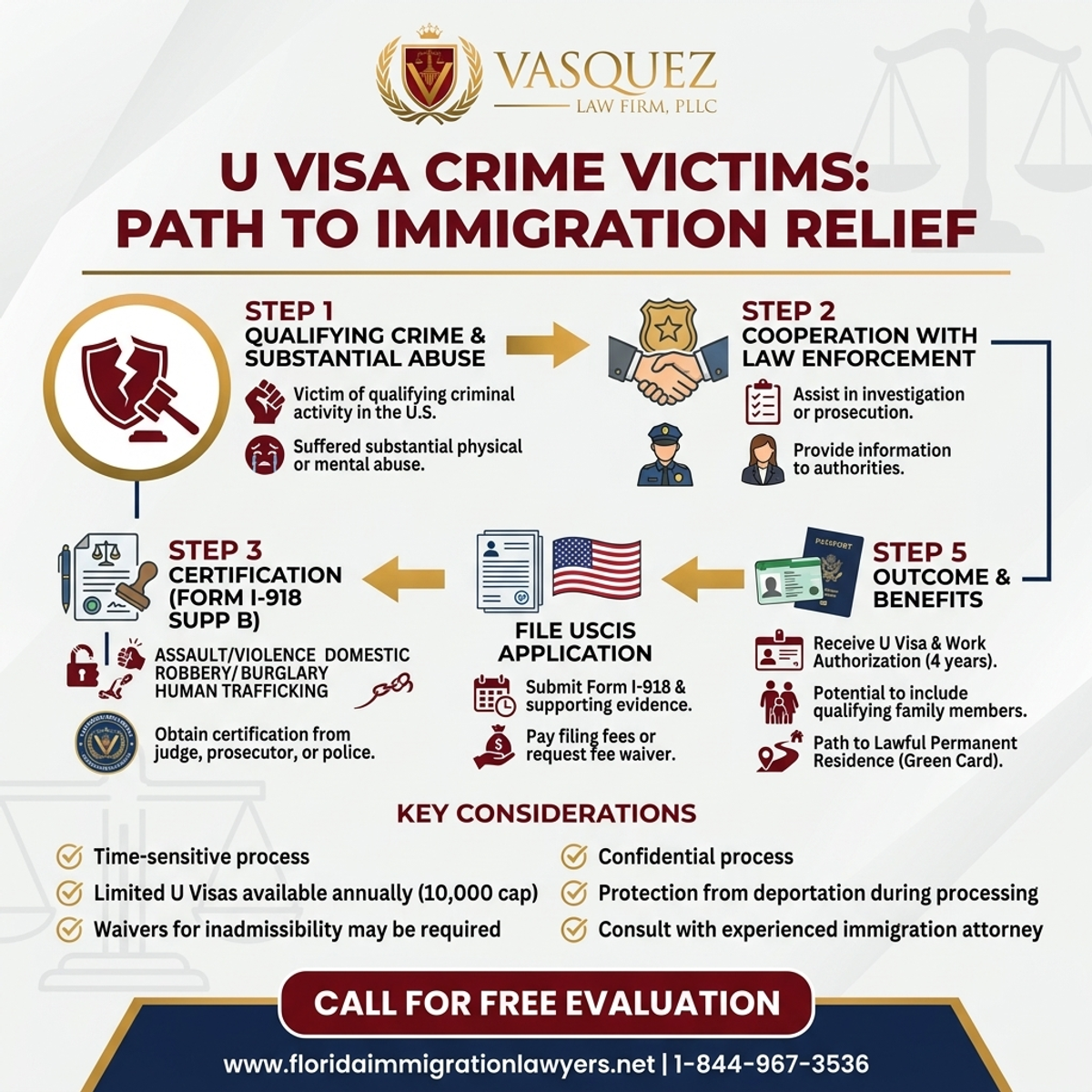
Eligibility for the U visa is outlined in the Immigration and Nationality Act (INA) Section 101(a)(15)(U) and further detailed in 8 CFR 214.14. To qualify, an applicant must demonstrate four key elements: 1) They are a victim of a qualifying criminal activity; 2) They have suffered substantial physical or mental abuse as a result of the crime; 3) They possess information about the criminal activity; and 4) They have been, are being, or are likely to be helpful to a federal, state, or local law enforcement agency, prosecutor, judge, or other authority investigating or prosecuting the crime. This last element is often the most challenging to obtain, as it requires specific certification from a qualifying agency in Florida.
Qualifying criminal activities are broad and include severe forms of domestic violence, sexual assault, human trafficking, kidnapping, abduction, torture, aggravated assault, blackmail, extortion, false imprisonment, felony assault, female genital mutilation, incest, involuntary servitude, murder, manslaughter, obstruction of justice, perjury, prostitution, rape, sexual exploitation, slave trade, stalking, torture, witness tampering, and any attempt, conspiracy, or solicitation to commit any of these crimes. In Florida, victims of these crimes often interact with local police departments, sheriff's offices, State Attorney's offices, or even federal agencies like the FBI or Homeland Security Investigations. The critical component is securing the cooperation certification from these agencies.
The Step-by-Step U Visa Application Process in Florida
Navigating the U visa application process can be complex and intimidating, especially for victims still recovering from trauma. Having a clear understanding of each step is crucial. This detailed outline provides a roadmap for U visa crime victims Florida, emphasizing the importance of legal guidance throughout.
-
Obtain Law Enforcement Certification (Form I-918, Supplement B): This is often the most critical and challenging step. You must demonstrate that you were a victim of a qualifying crime and have been, are being, or are likely to be helpful to the investigation or prosecution. You will need to contact the relevant law enforcement agency in Florida that investigated your crime, such as the Miami-Dade Police Department, the Broward County Sheriff's Office, the Florida Department of Law Enforcement (FDLE), or a local State Attorney's Office. An experienced immigration attorney can help you prepare a compelling request and communicate with these agencies. This certification is crucial for proving your cooperation and eligibility for the U visa.
-
Gather Supporting Documentation: Beyond the certification, you will need to collect extensive evidence to support your petition. This includes police reports, medical records detailing injuries or psychological impact, affidavits from witnesses, and a detailed personal statement describing the crime, the harm you suffered, and your cooperation with authorities. Evidence of your presence in the U.S. and good moral character is also important. Your legal team will assist in compiling a strong evidence package.
-
File Form I-918, Petition for U Nonimmigrant Status: Once all documentation is prepared, your attorney will file Form I-918, Petition for U Nonimmigrant Status, along with Form I-918, Supplement B (U Nonimmigrant Status Certification), and all supporting evidence with U.S. Citizenship and Immigration Services (USCIS). This application is filed centrally, not at a local Florida USCIS office, but your residence in Florida will be noted. It's essential that the petition is complete and accurate to avoid delays or requests for additional evidence.
-
Attend Biometrics Appointment: After filing, USCIS will send you a notice to attend a biometrics appointment at an Application Support Center (ASC) in Florida, such as those in Miami, Orlando, or Jacksonville. Here, your fingerprints, photograph, and signature will be collected for background checks. This is a standard procedure for almost all immigration applications.
Step-by-Step Process — U Visa Crime Victims Florida: Path to Immigration Relief
-
Prima Facie Determination and Work Authorization: Due to the annual cap on U visas (10,000 per fiscal year), there is a significant backlog. USCIS will first review your petition to determine if you meet the basic eligibility criteria for a “bona fide” (BFO) determination. If you receive a bona fide determination, you may be eligible to apply for work authorization (Form I-765, Application for Employment Authorization) and deferred action while you wait for a U visa to become available. This EAD is incredibly important for victims to gain financial independence and stability while their case is pending.
-
Interview (If Required) and Final Decision: While not all U visa applicants are interviewed, USCIS may request one, especially if there are questions about your testimony or evidence. If an interview is scheduled, it would likely take place at a USCIS field office in Florida. After all reviews are complete and a U visa becomes available, USCIS will issue a final decision. If approved, you will be granted U nonimmigrant status for four years.
-
Adjustment of Status to Lawful Permanent Resident: After holding U nonimmigrant status for three continuous years in the U.S., you may be eligible to apply for adjustment of status to become a lawful permanent resident (green card holder) by filing Form I-485. You must demonstrate that your continued presence in the U.S. is justified on humanitarian grounds, to ensure family unity, or is otherwise in the public interest. This final step secures your long-term future in Florida.
Essential Documents for Your U Visa Petition
A successful U visa petition hinges on a thoroughly prepared and well-documented application. Missing or incorrect documents can lead to significant delays or even denial. For U visa crime victims Florida, ensuring every piece of evidence is properly submitted is crucial. Here is a comprehensive checklist of documents typically required:
- Form I-918, Petition for U Nonimmigrant Status: The primary application form, accurately filled out and signed.
- Form I-918, Supplement B, U Nonimmigrant Status Certification: This form must be completed and signed by a qualifying law enforcement agency in Florida (e.g., local police, sheriff, State Attorney's Office, federal agency). It confirms your victim status and cooperation.
- Personal Statement: A detailed written declaration from you, the victim, describing the criminal activity, the harm you suffered (physical and/or mental), and your helpfulness to law enforcement. This statement should be comprehensive and compelling.
- Evidence of Qualifying Criminal Activity: Police reports, court documents, charging documents, sentencing records, and any other official records from the Florida justice system related to the crime.
- Evidence of Substantial Physical or Mental Abuse: Medical records, psychological evaluations, therapist's notes, photographs of injuries, and affidavits from doctors or counselors detailing the impact of the crime.
- Evidence of Cooperation: Letters from law enforcement, prosecutor's statements, court transcripts, or any other documentation confirming your assistance in the investigation or prosecution.
- Proof of U.S. Presence: Any documents showing your presence in the United States, such as utility bills, leases, school records, employment records, or entry stamps.
- Identity and Nationality Documents: Passport, birth certificate, national identity card, or any other documents establishing your identity and country of origin.
- Family Member Information (if applicable): If you are petitioning for qualifying family members (spouse, children, parents for child victims), you will need their identity documents and proof of relationship (marriage certificates, birth certificates).
- Biographic Information: Form G-325A (Biographic Information).
- Photographs: Passport-style photographs of yourself and any derivative family members.
- Fee Waiver Request (if applicable): Form I-912, Request for Fee Waiver, if you cannot afford the filing fees.
Timelines and Processing Expectations for U Visas in Florida (2026)
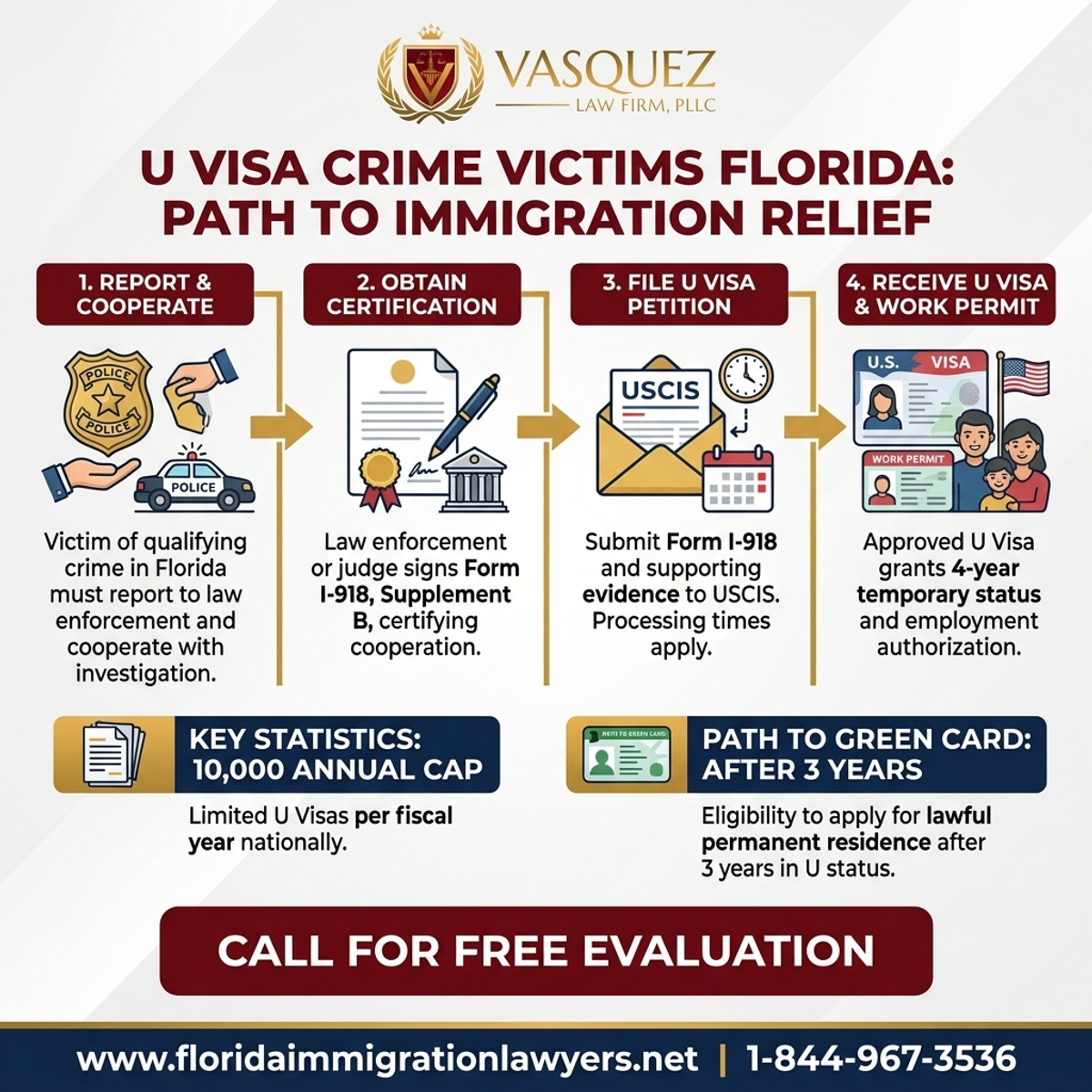
The U visa process, while a vital path to relief, is known for its lengthy processing times. For U visa crime victims Florida, understanding these timelines can help manage expectations and plan for the future. USCIS processes U visa petitions centrally, and the national backlog significantly impacts all applicants, regardless of their location in Florida. As of 2026, applicants should anticipate several years for a final decision due to the annual cap of 10,000 U visas.
Initially, after filing Form I-918, USCIS will send a receipt notice, typically within a few weeks. The next significant step is the biometrics appointment, which usually occurs within a few months of filing. The most crucial waiting period is for the bona fide determination (BFO). This review can take several years, often ranging from 3 to 5 years or more. If USCIS determines your petition is bona fide, you may then apply for employment authorization (EAD) and deferred action, allowing you to legally work and remain in the U.S. while your U visa petition is in the queue. Receiving an EAD can take an additional 6-12 months after a BFO determination.
Key Statistics — U Visa Crime Victims Florida: Path to Immigration Relief
Once a U visa becomes available under the annual cap, USCIS will conduct a final review of your petition. This stage can also take several months. If approved, you will be granted U nonimmigrant status for four years. During this period, you can live and work legally in Florida. After three continuous years in U status, you become eligible to apply for adjustment of status to lawful permanent resident (green card holder) by filing Form I-485. The I-485 application process typically takes another 1-2 years. From initial filing to obtaining a green card, the entire journey can span 7 to 10 years or even longer. While these timelines can be daunting, the long-term benefits of safety and legal status make the wait worthwhile for many victims in Florida.
Cost Factors and Fee Breakdown for U Visa Petitions
Understanding the potential costs associated with a U visa petition is an important part of the planning process for U visa crime victims Florida. While some immigration applications have significant filing fees, U visa petitioners generally benefit from certain fee exemptions. However, other expenses can still arise, making legal counsel an invaluable investment.
One of the significant advantages for U visa applicants is that there are generally no USCIS filing fees for Form I-918, Petition for U Nonimmigrant Status, or for Form I-765, Application for Employment Authorization, when filed concurrently with or based on a pending U visa petition. This is a crucial relief for victims who often face financial hardship. However, if you apply for adjustment of status (Form I-485) after holding U status for three years, there will be filing fees associated with that application, though fee waivers may still be available for eligible individuals. It's important to note that USCIS fees are subject to change, and it's always best to consult the official USCIS website for the most current fee schedule.
Beyond government filing fees, other costs can include attorney fees. While it is possible to file a U visa petition independently, the complexity of the requirements, the need to secure law enforcement certification, and the extensive documentation often make legal representation highly advisable. Experienced immigration attorneys, like those at Florida Immigration Lawyers, can guide you through every step, prepare a robust petition, communicate with law enforcement agencies on your behalf, and represent you if interviews or requests for evidence arise. Attorney fees vary based on the complexity of the case and the services provided, but many firms offer flexible payment plans. Other potential costs might include fees for medical examinations (required for adjustment of status), translation services for foreign language documents, and postage or courier services. It is always wise to discuss all potential costs upfront with your legal team during your initial consultation.
Do not navigate this complex and sensitive process alone. The dedicated attorneys at Florida Immigration Lawyers understand the unique challenges faced by U visa crime victims Florida. We are committed to providing compassionate and effective legal representation to help you secure the protection and relief you deserve. Contact Florida Immigration Lawyers today for expert guidance and support.
Protecting Victims: Resources and Support in Florida
Beyond legal immigration relief, U visa crime victims Florida often need comprehensive support to recover from trauma and rebuild their lives. Florida offers a network of resources designed to assist victims of crime, regardless of their immigration status. These resources can provide crucial aid, from immediate safety to long-term healing and stability. Understanding where to find these services can make a significant difference in a victim's journey towards recovery and successful immigration. Our firm often works in conjunction with these organizations to provide holistic support.
Many local and state agencies in Florida are dedicated to victim advocacy. The Florida Office of the Attorney General, through its Victim Services section, provides information and resources on victim compensation, restitution, and referrals to local programs. Each county, including Miami-Dade, Broward, Palm Beach, Orange (Orlando), and Hillsborough (Tampa), typically has victim services divisions within their State Attorney's Offices or Sheriff's Departments. These offices can offer crisis intervention, emotional support, safety planning, and help navigating the criminal justice system. They can also be instrumental in facilitating communication with law enforcement for U visa certification purposes.
Non-profit organizations play a vital role in supporting crime victims. Shelters for domestic violence and human trafficking victims, such as those operated by the Florida Coalition Against Domestic Violence or local agencies like SafeSpace in Miami, provide safe housing, counseling, and legal advocacy. Organizations focused on immigrant rights and services also often have programs tailored to assist victims in understanding their options and accessing resources. These groups can provide invaluable practical assistance, such as help with transportation, food, clothing, and referrals to mental health professionals who understand the unique challenges faced by immigrant victims. Connecting with these local Florida resources can complement the legal assistance provided by your immigration attorney, creating a robust support system as you pursue your U visa.
Common Mistakes U Visa Crime Victims in Florida Should Avoid
The U visa application process is intricate, and even minor errors can lead to significant delays or denials. For U visa crime victims Florida, avoiding common pitfalls is essential to a successful outcome. Here are some critical mistakes to watch out for:
-
Failing to Obtain Law Enforcement Certification: This is the cornerstone of a U visa petition. Many victims mistakenly believe a police report alone is sufficient. Without a signed Form I-918, Supplement B from a qualifying Florida law enforcement agency, the petition cannot be approved. Proactively working with an attorney to secure this certification is vital.
-
Incomplete or Inaccurate Forms: USCIS is highly particular about complete and accurate forms. Missing information, incorrect dates, or unsigned sections can result in a Request for Evidence (RFE) or outright denial, significantly delaying the process. Double-checking every detail is crucial.
-
Insufficient Evidence of Harm or Cooperation: A strong petition requires robust evidence of substantial physical or mental abuse and clear documentation of your helpfulness to law enforcement. Vague statements or a lack of corroborating medical or police records can weaken your case. Gather all possible supporting documents.
-
Inconsistent Statements: Any discrepancies between your personal statement, police reports, or testimony can raise red flags for USCIS. It is critical to be consistent and truthful in all communications regarding the crime and your cooperation. An attorney can help you prepare your statement carefully.
-
Not Disclosing Criminal History (if any): Even minor offenses, if not properly disclosed and addressed, can impact your eligibility. Always be transparent with your attorney about any past arrests or convictions, as waivers may be available. Concealing information is a serious mistake.
-
Failing to Maintain Communication with Law Enforcement: Your willingness to cooperate is ongoing. If law enforcement attempts to contact you for further assistance and you fail to respond, it could jeopardize your certification or the outcome of your petition. Stay in touch with the investigating agency.
-
Leaving the U.S. Without Authorization: While a U visa provides protection, it does not automatically grant advance parole. Leaving the United States without specific authorization from USCIS can be considered abandoning your application and may prevent you from re-entering, especially if you have an unlawful presence issue. Always consult your attorney before any travel plans.
-
Waiting Too Long to Apply: While there is no strict deadline for U visa applications, delays can make it harder to gather evidence, especially law enforcement certification, as memories fade and personnel change. Seek legal counsel as soon as safely possible after the crime.
-
Not Seeking Legal Counsel: The U visa process is highly complex and emotionally taxing. Attempting to navigate it alone can lead to critical mistakes. An experienced Florida immigration lawyer can significantly increase your chances of success and provide invaluable support.
When to Call a Florida Immigration Lawyer for U Visa Assistance
While the U visa offers a beacon of hope for U visa crime victims Florida, the application process is anything but straightforward. The intricate legal requirements, the need for sensitive communication with law enforcement, and the extensive documentation demand professional expertise. Knowing when to seek legal counsel can be the difference between approval and denial.
You should contact Florida Immigration Lawyers immediately if you have been a victim of a qualifying crime, regardless of your current immigration status. Our attorneys can assess your eligibility, explain the process in clear terms, and help you understand your rights. This is especially crucial if you have any criminal history yourself, as waivers may be necessary, or if you have previously been ordered removed or deported. Our team can evaluate how these factors might affect your U visa petition and develop a strategic approach.
Furthermore, obtaining the crucial law enforcement certification (Form I-918, Supplement B) is often the most challenging hurdle. Law enforcement agencies in Florida may not always be familiar with the U visa process or may require specific information to complete the certification. Our attorneys have experience communicating with various agencies across Florida, from the Miami-Dade Police Department to the State Attorney's Office in Orlando, to advocate for your certification. We can help you prepare a compelling request and address any concerns they may have. If you are struggling to get this certification, or if an agency has denied your request, it's a clear sign you need legal intervention.
Finally, if you have already filed your petition and received a Request for Evidence (RFE) from USCIS, or if your case has been pending for an unusually long time without updates, it is vital to consult with an attorney. An RFE indicates that USCIS requires more information or clarification, and a well-crafted response is critical to keeping your case on track. Our lawyers can help you respond effectively, ensuring your petition is as strong as possible. Do not wait until your case faces significant challenges; proactive legal guidance from Florida Immigration Lawyers can safeguard your future.
About Florida Immigration Lawyers
Florida Immigration Lawyers is a leading immigration law firm dedicated to serving individuals and families across the entire state of Florida. With a deep understanding of U.S. immigration law and a compassionate approach, we specialize in providing comprehensive legal solutions for a wide range of immigration matters, including U visas for crime victims. Our team of experienced attorneys is committed to protecting the rights and futures of our clients, offering expert guidance through even the most complex legal challenges.
We pride ourselves on our client-focused service, ensuring that every individual receives personalized attention and strategic representation tailored to their unique circumstances. For U visa crime victims Florida, we offer a safe and confidential environment where you can share your story and receive empathetic legal counsel. Our services extend beyond just filing paperwork; we advocate for you, communicate with government agencies, and prepare you for every step of the process.
At Florida Immigration Lawyers, we understand the urgency and sensitivity of immigration cases. That's why we are available 24/7 to answer your questions and provide support. We offer free, no-obligation consultations to discuss your case and outline your options. Whether you are in Miami, Orlando, Tampa, Jacksonville, or any other city in Florida, our dedicated team is here to help. Visit our website or call us at 1-844-967-3536 to learn how we can assist you in achieving your immigration goals. Se Habla Español - Estamos aqui para ayudarle.
Sources and References
- U.S. Citizenship and Immigration Services (USCIS) - U Nonimmigrant Status
- Executive Office for Immigration Review (EOIR)
- 8 U.S.C. Chapter 12 - Immigration and Nationality Act (INA) Section 101(a)(15)(U)
- 8 CFR 214.14 - Nonimmigrant classes; U nonimmigrant status
- USCIS Policy Manual, Volume 3, Part B, Chapter 5 - U Nonimmigrant Status
Related services: asylum and refugee protection, asylum application process, refugee status and resettlement, withholding of removal.
This article provides general legal information and is not intended as legal advice. Every case is unique, and outcomes depend on specific facts and circumstances. Contact an attorney for advice about your particular situation. Immigration laws are subject to change.
If you are a crime victim in Florida seeking safety and a path to legal status, remember that you are not alone. The U visa offers a powerful form of protection, and our compassionate legal team is ready to guide you through every step. Do not let fear or uncertainty prevent you from seeking the justice and relief you deserve. Contact Florida Immigration Lawyers for a free consultation at 1-844-967-3536. Se Habla Espanol - Estamos aqui para ayudarle.
If you need legal assistance, learn more about speak with an immigration lawyer, or call us at 1-844-967-3536 for a free consultation.
Do Not Navigate This Process Alone
Our experienced immigration attorneys are ready to fight for you. Get a free, confidential consultation today.
Se Habla Español
Frequently Asked Questions
Florida Immigration Lawyers
Immigration Attorney | Founder, Vasquez Law Firm
U.S. Air Force veteran and immigration attorney with thousands of cases resolved. J.D., NCCU School of Law. AILA member. Admitted to the 4th, 5th, and 11th Circuit Courts.
Available 24/7 - Free Evaluations
Related Legal Services
Our Florida immigration attorneys can help you with deportation defense, citizenship and naturalization and family immigration services. Call today at 1-844-967-3536 for a free consultation.
Related Links
Related Topics
Free Legal Consultation
Discuss your case with our experienced attorneys. We're available 24/7.
Se Habla Español - Estamos aquí para ayudarle.
Related Articles
Understanding Good Moral Character for Naturalization in Florida
Learn about the importance of good moral character for naturalization in Florida. Understand how it impacts your N-400 application and what steps to take to ensure a successful process.
H-4 EAD: Florida Spouse Work Permit Guide for H-1B Families
For H-1B families in Florida, the H-4 EAD offers a vital pathway for eligible spouses to obtain work authorization. This guide details H-4 EAD eligibility requirements, the step-by-step application process, necessary documents, and what to expect regarding processing times and costs. We address common mistakes that can lead to delays or denials and emphasize the importance of accurate submission. Florida Immigration Lawyers provides expert assistance for H-4 EAD applications, ensuring H-1B families in Pembroke Pines, Miami, and throughout Florida can navigate the complexities of immigration law with confidence. Learn how to secure your spouse's work permit and contribute to your family's financial stability. Contact us for a free consultation.
Naturalization Process Timeline in Florida | VLF Florida
Explore the naturalization process timeline in Florida. Understand the steps, required documents, and potential pitfalls. Contact Florida Immigration Lawyers for expert guidance and a free consultation.
Dual Citizenship in Florida: Navigating Immigration
Explore dual citizenship in Florida and learn the steps to obtaining it. Discover how to navigate immigration laws and naturalization processes for a more flexible future.
