Change of Status for Student Visa in Florida | VLF Florida
Changing your student visa status in Florida is a complex process. Learn about eligibility, required documents, and common mistakes to avoid. Contact Florida Immigration Lawyers for expert guidance.

Change of Status for Student Visa in Florida | VLF Florida
Navigating the complexities of U.S. immigration law can be daunting, especially when you're looking to change your nonimmigrant status. For individuals currently in Florida on a different visa and wishing to pursue academic or vocational studies, understanding the process of changing to a student visa (F-1 or M-1) is crucial. This comprehensive guide from VLF Florida will walk you through the essential steps, requirements, and considerations for a successful change of status application, ensuring you have the knowledge to pursue your educational dreams in the Sunshine State.
Whether you're a tourist, a business visitor, or hold another nonimmigrant visa, transitioning to student status requires careful planning and adherence to strict USCIS regulations. Our experienced immigration attorneys are dedicated to providing clear, actionable advice to help you achieve your goals.
Understanding Student Visa Change of Status in Florida
A "change of status" allows an individual already present in the United States on one nonimmigrant visa to switch to another nonimmigrant visa category without having to leave the country. For prospective students, this typically means changing to an F-1 (academic student) or M-1 (vocational student) visa. This process is distinct from applying for a new visa at a U.S. embassy or consulate abroad.
Florida, with its diverse educational institutions and vibrant culture, attracts students from all over the world. Understanding the specific requirements for F-1 and M-1 visas is the first step. The F-1 visa is for academic studies at universities, colleges, high schools, private elementary schools, seminaries, conservatories, and other academic institutions, including language training programs. The M-1 visa is for vocational or other non-academic studies. Both require you to be accepted by a school approved by the Student and Exchange Visitor Program (SEVP).
It's vital to initiate the change of status process well before your current authorized stay expires. Overstaying your visa, even by a single day, can lead to severe consequences, including bars from future U.S. entry and potential deportation proceedings. Therefore, timely and accurate application submission is paramount.
Eligibility Requirements for Changing to a Student Visa (F-1 or M-1)
To be eligible for a change of status to an F-1 or M-1 student visa, you must meet several key criteria:
- Maintain Lawful Nonimmigrant Status: You must currently be in the U.S. in a lawful nonimmigrant status (e.g., B-1/B-2 visitor, H-1B worker, etc.). You cannot apply for a change of status if you have overstayed your previous visa, violated its terms, or engaged in unauthorized employment.
- No Unauthorized Employment: You must not have engaged in any unauthorized employment in the U.S. This is a strict requirement, and any violation can result in denial.
- Valid Passport: You must possess a valid passport that will remain valid for at least six months beyond your intended period of stay.
- Intent to Depart: You must demonstrate a clear intent to depart the U.S. after completing your studies. F-1 and M-1 visas are nonimmigrant visas, meaning they are temporary.
- Sufficient Funds: You must prove that you have sufficient funds to cover your tuition, living expenses, and other costs for the entire duration of your proposed study without resorting to unauthorized employment. This can be demonstrated through bank statements, scholarship letters, or affidavits of support.
- Acceptance into SEVP-Approved School: You must be accepted by a school that is approved by the Student and Exchange Visitor Program (SEVP). Upon acceptance, the school will issue you a Form I-20, Certificate of Eligibility for Nonimmigrant Student Status.
- Timely Application: Your application must be filed before your current authorized period of stay expires. USCIS generally recommends filing at least 45 days before your current status ends, but earlier is always better.
The Application Process: Step-by-Step Guide
The process of changing your status to an F-1 or M-1 student visa involves several critical steps:
- Get Accepted by a SEVP-Approved School and Receive Form I-20: This is the foundational step. You must apply to and be accepted by an SEVP-certified institution in Florida. Once accepted, the Designated School Official (DSO) will issue you a Form I-20. This document is essential as it confirms your enrollment and provides details about your program of study and estimated costs.
- Pay the SEVIS I-901 Fee: Before filing your change of status application, you must pay the SEVIS I-901 fee. This fee supports the Student and Exchange Visitor Information System (SEVIS), which tracks F, M, and J nonimmigrants. Keep proof of payment.
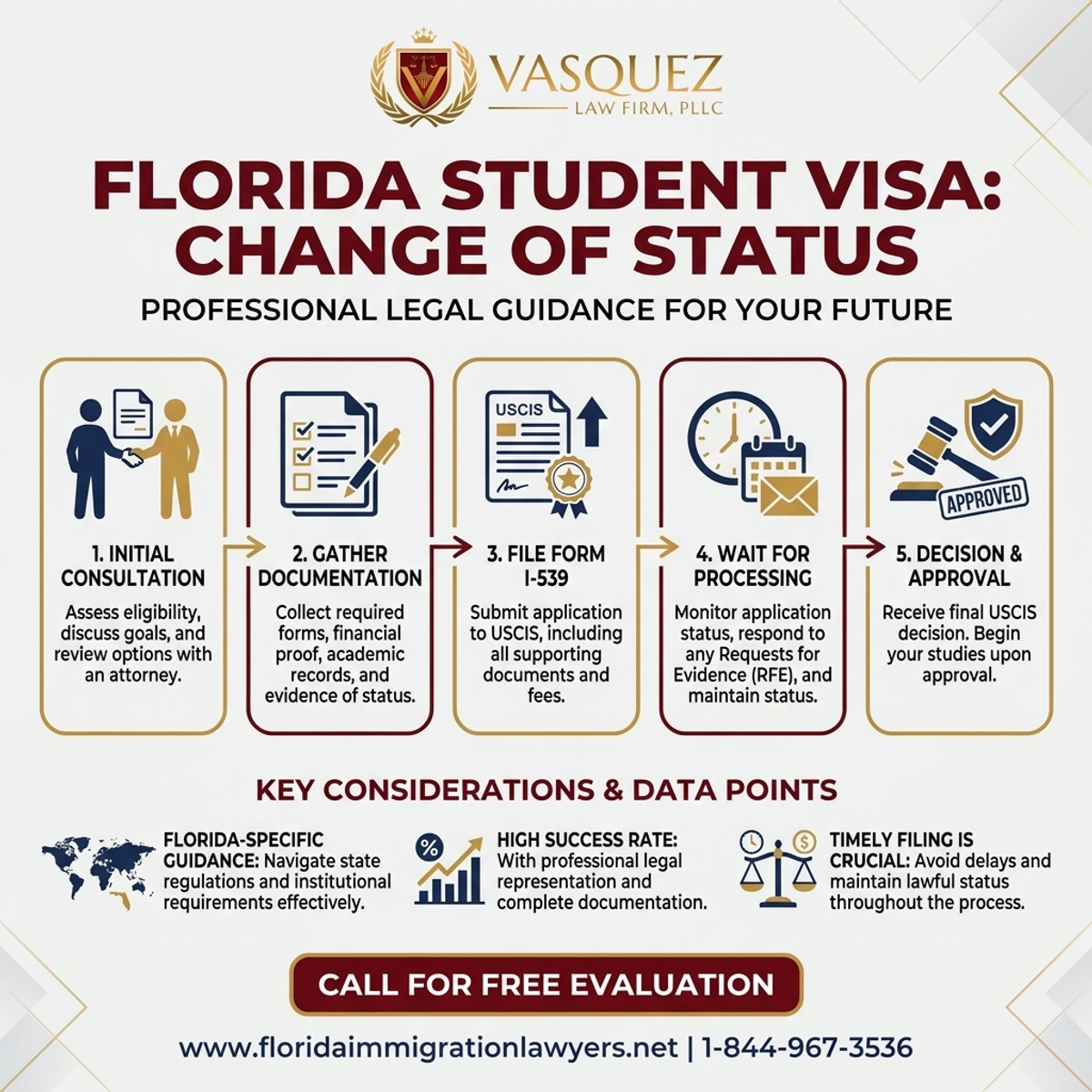
- File Form I-539, Application to Extend/Change Nonimmigrant Status: This is the primary form for your change of status request. You will complete this form, providing details about your current status, the status you are requesting, and your personal information.
- Gather Supporting Documents: Compile all necessary supporting documentation. This includes your Form I-20, proof of SEVIS fee payment, financial evidence, copies of your passport and current visa, your I-94 arrival/departure record, academic transcripts (if applicable), and a personal statement explaining your reasons for wanting to change status and pursue studies in the U.S.
- Submit Your Application Package to USCIS: Mail your completed Form I-539 and all supporting documents to the appropriate USCIS service center. Ensure you follow the filing instructions precisely, including the correct mailing address and payment of the filing fee.
- Attend Biometrics Appointment (if required): After filing, you may receive a notice to attend a biometrics appointment at an Application Support Center (ASC). Here, your fingerprints and photograph will be taken for background checks.
- Wait for USCIS Decision: Processing times can vary significantly. During this period, it's crucial to maintain your current nonimmigrant status. USCIS will notify you of their decision via mail. If approved, you will receive an I-797 approval notice.
Key Documents Required for Your Application
A well-prepared application package is key to success. Here’s a detailed list of documents typically required:
- Form I-539: Completed and signed Application to Extend/Change Nonimmigrant Status.
- Form I-20: Original Certificate of Eligibility for Nonimmigrant Student Status, issued by your SEVP-approved school.
- Proof of SEVIS I-901 Fee Payment: Receipt of payment for the SEVIS fee.
- Financial Evidence: Bank statements, scholarship letters, affidavits of support, or other documents proving you have sufficient funds to cover tuition and living expenses.
- Passport and Visa Copies: Copies of your passport biographical page, any U.S. visas, and all pages with U.S. entry stamps.
- I-94 Arrival/Departure Record: Printout of your electronic I-94 record from the CBP website.
- Current Visa Status Documentation: Copies of your current visa stamp, I-797 approval notices (if applicable), and any other documents related to your current nonimmigrant status.
- Personal Statement/Cover Letter: A letter explaining why you wish to change your status, your academic goals, and how you will maintain your status.
- Academic Transcripts/Diplomas: If applicable, provide copies of previous academic records.
- Marriage Certificate/Birth Certificates: If applying with dependents (e.g., F-2/M-2 status), provide proof of relationship.
- Passport-style Photographs: Recent photographs meeting USCIS specifications.
Maintaining Your Current Status While Your Application is Pending
It is absolutely critical to maintain your current lawful nonimmigrant status while your change of status application is pending with USCIS. This means:
- Do Not Overstay: Ensure your application is filed before your current I-94 expiration date. If your I-94 expires while your I-539 is pending, you are generally permitted to remain in the U.S. until a decision is made, provided you filed on time and have not violated your status. This is known as a "period of authorized stay."
- No Unauthorized Work: Do not engage in any form of employment unless your current visa status explicitly permits it. Student visas (F-1/M-1) have strict rules regarding employment, and unauthorized work can lead to denial of your application and future immigration problems.
- Adhere to Current Visa Conditions: Continue to abide by all the terms and conditions of your current nonimmigrant visa. For example, if you are on a B-2 tourist visa, you should not enroll in classes or engage in activities inconsistent with tourist status.
- Travel Restrictions: Generally, you should avoid traveling outside the U.S. while your change of status application is pending. If you leave the U.S., USCIS will consider your application abandoned, and you will need to apply for an F-1/M-1 visa at a U.S. embassy or consulate abroad to re-enter.
Failure to maintain your status can lead to your application being denied, and in severe cases, could initiate deportation defense proceedings. Always consult with an attorney if you are unsure about your status or have concerns about potential violations.
Common Pitfalls and How to Avoid Them
Changing your visa status can be a complex process, and several common mistakes can lead to delays or even denial of your application:
- Filing Late: Submitting your I-539 application after your current authorized stay has expired is one of the most common reasons for denial. Always file well in advance.
- Incomplete Application: Missing forms, unsigned documents, or insufficient supporting evidence can cause USCIS to issue a Request for Evidence (RFE) or deny your application outright. Double-check all forms and ensure all required documents are included.
- Insufficient Funds: Failing to provide clear and convincing evidence of sufficient financial resources to cover your education and living expenses is a major red flag. Ensure your financial documents are up-to-date and clearly demonstrate the required funds.
- Misrepresentation: Providing false information or omitting material facts can lead to a finding of misrepresentation, which has severe, long-term immigration consequences. Always be truthful and accurate in your application.
- Violating Current Status: Engaging in activities inconsistent with your current nonimmigrant status (e.g., studying on a tourist visa before approval, unauthorized work) will almost certainly result in denial.
- Lack of Nonimmigrant Intent: USCIS must be convinced that you intend to return to your home country after completing your studies. If your application or supporting documents suggest an intent to remain in the U.S. permanently, it could be denied.
- Choosing the Wrong Visa Category: Ensure you are applying for the correct student visa (F-1 for academic, M-1 for vocational) based on your program of study.
Careful preparation and attention to detail are paramount. When in doubt, seeking legal counsel can help you navigate these potential pitfalls.
Exploring Other Visa Options and Pathways in Florida
While changing to a student visa is a common pathway for many, it's important to recognize that the broader landscape of U.S. immigration offers various other options depending on an individual's unique circumstances and goals. Florida, being a hub for international activity, presents numerous opportunities beyond student status. For some, their long-term aspirations might extend beyond temporary study, leading them to explore employment-based visas, family-sponsored visas, or even pathways to permanent residency.
For instance, after completing an F-1 program, many students pursue Optional Practical Training (OPT) or STEM OPT, which allows them to gain work experience related to their field of study. This can sometimes be a bridge to an H-1B (specialty occupation) visa, allowing them to transition from student to skilled worker status. Understanding these potential transitions early can help in strategic planning for your future in the U.S. Our immigration practice areas cover a wide range of these options.
In more challenging situations, such as if a student faces unforeseen dangers in their home country or experiences persecution, alternative protections like asylum might become a critical consideration. While distinct from student visas, these pathways are part of the comprehensive immigration framework designed to protect vulnerable individuals. Similarly, if a change of status application is denied and leads to concerns about remaining in the U.S. lawfully, understanding options like deportation defense becomes essential. These are complex areas of law that require specialized legal expertise.
Step-by-Step Process — Change of Status for Student Visa in Florida | VLF Florida
It's crucial to periodically assess your long-term goals and how your current visa status aligns with them. Immigration laws are dynamic, and what might be the best path today could evolve. Consulting with an immigration attorney can provide clarity on all available options, helping you make informed decisions about your future in Florida and the United States.
The Role of an Experienced Immigration Attorney
Navigating the intricacies of U.S. immigration law, particularly for a change of status, can be overwhelming. An experienced immigration attorney can be an invaluable asset throughout this process. Here's how VLF Florida can assist you:
- Expert Guidance: Our attorneys possess in-depth knowledge of immigration laws and regulations. We can assess your eligibility, explain the process clearly, and advise you on the best course of action.
- Application Preparation: We will help you meticulously prepare your Form I-539 and all supporting documentation, ensuring accuracy and completeness to minimize the risk of RFEs or denials.
- Evidence Review: We will review your financial documents, personal statement, and other evidence to ensure they meet USCIS requirements and effectively support your application.
- Responding to RFEs: If USCIS issues a Request for Evidence, we can help you understand what is required and prepare a comprehensive response.
- Troubleshooting: Should any issues arise during the processing of your application, our team can advocate on your behalf with USCIS.
- Peace of Mind: With professional legal representation, you can have greater confidence that your application is handled correctly, allowing you to focus on your studies and future.
Our dedicated attorneys at VLF Florida are committed to providing personalized and effective legal solutions for individuals seeking to change their status to a student visa. We understand the importance of your educational journey and are here to support you every step of the way.
Frequently Asked Questions (FAQs)
Q1: Can I start studying immediately after I file my change of status application?
A: No. You must wait for USCIS to approve your change of status to F-1 or M-1 before you can begin your studies. Starting classes before approval can be considered a violation of your current nonimmigrant status and could lead to the denial of your application and future immigration issues. The only exception is if you are already in a status that permits study, such as an F-2 dependent, though even then, specific rules apply.
Q2: What happens if my current visa expires while my change of status application is pending?
A: If you filed your I-539 application on time and it is still pending, you are generally in a "period of authorized stay" and are permitted to remain in the U.S. lawfully until USCIS makes a decision. However, you cannot travel outside the U.S. during this period without abandoning your application. If your application is denied, you may need to depart the U.S. immediately or face potential overstay consequences.
Q3: Can I work while my change of status to a student visa is pending?
A: Generally, no. You must adhere to the employment rules of your current nonimmigrant status. Most nonimmigrant statuses that allow for a change to student status (like B-1/B-2 visitors) do not permit employment. Engaging in unauthorized employment while your application is pending will almost certainly lead to a denial of your change of status request.
Q4: How long does it take for USCIS to process a change of status application?
A: Processing times vary widely depending on the USCIS service center, current caseloads, and the completeness of your application. It can range from a few months to over a year. You can check the estimated processing times on the USCIS website. It is advisable to file as early as possible.
Q5: What if my change of status application is denied?
A: If your application is denied, you will receive a denial notice explaining the reasons. Depending on the circumstances of the denial and your current status, you may need to depart the U.S. immediately, or you might have options to appeal or refile. Consulting with an immigration attorney immediately after a denial is crucial to understand your options and avoid accruing unlawful presence.
Q6: Can I change my status from a B-1/B-2 visitor visa to an F-1 student visa?
A: Yes, it is possible to change status from a B-1 (business visitor) or B-2 (tourist visitor) visa to an F-1 student visa, provided you meet all eligibility requirements. However, it's important to demonstrate that you had no preconceived intent to study when you initially entered the U.S. on your B visa. Applying too soon after entry might raise questions about your original intent.
Q7: Do I need to pay the SEVIS I-901 fee again if I previously paid it for a different visa?
A: Yes, if you are changing to F-1 or M-1 status, you must pay the SEVIS I-901 fee for your new student record, even if you paid it previously for another SEVIS-related status (like J-1). The fee is tied to your specific SEVIS record (indicated by your SEVIS ID on Form I-20).
Q8: Can my dependents (spouse and children) also change their status with me?
A: Yes, your spouse and unmarried children under 21 can apply to change their status to F-2 or M-2 dependent status concurrently with your F-1 or M-1 application. They would typically be included on your Form I-539 or file their own separate I-539 applications, depending on the specific instructions and number of applicants. Each dependent will also need their own Form I-20.
The journey to studying in Florida through a change of status can be intricate, but with the right guidance, it is entirely achievable. At VLF Florida, we are committed to helping you navigate the complexities of immigration law. For a free consultation and personalized assistance with your change of status application, don't hesitate to contact us today. Let us help you turn your educational aspirations into reality.
Sources and References
- U.S. Citizenship and Immigration Services (USCIS)
- Executive Office for Immigration Review (EOIR)
- U.S. Department of State - Bureau of Consular Affairs
- Immigration and Nationality Act (INA), 8 U.S.C. Chapter 12
Do Not Navigate This Process Alone
Our experienced immigration attorneys are ready to fight for you. Get a free, confidential consultation today.
Se Habla Español
Frequently Asked Questions
Florida Immigration Lawyers
Immigration Attorney | Founder, Vasquez Law Firm
U.S. Air Force veteran and immigration attorney with thousands of cases resolved. J.D., NCCU School of Law. AILA member. Admitted to the 4th, 5th, and 11th Circuit Courts.
Available 24/7 - Free Evaluations
Related Legal Services
Our Florida immigration attorneys can help you with deportation defense, citizenship and naturalization and family immigration services. Call today at 1-844-967-3536 for a free consultation.
Related Links
Related Topics
Free Legal Consultation
Discuss your case with our experienced attorneys. We're available 24/7.
Se Habla Español - Estamos aquí para ayudarle.
Related Articles
Unlawful Presence Waiver in Florida: What You Need to Know
Discover the steps to securing an I-601A provisional waiver for unlawful presence in Florida. Learn about eligibility, processing times, and common mistakes to avoid. Contact Florida Immigration Lawyers for a free consultation today.
U Visa Certification Florida: Law Enforcement & Victims
For non-citizen crime victims in Florida, securing U visa certification is a critical step towards legal protection and residency. This comprehensive guide from Florida Immigration Lawyers details the process, focusing on how law enforcement agencies across the state, including in Coral Springs, play a vital role in issuing Form I-918 Supplement B. Learn about eligibility, the step-by-step application, essential documents, and navigating complex processing timelines. We also highlight common mistakes to avoid and when to seek expert legal counsel. Understanding these crucial elements is essential for a successful U visa petition and for finding safety and stability in the U.S.
Stokes Interview: Navigating Marriage Fraud in Florida
A Stokes interview is a specialized, separate interview conducted by USCIS when there are suspicions of marriage fraud in a green card application. This rigorous process involves individual questioning of spouses, focusing on inconsistencies in their testimonies to determine the authenticity of their marital bond. For couples in Florida, navigating this high-stakes interview requires meticulous preparation, extensive documentation, and often the strategic guidance of an experienced immigration lawyer. Understanding the process, preparing for detailed questions, and presenting a strong case are crucial for overcoming marriage fraud allegations and securing your immigration future. Florida Immigration Lawyers stands ready to assist you.
Immigration Attorney Gainesville: North Florida Legal Help
For those in Gainesville, Alachua County, and throughout North Florida, navigating U.S. immigration law requires expert guidance. An experienced immigration attorney can simplify complex processes, from family-based petitions and employment visas to critical asylum claims and deportation defense. This comprehensive guide outlines the essential services provided by an immigration attorney, details necessary documentation, clarifies processing timelines, and discusses associated costs. We also highlight common mistakes to avoid and crucial scenarios where legal counsel is indispensable. Florida Immigration Lawyers serves all of Florida, including Gainesville and St. Petersburg, providing dedicated legal support to help you achieve your immigration goals. Contact us for a free consultation to discuss your specific needs.