What to Do After a Florida Car Accident: 14-Day PIP Rule
After a car accident in Florida, understanding the 14-day PIP rule is crucial. Learn the steps to take, including seeking medical attention within 14 days, documenting injuries, and consulting a personal injury attorney. Contact Florida Immigration Lawyers at 1-844-967-3536 for a free consultation.

What to Do After a Florida Car Accident: Navigating the Critical 14-Day PIP Rule
A car accident can be a jarring, life-altering event, especially in a busy state like Florida. The aftermath often brings confusion, stress, and a myriad of questions about legal obligations, medical care, and insurance claims. Knowing the correct steps to take immediately following a collision, and in the days and weeks that follow, is paramount to protecting your health, your rights, and your financial well-being. One of the most critical aspects unique to Florida law is the 14-day Personal Injury Protection (PIP) rule, a deadline that can significantly impact your ability to recover compensation for your injuries. This comprehensive guide will walk you through every essential step, from the accident scene to securing legal representation, ensuring you’re well-prepared to navigate the complexities of a Florida car accident claim.
Immediate Steps at the Scene of a Florida Car Accident
The moments immediately following a car accident are often chaotic, but your actions during this critical time can have a profound impact on your future claim. Prioritize safety and gather crucial information.
1. Ensure Safety and Check for Injuries
First and foremost, check yourself and your passengers for any injuries. If anyone is seriously hurt, call 911 immediately. If your vehicle is drivable and it's safe to do so, move it to the side of the road to prevent further accidents. If not, turn on your hazard lights.
2. Call 911 and Report the Accident
Even if the accident seems minor, always call 911. Law enforcement will create an official accident report, which is vital for your insurance claim and potential legal proceedings. Provide accurate information but avoid admitting fault, even if you think you might be partially responsible. Stick to the facts.
3. Exchange Information
Obtain contact and insurance information from all drivers involved. This includes names, phone numbers, insurance company names, policy numbers, and vehicle license plate numbers. If there are witnesses, ask for their contact information as well; their testimony could be invaluable.
4. Document the Scene Extensively
With smartphones readily available, documenting the accident scene is easier than ever. Take numerous photos and videos from various angles. Capture damage to all vehicles, skid marks, road conditions, traffic signs, weather conditions, and any visible injuries. The more evidence you collect, the stronger your case will be. Note the date, time, and location of the accident.
5. Do Not Admit Fault or Discuss Details Extensively
It's natural to feel shaken or apologetic after an accident, but never admit fault, apologize, or speculate about who caused the collision. Any statements you make at the scene could be used against you later. Limit your discussion to exchanging information with other parties and providing factual details to law enforcement.
The Critical 14-Day PIP Rule in Florida: Don't Miss This Deadline
Florida operates under a "no-fault" insurance system, which means your own Personal Injury Protection (PIP) insurance typically covers your initial medical expenses, regardless of who was at fault for the accident. However, there's a crucial deadline that many accident victims overlook, potentially jeopardizing their right to benefits: the 14-day rule.
Understanding Florida's PIP Law
Florida Statute 627.736 mandates that all drivers carry PIP coverage, providing $10,000 in medical and disability benefits. This coverage is designed to ensure you receive prompt medical attention without waiting for fault to be determined. However, to access these benefits, you must seek initial medical treatment within 14 days of the accident.
Why 14 Days is Crucial
If you fail to seek medical treatment within this 14-day window, your PIP benefits for medical expenses could be severely limited or denied entirely. This means you could be personally responsible for thousands of dollars in medical bills, even if your injuries are directly related to the accident. Many injuries, such as whiplash or soft tissue damage, may not manifest symptoms immediately, making it even more vital to see a medical professional promptly.
What Qualifies as "Initial Medical Treatment"?
To satisfy the 14-day rule, you must be seen by a qualified medical provider. This includes a medical doctor (MD), doctor of osteopathy (DO), chiropractor, or dentist. Emergency room visits, urgent care clinics, and primary care physicians all count. It's not enough to simply feel okay; a professional medical evaluation creates an official record linking your injuries to the accident, which is essential for your claim.
Emergency Medical Condition (EMC) Determination
Another layer to Florida's PIP law is the determination of an "Emergency Medical Condition" (EMC). If a physician determines you have an EMC, your PIP benefits can cover up to the full $10,000. If no EMC is determined, your benefits are capped at $2,500. This highlights the importance of thorough medical evaluation and documentation, as it directly impacts the extent of your available coverage. Ensure your treating physician clearly documents their findings regarding an EMC if applicable.
Do not underestimate the importance of this 14-day deadline. Even if you feel fine immediately after the accident, pain and symptoms can develop days later. A quick visit to a doctor ensures your eligibility for PIP benefits and establishes a medical record that will be critical for any future personal injury claim.
Seeking Comprehensive Medical Attention After Your Accident
Beyond the initial 14-day window, consistent and thorough medical care is paramount. Your health is the top priority, but proper medical documentation also forms the backbone of any personal injury claim.
Types of Healthcare Providers
- Emergency Room (ER) or Urgent Care: For immediate, acute injuries or if you suspect a serious condition.
- Primary Care Physician (PCP): Your family doctor can assess your overall health and refer you to specialists.
- Chiropractor: Often crucial for neck, back, and soft tissue injuries common in car accidents.
- Orthopedist or Neurologist: Specialists who can diagnose and treat more specific musculoskeletal or nerve damage.
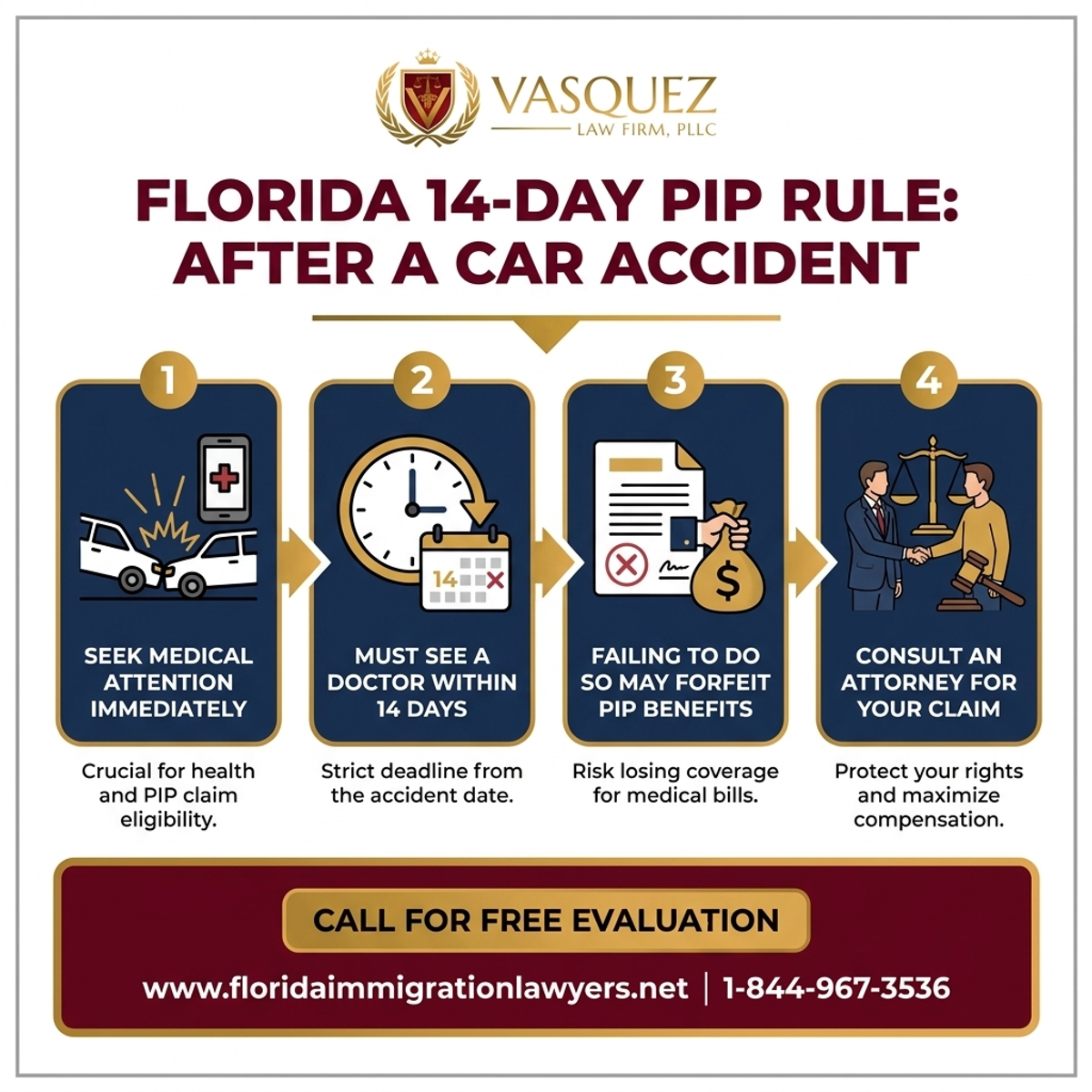
Step-by-Step Process — What to Do After a Florida Car Accident: 14-Day PIP Rule
Follow all medical advice, attend all appointments, and complete any prescribed therapies. Gaps in treatment can be used by insurance companies to argue that your injuries are not serious or not related to the accident.
Navigating Insurance Companies: A Careful Approach
Dealing with insurance adjusters can be tricky. Remember, their primary goal is to minimize payouts, not to ensure you receive maximum compensation. Proceed with caution and knowledge.
1. Report the Accident Promptly
Notify your own insurance company of the accident as soon as possible, even if you weren't at fault. Most policies require prompt notification. However, keep your initial statement brief and factual. Do not speculate or admit fault.
2. Be Wary of Early Settlement Offers
The at-fault driver's insurance company may contact you quickly with a lowball settlement offer, especially if your injuries aren't immediately apparent. They hope you'll accept before you fully understand the extent of your injuries or the long-term costs. Never accept an offer or sign any releases without first consulting with an attorney.
3. Limit Your Statements
You are generally not obligated to provide a recorded statement to the other driver's insurance company. If they insist, politely decline and refer them to your attorney. Anything you say can be twisted and used against you. Even with your own insurer, be factual and avoid detailed discussions about fault or injury severity until you've consulted legal counsel and had a full medical evaluation.
4. Understand Your Policy and the Other Driver's
Familiarize yourself with your own insurance policy's coverage limits and terms. Your attorney can help you understand how your PIP, uninsured/underinsured motorist (UM/UIM), and collision coverages apply. They can also investigate the other driver's insurance to determine potential avenues for recovery beyond your PIP.
Why Hire a Florida Car Accident Attorney?
While you might think you can handle a car accident claim on your own, the reality is that insurance companies have vast resources and experienced adjusters whose job it is to pay you as little as possible. A skilled car accident attorney levels the playing field.
How an Attorney Helps
- Investigation: Your attorney will conduct a thorough investigation, gathering evidence, interviewing witnesses, and consulting with experts to build a strong case.
- Medical Care Guidance: They can help you find appropriate medical specialists and ensure your injuries are properly documented.
- Negotiation: Attorneys are expert negotiators, dealing directly with insurance companies to secure a fair settlement that covers all your damages.
- Litigation: If a fair settlement cannot be reached, your attorney is prepared to take your case to court, advocating fiercely on your behalf.
- Understanding Complex Laws: They navigate Florida's complex traffic laws, PIP regulations, and personal injury statutes, ensuring no deadlines are missed and all legal avenues are explored.
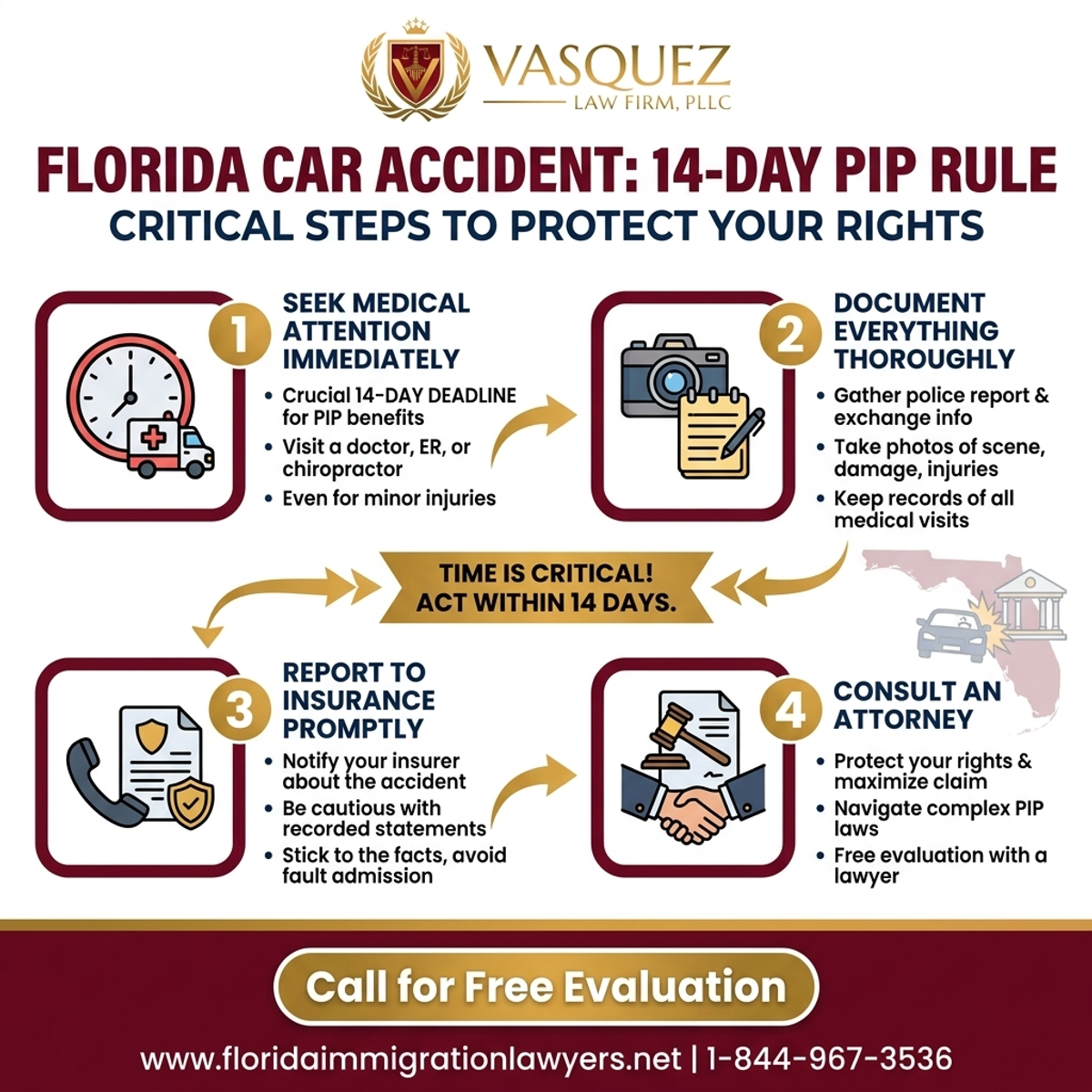
Key Statistics — What to Do After a Florida Car Accident: 14-Day PIP Rule
Most personal injury attorneys work on a contingency fee basis, meaning you pay nothing upfront, and they only get paid if they win your case. This makes legal representation accessible to everyone, regardless of their financial situation. Don't delay; the sooner you involve an attorney, the better your chances of a successful outcome. Our dedicated attorneys are ready to review your case and provide expert guidance.
Beyond Car Accidents: Our Firm's Commitment to Comprehensive Legal Support
While navigating the aftermath of a car accident in Florida requires specialized knowledge and dedicated advocacy, our commitment to justice extends far beyond personal injury claims. We understand that life's challenges can take many forms, and individuals often require robust legal support across a spectrum of issues. Our firm prides itself on offering comprehensive legal services, ensuring that our clients receive expert guidance and zealous representation, no matter the complexity of their situation.
The legal landscape, whether dealing with the intricacies of Florida's PIP laws or the daunting federal regulations governing immigration, demands a meticulous and empathetic approach. Just as we fight tirelessly for car accident victims to secure fair compensation, we also stand as staunch advocates for those facing other significant legal battles. For instance, the journey to a new life in the United States can be fraught with legal hurdles. Our team is deeply committed to assisting individuals and families with various immigration matters, from visa applications and green card processes to naturalization.
Furthermore, we recognize the profound importance of protecting vulnerable populations. Individuals seeking safety and freedom from persecution often face an arduous path. Our firm provides critical legal assistance to those pursuing asylum, helping them navigate complex international and domestic laws to find refuge and build new lives. Similarly, the threat of removal from the country can be devastating. We offer robust deportation defense services, fighting to protect our clients' rights and keep families together in the face of challenging legal proceedings.
Our holistic approach means that when you seek our help, you gain access to a team of professionals dedicated to understanding your unique circumstances and providing tailored legal strategies. We believe that everyone deserves access to high-quality legal representation, whether they've been injured in an accident, are striving for a new beginning, or are defending their right to remain in the country. Our diverse expertise ensures that we can be a trusted partner through various legal challenges, always with the goal of achieving the best possible outcome for you. If you have questions about any of our practice areas or need legal assistance, don't hesitate to contact us today.
Types of Damages You Can Recover After a Florida Car Accident
Beyond immediate medical bills, a car accident can lead to a range of financial and non-financial losses.
Sources and References
- U.S. Citizenship and Immigration Services (USCIS)
- Executive Office for Immigration Review (EOIR)
- U.S. Department of State - Bureau of Consular Affairs
- Immigration and Nationality Act (INA), 8 U.S.C. Chapter 12
Do Not Navigate This Process Alone
Our experienced immigration attorneys are ready to fight for you. Get a free, confidential consultation today.
Se Habla Español
Frequently Asked Questions
Florida Immigration Lawyers
Immigration Attorney | Founder, Vasquez Law Firm
U.S. Air Force veteran and immigration attorney with thousands of cases resolved. J.D., NCCU School of Law. AILA member. Admitted to the 4th, 5th, and 11th Circuit Courts.
Available 24/7 - Free Evaluations
Related Legal Services
Our Florida immigration attorneys can help you with Florida car accident claims, slip-and-fall premises liability and Florida wrongful death claims. Call today at 1-844-967-3536 for a free consultation.
Related Links
Related Topics
Free Legal Consultation
Discuss your case with our experienced attorneys. We're available 24/7.
Se Habla Español - Estamos aquí para ayudarle.
Related Articles
Florida Truck Accident: I-4 Multi-Party Crash Claims
A Florida truck accident on I-4, especially an 18-wheeler crash involving multiple parties, presents unique and complex legal challenges. Victims face severe injuries and a difficult path to compensation due to intricate federal FMCSA regulations and Florida's specific personal injury laws, including modified comparative negligence. This guide explains how multi-party liability works, the critical role of FMCSA rules, essential steps to take after a crash, and the documentation needed for a strong claim. Discover common mistakes to avoid and when to seek immediate legal counsel to protect your rights. Our firm, led by Harold Estrada-Rodriguez, Florida Bar No. 1041171, offers compassionate representation on a no recovery, no fee basis for truck accident victims across Florida, including Orlando, Kissimmee, and Fort Lauderdale areas.
Florida Car Accident: Understand the 14-Day PIP Rule
After a car accident in Florida, understanding the 14-day PIP rule is crucial. Learn what steps to take to ensure you receive the benefits you're entitled to. Call Florida Immigration Lawyers for a free consultation.
Truck Accident on I-4? Florida 18-Wheeler Crash Claims
Injured in a Florida 18-wheeler crash on I-4? Our Orlando & Kissimmee personal injury lawyers handle complex truck accident cases. Learn your rights. Contact
Florida Rear-End Collision: Whiplash & Herniated Disc Claims
Rear-end collisions in Florida often result in whiplash and herniated discs, leading to significant pain and medical expenses. Understanding your rights and the claims process is crucial for securing compensation. Key points include the importance of medical documentation, Florida's no-fault insurance laws, and the role of comparative negligence in claims.