Florida Truck Accident: I-4 Multi-Party Crash Claims
A Florida truck accident on I-4, especially an 18-wheeler crash involving multiple parties, presents unique and complex legal challenges. Victims face severe injuries and a difficult path to compensation due to intricate federal FMCSA regulations and Florida's specific personal injury laws, including modified comparative negligence. This guide explains how multi-party liability works, the critical role of FMCSA rules, essential steps to take after a crash, and the documentation needed for a strong claim. Discover common mistakes to avoid and when to seek immediate legal counsel to protect your rights. Our firm, led by Harold Estrada-Rodriguez, Florida Bar No. 1041171, offers compassionate representation on a no recovery, no fee basis for truck accident victims across Florida, including Orlando, Kissimmee, and Fort Lauderdale areas.

Navigating a Florida truck accident claim, especially after an 18-wheeler crash on a busy highway like I-4, involves complex legal challenges. These incidents often involve multiple parties, including the truck driver, trucking company, cargo loaders, and even vehicle manufacturers. Understanding federal regulations from the Federal Motor Carrier Safety Administration (FMCSA) is crucial, as violations can establish negligence. Victims must act quickly to preserve evidence and understand Florida's specific personal injury laws, such as the modified comparative negligence rule under §768.81, Florida Statutes. Seeking legal counsel from an experienced attorney is vital to identify all liable parties and maximize compensation.
- Truck accidents often involve multiple liable parties beyond the driver.
- FMCSA regulations dictate safety standards for commercial vehicles.
- Florida law, including §768.81, governs negligence and compensation.
- Prompt action and evidence collection are critical for a strong claim.
- An attorney can help navigate complex laws and pursue fair compensation.
A sudden, jarring impact on a Florida highway can change your life in an instant. Imagine you're driving on I-4 near Orlando or Kissimmee, perhaps commuting to work or heading to a family event, when an 18-wheeler truck causes a devastating multi-vehicle collision. The aftermath is chaotic: mangled metal, emergency sirens, and the terrifying realization that your life, and potentially your future, has been irrevocably altered. Truck accidents, especially those involving large commercial vehicles, are far more complex than typical car crashes. They often result in severe injuries, extensive property damage, and a labyrinth of legal questions that can overwhelm even the most resilient individuals.
Understanding your rights and the intricate legal landscape following such an incident is paramount. Who is responsible when an 18-wheeler causes a pile-up on I-4, involving multiple cars and possibly multiple commercial entities? What role do federal regulations play? And how do Florida's specific personal injury laws impact your ability to recover compensation? This comprehensive guide will explore the complexities of multi-party truck accident claims in Florida, focusing on the critical role of FMCSA regulations and the steps you need to take to protect your interests.
At Florida Immigration Lawyers, we understand the profound impact a serious injury can have on your life and the lives of your loved ones. Our dedicated team, led by Harold Estrada-Rodriguez, Florida Bar No. 1041171, is here to provide compassionate and effective legal representation for personal injury victims across Florida. If you or a loved one has been involved in a truck accident, do not hesitate to seek professional guidance. Call Florida Immigration Lawyers at 1-844-967-3536 for a free consultation to discuss your specific situation and explore your legal options.
The Devastating Reality of 18-Wheeler Crashes on Florida's I-4
Florida's Interstate 4, a major artery connecting cities like Tampa, Orlando, and Daytona Beach, is notorious for its heavy traffic and frequent accidents. When an 18-wheeler, weighing up to 80,000 pounds, is involved in a collision on such a congested highway, the consequences are often catastrophic. Unlike passenger vehicles, commercial trucks require significantly longer stopping distances, have larger blind spots, and can cause immense kinetic energy upon impact. This disparity in size and weight often leads to severe injuries for occupants of smaller vehicles, including traumatic brain injuries, spinal cord damage, broken bones, and even wrongful death.
The sheer force of these collisions can turn a single incident into a multi-party pile-up, complicating liability determinations. The high volume of commercial traffic, combined with tourist activity and construction zones, makes I-4 a particularly hazardous stretch of road for truck accidents. Victims in areas like Orlando, Kissimmee, and even farther south towards Fort Lauderdale, often face similar challenges when dealing with the aftermath of large truck collisions. The economic impact can be staggering, encompassing medical bills, lost wages, and long-term rehabilitation costs. Beyond the financial burden, victims often suffer immense emotional distress and a diminished quality of life. Understanding the unique dangers and legal landscape of these crashes is the first step toward recovery.
Why I-4 Truck Accidents Are So Complex
Several factors contribute to the complexity of I-4 truck accidents. The high speed limits, frequent lane changes, and the sheer number of vehicles create an environment where small errors can have massive repercussions. When a truck driver is fatigued, distracted, or operating under the influence, the danger escalates exponentially. Furthermore, the commercial nature of these vehicles introduces layers of federal and state regulations that do not apply to standard car accidents. This means that a thorough investigation must go beyond just the driver's actions and delve into the policies and practices of the trucking company, cargo loaders, and even maintenance providers. The scene itself can be overwhelming, making it difficult for victims to know what information to gather or what steps to take in the immediate aftermath.
Understanding Multi-Party Liability in Florida Truck Crashes
One of the most distinguishing features of truck accident claims is the potential for multi-party liability. Unlike a typical car accident where fault usually rests with one or two drivers, an 18-wheeler crash can involve numerous entities. Identifying all responsible parties is crucial for ensuring victims receive full compensation for their injuries and losses. This process requires an in-depth investigation into various aspects of the accident, from driver logs to vehicle maintenance records.
In Florida, our legal system allows victims to pursue claims against any party whose negligence contributed to the accident. This concept is particularly relevant in truck accident cases. For example, if a truck driver caused the accident due to fatigue, the driver themselves might be liable. However, if the trucking company pressured the driver to exceed Hours-of-Service limits, or failed to adequately train or supervise them, the company could also share responsibility. This principle of vicarious liability holds employers accountable for the negligent actions of their employees while on the job. Furthermore, if the truck had a faulty brake system due to a manufacturing defect, or if the cargo was improperly loaded causing the truck to become unstable, other parties such as the manufacturer or the cargo loader could be brought into the lawsuit.
Potential Defendants in a Truck Accident Claim:
- The Truck Driver: For negligence such as distracted driving, speeding, fatigue, or driving under the influence.
- The Trucking Company: For negligent hiring, training, supervision, maintenance, or pressuring drivers to violate regulations.
- The Cargo Loader/Shipper: If improperly loaded cargo shifted, causing the truck to lose control.
- The Truck or Parts Manufacturer: For defects in the truck's design, manufacturing, or specific components (e.g., brakes, tires).
- Maintenance Providers: If negligent maintenance contributed to mechanical failure.
- Other Drivers: If another passenger vehicle's negligence also contributed to the multi-vehicle crash.
Florida follows a modified comparative negligence rule, codified in §768.81, Florida Statutes. This means that if you are found to be partially at fault for the accident, your compensation will be reduced by your percentage of fault. However, if your fault is determined to be 50% or greater, you may be barred from recovering damages. This rule makes it even more critical to have an attorney who can skillfully argue your case and minimize any perceived fault on your part, especially in complex multi-party scenarios on highways like I-4.
The Critical Role of FMCSA Regulations in 18-Wheeler Accidents
The Federal Motor Carrier Safety Administration (FMCSA) is a division of the U.S. Department of Transportation (DOT) responsible for regulating the trucking industry. Their mission is to reduce crashes, injuries, and fatalities involving large trucks and buses. These extensive regulations, found in Title 49 of the Code of Federal Regulations (CFR), cover nearly every aspect of commercial trucking, from driver qualifications and hours of service to vehicle maintenance and hazardous materials transportation. Violations of these FMCSA rules are often a key factor in establishing negligence in truck accident cases.
For instance, FMCSA regulations dictate strict Hours-of-Service (HOS) rules, limiting how long a truck driver can operate without rest. A common violation involves drivers exceeding these limits, leading to fatigue-related accidents. If a truck driver involved in an I-4 crash was found to be in violation of HOS rules, it could be strong evidence of negligence. Similarly, regulations cover drug and alcohol testing for commercial drivers, vehicle inspection and maintenance requirements (49 CFR Part 396), and even the proper securing of cargo (49 CFR Part 392.9). A failure to comply with any of these rules can indicate a breach of the standard of care expected from commercial carriers and their drivers.
When investigating a truck accident, attorneys will meticulously examine various records to uncover potential FMCSA violations. These include driver logs (Electronic Logging Devices or ELDs), vehicle maintenance records, drug and alcohol test results, and the trucking company's safety ratings. Evidence of a systemic failure by a trucking company to adhere to FMCSA standards can lead to significant liability. This is why it is so important to have a legal team that understands these complex federal regulations and how to apply them to your specific accident case. Holding trucking companies accountable for regulatory non-compliance not only helps victims but also promotes greater safety on our roads, including Florida's busy I-4 corridor.
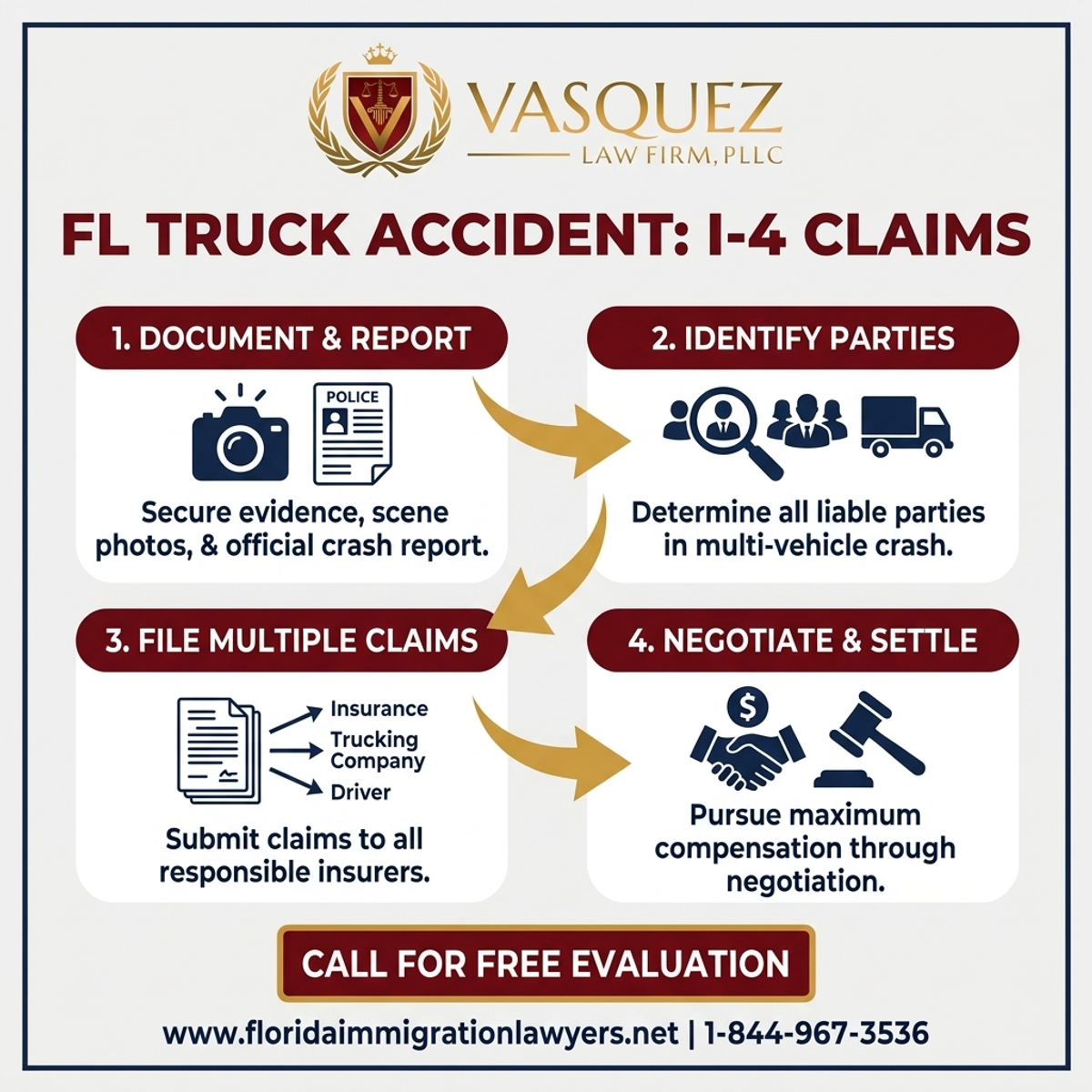
Step-by-Step Process — Florida Truck Accident: I-4 Multi-Party Crash Claims
Do not navigate this complex process alone. Trucking companies and their insurers have vast resources. Contact Florida Immigration Lawyers today at 1-844-967-3536 for a free consultation to protect your rights and pursue the compensation you deserve.
Steps to Take After a Florida Truck Accident: A Step-by-Step Guide
The moments immediately following an 18-wheeler crash on a highway like I-4 are critical. Your actions can significantly impact the outcome of any future personal injury claim. While your safety and well-being are the top priority, if you are able, taking these steps can help preserve vital evidence and protect your legal rights.
- Ensure Safety and Call 911: Move to a safe location if possible, but stay at the scene. Immediately call 911 to report the accident. Request police and emergency medical services. Even if you feel fine, it's crucial to be checked by paramedics.
- Document the Scene: If your condition allows, take photos and videos of everything: vehicle damage, road conditions, traffic signs, skid marks, debris, the truck's company name and DOT number, and any visible injuries. Note the location, time, and weather.
- Exchange Information: Collect contact and insurance information from all drivers involved, including the truck driver, and any passengers or witnesses. Get the truck's license plate number, VIN, and the trucking company's name and DOT number.
- Do Not Admit Fault: Avoid discussing the accident's specifics with anyone other than law enforcement and your attorney. Never admit fault, even if you think you might be partially to blame. Statements made at the scene can be used against you.
- Seek Medical Attention: Even if you decline ambulance transport, see a doctor or visit an urgent care facility as soon as possible. Some injuries, like whiplash or internal bleeding, may not manifest immediately. Timely medical documentation is crucial for your claim. Remember Florida's Personal Injury Protection (PIP) law, §627.736, which generally requires initial medical treatment within 14 days of the accident to qualify for benefits.
- Notify Your Insurance Company: Report the accident to your own insurance company promptly. However, be cautious about providing detailed statements without first consulting an attorney.
- Contact an Attorney: The complexity of truck accidents, especially those with multiple parties and federal regulations, makes legal representation indispensable. An experienced Florida personal injury attorney can guide you through the process, investigate the crash, identify liable parties, and handle communications with insurance companies.
Following these steps can significantly strengthen your truck accident claim. Remember, time is of the essence, as evidence can disappear and witnesses' memories can fade. Florida's statute of limitations for personal injury claims, as per §95.11(4)(a), is generally two years from the date of the accident (for incidents after March 24, 2023), making prompt action vital.
Essential Documentation for Your Truck Accident Claim
Building a strong truck accident claim requires a meticulous collection of evidence and documentation. The more comprehensive your records, the better positioned you will be to prove negligence and the extent of your damages. Here is a checklist of essential documents and information your attorney will need to pursue your claim effectively:
- Police Accident Report: This official document provides crucial details about the accident, including driver information, witness statements, and initial findings by law enforcement.
- Medical Records and Bills: All documentation related to your injuries, diagnoses, treatments, prescriptions, and therapy. This includes hospital records, doctor's notes, and itemized medical bills.
- Proof of Lost Wages: Pay stubs, employment verification, tax returns, and letters from your employer detailing time missed from work and lost income.
- Vehicle Repair Estimates or Total Loss Statement: Documentation from mechanics or insurance adjusters detailing the damage to your vehicle and the cost of repairs or its fair market value if totaled.
- Photos and Videos: Any visual evidence you collected at the scene, including vehicle damage, road conditions, debris, and injuries.
- Driver's Logbooks/ELD Data: These records, particularly Electronic Logging Device (ELD) data, provide critical information about the truck driver's hours of service, breaks, and driving patterns.
- Trucking Company Records: This can include driver qualification files, maintenance logs for the truck, safety records, and insurance policies.
- Witness Statements: Contact information and statements from anyone who witnessed the accident.
- Personal Journal: A detailed log of your pain levels, daily limitations, emotional distress, and how the injuries impact your life.
- Correspondence with Insurance Companies: Keep copies of all communications, emails, and letters exchanged with any insurance adjuster.
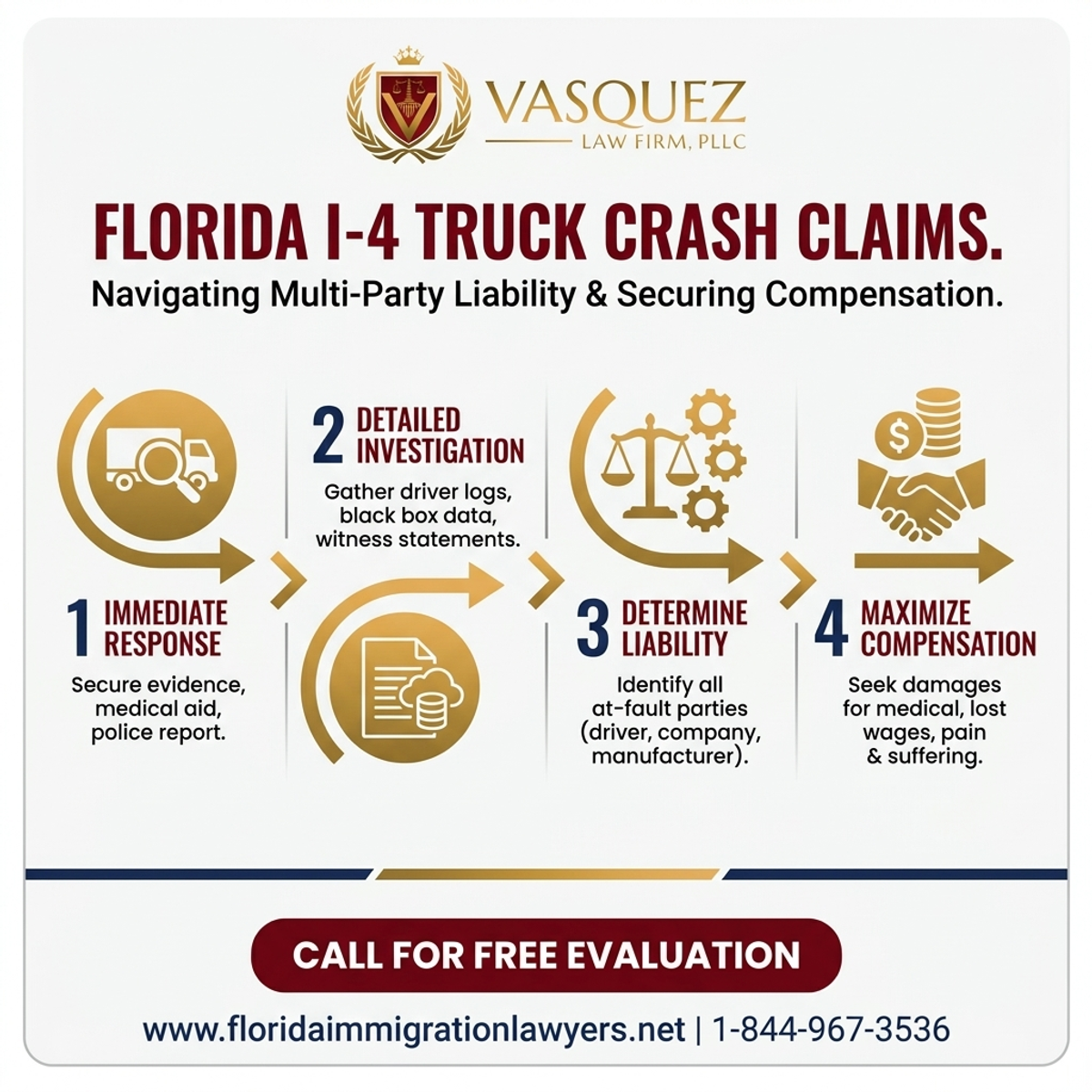
Key Statistics — Florida Truck Accident: I-4 Multi-Party Crash Claims
Gathering these documents can be a daunting task, especially while recovering from serious injuries. An experienced personal injury attorney in Florida can assist you in obtaining these records, including subpoenas for trucking company documents and expert testimony, to build a compelling case on your behalf. This thorough approach is essential when dealing with powerful trucking companies and their aggressive insurance adjusters.
Navigating the Legal Timeline and Compensation Process
The legal process following a severe Florida truck accident, particularly on a busy corridor like I-4, can be lengthy and complex. Understanding the typical timeline and what to expect can help manage your expectations and prepare you for the journey ahead. While every case is unique, a general framework involves several distinct stages, from initial investigation to potential settlement or trial.
Typical Timeline for a Truck Accident Claim:
- Immediate Aftermath (Days to Weeks): This includes seeking medical attention, reporting the accident, and beginning initial evidence collection. Your attorney will send spoliation letters to preserve evidence (e.g., truck data, driver logs).
- Investigation and Demand (Weeks to Months): Your attorney will conduct a thorough investigation, gather all necessary documents (medical records, police reports, FMCSA data), and establish liability. Once your medical treatment is complete or stabilized, a demand package is sent to the at-fault party's insurance company.
- Negotiation (Months): The insurance company will review the demand and likely make a low initial settlement offer. Your attorney will negotiate on your behalf, presenting a strong case for fair compensation. Many cases settle during this phase.
- Litigation (Months to Years): If a fair settlement cannot be reached, a lawsuit may be filed. This initiates the litigation phase, which includes discovery (exchanging information, depositions), mediation (attempting to settle with a neutral third party), and potentially trial. The 9th Judicial Circuit Court, serving Orange and Osceola counties, often handles such cases in the Orlando/Kissimmee area.
- Trial and Verdict (If Necessary): If mediation fails, the case proceeds to trial. A judge or jury will hear the evidence and render a verdict. This is the longest and most resource-intensive part of the process.
- Appeals (Post-Trial): Either party may appeal the verdict, which can further extend the timeline.
Compensation in a Florida truck accident claim can cover a wide range of damages. These typically include economic damages such as medical expenses (past and future), lost wages (past and future), and property damage. Non-economic damages compensate for pain and suffering, emotional distress, loss of enjoyment of life, and disfigurement. In cases of egregious negligence, punitive damages may also be sought, though they are rare and have specific legal requirements. Our firm has experience with cases across Florida, including those impacting Fort Lauderdale residents, and understands the nuances of local legal proceedings.
Cost Factors and Attorney Fees in Truck Accident Cases
Concerns about legal costs often deter accident victims from seeking the representation they desperately need. However, in Florida personal injury cases, including complex truck accident claims, most attorneys work on a contingency fee basis. This means that you, as the client, pay no upfront fees or hourly charges. Our firm operates on a no recovery, no fee basis. You only pay attorney fees if we successfully secure compensation for you through a settlement or a favorable verdict at trial.
A contingency fee is typically a percentage of the total compensation recovered. This percentage is agreed upon at the outset of your case and is clearly outlined in a written retainer agreement. This arrangement allows victims, regardless of their financial situation, to pursue justice against powerful trucking companies and their insurers without added financial stress. It aligns our interests with yours: our success is directly tied to your success.
What is Included in a Contingency Fee Agreement?
- Attorney Fees: The percentage of the settlement or award that goes to your legal team.
- Case Costs and Expenses: These are separate from attorney fees and include out-of-pocket expenses incurred during the litigation process. Examples include court filing fees, deposition costs, expert witness fees, obtaining medical records, private investigator fees, and other administrative costs. These expenses are typically reimbursed from the settlement or award before attorney fees are calculated.
It's important to understand that while attorney fees are contingent upon success, case costs and expenses are usually the client's responsibility, regardless of the outcome. However, most personal injury firms, including Florida Immigration Lawyers, will advance these costs on your behalf and only seek reimbursement from the final settlement or award. This ensures that you are not burdened with out-of-pocket expenses during your recovery. Our goal is to make quality legal representation accessible and stress-free for victims of truck accidents across Florida.
Common Mistakes to Avoid After a Florida Truck Accident
After a traumatic truck accident, it's easy to make missteps that could jeopardize your personal injury claim. Being aware of these common mistakes can help you protect your rights and strengthen your case.
- Failing to Seek Immediate Medical Attention: Delaying medical evaluation can not only harm your health but also allow insurance companies to argue that your injuries were not caused by the accident or are not as severe as claimed.
- Not Documenting the Scene Thoroughly: Relying solely on the police report can be a mistake. Take your own photos and videos of the scene, vehicle damage, and any visible injuries from multiple angles.
- Admitting Fault or Apologizing: Any statement that could be interpreted as an admission of fault, even a simple apology, can be used against you by insurance adjusters to reduce or deny your claim. Stick to the facts.
- Giving a Recorded Statement to Insurance Companies Without Legal Counsel: Insurance adjusters, even your own, are not on your side. Their goal is to minimize payouts. Providing a recorded statement without an attorney's guidance can lead to misinterpretations or traps that harm your case.
- Signing Documents Without Reviewing Them With an Attorney: Never sign anything from an insurance company, including medical releases or settlement offers, without having your attorney review it first. You could be waiving crucial rights or accepting a lowball offer.
- Not Following Through with Medical Treatment: Gaps in medical treatment can signal to insurance companies that your injuries are not serious or that you have recovered. Consistently follow your doctor's recommendations and attend all appointments.
- Communicating with the Trucking Company Directly: Trucking companies and their legal teams are highly sophisticated. Any direct communication from you could be used to gather information against your claim. Let your attorney handle all communications.
- Delaying Legal Action: Florida has a statute of limitations for personal injury claims (§95.11(4)(a)). Waiting too long can mean losing your right to file a lawsuit altogether. Evidence also degrades over time.
- Underestimating the Value of Your Claim: Truck accident injuries are often severe and have long-term impacts. Without an attorney, you might undervalue your future medical needs, lost earning capacity, and pain and suffering.
- Discarding Damaged Property or Clothing: Keep any clothing, personal items, or even parts of your vehicle that were damaged in the accident, as they can serve as physical evidence.
When to Call a Lawyer After a Florida Truck Accident
The decision to hire an attorney after a truck accident, especially a complex 18-wheeler crash on I-4 involving multiple parties, is one of the most important choices you will make. While some minor car accidents might be manageable without legal representation, a truck accident is almost never one of them. The stakes are simply too high, and the legal landscape too intricate, to navigate alone. You should contact an experienced Florida personal injury lawyer as soon as possible after receiving medical attention.
Here are specific scenarios and warning signs that strongly indicate you need immediate legal assistance:
- Serious Injuries: If you or a loved one sustained severe injuries requiring extensive medical treatment, hospitalization, or long-term care, an attorney is essential to ensure all current and future medical costs are covered.
- Multi-Party Accident: When more than two vehicles or multiple commercial entities are involved, determining liability becomes incredibly complex. An attorney can investigate and identify all responsible parties.
- Trucking Company or Insurer Contact: If the trucking company's representatives or their insurance adjusters contact you, it's a clear sign you need legal counsel. They are not looking out for your best interests.
- FMCSA Violations: If you suspect the truck driver or company violated federal trucking regulations, an attorney can launch an investigation to uncover these critical details.
- Disputed Liability: If the other party or their insurance company disputes who was at fault, an attorney can gather evidence and build a strong case to prove negligence.
- Unfair Settlement Offers: Insurance companies frequently offer lowball settlements early on. An attorney can evaluate the true value of your claim and negotiate for fair compensation.
- Wrongful Death: In the tragic event of a fatality, a wrongful death claim under Florida Statutes §768.16-26 requires specialized legal expertise to ensure surviving family members receive justice and compensation.
At Florida Immigration Lawyers, Harold Estrada-Rodriguez, Florida Bar No. 1041171, provides experienced and dedicated legal representation for personal injury victims throughout Florida. We understand the unique challenges posed by truck accident cases, whether they occur on I-4, the Turnpike, or other major roadways. We handle the legal complexities so you can focus on your recovery. Remember, there's no recovery, no fee, so you have nothing to lose by seeking our professional guidance.
Reviewed By
This article was reviewed for Florida legal accuracy by Harold Estrada-Rodriguez, Florida Bar No. 1041171, the attorney responsible for personal injury matters at Florida Immigration Lawyers. Personal injury representation in Florida only. No recovery, no fee.
About Florida Immigration Lawyers
Florida Immigration Lawyers is a dedicated legal practice proudly serving communities across Florida, including Orlando, Kissimmee, and the surrounding areas. While our name reflects our deep commitment to immigration law, our firm also provides robust representation for victims of personal injury. All personal injury matters are handled by Harold Estrada-Rodriguez, Florida Bar No. 1041171, an attorney with a strong commitment to justice for accident victims. We understand that life's challenges can come in many forms, and we are here to offer comprehensive legal support when you need it most.
Our mission is to provide compassionate, effective, and client-focused legal services. We believe in empowering our clients by offering clear guidance and aggressive advocacy. Whether you're dealing with the aftermath of a devastating 18-wheeler crash on I-4 or navigating complex immigration processes, our team is equipped to help. We offer free consultations to discuss your case and are available 24/7 because we know legal issues don't adhere to business hours. For trusted legal counsel in Florida, visit floridaimmigrationlawyers.net or call us directly. We are here to help you achieve the best possible outcome.
Sources and References
- Florida Statutes §95.11(4)(a) - Limitations, Actions Other Than for Recovery of Real Property
- Florida Statutes §627.736 - Required Personal Injury Protection Benefits; Exclusions; Primary; When Incurred
- Florida Statutes §768.81 - Comparative Fault
- Florida Statutes Chapter 768 - Negligence
- U.S. Federal Motor Carrier Safety Administration (FMCSA)
- U.S. Department of Justice
- U.S. Department of State
- 49 CFR Part 390-399 - Federal Motor Carrier Safety Regulations
Related services: auto accident claims, wrongful death from truck collision.
This article provides general legal information and is not intended as legal advice. Every case is unique, and outcomes depend on specific facts and circumstances. Contact an attorney for advice about your particular situation.
If you've been injured in a truck accident on I-4 or anywhere in Florida, don't face the powerful trucking companies and their insurers alone. Our experienced personal injury team is ready to fight for your rights and help you secure the compensation you deserve. We offer free, confidential consultations to discuss your case and provide clear legal options. Call Florida Immigration Lawyers today at 1-844-967-3536. Se Habla Espanol - Estamos aqui para ayudarle.
If you need legal assistance, learn more about our Florida personal injury representation, or call us at 1-844-967-3536 for a free consultation.
Do Not Navigate This Process Alone
Our experienced immigration attorneys are ready to fight for you. Get a free, confidential consultation today.
Se Habla Español
Frequently Asked Questions
Florida Immigration Lawyers
Immigration Attorney | Founder, Vasquez Law Firm
U.S. Air Force veteran and immigration attorney with thousands of cases resolved. J.D., NCCU School of Law. AILA member. Admitted to the 4th, 5th, and 11th Circuit Courts.
Available 24/7 - Free Evaluations
Related Legal Services
Our Florida immigration attorneys can help you with Florida wrongful death claims, Florida personal injury attorney Harold Estrada-Rodriguez and free personal injury consultation. Call today at 1-844-967-3536 for a free consultation.
Related Links
Related Topics
Free Legal Consultation
Discuss your case with our experienced attorneys. We're available 24/7.
Se Habla Español - Estamos aquí para ayudarle.
Related Articles
What to Do After a Florida Car Accident: 14-Day PIP Rule
After a car accident in Florida, understanding the 14-day PIP rule is crucial. Learn the steps to take, including seeking medical attention within 14 days, documenting injuries, and consulting a personal injury attorney. Contact Florida Immigration Lawyers at 1-844-967-3536 for a free consultation.
Florida Car Accident: Understand the 14-Day PIP Rule
After a car accident in Florida, understanding the 14-day PIP rule is crucial. Learn what steps to take to ensure you receive the benefits you're entitled to. Call Florida Immigration Lawyers for a free consultation.
Truck Accident on I-4? Florida 18-Wheeler Crash Claims
Injured in a Florida 18-wheeler crash on I-4? Our Orlando & Kissimmee personal injury lawyers handle complex truck accident cases. Learn your rights. Contact
Florida Rear-End Collision: Whiplash & Herniated Disc Claims
Rear-end collisions in Florida often result in whiplash and herniated discs, leading to significant pain and medical expenses. Understanding your rights and the claims process is crucial for securing compensation. Key points include the importance of medical documentation, Florida's no-fault insurance laws, and the role of comparative negligence in claims.