Truck Accident on I-4? Florida 18-Wheeler Crash Claims
Injured in a Florida 18-wheeler crash on I-4? Our Orlando & Kissimmee personal injury lawyers handle complex truck accident cases. Learn your rights. Contact

A Florida 18-wheeler crash, especially on busy highways like I-4 near Tampa, involves complex legal challenges often with multiple responsible parties. These accidents differ significantly from standard car crashes due to the severe injuries, extensive damages, and strict federal regulations governing commercial vehicles. Identifying all potential defendants, such as the truck driver, trucking company, and maintenance providers, is crucial. Federal Motor Carrier Safety Administration (FMCSA) rules, like Hours of Service, play a vital role in determining liability. Seeking immediate medical attention and consulting an experienced personal injury attorney is essential to protect your rights and pursue fair compensation.
- 18-wheeler crashes involve complex liability.
- Multiple parties can be held responsible, not just the driver.
- FMCSA regulations are key to proving negligence.
- Injuries are often severe, requiring extensive medical care.
- A Florida personal injury lawyer is crucial for navigating these cases.
The roar of an 18-wheeler on Florida's highways, particularly congested stretches like I-4 through Tampa, Orlando, and Kissimmee, is a constant presence. While these commercial trucks are vital for our economy, they also pose immense risks. When a massive truck weighing tens of thousands of pounds collides with a passenger vehicle, the consequences are often catastrophic. Victims of a Florida truck accident face not only life-altering injuries and property damage but also a daunting legal battle against well-funded trucking companies and their insurers.
Navigating the aftermath of an 18-wheeler crash on I-4 can feel overwhelming. You might be grappling with severe pain, mounting medical bills, and lost wages, all while trying to understand how to seek justice. Unlike typical car accidents, commercial truck collisions involve a labyrinth of federal and state regulations, complex liability issues, and potentially multiple defendants. Understanding your rights and the unique aspects of these cases is crucial for securing the compensation you deserve.
This comprehensive guide will demystify the process of handling a Florida 18-wheeler crash claim. We will explore the role of FMCSA regulations, identify potential multi-party defendants, outline the steps of a personal injury claim, and discuss common pitfalls to avoid. If you or a loved one has been injured in a devastating truck accident on I-4 or anywhere in Florida, do not face this challenge alone. Call Florida Immigration Lawyers at 1-844-967-3536 for a free consultation with an experienced personal injury attorney today. We are here to help you understand your options and fight for your future.
The Unique Dangers of Florida 18-Wheeler Crashes on I-4
Florida's Interstate 4, a major artery connecting Tampa, Orlando, and Daytona Beach, is notorious for its heavy traffic and frequent construction zones. This environment significantly increases the risk of severe accidents, especially those involving large commercial trucks. An 18-wheeler, also known as a semi-truck or tractor-trailer, can weigh up to 80,000 pounds when fully loaded. This massive weight, combined with high speeds and sudden stops, creates an incredibly dangerous situation for smaller passenger vehicles.
The sheer size and momentum of these vehicles mean that even a minor lapse in judgment can lead to devastating outcomes. Common causes of truck accidents on I-4 and other Florida highways include driver fatigue, distracted driving (e.g., cell phone use), speeding, improper lane changes, aggressive driving, and driving under the influence. Additionally, mechanical failures due to inadequate maintenance, tire blowouts, or improperly secured cargo can trigger multi-vehicle pile-ups, making liability even more complicated.
Victims of these crashes often sustain catastrophic injuries such as traumatic brain injuries, spinal cord damage, severe fractures, internal organ damage, and even wrongful death. The medical costs associated with these injuries can be astronomical, requiring long-term care, rehabilitation, and adaptive equipment. Furthermore, the emotional and psychological toll, including PTSD and chronic pain, can profoundly impact a victim's quality of life. Understanding the unique dynamics of an I-4 crash involving an 18-wheeler is the first step in building a strong personal injury claim.
The aftermath of such an accident is typically chaotic. Emergency services, including the Florida Highway Patrol (FHP), will respond to secure the scene, assess injuries, and begin their preliminary investigation. However, their primary role is public safety and initial reporting, not necessarily gathering evidence for a civil lawsuit. This is where an experienced legal team becomes invaluable, initiating an independent investigation immediately to preserve critical evidence that could otherwise be lost.
Understanding FMCSA Regulations and Their Impact on Liability
Unlike standard vehicle accidents, 18-wheeler crashes are subject to a complex web of federal regulations enforced by the Federal Motor Carrier Safety Administration (FMCSA). These rules are designed to enhance safety and prevent commercial vehicle accidents. When a trucking company or driver violates these regulations, it often serves as strong evidence of negligence in a personal injury claim. Understanding these rules is paramount to building a successful case.
Key FMCSA regulations include Hours of Service (HOS) rules, which dictate how long a truck driver can operate their vehicle without rest. For instance, most property-carrying drivers are limited to 11 hours of driving within a 14-hour workday, followed by 10 consecutive hours off-duty. Violations of HOS rules are a common cause of driver fatigue, a leading factor in severe truck accidents. The FMCSA also mandates strict drug and alcohol testing for commercial drivers, ensuring they are fit to operate heavy machinery. You can review detailed regulations and safety initiatives directly on the FMCSA website.
Beyond driver conduct, FMCSA regulations cover vehicle maintenance and inspection requirements. Trucking companies are obligated to regularly inspect and maintain their fleet, keeping detailed records of repairs and inspections. Faulty brakes, worn tires, or defective lighting can all contribute to an accident, and a failure to adhere to maintenance standards can establish negligence. Furthermore, cargo securement rules dictate how freight must be loaded and secured to prevent shifting, which can cause rollovers or loss of control, as detailed in 49 CFR Part 393.100-393.136.
When an 18-wheeler crash occurs, our legal team will meticulously investigate whether any FMCSA regulations were violated. This involves examining the truck's black box data, driver logbooks (Electronic Logging Devices or ELDs), maintenance records, and the driver's employment history. Proving a direct link between a regulatory violation and the cause of the accident can significantly strengthen your claim for compensation. These regulations provide a clear standard of care that commercial trucking operations must meet, and any deviation can be a basis for liability.
Identifying Multi-Party Defendants in a Florida Truck Accident Claim
One of the most distinguishing features of a Florida 18-wheeler crash, especially on a busy corridor like I-4, is the potential for multiple liable parties. Unlike a typical car accident where liability might rest solely with one driver, a commercial truck accident can involve a complex web of individuals and entities. Identifying and holding all responsible parties accountable is crucial for maximizing your compensation and ensuring justice.
The most obvious defendant is typically the truck driver. Their negligence, whether due to fatigue, distraction, speeding, or impairment, is often a direct cause of the collision. However, the driver is rarely the sole party at fault. The trucking company that employs the driver is frequently a primary defendant. They can be held liable under various legal theories, including negligent hiring, negligent supervision, negligent training, negligent retention, or for failing to properly maintain their vehicles. They are also often vicariously liable for their driver's actions under the principle of "respondeat superior."
Other potential defendants include the owner of the truck or trailer, if different from the trucking company, and the cargo loader. If the cargo was improperly loaded or secured, leading to an unstable truck or shifting weight, the company responsible for loading could be held liable. Similarly, a maintenance company or an independent mechanic could be at fault if the accident was caused by faulty repairs or neglected maintenance. Even the manufacturer of a defective truck part (e.g., brakes, tires) could be a defendant in a product liability claim.
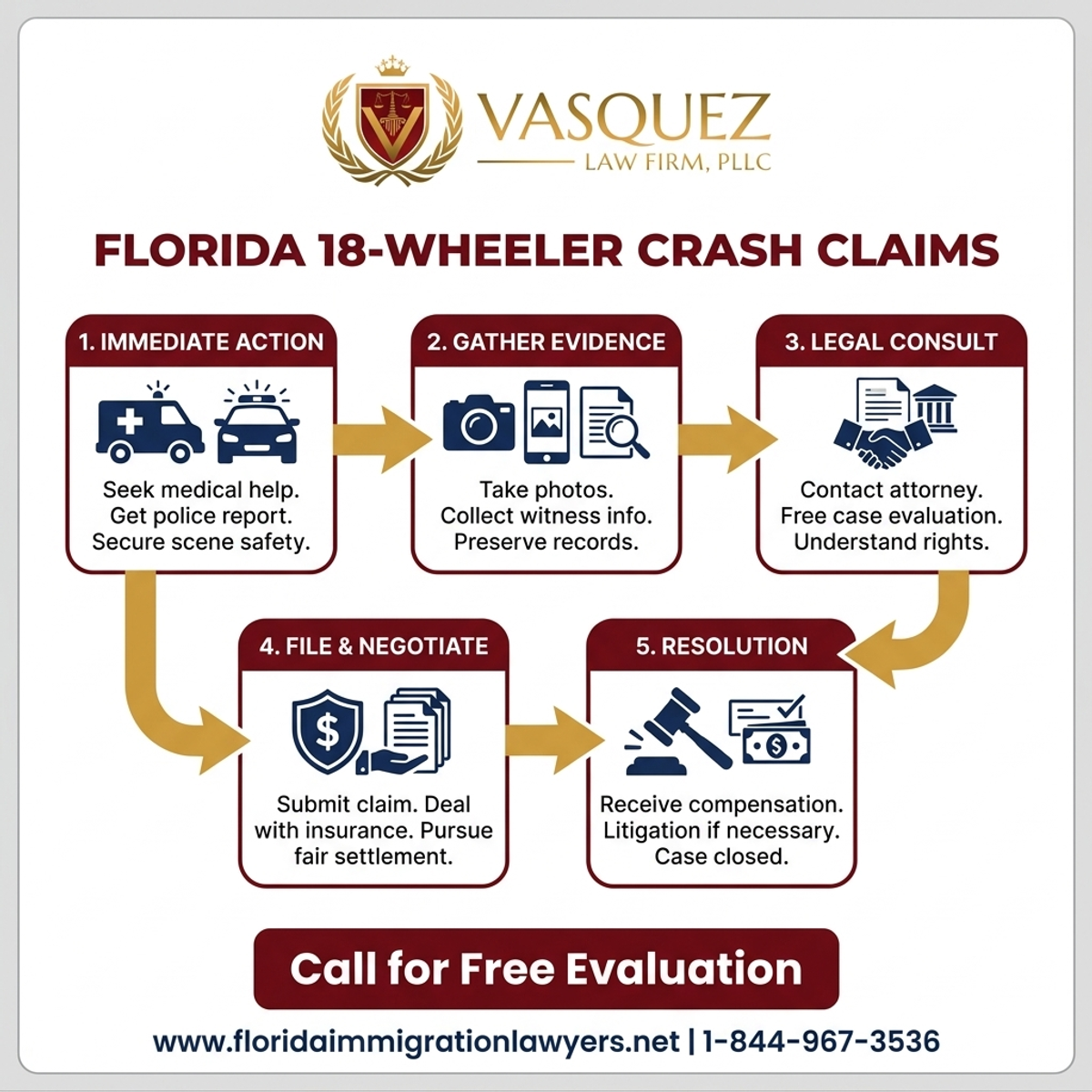
Step-by-Step Process — Truck Accident on I-4? Florida 18-Wheeler Crash Claims
In some cases, government entities responsible for road design, maintenance, or signage could bear partial responsibility if a road defect contributed to the I-4 crash. For example, if a poorly maintained road surface or inadequate warning signs in a construction zone led to the accident, the state or local government might be a defendant. However, pursuing claims against government entities involves specific legal hurdles, including sovereign immunity limitations as outlined in Florida Statute §768.28, which caps damages and requires specific notice procedures. Our legal team will conduct a thorough investigation to uncover every potential defendant and build a comprehensive case against them.
The Personal Injury Claim Process After a Florida 18-Wheeler Crash
Recovering from an 18-wheeler crash on I-4 is a long and arduous journey, both physically and legally. Understanding the steps involved in a personal injury claim can help you prepare for what lies ahead. The process typically begins immediately after the accident and can extend for months or even years, especially in complex multi-party cases.
- Immediate Actions & Medical Care: After ensuring your safety and calling 911, seek immediate medical attention, even if you feel fine. Many serious injuries, like whiplash or concussions, have delayed symptoms. Documenting your injuries from the outset is crucial for your claim. Follow all medical advice and keep detailed records of every visit, diagnosis, and treatment.
- Accident Investigation & Evidence Collection: Your attorney will launch an independent investigation. This involves collecting police reports, witness statements, accident scene photos/videos, truck black box data, driver logbooks (ELDs), maintenance records, and trucking company policies. We may also engage accident reconstruction experts to determine fault.
- Identifying All Liable Parties: As discussed, this is a critical step in 18-wheeler cases. Our team will meticulously research and identify all potential defendants, from the driver and trucking company to maintenance providers and cargo loaders.
- Calculating Damages: We will work with medical experts, vocational specialists, and economists to accurately assess the full extent of your damages. This includes current and future medical expenses, lost wages, loss of earning capacity, pain and suffering, emotional distress, and property damage.
- Demand Letter & Negotiation: Once your medical treatment is stable and your damages are quantified, a formal demand letter is sent to the at-fault parties' insurance companies. This letter outlines the facts, liability, and the compensation sought. Negotiations will ensue, often involving multiple rounds of offers and counteroffers.
- Filing a Lawsuit (Litigation): If negotiations do not result in a fair settlement, a personal injury lawsuit will be filed in the appropriate Florida court, such as the 9th Judicial Circuit Court serving Orange and Osceola counties (Orlando/Kissimmee). This initiates the litigation phase, which involves discovery (exchanging information), depositions (sworn testimonies), and potentially mediation or arbitration.
- Trial: A small percentage of cases proceed to trial. If your case goes to court, our attorneys will present your case to a jury, advocating fiercely for your rights and seeking a favorable verdict.
- Settlement or Verdict & Appeals: If successful, you will receive compensation either through a settlement agreement or a jury verdict. The losing party may have the right to appeal the decision.
Throughout this complex process, strict deadlines apply. Florida Statute §95.11(4)(a) generally sets the statute of limitations for personal injury claims at two years from the date of the accident. Missing this deadline can permanently bar you from seeking compensation. This is why prompt legal action is vital.
Document Checklist for Your Florida 18-Wheeler Crash Claim
Organizing crucial documents after an 18-wheeler crash is essential for building a strong personal injury claim. The more information you can provide to your attorney, the more efficiently they can investigate and advocate on your behalf. Here's a comprehensive checklist of documents and information you should gather:
- Police Report: The official report filed by the Florida Highway Patrol (FHP) or local law enforcement.
- Medical Records: All records related to your injuries, including ambulance reports, emergency room visits, doctor's notes, diagnostic test results (X-rays, MRIs), physical therapy records, and medication prescriptions.
- Medical Bills: Itemized statements for all medical treatments, hospital stays, prescriptions, and rehabilitation services.
- Proof of Lost Wages: Pay stubs, employment verification letters, income tax returns, or statements from your employer detailing missed work and lost income.
- Vehicle Repair Estimates/Bills: Documentation of the damage to your vehicle, repair costs, or total loss valuation.
- Photographs and Videos: Any images or footage taken at the accident scene, including vehicle damage, road conditions, skid marks, injuries, and surrounding areas.
- Witness Information: Names, phone numbers, and addresses of any eyewitnesses to the crash.
- Trucking Company Information: Name of the trucking company, truck number, and U.S. DOT number (often found on the side of the truck).
- Driver Information: Name, contact details, and insurance information of the truck driver.
- Insurance Policies: Your own auto insurance policy (including PIP and uninsured/underinsured motorist coverage) and any correspondence with your insurer.
- Personal Journal/Diary: A detailed account of your pain levels, daily limitations, emotional distress, and how the injuries impact your life.
- Communication Records: Any emails, letters, or notes from conversations with insurance adjusters, the trucking company, or other parties involved.
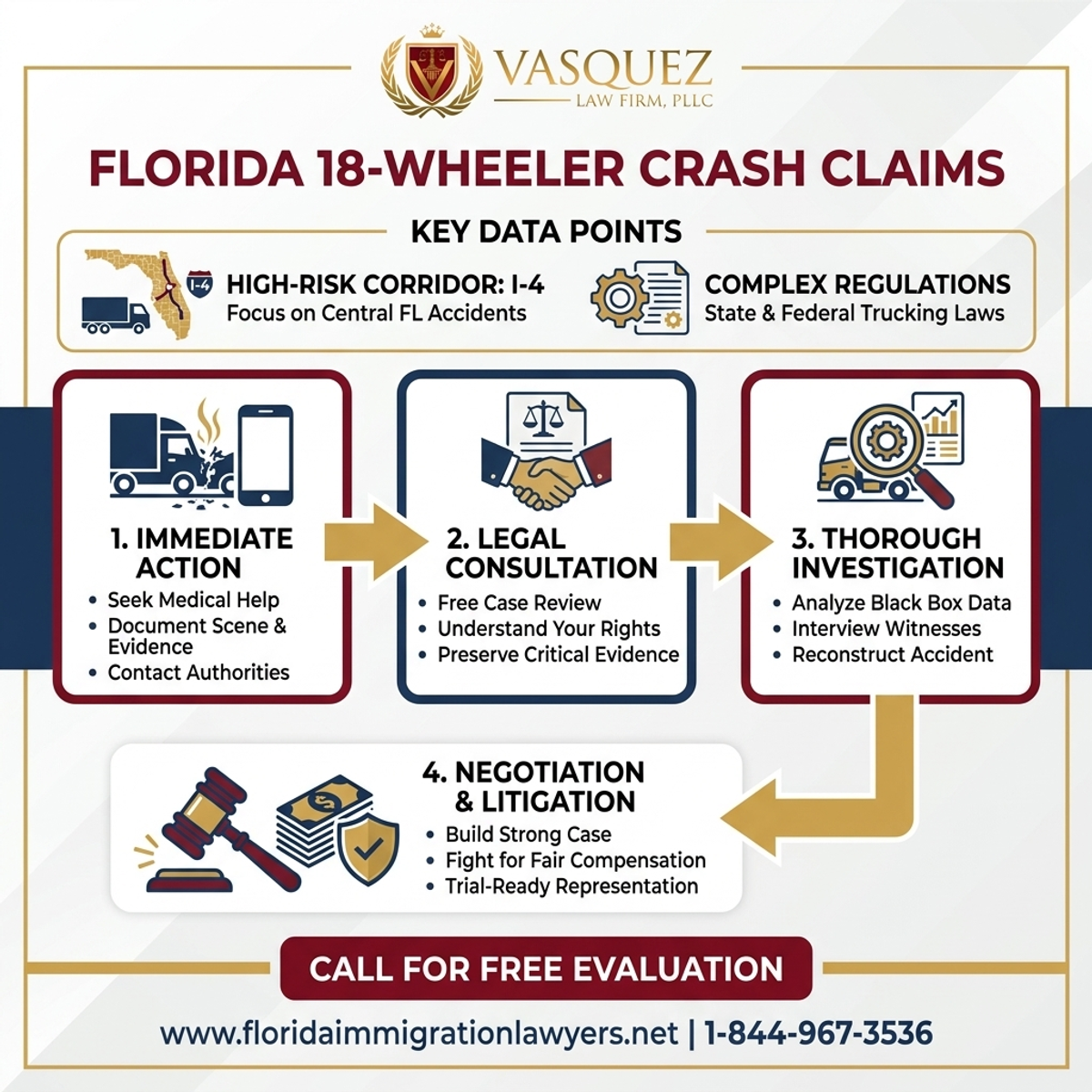
Key Statistics — Truck Accident on I-4? Florida 18-Wheeler Crash Claims
Even if you don't have all these documents immediately, gather what you can. Your attorney will assist you in obtaining the remaining necessary records through formal requests and legal discovery processes. Having these documents readily available streamlines the initial stages of your case and provides a clear picture of the incident and its aftermath.
Timeline and Processing Expectations for Florida Truck Accident Claims
The timeline for resolving a Florida 18-wheeler crash claim can vary significantly depending on the complexity of the accident, the severity of injuries, the number of liable parties, and the willingness of insurance companies to negotiate fairly. Unlike simpler car accidents, these cases rarely conclude quickly.
Initial Phase (First 1-3 Months): This period focuses on immediate medical treatment, initial investigation, and evidence preservation. You'll be focusing on your recovery while your attorney gathers police reports, witness statements, and initiates requests for truck data. Establishing the full extent of your injuries and the necessary medical treatment is paramount. During this time, your Personal Injury Protection (PIP) coverage (mandated by Florida Statute §627.736) will typically cover 80% of your medical bills up to $10,000, provided you seek initial medical treatment within 14 days of the accident. However, severe 18-wheeler crash injuries will far exceed PIP limits, necessitating pursuit of claims against other liable parties.
Treatment and Investigation Phase (3-12+ Months): This is often the longest phase. Your medical treatment continues, potentially involving specialists, surgeries, and rehabilitation. Your attorney's investigation deepens, involving accident reconstructionists, expert witnesses, and detailed discovery from the trucking company. This includes reviewing driver logs, maintenance records, and potentially taking depositions of key personnel. The goal is to fully understand the financial, physical, and emotional impact of your injuries, known as reaching "maximum medical improvement" (MMI).
Negotiation and Settlement Phase (6-18+ Months): Once you've reached MMI and all damages are quantified, your attorney will send a comprehensive demand package to the insurance companies. This usually leads to negotiations. Many cases settle during this phase, avoiding the need for a trial. However, if insurers are unwilling to offer a fair settlement, litigation becomes necessary.
Litigation Phase (12-24+ Months): If a lawsuit is filed, the timeline extends. This phase involves formal discovery, motions, depositions, and potentially court-ordered mediation. A trial date could be set many months after the lawsuit is filed. While most cases settle before trial, being prepared for litigation is essential.
Trial and Post-Trial (2-5+ Years): Only a small percentage of cases go to trial. A trial can last anywhere from a few days to several weeks. If a verdict is reached, there may be appeals, further extending the process. While this timeline can seem daunting, having an experienced personal injury attorney on your side ensures that all deadlines are met and your case is diligently pursued.
Cost Factors and Attorney Fees in Florida 18-Wheeler Crash Cases
One of the primary concerns for victims of an 18-wheeler crash on I-4 or any Florida highway is the cost of legal representation. The good news is that reputable personal injury law firms, including Florida Immigration Lawyers, handle these complex cases on a contingency fee basis. This means you pay no recovery, no fee. You do not pay any attorney fees upfront, and you only pay if we successfully recover compensation for you, either through a settlement or a court verdict.
Here's how the contingency fee arrangement typically works:
- No Upfront Costs: You will not be asked to pay hourly rates or retainers. This allows you to focus on your recovery without the added financial stress of legal bills.
- Percentage of Recovery: Our fee is a pre-agreed percentage of the total compensation we secure for you. This percentage is typically between 33.3% and 40%, but it is clearly outlined in our retainer agreement.
- Case Expenses: In addition to attorney fees, there are case expenses (also known as "costs"). These can include filing fees, court reporter fees for depositions, expert witness fees (accident reconstructionists, medical experts), private investigator fees, and the cost of obtaining medical records. We typically advance these costs on your behalf and are reimbursed from the settlement or verdict.
It is important to understand that the costs associated with litigating a severe 18-wheeler crash case can be substantial, often running into tens of thousands of dollars due to the need for expert testimony and extensive discovery. However, with a contingency fee arrangement, these costs are only recouped if your case is successful. This structure aligns our interests with yours: we are motivated to achieve the maximum possible compensation for your injuries.
When considering legal representation, always discuss the fee structure and how expenses are handled upfront. A transparent attorney will ensure you fully understand the financial aspects of your case before proceeding. Our commitment at Florida Immigration Lawyers is to provide exceptional legal representation without adding to your financial burden during a challenging time. We believe everyone deserves access to justice, regardless of their current financial situation after a devastating truck accident.
Do not navigate the complexities of a Florida 18-wheeler crash claim alone. The stakes are too high, and the legal landscape is too intricate. Contact Florida Immigration Lawyers today at 1-844-967-3536 for a free, no-obligation consultation. Let our experienced personal injury attorneys fight for your rights and secure the compensation you deserve.
Common Mistakes to Avoid After a Florida 18-Wheeler Crash
The period immediately following a devastating truck accident is critical. Making certain missteps can severely jeopardize your ability to recover fair compensation. Be aware of these common mistakes:
- Delaying Medical Treatment: Waiting to see a doctor can not only harm your health but also allow insurance companies to argue that your injuries were not serious or were caused by something other than the accident. Seek medical attention immediately and follow all prescribed treatment plans.
- Not Calling the Police: Always call 911 to ensure a police report is filed, even if the damage seems minor. The official report documents the scene, involved parties, and initial observations, which is vital evidence for your claim.
- Admitting Fault or Apologizing: Never admit fault or apologize at the scene of an accident, even if you feel partially responsible. Such statements can be used against you by insurance adjusters to deny or reduce your claim. Stick to the facts.
- Giving a Recorded Statement to the Trucking Company's Insurer: The trucking company's insurance adjuster will likely contact you quickly. Do not give a recorded statement or sign any documents without consulting your attorney first. They are not on your side and will try to minimize their payout.
- Failing to Collect Evidence at the Scene:
If you need legal assistance, learn more about Florida personal injury case review, or call us at 1-844-967-3536 for a free consultation.
If physically able, take photos and videos of the accident scene, vehicle damage, road conditions, skidRelated services: auto accident claims, wrongful death from truck collision.
Sources and References
- U.S. Citizenship and Immigration Services (USCIS)
- Executive Office for Immigration Review (EOIR)
- U.S. Department of State - Bureau of Consular Affairs
- Immigration and Nationality Act (INA), 8 U.S.C. Chapter 12
Do Not Navigate This Process Alone
Our experienced immigration attorneys are ready to fight for you. Get a free, confidential consultation today.
Se Habla Español
Frequently Asked Questions
Florida Immigration Lawyers
Immigration Attorney | Founder, Vasquez Law Firm
U.S. Air Force veteran and immigration attorney with thousands of cases resolved. J.D., NCCU School of Law. AILA member. Admitted to the 4th, 5th, and 11th Circuit Courts.
Available 24/7 - Free Evaluations
Related Legal Services
Our Florida immigration attorneys can help you with free personal injury consultation, Florida personal injury representation and Florida car accident claims. Call today at 1-844-967-3536 for a free consultation.
Related Links
Related Topics
Free Legal Consultation
Discuss your case with our experienced attorneys. We're available 24/7.
Se Habla Español - Estamos aquí para ayudarle.
Related Articles
Florida Rear-End Collision: Whiplash & Herniated Disc Claims
Rear-end collisions in Florida often result in whiplash and herniated discs, leading to significant pain and medical expenses. Understanding your rights and the claims process is crucial for securing compensation. Key points include the importance of medical documentation, Florida's no-fault insurance laws, and the role of comparative negligence in claims.
How Florida PIP No-Fault Medical Benefits Work | VLF Florida
Discover how Florida's PIP no-fault insurance system works to protect you after an auto accident. From understanding medical benefits to avoiding common mistakes, this guide offers essential information for navigating PIP claims. Call Florida Immigration Lawyers at 1-844-967-3536 for a free consultation.
Florida Car Accident: Navigating the 14-Day PIP Rule
After a car accident in Florida, understanding the 14-day PIP rule is crucial. This guide explains the steps to take, ensuring you receive necessary medical treatment and compensation. Call Florida Immigration Lawyers for a free consultation.
What to Do After Florida Car Crash 14-Day PIP Rule
After a car accident in Florida, it’s crucial to act within the 14-day PIP rule. Learn the steps to take for medical and legal protection. Call Florida Immigration Lawyers at 1-844-967-3536 for a free consultation.