U Visa Certification Florida: Law Enforcement & Victims
For non-citizen crime victims in Florida, securing U visa certification is a critical step towards legal protection and residency. This comprehensive guide from Florida Immigration Lawyers details the process, focusing on how law enforcement agencies across the state, including in Coral Springs, play a vital role in issuing Form I-918 Supplement B. Learn about eligibility, the step-by-step application, essential documents, and navigating complex processing timelines. We also highlight common mistakes to avoid and when to seek expert legal counsel. Understanding these crucial elements is essential for a successful U visa petition and for finding safety and stability in the U.S.

U visa certification is a crucial step for eligible crime victims seeking U nonimmigrant status in the United States. In Florida, this process involves securing a signed certification from a qualifying law enforcement agency or prosecutor's office confirming that you were a victim of a qualifying criminal activity and have been, are being, or are likely to be helpful in the investigation or prosecution of that crime. This certification, typically Form I-918 Supplement B, is essential for demonstrating your eligibility to USCIS. Understanding local agency procedures in areas like Coral Springs and across Florida is vital for a successful application.
- U visa certification is required from a law enforcement agency.
- It confirms victimhood and helpfulness in a qualifying crime investigation.
- Form I-918 Supplement B is the official certification document.
- Local agency policies in Florida can vary significantly.
- Legal assistance is highly recommended for navigating this complex process.
Imagine you have survived a terrible crime in Florida, perhaps in the bustling community of Coral Springs or anywhere across the Sunshine State. You've cooperated with the authorities, provided crucial information, and now you fear for your safety or face the daunting prospect of deportation. This is where the U visa certification process becomes a beacon of hope for many non-citizen crime victims. The U nonimmigrant status offers protection and a path to legal residency for those who have suffered substantial physical or mental abuse due to certain qualifying criminal activities and are willing to assist law enforcement.
Navigating the complexities of immigration law, especially when it involves sensitive situations like crime victimhood, can be overwhelming. This comprehensive guide from Florida Immigration Lawyers will walk you through the intricacies of obtaining U visa certification in Florida, focusing on the vital role of law enforcement agencies and providing actionable steps. We will cover everything from eligibility requirements to common pitfalls, ensuring you are well-informed. Do not face this challenge alone; call Florida Immigration Lawyers at 1-844-967-3536 for a free consultation to discuss your specific situation.
Understanding U Visa Certification in Florida
The U nonimmigrant status, commonly known as the U visa, was created by Congress to protect victims of certain crimes who have suffered substantial mental or physical abuse and are helpful to law enforcement or government officials in the investigation or prosecution of criminal activity. A critical component of the U visa application is the U visa certification, which is formal documentation from a certifying agency affirming the victim's cooperation and the nature of the crime. Without this certification, the U visa petition, Form I-918, Petition for U Nonimmigrant Status, cannot move forward.
In Florida, the process for obtaining this certification can vary depending on the specific law enforcement agency involved. Agencies in cities like Coral Springs, Miami, Orlando, or Tampa may have their own internal policies and procedures for reviewing and signing Form I-918 Supplement B, U Nonimmigrant Status Certification. It is crucial to understand that while a certifying agency may certify, they are not legally obligated to do so. Their decision often hinges on the victim's level of helpfulness and the agency's assessment of the case's merits. This discretion underscores the importance of proper preparation and legal guidance.
The U visa provides a unique pathway for eligible individuals, offering not only temporary legal status but also work authorization and, after three years, a potential path to a green card. This status is invaluable for victims who might otherwise be hesitant to report crimes due to fear of deportation or lack of legal protections. The U visa is a testament to the principle that public safety benefits when all victims, regardless of immigration status, feel empowered to come forward and assist in bringing criminals to justice. It's a critical tool for both victim protection and community safety.
Eligibility for U Nonimmigrant Status
To be eligible for a U visa, an applicant must meet several key criteria. First, they must be the victim of a qualifying criminal activity. The Immigration and Nationality Act (INA) lists several such crimes, including rape, torture, trafficking, domestic violence, sexual assault, abduction, incest, blackmail, extortion, false imprisonment, hostage situations, murder, manslaughter, felonious assault, witness tampering, obstruction of justice, perjury, and attempt, conspiracy, or solicitation to commit any of these crimes. Second, the applicant must have suffered substantial physical or mental abuse as a result of the crime. This abuse is assessed on a case-by-case basis, considering the severity of the harm.
Third, the applicant must possess information concerning the criminal activity. This means they were a direct witness or had knowledge relevant to the investigation or prosecution. Fourth, they must have been, be being, or be likely to be helpful to a federal, state, or local law enforcement agency, prosecutor, judge, or other government official investigating or prosecuting the crime. This helpfulness is the core of the U visa certification. Finally, the criminal activity must have occurred in the U.S. or violated U.S. law. Understanding these criteria is the first step toward building a strong U visa petition. For more detailed information, refer to the official USCIS website.
The Role of Florida Law Enforcement in U Visa Petitions
Law enforcement agencies throughout Florida play an indispensable role in the U visa process. Their certification is the bedrock of a successful U visa application. When a victim approaches a police department, sheriff's office, or prosecutor's office for a U visa certification, these agencies are tasked with verifying that the individual was indeed a victim of a qualifying crime and that they have been or will be helpful in the investigation or prosecution. This verification is formalized through the signing of Form I-918 Supplement B.
The decision to certify often rests on the discretion of the certifying official, who could be the head of the agency, a designated official, or the prosecutor. Agencies like the Coral Springs Police Department, Broward Sheriff's Office, or the State Attorney's Office for the 17th Judicial Circuit (serving Broward County, including Coral Springs) are examples of entities that may issue certifications. Each agency typically has its own protocol for handling these requests, which can involve reviewing police reports, court documents, victim statements, and sometimes conducting interviews. The goal is to ensure that the certification accurately reflects the victim's cooperation and the seriousness of the crime.
It is important for victims and their legal representatives to approach these agencies with a clear, well-organized request, providing all necessary documentation to facilitate a timely review. Building a cooperative relationship with law enforcement is key. In many cases, agencies are committed to supporting victims and ensuring justice, recognizing the U visa as a valuable tool in achieving these goals. However, delays or denials can occur, especially if the request is incomplete or the agency's policies are not fully understood. This highlights why experienced legal counsel is so important when seeking immigration assistance in Florida.
Who Can Certify?
According to USCIS regulations, a certifying agency is a federal, state, or local law enforcement agency, prosecutor, judge, or other authority that has responsibility for the detection, investigation, prosecution, conviction, or sentencing of qualifying criminal activity. This broad definition ensures that various entities can provide the necessary certification. In Florida, this includes municipal police departments (like Coral Springs PD), county sheriff's offices, state attorney's offices, the Florida Department of Law Enforcement (FDLE), and even federal agencies such as the FBI or Homeland Security Investigations (HSI). The key is that the official signing the certification must have supervisory authority over the relevant investigation or prosecution.
It's crucial to identify the correct agency and individual to approach based on where the crime occurred and which agency handled the investigation. For instance, if a crime was investigated by the Coral Springs Police Department, their designated official or chief would be the appropriate certifier. If the case proceeded to prosecution, the State Attorney's Office would also be a potential certifying entity. Understanding this hierarchy and jurisdiction is vital to avoid delays. An experienced immigration attorney can help pinpoint the correct certifying agency and streamline the request process, ensuring all requirements under 8 CFR 214.14(a)(2) are met.
Step-by-Step Guide to Obtaining U Visa Certification
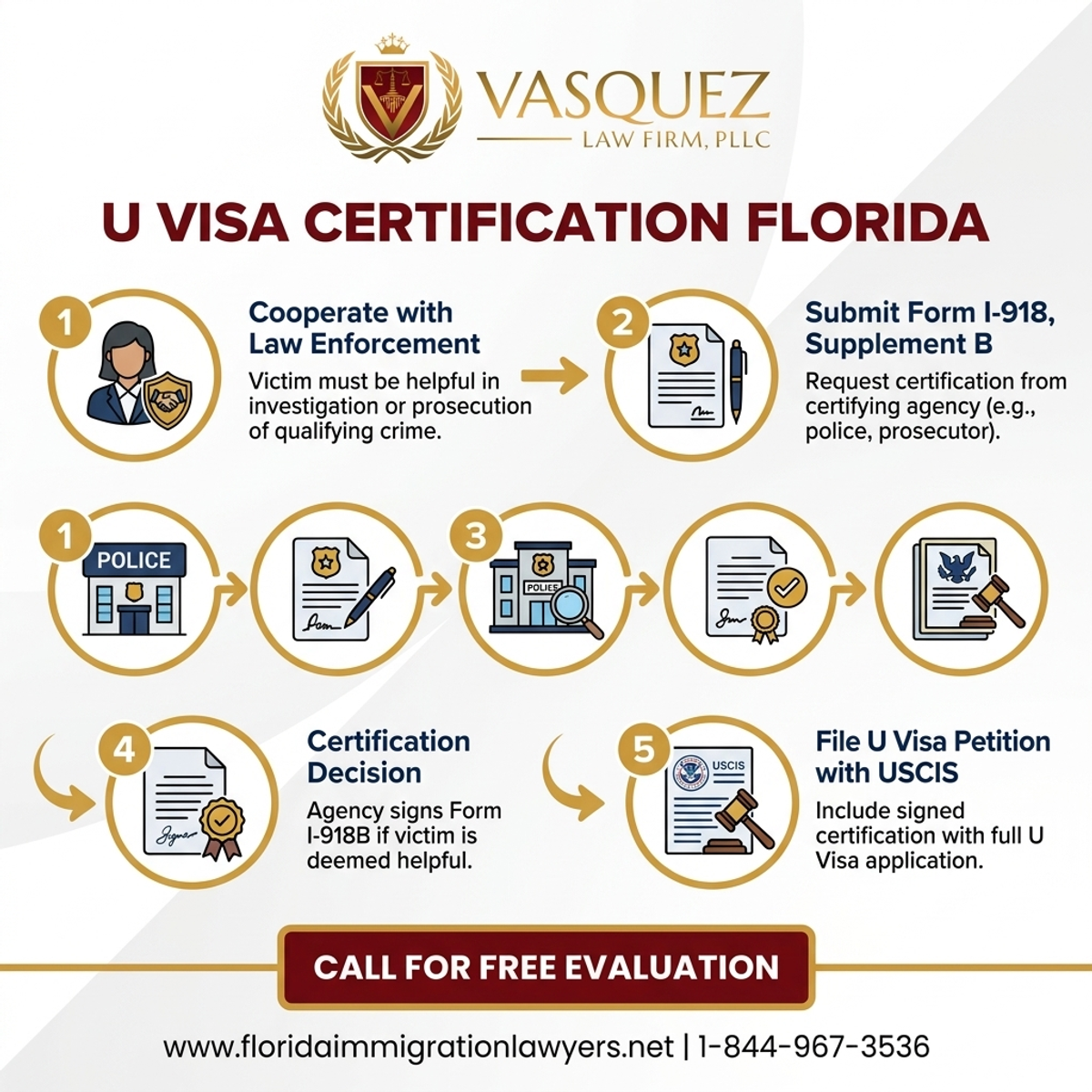
Obtaining a U visa certification is a methodical process that requires careful attention to detail and persistent follow-up. Here is a step-by-step guide to help you navigate this critical phase:
-
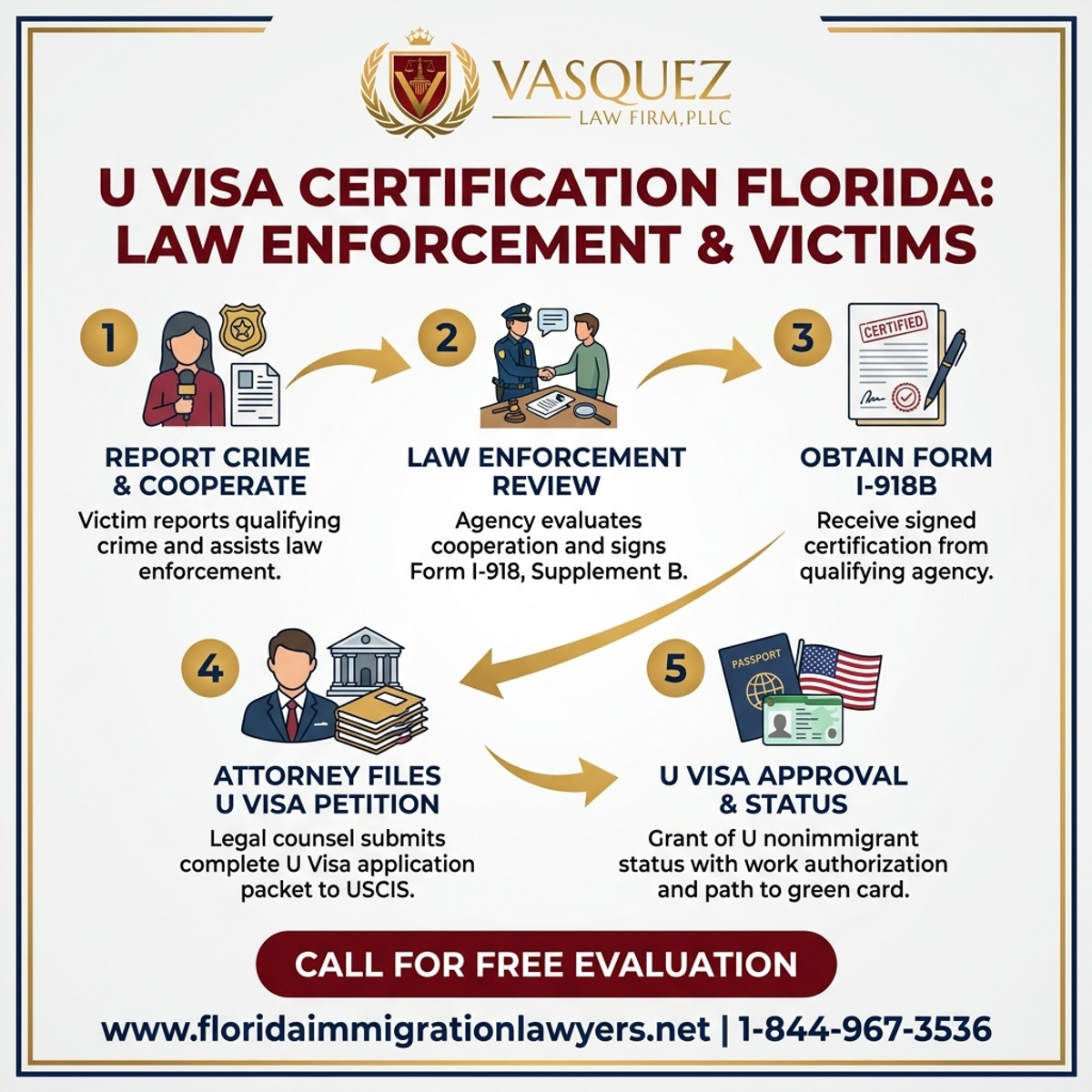
Identify the Qualifying Crime and Law Enforcement Agency: First, confirm that the crime you were a victim of is a qualifying criminal activity for U visa purposes. Then, identify the specific law enforcement agency (e.g., Coral Springs Police Department, Broward Sheriff's Office) or prosecutor's office that investigated or prosecuted the crime. Gather any police reports, incident numbers, or court documents related to the case.
-
Demonstrate Helpfulness: Reflect on how you have assisted or are willing to assist the investigating agency. This could include providing statements, testifying, identifying perpetrators, or maintaining communication with investigators. Document all instances of your cooperation, as this will be crucial evidence.
-
Complete Form I-918 Supplement B: This is the official U Nonimmigrant Status Certification form. You or your attorney will complete your portion of the form, providing your personal details and information about the crime. Do not sign the certifier's portion; that is for the law enforcement official.
-
Prepare a Comprehensive Request Package: Compile a package for the certifying agency that includes: a cover letter explaining your request, the completed Form I-918 Supplement B, a copy of the police report or relevant court documents, a personal statement detailing the crime and your helpfulness, and any supporting evidence of your cooperation. A well-organized package increases the likelihood of a timely review.
Step-by-Step Process — U Visa Certification Florida: Law Enforcement & Victims
-
Submit the Request to the Certifying Agency: Submit your package according to the agency's specific procedures. Some agencies prefer email, others require mail or in-person submission. Always retain proof of submission. Follow up respectfully and periodically, as agencies can be busy. An attorney can facilitate this communication and navigate any internal bureaucratic hurdles.
-
Receive the Signed Certification: Once the agency reviews your request and determines you meet the criteria, a designated official will sign Form I-918 Supplement B. This signed form is valid for six months from the date of signature and must be submitted to USCIS with your Form I-918 petition within that timeframe. If more than six months pass, you may need to request a new certification. This is a critical document for your U visa application.
Essential Document Checklist for Your U Visa Petition
A thorough and well-organized submission is paramount for a successful U visa petition. Beyond the crucial U visa certification, several other documents are required by USCIS. Missing or incomplete documentation can lead to delays or even denial. Here is a comprehensive checklist of documents typically needed for your Form I-918 petition:
- Form I-918, Petition for U Nonimmigrant Status: The primary application form.
- Form I-918 Supplement B, U Nonimmigrant Status Certification: The signed certification from the law enforcement agency, dated within six months of submission to USCIS.
- Form I-918 Supplement A, Petition for Qualifying Family Member of U-1 Nonimmigrant: If you are petitioning for eligible family members (spouse, children, parents for U-1 under 21, or unmarried siblings under 18 for U-1 under 21).
- Form I-192, Application for Advance Permission to Enter as a Nonimmigrant: If you are inadmissible to the U.S. (e.g., due to prior immigration violations, certain criminal history). This waiver is often necessary for U visa applicants.
- Personal Statement: A detailed narrative from the applicant describing the crime, the substantial physical or mental abuse suffered, and their helpfulness to law enforcement. This statement is incredibly important for conveying your story and meeting eligibility criteria.
- Evidence of Substantial Physical or Mental Abuse: Medical records, psychological evaluations, police reports, affidavits from counselors or social workers, and photos of injuries.
- Evidence of Helpfulness: Police reports, court transcripts, letters from law enforcement officials, witness statements, or any documentation demonstrating your cooperation.
- Evidence of Qualifying Criminal Activity: Police reports, court records, news articles, or other official documents confirming the crime.
- Proof of Identity and Nationality: Passport, birth certificate, national identity card, or other official identification.
- Photographs: Two passport-style photos meeting USCIS specifications.
- Proof of Relationship (for family members): Birth certificates, marriage certificates, or other official documents establishing the relationship.
- Additional Supporting Documents: Any other evidence that strengthens your claim of victimhood, abuse, or helpfulness.
Navigating U Visa Processing Timelines and Expectations
The U visa application process, from obtaining the U visa certification to final approval, is notoriously lengthy. Applicants in Florida and nationwide should prepare for significant waiting periods. After submitting Form I-918 and all supporting documents, USCIS will first issue a receipt notice (Form I-797C). Then, applicants are typically placed on a waitlist due to the annual cap of 10,000 U visas issued each fiscal year. This cap applies only to principal U-1 visa recipients, not to qualifying family members.
During the waitlist period, which can span several years, USCIS may grant bona fide determinations (BFDs) to eligible applicants. A BFD allows applicants to receive employment authorization and deferred action, providing temporary protection from deportation and the ability to work legally while awaiting a final decision. This is a crucial benefit for many victims in Florida seeking stability. Processing times can be found on the USCIS processing times website, but generally, expect it to take 5-7 years for a final decision after initial submission, with BFDs often issued within 3-5 years.
Key Statistics — U Visa Certification Florida: Law Enforcement & Victims
It is important to maintain consistent communication with your attorney and USCIS, and to inform them of any changes in your contact information or circumstances. While the wait is long, the U visa offers substantial benefits. After three years in U nonimmigrant status, you may be eligible to apply for lawful permanent residence (a green card) through Form I-485, Application to Register Permanent Residence or Adjust Status, provided you meet all other eligibility requirements. Patience and diligent record-keeping are essential throughout this extended process.
Cost Factors and Legal Fees for U Visa Applications
Understanding the financial aspects of a U visa application, including the crucial step of obtaining U visa certification, is an important consideration for many victims in Florida. While USCIS does not charge a filing fee for Form I-918, Petition for U Nonimmigrant Status, or Form I-918 Supplement A for qualifying family members, there are other costs involved. For instance, if you need to file Form I-192, Application for Advance Permission to Enter as a Nonimmigrant (a waiver for inadmissibility), there is a separate filing fee. However, a fee waiver may be available for this form if you can demonstrate an inability to pay. USCIS fees are subject to change, so always check the most current fee schedule on their website.
Beyond government filing fees, the most significant cost factor for most applicants will be legal fees for representation by an experienced immigration attorney. While it is technically possible to file a U visa petition without legal counsel, the complexity of the process, the sensitive nature of the information involved, and the discretion exercised by both law enforcement and USCIS make attorney representation highly advisable. An attorney can assist with:
- Preparing a compelling personal statement.
- Gathering and organizing supporting evidence.
- Strategically approaching law enforcement for the U visa certification.
- Drafting the cover letter and preparing the entire I-918 package.
- Identifying and filing necessary waivers (Form I-192).
- Responding to Requests for Evidence (RFEs) from USCIS.
- Communicating with USCIS on your behalf.
Legal fees for U visa cases can vary widely depending on the complexity of the case, the number of family members included, and the attorney's experience. Many firms, including Florida Immigration Lawyers, offer payment plans to make legal representation more accessible. Investing in experienced legal counsel can significantly increase your chances of success and provide peace of mind throughout this challenging process. Remember, a successful U visa can lead to work authorization and eventually a green card, making the legal investment worthwhile for long-term stability in Florida.
Common Mistakes to Avoid in U Visa Certification and Application
The U visa process is fraught with potential pitfalls that can lead to significant delays or even denial. Avoiding these common mistakes is crucial for a successful outcome, especially when dealing with the critical U visa certification:
-
Failing to Obtain a Timely Certification: The I-918 Supplement B must be signed by a certifying official within six months of the U visa petition's submission to USCIS. Many applicants wait too long, and the certification expires, requiring a new request. Always prioritize this step.
-
Approaching the Wrong Law Enforcement Agency: Submitting your request to an agency that did not investigate the crime, or to an official without proper authority, will result in delays or rejection. Ensure you identify the correct agency and appropriate certifier from the outset.
-
Incomplete or Inconsistent Information: Any discrepancies between your personal statement, police reports, and the certification can raise red flags for USCIS. Ensure all information is accurate and consistent across all submitted documents.
-
Insufficient Evidence of Substantial Abuse: Simply stating you were a victim is not enough. You must provide compelling evidence of the substantial physical or mental abuse suffered as a direct result of the qualifying criminal activity. Medical records, psychological evaluations, and detailed affidavits are critical.
-
Lack of Demonstrated Helpfulness: The U visa is contingent on your cooperation. If you cannot clearly articulate or provide evidence of how you have been, are being, or are likely to be helpful to law enforcement, your application will likely fail. Maintain open communication with investigators.
-
Not Addressing Inadmissibility Issues: Many U visa applicants have prior immigration violations or minor criminal histories that make them inadmissible to the U.S. Failing to file Form I-192, Application for Advance Permission to Enter as a Nonimmigrant, or not adequately documenting the waiver request, can lead to denial. Consult an attorney to identify and address all inadmissibility grounds.
-
Missing the Annual Cap: While not a mistake by the applicant, understanding the 10,000 annual cap is crucial for managing expectations regarding processing times. This cap means a long waitlist, but early filing is key to getting on that list sooner.
-
Not Keeping Copies of All Documents: Always retain complete copies of everything you submit to both the certifying agency and USCIS. This includes the initial request package, the signed certification, and the full I-918 petition. This is vital for your records and for responding to any RFEs.
-
Failing to Update USCIS with Address Changes: If you move, you must notify USCIS promptly using Form AR-11, Alien's Change of Address Card. Missing important notices due to an outdated address can have severe consequences, including case abandonment or denial. This is especially important for Florida's transient population.
-
Attempting the Process Without Legal Counsel: The U visa is one of the most complex humanitarian immigration benefits. Without an experienced immigration attorney, you risk making critical errors that could jeopardize your eligibility and future in the U.S. Seeking professional help is an investment in your safety and stability.
When to Call a Lawyer for U Visa Certification in Florida
The U visa process, particularly securing the crucial U visa certification from law enforcement, is highly complex and emotionally sensitive. While some individuals may attempt to navigate it alone, the stakes are incredibly high, and the nuances of immigration law are vast. Knowing when to seek professional legal assistance can make all the difference between success and failure. You should strongly consider contacting an experienced immigration attorney at Florida Immigration Lawyers if any of the following scenarios apply to you:
- Uncertainty About Eligibility: If you are unsure whether the crime you experienced qualifies for a U visa, or if you meet the criteria for substantial abuse or helpfulness.
- Difficulty Obtaining Certification: If a law enforcement agency in Coral Springs or elsewhere in Florida is unresponsive, denying your request, or has complex internal procedures that are hard to navigate.
- Inadmissibility Concerns: If you have any past immigration violations, criminal history, or other issues that might make you inadmissible to the U.S., requiring a waiver (Form I-192).
- Language Barriers: If English is not your primary language, effective communication with law enforcement and USCIS can be challenging. An attorney can ensure your story is accurately conveyed.
- Fear of Retaliation: If you fear retaliation from perpetrators or others, an attorney can help you understand your rights and protections.
- Complex Crime Details: If the crime involved multiple agencies, jurisdictions, or complex legal details that are difficult to explain or document.
- Need for Family Petitions: If you wish to include qualifying family members in your U visa petition, the process becomes more intricate.
- Receiving a Request for Evidence (RFE): If USCIS sends an RFE, it means they need more information. Responding effectively requires legal expertise.
- Facing Deportation Proceedings: If you are currently in removal proceedings, a U visa can potentially offer a path to relief. Our deportation defense attorneys are adept at handling such cases.
Florida Immigration Lawyers has extensive experience assisting crime victims throughout Florida in obtaining U visas. We understand the unique challenges faced by immigrants in communities like Coral Springs and are dedicated to providing compassionate and effective legal representation. Our attorneys are well-versed in the specific requirements of the INA, such as 8 U.S.C. § 1101(a)(15)(U) for U nonimmigrant status, and can guide you through every step.
For more information on victim protection, you can also explore resources from the Department of Justice's Office on Violence Against Women, which often partners with local law enforcement to support victims.
About Florida Immigration Lawyers
Florida Immigration Lawyers is a leading immigration law firm dedicated to serving individuals and families across the entire state of Florida. With a deep understanding of the complexities and sensitivities involved in immigration matters, we provide compassionate, effective, and results-driven legal representation. Our team of experienced attorneys specializes in a wide range of immigration services, including U visas, asylum, citizenship applications, family-based petitions, deportation defense, and business immigration solutions. We are committed to protecting the rights and securing the futures of our clients.
We pride ourselves on our client-focused approach, offering personalized strategies tailored to each unique case. Our attorneys are available 24/7 to provide support and answer your urgent questions, understanding that immigration issues often arise unexpectedly. We offer free consultations to help you understand your options and develop a clear path forward. With offices conveniently located and serving all Florida communities, including Coral Springs, Miami, Orlando, and Tampa, Florida Immigration Lawyers is your trusted partner for all your immigration needs. Call us today at 1-844-967-3536 or visit our website at https://www.floridaimmigrationlawyers.net to learn more about how we can help you achieve your immigration goals.
Sources and References
- U.S. Citizenship and Immigration Services (USCIS) - U Nonimmigrant Status (U Visa)
- U.S. Department of Justice - Office on Violence Against Women (OVW)
- 8 U.S.C. § 1101(a)(15)(U) - Immigration and Nationality Act (INA) defining U Nonimmigrant Status.
- 8 CFR 214.14 - Regulations governing U Nonimmigrant Status.
- Form I-918, Petition for U Nonimmigrant Status, and Form I-918 Supplement B, U Nonimmigrant Status Certification.
Related services: asylum application process, refugee status and resettlement, withholding of removal, humanitarian protection programs.
This article provides general legal information and is not intended as legal advice. Every case is unique, and outcomes depend on specific facts and circumstances. Contact an attorney for advice about your particular situation.
Securing your future in Florida as a crime victim begins with understanding your rights and the available legal pathways. The U visa certification is a vital first step towards safety and stability. Do not delay in seeking the professional guidance you need. Call Florida Immigration Lawyers today at 1-844-967-3536 for a free, confidential consultation. Se Habla Espanol - Estamos aqui para ayudarle.
Do Not Navigate This Process Alone
Our experienced immigration attorneys are ready to fight for you. Get a free, confidential consultation today.
Se Habla Español
Frequently Asked Questions
Florida Immigration Lawyers
Immigration Attorney | Founder, Vasquez Law Firm
U.S. Air Force veteran and immigration attorney with thousands of cases resolved. J.D., NCCU School of Law. AILA member. Admitted to the 4th, 5th, and 11th Circuit Courts.
Available 24/7 - Free Evaluations
Related Legal Services
Our Florida immigration attorneys can help you with business immigration, asylum protection and deportation defense. Call today at 1-844-967-3536 for a free consultation.
Related Links
Related Topics
Free Legal Consultation
Discuss your case with our experienced attorneys. We're available 24/7.
Se Habla Español - Estamos aquí para ayudarle.
Related Articles
Stokes Interview: Navigating Marriage Fraud in Florida
A Stokes interview is a specialized, separate interview conducted by USCIS when there are suspicions of marriage fraud in a green card application. This rigorous process involves individual questioning of spouses, focusing on inconsistencies in their testimonies to determine the authenticity of their marital bond. For couples in Florida, navigating this high-stakes interview requires meticulous preparation, extensive documentation, and often the strategic guidance of an experienced immigration lawyer. Understanding the process, preparing for detailed questions, and presenting a strong case are crucial for overcoming marriage fraud allegations and securing your immigration future. Florida Immigration Lawyers stands ready to assist you.
Immigration Attorney Gainesville: North Florida Legal Help
For those in Gainesville, Alachua County, and throughout North Florida, navigating U.S. immigration law requires expert guidance. An experienced immigration attorney can simplify complex processes, from family-based petitions and employment visas to critical asylum claims and deportation defense. This comprehensive guide outlines the essential services provided by an immigration attorney, details necessary documentation, clarifies processing timelines, and discusses associated costs. We also highlight common mistakes to avoid and crucial scenarios where legal counsel is indispensable. Florida Immigration Lawyers serves all of Florida, including Gainesville and St. Petersburg, providing dedicated legal support to help you achieve your immigration goals. Contact us for a free consultation to discuss your specific needs.
Military Naturalization Expedited at Florida Bases
Explore expedited military naturalization processes for service members at Florida bases like MacDill. Learn about eligibility, steps, and common mistakes. Contact Florida Immigration Lawyers for a free consultation.
Protect Yourself from Immigration Scams in Florida
Learn how to protect against immigration scams in Florida, focusing on St. Petersburg. This guide covers identifying scams, verifying credentials, and getting legal help. Call Florida Immigration Lawyers at 1-844-967-3536 for assistance.