Dual Citizenship in Florida: Navigating Immigration
Explore dual citizenship in Florida and learn the steps to obtaining it. Discover how to navigate immigration laws and naturalization processes for a more flexible future.

Florida, a vibrant hub of diverse cultures and international connections, sees a significant number of residents navigating the complexities of immigration and citizenship. Among the most intriguing and often misunderstood aspects is dual citizenship. Far from being a niche concept, holding two passports is a reality for many Floridians, offering both unique opportunities and specific challenges. This comprehensive guide delves into the intricacies of dual citizenship in the Sunshine State, exploring the naturalization process, the advantages and potential pitfalls of dual nationality, and how to navigate the legal landscape effectively.
Understanding Dual Citizenship in Florida
Dual citizenship, or dual nationality, occurs when a person is a citizen of two countries simultaneously. The United States generally permits dual nationality, meaning that a U.S. citizen may also be a citizen of another country without losing their U.S. citizenship. This is a common misconception, as many believe the U.S. requires renunciation of other citizenships upon naturalization. While the Oath of Allegiance includes a phrase about renouncing foreign allegiances, the U.S. Supreme Court and subsequent federal policy have clarified that this does not automatically revoke other citizenships unless the individual explicitly intends to do so and takes formal steps with the foreign government.
For Floridians, understanding how dual citizenship is acquired is crucial. It can happen through several avenues:
- Birth: A child born in the U.S. to foreign parents may be a U.S. citizen by birthright (Jus Soli) and a citizen of their parents' country by descent (Jus Sanguinis).
- Descent: A child born outside the U.S. to U.S. citizen parents may acquire U.S. citizenship at birth, while also retaining the citizenship of their birth country.
- Naturalization: A foreign national who naturalizes as a U.S. citizen may retain their original citizenship if their home country's laws permit it. Similarly, a U.S. citizen may naturalize in another country and retain U.S. citizenship.
Florida itself does not have specific laws governing dual citizenship; rather, it is determined by federal immigration law and the laws of the other sovereign nation involved. This means that while the process of becoming a U.S. citizen is uniform across states, the ability to retain a second citizenship depends entirely on the laws of that other country.
The Path to Naturalization for Dual Citizenship Seekers
For many, dual citizenship begins with the naturalization process in the United States. Becoming a U.S. citizen is a significant step, and for those hoping to retain their original nationality, understanding the nuances is key. The general requirements for naturalization include:
- Being at least 18 years old.
- Holding a Green Card (Lawful Permanent Resident status) for at least 5 years (or 3 years if married to a U.S. citizen).
- Demonstrating continuous residence and physical presence in the U.S.
- Showing good moral character.
- Passing English language and U.S. civics tests.
- Demonstrating an attachment to the principles and ideals of the U.S. Constitution.
The application process typically involves submitting Form N-400, Application for Naturalization, attending a biometrics appointment, and undergoing an interview with a USCIS officer. The final step is taking the Oath of Allegiance. While this oath requires renouncing allegiance to any foreign state, the U.S. government generally interprets this as an expression of intent to transfer primary allegiance to the U.S., not an automatic renunciation of other citizenships. However, it is crucial for individuals to understand the laws of their country of origin regarding retention of citizenship upon naturalization elsewhere. Some countries automatically revoke citizenship, while others require formal renunciation. Navigating this complex legal terrain often requires expert guidance. For comprehensive support with your immigration journey, explore our dedicated immigration practice areas.
Benefits and Challenges of Holding Two Passports
Holding dual citizenship, and consequently two passports, opens up a world of opportunities but also comes with a unique set of responsibilities and potential complexities. Understanding both sides of this coin is essential for anyone considering or currently holding dual nationality, especially in a globally connected state like Florida.
The Advantages of Dual Nationality:
- Increased Travel Freedom: One of the most immediate and tangible benefits is enhanced mobility. Dual citizens often enjoy easier entry into both countries, potentially without the need for visas, and can stay for extended periods. This is particularly advantageous for individuals with family or business interests across borders.
- Economic and Business Opportunities: Dual citizenship can unlock greater economic freedom. It allows individuals to live, work, and own property in both countries without needing work permits or special visas. This can facilitate international business ventures, investment opportunities, and broader career prospects, especially beneficial for Floridians with strong ties to Latin America or Europe.
- Stronger Family Ties: For families with members in different countries, dual citizenship simplifies visits, allows for extended stays, and can even make it easier for family reunification processes. It strengthens cultural connections and ensures that individuals can maintain close relationships with relatives in both nations.
- Political Participation: Dual citizens may have the right to vote and even hold public office in both countries, allowing for greater civic engagement and influence in the political landscape of their homelands.
- Cultural Enrichment: Beyond legal and economic benefits, dual nationality fosters a deeper connection to multiple cultures, languages, and traditions, enriching an individual's personal identity and worldview.
The Challenges and Considerations:
- Tax Implications: This is often the most significant challenge. U.S. citizens and Green Card holders are subject to worldwide taxation, meaning they must report income earned anywhere in the world to the IRS. Dual citizens may also have reporting obligations in their other country of citizenship, potentially leading to complex tax situations and the need for specialized tax advice regarding Foreign Account Tax Compliance Act (FATCA) and Foreign Bank and Financial Accounts (FBAR) reporting.
- Military Service Obligations: Some countries require their citizens, including dual nationals, to perform military service. While the U.S. does not require military service from its dual citizens for another country, individuals must be aware of and comply with the laws of their other country of citizenship.
- Potential for Conflicting Laws: In certain situations, the laws of the two countries might conflict, particularly regarding legal rights, duties, or even political allegiances. Navigating such conflicts requires careful consideration and legal counsel.
- Complexity in Legal and Administrative Matters: Dealing with two sets of government bureaucracies, legal systems, and administrative requirements can be time-consuming and confusing. This can apply to everything from renewing passports to estate planning and property ownership.
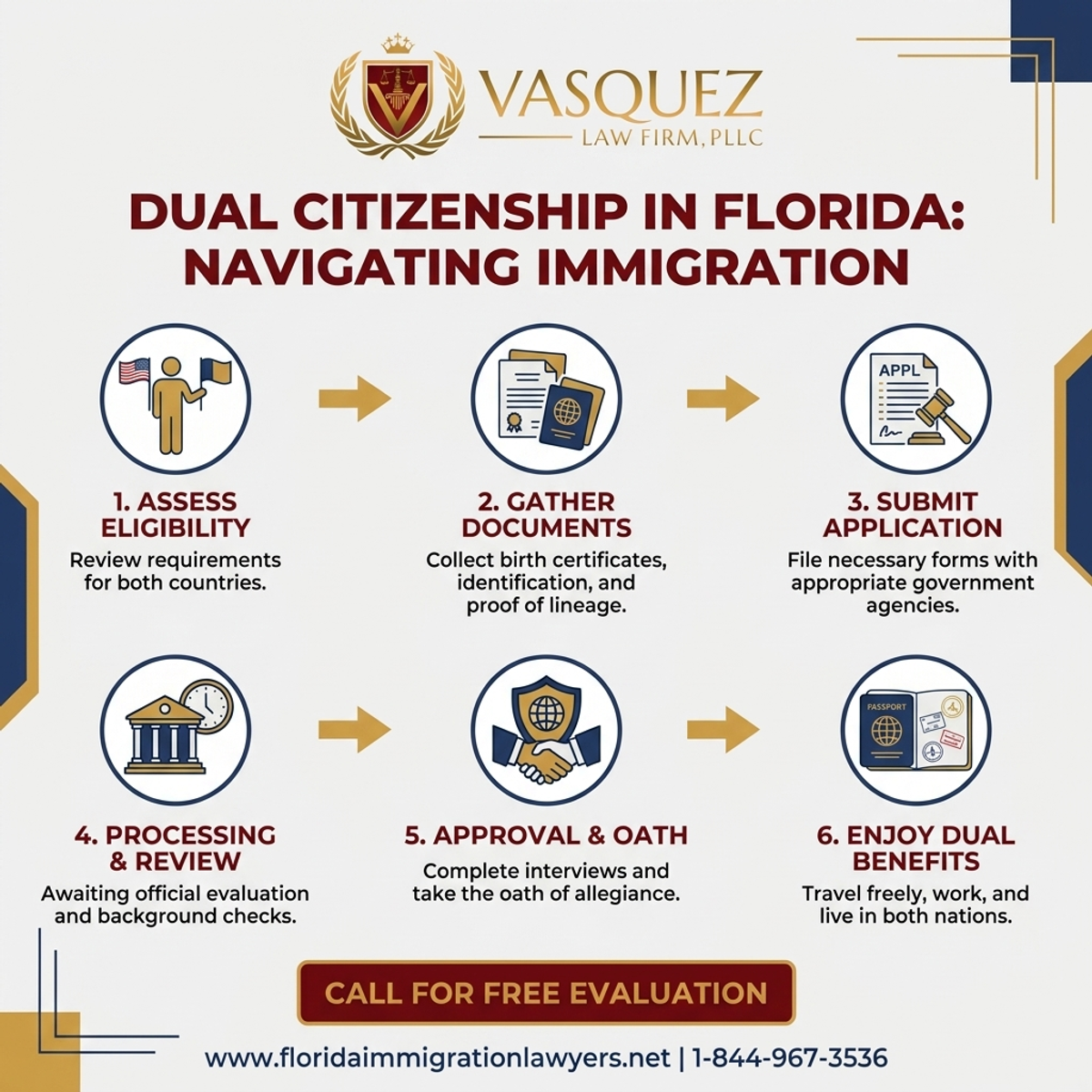
Step-by-Step Process — Dual Citizenship in Florida: Navigating Immigration
Weighing these benefits against the challenges is a critical step in making informed decisions about dual citizenship. While the advantages can be substantial, the complexities, particularly concerning taxation and legal obligations, underscore the importance of professional guidance.
Navigating Complex Immigration Scenarios in Florida
Florida's diverse population means that immigration scenarios are rarely straightforward. Dual citizenship can intersect with various other immigration issues, creating unique challenges and opportunities. Understanding these intersections is vital for comprehensive legal planning.
Dual Citizenship and Asylum Claims:
While seemingly contradictory, a dual national might, in rare circumstances, seek asylum. For instance, if one of their countries of citizenship becomes unsafe due to persecution, and the other country offers no protection or is also a source of persecution, an individual might still qualify for asylum in the U.S. This is a highly complex area, as generally, individuals are expected to seek protection in their other country of citizenship if it is safe. However, specific circumstances can override this expectation. If you or someone you know is facing persecution and needs protection, our firm offers dedicated services in asylum law.
Dual Citizenship and Deportation Defense:
Holding dual citizenship can sometimes offer a layer of protection against deportation, but it is not a guaranteed shield. If a lawful permanent resident (Green Card holder) faces deportation proceedings, having a second citizenship might provide an alternative country to which they could be deported, potentially making removal less disruptive than if they had no other country to return to. However, U.S. immigration law dictates the grounds for deportation, and dual citizenship does not automatically exempt an individual from these laws. In fact, certain criminal convictions or immigration violations can lead to the loss of U.S. permanent residency, regardless of other citizenships. For critical legal support in such situations, our expertise in deportation defense is invaluable.
Common Misconceptions about Dual Citizenship:
- "The U.S. doesn't allow dual citizenship": As discussed, the U.S. generally tolerates dual nationality.
- "You have to choose one citizenship at 18": This is false. Individuals can maintain dual citizenship indefinitely if both countries permit it.
- "Dual citizens don't pay U.S. taxes on foreign income": This is a dangerous misconception. U.S. citizens and residents are taxed on worldwide income, though tax treaties and foreign tax credits can mitigate double taxation.
The intricate interplay between dual citizenship and other immigration matters underscores the importance of seeking qualified legal counsel. An experienced immigration attorney can help individuals understand their rights, obligations, and the best strategies for their specific situation.
Specific Considerations for Floridians
Florida's unique demographic and geographic position amplify certain aspects of dual citizenship. The state's proximity to Latin America and the Caribbean, coupled with a significant European expatriate community, means that dual nationality is a common reality for many residents.
- Latin American & Caribbean Ties: Many countries in Latin America and the Caribbean, such as Mexico, Colombia, Dominican Republic, and Jamaica, readily permit dual citizenship. This facilitates strong family and business connections between Florida and these regions, making dual nationality a practical choice for many Floridians.
- Real Estate & Business Implications: Dual citizenship can simplify property ownership and business operations in both countries. For example, a Floridian with dual U.S.-Mexican citizenship might find it easier to invest in real estate or establish a business in Mexico without the restrictions often placed on foreign nationals.
- Estate Planning for Dual Citizens: Estate planning becomes more complex with dual citizenship, as individuals may have assets in multiple countries and be subject to different inheritance and tax laws. Proper planning requires understanding the legal frameworks of both nations to ensure assets are distributed according to one's wishes and to minimize tax liabilities.
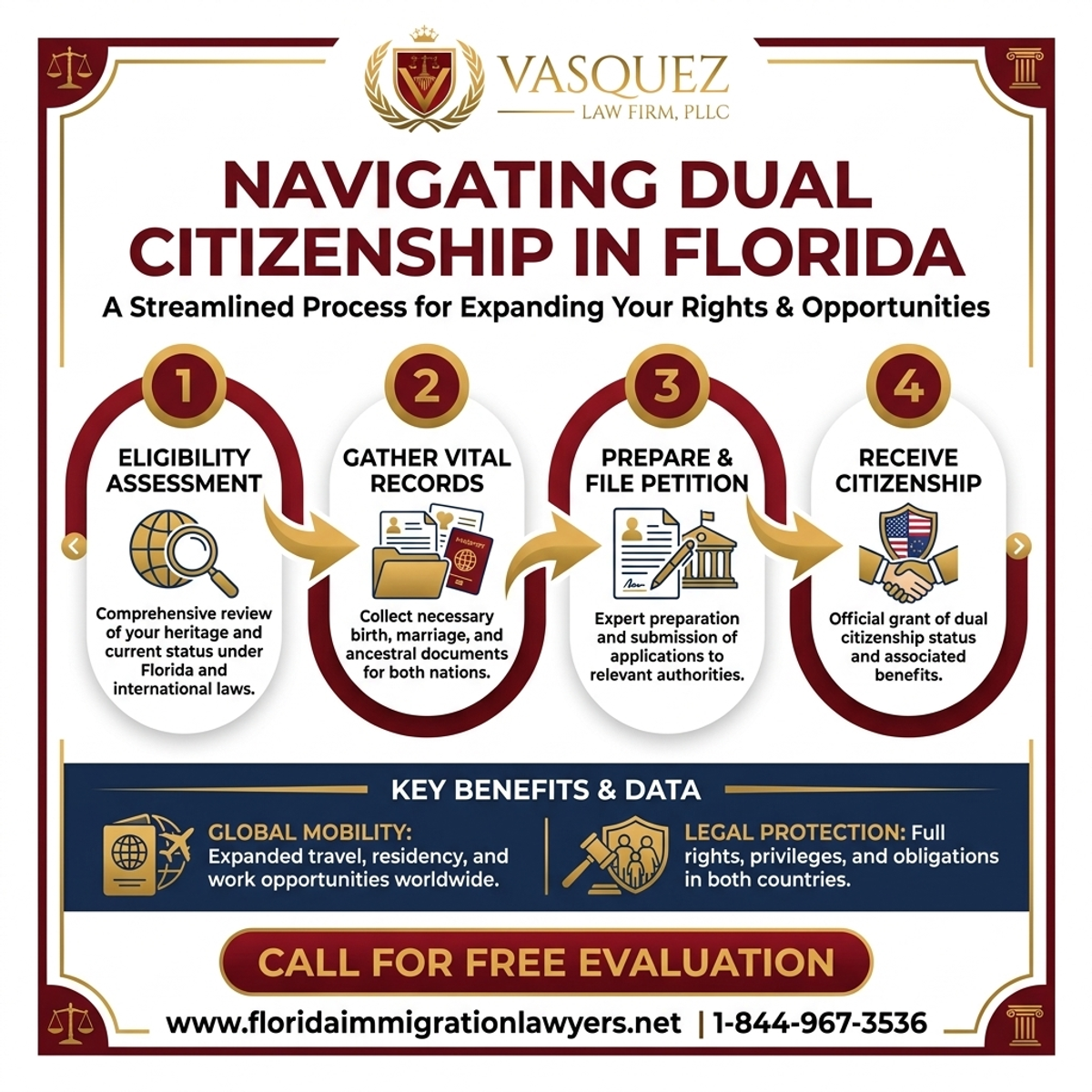
Key Statistics — Dual Citizenship in Florida: Navigating Immigration
These specific considerations highlight why a one-size-fits-all approach to dual citizenship is insufficient. Personalized advice, tailored to an individual's unique circumstances and the laws of their specific countries of citizenship, is paramount.
Renunciation vs. Retention: Making Informed Decisions
While the U.S. generally permits dual citizenship, there are situations where an individual might consider renouncing one of their citizenships. This is a serious decision with significant consequences and should not be undertaken lightly.
When Renunciation Might Be Necessary:
- To Avoid Conflicting Obligations: In rare cases, an individual might find that the obligations or allegiances required by their two citizenships are irreconcilable, leading them to choose one over the other.
- For Security Clearances or Specific Government Positions: Certain high-level government positions or security clearances in the U.S. may require individuals to renounce foreign citizenships to avoid potential conflicts of interest or security risks.
- To Simplify Tax Obligations: For some, the complexities and costs associated with worldwide taxation for U.S. citizens can become overwhelming, leading them to renounce U.S. citizenship, though this is a drastic and often irreversible step.
- If Required by the Other Country: Some countries may require renunciation of other citizenships to acquire or retain theirs, forcing a choice.
The Process of Renunciation:
Renouncing U.S. citizenship is a
Sources and References
- U.S. Citizenship and Immigration Services (USCIS)
- Executive Office for Immigration Review (EOIR)
- U.S. Department of State - Bureau of Consular Affairs
- Immigration and Nationality Act (INA), 8 U.S.C. Chapter 12
Do Not Navigate This Process Alone
Our experienced immigration attorneys are ready to fight for you. Get a free, confidential consultation today.
Se Habla Español
Frequently Asked Questions
Florida Immigration Lawyers
Immigration Attorney | Founder, Vasquez Law Firm
U.S. Air Force veteran and immigration attorney with thousands of cases resolved. J.D., NCCU School of Law. AILA member. Admitted to the 4th, 5th, and 11th Circuit Courts.
Available 24/7 - Free Evaluations
Related Legal Services
Our Florida immigration attorneys can help you with deportation defense, citizenship and naturalization and family immigration services. Call today at 1-844-967-3536 for a free consultation.
Related Links
Related Topics
Free Legal Consultation
Discuss your case with our experienced attorneys. We're available 24/7.
Se Habla Español - Estamos aquí para ayudarle.
Related Articles
Naturalization Process Timeline in Florida | VLF Florida
Explore the naturalization process timeline in Florida. Understand the steps, required documents, and potential pitfalls. Contact Florida Immigration Lawyers for expert guidance and a free consultation.
Change of Status for Student Visa in Florida | VLF Florida
Changing your student visa status in Florida is a complex process. Learn about eligibility, required documents, and common mistakes to avoid. Contact Florida Immigration Lawyers for expert guidance.
Unlawful Presence Waiver in Florida: What You Need to Know
Discover the steps to securing an I-601A provisional waiver for unlawful presence in Florida. Learn about eligibility, processing times, and common mistakes to avoid. Contact Florida Immigration Lawyers for a free consultation today.
U Visa Certification Florida: Law Enforcement & Victims
For non-citizen crime victims in Florida, securing U visa certification is a critical step towards legal protection and residency. This comprehensive guide from Florida Immigration Lawyers details the process, focusing on how law enforcement agencies across the state, including in Coral Springs, play a vital role in issuing Form I-918 Supplement B. Learn about eligibility, the step-by-step application, essential documents, and navigating complex processing timelines. We also highlight common mistakes to avoid and when to seek expert legal counsel. Understanding these crucial elements is essential for a successful U visa petition and for finding safety and stability in the U.S.