Naturalization Process Timeline in Florida | VLF Florida
Explore the naturalization process timeline in Florida. Understand the steps, required documents, and potential pitfalls. Contact Florida Immigration Lawyers for expert guidance and a free consultation.

Naturalization Process Timeline in Florida | VLF Florida
Becoming a U.S. citizen through naturalization is a monumental step, offering a lifetime of benefits and opportunities. For many immigrants in Florida, understanding the naturalization process timeline is crucial for planning their journey. While the path to citizenship can seem complex, breaking it down into manageable stages, from eligibility to the oath ceremony, can make it less daunting. This comprehensive guide will walk you through each phase of the naturalization process, providing insights into what to expect and how to prepare. At VLF Florida, we understand the nuances of immigration law and are dedicated to guiding you through every step, ensuring your application is strong and your path to citizenship is as smooth as possible.
Understanding Naturalization Eligibility Requirements
Before embarking on the naturalization journey, it's essential to confirm you meet the fundamental eligibility criteria set by U.S. Citizenship and Immigration Services (USCIS). These requirements are non-negotiable and form the bedrock of a successful application. Generally, applicants must:
- Be at least 18 years old: On the day you file your Form N-400, Application for Naturalization.
- Be a Lawful Permanent Resident (Green Card holder): You must have held your Green Card for at least five years. This period can be reduced to three years if you are married to a U.S. citizen and meet specific additional criteria, such as living in marital union with your citizen spouse for the entire three-year period.
- Demonstrate continuous residency: This means you must have resided continuously in the U.S. for at least five years (or three years if married to a U.S. citizen) immediately preceding the date of filing your N-400 application. While short trips abroad are generally permissible, extended absences can break the continuous residency requirement. An absence of six months to one year raises a presumption of a break, which you may need to overcome with evidence. An absence of more than one year automatically breaks continuous residency.
- Show physical presence: You must have been physically present in the U.S. for at least half of the required continuous residency period (i.e., 30 months for the five-year rule, or 18 months for the three-year rule).
- Reside in the state or USCIS district for at least three months: You must have lived in the state or USCIS district where you file your N-400 for at least three months prior to filing. This ensures that your local USCIS office has jurisdiction over your case.
- Possess good moral character: This is a crucial, often subjective, requirement. USCIS evaluates your moral character for the statutory period (five or three years) immediately preceding your application. Factors like criminal history, failure to pay taxes, or misrepresentation can negatively impact this assessment. It's vital to be transparent about any past issues and seek legal advice if you have concerns.
- Demonstrate an attachment to the principles and ideals of the U.S. Constitution: This is generally assessed through your oath of allegiance and your willingness to uphold the laws of the United States.
- Be able to read, write, and speak basic English: This is tested during your naturalization interview. There are exceptions for applicants who are over a certain age and have been Green Card holders for a specific number of years (e.g., 50 years old and 20 years as an LPR, or 55 years old and 15 years as an LPR).
- Have a basic understanding of U.S. history and government (civics): This is also tested during the interview. USCIS provides study materials to help applicants prepare.
Meeting these requirements is the first hurdle. If you have any doubts about your eligibility, particularly concerning continuous residency, good moral character, or specific exceptions, consulting with an immigration attorney is highly recommended to assess your unique situation.
The Application Process: Form N-400 Submission
Once you've confirmed your eligibility, the next step is to prepare and submit Form N-400, Application for Naturalization. This form is extensive and requires detailed personal information, residency history, employment history, marital history, and responses to questions about your good moral character. Accuracy and completeness are paramount, as errors or omissions can lead to delays or even denial.
Gathering all necessary supporting documents is equally important. This typically includes copies of your Green Card, marriage certificates (if applicable), divorce decrees, birth certificates, tax returns, and any court or police records. Organizing these documents meticulously before filing will streamline the process. You'll also need to submit the applicable filing fee, which can be paid online or by mail. Fee waivers or reduced fees may be available for eligible applicants based on income or receipt of public benefits. After submitting your N-400, USCIS will send you a receipt notice, confirming they have received your application.
Biometrics Appointment
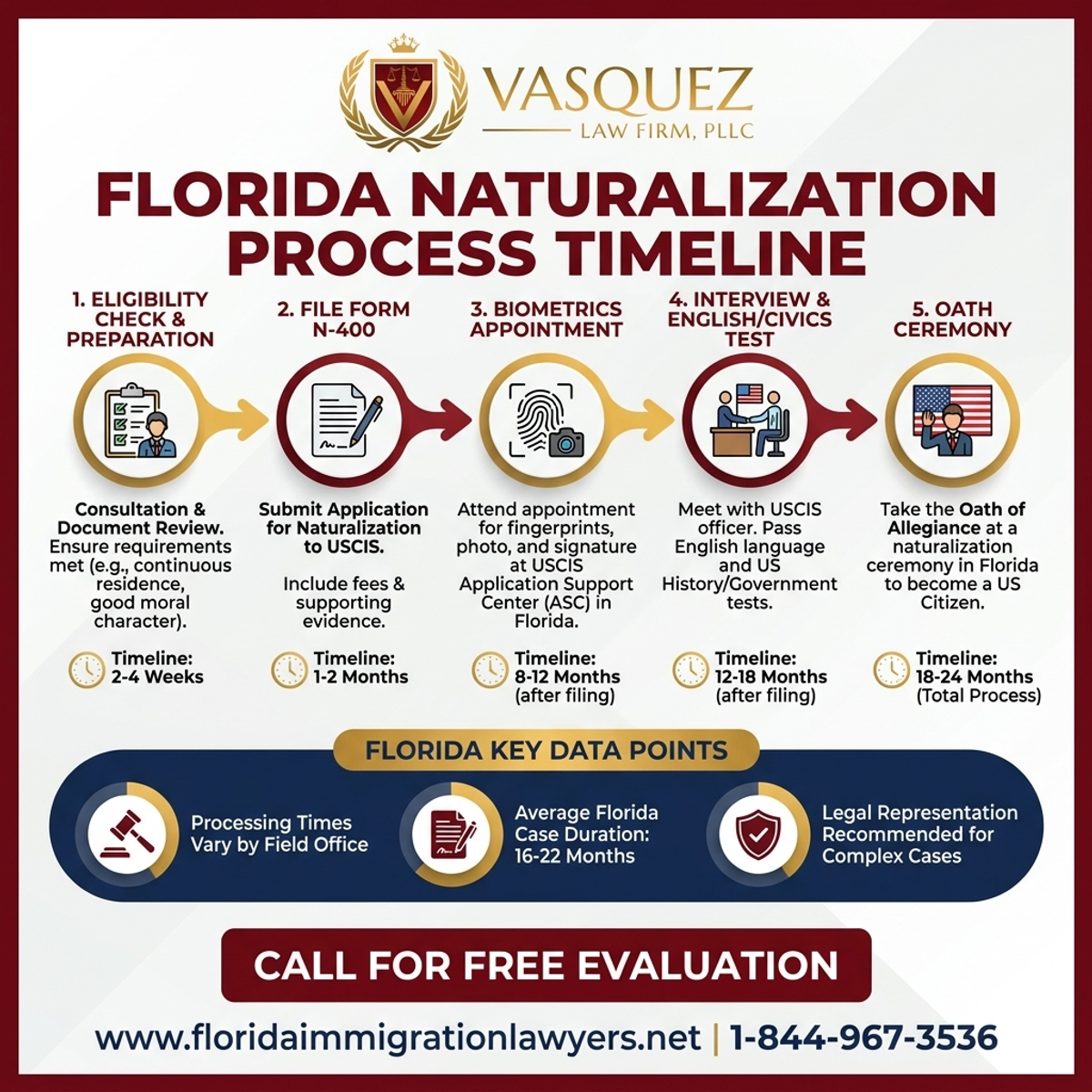
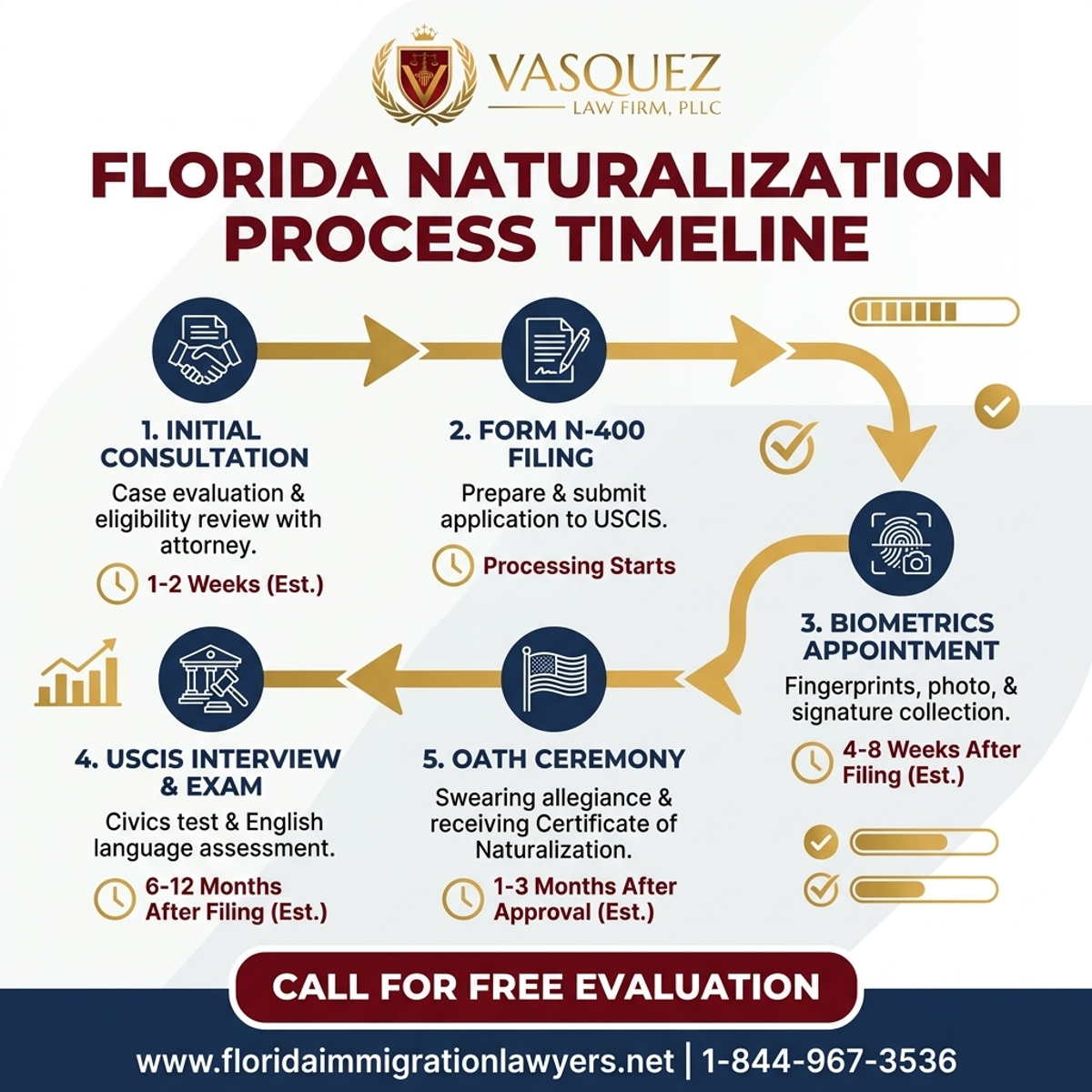
Within a few weeks or months of filing your N-400, you will receive an appointment notice for a biometrics services appointment at a local Application Support Center (ASC). This appointment is mandatory. During the biometrics appointment, USCIS will collect your fingerprints, photograph, and signature. These are used to conduct background checks and verify your identity. The biometrics data is crucial for national security checks and ensuring you meet the good moral character requirement. It's a quick process, usually lasting less than 30 minutes, but failing to attend can lead to delays or rejection of your application.
Step-by-Step Process — Naturalization Process Timeline in Florida | VLF Florida
The Naturalization Interview
After your biometrics are processed and background checks are completed, USCIS will schedule your naturalization interview. This is a critical stage where an immigration officer will review your N-400 application with you, verify the information, and assess your English language proficiency and knowledge of U.S. civics. The interview typically covers:
- English Test: You will be asked to read and write simple sentences in English and answer questions about yourself and your application verbally.
- Civics Test: You will be asked up to 10 questions from a list of 100 civics questions. You must answer at least 6 correctly to pass.
- Review of N-400: The officer will go through your application, asking questions to confirm details, clarify any discrepancies, and assess your good moral character. Be prepared to answer questions about your travel history, employment, marital status, and any past interactions with law enforcement.
It's vital to be honest and provide accurate information during the interview. If you need an accommodation for a disability or require an interpreter (if you qualify for an English exemption), make sure to request it in advance. Preparing thoroughly for both the English and civics tests, and reviewing your N-400 application, will significantly increase your chances of a successful interview.
Decision and Oath Ceremony
Following your interview, the USCIS officer will make a decision on your application. There are three possible outcomes:
- Approved: If all requirements are met, you will typically receive a notice for your Oath of Allegiance ceremony.
- Continued: If the officer needs more information or if you failed a portion of the English or civics test, your application may be continued. You will be given a chance to provide additional documents or re-take the tests.
- Denied: If you do not meet the eligibility requirements or fail to provide requested information, your application may be denied. You will receive a written explanation of the reasons for denial.
Key Statistics — Naturalization Process Timeline in Florida | VLF Florida
The Oath of Allegiance ceremony is the final step in becoming a U.S. citizen. During this ceremony, you will take an oath to support the Constitution and laws of the United States. You will then receive your Certificate of Naturalization, which is proof of your U.S. citizenship. This document is extremely important and should be kept safe, as it will be needed for things like applying for a U.S. passport, registering to vote, and proving your citizenship.
Beyond the Basics: Advanced Considerations and the Value of Legal Expertise
While the general naturalization timeline provides a clear roadmap, many applicants encounter unique circumstances that can complicate the process. Understanding these advanced considerations and recognizing when to seek professional legal guidance can be the difference between a smooth journey and significant delays or even denial. For instance, issues related to continuous residency can be more intricate than they appear. Extended trips abroad, even if within the six-month threshold, might raise questions about your intent to reside permanently in the U.S. Similarly, demonstrating 'good moral character' can be complex, especially if you have any past criminal record, no matter how minor or old. Certain offenses, even those not leading to jail time, can be deemed a bar to naturalization. It's crucial to disclose all relevant information and understand how it might impact your case.
Furthermore, some applicants may qualify for waivers for certain requirements, such as the English language test due to age and time as a permanent resident, or for certain moral character issues. Navigating these waivers requires a thorough understanding of USCIS policy and the ability to present a compelling case. The application process also intersects with broader immigration law. For example, individuals who initially came to the U.S. through pathways like asylum, and later adjusted to permanent residency, may have specific nuances in their naturalization application that require careful attention. Understanding the full scope of your immigration history is vital.
This is where the expertise of an experienced immigration attorney becomes invaluable. A knowledgeable lawyer can:
- Conduct a comprehensive review of your eligibility, identifying potential red flags before you even file.
- Help you gather and organize all necessary documentation, ensuring nothing is missed.
- Prepare you thoroughly for the naturalization interview, including mock civics and English tests, and guidance on how to answer difficult questions.
- Represent you during the interview, if necessary, providing support and addressing any legal issues that arise.
- Assist in drafting responses to Requests for Evidence (RFEs) or Notices of Intent to Deny (NOIDs), which are common in complex cases.
- Advise on strategies to mitigate the impact of past issues, such as minor criminal offenses, on your good moral character assessment.
- Provide peace of mind, knowing that your application is being handled by professionals who understand the intricacies of U.S. immigration law.
Ultimately, U.S. citizenship provides unparalleled security and benefits, including protection from issues like deportation. Investing in expert legal guidance is an investment in your future and the stability that citizenship offers. If you have any concerns about your eligibility or wish to ensure your naturalization process is handled with the utmost care, we encourage you to contact our firm for a consultation.
What to Do If Your Application is Denied
While disappointing, a denial of your naturalization application is not necessarily the end of your journey. If your N-400 is denied, you will receive a written notice explaining the reasons for the denial. It's crucial to carefully review this notice with an immigration attorney to understand your options. Depending on the reason for denial, you may have several paths forward:
- Request a Hearing with an Immigration Officer (Form N-336): If you believe the denial was based on a legal error or a factual misunderstanding, you can file Form N-336, Request for a Hearing on a Decision in Naturalization Proceedings. This allows you to present new evidence or arguments to a different USCIS officer.
- Reapply: In many cases, especially if the denial was due to a temporary issue (like failing the English or civics test, or a minor good moral character issue that has since been resolved), you may be able to reapply for naturalization after addressing the deficiencies. There is no limit to how many times you can apply, as long as you meet the eligibility criteria at the time of each new application.
- Address Underlying Issues: If the denial was due to a significant legal or character issue, you might need to resolve those underlying problems before reapplying. This could involve seeking legal counsel to address criminal records, tax issues, or other complex matters.
It's important not to delay in seeking legal advice after a denial, as there are often strict deadlines for filing appeals or reapplying. An attorney can help you understand the specific reasons for denial and advise on the most effective strategy for moving forward.
Benefits of U.S. Citizenship
Achieving U.S. citizenship through naturalization opens up a world of benefits and rights that are not available to lawful permanent residents. These include:
- The Right to Vote: As a citizen, you gain the fundamental right to participate in federal, state, and local elections, giving you a voice in the democratic process.
- Protection from Deportation: U.S. citizens cannot be deported, providing unparalleled security and peace of mind, even if you commit certain crimes in the future (though you can still face criminal penalties).
- Ability to Petition for More Family Members: Citizens can petition for a broader range of family members, including parents, siblings, and married children, and these petitions often have shorter waiting times than those filed by Green Card holders.
- Eligibility for Federal Jobs: Many federal government jobs are restricted to U.S. citizens.
- Travel with a U.S. Passport: A U.S. passport offers greater ease of international travel and protection by U.S. embassies and consulates abroad.
- Running for Public Office: Citizens are eligible to run for most public offices, further deepening their civic engagement.
- No More Green Card Renewals: You eliminate the need to renew your Green Card every 10 years, saving time and money.
- Citizenship for Children: In most cases, children born abroad to U.S. citizens or children who are Green Card holders residing with their citizen parent may automatically derive U.S. citizenship.
These benefits underscore the profound impact naturalization has on an individual's life and their integration into American society.
Conclusion
The naturalization process in Florida, while detailed, is a rewarding journey that culminates in the profound privilege of U.S. citizenship. From meeting the initial eligibility requirements to taking the Oath of Allegiance, each step requires careful attention to detail and a thorough understanding of USCIS regulations. While the timeline can vary, typically ranging from 6 to 18 months, thorough preparation and accurate documentation are key to a smooth process. At VLF Florida, our dedicated immigration attorneys are here to provide expert guidance and support at every stage, ensuring your application is strong and your path to citizenship is clear. Don't navigate this significant journey alone. Contact VLF Florida today for a free consultation and let us help you achieve your dream of becoming a U.S. citizen.
Frequently Asked Questions About Naturalization in Florida
1. How long does the naturalization process typically take in Florida?
The naturalization process timeline can vary significantly based on the USCIS field office processing your application, the complexity of your case, and current caseloads. Generally, it can take anywhere from 6 to 18 months from the date you file your N-400 application until you take the Oath of Allegiance. You can check current processing times on the USCIS website.
2. Can I travel outside the U.S. while my naturalization application is pending?
Yes, you can generally travel outside the U.S. while your N-400 is pending. However, it's crucial to ensure that any trips do not jeopardize your continuous residency or physical presence requirements. Long absences (over six months) can be problematic. Always consult with an attorney before making travel plans if you have a pending naturalization application, especially if your trips are lengthy or frequent.
3. What if I fail the English or civics test during my interview?
If you fail either the English or civics test, or both, during your initial interview, USCIS will typically give you a second opportunity to retake the failed portion(s) within 60 to 90 days. If you fail a second time, your application will likely be denied, but you can usually reapply.
4. Are there any exemptions to the English language requirement?
Yes, there are two main exemptions based on age and length of permanent residency:
- 50/20 Rule: If you are 50 years old or older and have been a lawful permanent resident for at least 20 years.
- 55/15 Rule: If you are 55 years old or older and have been a lawful permanent resident for at least 15 years.
5. What is 'good moral character' and how is it assessed?
Good moral character is a broad legal concept that USCIS assesses based on your conduct during the statutory period (typically 3 or 5 years) immediately preceding your N-400 filing. Factors that can negatively impact a finding of good moral character include certain criminal convictions, habitual drunkenness, failing to pay child support, false testimony, or polygamy. USCIS reviews your entire history, not just the statutory period, for relevant issues.
6. Can a criminal record prevent me from becoming a U.S. citizen?
Yes, certain criminal offenses can prevent you from establishing good moral character, which is a requirement for naturalization. The impact depends on the nature of the crime, when it occurred, and the sentence received. Some crimes are permanent bars to naturalization, while others may only be an issue for the statutory period. It is crucial to disclose all arrests and convictions, even if expunged, and consult with an immigration attorney if you have any criminal history.
7. Do I need an attorney for the naturalization process?
While it's not legally required to have an attorney, hiring one can significantly benefit your application, especially if your case has complexities (e.g., criminal history, long absences, previous immigration issues). An attorney can ensure your application is accurate, prepare you for the interview, and represent you if any issues arise. For a straightforward case, it might not be strictly necessary, but for peace of mind and to avoid potential pitfalls, many applicants choose legal representation.
8. What happens after I become a U.S. citizen?
After taking the Oath of Allegiance and receiving your Certificate of Naturalization, you are officially a U.S. citizen. You can then apply for a U.S. passport, register to vote, and enjoy all the rights and responsibilities of citizenship. You should keep your Certificate of Naturalization in a safe place, as it is your proof of citizenship.
Sources and References
- U.S. Citizenship and Immigration Services (USCIS)
- Executive Office for Immigration Review (EOIR)
- U.S. Department of State - Bureau of Consular Affairs
- Immigration and Nationality Act (INA), 8 U.S.C. Chapter 12
Do Not Navigate This Process Alone
Our experienced immigration attorneys are ready to fight for you. Get a free, confidential consultation today.
Se Habla Español
Frequently Asked Questions
Florida Immigration Lawyers
Immigration Attorney | Founder, Vasquez Law Firm
U.S. Air Force veteran and immigration attorney with thousands of cases resolved. J.D., NCCU School of Law. AILA member. Admitted to the 4th, 5th, and 11th Circuit Courts.
Available 24/7 - Free Evaluations
Related Legal Services
Our Florida immigration attorneys can help you with family immigration services, immigration practice areas and free immigration consultation. Call today at 1-844-967-3536 for a free consultation.
Related Links
Related Topics
Free Legal Consultation
Discuss your case with our experienced attorneys. We're available 24/7.
Se Habla Español - Estamos aquí para ayudarle.
Related Articles
Dual Citizenship in Florida: Navigating Immigration
Explore dual citizenship in Florida and learn the steps to obtaining it. Discover how to navigate immigration laws and naturalization processes for a more flexible future.
Change of Status for Student Visa in Florida | VLF Florida
Changing your student visa status in Florida is a complex process. Learn about eligibility, required documents, and common mistakes to avoid. Contact Florida Immigration Lawyers for expert guidance.
Unlawful Presence Waiver in Florida: What You Need to Know
Discover the steps to securing an I-601A provisional waiver for unlawful presence in Florida. Learn about eligibility, processing times, and common mistakes to avoid. Contact Florida Immigration Lawyers for a free consultation today.
U Visa Certification Florida: Law Enforcement & Victims
For non-citizen crime victims in Florida, securing U visa certification is a critical step towards legal protection and residency. This comprehensive guide from Florida Immigration Lawyers details the process, focusing on how law enforcement agencies across the state, including in Coral Springs, play a vital role in issuing Form I-918 Supplement B. Learn about eligibility, the step-by-step application, essential documents, and navigating complex processing timelines. We also highlight common mistakes to avoid and when to seek expert legal counsel. Understanding these crucial elements is essential for a successful U visa petition and for finding safety and stability in the U.S.
