H-4 EAD: Florida Spouse Work Permit Guide for H-1B Families
For H-1B families in Florida, the H-4 EAD offers a vital pathway for eligible spouses to obtain work authorization. This guide details H-4 EAD eligibility requirements, the step-by-step application process, necessary documents, and what to expect regarding processing times and costs. We address common mistakes that can lead to delays or denials and emphasize the importance of accurate submission. Florida Immigration Lawyers provides expert assistance for H-4 EAD applications, ensuring H-1B families in Pembroke Pines, Miami, and throughout Florida can navigate the complexities of immigration law with confidence. Learn how to secure your spouse's work permit and contribute to your family's financial stability. Contact us for a free consultation.

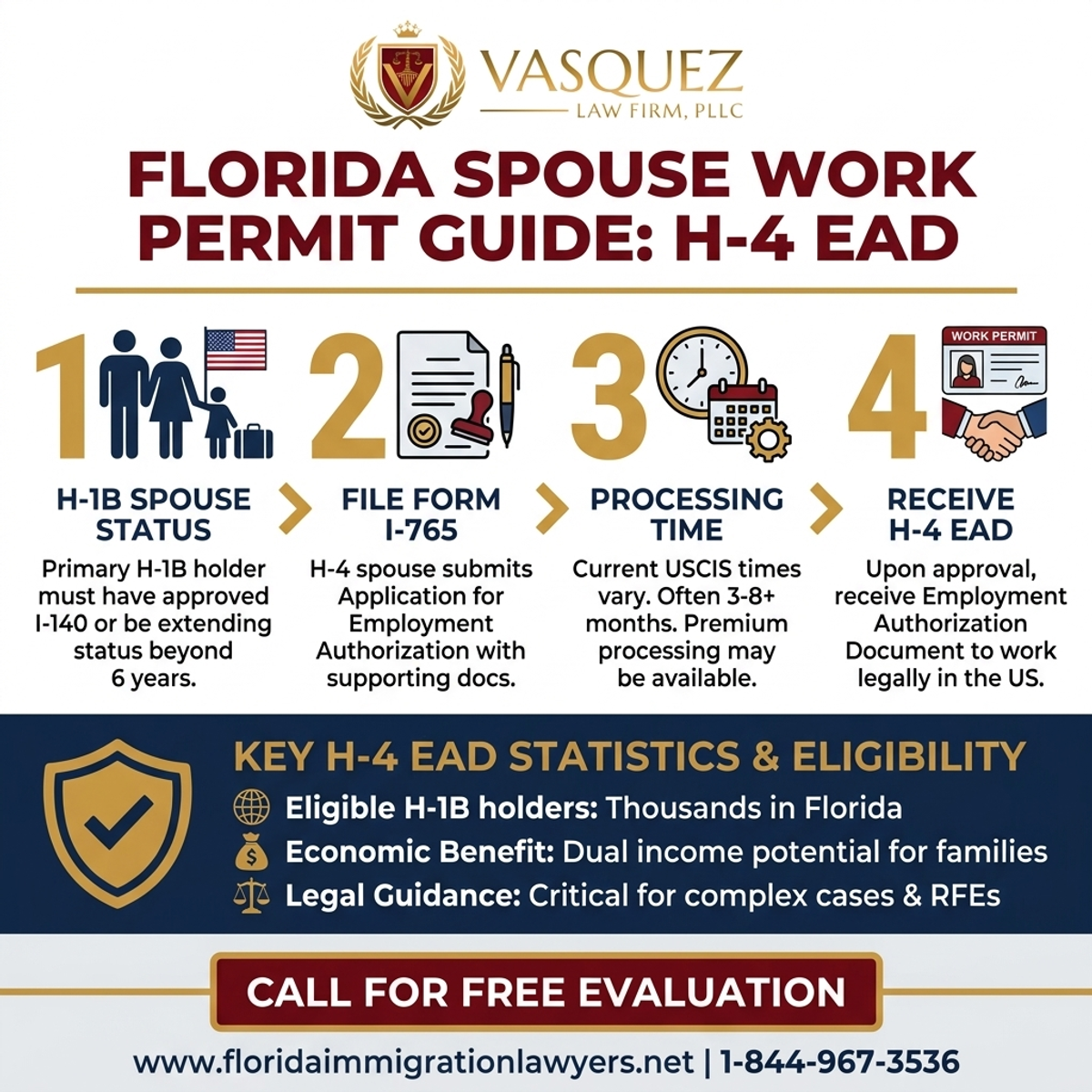
The H-4 EAD allows certain H-4 visa holders, primarily spouses of H-1B nonimmigrants who are seeking lawful permanent resident status, to obtain work authorization in the United States. This permit is crucial for many H-1B families in Florida, offering financial stability and career opportunities. Eligibility hinges on the H-1B spouse having an approved Form I-140, Immigrant Petition for Alien Worker, or being granted H-1B status under AC21 to extend their stay beyond six years. Navigating the application process involves submitting Form I-765 to USCIS, along with supporting documents. Consulting an experienced Florida immigration lawyer is highly recommended to ensure compliance and a smooth application.
- H-4 EAD provides work authorization for eligible H-4 spouses.
- Eligibility requires the H-1B spouse to have an approved I-140 or specific H-1B extensions.
- The application involves filing Form I-765 with USCIS.
- Processing times can vary significantly, so early application is key.
- Expert legal assistance can prevent delays and denials.
Are you an H-1B visa holder in Florida, perhaps in the bustling tech corridors of Miami or the healthcare hubs of Orlando, wondering about work opportunities for your spouse? Or are you an H-4 visa holder in Pembroke Pines, eager to contribute your skills to the Florida economy? The H-4 EAD (Employment Authorization Document) is a vital pathway for eligible H-4 spouses of H-1B nonimmigrants to gain work authorization in the U.S. This document can transform your family's financial security and empower spouses to pursue their professional aspirations in Florida.
Navigating the complex landscape of U.S. immigration law can be daunting, especially when dealing with specific categories like the H-4 EAD. Understanding the eligibility criteria, the application process, and potential pitfalls is crucial for a successful outcome. This comprehensive guide will walk you through everything you need to know about the H-4 EAD in Florida, from initial eligibility to common mistakes to avoid. We will cover the specific requirements, necessary documentation, and what to expect during the processing period. Our goal is to provide clear, actionable information to help H-1B families in Florida secure work authorization for H-4 spouses. Do not hesitate to call Florida Immigration Lawyers at 1-844-967-3536 for a free consultation and personalized guidance.
Understanding H-4 EAD Eligibility and Benefits in Florida
The H-4 EAD is a specific type of work permit that allows certain H-4 dependent spouses of H-1B visa holders to work legally in the United States. This authorization was first introduced in 2015 by the Department of Homeland Security (DHS) to address the challenges faced by H-1B families, particularly the professional stagnation of highly skilled H-4 spouses. For families residing in Florida, a state known for its diverse economy and growing industries, the H-4 EAD offers significant advantages. It allows spouses to pursue careers, start businesses, and contribute to the household income, thereby enhancing the overall quality of life for H-1B families.
To be eligible for an H-4 EAD, the H-1B principal applicant must meet one of two key conditions. First, they must be the principal beneficiary of an approved Form I-140, Immigrant Petition for Alien Worker. This means their green card process has progressed to a significant stage. Second, the H-1B principal must have been granted H-1B status under sections 106(a) and (b) of the American Competitiveness in the Twenty-first Century Act of 2000 (AC21), which allows for extensions of H-1B status beyond the six-year limit. This typically occurs if their PERM labor certification application or I-140 petition was filed at least 365 days prior to the end of their six-year H-1B authorized period of stay. Without meeting one of these two criteria, an H-4 spouse is generally not eligible for an EAD. It is vital to confirm your H-1B spouse’s status before proceeding with an H-4 EAD application.
Who Qualifies for an H-4 EAD?
Beyond the H-1B spouse's status, the H-4 applicant must also maintain valid H-4 nonimmigrant status. This means they must have entered the U.S. legally as an H-4 dependent and continue to adhere to the terms of their visa. If the H-4 status is expiring soon, it is often advisable to file an extension of stay concurrently with the EAD application. This helps prevent gaps in status or work authorization. The H-4 EAD is not available to all H-4 visa holders; specifically, children of H-1B visa holders (who also hold H-4 status) are not eligible for this work permit. This distinction is important for families planning their immigration strategy in Florida. Understanding these intricate eligibility rules is where the guidance of an experienced immigration attorney becomes invaluable.
The Step-by-Step H-4 EAD Application Process
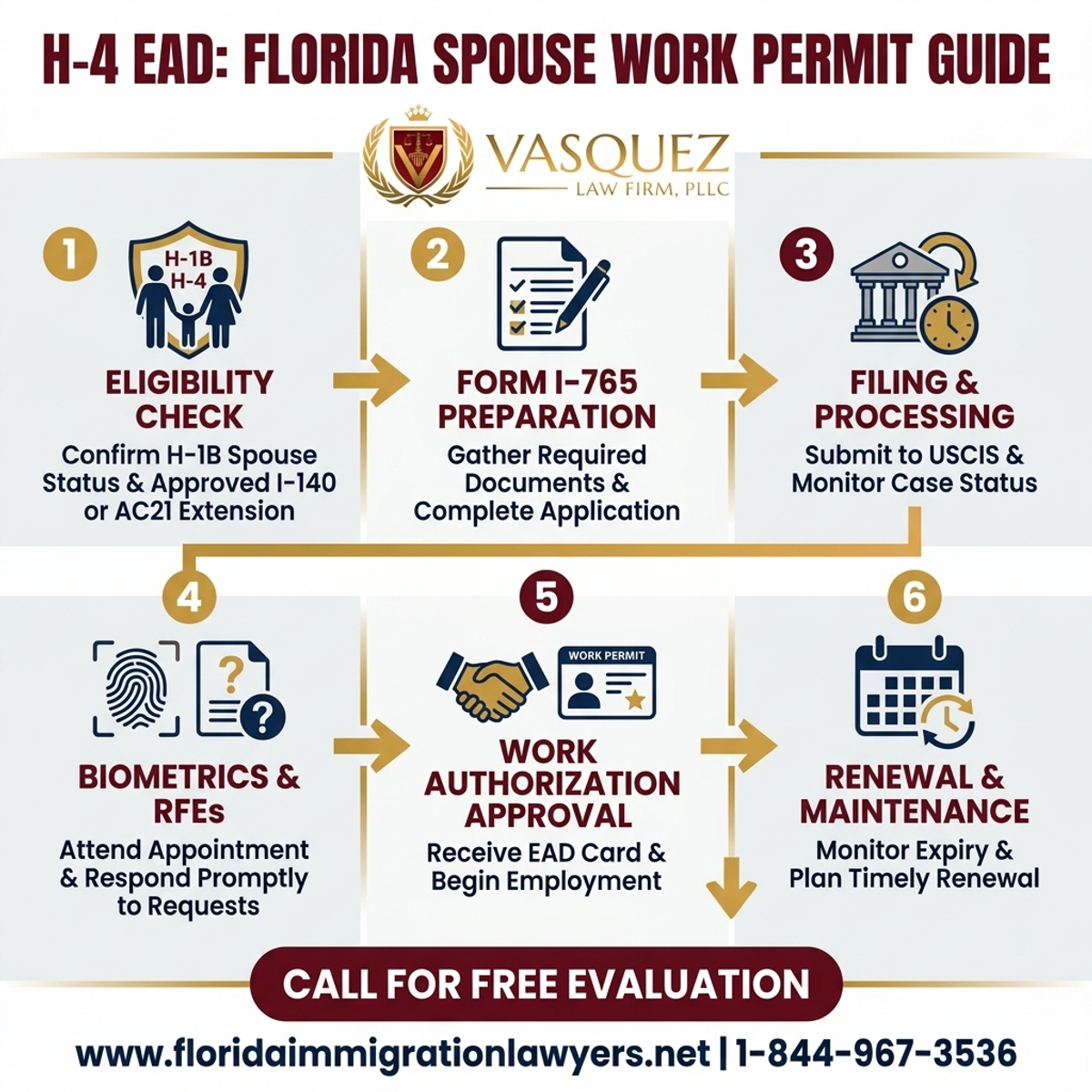
Applying for an H-4 EAD can seem complex, but by following a structured approach, you can navigate the process effectively. This section outlines the typical steps involved in securing your work authorization, a process that is standardized across the U.S., including for applicants in Florida. Each step requires careful attention to detail and accurate submission of information to the U.S. Citizenship and Immigration Services (USCIS). Missing steps or providing incorrect details can lead to delays or even denial of your application, impacting your ability to work and contribute.
- Gather Required Documents: Before filling out any forms, collect all necessary supporting documents. This includes proof of your H-4 status, your H-1B spouse's status, their approved I-140 or AC21 extension documentation, marriage certificate, and identification. A comprehensive checklist is provided in a later section.
- Complete Form I-765, Application for Employment Authorization: This is the primary form for your H-4 EAD application. Fill it out completely and accurately. Pay close attention to sections requesting your immigration status, the category of EAD you are applying for (c)(26) for H-4 EAD), and your personal details. Ensure all names match those on your identification documents.
- Prepare Supporting Evidence: Assemble all your collected documents. This typically includes copies of your passport, visa, I-94 record, marriage certificate, your H-1B spouse's I-797 approval notices (H-1B and I-140), and any previous EADs. Organize these documents clearly to facilitate USCIS review.
- Calculate and Prepare Filing Fees: USCIS charges a fee for filing Form I-765. The fee amount can change, so always check the official USCIS website for the most current fee schedule. You can pay by money order, personal check, cashier's check, or by credit card using Form G-1450, Authorization for Credit Card Transactions.
- Mail Your Application Packet: Send your completed Form I-765, supporting documents, and fee payment to the correct USCIS lockbox facility. The specific mailing address depends on where you live and the type of form you are filing, so consult the Form I-765 instructions on the USCIS website. For Florida residents, this generally means sending it to a specific lockbox designated for I-765 applications.
- Receive Receipt Notice: After USCIS receives your application, they will send you a Form I-797C, Notice of Action, which is your receipt notice. This notice will contain your case receipt number, which you can use to track the status of your application online.
- Attend Biometrics Appointment (If Required): In some cases, USCIS may send you an appointment notice for biometrics collection (fingerprints, photograph, signature). This is a standard procedure to verify your identity and conduct background checks.
- Receive Decision: USCIS will review your application and evidence. If approved, you will receive your EAD card by mail. If there are issues, you may receive a Request for Evidence (RFE) or a Notice of Intent to Deny (NOID).
Essential Document Checklist for Your H-4 EAD Application
A thorough and accurate submission of documents is critical for a smooth H-4 EAD application process. Any missing or incorrect documentation can lead to significant delays, Requests for Evidence (RFEs), or even a denial. By preparing a comprehensive packet, you can minimize potential complications and expedite the review of your application by USCIS. This checklist is designed to help H-4 spouses in Florida gather all the necessary evidence for their work authorization application. Remember to submit clear copies of all documents, not originals, unless specifically requested by USCIS.
Documents for the H-4 Applicant:
- Completed Form I-765, Application for Employment Authorization.
- Two passport-style photographs taken within 30 days of filing.
- Copy of your most recent Form I-94, Arrival/Departure Record.
- Copy of your H-4 visa stamp in your passport (if applicable).
- Copy of your passport biographical page.
- Copy of your marriage certificate (with certified English translation if not in English).
- Copy of your most recent Form I-797 approval notice for H-4 status.
- Copy of any previous EAD cards (if applicable).
Documents for the H-1B Principal Applicant (Spouse):
- Copy of their most recent Form I-797 approval notice for H-1B status.
- Copy of their approved Form I-140, Immigrant Petition for Alien Worker (if applicable).
- Evidence of H-1B extension under AC21 (e.g., I-797 approval notice showing extension beyond 6 years based on PERM/I-140 filed 365 days prior).
- Copy of their passport biographical page and H-1B visa stamp.
Step-by-Step Process — H-4 EAD: Florida Spouse Work Permit Guide for H-1B Families
It is important to ensure consistency across all documents. For instance, names on your marriage certificate should match your passports. If there are any discrepancies, provide additional evidence such as a name change affidavit or an explanation. Always keep a complete copy of your submitted application packet for your records. This can be invaluable if USCIS requests further information or if you need to re-file. Consulting with a Florida Immigration Lawyer can help you verify that your document packet is complete and correctly assembled before submission.
H-4 EAD Processing Timelines and Expectations in Florida
Understanding the processing times for your H-4 EAD application is crucial for planning your professional life in Florida. USCIS processing times can vary significantly based on the service center handling your case, the volume of applications, and current immigration policies. While there are general estimates, it is important to check the USCIS website for the most up-to-date information. Historically, H-4 EAD applications have taken anywhere from a few months to over a year to process. This variability necessitates early application, especially for renewals, to prevent gaps in work authorization.
For H-4 EAD applicants in Florida, your application will be processed by one of the USCIS service centers, typically the California Service Center or the Vermont Service Center, depending on the mailing address and type of application. These centers handle applications from across the country. Once your application is submitted, you will receive a receipt notice (Form I-797C) within a few weeks. This notice confirms USCIS has received your application and provides a receipt number you can use to track your case online. Biometrics appointments, if required, usually occur a few weeks to a couple of months after the receipt notice. The final approval and mailing of your EAD card will follow the processing of your case.
What to Expect During Processing:
- Receipt Notice: Within 2-4 weeks of filing.
- Biometrics Appointment: 4-8 weeks after receipt notice (if required).
- Request for Evidence (RFE): USCIS may issue an RFE if they need more information or clarification. Responding promptly and thoroughly is critical.
- Approval or Denial: The total processing time until decision can range from 6 to 15 months or even longer. It is essential to monitor your case status online using your receipt number.
- EAD Card Mailing: Once approved, the EAD card is typically mailed within 7-10 days.
It is important to note that you cannot begin employment until you have the physical EAD card in hand. Planning for potential delays is key, especially if you are transitioning between jobs or renewing an existing EAD. Many H-1B families in Florida choose to file their H-4 EAD renewal applications well in advance, sometimes 5-6 months before expiration, to mitigate the risk of employment gaps. An immigration attorney can help you monitor your case and respond to any USCIS inquiries efficiently, ensuring your application stays on track.
Do not navigate this process alone. Contact Florida Immigration Lawyers today for assistance with your H-4 EAD application and to ensure your family's future in Florida is secure.
Cost Factors and Fee Breakdown for H-4 EAD Applications
Understanding the financial aspects of applying for an H-4 EAD is an important part of the planning process for H-1B families in Florida. While the primary cost is the USCIS filing fee, there are other potential expenses to consider. These costs can include legal fees for attorney assistance, translation fees for foreign documents, and postage. Being aware of these different financial components will help you budget effectively and avoid any unexpected expenses during your application journey.
USCIS Filing Fees:
- Form I-765, Application for Employment Authorization: This is the mandatory fee for filing your EAD application. It is crucial to check the official USCIS website or the Form I-765 instructions for the most current fee amount, as these are subject to change without prior notice. As of my last update, the fee for Form I-765 is a specific amount, which should be verified directly from USCIS.
It is important to pay the correct fee. Overpayment or underpayment can lead to your application being rejected or delayed. USCIS accepts various payment methods, including personal checks, money orders, cashier's checks, and credit card payments via Form G-1450. Ensure that checks are made payable to the "U.S. Department of Homeland Security."
Key Statistics — H-4 EAD: Florida Spouse Work Permit Guide for H-1B Families
Potential Additional Costs:
- Legal Fees: While not mandatory, hiring an immigration attorney is highly recommended. Legal fees for H-4 EAD applications can vary depending on the complexity of your case and the services provided (e.g., full application preparation, review, RFE response). An attorney can save you time, reduce stress, and significantly lower the risk of errors or denials.
- Translation Fees: If any of your supporting documents, such as your marriage certificate, are not in English, they must be accompanied by a certified English translation. Translation services will incur additional costs.
- Photography Fees: You will need two passport-style photographs for your application. These can be taken at various retail locations for a small fee.
- Postage and Shipping: While seemingly minor, the cost of sending your application packet via certified mail or courier service adds up, especially if you need to respond to RFEs.
When budgeting for your H-4 EAD application in Florida, it is wise to factor in a buffer for unexpected costs. While the USCIS fee is fixed, other expenses are variable. Investing in professional legal assistance from Florida Immigration Lawyers can often be cost-effective in the long run, preventing costly mistakes and ensuring a smoother process for your family's work authorization.
Common Mistakes to Avoid in H-4 EAD Applications
Applying for an H-4 EAD involves strict adherence to USCIS guidelines. Even minor errors can lead to significant delays, Requests for Evidence (RFEs), or outright denial, impacting your ability to work and your family's stability in Florida. Being aware of these common pitfalls can help you prepare a strong and accurate application.
- Failing to Meet H-1B Spouse's Eligibility: The H-4 spouse is only eligible if the H-1B spouse has an approved I-140 or has received H-1B extensions under AC21 beyond the 6-year limit. Applying without meeting these conditions will result in denial. Always verify your H-1B spouse's status and documentation.
- Incorrectly Filling Out Form I-765: Errors in personal details, incorrect EAD category selection (should be (c)(26)), or incomplete sections are common. Double-check every field for accuracy and consistency with other documents.
- Submitting Insufficient or Incorrect Supporting Documents: Missing copies of passports, I-94s, marriage certificates, or the H-1B spouse's I-797/I-140 can lead to RFEs and delays. Ensure all required documents from the checklist are included and are clear copies.
- Incorrect Filing Fee or Payment Method: USCIS fees change periodically. Submitting an outdated fee amount or an improper payment method (e.g., personal check without sufficient funds) will cause the application to be rejected. Always verify the current fee on the USCIS website.
- Not Filing H-4 Extension Concurrently (If Applicable): If your H-4 status is expiring soon, failing to file an H-4 extension (Form I-539) concurrently with your EAD application can lead to a gap in status and potential work authorization issues.
- Mailing to the Wrong USCIS Lockbox: USCIS has different mailing addresses for various forms and states. Sending your application to the wrong lockbox will cause significant delays. Check the Form I-765 instructions for the correct address for Florida residents.
- Ignoring a Request for Evidence (RFE): An RFE means USCIS needs more information. Failing to respond by the deadline or providing an inadequate response will likely lead to a denial. Take RFEs seriously and seek legal advice.
- Applying Too Late for Renewals: Processing times can be lengthy. Waiting until your current EAD is about to expire to file a renewal can lead to a period where you are unauthorized to work. File renewals 5-6 months in advance.
- Not Keeping Copies of Your Application: Always retain a complete copy of your entire application packet, including all forms, documents, and payment receipts. This is essential for your records and if USCIS requests further information.
- Failing to Disclose All Prior Immigration History: Any prior visa denials, overstays, or other immigration issues must be accurately disclosed. Concealing information can have severe consequences.
- Assuming H-4 Children are Eligible: The H-4 EAD is only for spouses, not for H-4 dependent children. Applying for children under this category will result in denial.
- Not Seeking Legal Counsel: Immigration law is complex. Attempting to navigate the H-4 EAD process without professional legal advice can lead to costly and time-consuming errors.
When to Call Florida Immigration Lawyers for H-4 EAD Assistance
While the information provided in this guide is comprehensive, the nuances of immigration law often require personalized attention. Knowing when to seek professional legal help for your H-4 EAD application can make a significant difference in the outcome. Florida Immigration Lawyers are dedicated to assisting H-1B families throughout Florida, including those in Pembroke Pines, Miami, and Orlando, with their work authorization needs. We understand the specific challenges and opportunities within the Florida immigration landscape.
You should consider contacting an attorney if you encounter any of the following scenarios:
- Complex Eligibility Questions: If your H-1B spouse's I-140 status is unclear, or if their H-1B extension under AC21 involves intricate details, an attorney can help confirm your eligibility.
- Previous Denials or Immigration Issues: If you or your H-1B spouse have had past immigration applications denied, overstays, or other complexities in your immigration history, legal counsel is essential to address these issues properly.
- Requests for Evidence (RFEs): Receiving an RFE from USCIS means your application needs more supporting documentation or clarification. An attorney can help you understand the RFE and prepare a thorough, timely response.
- Concurrent Filings: If you need to file an H-4 extension (Form I-539) concurrently with your H-4 EAD (Form I-765), an attorney can ensure both applications are correctly coordinated and submitted.
- Expiring Status or EAD: If your H-4 status or current EAD is nearing expiration and you need to file a renewal, an attorney can help you file proactively to avoid gaps in employment authorization.
- Desire for Peace of Mind: Even if your case seems straightforward, the stress and uncertainty of immigration processes can be overwhelming. An attorney provides peace of mind by ensuring everything is filed correctly and efficiently.
Our experienced team at Florida Immigration Lawyers is here to guide you through every step, offering clear advice and robust representation. We are familiar with the specific requirements and common challenges faced by H-1B families seeking work authorization in Florida. Do not risk your future or your ability to work. Contact us today for a free consultation.
About Florida Immigration Lawyers
At Florida Immigration Lawyers, we are a leading immigration law firm dedicated to serving individuals and families across the entire state of Florida. With offices strategically located to assist clients from Pembroke Pines to Jacksonville, and everywhere in between, we pride ourselves on providing compassionate, effective, and results-driven legal representation. Our team of experienced attorneys understands the profound impact immigration matters have on our clients' lives, and we are committed to offering personalized strategies tailored to each unique situation.
We specialize in a comprehensive range of immigration services, including family-based immigration, employment visas, asylum, deportation defense, and citizenship applications. Whether you are seeking an H-4 EAD, navigating the green card process, or facing complex immigration challenges, our firm is equipped to provide the expert guidance you need. We believe in clear communication, transparency, and empowering our clients with knowledge throughout their legal journey. Our commitment extends to offering accessible legal support, which is why we provide free consultations and are available 24/7 to address your urgent concerns. Choose Florida Immigration Lawyers for dedicated advocacy and a steadfast partner in achieving your immigration goals. Visit our website at https://www.floridaimmigrationlawyers.net or call us at 1-844-967-3536.
Sources and References
- U.S. Citizenship and Immigration Services (USCIS)
- USCIS Form I-765, Application for Employment Authorization
- USCIS Check Case Processing Times
- Executive Office for Immigration Review (EOIR)
- 8 U.S.C. § 1101 et seq. - Immigration and Nationality Act (INA)
- 8 C.F.R. § 274a.12(c)(26) - Classes of aliens authorized to accept employment.
- American Competitiveness in the Twenty-first Century Act of 2000 (AC21)
Related services: family petition process, family-based green cards, fiancé visa (K-1).
This article provides general legal information and is not intended as legal advice. Every case is unique, and outcomes depend on specific facts and circumstances. Contact an attorney for advice about your particular situation.
Securing an H-4 EAD can open up a world of professional opportunities for H-1B spouses in Florida. While the process requires diligence and adherence to specific regulations, the benefits of work authorization are substantial. Do not let the complexities of immigration law deter you from pursuing your goals. The experienced immigration attorneys at Florida Immigration Lawyers are here to provide the expert guidance and support you need. We offer comprehensive services for H-1B families throughout Florida. For a free, confidential consultation, call us today at 1-844-967-3536. Se Habla Espanol - Estamos aqui para ayudarle.
If you need legal assistance, learn more about learn about family-based immigration, or call us at 1-844-967-3536 for a free consultation.
Do Not Navigate This Process Alone
Our experienced immigration attorneys are ready to fight for you. Get a free, confidential consultation today.
Se Habla Español
Frequently Asked Questions
Florida Immigration Lawyers
Immigration Attorney | Founder, Vasquez Law Firm
U.S. Air Force veteran and immigration attorney with thousands of cases resolved. J.D., NCCU School of Law. AILA member. Admitted to the 4th, 5th, and 11th Circuit Courts.
Available 24/7 - Free Evaluations
Related Legal Services
Our Florida immigration attorneys can help you with citizenship and naturalization, family immigration services and immigration practice areas. Call today at 1-844-967-3536 for a free consultation.
Related Links
Related Topics
Free Legal Consultation
Discuss your case with our experienced attorneys. We're available 24/7.
Se Habla Español - Estamos aquí para ayudarle.
Related Articles
Understanding Good Moral Character for Naturalization in Florida
Learn about the importance of good moral character for naturalization in Florida. Understand how it impacts your N-400 application and what steps to take to ensure a successful process.
Naturalization Process Timeline in Florida | VLF Florida
Explore the naturalization process timeline in Florida. Understand the steps, required documents, and potential pitfalls. Contact Florida Immigration Lawyers for expert guidance and a free consultation.
Dual Citizenship in Florida: Navigating Immigration
Explore dual citizenship in Florida and learn the steps to obtaining it. Discover how to navigate immigration laws and naturalization processes for a more flexible future.
Change of Status for Student Visa in Florida | VLF Florida
Changing your student visa status in Florida is a complex process. Learn about eligibility, required documents, and common mistakes to avoid. Contact Florida Immigration Lawyers for expert guidance.