T Visa for Trafficking Victims in Florida
Learn about T visas for trafficking victims in Florida. Discover eligibility, application steps, and common mistakes to avoid. Call us for a free consultation.

The T Visa offers crucial protection for victims of human trafficking in Florida, providing a pathway to safety, stability, and ultimately, a new life. If you or someone you know has been a victim of this heinous crime, understanding your rights and the legal avenues available is the first, critical step towards recovery. At VLF Florida, we are deeply committed to advocating for trafficking survivors, helping them navigate the often overwhelming complexities of the U.S. immigration system to secure the protections they deserve.
Understanding the T Visa: A Lifeline for Trafficking Victims
The T Nonimmigrant Status, commonly known as the T Visa, is a vital immigration benefit designed to protect victims of severe forms of human trafficking. Established by the Victims of Trafficking and Violence Protection Act of 2000 (VTVPA), this visa not only offers a temporary legal status but also encourages victims to cooperate with law enforcement in the investigation and prosecution of trafficking crimes, without fear of deportation. It recognizes the immense trauma experienced by survivors and aims to provide a secure environment for healing and rebuilding.
Human trafficking is a modern form of slavery, involving the use of force, fraud, or coercion to exploit individuals for labor or commercial sex acts. It can happen to anyone, regardless of age, gender, nationality, or socioeconomic status, and often goes undetected. In Florida, a state with significant international travel and diverse populations, the risk of human trafficking is particularly acute. The T Visa is a beacon of hope, offering a means for victims to escape their exploiters and begin a journey toward freedom and justice.
Unlike some other immigration pathways, the T Visa is specifically tailored to the unique circumstances of trafficking victims. It acknowledges that victims are often held captive not just physically, but also psychologically, through threats to themselves or their families, debt bondage, or manipulation. The visa's provisions are designed to counteract these forms of control, providing a legal shield against further exploitation and deportation, while also offering a potential path to permanent residency.
Comprehensive Eligibility Requirements for T Nonimmigrant Status
To qualify for a T Visa, applicants must meet several specific and stringent criteria. Understanding these requirements is paramount for a successful application:
1. Victim of a Severe Form of Human Trafficking
The law defines a "severe form of human trafficking" as:
- Sex Trafficking: The recruitment, harboring, transportation, provision, or obtaining of a person for the purpose of a commercial sex act, where the commercial sex act is induced by force, fraud, or coercion, or where the person induced to perform such act has not attained 18 years of age.
- Labor Trafficking: The recruitment, harboring, transportation, provision, or obtaining of a person for labor or services, through the use of force, fraud, or coercion for the purpose of subjection to involuntary servitude, peonage, debt bondage, or slavery.
It's crucial to demonstrate that these elements were present in your situation. This often involves providing detailed accounts of the force, fraud, or coercion used by your trafficker(s).
2. Physical Presence in the United States Due to Trafficking
Applicants must demonstrate that they are physically present in the United States, American Samoa, the Commonwealth of the Northern Mariana Islands, or at a U.S. port of entry on account of such trafficking. This means your presence in the U.S. must be directly linked to the trafficking situation, whether you were brought here for exploitation, or the exploitation occurred while you were already present.
3. Compliance with Reasonable Requests from Law Enforcement
Generally, T Visa applicants must comply with any reasonable request for assistance in the investigation or prosecution of acts of trafficking. This requirement is critical as the T Visa program aims to bolster efforts to combat human trafficking. However, there are important exceptions:
- Age Exception: If you are under 18 years of age, you are not required to comply with law enforcement requests.
- Trauma Exception: If you are unable to cooperate due to physical or psychological trauma, this requirement may be waived. This acknowledges the profound impact trafficking has on victims and prioritizes their well-being.
Working with law enforcement can be a daunting prospect for survivors. An experienced attorney can help facilitate this cooperation, ensuring your rights are protected and that any requests are reasonable and appropriate given your circumstances.
4. Suffering Extreme Hardship Upon Removal
Applicants must demonstrate that they would suffer extreme hardship involving unusual and severe harm if they were removed from the United States. This is a high bar and requires compelling evidence. Factors considered include:
- The nature and extent of the harm suffered from the trafficking.
- The risk of re-victimization in your home country.
- The need for continued medical or psychological treatment in the U.S.
- The absence of adequate protection or services in your home country.
- The potential for retaliation against you or your family if you return.
This requirement underscores the humanitarian aspect of the T Visa, recognizing that returning a survivor to a potentially unsafe or unsupportive environment could cause irreparable harm.
The T Visa Application Process: A Step-by-Step Guide
The T Visa application process is complex and requires meticulous preparation. Here’s a general overview of the steps involved:
1. Gathering Crucial Evidence and Documentation
The foundation of a strong T Visa petition is comprehensive evidence. This includes:
- Personal Declaration: A detailed, chronological statement from the applicant describing the trafficking experience, the force, fraud, or coercion used, the harm suffered, and why returning to their home country would cause extreme hardship. This is often the most critical piece of evidence.
- Corroborating Evidence: Any documents that support the claims in your declaration, such as medical records, police reports, witness statements, photographs, travel documents, financial records showing exploitation, or evidence of threats.
- Law Enforcement Endorsement (Form I-914, Supplement B): This is a crucial document where a law enforcement agency (e.g., local police, FBI, ICE) confirms that you are a victim of human trafficking and have cooperated with their investigation. While not always mandatory (especially for minors or those unable to cooperate), it significantly strengthens the application.
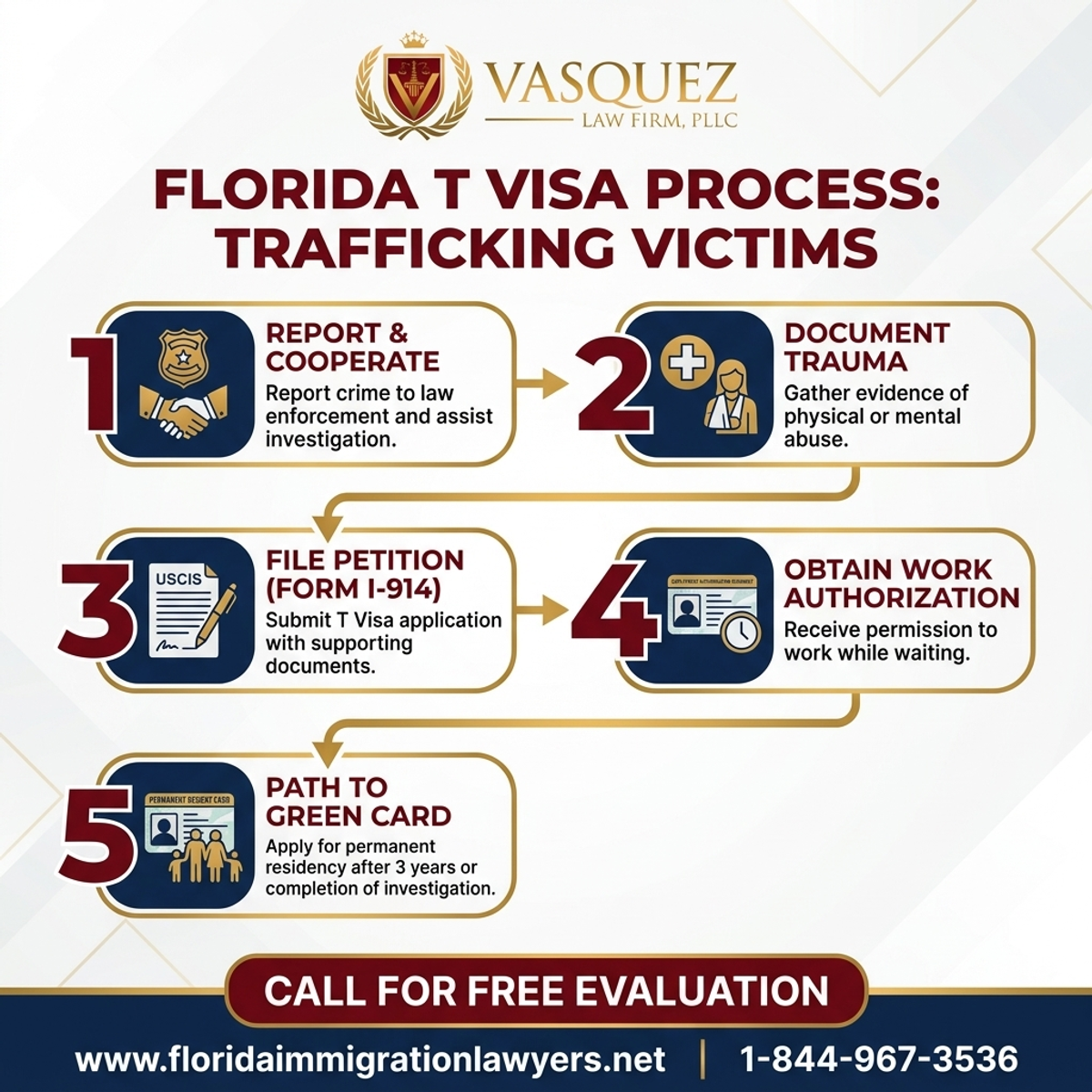
Step-by-Step Process — T Visa for Trafficking Victims in Florida | VLF Florida
2. Filing Form I-914, Application for T Nonimmigrant Status
Once all documentation is prepared, the application package, including Form I-914 and all supporting evidence, is filed with U.S. Citizenship and Immigration Services (USCIS). USCIS reviews the application to determine if the eligibility criteria have been met.
3. Potential Interviews and Requests for Evidence (RFEs)
USCIS may request additional evidence (RFE) if the initial submission is incomplete or unclear. In some cases, an interview may be required. Navigating RFEs and interviews effectively is vital, and legal representation can be invaluable during these stages.
Benefits and Protections Afforded by a T Visa
A T Visa offers profound benefits that can transform a survivor's life:
- Work Authorization: T Visa holders are eligible to apply for employment authorization, allowing them to work legally in the U.S. and achieve financial independence.
- Path to Lawful Permanent Residency: After three years in T nonimmigrant status, or upon completion of the investigation or prosecution of the trafficking act (whichever comes sooner), T Visa holders can apply for adjustment of status to become a lawful permanent resident (Green Card holder), provided they meet certain conditions.
- Derivative T Visas for Qualifying Family Members: Certain immediate family members of the principal T Visa applicant may also be eligible for derivative T Visas, allowing families to reunite and heal together. This includes spouses, children, unmarried siblings under 18, and parents (if the principal applicant is under 21).
- Protection from Deportation: Perhaps one of the most critical benefits, the T Visa provides protection from removal from the United States. This is particularly important for individuals who might otherwise face deportation proceedings.
- Access to Federal and State Benefits: T Visa holders may be eligible for certain federal and state benefits and services, including public assistance, medical care, and job training, which are crucial for recovery and integration.
The Critical Role of Legal Counsel in T Visa Petitions
Applying for a T Visa is an intricate legal process, fraught with potential pitfalls and complexities. For survivors of human trafficking, who have already endured immense trauma, navigating this system alone can be overwhelming, if not impossible. This is where the expertise of a dedicated immigration attorney becomes not just beneficial, but often essential.
An experienced legal team, like the one at VLF Florida, plays a pivotal role in every stage of the T Visa petition. Firstly, we provide a safe and confidential space for survivors to share their stories, ensuring they feel heard and respected. We understand the sensitive nature of these cases and prioritize the emotional well-being of our clients. Our attorneys are adept at identifying whether an individual meets the stringent eligibility criteria, offering honest assessments and guiding clients through the nuances of what constitutes a “severe form of human trafficking” and “extreme hardship.”
Secondly, the process of gathering compelling evidence is often the most challenging aspect. Victims may lack documentation, fear authorities, or struggle to recall traumatic events. Our attorneys assist in meticulously collecting all necessary supporting documents, including medical records, psychological evaluations, and critical corroborating evidence. We are skilled in drafting comprehensive and persuasive personal declarations that accurately reflect the client's experience while adhering to legal requirements. Furthermore, we can facilitate communication with law enforcement agencies, helping clients understand their rights and obligations when cooperating with investigations, and ensuring that any requests are reasonable and appropriate. This liaison is crucial for obtaining the necessary law enforcement endorsement (Form I-914, Supplement B), which can significantly strengthen a petition.
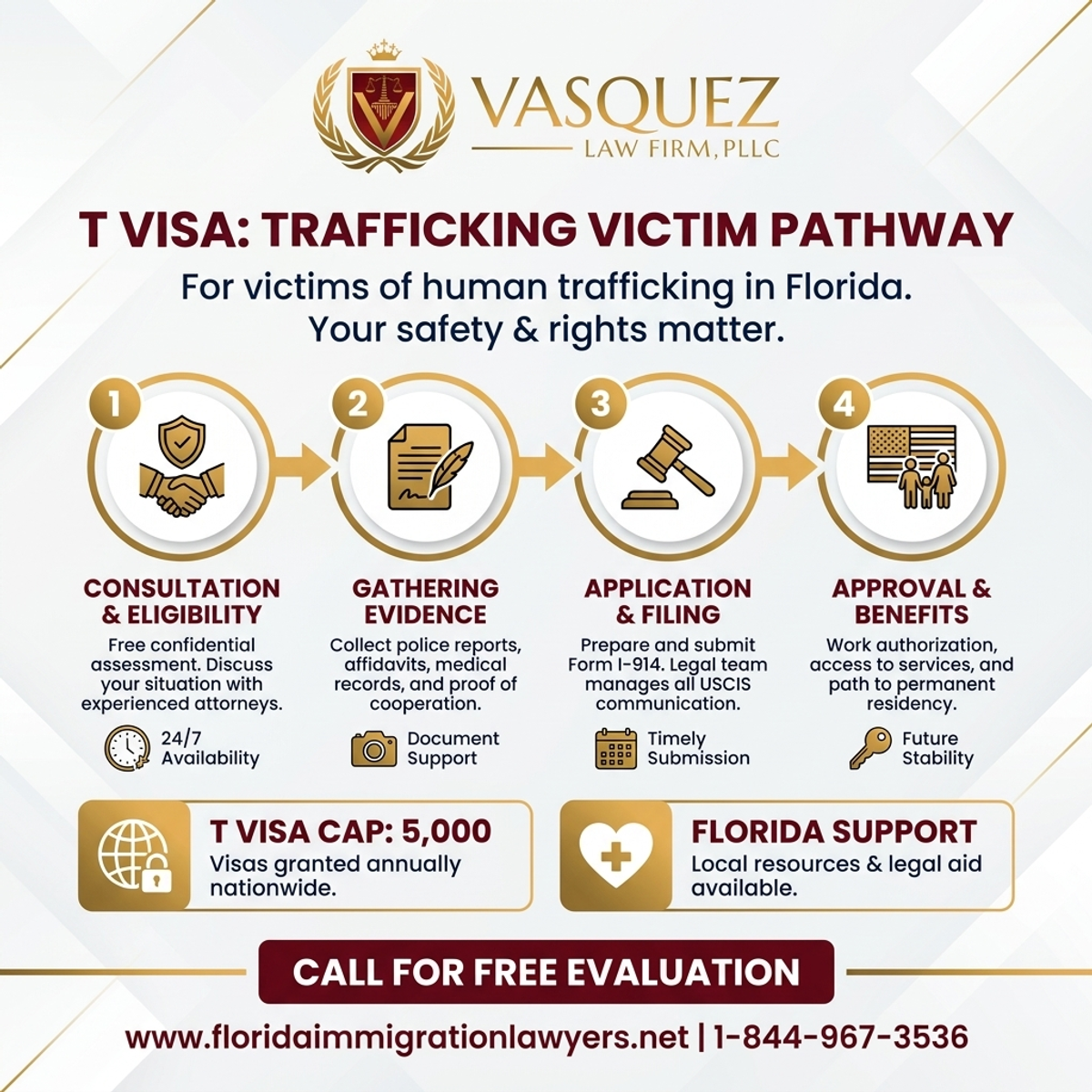
Key Statistics — T Visa for Trafficking Victims in Florida | VLF Florida
Finally, the U.S. immigration landscape is constantly evolving, with complex laws and regulations that can be difficult for non-specialists to interpret. Our attorneys possess in-depth knowledge of these laws, allowing us to anticipate potential challenges, respond effectively to Requests for Evidence (RFEs) from USCIS, and represent clients during interviews. We are committed to protecting the rights of trafficking victims, ensuring their applications are thorough, accurate, and presented in the most favorable light possible, maximizing their chances of approval and helping them secure a brighter future.
Beyond the T Visa: Exploring Other Avenues for Protection and Relief
While the T Visa is specifically tailored for victims of human trafficking, it's important to recognize that other immigration relief options may exist depending on an individual's unique circumstances. Sometimes, a victim may qualify for multiple forms of relief, or the T Visa may not be the most suitable path.
For instance, victims of certain other qualifying crimes who have suffered substantial physical or mental abuse may be eligible for a U Visa. This visa also offers protection and a path to lawful permanent residency, encouraging cooperation with law enforcement. The specific type of crime and the nature of cooperation differ from the T Visa, making a careful assessment by an immigration attorney crucial.
Individuals who have fled their home countries due to a well-founded fear of persecution based on race, religion, nationality, membership in a particular social group, or political opinion might be eligible for asylum. While distinct from trafficking, some trafficking victims may also have valid asylum claims if their persecution is linked to one of these protected grounds. Exploring this option can provide an alternative or supplementary layer of protection.
Moreover, for those already in removal proceedings, understanding all available defenses is paramount. Our firm specializes in deportation defense, exploring every possible avenue to prevent removal and secure legal status. This holistic approach ensures that no stone is left unturned in the pursuit of justice and stability for our clients.
Seeking Justice and Stability: How VLF Florida Can Help
The journey from victim to survivor is arduous, but you do not have to walk it alone. The legal team at VLF Florida is dedicated to providing compassionate, knowledgeable, and effective legal representation to victims of human trafficking in Florida. We understand the profound impact of these experiences and are here to offer unwavering support and expert guidance through every step of the T Visa application process and beyond.
Our commitment extends to ensuring that you understand your rights, explore all available legal options, and receive the highest quality legal advocacy. We believe that every survivor deserves the chance to live a life free from fear and exploitation, with the opportunity to build a secure future in the United States. If you are a victim of human trafficking or know someone who is, please do not hesitate to reach out. Your safety and well-being are our top priority.
Contact VLF Florida today for a confidential and free consultation. Let us help you take the first step towards healing and justice. Call us at (844) 967-3536 or visit our contact page to schedule an appointment. We are here to help you reclaim your life.
Sources and References
- U.S. Citizenship and Immigration Services (USCIS)
- Executive Office for Immigration Review (EOIR)
- U.S. Department of State - Bureau of Consular Affairs
- Immigration and Nationality Act (INA), 8 U.S.C. Chapter 12
Do Not Navigate This Process Alone
Our experienced immigration attorneys are ready to fight for you. Get a free, confidential consultation today.
Se Habla Español
Frequently Asked Questions
Harold Estrada-Rodriguez
Florida Immigration Attorney · FL Bar No. 1041171
Florida Bar attorney handling Florida-jurisdiction immigration matters. Bilingual representation, free consultations.
Available 24/7 - Free Evaluations
Related Legal Services
Our Florida immigration attorneys can help you with deportation defense, citizenship and naturalization and family immigration services. Call today at 1-844-967-3536 for a free consultation.
Related Links
Related Topics
Free Legal Consultation
Discuss your case with our experienced attorneys. We're available 24/7.
Se Habla Español - Estamos aquí para ayudarle.
Related Articles
Military Naturalization Florida: Expedited Path to Citizenship
For military personnel stationed in Florida, achieving U.S. citizenship through military naturalization is an expedited and often fee-exempt process. This guide details the unique benefits available under INA Sections 328 and 329, providing a step-by-step overview of the N-400 application for service members at bases like MacDill AFB. Learn about the specific eligibility requirements, the crucial documents needed, and what to expect regarding timelines for expedited processing as of 2026. We also cover potential costs, common mistakes to avoid, and when legal assistance from Florida Immigration Lawyers is essential to navigate complex cases. Secure your future in the nation you serve with expert guidance.
Advance Parole Travel Document in Florida | VLF Florida
Learn how to obtain an advance parole travel document in Florida, focusing on Hialeah. Understand application steps, required documents, and common pitfalls. Contact Florida Immigration Lawyers at 1-844-967-3536 for guidance.
RFE Response in Florida: How to Handle USCIS Requests
Learn how to handle an RFE in Florida, including steps to respond and common mistakes to avoid. Contact Florida Immigration Lawyers for a free consultation.
H-2A Visa for Florida Growers: Guide for Agricultural Workers
The H-2A visa program is vital for Florida's agricultural industry, enabling growers to address seasonal labor shortages by bringing in temporary agricultural workers. This comprehensive guide, updated for 2026, details the H-2A requirements for both employers and workers, outlining the application process, associated costs, and critical deadlines. Learn about worker protections, common mistakes to avoid, and the significant economic impact of H-2A workers on Florida's farms. Florida Immigration Lawyers offers expert guidance to ensure compliance and a smooth process for all parties, supporting Kissimmee and other agricultural communities throughout the state. Contact us for a free consultation to navigate this complex immigration pathway.