We Just Received an RFE: Alternatives for Gainesville
Receiving a Request for Evidence (RFE) can be overwhelming, especially if your current legal firm isn't responsive. Learn how to navigate this process in Gainesville, Florida, and discover alternatives to ensure your immigration journey stays on track. Contact Florida Immigration Lawyers for expert guidance.
- Act swiftly to meet the RFE deadline.
- Consider other reputable firms if needed.
- Understand the importance of a detailed response.
Introduction
Receiving a Request for Evidence (RFE) from USCIS can be stressful, especially if your current legal representation is unresponsive. In Gainesville, Florida, immigrants face this challenge and need clear guidance on how to proceed. This article provides actionable steps for responding to an RFE, highlights alternatives to Lighthouse for corporate immigration, and emphasizes the importance of timely and accurate submissions. Call Florida Immigration Lawyers at 1-844-967-3536 for a free consultation.
The anxiety that comes with an RFE is often compounded when your legal counsel, whom you've entrusted with your future, becomes unreachable. This situation demands immediate and decisive action. For individuals and businesses in Gainesville, Florida, understanding your options and the critical steps involved in addressing an RFE is paramount to safeguarding your immigration journey.
This comprehensive guide aims to demystify the RFE process, offering practical advice and outlining the crucial role a responsive and knowledgeable immigration attorney plays. We will explore various aspects, from understanding the RFE's nuances to assembling a robust response, ensuring you are well-equipped to navigate this challenging phase, even if it means seeking new legal representation.
What is a Request for Evidence (RFE) from USCIS?
An RFE is a formal request from USCIS for additional documentation or information to make a decision on your immigration application. As of 2026, an RFE can be issued for various reasons, including missing information, insufficient evidence, or discrepancies in your application.
Responding to an RFE requires providing the requested documentation by the deadline specified in the notice. Failure to respond adequately can lead to denial of your application. Understanding the RFE process is crucial for navigating your immigration journey successfully.
RFEs are not uncommon and can arise from a multitude of factors. Sometimes, it's as simple as an oversight in the initial application, such as a missing signature or an outdated form. Other times, USCIS may require more substantive proof to establish eligibility, especially for complex categories like employment-based visas (e.g., proving a specialty occupation for an H-1B) or family-based petitions (e.g., demonstrating a bona fide marriage).
It's vital to remember that receiving an RFE does not mean your application is destined for denial; rather, it signifies an opportunity to present a more compelling and complete case. The specific nature of the RFE will dictate the type and volume of evidence needed. For instance, an RFE for an I-485 adjustment of status might ask for updated medical exams or proof of financial support, while an RFE for an I-140 immigrant petition could demand more evidence of the beneficiary's qualifications or the employer's ability to pay the proffered wage. Florida Immigration Lawyers are adept at interpreting these diverse RFE types and crafting targeted responses.
How to Respond to an RFE in Florida
Responding to an RFE involves several key steps that must be executed meticulously to ensure a favorable outcome. Here's a step-by-step guide:
- Carefully read the RFE notice to understand what additional evidence is required.
- Gather the requested documents and any additional supporting information.
- Ensure all documents are translated into English if necessary.
- Organize your response in a clear and logical manner.
- Submit your response before the deadline to the correct USCIS address.
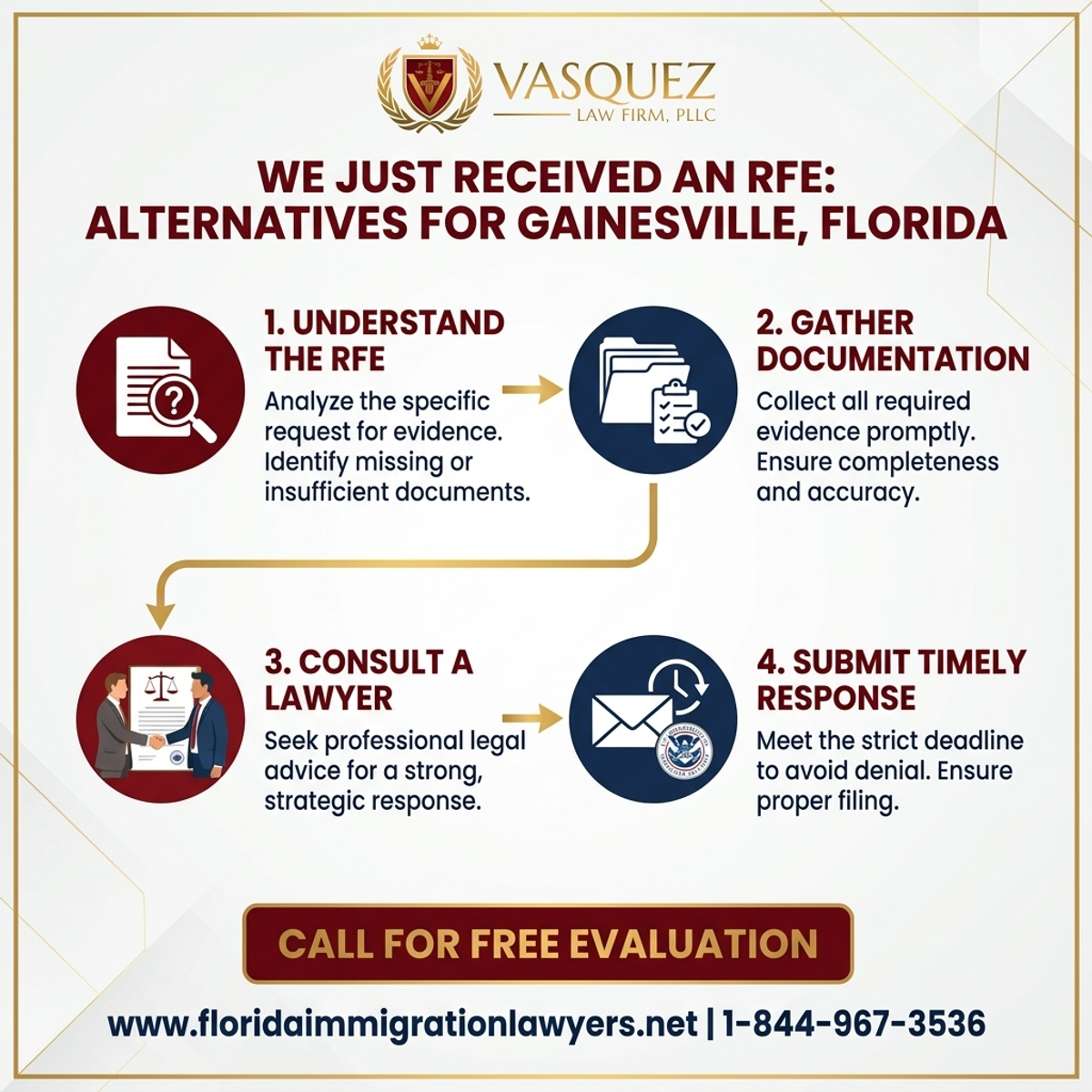
Step-by-Step Process — We Just Received an RFE: Alternatives for Gainesville, Florida
It's advisable to consult with an immigration attorney to review your response for completeness and accuracy. Florida Immigration Lawyers can assist in this process.
Diving deeper into each step, 'carefully reading the RFE' means more than just skimming. You must analyze every sentence, identify specific legal citations, and understand the precise deficiencies USCIS has identified. A common mistake is to provide generic documents without directly addressing the RFE's core concerns. For example, if USCIS questions the bona fides of a marriage, simply submitting a marriage certificate is insufficient; you'll need joint bank statements, utility bills, photos, affidavits from friends and family, and other compelling evidence.
When 'gathering documents,' consider both primary and secondary evidence. Primary evidence is usually preferred, but if unavailable, secondary evidence with a detailed explanation for the absence of primary documents can be crucial. This might include obtaining certified copies of vital records, letters from employers detailing job duties and salaries, or expert opinions from specialists in relevant fields. Remember that all foreign language documents must be accompanied by a full English translation, certified by the translator as complete and accurate, along with the translator's certification of competence.
Finally, 'organizing your response' effectively can significantly aid the USCIS officer reviewing your case. Use tabs, dividers, and a detailed table of contents that cross-references your cover letter with the submitted evidence. This professionalism reflects positively on your application and helps prevent further requests for clarification. Always send your response via a trackable mailing service and keep a complete copy for your records. If your current firm is unresponsive, Florida Immigration Lawyers can step in to quickly assess your RFE and help you compile a thorough, organized, and timely response, even under tight deadlines. Call 1-844-967-3536 for immediate assistance.
Document Checklist for RFE Responses
When responding to an RFE, having a comprehensive document checklist can help ensure you include all necessary information. Here is a basic list:
- A copy of the RFE notice.
- All requested documents mentioned in the RFE.
- Additional supporting evidence that strengthens your case.
- Translations of documents not in English.
- A cover letter summarizing your response and highlighting key points.
Beyond this basic list, consider the specific nature of your application. For employment-based petitions, requested documents might include updated employer letters, tax returns, payroll records, business licenses, or evidence of specialized knowledge. For family-based petitions, you might need updated financial affidavits, proof of relationship (birth certificates, marriage licenses), joint financial documents, or evidence of cohabitation.
The 'additional supporting evidence' is where an experienced attorney truly shines. While the RFE specifies what USCIS *needs*, a skilled lawyer will also identify what evidence *strengthens* your case, even if not explicitly requested. This proactive approach can address underlying concerns USCIS might have, preventing future RFEs or denials. For instance, if an RFE questions your financial sponsor's ability to support you, providing additional assets or a co-sponsor, even if not explicitly asked, can significantly bolster your response.
Your 'cover letter' serves as the roadmap for the USCIS officer. It should clearly reference the RFE notice, outline each point raised by USCIS, and indicate precisely where in your submitted package the corresponding evidence can be found. This meticulous organization not only demonstrates your thoroughness but also streamlines the review process for USCIS. Florida Immigration Lawyers can help you prepare a comprehensive document checklist and a compelling cover letter tailored to your specific RFE.
Timeline and Processing Expectations for RFE Responses
Understanding the timeline for processing RFE responses is crucial. Here is an overview:
| Stage | Typical Timeframe | Notes |
|---|---|---|
| RFE Issuance | Varies | Depends on case complexity |
| Response Preparation | Up to 30 days | Ensure thoroughness |
| USCIS Review | 60-90 days | Varies based on workload |
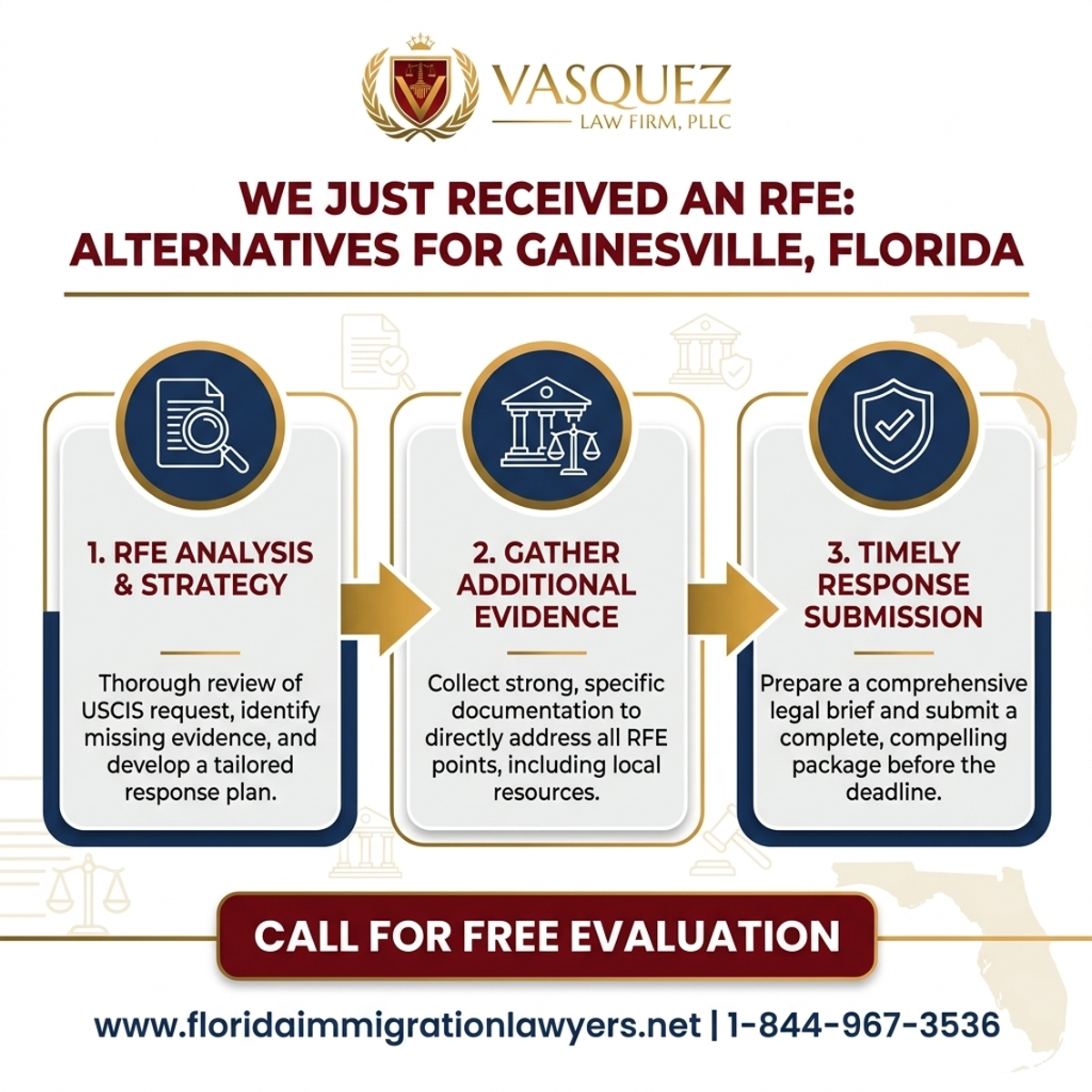
Key Statistics — We Just Received an RFE: Alternatives for Gainesville, Florida
Timely submission is vital to prevent delays in your immigration process.
The 'RFE Issuance' timeframe can be highly unpredictable, ranging from a few months to over a year after your initial submission, depending on the application type, service center, and current USCIS backlogs. Once issued, the RFE notice will specify a deadline, typically ranging from 30 to 87 days. This period for 'Response Preparation' is critical, and any delay in starting can jeopardize your ability to gather all necessary evidence.
After you submit your response, the 'USCIS Review' period also varies significantly. While 60-90 days is a common estimate, some complex cases can take longer, especially if USCIS decides to conduct an interview or issue a second RFE. You can track your case status online using the receipt number provided on your RFE notice. However, the online status updates may not always reflect the most granular details of the review process.
It's important to manage your expectations and remain patient during this waiting period. However, vigilance is also key. If the processing time significantly exceeds the typical timeframe, or if your online status hasn't updated for an unusually long period, it might be appropriate for your attorney to submit an inquiry. Florida Immigration Lawyers regularly monitor case timelines and can advise on when and how to follow up with USCIS effectively.
Cost Factors and Fee Breakdown for RFE Responses
Responding to an RFE may involve various costs. Here's a general breakdown:
| Item | Typical Fee | Notes |
|---|---|---|
| Attorney Fees | Varies | Depends on case complexity |
| Document Translation | Varies | Based on document length |
| Additional Evidence Gathering | Varies | May incur additional costs |
Consulting with an attorney can provide a clearer picture of potential costs specific to your situation.
'Attorney Fees' can range widely. Some firms charge a flat fee for RFE responses, while others bill hourly. The cost will depend on the complexity of the RFE, the amount of evidence required, the legal research involved, and the attorney's experience. A straightforward RFE for a missing document will naturally cost less than one questioning eligibility or requiring extensive legal argumentation. It's crucial to get a clear, transparent fee agreement from your attorney upfront.
'Document Translation' costs are typically per page or per word, so longer documents or multiple foreign-language documents can add up. Ensure you use a reputable, certified translator, as USCIS may reject translations that do not meet their standards. 'Additional Evidence Gathering' might involve fees for obtaining certified copies of birth certificates, marriage licenses, police records, or academic transcripts from various agencies or institutions. Courier services for secure and trackable delivery of your RFE response will also incur a small cost.
While these costs can seem daunting, viewing them as an investment in the success of your immigration application is essential. Attempting to navigate a complex RFE without professional help can lead to denial, requiring you to restart the entire application process and incur even greater costs and delays. Florida Immigration Lawyers offer clear fee structures and will discuss all potential costs with you during your free consultation, ensuring you have a complete understanding of the financial commitment. Call us at 1-844-967-3536 to discuss your RFE and associated costs.
Do not navigate this process alone. Contact Florida Immigration Lawyers today for assistance with your RFE response.
Common Mistakes to Avoid When Responding to an RFE
Successfully responding to a Request for Evidence is a critical juncture in your immigration journey. Even minor missteps can have significant consequences, potentially leading to delays or even outright denial of your application. Being aware of common pitfalls can help you avoid them and ensure your response is as robust as possible.
- Ignoring the RFE deadline. Missing the deadline can result in application denial.
- Submitting incomplete documentation. This can lead to further delays or denials.
- Failing to include translations for non-English documents. USCIS requires all documents to be in English.
- Not organizing your response effectively. A disorganized response can be difficult for USCIS to review.
- Overlooking additional evidence that could strengthen your case.
- Not seeking professional legal advice. An attorney can help ensure your response is accurate and complete.
- Sending the response to the wrong address. Always double-check the address on the RFE notice.
- Ignoring minor discrepancies in your application. Address these to avoid complications.
- Assuming all RFEs are the same. Each RFE is unique and requires a tailored response.
- Failing to keep a copy of your response for your records.
Avoiding these common mistakes is paramount to a successful RFE response. The complexity of immigration law, combined with the specific demands of each RFE, makes professional guidance invaluable. Florida Immigration Lawyers are experienced in identifying and rectifying these issues, ensuring your response is comprehensive, accurate, and submitted correctly the first time.
Frequently Asked Questions About RFEs
Navigating an RFE can bring up many questions. Here are answers to some common inquiries to help clarify the process and provide practical advice.
When to Call a Lawyer for Your RFE Response
Consider calling a lawyer if your RFE involves complex legal issues, if you're unsure about the required documentation, or if you're facing a tight deadline. Florida Immigration Lawyers offer comprehensive services to guide you through the RFE response process, ensuring that your case is handled diligently and professionally.
Beyond general complexity, specific scenarios almost always warrant immediate legal consultation. These include RFEs that question your fundamental eligibility for the immigration benefit, raise concerns about potential fraud or misrepresentation, involve a criminal history, or challenge the validity of your marriage or employment. In such cases, a nuanced legal strategy and compelling argumentation are essential, which only an experienced immigration attorney can provide.
Moreover, if your current legal representation has become unresponsive, switching to a proactive firm like Florida Immigration Lawyers is not just advisable but often critical. A new attorney can quickly review your RFE, assess the situation, and take immediate steps to prepare a robust response, ensuring that precious time is not lost. They can also help identify any underlying issues that might have led to the RFE and address them comprehensively. Don't hesitate to call Florida Immigration Lawyers at 1-844-967-3536 for a free consultation if you find yourself in this challenging situation.
About Florida Immigration Lawyers
Florida Immigration Lawyers is a dedicated firm offering expert immigration services throughout Florida. Our experienced attorneys specialize in a wide range of immigration matters, including RFE responses, asylum, deportation defense, citizenship, family immigration, and business immigration. Call us at 1-844-967-3536 for a free consultation. We are available 24/7 to assist you with your immigration needs.
Our commitment extends beyond just legal representation; we pride ourselves on providing compassionate, client-centered advocacy. We understand the profound impact immigration matters have on individuals and families, and we strive to offer clear communication, transparent processes, and unwavering support. Our team is dedicated to staying abreast of the ever-evolving immigration laws and policies, ensuring that our clients receive the most current and effective legal strategies.
Whether you are facing a complex RFE, navigating the intricacies of family-based petitions, or seeking protection through asylum, Florida Immigration Lawyers are here to be your trusted legal partners. We offer services in multiple languages, including Spanish (Se Habla Español), to ensure that language barriers never prevent you from accessing the legal assistance you deserve. Your immigration success is our priority.
Sources and References
- U.S. Citizenship and Immigration Services (USCIS)
- Executive Office for Immigration Review (EOIR)
- 8 U.S.C. Chapter 12 - Immigration and Nationality Act
Related services: immigration practice areas, family immigration services.
This article provides general legal information and is not intended as legal advice. Every case is unique, and outcomes depend on specific facts and circumstances. Contact an attorney for advice about your particular situation.
For personalized assistance with your RFE response, call Florida Immigration Lawyers at 1-844-967-3536 for a free consultation. Se Habla Español - Estamos aquí para ayudarle.
If you need legal assistance, learn more about speak with an immigration lawyer, or call us at 1-844-967-3536 for a free consultation.
Do Not Navigate This Process Alone
Our experienced immigration attorneys are ready to fight for you. Get a free, confidential case review today.
Se Habla Español
Or leave your details and we’ll call you:
Free Evaluation in 24 Hours
Or talk to us right now

AI voice assistant — available 24/7
FreeFrequently Asked Questions

William J. Vásquez
Founding Attorney · Vasquez Law Firm
U.S. Air Force veteran and immigration attorney with years of hands-on U.S. immigration experience. J.D., NCCU School of Law. AILA member. Admitted to the 4th, 5th, and 11th Circuit Courts.
Available 24/7 - Free Evaluations
Reviewed for legal accuracy by William J. Vásquez
Licensed in North Carolina; U.S. immigration is federal practice.
Related Legal Services
Our Florida immigration attorneys can help you with immigration lawyer cost in Florida, experienced immigration attorneys and asylum protection. Call today at 1-844-967-3536 for a free case review.
Related Links
Related Topics
Free Legal Case Review
Discuss your case with our experienced attorneys. We're available 24/7.
Se Habla Español - Estamos aquí para ayudarle.
Related Articles
Immigration Lawyer Orlando Free Consultation in Florida
For individuals and families in Orlando, Florida, navigating the complexities of U.S. immigration law requires expert guidance. An immigration lawyer in Orlando offers crucial support for everything from visa applications and green card processes to naturalization and deportation defense. This comprehensive guide details what a free consultation covers, providing a step-by-step overview of immigration pathways, essential document checklists, and expected timelines in 2026. We also highlight common mistakes to avoid, discuss the critical role of legal counsel in deportation and asylum cases, and explain why choosing a local Orlando immigration attorney is beneficial. Florida Immigration Lawyers is dedicated to serving the diverse community of Orlando with compassionate, effective legal solutions, ensuring you receive personalized advice and robust representation for a successful immigration journey.
Orlando Cancellation of Removal Attorney: Your Guide
Facing deportation in Orlando, Florida? Learn about cancellation of removal, a form of relief available in immigration court. Understand eligibility requirements, application processes, and the importance of legal representation. Discover common mistakes to avoid and when to seek legal help. Call Florida Immigration Lawyers for expert guidance.
K3 Visa Processing Time 2026: Your Florida Guide
For U.S. citizens in Florida hoping to reunite with their foreign spouses, understanding the K3 visa processing time in 2026 is essential. This non-immigrant visa allows spouses to enter the U.S. while their immigrant visa petition (Form I-130) is pending, bridging the gap to permanent residency. While processing times for the K-3 visa can range from 12 to 24 months, various factors, including USCIS caseloads and the completeness of your application, play a significant role. This comprehensive guide details K-3 visa eligibility, the step-by-step application process, required documentation, and associated costs. We also address how the Visa Bulletin and priority dates factor into the subsequent adjustment of status. Navigating this intricate legal journey requires precision and expertise. Florida Immigration Lawyers is here to provide the support and guidance you need, ensuring your application is meticulously prepared and strategically managed. Don't hesitate to reach out for a free case review to discuss your specific circumstances and plan your path forward.
Florida Refugee Immigration Help: 2026 Guide
For those seeking Florida refugee immigration help, understanding the path to safety and resettlement is critical. Refugee status is granted to individuals facing persecution in their home countries, and the process typically begins overseas, involving referrals from UNHCR or U.S. Embassies. This guide clarifies eligibility criteria, the multi-step application process, and the vital role of resettlement agencies in Florida, particularly in the Orlando area. We detail the necessary documentation, provide an estimated timeline for the various stages, and break down potential costs, emphasizing that government application fees for refugees are generally waived. Avoiding common mistakes like inconsistent information or missed deadlines is paramount. Florida Immigration Lawyers offers compassionate, expert legal counsel to navigate these complexities, from preparing for USCIS interviews to addressing family reunification concerns. We are dedicated to advocating for your rights and helping you build a secure future in Florida. Contact us for a free case review.