Deportation Defense Lawyer: Orlando & Florida Removal Help
Facing deportation in Orlando, St. Petersburg, or anywhere in Florida is a daunting prospect that requires immediate and expert legal intervention. Our comprehensive guide to deportation defense outlines the intricate process of removal proceedings, from receiving a Notice to Appear (NTA) to navigating immigration court hearings and potential appeals. We detail essential documents, typical timelines as of 2026, and cost factors involved in building a robust defense. Understanding common mistakes and knowing when to call an experienced immigration lawyer are crucial for protecting your rights and securing your future in the U.S. Florida Immigration Lawyers offers compassionate, strategic representation for complex deportation cases across the state, ensuring you have the best possible chance to remain with your family.

Deportation defense refers to legal strategies and representation aimed at preventing an individual from being removed (deported) from the United States. In Florida, particularly for residents of Orlando, St. Petersburg, and surrounding areas, effective defense is crucial due to complex immigration laws and the severity of potential consequences. A skilled immigration lawyer can identify avenues for relief, such as asylum, cancellation of removal, or adjustment of status, and guide you through the intricate immigration court process. Early legal intervention significantly improves your chances of a favorable outcome in removal proceedings.
- Legal representation is essential for navigating complex immigration court procedures.
- Various forms of relief may be available to prevent deportation, depending on your specific case.
- Acting quickly after receiving a Notice to Appear (NTA) is vital for building a strong defense.
- Florida's immigration courts, like the one in Orlando, handle a high volume of cases, making expert guidance invaluable.
Facing the threat of deportation can be one of the most terrifying experiences for an immigrant and their family. The thought of being separated from loved ones, losing your life in the United States, and returning to a country you may no longer know is overwhelming. If you or someone you know in Orlando, St. Petersburg, or anywhere in Florida has received a Notice to Appear (NTA) or is otherwise facing deportation defense, understanding your rights and options is paramount. This article will serve as a comprehensive guide to navigating removal proceedings in Florida, offering clarity on the process, common defenses, and why immediate legal action is critical.
At Florida Immigration Lawyers, we understand the stakes involved. Our dedicated team of immigration attorneys is committed to providing robust **deportation defense** for individuals across the state, including those appearing before the Orlando Immigration Court. We believe everyone deserves a fair chance to remain in the U.S. and build a better life. Do not face this challenge alone. Call Florida Immigration Lawyers at 1-844-967-3536 for a free consultation to discuss your specific situation and explore your defense strategies.
What is Deportation Defense and Why is it Crucial in Florida?
Deportation defense encompasses all legal efforts to prevent a non-citizen from being removed from the United States. This process, officially known as removal proceedings, is initiated by the Department of Homeland Security (DHS) and adjudicated by an Immigration Judge within the Executive Office for Immigration Review (EOIR). For individuals in Florida, the stakes are particularly high. Florida is home to a vast and diverse immigrant population, and its immigration courts, including the busy Orlando Immigration Court, handle thousands of cases annually. The outcomes of these cases profoundly impact families and communities across the state.
Effective **deportation defense** involves carefully analyzing the reasons for removal, identifying potential forms of relief, and presenting a compelling case to the Immigration Judge. This might include demonstrating eligibility for asylum if you fear persecution in your home country, seeking cancellation of removal for long-term residents with U.S. citizen family members, or adjusting your status based on a qualifying relationship. The Immigration and Nationality Act (INA), specifically INA § 240 (8 U.S.C. § 1229a), governs removal proceedings, outlining the procedures and available forms of relief. Navigating these complex statutes and regulations requires the expertise of an experienced immigration lawyer who understands the nuances of Florida's immigration landscape and federal immigration law.
Without proper legal representation, individuals often miss critical deadlines, fail to present necessary evidence, or are unaware of available defenses. This can lead to an automatic order of removal, with devastating consequences. A skilled attorney can help you understand the charges against you, prepare all required documentation, represent you in court, and fight tirelessly to protect your right to remain in the U.S. Whether you are in Orlando, St. Petersburg, or another Florida community, securing expert legal counsel is the first and most important step in any removal proceeding.
How Do Removal Proceedings Begin in Orlando or St. Petersburg?
Removal proceedings in Florida typically begin with the issuance of a Notice to Appear (NTA) by the Department of Homeland Security (DHS). This document formally charges a non-citizen with being deportable under immigration law and orders them to appear before an Immigration Judge. Residents of Orlando, St. Petersburg, and surrounding areas will typically receive an NTA instructing them to appear at the Orlando Immigration Court, located at 5440 L.B. McLeod Road, Suite 200, Orlando, FL 32811. Receiving an NTA is a serious matter that demands immediate attention.
The NTA will specify the alleged violations of immigration law, which can range from overstaying a visa, entering the U.S. without inspection, or committing certain criminal offenses. It will also list the date and time for your initial Master Calendar Hearing. Reasons for an NTA can vary widely. For example, individuals might receive an NTA after being apprehended at the border by Customs and Border Protection (CBP), following an arrest by Immigration and Customs Enforcement (ICE) within Florida, or even after a routine USCIS interview reveals an immigration violation. It is crucial to understand that an NTA is not a final deportation order, but rather the beginning of a legal process where you have the opportunity to present your case.
Upon receiving an NTA, it is imperative to contact an experienced **deportation defense** lawyer. Your attorney can review the NTA, explain the charges, and begin strategizing your defense. Many individuals in Florida are apprehended by ICE during targeted operations or after interactions with local law enforcement that lead to immigration holds. Knowing your rights, even during an encounter with immigration officials, can significantly impact the trajectory of your case. For more information on the immigration court system, visit the Executive Office for Immigration Review (EOIR) website.
What are the Key Steps in a Florida Deportation Defense Case?
Navigating removal proceedings in Florida involves a series of structured legal steps within the immigration court system. While each case is unique, understanding the general process is crucial for effective **deportation defense**. Your case will typically move through several stages, from an initial hearing to a final decision, potentially including appeals.
Here is a detailed breakdown of the typical steps involved in a deportation defense case in Florida:
- Receipt of Notice to Appear (NTA) and Master Calendar Hearing: The process begins when you receive an NTA from DHS, detailing the charges against you and scheduling your first appearance, known as a Master Calendar Hearing. At this hearing, the Immigration Judge will confirm your identity, ensure you understand the charges, and ask you to admit or deny the factual allegations and charges of deportability. You will also be asked to inform the court if you intend to seek legal representation and what forms of relief you plan to pursue. This initial hearing is procedural, but it sets the stage for your entire case.
- Pleadings and Identification of Relief: Following the Master Calendar Hearing, you and your attorney will formally respond to the NTA. This involves admitting or denying the allegations and charges. More importantly, your attorney will identify and apply for any available forms of relief from removal. This could include applying for asylum, withholding of removal, protection under the Convention Against Torture, cancellation of removal for certain non-permanent residents (8 U.S.C. § 1229b), adjustment of status, or various waivers of inadmissibility. Each form of relief has specific eligibility requirements that must be met.
- Individual Hearing (Merits Hearing): This is the core of your defense. The Individual Hearing is a trial-like proceeding where you and your attorney present evidence, testimony, and legal arguments to support your application for relief. DHS counsel will also present their case, often attempting to demonstrate your deportability and argue against your eligibility for relief. You may testify, call witnesses, and submit documents. The Immigration Judge will hear all arguments and evidence to make an informed decision.
- Immigration Judge Decision: After the Individual Hearing concludes, the Immigration Judge will issue a decision. This can be an oral decision delivered immediately after the hearing or a written decision mailed to you and your attorney at a later date. The judge will either grant your application for relief, allowing you to remain in the U.S., or deny it, ordering your removal.
- Appeals Process: If the Immigration Judge denies your application for relief and orders your removal, you generally have the right to appeal the decision. The first level of appeal is to the Board of Immigration Appeals (BIA), an administrative body that reviews decisions made by Immigration Judges. If the BIA upholds the removal order, further appeals may be possible to a U.S. Court of Appeals for the federal circuit, depending on the nature of your case and the legal issues involved.
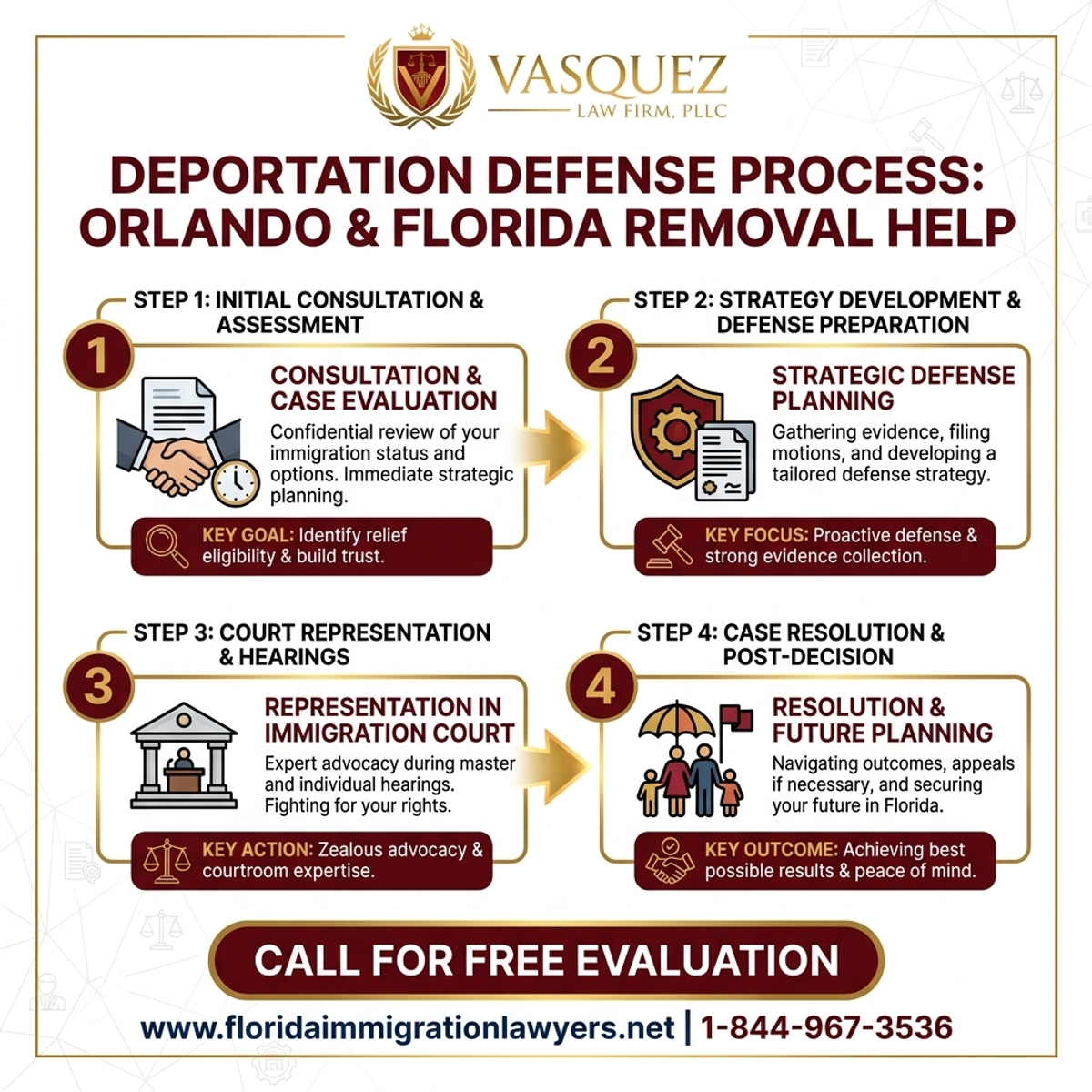
Step-by-Step Process — Deportation Defense Lawyer: Orlando & Florida Removal Help
Throughout these steps, having a dedicated **deportation defense** lawyer in Orlando or St. Petersburg is invaluable. Your attorney will ensure all deadlines are met, prepare comprehensive legal arguments, and represent your best interests at every stage of the proceedings. The Orlando Immigration Court processes cases with strict adherence to federal regulations, making professional legal guidance indispensable.
What Documents Are Essential for Your Removal Proceedings Defense?
A successful **deportation defense** in Florida hinges on a meticulously prepared and well-documented case. Gathering the correct documents is a critical step, as these materials serve as evidence to support your eligibility for various forms of relief from removal. Without proper documentation, even a strong verbal argument may falter. Your attorney will guide you through this process, but understanding the types of documents you might need is an important starting point.
Here is a comprehensive checklist of documents that are typically essential for a removal proceedings defense:
- Identity and Nationality Proof: This includes your passport, birth certificate, national identity cards, or any other official documents proving your identity and country of origin.
- Marriage and Birth Certificates: If your defense involves family-based relief, such as adjustment of status or cancellation of removal, you will need marriage certificates for you and your spouse, and birth certificates for your U.S. citizen or lawful permanent resident children.
- Police and Court Records: Any criminal history, no matter how minor, must be disclosed. You will need certified copies of all arrest records, court dispositions, and sentencing documents. Failure to disclose can lead to severe penalties.
- Financial Documents: Evidence of your financial stability and contributions to the U.S. economy, such as tax returns (Form 1040), W-2s, pay stubs, and employment verification letters, can be crucial.
- Evidence of Hardship: If you are seeking cancellation of removal or a waiver, you will need to demonstrate extreme and unusual hardship to a qualifying U.S. citizen or lawful permanent resident relative. This may include medical records, psychological evaluations, school records, and affidavits from family members.
- Proof of U.S. Ties: Documents demonstrating your strong ties to the U.S. community, such as utility bills, lease agreements, mortgage statements, school enrollment records, community involvement letters, and character reference letters, can strengthen your case.
- Asylum-Specific Evidence: For asylum claims, you will need a detailed personal statement describing your persecution, country conditions reports from reputable sources, medical records documenting injuries from persecution, and affidavits from witnesses to the persecution.
- Affidavits: Sworn statements from family members, friends, employers, or community leaders attesting to your good moral character, family relationships, or specific circumstances relevant to your case.
- Immigration Records: Copies of any previous immigration applications, visas, entry stamps, or correspondence with USCIS or other immigration agencies. You can request your A-file (Alien File) from USCIS or ICE through a Freedom of Information Act (FOIA) request.
Organizing these documents can be daunting, but your immigration lawyer will provide a tailored checklist and help you gather all necessary evidence. In the Orlando Immigration Court, judges expect comprehensive and well-organized submissions. Being prepared demonstrates your commitment to your case and can significantly influence the outcome.
What is the Typical Timeline for Deportation Defense Cases in 2026?
The timeline for **deportation defense** cases in Florida, particularly in the Orlando Immigration Court, can vary significantly depending on numerous factors. As of 2026, immigration courts across the U.S. continue to face substantial backlogs, which can prolong proceedings. However, understanding general timeframes for different stages can help manage expectations. It is important to remember that these are typical estimates, and individual cases may proceed faster or slower.
Here is an overview of the typical timeline for deportation defense cases:
| Stage | Typical Timeframe | Notes |
|---|---|---|
| NTA Issuance to Master Calendar Hearing | 1-6 months | Varies significantly by court backlog and jurisdiction. Orlando Immigration Court often has a busy docket. |
| Master Calendar Hearing to Individual Hearing | 6-24 months | Depends on case complexity, judge's calendar, and how many forms of relief are sought (e.g., asylum cases may take longer). |
| Individual Hearing Decision | Immediately or a few weeks | Judge may issue an oral decision at the end of the hearing or a written decision later. |
| Board of Immigration Appeals (BIA) Review | 6-24 months | Time for BIA to review the appeal and issue a decision. Can be longer for complex legal questions. |
| Federal Circuit Court Appeal | 12-36 months | If further appeal is possible, this is a lengthy and complex judicial process. |
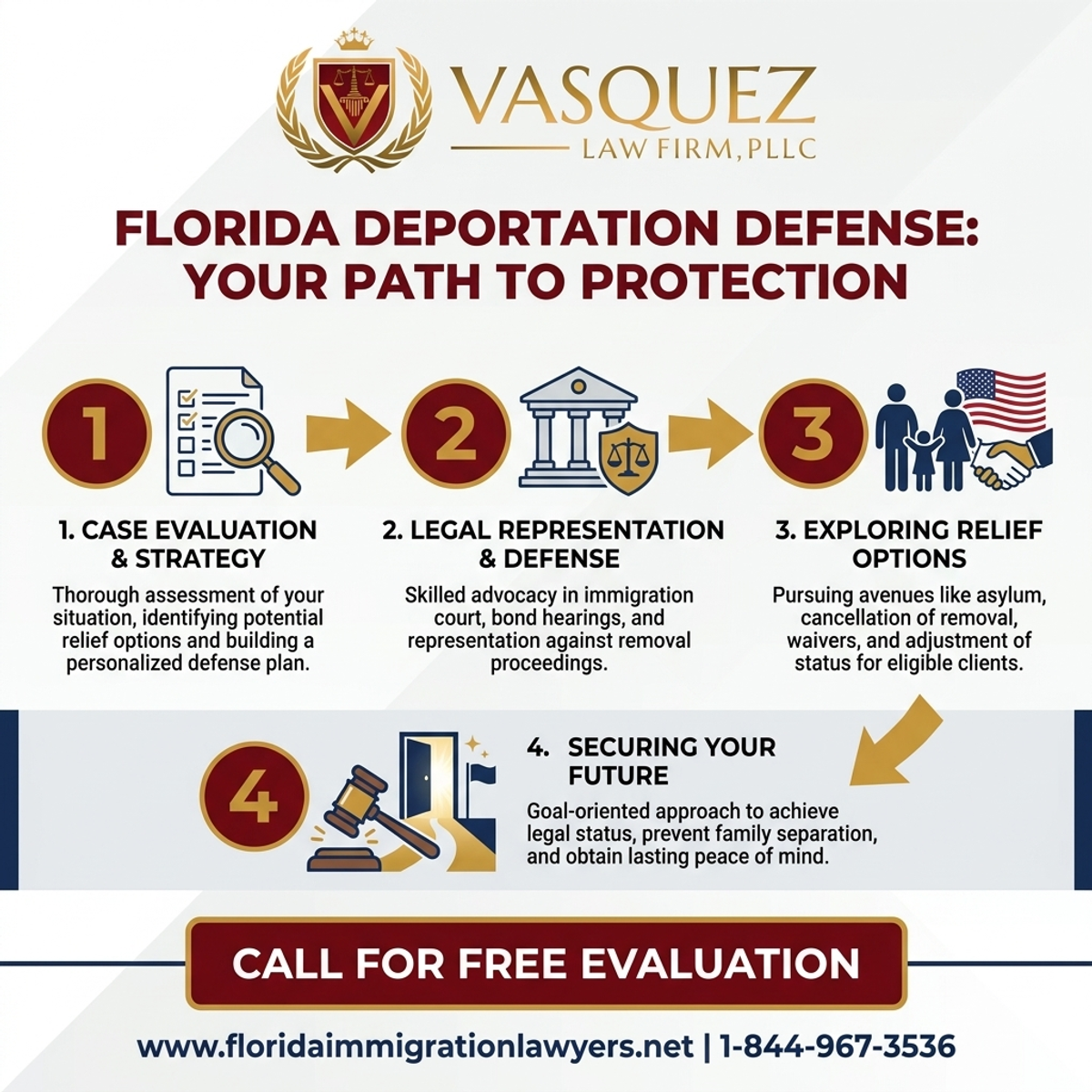
Key Statistics — Deportation Defense Lawyer: Orlando & Florida Removal Help
Factors that influence these timelines include the specific Immigration Judge assigned to your case, the complexity of your legal arguments and evidence, the type of relief you are seeking, and the current backlog at the Orlando Immigration Court and the BIA. Additionally, policy changes at DHS or EOIR can affect processing times. For example, recent shifts in enforcement priorities or changes in asylum processing rules can either expedite or delay certain types of cases. An experienced **deportation defense** lawyer will keep you informed about the expected timeline for your particular case and any developments that might affect it.
Understanding the Costs of Deportation Defense: Fees & Factors
The cost of mounting a strong **deportation defense** in Florida is a significant consideration for many individuals and families. It is important to understand that there isn't a single fixed fee for removal proceedings; rather, costs vary widely based on several factors. These factors include the complexity of your case, the specific forms of relief you are pursuing, the amount of evidence and preparation required, and the experience level of your chosen immigration attorney. Investing in qualified legal representation is often the most critical expenditure, as it directly impacts your chances of remaining in the United States.
Here is a breakdown of typical cost factors and fees associated with deportation defense:
| Item | Typical Fee | Notes |
|---|---|---|
| Attorney Fees | Varies significantly | Based on case complexity, lawyer experience, and whether a flat fee or hourly rate is charged. Complex cases (e.g., criminal grounds of inadmissibility) are generally more expensive. |
| Government Filing Fees | Varies by form | Required by USCIS or EOIR for applications for relief (e.g., I-589 for asylum, I-485 for adjustment of status, I-601 for waivers). Fees are subject to change; check USCIS website for current amounts. |
| Expert Witness Fees | Varies | If your case requires testimony from psychologists, country conditions experts, or other specialists, their fees can add to the total cost. |
| Document Translation Services | Varies | All documents submitted to immigration court must be in English or accompanied by a certified English translation. Costs depend on the volume and language of documents. |
| Travel and Associated Costs | If applicable | For hearings or interviews outside of your immediate area, or if your attorney needs to travel extensively for your case. |
While the upfront costs can seem substantial, consider it an investment in your future and your ability to remain with your family in the U.S. Many law firms, including Florida Immigration Lawyers, offer payment plans or flexible fee structures to make legal representation more accessible. During your free consultation, we can discuss the potential costs involved in your specific **deportation defense** case and provide a transparent fee agreement. Our goal is to ensure you receive the highest quality legal services without unnecessary financial burden.
Do not navigate this process alone. Contact Florida Immigration Lawyers today to learn how our experienced **deportation defense** attorneys can assist you.
Common Mistakes to Avoid in Deportation Proceedings
Navigating the complexities of immigration court can be daunting, and even minor missteps can have severe consequences, potentially leading to an order of removal. Avoiding common mistakes is as crucial as building a strong defense. Be aware of these pitfalls to protect your case:
- Failing to Appear for Hearings: This is perhaps the most critical mistake. If you miss a scheduled Master Calendar Hearing or Individual Hearing without valid reason, the Immigration Judge will likely issue an in absentia order of removal. This means you will be deported without having had the chance to present your defense. Always confirm your hearing dates and times, and notify the court and your attorney immediately if an unavoidable conflict arises.
- Misrepresenting Facts or Lying to Immigration Officials: Any false statements or omissions, whether intentional or unintentional, can be devastating. Lying on applications or during testimony can lead to charges of fraud or misrepresentation, making you inadmissible or deportable and potentially barring you from future immigration benefits. Always be truthful and transparent with your attorney.
- Missing Deadlines for Filing Applications or Evidence: Immigration court operates on strict deadlines. Failing to submit applications for relief (e.g., asylum, cancellation of removal) or supporting evidence by the court-ordered dates can result in the denial of your application, regardless of its merits. An attorney ensures all filings are timely and complete.
- Not Disclosing All Criminal History: Even minor arrests or convictions, including those expunged or sealed, must be disclosed to your attorney and the immigration court. What might seem insignificant in criminal law can have severe immigration consequences, potentially making you deportable or inadmissible. Full disclosure allows your attorney to address these issues proactively.
- Assuming You Don't Need a Lawyer: The immigration legal system is incredibly complex, with constantly changing laws and procedures. Attempting to represent yourself without legal training dramatically reduces your chances of success. An experienced **deportation defense** lawyer understands the law, court procedures, and how to effectively present your case.
- Speaking to ICE or DHS Without Counsel: If you are detained or approached by Immigration and Customs Enforcement (ICE) or other Department of Homeland Security (DHS) officials, you have the right to remain silent and request an attorney. Do not answer questions or sign documents without legal counsel present, as your statements can be used against you in court.
- Failing to Gather Sufficient Evidence: A strong defense relies on compelling evidence. Not providing enough documentation, such as proof of ties to the U.S., hardship to family members, or evidence for an asylum claim, weakens your case. Your attorney will help you identify and collect all necessary supporting materials.
- Moving Without Notifying the Court: If your address changes during removal proceedings, you are legally required to notify the immigration court and DHS within five days using Form EOIR-33, Change of Address. Failure to do so can result in you not receiving important notices, including hearing dates, potentially leading to an in absentia removal order.
- Not Understanding the Charges Against You: The NTA can be confusing, listing complex legal jargon. If you don't fully understand why DHS believes you are deportable, you cannot effectively defend yourself. Your attorney will explain the charges in clear terms and help you formulate a response.
- Ignoring the Possibility of Appeals: If an Immigration Judge issues an unfavorable decision, many individuals feel defeated. However, you often have the right to appeal to the Board of Immigration Appeals (BIA). Failing to pursue a timely appeal means forfeiting a crucial opportunity to overturn an adverse decision.
By being aware of these common mistakes and working closely with a knowledgeable **deportation defense** lawyer, you can significantly strengthen your position and improve your chances of a successful outcome in your removal proceedings in Orlando or anywhere in Florida.
When to Call a Lawyer for Deportation Defense
The decision of when to seek legal counsel for **deportation defense** is critical, and in most cases, the answer is: as soon as possible. The complexities of immigration law, combined with the severe consequences of removal, make early legal intervention indispensable. If you are in Orlando, St. Petersburg, or any part of Florida, and find yourself in any of the following situations, it is imperative to contact an immigration lawyer immediately.
You should call a lawyer if you:
- Receive a Notice to Appear (NTA): This is the most direct indication that you are facing removal proceedings. Do not delay; an NTA starts a legal clock with strict deadlines. Your attorney can review the NTA and prepare your defense from the outset.
- Are Detained by ICE: If you or a loved one is arrested or detained by Immigration and Customs Enforcement (ICE), contact an attorney immediately. Your lawyer can help secure release on bond, if eligible, and begin building a defense while you are in custody.
- Have a Prior Deportation Order: If you were previously deported and re-entered the U.S., you may be subject to reinstatement of a prior removal order, which is extremely difficult to fight without legal help.
- Have Criminal Charges or Convictions: Even minor criminal offenses can have severe immigration consequences, leading to deportability or inadmissibility. An attorney specializing in both criminal and immigration law (crimmigration) can assess the impact of your criminal record on your immigration status.
- Are Seeking Asylum or Other Forms of Relief: Applying for complex forms of relief like asylum, cancellation of removal, or waivers requires extensive documentation and legal arguments. A lawyer can ensure your application is strong and meets all eligibility criteria.
- Are Facing an Appeal: If an Immigration Judge has issued an order of removal, you typically have a limited time to file an appeal with the Board of Immigration Appeals (BIA). An experienced attorney can file the appeal and represent you.
- Are Unsure of Your Immigration Status: If you are confused about your current immigration status or believe it might be at risk, a consultation with an immigration lawyer can clarify your situation and proactively address potential issues before they escalate into removal proceedings.
Red flags include receiving any official communication from DHS or EOIR, being questioned by immigration officials, or having a visa expire. In these situations, proactive legal advice can prevent serious problems. Florida Immigration Lawyers offers comprehensive **deportation defense** services for clients across the state, from Orlando and St. Petersburg to Miami and Jacksonville. We are here to provide the guidance and representation you need during this challenging time.
About Florida Immigration Lawyers
Florida Immigration Lawyers is a leading immigration law firm dedicated to serving individuals and families across the entire state of Florida. With a deep understanding of U.S. immigration laws and a passion for helping our clients achieve their American dreams, we provide comprehensive legal services tailored to your unique needs. Our firm is built on principles of integrity, empathy, and aggressive advocacy, ensuring that every client receives the highest level of personalized attention and expert representation.
We specialize in a wide range of immigration matters, including robust **deportation defense**, asylum, deportation defense, citizenship, family-based immigration, and business immigration. Our experienced attorneys are adept at navigating the complexities of USCIS procedures, immigration court hearings, and federal appeals. We pride ourselves on offering compassionate support and strategic legal counsel, whether you are in Orlando, St. Petersburg, Miami, or any other Florida city.
Choosing Florida Immigration Lawyers means choosing a team that is available 24/7 to address your urgent needs. We offer free, confidential consultations to help you understand your options without financial commitment. Our bilingual staff ensures clear communication, making the legal process accessible to everyone. Let us put our expertise to work for you. Contact us today at 1-844-967-3536 or visit www.floridaimmigrationlawyers.net to schedule your free consultation. Your future in Florida is our priority.
Sources and References
- U.S. Citizenship and Immigration Services (USCIS)
- Executive Office for Immigration Review (EOIR)
- 8 U.S.C. Chapter 12 - Immigration and Nationality Act (INA)
- INA § 240 (8 U.S.C. § 1229a) - Removal Proceedings
- 8 U.S.C. § 1229b - Cancellation of Removal; Adjustment of Status
- 8 CFR Part 1240 - Proceedings to Determine Deportability or Inadmissibility; Apprehension, Custody, Detention, and Removal of Aliens; Removal; Voluntary Departure
Related services: immigration waivers, humanitarian protection programs, DACA renewal and applications, temporary protected status (TPS).
This article provides general legal information and is not intended as legal advice. Every case is unique, and outcomes depend on specific facts and circumstances. Contact an attorney for advice about your particular situation. Immigration laws are subject to frequent change.
If you are facing **deportation defense** in Florida, time is of the essence. Do not delay in seeking expert legal counsel. Contact Florida Immigration Lawyers today for a free, confidential consultation. Our dedicated team is ready to fight for your rights and help you explore every possible defense. Call us now at 1-844-967-3536. Se Habla Espanol - Estamos aqui para ayudarle.
Do Not Navigate This Process Alone
Our experienced immigration attorneys are ready to fight for you. Get a free, confidential consultation today.
Se Habla Español
Or leave your details and we’ll call you:
Free Evaluation in 24 Hours
Or talk to us right now

AI voice assistant — available 24/7
FreeFrequently Asked Questions

William J. Vásquez
Founding Attorney · Vasquez Law Firm
U.S. Air Force veteran and immigration attorney with years of hands-on U.S. immigration experience. J.D., NCCU School of Law. AILA member. Admitted to the 4th, 5th, and 11th Circuit Courts.
Available 24/7 - Free Evaluations
Reviewed for legal accuracy by William J. Vásquez
Licensed in North Carolina; U.S. immigration is federal practice.
Related Legal Services
Our Florida immigration attorneys can help you with deportation defense, citizenship and naturalization and family immigration services. Call today at 1-844-967-3536 for a free consultation.
Related Links
Related Topics
Free Legal Consultation
Discuss your case with our experienced attorneys. We're available 24/7.
Se Habla Español - Estamos aquí para ayudarle.
Related Articles
Immigration Lawyer Orlando Free Consultation: Your Guide
Looking for an immigration lawyer in Orlando? Discover your options for a free consultation with experienced, Spanish-speaking attorneys. Our guide helps you navigate Florida's complex immigration system.
Immigration Lawyer Orlando Free Consultation in Florida
For individuals and families in Orlando, Fort Lauderdale, Homestead, and throughout Florida, understanding U.S. immigration law is paramount. This comprehensive guide from Florida Immigration Lawyers details the complexities of green card applications, citizenship, and deportation defense. We explore why an experienced immigration lawyer is essential, provide step-by-step processes for common applications, outline necessary documents, and discuss typical timelines and costs. Learn to avoid common mistakes and discover when immediate legal counsel is critical. With a focus on Florida-specific challenges and up-to-date information for 2026, our firm offers personalized assistance. Schedule a free consultation to protect your rights and achieve your immigration goals.
Fiance Visa Lawyer: K-1 Process Guide for Florida 2026
Uniting with your foreign national fiance in Florida through the K-1 visa involves intricate legal steps, from filing the initial petition to securing permanent residency. This comprehensive guide, tailored for 2026, details the K-1 fiance visa process, including eligibility, required documentation, estimated timelines, and associated costs. Learn about the crucial role a fiance visa lawyer plays in navigating USCIS requirements, preparing for consular interviews, and avoiding common pitfalls that can delay your journey. Whether you reside in Pembroke Pines or elsewhere in Florida, understanding these procedures is vital for a successful outcome. Discover how professional legal assistance can simplify the process, ensuring your application is complete, accurate, and robust. Florida Immigration Lawyers offers expert guidance to help you bring your loved one to the U.S. and build your life together.
I-601 Waiver Lawyer Florida: Comprehensive Guide 2026
For many immigrants in Florida, overcoming grounds of inadmissibility is a critical step towards securing their future in the U.S. An I-601 waiver provides a pathway to address issues like unlawful presence, certain criminal convictions, or immigration fraud. This comprehensive guide, relevant for 2026, explains who needs an I-601 waiver, how to prove "extreme hardship" to a qualifying U.S. citizen or lawful permanent resident relative, and the step-by-step application process. We also cover typical timelines, cost factors, and crucial mistakes to avoid. Florida Immigration Lawyers offers expert guidance for I-601 waiver applications across the state, ensuring you build the strongest possible case and navigate the complex legal requirements effectively. Contact us for a free consultation to discuss your specific situation.