Child Status Protection Act (CSPA) & Aging Out Florida
The Child Status Protection Act (CSPA) is a vital immigration law preventing children from "aging out" of eligibility for green cards due to processing delays. For Florida families in Kissimmee, Orlando, and beyond, understanding CSPA means securing your child's future. This guide explains CSPA eligibility, the complex age calculation, required documents, and critical deadlines. Learn how to navigate the process, avoid common mistakes like missing the one-year "sought to acquire" rule, and understand the associated costs. Florida Immigration Lawyers offers expert guidance to ensure your child receives the CSPA protection they deserve. Contact us for a free consultation to protect your family's path to permanent residency.

Quick Answer: Understanding CSPA and Aging Out in Florida
The Child Status Protection Act (CSPA) is a critical U.S. immigration law designed to protect certain immigrant children from "aging out" of eligibility for immigration benefits due to processing delays. As of 2026, CSPA allows children to retain their classification as a "child" (under 21) even if they turn 21 before their visa becomes available, preventing their derivative beneficiary status from being lost. This law is particularly vital for families in Florida, where immigration application volumes can lead to extended processing times. Understanding CSPA is essential for anyone navigating family-based immigration in Kissimmee, Orlando, or anywhere across the Sunshine State.
- CSPA freezes a child's age for immigration purposes.
- It applies to family-sponsored, employment-based, and diversity lottery visas, as well as asylum/refugee cases.
- A specific calculation determines the CSPA age, subtracting petition processing time.
- Prompt action, including "seeking to acquire" permanent residence within one year, is crucial.
- Consulting an experienced Florida immigration lawyer is highly recommended for CSPA eligibility.
Imagine your family has waited years for an immigration visa, only to discover that your child, who was under 21 when the process began, has now turned 21 due to lengthy bureaucratic delays. This heart-wrenching scenario, known as "aging out," can shatter dreams of family unity. Fortunately, the Child Status Protection Act (CSPA) was enacted to prevent such injustices. For families across Florida, from the vibrant communities of Kissimmee and Orlando to the diverse neighborhoods of Miami, understanding CSPA is not just beneficial-it's essential.
This comprehensive guide from Florida Immigration Lawyers will demystify the CSPA, explaining how it works, who is eligible, and what steps you need to take to protect your child's immigration future in 2026 and beyond. We will delve into the complex calculations, outline necessary documentation, and highlight common pitfalls to avoid. Our goal is to empower you with the knowledge to navigate this critical aspect of immigration law effectively. Don't let processing delays jeopardize your family's future. Call Florida Immigration Lawyers at 1-844-967-3536 for a free consultation today.
What is the Child Status Protection Act (CSPA) and How Does it Prevent Aging Out in Florida?
The Child Status Protection Act (CSPA) is a federal law, signed into law on August 6, 2002, that provides a mechanism to prevent certain children from losing their eligibility for immigration benefits when they turn 21 years old while their immigration petition is pending. Before CSPA, many children "aged out" if their petition was not approved and a visa became available before their 21st birthday, forcing them to file new petitions and often wait many more years. CSPA's core purpose is to "freeze" a child's age for immigration purposes, ensuring that bureaucratic delays do not unfairly penalize families seeking to immigrate together. This protection is particularly vital in Florida, a state with significant immigration activity and corresponding processing times at USCIS field offices in locations like Orlando, Miami, and Tampa.
For example, in Kissimmee, a family-sponsored petition for a child might take several years to process. Without CSPA, if the child turned 21 during this wait, they would automatically become an adult child, often shifting to a less favorable visa category with even longer waits. CSPA addresses this by introducing a specific age calculation that accounts for the time a visa petition was pending. It acknowledges that the government's processing delays, not the child's natural aging, should not be a barrier to immigration. The law aims to uphold the principle of family unity, which is a cornerstone of U.S. immigration policy, by allowing derivative beneficiaries to maintain their eligibility despite administrative backlogs. Understanding this foundational aspect of the CSPA is the first step toward securing your child's future in Florida.
Who is Eligible for CSPA Protection in Florida?
CSPA protection is available to certain categories of derivative beneficiaries whose age would otherwise exceed 21 before they can finalize their immigration process. Eligibility is not universal and depends on the specific immigration category and the timing of certain events. Generally, CSPA applies to children who are derivative beneficiaries of family-sponsored immigrant visa petitions (except for immediate relatives of U.S. citizens), employment-based immigrant visa petitions, and Diversity Visa lottery applications. It also extends protection to certain children of refugees and asylees. Understanding your specific visa category is crucial for determining CSPA eligibility, especially for families navigating the system from Florida's diverse communities, where various immigration pathways are common.
Specifically, to be eligible for CSPA, a child must generally meet two main criteria. First, they must be the beneficiary of a qualifying visa petition (e.g., Form I-130 for family-sponsored, Form I-140 for employment-based, or a Diversity Visa registration). Second, they must "seek to acquire" permanent residence within one year of a visa becoming available. This typically means filing Form I-485 (Application to Register Permanent Residence or Adjust Status) with USCIS if adjusting status in the U.S., or applying for an immigrant visa at a U.S. consulate abroad if consular processing. This one-year rule is critical and often a point of confusion for applicants in Florida. Failure to act promptly within this timeframe can lead to the loss of CSPA benefits, regardless of the calculated CSPA age. The law is detailed in 8 U.S.C. § 1153(h), also known as INA Section 203(h), which outlines the specific conditions for age calculation and eligibility.
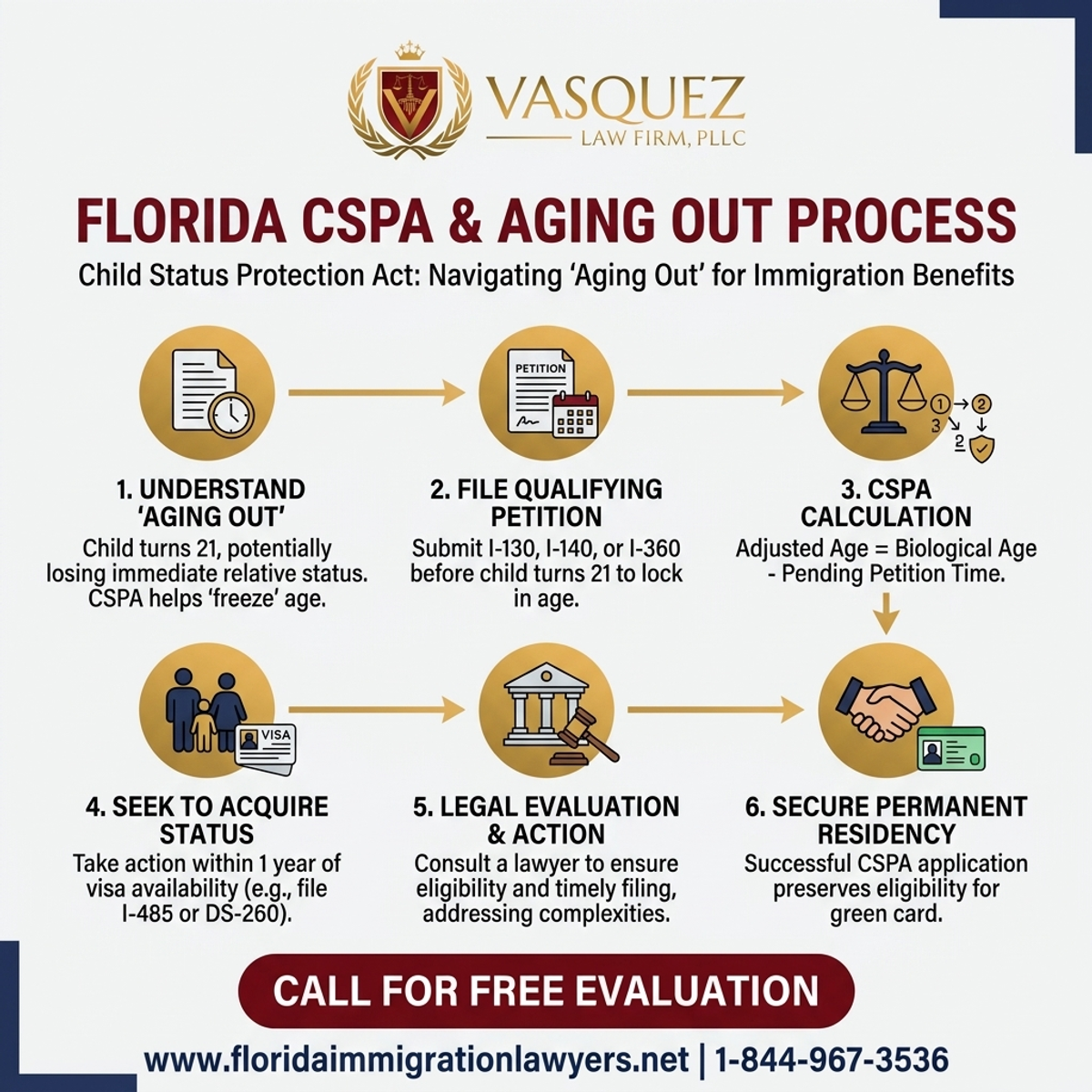
Step-by-Step Process — Child Status Protection Act (CSPA) & Aging Out Florida
How Does the CSPA Calculation Work for Florida Immigrants?
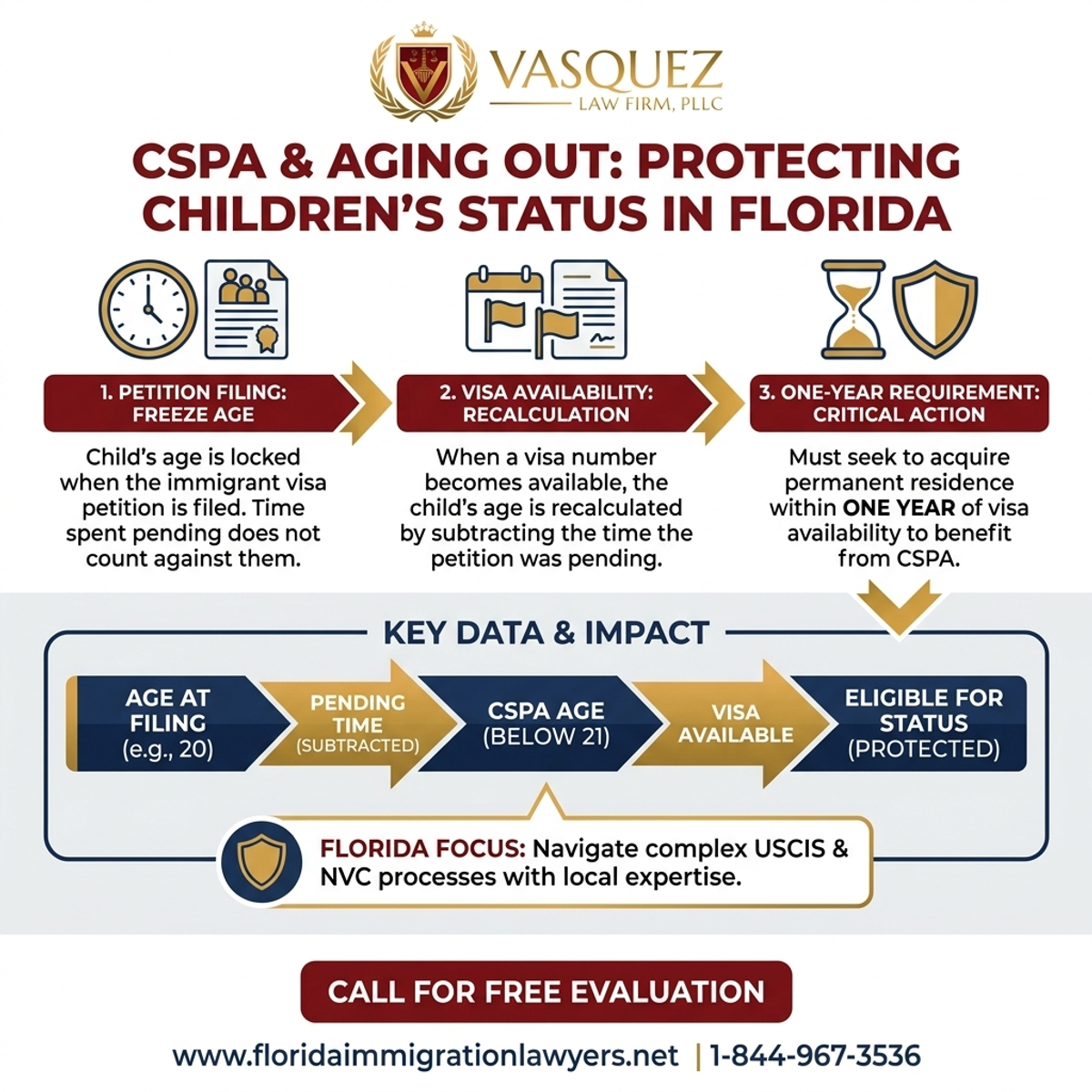
The CSPA calculation is a specific formula used to determine a child's "CSPA age" for immigration purposes. This age is not the child's biological age but a statutory age that accounts for the time an immigration petition was pending. For most family-sponsored and employment-based categories, the CSPA age is calculated by taking the child's biological age on the date a visa becomes available (either the final action date or the filing date, depending on the Visa Bulletin chart being used by USCIS or the State Department for that month) and subtracting the number of days the immigrant visa petition (e.g., Form I-130 or I-140) was pending. If this calculated age is under 21, the child is generally protected by CSPA, provided they meet the "sought to acquire" requirement. This calculation is a key element for families in Florida, particularly those dealing with the fluctuating visa bulletin and varying processing times at the National Visa Center.
For example, if a Form I-130 petition was filed on a child's behalf when they were 15 and was pending for 3 years, and the visa became available when they were 21 years and 6 months old, their CSPA age would be 21 years and 6 months minus 3 years = 18 years and 6 months. Since 18 years and 6 months is under 21, the child is CSPA protected. This precise calculation is what makes CSPA so powerful in preventing aging out. However, the complexity lies in accurately identifying the correct "visa availability date" and the exact "petition pending time," which can be challenging given the dynamic nature of the Visa Bulletin and USCIS processing. Errors in this calculation can lead to significant delays or even denial of benefits. This is why many families in Kissimmee and across Florida seek professional legal guidance to ensure accuracy.
Step-by-Step CSPA Calculation
- Determine the Child's Biological Age on Visa Availability Date: Identify the specific date when an immigrant visa became available for the child's category. This is typically found in the Department of State's Visa Bulletin (Final Action Dates or Dates for Filing, as instructed by USCIS). Note the child's exact age (years, months, days) on this date.
- Calculate Petition Pending Time: Subtract the date the immigrant visa petition (e.g., Form I-130, I-140) was filed from the date it was approved. This gives you the total number of days the petition was pending with USCIS.
- Subtract Pending Time from Biological Age: Subtract the calculated petition pending time from the child's biological age on the visa availability date. The result is the child's CSPA age.
- Check the 21-Year Threshold: If the CSPA age is less than 21, the child is generally protected by CSPA.
- Verify "Sought to Acquire" Requirement: Ensure the child (or their parent) took action to "seek to acquire" permanent residence within one year of the visa becoming available. This means filing Form I-485 or applying for an immigrant visa at a consulate.
Key Dates and Deadlines
Accurately identifying key dates is paramount for CSPA. The "priority date" is the date the petition was properly filed, and it determines when a visa might become available. The "visa availability date" is when the priority date becomes current according to the Visa Bulletin. For CSPA, the child's age is locked on the visa availability date. Missing the one-year "sought to acquire" deadline is one of the most common reasons CSPA protection is lost. This is a strict deadline that requires careful monitoring of the Visa Bulletin and prompt action once a visa becomes current. Families in Florida should understand that these dates are not static and require consistent attention.
Navigating the CSPA Process: A Step-by-Step Guide for Florida Residents
Navigating the CSPA process requires careful attention to detail and adherence to specific timelines. For Florida residents, this involves understanding the interplay between USCIS processing, Department of State visa availability, and the precise CSPA age calculation. The process generally begins with the filing of an underlying immigrant visa petition. Once that petition is approved and a visa becomes available, the CSPA calculation comes into play. It is essential to continuously monitor the Visa Bulletin and USCIS processing times, especially at Florida-specific offices, to ensure no critical deadlines are missed. Proactive engagement with the process is key to a successful outcome.
Required Documents for CSPA Claims
While CSPA is a legal provision, not a separate application form, supporting documentation is crucial for USCIS or the Department of State to determine eligibility. When applying for adjustment of status (Form I-485) or an immigrant visa, you will need to submit documents that establish your child's age, the filing and approval dates of the underlying petition, and proof of your efforts to "seek to acquire" permanent residence. These documents help immigration authorities verify the CSPA calculation and ensure compliance with all requirements. Organizing these documents meticulously from the outset can prevent delays and requests for further evidence.
- Birth Certificate of the Child (and petitioner, if applicable).
- Copy of the approved Form I-130, I-140, or other underlying petition.
- Form I-797, Notice of Action (Approval Notice) for the petition.
- Visa Bulletin charts showing when the visa became available.
- Proof of filing Form I-485 or immigrant visa application (e.g., receipt notice, interview notice) within one year of visa availability.
- Passports and visa records.
- Marriage certificates (if applicable, to establish relationship).
Key Statistics — Child Status Protection Act (CSPA) & Aging Out Florida
Typical CSPA Processing Timelines in 2026
As of 2026, CSPA itself does not have a separate processing timeline; rather, it is a determination made during the adjudication of the underlying adjustment of status application (Form I-485) or immigrant visa application. The overall timeline depends heavily on the specific visa category, the country of chargeability, and the current backlogs at USCIS and the National Visa Center. Florida residents might experience processing times similar to national averages, but local USCIS offices and the volume of applications can influence individual case speeds. The key is to understand that the CSPA calculation is applied at the time of adjudication, meaning the total time from petition filing to green card approval can still be several years.
| Stage | Typical Timeframe (As of 2026) | Notes |
|---|---|---|
| I-130 Petition Filing to Approval | 6 months - 10+ years (highly variable) | Depends on relationship category and petitioner's status (USC vs. LPR). |
| Visa Availability (Priority Date Becomes Current) | Varies greatly (months to decades) | Determined by the Department of State's monthly Visa Bulletin. |
| Filing I-485 or DS-260 (Consular Processing) | Within 1 year of visa availability | CRITICAL CSPA deadline to "seek to acquire." |
| I-485 Adjudication (Adjustment of Status) | 12 months - 36+ months | Influenced by USCIS field office (e.g., Miami, Orlando), workload, and RFE responses. |
| Immigrant Visa Interview (Consular Processing) | 6 months - 18 months after DS-260 | Interview at a U.S. Embassy/Consulate abroad. |
What Are the Costs Associated with CSPA and Related Immigration Applications in Florida?
Understanding the financial aspects of the CSPA process is essential for families in Florida. While there is no separate fee specifically for CSPA, the protection is determined during the adjudication of the underlying immigration application, which does involve various government filing fees. These fees are set by USCIS and the Department of State and are subject to change, often without extensive prior notice. As of 2026, applicants should anticipate fees for the immigrant visa petition (e.g., Form I-130), the application for adjustment of status (Form I-485) or immigrant visa application (Form DS-260), biometric services, and potentially medical examinations. These costs can accumulate, making financial planning a crucial part of the immigration journey for Florida residents.
Beyond government fees, a significant cost factor for many families is legal representation. Retaining an experienced immigration attorney, particularly one familiar with Florida's specific immigration landscape and CSPA intricacies, can be invaluable. Attorneys' fees vary based on the complexity of the case, the services provided, and the firm's experience. While an attorney's fee is an additional expense, it can often save time, prevent costly mistakes, and increase the likelihood of a successful outcome, especially in complex CSPA calculations or cases with prior immigration issues. Florida Immigration Lawyers offers free consultations to discuss your specific situation and provide clear fee structures.
| Item | Typical Fee (As of 2026 - Subject to Change) | Notes |
|---|---|---|
| Form I-130, Petition for Alien Relative | Varies (e.g., $535-$625) | Filed by the U.S. citizen or LPR petitioner. |
| Form I-485, Application to Adjust Status | Varies (e.g., $1,140-$1,440 for adult, lower for child under 14) | Includes biometric services fee for most applicants. |
| Form DS-260, Immigrant Visa Application (Consular) | $325 per applicant | Paid to the Department of State for consular processing. |
| Medical Examination Fees | $200-$500 (approx.) | Paid to a USCIS-approved civil surgeon in the U.S. or panel physician abroad. |
| USCIS Immigrant Fee (after visa approval) | $220 | Required for most immigrant visa holders before receiving green card. |
| Attorney Fees | Variable (depends on case complexity) | Covers legal counsel, document preparation, and representation. |
Do not navigate this complex process alone. The stakes are too high when your family's future is on the line. Contact Florida Immigration Lawyers today to ensure your child receives the CSPA protection they deserve and to avoid critical errors that could lead to delays or denials. Our experienced team is ready to assist you.
Common Mistakes to Avoid in CSPA Cases
Navigating CSPA can be challenging, and even minor errors can have significant consequences, potentially leading to the loss of crucial immigration benefits for your child. Being aware of these common mistakes can help Florida families protect their loved ones' futures.
- Incorrect CSPA Age Calculation: Miscalculating the CSPA age is a frequent error. Using the wrong "visa availability date" or incorrectly subtracting the petition's pending time can lead to a false sense of security or unnecessary panic. Always double-check your figures.
- Missing the "Sought to Acquire" Deadline: This is perhaps the most critical mistake. Failing to file Form I-485 or apply for an immigrant visa within one year of the visa becoming available will result in the loss of CSPA protection, regardless of the calculated CSPA age.
- Failing to Monitor the Visa Bulletin: The Visa Bulletin changes monthly. Not staying current with the Final Action Dates or Dates for Filing can cause you to miss when your child's visa becomes available, leading to the one-year deadline expiring unnoticed.
- Not Understanding Immediate Relative vs. Preference Categories: CSPA generally does not apply to immediate relatives of U.S. citizens (unmarried children under 21), as they do not have a visa backlog. Trying to apply CSPA where it's not needed or failing to understand its specific application to preference categories can cause confusion.
- Incorrectly Filing the Underlying Petition: Errors in the initial I-130 or I-140 petition can cause delays in approval, which, while extending the "pending time" for CSPA calculation, can also complicate the overall process. Ensure all initial filings are accurate and complete.
- Not Updating Contact Information with USCIS/NVC: If your address changes, and USCIS or the National Visa Center cannot reach you, you might miss important notices, including those indicating visa availability or requests for evidence, thereby missing deadlines.
- Assuming CSPA Applies Automatically: CSPA is a protective measure, but it does not automatically apply. You (or your lawyer) must present the case for CSPA eligibility during the adjustment of status or consular processing stage.
- Delaying Legal Consultation: Waiting until the last minute or after a denial to consult an attorney limits options. Early legal advice can help identify potential CSPA issues and plan accordingly.
- Providing Inconsistent Information: Submitting conflicting dates or information across different forms or interviews can raise red flags and complicate the CSPA determination.
- Not Retaining All Immigration Documents: Keep copies of every petition, notice, receipt, and communication from USCIS or the Department of State. These documents are vital for proving your CSPA eligibility and calculating ages and timelines.
When to Call a Florida Immigration Lawyer for CSPA Assistance
The intricacies of the Child Status Protection Act make it one of the more complex areas of immigration law. While this guide provides general information, every CSPA case has unique facts and circumstances. You should strongly consider contacting an experienced Florida immigration lawyer if you are facing any of the following situations:
- You are unsure how to calculate your child's CSPA age accurately.
- Your child is approaching their 21st birthday, and their visa petition is still pending.
- You have received a Request for Evidence (RFE) from USCIS or a query from a U.S. consulate regarding your child's age.
- Your child has already turned 21, and you believe they may have aged out, but you want to explore if CSPA can still apply.
- There have been changes in your family situation (e.g., marriage, divorce, or changes in the principal applicant's status) that might affect CSPA eligibility.
- You have previously been denied CSPA protection or experienced complications with an immigration application due to age.
- You are unfamiliar with monitoring the Visa Bulletin or understanding its complex charts.
- You have any doubts about meeting the one-year "sought to acquire" deadline.
Florida Immigration Lawyers has extensive experience with CSPA cases, helping families in Kissimmee, Orlando, and throughout Florida navigate these challenges. We can assess your situation, perform accurate CSPA calculations, and ensure all necessary steps are taken to protect your child's immigration status. Our team stays current with the latest policy updates, including those from EOIR and USCIS, to provide you with the most reliable advice.
About Florida Immigration Lawyers
Florida Immigration Lawyers is a leading immigration law firm dedicated to serving individuals and families across the entire state of Florida. With a deep understanding of U.S. immigration laws and a compassionate approach, we provide comprehensive legal representation for a wide range of immigration matters. Our team of skilled attorneys is committed to helping clients achieve their American dream, whether through family-based visas, employment immigration, naturalization, or deportation defense. We pride ourselves on offering personalized attention, strategic advice, and unwavering support throughout every step of the legal process. We understand the unique challenges faced by immigrants in Florida and strive to be a trusted advocate for our community.
Our services include assisting with complex CSPA cases, family-based immigration, citizenship applications, asylum claims, and deportation defense. We are available 24/7 to address your urgent legal needs and offer free consultations to discuss your case. Choose Florida Immigration Lawyers for dedicated advocacy, expertise, and a commitment to your success. Visit our website at https://www.floridaimmigrationlawyers.net or call us at 1-844-967-3536.
Sources and References
- U.S. Citizenship and Immigration Services (USCIS)
- Executive Office for Immigration Review (EOIR)
- U.S. Department of State - Bureau of Consular Affairs (Visa Bulletin)
- 8 U.S.C. Chapter 12 - Immigration and Nationality Act (INA), specifically INA Section 203(h)
- 8 CFR Part 204 - Petitions for alien relatives, orphans, and special immigrants
- USCIS Policy Manual, Volume 7, Part A, Chapter 7 - Child Status Protection Act (CSPA)
Related services: immigration practice areas, business immigration, experienced immigration attorneys, free immigration consultation.
This article provides general legal information and is not intended as legal advice. Every case is unique, and outcomes depend on specific facts and circumstances. Contact an attorney for advice about your particular situation.
Don't leave your child's immigration future to chance. The complexities of CSPA require expert guidance to ensure all requirements are met and deadlines are honored. Contact Florida Immigration Lawyers today for your free consultation at 1-844-967-3536. Se Habla Espanol - Estamos aqui para ayudarle.
If you need legal assistance, learn more about how our immigration attorneys can help, or call us at 1-844-967-3536 for a free consultation.
Do Not Navigate This Process Alone
Our experienced immigration attorneys are ready to fight for you. Get a free, confidential consultation today.
Se Habla Español
Frequently Asked Questions
Harold Estrada-Rodriguez
Florida Immigration Attorney · FL Bar No. 1041171
Florida Bar attorney handling Florida-jurisdiction immigration matters. Bilingual representation, free consultations.
Available 24/7 - Free Evaluations
Related Legal Services
Our Florida immigration attorneys can help you with deportation defense, citizenship and naturalization and family immigration services. Call today at 1-844-967-3536 for a free consultation.
Related Links
Related Topics
Free Legal Consultation
Discuss your case with our experienced attorneys. We're available 24/7.
Se Habla Español - Estamos aquí para ayudarle.
Related Articles
Deportation Defense Lawyer: Orlando & Florida Removal Help
Facing deportation in Orlando, St. Petersburg, or anywhere in Florida is a daunting prospect that requires immediate and expert legal intervention. Our comprehensive guide to deportation defense outlines the intricate process of removal proceedings, from receiving a Notice to Appear (NTA) to navigating immigration court hearings and potential appeals. We detail essential documents, typical timelines as of 2026, and cost factors involved in building a robust defense. Understanding common mistakes and knowing when to call an experienced immigration lawyer are crucial for protecting your rights and securing your future in the U.S. Florida Immigration Lawyers offers compassionate, strategic representation for complex deportation cases across the state, ensuring you have the best possible chance to remain with your family.
Free Immigration Consultation: Florida Legal Help | VLF Florida
Unlock clarity on your immigration journey with a free consultation in Florida. This comprehensive guide from Florida Immigration Lawyers details what to expect, how to prepare, and the profound benefits of expert legal advice. Learn about specific challenges in areas like Hialeah, navigate complex processing timelines, and understand costs beyond your initial consultation. Discover how a dedicated Florida immigration lawyer can support your visa, green card, naturalization, or deportation defense case. Avoid common pitfalls and gain peace of mind by connecting with trusted legal professionals. Your path to a secure future starts with a no-cost, expert assessment.
ICE Check-In Attorney Representation in Florida | VLF Florida
Navigating ICE check-ins in Florida, especially Tampa, can be daunting. Understanding ISAP, legal requirements, and having an attorney can make a significant difference. Learn more about these processes and why legal representation is crucial.
J-1 Waiver for Physicians in Florida: Your 2026 Guide
Physicians holding J-1 visas often face a two-year home residency requirement after their program. However, the J-1 waiver, particularly through the Conrad 30 program, offers a critical pathway to remain and practice medicine in the United States, especially in Florida's designated medically underserved areas. This comprehensive guide for 2026 details the requirements, application process, common pitfalls, and how Florida Immigration Lawyers can assist you in navigating this complex immigration journey to secure your future in healthcare.