Citizenship Interview Tips Florida: Your 2026 Guide
Navigating the U.S. citizenship interview process in Florida can be complex, but with the right preparation, success is well within reach. This comprehensive guide provides essential tips for Florida residents, particularly those in Hollywood and surrounding areas, preparing for their naturalization interview in 2026. Learn about the step-by-step process, critical documents to gather, how to master the English and civics tests, and what to expect after your interview. We also cover common mistakes to avoid and when it's crucial to seek expert legal assistance. Florida Immigration Lawyers is here to support you every step of the way, offering free consultations to help you achieve your American dream.

Quick Answer: Citizenship Interview Tips Florida
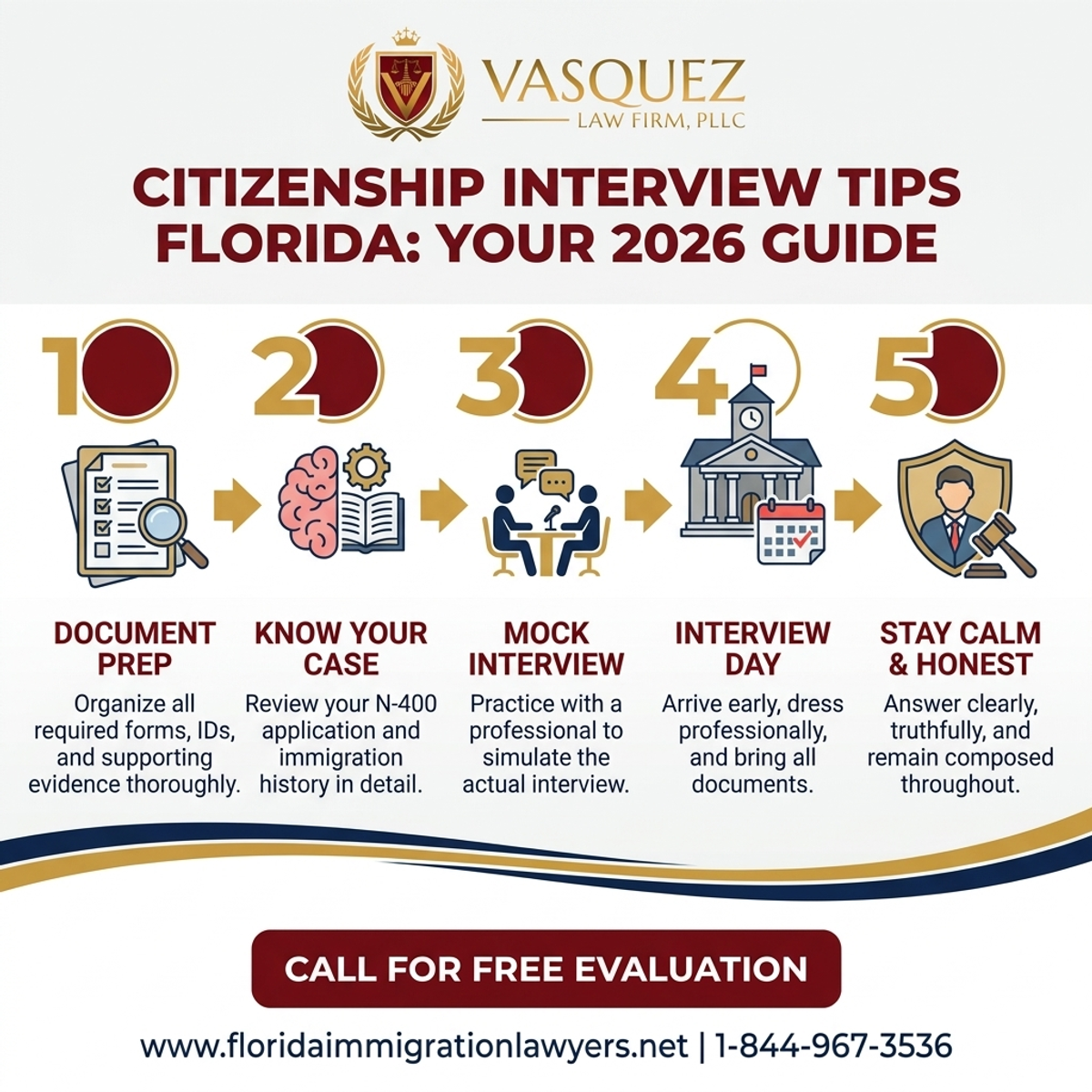
To successfully navigate your citizenship interview in Florida, thorough preparation is essential. This includes reviewing your N-400 application, studying U.S. history and government (civics), practicing your English reading and writing, and gathering all necessary documents. The USCIS officer will assess your eligibility, English proficiency, and civic knowledge. Understanding the process, anticipating common questions, and seeking legal guidance from Florida Immigration Lawyers can significantly increase your chances of a positive outcome. As of 2026, staying informed about current USCIS policies is also crucial.
- Review your N-400 application thoroughly before the interview.
- Study U.S. civics questions and practice English reading/writing.
- Gather all original documents and bring them to your interview.
- Be honest, respectful, and clear in your responses.
- Consider legal representation for complex cases or added assurance.
Becoming a U.S. citizen is a monumental achievement, representing the culmination of years of hard work and dedication. For many immigrants in Florida, particularly in vibrant communities like Hollywood, the citizenship interview is the final significant hurdle in this journey. This interview can feel daunting, but with the right preparation and guidance, it is a manageable and often successful step towards naturalization. Understanding what to expect, how to prepare effectively, and the specific requirements for applicants in Florida is crucial.
This comprehensive guide from Florida Immigration Lawyers provides essential citizenship interview tips Florida residents need for 2026. We will cover the interview process, what documents to bring, common questions, and how to confidently demonstrate your eligibility and commitment to the United States. Our goal is to empower you with the knowledge and strategies necessary to approach your naturalization interview with confidence. Do not navigate this complex process alone. For personalized assistance and to ensure you are fully prepared, call Florida Immigration Lawyers at 1-844-967-3536 for a free consultation today. We are here to help you achieve your American dream.
What is the Citizenship Interview Process in Florida?
The citizenship interview process in Florida, as across the U.S., involves a meeting with a USCIS officer who reviews your N-400 application, assesses your English proficiency, and tests your knowledge of U.S. civics. This interview typically lasts 20-30 minutes and is a critical step towards naturalization. The officer will verify your identity, review your application details, and ask about your background, moral character, and loyalty to the U.S.
The naturalization process begins with filing Form N-400, Application for Naturalization, with USCIS. After submission, you will receive a receipt notice, followed by an appointment for biometrics (fingerprints, photograph, and signature). These biometrics are used for background checks by the FBI. Once background checks are complete, USCIS will schedule your interview at a local field office, such as the Miami, Hialeah, or Orlando offices, depending on your residence in Florida. You will receive an interview notice by mail detailing the date, time, and location.
During the interview, the USCIS officer will first administer an oath to tell the truth. They will then review your N-400 application, confirming all information is accurate and up-to-date. This includes questions about your personal history, family, employment, travel, and any interactions with law enforcement. The officer will also conduct the English test (reading, writing, and speaking) and the civics test. If you pass, the officer may recommend approval immediately, or they may request additional documents or a second interview. Understanding each stage and preparing thoroughly is key to a successful outcome in your naturalization interview.
How Can I Prepare for My Naturalization Interview in Hollywood, Florida?
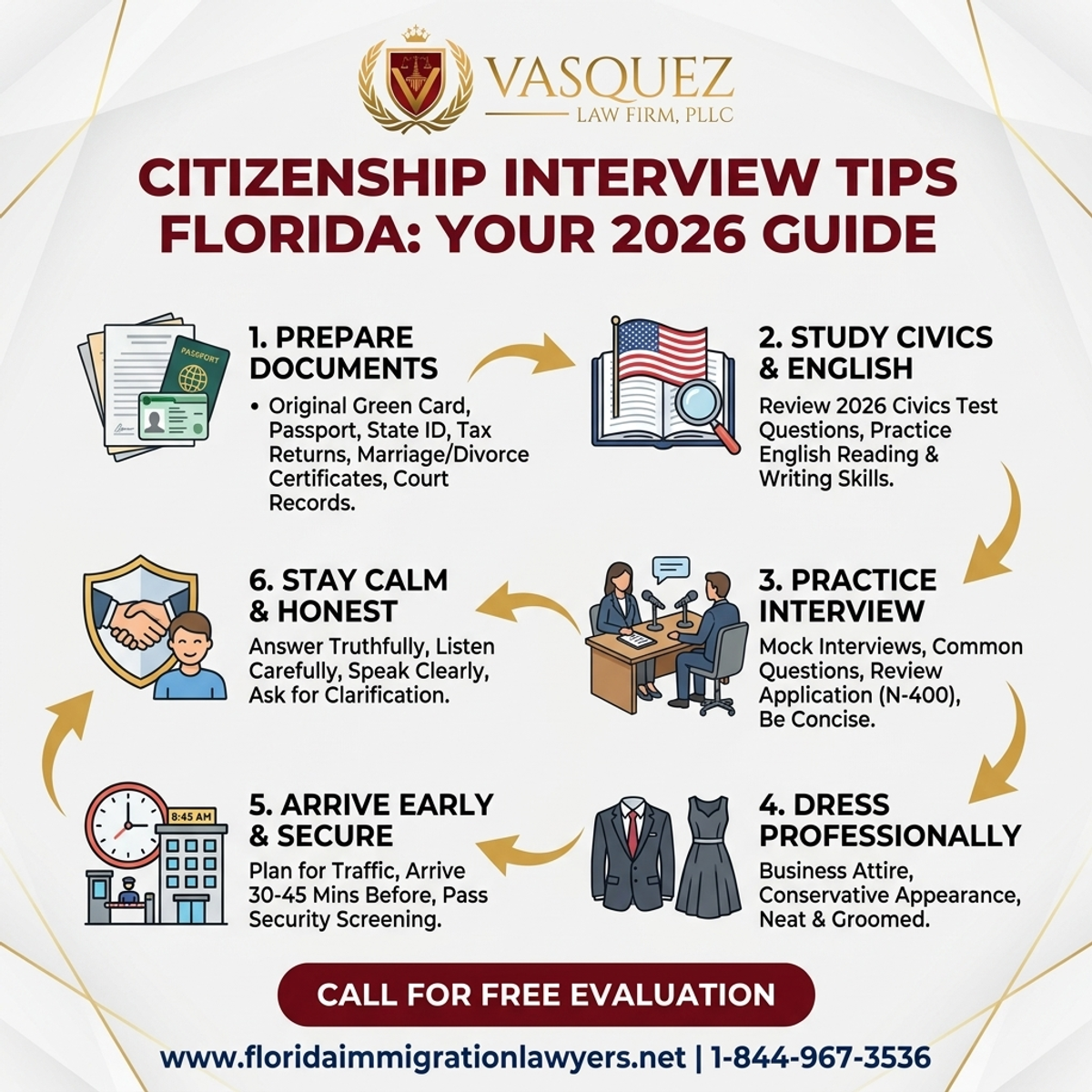
Preparing for your naturalization interview in Hollywood, Florida, requires a multi-faceted approach focusing on document organization, English proficiency, and civics knowledge. Start by thoroughly reviewing your submitted Form N-400, ensuring you remember every detail and can articulate your answers clearly. Gather all original documents supporting your application, as well as any updated information since you filed. Practice speaking English, especially answering personal questions about your application, and study the 100 civics questions provided by USCIS.
Step-by-Step Preparation Guide for Your Citizenship Interview
Follow these detailed steps to ensure you are fully prepared for your citizenship interview:
- Review Your N-400 Application: Read through your entire N-400 form and any supporting documents you submitted. Make sure you are familiar with every answer you provided. The officer will likely go through the application question by question. If anything has changed since you filed, be prepared to explain it clearly and provide updated documentation.
- Master the English Language Test: The interview includes tests on your ability to read, write, and speak English.
- Speaking: Your ability to understand and answer the officer's questions demonstrates your speaking proficiency. Practice answering questions about your N-400 and general topics.
- Reading: You will be asked to read one out of three sentences correctly. Practice reading sentences from the official USCIS vocabulary list.
- Writing: You will be asked to write one out of three sentences correctly. Practice writing sentences from the official USCIS vocabulary list.
- Study for the Civics Test: You must answer 6 out of 10 questions correctly from a list of 100 civics questions. USCIS provides study materials online. Focus on understanding the concepts, not just memorizing answers. USCIS Civics Test Study Materials are your best resource.
- Gather All Required Documents: Create a well-organized folder with all original documents, even those you sent copies of. This includes your green card, passports, marriage certificates, divorce decrees, tax returns, and any evidence related to your N-400 answers.
- Practice Interview Questions: Have a friend or family member conduct mock interviews with you. This helps you get comfortable speaking under pressure and ensures your answers are clear and concise. Focus on questions about your good moral character, U.S. history, and government.
- Understand Waivers and Accommodations: If you have a medical condition that prevents you from meeting the English or civics requirements, ensure you have a Form N-648, Medical Certification for Disability Exemptions, prepared by a licensed medical professional. USCIS also provides accommodations for disabilities.
Step-by-Step Process — Citizenship Interview Tips Florida: Your 2026 Guide
What Documents Do I Need for My USCIS Citizenship Interview?
For your USCIS citizenship interview, you must bring a comprehensive set of original documents to verify the information in your N-400 application. This typically includes your Permanent Resident Card (Green Card), state identification, passports, and all documents related to marital status, children, and any arrests or citations. Failing to bring required documents can lead to delays or even a denial of your naturalization application. Always err on the side of bringing more documentation than you think you need.
Essential Document Checklist for Your Interview
Organizing your documents beforehand is a crucial citizenship interview tip Florida residents should follow. Bring the following original documents to your interview:
- Your Permanent Resident Card (Green Card).
- Your state-issued identification (driver's license or state ID).
- All current and expired passports, including travel documents.
- State identification (driver's license or state ID card).
- Marriage certificate(s), if applicable.
- Divorce decree(s) or annulment records, if applicable.
- Death certificate(s) for former spouse(s), if applicable.
- Birth certificates for all your children (even if they are not applying with you).
- Proof of selective service registration, if applicable (for males aged 18-26).
- Tax returns for the past five years (or three years if married to a U.S. citizen and applying under the three-year rule).
- Evidence of continuous residence (e.g., utility bills, leases, bank statements, school transcripts).
- Court disposition records for any arrests, citations, or detentions, even if charges were dropped or expunged. This applies even to minor traffic tickets that involved an arrest.
- Proof of payment of child support or alimony, if applicable.
- Any documents you submitted with your N-400 application (e.g., certified translations, affidavits).
- Your interview appointment notice.
Make sure all foreign language documents are accompanied by a certified English translation.
What Happens After the Naturalization Interview?
After your naturalization interview, the USCIS officer will inform you of the outcome. In many cases, if you pass both tests and the officer is satisfied with your application, they may give you a decision notice recommending approval. Sometimes, they may issue a Request for Evidence (RFE) if more documents are needed, or schedule a second interview if there are unresolved issues. The final step after approval is the Oath of Allegiance Ceremony, where you officially become a U.S. citizen. This ceremony typically occurs within a few weeks to a few months after the interview.
Timeline and Processing Expectations (As of 2026)
Processing times can vary significantly based on the USCIS field office and national backlogs. Here is a general timeline for naturalization in Florida as of 2026:
Key Statistics — Citizenship Interview Tips Florida: Your 2026 Guide
| Stage | Typical Timeframe | Notes |
|---|---|---|
| N-400 Filing to Biometrics Appointment | 2-6 weeks | Receipt notice issued shortly after filing. Biometrics appointment scheduled. |
| Biometrics to Interview Scheduling | 6-12 months | Background checks are conducted during this period. Varies by field office. |
| Interview to Decision | Same day to 120 days | Officer may approve on the spot, issue RFE, or continue the case. |
| Decision to Oath Ceremony | 2-8 weeks | Can be scheduled quickly, sometimes even on the same day in larger offices like Miami. |
| Total Naturalization Process | 10-24 months | This is an average. Complex cases or backlogs can extend this. |
Cost Factors and Fee Breakdown for Naturalization
The cost of naturalization primarily involves the USCIS filing fee for Form N-400, Application for Naturalization. As of 2026, this fee typically includes the application processing and biometric services. While the fee is subject to change, it is a significant component of the overall expense. Additional costs may include legal representation, document translation services, and travel expenses to USCIS offices in Florida, such as the one serving Hollywood residents. Fee waivers may be available for eligible low-income applicants.
Typical Fee Breakdown for Naturalization (As of 2026)
Understanding the financial aspects is an important citizenship interview tip Florida applicants should consider. Here's a breakdown of potential costs:
| Item | Typical Fee | Notes |
|---|---|---|
| USCIS Form N-400 Filing Fee | Varies (check current USCIS fee schedule) | This fee covers both the application processing and biometric services. |
| Legal Representation | Varies by attorney and complexity | Highly recommended for complex cases, previous immigration issues, or simply for peace of mind. |
| Document Translation Services | Varies by document and language | Required for any foreign language documents submitted. Must be certified. |
| Travel Expenses | Varies | Costs for transportation to USCIS field offices in Miami, Hialeah, or Orlando for biometrics and interview. |
| Mail/Shipping Costs | Minor | For sending your N-400 application and any requested evidence to USCIS. |
USCIS publishes its most current fee schedule on its website. Always consult the official USCIS Fees page for the exact amount before filing.
Common Challenges During the Citizenship Interview and How to Overcome Them
Even with thorough preparation, applicants may face unexpected challenges during their citizenship interview. These can range from nervousness affecting English speaking ability to complex questions about past events or changes in personal circumstances since filing. Overcoming these challenges requires remaining calm, asking for clarification when needed, and being honest and consistent in your answers. Acknowledging your nervousness to the officer can sometimes create a more understanding environment. Remember, the officer is looking for your eligibility and good moral character, not perfection.
Common Mistakes to Avoid During Your Citizenship Interview
Avoiding these common pitfalls can significantly improve your chances of a successful naturalization interview:
- Not Reviewing the N-400 Application: Many applicants forget details from their own application, leading to inconsistent answers. Review every question and your response carefully.
- Lack of English Practice: Underestimating the English test is a common error. Practice speaking, reading, and writing regularly to build confidence.
- Insufficient Civics Knowledge: Memorizing answers without understanding the concepts can lead to failure if the officer rephrases a question. Study the meaning behind the facts.
- Failing to Bring All Original Documents: Forgetting a crucial document can cause delays or require a second interview, prolonging your process. Always bring all originals.
- Providing Dishonest or Inconsistent Answers: Lying or providing conflicting information is grounds for denial and can lead to serious legal consequences under 8 U.S.C. § 1101 et seq. (Immigration and Nationality Act - INA). Always be truthful.
- Arriving Late or Unprepared: Punctuality and proper attire demonstrate respect for the process. Arriving late can lead to rescheduling or even denial.
- Not Disclosing Past Issues: Even minor arrests or citations, regardless of the outcome, must be disclosed. USCIS has access to your full criminal record.
- Ignoring Updates to Your Application: If your address, marital status, or employment changed since filing, you must inform the officer and provide proof.
- Failing to Seek Legal Advice for Complex Cases: If you have a criminal record, multiple divorces, or extensive travel, attempting to navigate the interview alone can be risky.
- Being Overly Argumentative or Disrespectful: Maintain a respectful and cooperative demeanor throughout the interview, even if you disagree with a question.
- Not Asking for Clarification: If you do not understand a question, politely ask the officer to repeat or rephrase it. Guessing can lead to incorrect answers.
- Bringing Unauthorized Individuals: Only your attorney or a certified interpreter (if applicable and pre-approved) can accompany you. Family members are generally not allowed in the interview room.
When to Call a Lawyer for Your Naturalization Process
While many applicants successfully navigate the naturalization interview independently, certain situations strongly warrant the expertise of an immigration attorney. If you have a criminal record, even a minor one, or have been arrested, it is critical to consult a lawyer. Similarly, if you have had multiple marriages or divorces, extensive travel outside the U.S., or have been involved in deportation or removal proceedings, legal counsel is invaluable. An attorney can help you prepare thoroughly, identify potential issues in your application, gather necessary documentation, and even accompany you to the interview in Florida.
Florida Immigration Lawyers specializes in complex naturalization cases, including those involving deportation defense, asylum claims, and issues related to good moral character. We can provide peace of mind by ensuring your application is robust and your interview preparation is comprehensive. Our team understands the nuances of immigration law, including provisions outlined in 8 CFR Part 316 regarding general requirements for naturalization. Do not risk your dream of citizenship; let our experienced attorneys guide you every step of the way. We serve clients across Florida, including Hollywood and surrounding areas, offering strategic advice tailored to your unique circumstances.
About Florida Immigration Lawyers
Florida Immigration Lawyers is a leading immigration law firm dedicated to serving individuals and families across the entire state of Florida. With offices and services accessible throughout the region, including Hollywood, Miami, Orlando, and Tampa, we provide expert legal representation in all areas of immigration law. Our experienced attorneys are committed to helping clients achieve their immigration goals, from family-based petitions and business visas to citizenship and deportation defense. We understand the profound impact immigration matters have on our clients' lives and approach each case with compassion, diligence, and a deep understanding of U.S. immigration laws.
We pride ourselves on our client-focused approach, offering transparent communication, strategic legal advice, and unwavering support. Our firm is available 24/7 to address urgent concerns and offers free consultations to assess your case. Whether you are preparing for your naturalization interview, seeking family immigration solutions, or navigating complex legal challenges, Florida Immigration Lawyers is your trusted partner. Call us today at 1-844-967-3536 or visit our website at https://www.floridaimmigrationlawyers.net to learn more about how we can assist you.
Sources and References
- U.S. Citizenship and Immigration Services (USCIS)
- Executive Office for Immigration Review (EOIR)
- U.S. Department of State (Travel.State.Gov)
- 8 U.S.C. Chapter 12 - Immigration and Nationality Act (INA)
- 8 CFR Part 316 - General Requirements for Naturalization
- USCIS Policy Manual, Part B - English and Civics Requirements
Related services: citizenship test preparation, dual citizenship guidance, citizenship test resources.
This article provides general legal information and is not intended as legal advice. Every case is unique, and outcomes depend on specific facts and circumstances. Contact an attorney for advice about your particular situation. Immigration laws are subject to change, and it is essential to consult with a qualified legal professional for the most current information.
Your journey to U.S. citizenship is within reach. With the right preparation and the support of dedicated legal professionals, you can approach your citizenship interview with confidence. Do not leave your future to chance. Contact Florida Immigration Lawyers today for a free, confidential consultation. Our team is ready to provide the expert guidance you need. Call us at 1-844-967-3536. Se Habla Español - Estamos aqui para ayudarle.
Do Not Navigate This Process Alone
Our experienced immigration attorneys are ready to fight for you. Get a free, confidential consultation today.
Se Habla Español
Frequently Asked Questions
Harold Estrada-Rodriguez
Florida Immigration Attorney · FL Bar No. 1041171
Florida Bar attorney handling Florida-jurisdiction immigration matters. Bilingual representation, free consultations.
Available 24/7 - Free Evaluations
Related Legal Services
Our Florida immigration attorneys can help you with family immigration services, immigration practice areas and free immigration consultation. Call today at 1-844-967-3536 for a free consultation.
Related Links
Related Topics
Free Legal Consultation
Discuss your case with our experienced attorneys. We're available 24/7.
Se Habla Español - Estamos aquí para ayudarle.
Related Articles
J-1 Waiver for Physicians in Florida: Your 2026 Guide
Physicians holding J-1 visas often face a two-year home residency requirement after their program. However, the J-1 waiver, particularly through the Conrad 30 program, offers a critical pathway to remain and practice medicine in the United States, especially in Florida's designated medically underserved areas. This comprehensive guide for 2026 details the requirements, application process, common pitfalls, and how Florida Immigration Lawyers can assist you in navigating this complex immigration journey to secure your future in healthcare.
Understanding PERM Labor Certification in Florida | VLF Florida
Learn about the PERM labor certification process in Florida, a vital step for employer-sponsored green cards. Understand timelines, costs, and common mistakes. Contact Florida Immigration Lawyers for expert guidance.
F-1 Reinstatement Process for Students in Florida | VLF Florida
F-1 reinstatement is vital for students in Florida who have fallen out of status. Learn about the process, documents needed, and how to apply. Contact Florida Immigration Lawyers for a free consultation.
H-4 EAD: Florida Work Permits for H-1B Spouses | VLF Florida
For H-1B spouses in Florida, an H-4 EAD is essential for work authorization, offering financial stability and career opportunities. This comprehensive guide covers H-4 EAD eligibility, application steps, required documents, processing times, and fees for 2026. Learn how to navigate the complexities, avoid common mistakes, and understand when to seek legal assistance from Florida Immigration Lawyers. We provide expert guidance for H-1B families in Homestead, Miami, and throughout Florida, ensuring a smooth application process.
