F-1 Reinstatement Process for Students in Florida
F-1 reinstatement is vital for students in Florida who have fallen out of status. Learn about the process, documents needed, and how to apply. Contact Florida Immigration Lawyers for a free consultation.

F-1 Reinstatement Process for Students in Florida | VLF Florida
Navigating the complexities of U.S. immigration law can be challenging, especially for international students. The F-1 student visa allows foreign nationals to pursue academic studies and language training programs in the United States. However, circumstances can sometimes lead students to fall "out of status," jeopardizing their academic journey and future in the U.S. If you're an F-1 student in Florida facing this predicament, understanding the F-1 reinstatement process is crucial. This comprehensive guide from VLF Florida will walk you through the steps, requirements, and critical considerations for reinstating your F-1 status, helping you regain your legal standing and continue your education. For broader guidance on various immigration matters, explore our dedicated immigration practice areas.
Understanding F-1 Status and Why Students Fall "Out of Status"
An F-1 visa holder is expected to maintain their nonimmigrant status by adhering to specific regulations set by U.S. Citizenship and Immigration Services (USCIS) and their educational institution. This includes maintaining full-time enrollment, making normal progress towards a degree, and refraining from unauthorized employment. Falling "out of status" means you have violated one or more of these conditions, even if unintentionally.
Common reasons students find themselves in this precarious situation include:
- Dropping Below Full-Time Enrollment: Failing to register for the required number of credits without prior authorization from your Designated School Official (DSO).
- Unauthorized Employment: Working off-campus without proper authorization (e.g., Curricular Practical Training (CPT) or Optional Practical Training (OPT)).
- Expired I-20: Allowing your Form I-20, Certificate of Eligibility for Nonimmigrant Student Status, to expire before completing your program of study.
- Academic or Disciplinary Issues: Being suspended or expelled from your school.
- Failure to Transfer Properly: Not completing the transfer process to a new school within the stipulated timeframe.
- Travel Violations: Re-entering the U.S. without a valid I-20 or after a significant period out of status.
The consequences of being out of status are severe. You lose your legal right to remain in the U.S., your visa becomes invalid, and you may accrue 'unlawful presence,' which can lead to bars from re-entering the country in the future. In extreme cases, being out of status can even lead to deportation proceedings.
Eligibility Requirements for F-1 Reinstatement
To be eligible for F-1 reinstatement, you must meet stringent criteria established by USCIS. These requirements are designed to ensure that reinstatement is granted only to students who genuinely deserve a second chance and have not willfully violated immigration laws. Key eligibility points include:
- No Willful Violation: You must demonstrate that your violation of F-1 status was due to circumstances beyond your control, or that the violation relates to a failure to maintain status that is excusable (e.g., a minor, unintentional oversight). You cannot have willfully violated your status.
- No Unauthorized Employment: You must not have engaged in unauthorized employment. If you did, it must have been for a very brief period and due to circumstances beyond your control.
- Not Subject to Deportation: You must not be deportable for any reason other than your failure to maintain F-1 status.
- Still Pursuing a Full Course of Study: You must currently be pursuing, or intend to pursue, a full course of study at a SEVP-approved institution. Your DSO must issue a new Form I-20 with a reinstatement recommendation.
- No Excessive Unlawful Presence: You must not have been out of status for more than five months at the time of filing your I-539 application, unless you can demonstrate exceptional circumstances.
- No Prior Reinstatement: Generally, you cannot have been reinstated to F-1 status in the past.
It's critical to understand that meeting these criteria requires compelling evidence and a well-articulated explanation. USCIS reviews each case individually, and the burden of proof rests entirely on the applicant.
The F-1 Reinstatement Application Process: A Step-by-Step Guide
The process of applying for F-1 reinstatement involves several crucial steps, each requiring careful attention to detail.
Step 1: Consult with Your Designated School Official (DSO)
Your DSO is your primary point of contact and an invaluable resource. As soon as you realize you're out of status, contact your DSO immediately. They can assess your situation, explain your options, and, if appropriate, recommend reinstatement by issuing a new Form I-20 with the reinstatement request checked. This new I-20 is fundamental to your application.
Step 2: Gather Required Documents
A complete application package is essential for a successful reinstatement. You will need:
- Form I-539, Application to Extend/Change Nonimmigrant Status: This is the primary form for your application.
- New Form I-20 with Reinstatement Recommendation: Issued by your DSO, indicating their support for your reinstatement.
- Financial Evidence: Proof that you have sufficient funds to cover your tuition, living expenses, and other costs for your entire program of study. This could include bank statements, scholarship letters, or sponsor affidavits.
- Academic Transcripts: Official transcripts from all U.S. institutions you have attended, demonstrating your academic progress and good standing.
- Copies of Passport, Visa, I-94, and Previous I-20s: These documents prove your identity, legal entry, and previous F-1 status.
- Any Other Supporting Documents: Depending on your specific situation, this might include medical records, police reports, or letters from professors.
Step 3: Prepare Your Personal Statement/Letter of Explanation
This is arguably the most critical component of your application. In this letter, you must clearly and convincingly explain:
- How you fell out of status: Be honest and provide specific dates and events.
- Why the violation was beyond your control: This is where you detail the "exceptional circumstances." Examples include a serious illness, an unforeseen financial crisis, natural disaster, or an administrative error by the school. You must provide supporting documentation for these claims.
- Your intention to comply with F-1 regulations: Reassure USCIS that you understand the rules and are committed to maintaining your status moving forward.
- Why you deserve reinstatement: Emphasize your academic goals and contributions.
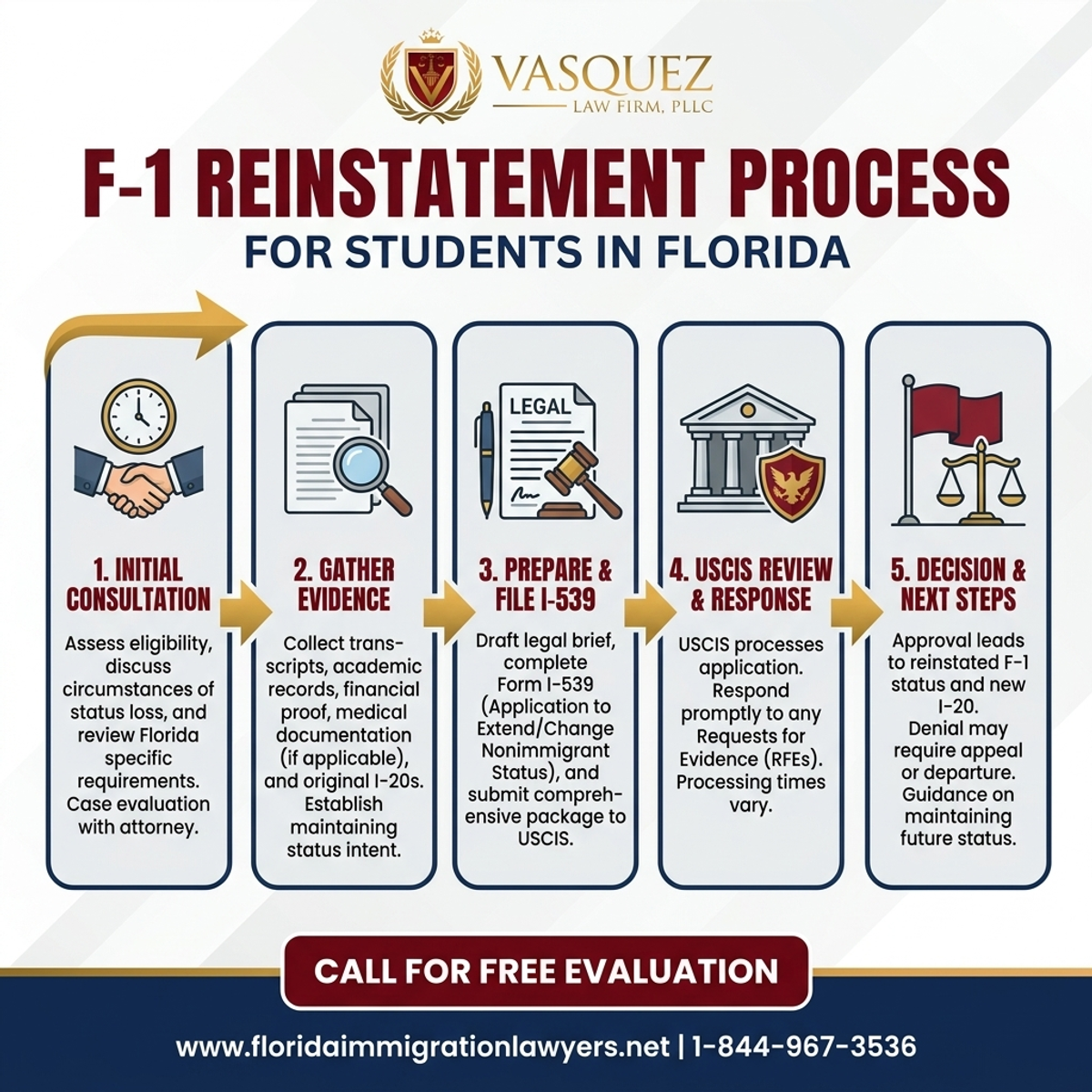
Step-by-Step Process — F-1 Reinstatement Process for Students in Florida | VLF Florida
The letter should be professional, concise, and well-supported by evidence. Avoid emotional appeals without factual backing.
Step 4: File Form I-539 with USCIS
Once all documents are prepared, you will mail your complete application package to the appropriate USCIS lockbox facility. Ensure you include the correct filing fee. After filing, you will typically receive a receipt notice, followed by an appointment for biometrics (fingerprinting).
Step 5: Awaiting a Decision
Processing times for I-539 applications can vary significantly, often taking several months. During this period, it is crucial to:
- Maintain your full course of study: Continue attending classes as if you were still in status.
- Avoid travel outside the U.S.: Leaving the U.S. while your I-539 is pending will likely result in the abandonment of your application.
- Do not engage in unauthorized employment: This is a strict rule; violating it will lead to denial.
If your application is approved, you will receive a new I-797 approval notice, and your I-94 record will be updated. If denied, you may need to explore other options, which could include leaving the U.S. or consulting with an attorney about potential deportation defense strategies if you accrue unlawful presence.
Alternatives to F-1 Reinstatement and Strategic Considerations
While F-1 reinstatement is often the most direct path to regaining legal status, it's not always the only option, nor is it always the best one, depending on your specific circumstances. Understanding the alternatives and considering strategic implications is vital, especially when the five-month rule or other eligibility criteria for reinstatement cannot be met.
One common alternative is to depart the U.S. and re-enter with a new F-1 visa and I-20. This option is typically considered if you have been out of status for more than five months, or if your violation was deemed willful, making you ineligible for reinstatement. The process involves obtaining a new I-20 from your school, applying for a new F-1 visa at a U.S. embassy or consulate abroad, and then re-entering the U.S. The primary advantage is that it can be quicker than waiting for an I-539 decision, and it "resets" your status. However, it carries significant risks: there's no guarantee your new visa will be approved, and you might face scrutiny at the port of entry upon re-entry. If you have accrued significant unlawful presence (more than 180 days), you could be subject to a 3-year or 10-year bar from re-entering the U.S., making this option impossible.
Another less common alternative, depending on your eligibility, might be to change to a different nonimmigrant status if you qualify. For instance, if you marry a U.S. citizen, you might be able to apply for adjustment of status. However, being out of status can complicate such applications, and it's essential to consult with an attorney to understand the implications of your current status on any potential change of status application.
For students who face severe circumstances in their home country, such as persecution or fear for their safety, exploring options like asylum might become a consideration. This is a complex legal process entirely separate from F-1 student status and requires a strong case and immediate legal advice.
The decision between pursuing reinstatement, leaving and re-entering, or exploring other avenues should not be taken lightly. It involves a careful assessment of your specific situation, including the length of time you've been out of status, the reasons for your violation, your academic and financial resources, and your long-term immigration goals. Consulting with an experienced immigration attorney is paramount. An attorney can help you weigh the pros and cons of each option, identify potential pitfalls, and guide you toward the most strategic and legally sound decision for your future. Our team of experienced attorneys at VLF Florida is here to provide personalized guidance.
Maintaining F-1 Status After Reinstatement Approval
Once your F-1 reinstatement is approved, the responsibility to maintain your legal status falls squarely on your shoulders. It's crucial to understand that reinstatement is a privilege, not a right, and any further violations could lead to more severe consequences. To ensure you remain in good standing:
- Enroll Full-Time: Always maintain a full course of study as required by your program and institution. Any exceptions, such as a reduced course load, must be pre-approved by your DSO and fall within USCIS regulations.
- Avoid Unauthorized Employment: Do not work off-campus without explicit authorization (CPT or OPT) and only within the parameters of that authorization.
- Keep Your I-20 Valid: Ensure your Form I-20 is always current. If your program end date approaches and you need more time, work with your DSO to extend your I-20 before it expires.
- Report Changes Promptly: Inform your DSO of any changes to your address, name, or program of study.
- Understand Travel Rules: Consult your DSO before traveling internationally, especially if your visa stamp has expired. Reinstatement does not automatically grant you a new visa stamp.
- Monitor Your I-94: Regularly check your electronic I-94 record to ensure it accurately reflects your F-1 status and duration of stay (D/S).
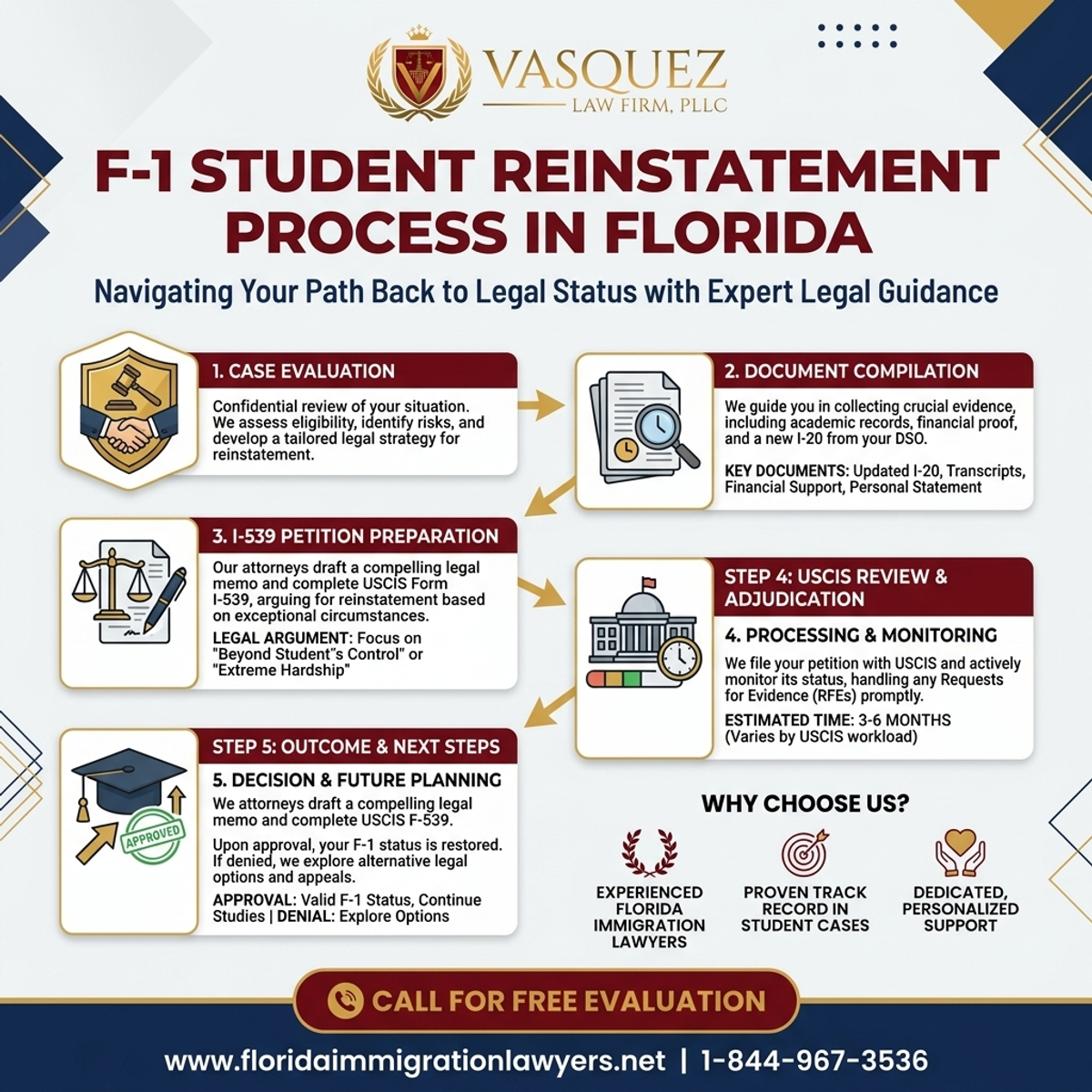
Key Statistics — F-1 Reinstatement Process for Students in Florida | VLF Florida
Proactive communication with your DSO and a clear understanding of F-1 regulations are your best defenses against future status violations.
Why Choose VLF Florida for Your F-1 Reinstatement?
Navigating the F-1 reinstatement process can be complex and stressful, especially when your academic future in the U.S. hangs in the balance. At VLF Florida, we understand the unique challenges international students face. Our team of dedicated immigration attorneys specializes in F-1 student visa matters, with extensive experience assisting students in Florida and across the nation.
We offer:
- Expert Guidance: Our attorneys possess in-depth knowledge of USCIS regulations and the nuances of F-1 reinstatement, ensuring your application is meticulously prepared and strategically presented.
- Personalized Approach: We recognize that every student's situation is unique. We take the time to understand your specific circumstances, providing tailored advice and developing a robust strategy for your case.
- Comprehensive Support: From gathering documents and drafting your personal statement to communicating with your DSO and USCIS, we guide you through every step of the process.
- Peace of Mind: With VLF Florida by your side, you can focus on your studies while we handle the legal complexities, giving you the
Sources and References
- U.S. Citizenship and Immigration Services (USCIS)
- Executive Office for Immigration Review (EOIR)
- U.S. Department of State - Bureau of Consular Affairs
- Immigration and Nationality Act (INA), 8 U.S.C. Chapter 12
Do Not Navigate This Process Alone
Our experienced immigration attorneys are ready to fight for you. Get a free, confidential consultation today.
Se Habla Español
Frequently Asked Questions
Harold Estrada-Rodriguez
Florida Immigration Attorney · FL Bar No. 1041171
Florida Bar attorney handling Florida-jurisdiction immigration matters. Bilingual representation, free consultations.
Available 24/7 - Free Evaluations
Related Legal Services
Our Florida immigration attorneys can help you with free immigration consultation, experienced immigration attorneys and business immigration. Call today at 1-844-967-3536 for a free consultation.
Related Links
Related Topics
Free Legal Consultation
Discuss your case with our experienced attorneys. We're available 24/7.
Se Habla Español - Estamos aquí para ayudarle.
Related Articles
H-4 EAD: Florida Work Permits for H-1B Spouses | VLF Florida
For H-1B spouses in Florida, an H-4 EAD is essential for work authorization, offering financial stability and career opportunities. This comprehensive guide covers H-4 EAD eligibility, application steps, required documents, processing times, and fees for 2026. Learn how to navigate the complexities, avoid common mistakes, and understand when to seek legal assistance from Florida Immigration Lawyers. We provide expert guidance for H-1B families in Homestead, Miami, and throughout Florida, ensuring a smooth application process.
H-4 EAD Spouse Work Permit in Florida | VLF Florida
Explore the rules for obtaining an H-4 EAD spouse work permit in Florida, specifically for residents in Hialeah. Learn about eligibility, application process, common mistakes, and when to seek legal help.
Immigration Attorney Orlando Florida: Your Guide to Success
Navigating immigration in Florida requires expert legal guidance. An immigration attorney in Orlando, Florida, provides essential help with visas, green cards, citizenship, and deportation defense. This guide covers the complexities of U.S. immigration law, the crucial role of an attorney, common application processes, timelines, and fees. Learn why proactive legal support from Florida Immigration Lawyers is vital for your success in 2026. Avoid common mistakes and understand when to seek professional immigration help for your unique situation in Orlando or Naples. Schedule your free consultation today.
K-3 Visa Timeline for Spouses in Florida | VLF Florida
Explore the 2026 K-3 spouse visa process for Florida residents. Learn about timelines, costs, and common pitfalls. Call Florida Immigration Lawyers for expert guidance.
