H-4 EAD: Florida Work Permits for H-1B Spouses
For H-1B spouses in Florida, an H-4 EAD is essential for work authorization, offering financial stability and career opportunities. This comprehensive guide covers H-4 EAD eligibility, application steps, required documents, processing times, and fees for 2026. Learn how to navigate the complexities, avoid common mistakes, and understand when to seek legal assistance from Florida Immigration Lawyers. We provide expert guidance for H-1B families in Homestead, Miami, and throughout Florida, ensuring a smooth application process.

An H-4 EAD (Employment Authorization Document) allows eligible H-4 dependent spouses of H-1B visa holders to work legally in the United States. In Florida, this authorization is crucial for many H-1B families, including those in areas like Homestead, seeking dual-income stability and career continuity. Eligibility typically requires the H-1B spouse to have an approved Form I-140 (Immigrant Petition for Alien Worker) or to have had their H-1B status extended beyond the standard six-year limit. The application involves filing Form I-765 with USCIS, often concurrently with an H-4 status extension or change of status.
- H-4 EAD grants work authorization to eligible H-1B spouses.
- Eligibility is tied to the H-1B spouse's green card process or extended H-1B status.
- The application requires filing Form I-765 with supporting documents.
- Processing times can vary, so early application is advisable.
- Consulting an immigration lawyer is recommended for complex cases or renewals.
Navigating the complexities of U.S. immigration law can be a daunting experience, especially when it impacts your family's ability to live and work together. For many H-1B visa holders and their spouses in Florida, securing an H-4 EAD is a critical step towards achieving financial stability and professional growth. This Employment Authorization Document allows eligible H-4 dependent spouses to legally work in the United States, transforming their lives from dependents to active contributors in the workforce.
Whether you reside in vibrant Miami, the bustling Orlando area, or the growing communities around Homestead, understanding the specific requirements and processes for obtaining an H-4 EAD is essential. This comprehensive guide from Florida Immigration Lawyers will demystify the H-4 EAD application, covering eligibility, required documents, timelines, and common pitfalls to avoid. We aim to provide clear, actionable information to help H-1B families in Florida secure their work authorization.
Do not let the intricate legal landscape overwhelm you. Empower yourself with knowledge and professional guidance. For personalized assistance with your H-4 EAD application or any immigration matter, call Florida Immigration Lawyers at 1-844-967-3536 for a free consultation today.
What is an H-4 EAD and who is eligible for it in Florida?
An H-4 EAD, or H-4 Employment Authorization Document, is a work permit granted by U.S. Citizenship and Immigration Services (USCIS) to certain H-4 nonimmigrant spouses of H-1B visa holders. This authorization allows these spouses to legally seek and hold employment in the United States, providing significant relief and economic opportunity for H-1B families across Florida, including those contributing to our diverse economy in cities like Tampa and Jacksonville.
Eligibility for an H-4 EAD is specifically tied to the H-1B principal's immigration status and progress towards lawful permanent residency. As of 2026, the primary conditions for H-4 EAD eligibility are outlined in 8 CFR 274a.12(c)(26). An H-4 spouse may apply for an EAD if the H-1B principal:
- Is the principal beneficiary of an approved Form I-140, Immigrant Petition for Alien Worker. This means the H-1B worker is on a path to obtaining a green card.
- Has been granted H-1B status under sections 106(a) and (b) of the American Competitiveness in the Twenty-first Century Act of 2000 (AC21). This typically means their H-1B status has been extended beyond the initial six-year maximum period based on a pending green card application.
It is important to note that not all H-4 spouses are eligible for an EAD. For instance, if the H-1B spouse has not yet reached the stage of an approved I-140 or a qualifying H-1B extension under AC21, the H-4 spouse will not be eligible for work authorization. This distinction is critical for H-1B families in Florida planning their careers and finances. Understanding these nuances is where legal counsel becomes invaluable, ensuring that you meet all criteria before investing time and resources into an application.
How do I apply for an H-4 EAD in Florida in 2026?
Applying for an H-4 EAD in Florida in 2026 involves a structured process with USCIS, primarily centered around filing Form I-765, Application for Employment Authorization. This process is generally consistent nationwide, with Florida applicants submitting to the same national lockbox facilities. The key is meticulous preparation and timely submission of all required forms and supporting documents to avoid delays or rejections.
Here is a step-by-step guide to applying for an H-4 EAD:
-
Determine Eligibility: First, confirm that the H-1B principal spouse meets one of the two eligibility criteria: an approved Form I-140 or an H-1B extension under AC21. Gather evidence of this eligibility, such as the I-797 approval notice for the I-140 or the H-1B extension.
-
Complete Form I-765: Accurately fill out Form I-765, Application for Employment Authorization. Ensure all sections are completed, paying close attention to Part 2, Item 27, where you must enter the correct eligibility category, which for H-4 EAD is (c)(26). Review every entry for accuracy to prevent common mistakes that can lead to Requests for Evidence (RFEs).
-
Gather Supporting Documents: Collect all necessary supporting documentation. This includes proof of your H-4 status (Form I-94, H-4 visa stamp, H-4 approval notices), your H-1B spouse's H-1B approval notices and I-140 approval (if applicable), marriage certificate, passport photos, and a copy of your government-issued identification. Ensure all copies are clear and legible.
-
Prepare Filing Fees: Include the required filing fee for Form I-765. As of 2026, USCIS fees are subject to change, so always check the latest fee schedule on the USCIS website before mailing your application. Payment can be made by money order, personal check, cashier's check, or by credit card using Form G-1450, Authorization for Credit Card Transactions.
-
Mail the Application: Send your complete application package to the correct USCIS lockbox facility. The specific mailing address depends on whether you are filing Form I-765 by itself, or concurrently with Form I-539 (Application to Extend/Change Nonimmigrant Status) for your H-4 status, and possibly Form I-129 for your H-1B spouse. Always verify the most current filing address on the USCIS website.
-
Attend Biometrics Appointment (if required): USCIS may require you to attend a biometrics appointment at an Application Support Center (ASC) in Florida, such as those in Miami, Orlando, or Jacksonville. You will receive a notice with the date, time, and location. Failure to attend can lead to denial of your application.
-
Track Your Case: Once USCIS accepts your application, you will receive a receipt notice (Form I-797C) with a receipt number. Use this number to track the status of your case online through the USCIS website. Be prepared for potential processing delays, especially for concurrent filings.
What documents are required for an H-4 EAD application?
A thorough and accurate submission of documents is paramount for a successful H-4 EAD application. Any missing or incorrect documentation can lead to delays, Requests for Evidence (RFEs), or even denial, significantly impacting your ability to work in Florida. Ensuring you have a complete checklist before mailing your application to USCIS is a critical step for H-1B families in Homestead, Miami, and throughout the state.
Here is a comprehensive checklist of documents typically required for an H-4 EAD application:
- Form I-765, Application for Employment Authorization: The primary application form, filled out completely and signed.
- Filing Fee: A check or money order payable to the U.S. Department of Homeland Security for the current fee, or Form G-1450 for credit card payments.
- Two Passport-Style Photos: Taken within 30 days of filing, meeting USCIS specifications (2x2 inches, white background, full face).
- Copy of Current Form I-94: Arrival/Departure Record, showing your current H-4 nonimmigrant status. Both front and back if printed from CBP website.
- Copy of H-4 Visa Stamp: From your passport (if applicable and if you entered the U.S. with an H-4 visa).
- Copies of All H-4 Approval Notices (I-797): If you have previously extended or changed your status to H-4.
- Copy of Your Passport: Biographical page, visa pages, and any pages with stamps.
- Copy of Your Birth Certificate: To establish identity.
- Copy of Marriage Certificate: To prove your legal relationship with the H-1B principal.
- Copy of H-1B Principal's Current Form I-94: Arrival/Departure Record.
- Copies of H-1B Principal's H-1B Approval Notices (I-797): For all periods of H-1B status.
- Evidence of H-1B Principal's Eligibility for EAD:
- Copy of H-1B principal's approved Form I-140, Immigrant Petition for Alien Worker (I-797 approval notice).
- OR copies of the H-1B principal's H-1B approval notices (Form I-797) showing an extension beyond the six-year limit under AC21 sections 106(a) and (b).
- Previous EAD Cards (if applicable): Copies of any prior EADs issued to you.
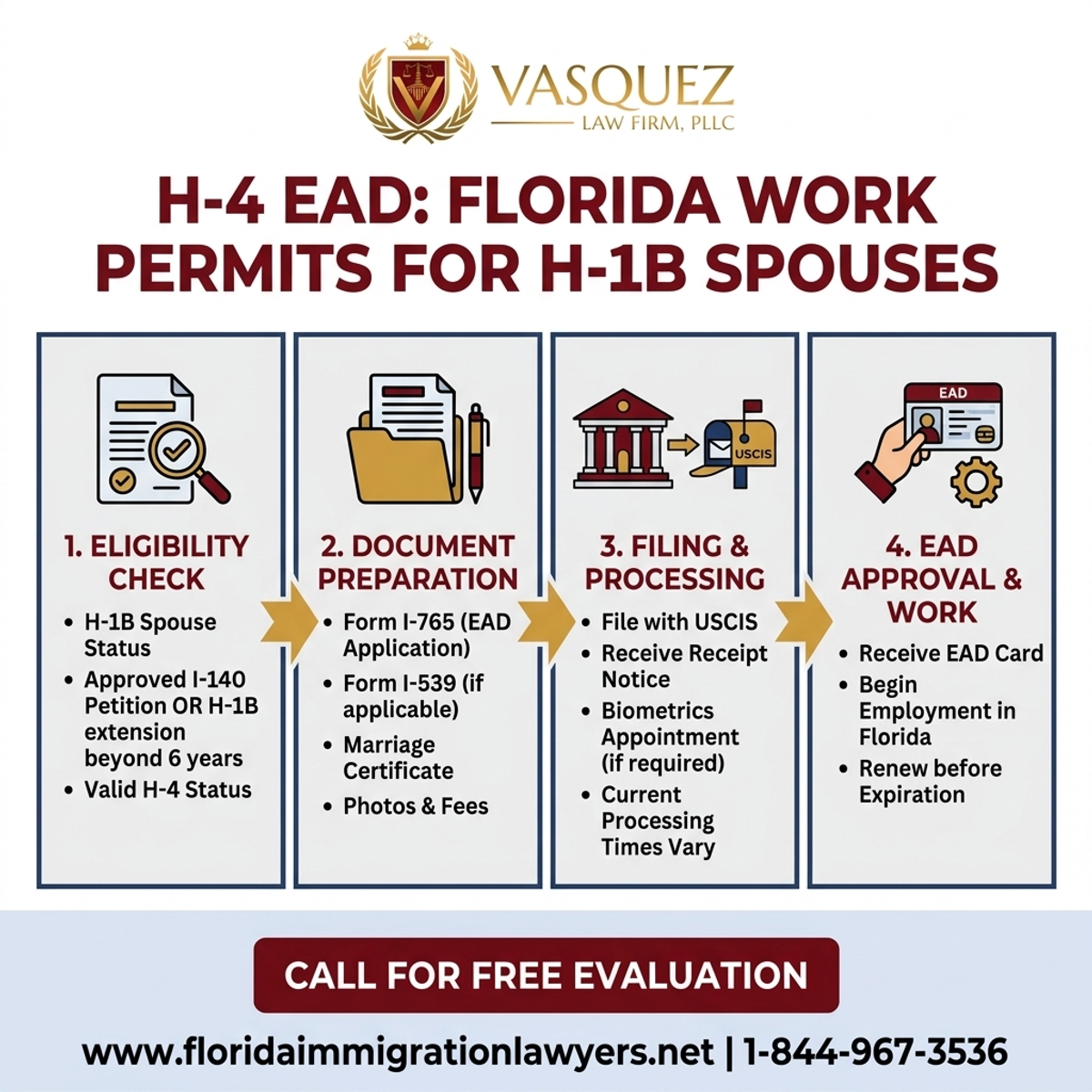
Step-by-Step Process — H-4 EAD: Florida Work Permits for H-1B Spouses
Organizing these documents clearly, perhaps with cover sheets for each category, can assist USCIS officers in processing your application more efficiently. Remember, submitting a robust and complete application package from the outset is the best strategy for a smooth process.
Do not navigate this process alone. The requirements for H-4 EAD applications can be intricate and specific. Contact Florida Immigration Lawyers today at 1-844-967-3536 for expert guidance and support.
Understanding the H-4 EAD Processing Timeline and Fees in 2026
The processing timeline for an H-4 EAD can vary significantly based on USCIS workload, the specific service center handling your case, and whether you file concurrently with an H-4 extension or H-1B petition. As of 2026, applicants in Florida should anticipate certain general timeframes, but it is crucial to check the latest USCIS processing times online for the most accurate estimates.
Typical H-4 EAD Processing Timeline (as of 2026):
| Stage | Typical Timeframe | Notes |
|---|---|---|
| Application Submission to Receipt Notice | 1-3 weeks | USCIS sends Form I-797C with a receipt number. |
| Biometrics Appointment Scheduling | 3-6 weeks after receipt | Notice sent for appointment at an ASC in Florida (e.g., Miami, Orlando). |
| Case Adjudication (if standalone I-765) | 6-12 months | Varies greatly by service center; check USCIS website. |
| Case Adjudication (if concurrent with I-539) | 8-15 months | Often processed together, but I-539 can sometimes delay EAD. |
| Card Production and Mailing | 1-2 weeks after approval | EAD card mailed to your Florida address. |
It is important to apply for renewal well in advance, ideally 5-6 months before your current EAD expires, to avoid gaps in employment authorization. USCIS does not offer premium processing for H-4 EAD applications directly, but if the H-1B petition is premium processed, it can sometimes indirectly expedite the H-4 and H-4 EAD if filed concurrently and linked.
H-4 EAD Application Fees (as of 2026):
| Item | Typical Fee | Notes |
|---|---|---|
| Form I-765 (H-4 EAD) | Check USCIS Fee Schedule | Fee is subject to change; always verify current amount. |
| Form I-539 (H-4 Extension/Change of Status) | Check USCIS Fee Schedule | Required if extending H-4 status concurrently. |
| Biometrics Fee (for I-539) | Check USCIS Fee Schedule | Required for I-539; often paid with I-539 fee. |
Always consult the official USCIS website for the most current fee information, as fees can be updated periodically. Incorrect fees will lead to your application being rejected.
Navigating H-4 EAD Challenges and Maintaining Status in Florida
While the H-4 EAD offers significant advantages, beneficiaries in Florida may encounter various challenges throughout their immigration journey. Understanding these potential hurdles and how to address them is crucial for maintaining continuous work authorization and legal status, particularly for families settled in diverse areas like Homestead or the bustling tech hubs of Orlando.
One common challenge is the variability in processing times. Unpredictable delays at USCIS service centers can create anxiety and employment gaps. To mitigate this, H-4 EAD holders should apply for renewal well in advance of their current EAD's expiration, typically 5 to 6 months prior. This proactive approach helps ensure continuity of employment authorization. Another issue arises when the H-1B principal changes employers or their H-1B status is impacted. Any change in the principal's H-1B status, including a new employer or a visa extension, may necessitate filing an updated H-4 extension (Form I-539) and a new H-4 EAD application (Form I-765) to ensure the H-4 spouse's status remains valid and linked to the principal's.
Furthermore, maintaining H-4 status itself is paramount. If the H-1B principal loses their H-1B status, the H-4 dependent's status is also jeopardized, which would invalidate the H-4 EAD. It is vital for H-1B families to stay informed about the H-1B principal's employment status and any changes that could affect their nonimmigrant visa. For instance, if the H-1B principal’s I-140 petition is withdrawn or revoked, the H-4 EAD eligibility based on that I-140 may be rescinded. Staying in compliance with all immigration regulations, including timely filing of extensions and updates, is key to avoiding serious complications.
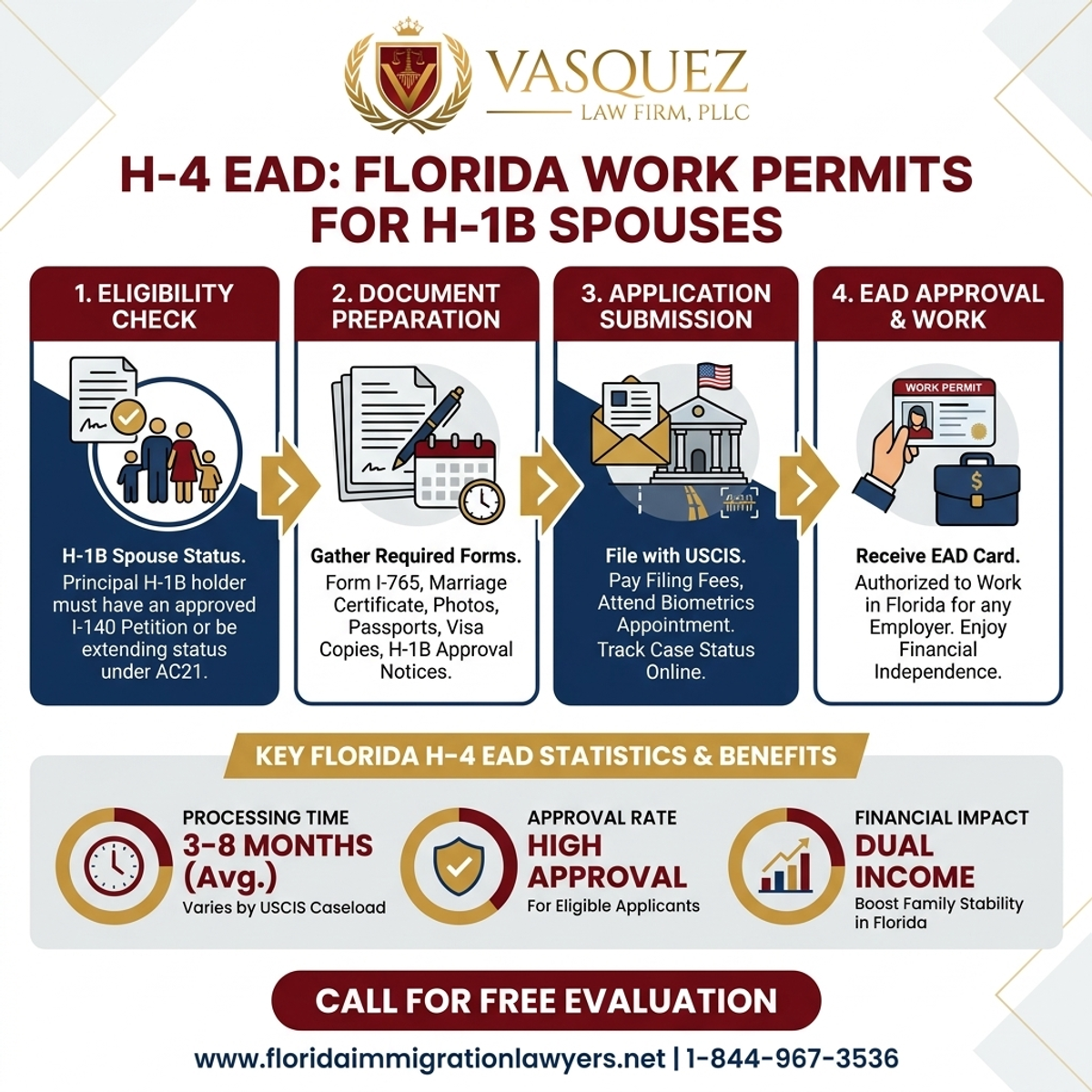
Key Statistics — H-4 EAD: Florida Work Permits for H-1B Spouses
The legal landscape surrounding H-4 EADs can also shift. For example, there have been past legal challenges to the H-4 EAD rule, and while it has been upheld, vigilance regarding policy changes from the Department of Homeland Security or new legislation from Congress is always prudent. Consulting with an experienced immigration attorney at Florida Immigration Lawyers can provide peace of mind and ensure you are always aware of your options and obligations under the evolving law.
Why is an H-4 EAD so important for H-1B families in Florida?
The H-4 EAD holds immense significance for H-1B families residing in Florida, transcending mere work authorization to impact their overall quality of life, financial stability, and integration into American society. For many professional couples who have relocated to Florida, often to contribute to our state's growing industries in technology, healthcare, or tourism, the ability for both spouses to work is not just a preference, but often a necessity.
Firstly, the H-4 EAD addresses a critical economic need. Living on a single income, particularly in high-cost-of-living areas like South Florida, can be challenging. The H-4 EAD allows families to double their income potential, easing financial burdens, enabling savings for education or homeownership, and providing a stronger economic foundation. This is particularly true in communities like Homestead, where dual incomes can significantly improve living standards and opportunities for children.
Secondly, it empowers H-4 spouses to continue their professional careers and utilize their skills and education. Many H-4 visa holders are highly educated professionals who were forced to put their careers on hold upon arriving in the U.S. The EAD allows them to rejoin the workforce, pursue their professional aspirations, contribute to the U.S. economy, and maintain a sense of personal fulfillment. This contributes to Florida's workforce by bringing in diverse talent and expertise that might otherwise be untapped.
Thirdly, the H-4 EAD fosters greater independence and reduces the psychological strain associated with dependency. The ability to earn an income and contribute to the household finances can significantly improve mental well-being and marital harmony. It allows H-4 spouses to build their own professional networks and integrate more fully into their Florida communities, moving beyond the isolation that can sometimes accompany dependent visa status. This aspect is particularly vital for immigrant communities seeking to build a stable and prosperous life in the U.S.
Common Mistakes to Avoid in Your H-4 EAD Application
Applying for an H-4 EAD can be complex, and even minor errors can lead to significant delays or denials. Being aware of these common pitfalls can help H-1B families in Florida avoid unnecessary stress and ensure a smoother application process.
-
Failing to Meet Eligibility Criteria: A common mistake is applying without ensuring the H-1B principal has an approved I-140 or an H-1B extension under AC21. Consequences: Automatic denial of the EAD application.
-
Submitting an Incomplete Form I-765: Omitting required information or failing to sign the form. Consequences: USCIS will reject the application, requiring you to resubmit and restart the processing clock.
-
Incorrect Filing Fee: Sending an outdated fee amount or an incorrect payment method. Consequences: Application rejection, leading to delays and the need to resubmit.
-
Expired H-4 Status or I-94: Applying for an EAD when your H-4 status has expired or is about to expire without concurrently filing Form I-539. Consequences: Potential denial and risk of accumulating unlawful presence.
-
Not Filing Concurrently with H-4 Extension: If your H-4 status needs to be extended, filing the I-765 without also filing Form I-539. Consequences: The EAD will only be valid for the duration of your current H-4 status, or denied if H-4 expires before EAD approval.
-
Missing or Incorrect Supporting Documents: Forgetting to include copies of the H-1B principal's I-140 approval, marriage certificate, or passport photos. Consequences: Request for Evidence (RFE), significantly extending processing times.
-
Incorrect Eligibility Category: Entering the wrong code in Part 2, Item 27 of Form I-765 (should be (c)(26) for H-4 EAD). Consequences: Application rejection or denial.
-
Not Attending Biometrics Appointment: Failing to appear for a scheduled biometrics appointment. Consequences: Application abandonment or denial, requiring a new application and fees.
-
Applying Too Late for Renewal: Waiting until your current H-4 EAD is about to expire to file for renewal. Consequences: Gaps in employment authorization, potentially leading to job loss or inability to work.
-
Ignoring Changes in H-1B Principal's Status: Not updating your H-4 EAD application if the H-1B principal changes employers or their I-140 is revoked. Consequences: Your EAD may become invalid, leading to unauthorized employment.
When to Call a Florida Immigration Lawyer for Your H-4 EAD
While this guide provides comprehensive information, the H-4 EAD process can still present unique challenges that are best handled by experienced legal professionals. At Florida Immigration Lawyers, we understand the nuances of immigration law and are committed to helping H-1B families in Homestead, Miami, and across Florida navigate these complexities successfully. You should consider contacting an attorney in the following situations:
- Complex Eligibility Questions: If you are unsure whether you meet the H-4 EAD eligibility criteria, especially concerning the H-1B principal's I-140 status or AC21 extensions.
- Previous Denials or RFEs: If your H-4 EAD application has been denied in the past or you have received a Request for Evidence (RFE) from USCIS.
- Concurrent Filings: When filing Form I-765 concurrently with Form I-539 (H-4 extension) and potentially an H-1B extension. These intertwined applications require careful coordination.
- Maintaining Status: If you or your H-1B spouse have had any changes in status, employment, or if there are concerns about maintaining lawful status.
- Expedited Processing Needs: While premium processing isn't available for H-4 EAD, an attorney can advise on potential strategies or advocate for your case if there are extreme circumstances.
- Appeals or Motions to Reopen: If your application has been denied and you believe the decision was incorrect or new evidence is available.
- Desire for Peace of Mind: Even if your case seems straightforward, having an expert review your application can prevent costly mistakes and provide confidence.
Our team at Florida Immigration Lawyers is well-versed in H-4 EAD regulations and can provide the strategic advice and diligent representation you need. We serve clients throughout Florida, ensuring that your application is prepared meticulously and submitted correctly.
About Florida Immigration Lawyers
Florida Immigration Lawyers is a leading immigration law firm dedicated to serving individuals and families across the entire state of Florida. With a deep understanding of U.S. immigration laws and policies, our experienced attorneys provide compassionate and effective legal representation for a wide range of immigration matters. From H-4 EAD applications and family-based petitions to complex asylum cases and deportation defense, we are committed to achieving the best possible outcomes for our clients.
We pride ourselves on our client-centered approach, offering personalized attention and strategic advice tailored to your unique situation. Our firm handles various practice areas, including family immigration, business immigration, citizenship, and more. We understand the profound impact immigration decisions have on your life and future. That's why we are available 24/7 to answer your questions and offer free consultations. Choose Florida Immigration Lawyers for dedicated advocacy and a steadfast commitment to your immigration success.
Contact us today at 1-844-967-3536 or visit our website at https://www.floridaimmigrationlawyers.net to learn how we can assist you.
Sources and References
- U.S. Citizenship and Immigration Services (USCIS) - H-4 and L-2 Employment Authorization
- USCIS Policy Manual - Volume 7, Part B, Chapter 3 (H-4 EAD Eligibility)
- 8 U.S.C. § 1101 et seq. - Immigration and Nationality Act (INA)
- 8 CFR § 274a.12(c)(26) - Classes of aliens authorized to work (H-4 EAD)
- Executive Office for Immigration Review (EOIR)
Related services: family petition process, family-based green cards, fiancé visa (K-1), marriage-based immigration.
This article provides general legal information and is not intended as legal advice. Every case is unique, and outcomes depend on specific facts and circumstances. Contact an attorney for advice about your particular situation.
Securing an H-4 EAD is a pivotal step for many H-1B families in Florida, offering both economic relief and professional fulfillment. Do not let the complexities of immigration law prevent you from achieving your goals. Our dedicated team at Florida Immigration Lawyers is here to provide the expert guidance you need throughout this process. Call us now at 1-844-967-3536 for a free, confidential consultation. Se Habla Español - Estamos aquí para ayudarle.
Do Not Navigate This Process Alone
Our experienced immigration attorneys are ready to fight for you. Get a free, confidential consultation today.
Se Habla Español
Or leave your details and we’ll call you:
Free Evaluation in 24 Hours
Or talk to us right now

AI voice assistant — available 24/7
FreeFrequently Asked Questions

William J. Vásquez
Founding Attorney · Vasquez Law Firm
U.S. Air Force veteran and immigration attorney with years of hands-on U.S. immigration experience. J.D., NCCU School of Law. AILA member. Admitted to the 4th, 5th, and 11th Circuit Courts.
Available 24/7 - Free Evaluations
Reviewed for legal accuracy by William J. Vásquez
Licensed in North Carolina; U.S. immigration is federal practice.
Related Legal Services
Our Florida immigration attorneys can help you with deportation defense, citizenship and naturalization and family immigration services. Call today at 1-844-967-3536 for a free consultation.
Related Links
Related Topics
Free Legal Consultation
Discuss your case with our experienced attorneys. We're available 24/7.
Se Habla Español - Estamos aquí para ayudarle.
Related Articles
Fiance Visa Lawyer: K-1 Process Guide for Florida 2026
Uniting with your foreign national fiance in Florida through the K-1 visa involves intricate legal steps, from filing the initial petition to securing permanent residency. This comprehensive guide, tailored for 2026, details the K-1 fiance visa process, including eligibility, required documentation, estimated timelines, and associated costs. Learn about the crucial role a fiance visa lawyer plays in navigating USCIS requirements, preparing for consular interviews, and avoiding common pitfalls that can delay your journey. Whether you reside in Pembroke Pines or elsewhere in Florida, understanding these procedures is vital for a successful outcome. Discover how professional legal assistance can simplify the process, ensuring your application is complete, accurate, and robust. Florida Immigration Lawyers offers expert guidance to help you bring your loved one to the U.S. and build your life together.
I-601 Waiver Lawyer Florida: Comprehensive Guide 2026
For many immigrants in Florida, overcoming grounds of inadmissibility is a critical step towards securing their future in the U.S. An I-601 waiver provides a pathway to address issues like unlawful presence, certain criminal convictions, or immigration fraud. This comprehensive guide, relevant for 2026, explains who needs an I-601 waiver, how to prove "extreme hardship" to a qualifying U.S. citizen or lawful permanent resident relative, and the step-by-step application process. We also cover typical timelines, cost factors, and crucial mistakes to avoid. Florida Immigration Lawyers offers expert guidance for I-601 waiver applications across the state, ensuring you build the strongest possible case and navigate the complex legal requirements effectively. Contact us for a free consultation to discuss your specific situation.
Immigration Lawyer Orlando Free Consultation in 2026
Navigating the complexities of U.S. immigration law requires expert guidance. For those in Orlando and across Florida, a free consultation with an immigration lawyer can provide crucial insights into your legal options without financial commitment. This comprehensive guide from Florida Immigration Lawyers details why an initial consultation is essential, what services immigration attorneys offer, the step-by-step process, typical timelines, and associated costs. We also highlight common mistakes to avoid and when it's critical to seek professional legal assistance. Our firm serves all of Florida, including Naples and Collier County, ensuring accessible, high-quality representation for families, businesses, asylum seekers, and individuals facing deportation. Understand your rights and build a strong case with trusted legal partners.
Stem OPT Immigration Lawyer: 2026 Florida Guide
For F-1 students in Florida, the STEM OPT extension offers a vital 24-month work authorization after their initial OPT. This guide, updated for 2026, covers eligibility, the step-by-step application process, required documents, and critical timelines. Graduates from Florida universities in STEM fields must navigate strict USCIS regulations, including the E-Verify employer requirement. Learn how to avoid common mistakes and when to seek professional legal assistance from a dedicated stem OPT immigration lawyer to ensure a successful application and continued career growth in the U.S. Florida Immigration Lawyers offers expert guidance for students across the state.