J-1 Waiver for Physicians in Florida: Your 2026 Guide
Physicians holding J-1 visas often face a two-year home residency requirement after their program. However, the J-1 waiver, particularly through the Conrad 30 program, offers a critical pathway to remain and practice medicine in the United States, especially in Florida's designated medically underserved areas. This comprehensive guide for 2026 details the requirements, application process, common pitfalls, and how Florida Immigration Lawyers can assist you in navigating this complex immigration journey to secure your future in healthcare.

A J-1 waiver allows foreign medical graduates (FMGs) on a J-1 visa to bypass the two-year home residency requirement (INA §212(e)) and remain in the U.S. to practice medicine. For physicians in Florida, the most common pathway is the Conrad 30 program, which requires a commitment to work in a designated medically underserved area for at least three years. This program is crucial for addressing physician shortages in communities like Jacksonville and rural Florida. As of 2026, the application process involves state sponsorship through the Florida Department of Health and federal approval by USCIS, often leading to an H-1B visa. Seeking legal guidance from Florida Immigration Lawyers is vital for navigating this complex process effectively.
- J-1 waivers exempt physicians from the two-year home residency rule.
- The Conrad 30 program is the primary route for FMGs in Florida.
- Physicians must commit to three years of service in an underserved area.
- The process involves both state and federal agencies.
- Legal assistance is highly recommended for successful applications.
Are you a talented foreign physician on a J-1 visa, passionate about serving patients, but facing the daunting prospect of a two-year home residency requirement? Many international medical graduates dream of contributing their skills to the U.S. healthcare system, especially in states like Florida, which has a significant need for medical professionals in various communities. The J-1 waiver offers a critical pathway to fulfill this dream, allowing you to continue your practice without returning to your home country immediately. Navigating the complexities of immigration law, particularly the Conrad 30 program for physicians in Florida, can be overwhelming. This comprehensive guide for 2026 will demystify the process, from eligibility requirements to application steps, and highlight how Florida Immigration Lawyers can be your trusted partner. Our dedicated team understands the unique challenges faced by FMGs and is committed to helping you secure your future in medicine in the Sunshine State. Call Florida Immigration Lawyers at 1-844-YO-PELEO for a free consultation today.
What is a J-1 Visa Waiver and How Does it Benefit Physicians in Florida?
A J-1 visa waiver is an exemption from the mandatory two-year home residency requirement (212(e)) imposed on certain J-1 exchange visitors, including foreign medical graduates (FMGs). This requirement, stipulated under the Immigration and Nationality Act (INA) Section 212(e), mandates that J-1 visa holders return to their home country for two years before they can change their visa status or apply for an immigrant visa. For physicians, this often means a significant disruption to their medical training or career progression in the U.S. The waiver allows these physicians to bypass this requirement, enabling them to apply for an H-1B temporary worker visa or even permanent residency, provided they meet specific criteria.
For physicians seeking to practice in Florida, the most common and beneficial type of J-1 waiver is the Conrad 30 program. This program permits each state's Department of Health to recommend up to 30 FMGs for a J-1 waiver each fiscal year. The primary benefit of this program is its focus on addressing physician shortages in designated Medically Underserved Areas (MUAs) or Health Professional Shortage Areas (HPSAs). Florida, with its diverse and growing population, has numerous such areas, particularly in rural counties and specific urban neighborhoods, including parts of Jacksonville. By committing to work for at least three years in one of these underserved locations, physicians not only fulfill their waiver obligation but also provide invaluable healthcare services to communities that desperately need them. This creates a win-win scenario, allowing FMGs to continue their careers in the U.S. while simultaneously improving access to quality medical care for Floridians.
Am I Eligible for a J-1 Waiver Through the Conrad 30 Program in 2026?
To be eligible for a J-1 waiver through the Conrad 30 program in 2026, you must generally meet several key criteria. First, you must be a foreign medical graduate currently holding a J-1 visa and subject to the two-year home residency requirement. You must have completed or be in the final year of your medical residency or fellowship. Your medical specialty must be in demand within Florida's underserved areas, which typically includes primary care fields like internal medicine, family medicine, pediatrics, obstetrics/gynecology, and psychiatry, though other specialties may be considered based on specific state needs.
Crucially, you must secure a full-time employment contract for at least three years with a healthcare facility located in a federally designated Medically Underserved Area (MUA), Medically Underserved Population (MUP), or Health Professional Shortage Area (HPSA) within Florida. This facility must demonstrate a genuine need for your services and attest that it serves patients regardless of their ability to pay. The Florida Department of Health (DOH) is responsible for reviewing and recommending eligible physicians for Conrad 30 waivers. They carefully assess each application, considering the physician's qualifications, the healthcare facility's needs, and the impact on the local community. It is essential to understand that Florida receives far more applicants than its 30 annual slots, making the application highly competitive. Strong applications often highlight a long-term commitment to serving Florida's diverse population, including areas like rural Collier County or specific HPSAs within larger cities such as Orlando or Jacksonville. As of 2026, the Florida DOH prioritizes applications that demonstrate the greatest impact on patient care in critical shortage areas. You cannot have received a “No Objection” statement from your home country, as this is another waiver category and generally incompatible with the Conrad 30 program.
Navigating the J-1 Waiver Physician Application Process in Florida: A Step-by-Step Guide
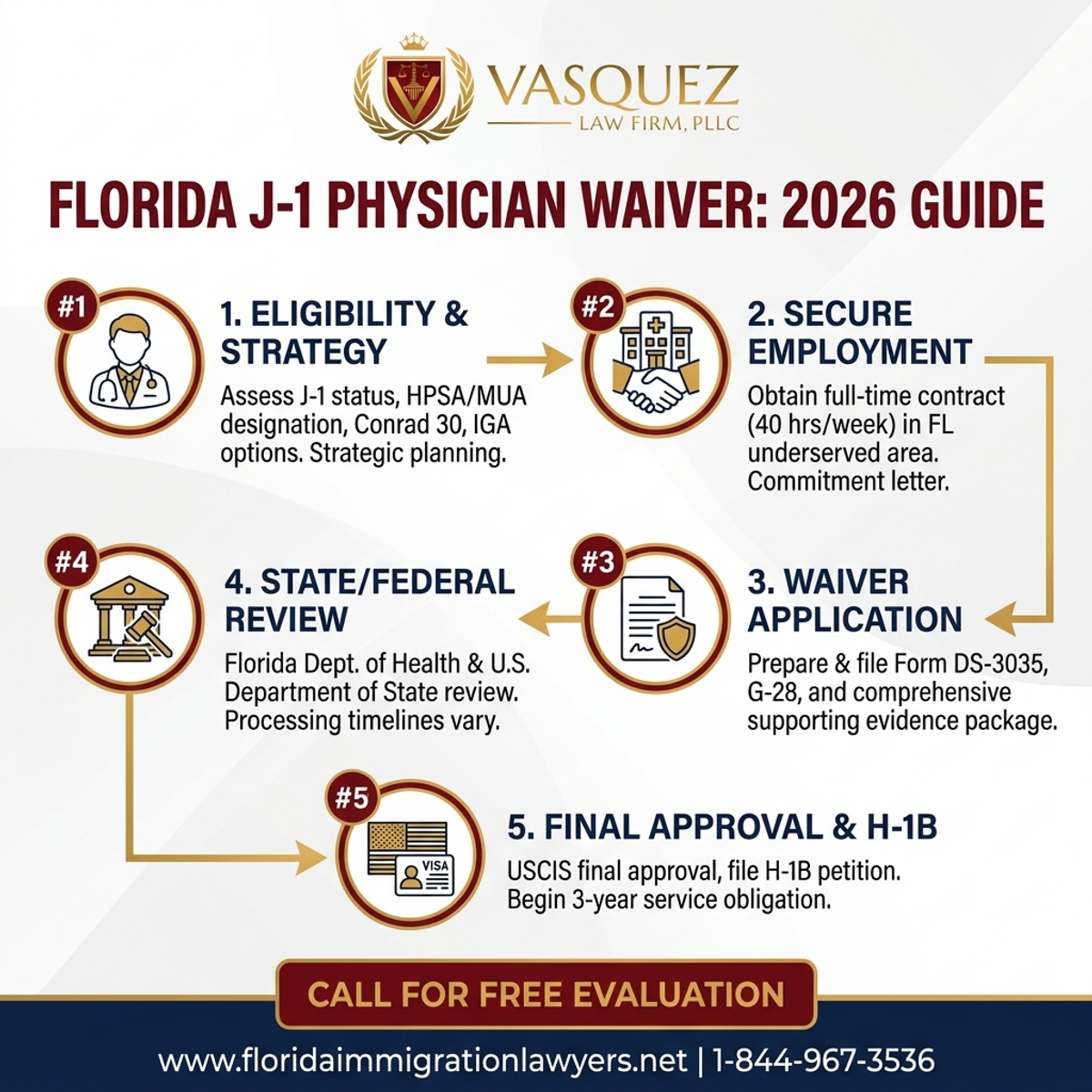
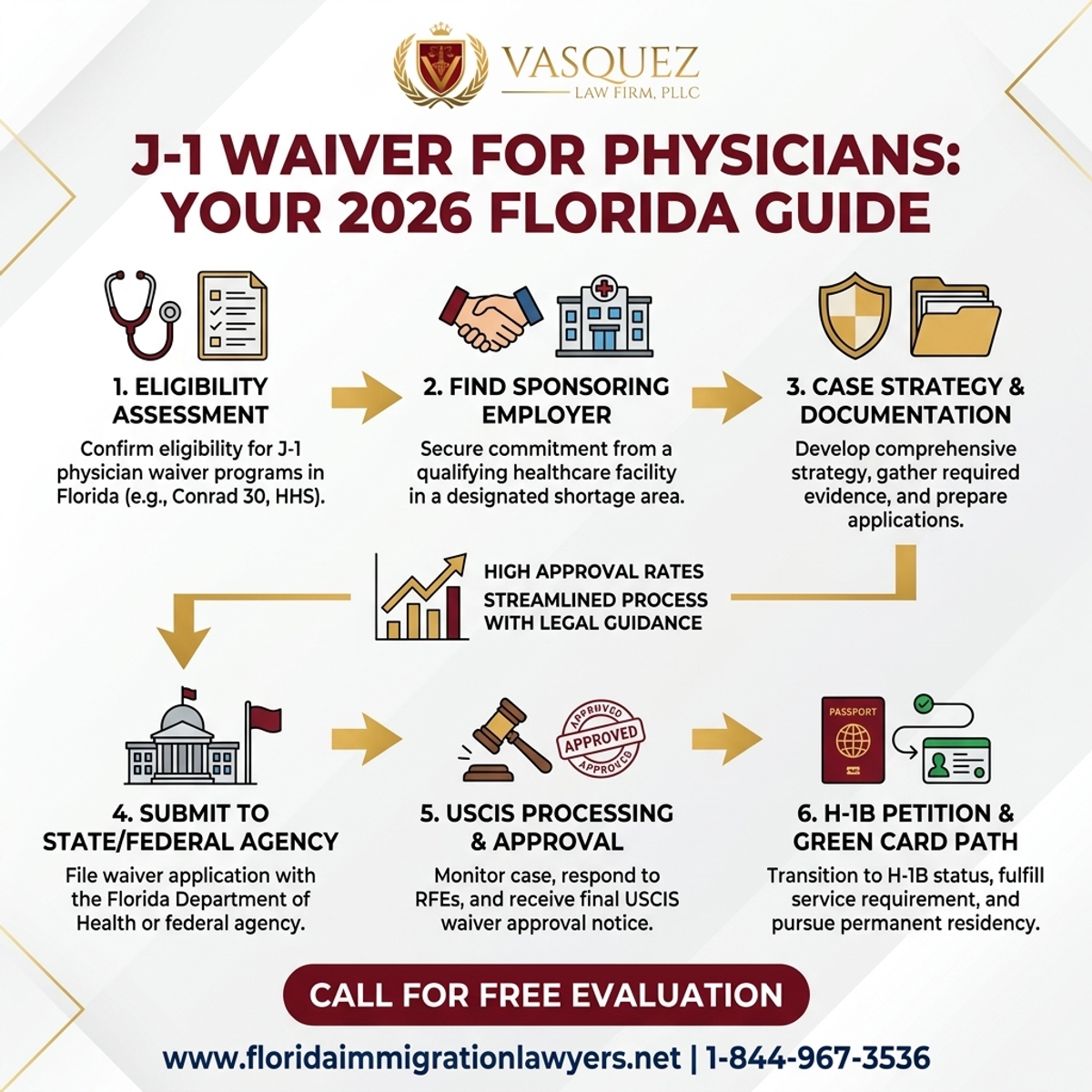
The J-1 waiver application process for physicians in Florida is a multi-stage journey involving both state and federal agencies. Meticulous preparation and adherence to deadlines are paramount for success. As of 2026, here's a general step-by-step guide:
- Secure a Job Offer in an Underserved Area: Your first critical step is to obtain a full-time employment contract (minimum three years) from a healthcare facility located in a federally designated Medically Underserved Area (MUA) or Health Professional Shortage Area (HPSA) in Florida. This contract must specify your salary, duties, and commitment to the underserved community. Facilities in areas like Jacksonville's urban core or rural Hendry County often seek J-1 waiver physicians.
- Apply to the Florida Department of Health (DOH): Once you have a qualifying job offer, you will submit a comprehensive application to the Florida DOH's J-1 Waiver Program. This package typically includes your employment contract, a letter from the facility detailing its need, evidence of your medical qualifications (ECFMG certificate, licenses), and personal statements. The Florida DOH reviews these applications and, if approved, issues a favorable recommendation to the U.S. Department of State.
- Submit J-1 Waiver Application to the Department of State (DOS): After receiving the Florida DOH's recommendation, you must then apply to the U.S. Department of State (DOS) using Form DS-3035, the J-1 Visa Waiver Recommendation Application. You will also need to send supporting documents, including your Statement of Reason, and copies of your visa, passport, and I-94. The DOS reviews all waiver applications and forwards its recommendation to USCIS.
- File Form I-612 with USCIS: The final step in the waiver process is filing Form I-612, Application for Waiver of the Foreign Residence Requirement, with U.S. Citizenship and Immigration Services (USCIS). This form is typically filed after the DOS has sent its favorable recommendation. USCIS will then make the final decision on your J-1 waiver.
- File H-1B Petition (Concurrent or Subsequent): Once your J-1 waiver is approved, you can then apply for an H-1B nonimmigrant visa. Many physicians choose to file their H-1B petition concurrently with the I-612 waiver application, especially if their J-1 status is expiring soon. The H-1B allows you to work legally for your sponsoring employer in the underserved area.
Required Documents for Your J-1 Waiver Application
A robust application packet is essential for both state and federal reviews. While specific requirements may vary slightly, generally you will need:
Step-by-Step Process — J-1 Waiver for Physicians in Florida: Your 2026 Guide
- A copy of your J-1 visa, passport, and I-94 arrival/departure record.
- Copies of all DS-2019 Forms (Certificate of Eligibility for Exchange Visitor Status).
- Educational Commission for Foreign Medical Graduates (ECFMG) Certificate.
- Medical license(s) in Florida or proof of eligibility.
- A signed, three-year full-time employment contract with a qualifying healthcare facility.
- A letter from the healthcare facility detailing the need for your services, patient population served, and commitment to serving all patients.
- Personal statement outlining your commitment to serving the underserved community.
- Curriculum Vitae (CV) and letters of recommendation.
- Completed Form DS-3035 and I-612, along with all required filing fees.
- Form G-28, Notice of Entry of Appearance as Attorney or Accredited Representative, if you are represented by an attorney.
What are the Typical Timelines and Costs for a J-1 Waiver Physician Application in Florida?
Understanding the timelines and associated costs for a J-1 waiver physician application in Florida is crucial for effective planning. As of 2026, the entire process can take a significant amount of time, typically ranging from 12 to 18 months or even longer, depending on various factors including the responsiveness of state agencies, the Department of State, and USCIS caseloads. It is important to begin the process well in advance of your J-1 visa expiration date.
Typical J-1 Waiver Application Timelines (As of 2026)
| Stage | Typical Timeframe | Notes |
|---|---|---|
| Florida DOH Application Review | 2-4 months | Highly competitive; state board meets periodically. Florida typically opens its application window annually, often in the fall, with deadlines in early spring. |
| DOS Recommendation Processing | 4-8 months | After Florida DOH recommendation, DOS reviews the request and sends its recommendation to USCIS. |
| USCIS I-612 Adjudication | 4-6 months | USCIS makes the final decision. Processing times can vary by service center. |
| H-1B Petition Filing & Approval | 3-9 months (regular) / 15 days (premium) | Filed concurrently or after I-612 approval. Subject to H-1B cap if applicable. Premium processing is available for an additional fee. |
| Total Estimated Time | 12-18+ months | This overall timeframe is an estimate and can fluctuate based on government processing times and individual case complexities. |
In addition to time, there are several costs associated with the J-1 waiver and subsequent H-1B application. It is important to note that government filing fees are subject to change and should always be verified on the official USCIS and Department of State websites. As of 2026, employers typically bear the majority of the H-1B filing fees, but physicians may be responsible for certain legal fees or premium processing costs.
Estimated J-1 Waiver & H-1B Application Costs (As of 2026)
| Item | Typical Fee (USD) | Notes |
|---|---|---|
| DOS J-1 Waiver Application (DS-3035) | No direct fee | Processing is part of the overall application. |
| USCIS Form I-612 Fee | Varies, check USCIS website | This fee is paid directly to USCIS when filing the I-612. |
| USCIS Form I-129 Fee (H-1B Petition) | Varies, check USCIS website | Paid by the employer. Several additional fees apply for H-1B, including ACWIA fee, fraud prevention and detection fee, and public law fee. |
| H-1B Premium Processing (optional) | Varies, check USCIS website | Expedites USCIS processing for I-129 to 15 calendar days. |
| Legal Fees | $5,000 - $10,000+ | Can vary widely based on attorney experience and case complexity. Covers preparation, filing, and communication with agencies. |
These figures are estimates for 2026 and are subject to change. It is crucial to consult with an immigration attorney to get the most current fee information and a personalized cost assessment for your specific case.
Do not navigate this process alone. The complexities of J-1 waivers, especially for physicians in Florida, require seasoned legal expertise. Contact Florida Immigration Lawyers today at 1-844-YO-PELEO for a free consultation to discuss your specific situation and how we can assist you.
Challenges and Considerations for J-1 Waiver Physicians in Florida
While the J-1 waiver program offers a vital path for FMGs, it comes with its own set of challenges and important considerations, particularly within Florida's competitive landscape. One significant challenge is the intense competition for the Conrad 30 slots. With only 30 recommendations available annually for the entire state of Florida, many highly qualified physicians apply, making successful selection highly competitive. The Florida Department of Health often receives hundreds of applications each year, meaning careful preparation and a compelling application are essential to stand out.
Another critical consideration is the strict adherence to the three-year service commitment in the designated underserved area. Physicians must remain employed in the specified MUA/HPSA for the entire duration. Any breach of this contract, such as early termination or relocation to a non-underserved area, can lead to severe immigration consequences, potentially triggering the two-year home residency requirement again and jeopardizing future immigration benefits. It's also important to understand the employer's commitment; the sponsoring facility must genuinely need a physician and be prepared to support the H-1B petition. Ensuring the employment contract is robust and clearly outlines all terms and conditions, including potential issues like facility mergers or changes in ownership, is vital. Furthermore, while the J-1 waiver allows for an H-1B, it does not immediately lead to permanent residency. Physicians will need to pursue a separate green card application, often through an employment-based petition (e.g., EB-2 with a National Interest Waiver or EB-3), which also has its own set of requirements and processing times.
Key Statistics — J-1 Waiver for Physicians in Florida: Your 2026 Guide
Finally, recent immigration policy changes, while not directly targeting J-1 waivers, can create an atmosphere of uncertainty. For instance, discussions around broader immigration reform or changes in visa processing can indirectly affect timelines or scrutiny levels. Staying informed through reliable legal counsel is paramount. For example, while the news about undocumented student bans or asylum decisions (like those referenced in recent news) may not directly impact J-1 waivers, they highlight the dynamic nature of U.S. immigration law and the importance of having an expert advocate on your side. Working with experienced Florida immigration lawyers can help mitigate these risks and ensure compliance throughout your journey.
Common Mistakes J-1 Waiver Physicians Should Avoid
Navigating the J-1 waiver process is complex, and even minor errors can lead to significant delays or outright denial. Here are common mistakes physicians should strive to avoid:
- Failing to Verify Underserved Area Designation: Assuming a location is underserved without official verification can be a critical error. Always confirm the MUA/HPSA status of your prospective employer's location using official HRSA tools. An incorrect designation will lead to immediate rejection by the Florida DOH.
- Submitting an Incomplete or Inaccurate Application: Missing documents, unsigned forms, or inconsistent information can cause substantial delays. The Florida DOH and USCIS require meticulous attention to detail. Double-check every item against the official checklists.
- Missing Application Deadlines: The Florida Conrad 30 program has specific application windows and strict deadlines, typically early in the year for the upcoming fiscal year. Missing these deadlines means waiting another year, significantly impacting your career plans.
- Not Having a Strong Employment Contract: A vague or incomplete employment contract can raise red flags. Ensure your contract explicitly states the three-year commitment, full-time employment, salary, and location within the underserved area.
- Applying for a "No Objection" Waiver Concurrently: You generally cannot pursue a Conrad 30 waiver if your home country has already issued a "No Objection" statement. These are distinct waiver categories with different requirements and are often mutually exclusive.
- Failing to Maintain J-1 Status: While your waiver application is pending, you must continue to maintain your lawful J-1 status. Letting your J-1 visa expire or violating its terms can jeopardize your entire waiver application.
- Prematurely Leaving the Sponsoring Employer: The three-year service commitment is legally binding. Leaving your employer before fulfilling this commitment without a new, approved waiver position can trigger the two-year home residency requirement and lead to serious immigration consequences.
- Underestimating Competition: Florida's 30 slots are highly sought after. Physicians who submit generic applications without highlighting their unique qualifications, commitment to Florida's specific needs, or the dire necessity of their services in the proposed location often face disappointment.
- Ignoring the Need for an H-1B Visa: A J-1 waiver only waives the two-year requirement; it does not grant work authorization. You must secure an H-1B visa (or another appropriate work visa) to legally work after your J-1 status concludes and your waiver is approved.
- Not Seeking Legal Counsel: Attempting to navigate the complex J-1 waiver process, including state-specific requirements, federal forms, and potential H-1B transition, without experienced legal guidance is a common and often costly mistake. An attorney can prevent errors and advocate on your behalf.
When to Call a Lawyer for Your J-1 Waiver Physician Case in Florida
The J-1 waiver process, especially for physicians seeking placement in Florida's underserved areas, is intricate and fraught with potential pitfalls. While this guide provides general information, every case has unique facts and circumstances that demand personalized legal attention. You should contact an experienced immigration lawyer at Florida Immigration Lawyers if you encounter any of the following scenarios or red flags:
- You are unsure about your eligibility for the Conrad 30 program or need help identifying qualifying underserved areas in Florida, such as those in Jacksonville or rural counties.
- You have received a job offer but need assistance reviewing the employment contract to ensure it meets all J-1 waiver and H-1B requirements.
- Your J-1 visa is approaching its expiration date, and you need to expedite the waiver and H-1B process to avoid lapses in status.
- You have a complex immigration history, such as previous visa denials, out-of-status periods, or unique family circumstances.
- You need to transfer your J-1 waiver to a new employer within the three-year commitment period and require guidance on the proper procedures.
- You have received a Request for Evidence (RFE) from USCIS or a denial from the Florida DOH or Department of State.
- You simply want peace of mind knowing that your application is meticulously prepared, correctly filed, and strategically presented to maximize your chances of success.
Florida Immigration Lawyers has extensive experience assisting physicians throughout Florida with their J-1 waiver and H-1B petitions. We understand the nuances of the Florida Department of Health's requirements and the federal immigration system. Our attorneys provide comprehensive support, from initial eligibility assessment and document preparation to responding to RFEs and advocating for your case. Don't leave your medical career and future in the U.S. to chance. We are here to help you navigate this complex journey.
About Florida Immigration Lawyers
Florida Immigration Lawyers is an immigration law firm dedicated to serving individuals and families across the entire state of Florida. With a deep understanding of U.S. immigration laws and a passion for helping our clients achieve their American dreams, we offer comprehensive legal services tailored to your unique needs. Our experienced attorneys focus on a wide range of immigration matters, including J-1 waivers for physicians, asylum, deportation defense, family immigration, business immigration, and citizenship applications. We pride ourselves on providing compassionate, client-focused representation, ensuring that you receive personalized attention and strategic guidance at every step of your immigration journey. We are available 24/7 for your convenience and offer free consultations to discuss your case. Choose Florida Immigration Lawyers for trusted legal advocacy and a commitment to your success.
Sources and References
- U.S. Citizenship and Immigration Services (USCIS) - J-1 Waiver for Physicians
- U.S. Department of State (DOS) - J-1 Waivers
- 8 U.S.C. § 1182(e) - Immigration and Nationality Act (INA) Section 212(e)
- 22 CFR § 41.63 - Regulations pertaining to J-1 exchange visitors and waivers.
- Health Resources and Services Administration (HRSA) - Find Shortage Areas
- Florida Department of Health, J-1 Visa Waiver Program (Conrad 30 Program) - (Specific link varies by year, often found under 'Physician Workforce' or 'Rural Health' sections on FloridaHealth.gov)
Related services: immigration practice areas, family immigration services.
This article provides general legal information and is not intended as legal advice. Every case is unique, and outcomes depend on specific facts and circumstances. Contact an attorney for advice about your particular situation. Immigration laws are subject to change.
Your medical career in Florida awaits. Don't let the complexities of immigration law stand in your way. Florida Immigration Lawyers is here to provide the guidance and support you need to secure your J-1 waiver and build a thriving practice in an underserved community. Contact us today at 1-844-YO-PELEO for a free consultation and take the first step towards a successful future. Se Habla Español - Estamos aqui para ayudarle.
If you need legal assistance, learn more about our immigration legal services, or call us at 1-844-YO-PELEO for a free consultation.
Do Not Navigate This Process Alone
Our experienced immigration attorneys are ready to fight for you. Get a free, confidential case review today.
Se Habla Español
Or leave your details and we’ll call you:
Free Evaluation in 24 Hours
Or talk to us right now
AI voice assistant — available 24/7
FreeFrequently Asked Questions

William J. Vásquez
Founding Attorney · Vasquez Law Firm
U.S. Air Force veteran and immigration attorney with years of hands-on U.S. immigration experience. J.D., NCCU School of Law. AILA member. Admitted to the 4th, 5th, and 11th Circuit Courts.
Available 24/7 - Free Evaluations
Reviewed for legal accuracy by William J. Vásquez
Licensed in North Carolina; U.S. immigration is federal practice.
Related Legal Services
Our Florida immigration attorneys can help you with immigration practice areas, free immigration consultation and business immigration. Call today at 1-844-YO-PELEO for a free case review.
Related Links
Related Topics
Free Legal Case Review
Discuss your case with our experienced attorneys. We're available 24/7.
Se Habla Español - Estamos aquí para ayudarle.
Related Articles
EAD Advance Parole Combo Card in Florida: What You Need
An EAD advance parole combo card allows individuals with pending adjustment applications to both work and travel abroad without jeopardizing their green card application. Learn how to apply in Florida, what documents you need, and common mistakes to avoid.
PERM Labor Certification in Florida: A 2026 Guide
Learn all about the PERM labor certification process in Florida, essential for employers sponsoring green card applicants. Understand the steps, document requirements, and common mistakes to avoid in this 2026 guide.
Dual Citizenship Lawyer in Florida: What You Need to Know
For Florida residents, the concept of dual citizenship, or holding two passports, offers a compelling blend of opportunities and challenges. While the U.S. generally permits dual nationality, the path to achieving this status requires a meticulous understanding of both U.S. immigration laws and the citizenship policies of your country of origin. This guide explores the definition of dual citizenship, the detailed step-by-step process for U.S. naturalization, and the significant benefits and potential pitfalls involved. We cover essential documentation, typical timelines, and cost considerations for 2026, providing crucial insights for anyone in Orlando, Miami, or across Florida considering this important legal step. Learn about common mistakes to avoid and understand when to seek professional legal counsel to navigate this complex process successfully. Florida Immigration Lawyers is here to provide expert, bilingual support for your dual citizenship journey.
Immigration Lawyer Orlando Free Consultation in Florida
For individuals and families in Orlando, Florida, navigating the complexities of U.S. immigration law requires expert guidance. An immigration lawyer in Orlando offers crucial support for everything from visa applications and green card processes to naturalization and deportation defense. This comprehensive guide details what a free consultation covers, providing a step-by-step overview of immigration pathways, essential document checklists, and expected timelines in 2026. We also highlight common mistakes to avoid, discuss the critical role of legal counsel in deportation and asylum cases, and explain why choosing a local Orlando immigration attorney is beneficial. Florida Immigration Lawyers is dedicated to serving the diverse community of Orlando with compassionate, effective legal solutions, ensuring you receive personalized advice and robust representation for a successful immigration journey.