H-2A Visa for Florida Growers: Guide for Agricultural Workers
The H-2A visa program is vital for Florida's agricultural industry, enabling growers to address seasonal labor shortages by bringing in temporary agricultural workers. This comprehensive guide, updated for 2026, details the H-2A requirements for both employers and workers, outlining the application process, associated costs, and critical deadlines. Learn about worker protections, common mistakes to avoid, and the significant economic impact of H-2A workers on Florida's farms. Florida Immigration Lawyers offers expert guidance to ensure compliance and a smooth process for all parties, supporting Kissimmee and other agricultural communities throughout the state. Contact us for a free consultation to navigate this complex immigration pathway.

The H-2A visa program allows U.S. employers, particularly Florida growers, to bring foreign nationals to the United States for temporary agricultural work. This nonimmigrant visa addresses seasonal or temporary labor shortages when there are not enough U.S. workers available. Employers must meet specific requirements, including demonstrating a temporary need and offering fair wages and working conditions. For agricultural workers, it provides a crucial pathway to legal employment in Florida's vital farming industry, supporting families and contributing significantly to the state's economy. Understanding the detailed process and legal obligations is essential for both employers and prospective workers seeking this opportunity.
- H-2A visas address seasonal agricultural labor shortages in Florida.
- Employers must prove temporary need and offer U.S. standard wages.
- Workers gain legal employment for specific agricultural tasks.
- The process involves Department of Labor and USCIS approvals.
- Legal guidance is crucial for successful H-2A applications.
H-2A Visa for Florida Growers: A Comprehensive Guide for Agricultural Workers
Florida's vibrant agricultural sector, from its sprawling citrus groves to its vast vegetable fields, relies heavily on a dedicated workforce. Each season, growers across the state, including those in and around Kissimmee, face the critical challenge of securing enough labor to cultivate and harvest their crops. This is where the H-2A visa program becomes an indispensable tool, connecting Florida farmers with temporary agricultural workers from abroad.
Understanding the H-2A visa is vital for both employers seeking to fill labor gaps and for foreign nationals looking for temporary agricultural employment in the Sunshine State. This comprehensive guide, updated for 2026, will demystify the H-2A visa process, outlining its requirements, benefits, and potential challenges. We will provide a step-by-step application guide, detail associated costs, and highlight common pitfalls to avoid. Our goal is to equip you with the knowledge needed to navigate this complex immigration pathway successfully.
Whether you are a Florida grower struggling with labor shortages or an agricultural worker aspiring to contribute to Florida's economy, this article offers critical insights. The H-2A program ensures fairness and legal compliance, protecting both employers and employees. Do not navigate this intricate process alone; expert legal guidance can make all the difference. For personalized assistance with your H-2A visa application or any immigration matter, call Florida Immigration Lawyers at 1-844-967-3536 for a free consultation today.
Understanding the H-2A Temporary Agricultural Worker Program in Florida
The H-2A visa program is a nonimmigrant visa category specifically designed to allow U.S. employers to bring foreign nationals to the United States to fill temporary agricultural jobs. This program is critical for Florida's agricultural industry, which often experiences labor shortages during peak planting and harvesting seasons. The primary goal is to provide a legal and regulated pathway for employers to access necessary labor when domestic workers are unavailable.
As of 2026, the H-2A program continues to play a pivotal role in sustaining Florida's diverse agricultural output, including citrus, tomatoes, sugarcane, and berries. Employers in regions like Kissimmee, Orlando, and throughout South Florida frequently utilize this program to ensure their farms operate efficiently. The program mandates strict protections for H-2A workers, ensuring they receive fair wages, housing, and transportation, aligning with U.S. labor standards. These protections are vital for maintaining a just and equitable work environment.
The legal framework for the H-2A visa is primarily found in the Immigration and Nationality Act (INA) Section 101(a)(15)(H)(ii)(a) and further regulated by the Department of Labor (DOL) and U.S. Citizenship and Immigration Services (USCIS). Employers must obtain a temporary labor certification from the DOL before petitioning USCIS. This certification confirms that there are not enough U.S. workers for the job and that employing foreign workers will not adversely affect the wages and working conditions of similarly employed U.S. workers.
What are the H-2A visa requirements for agricultural workers in Florida?
The H-2A visa program has strict requirements for both employers and workers to ensure fair labor practices and meet agricultural needs. Employers in Florida must demonstrate a temporary or seasonal need for labor and prove that there are not enough U.S. workers available to perform the work. Workers, in turn, must meet specific eligibility criteria related to their intent to return home and their ability to perform the agricultural work. These requirements are designed to protect all parties involved in the H-2A process.
For employers, securing an H-2A visa involves a multi-step process beginning with the Department of Labor. They must file a Form ETA-9142A, Application for Temporary Employment Certification, proving the temporary nature of the job and advertising the positions to U.S. workers. Employers must also offer wages at or above the Adverse Effect Wage Rate (AEWR) for Florida, provide free housing, and arrange transportation. For workers, the primary requirement is demonstrating an intent to return to their home country upon visa expiration and proving their capability for the agricultural tasks. This ensures the temporary nature of the visa is maintained.
Employer Responsibilities for H-2A Visas
Florida agricultural employers seeking H-2A workers must fulfill several key responsibilities. Firstly, they must offer employment that is truly temporary or seasonal, typically lasting less than one year. They are required to conduct extensive recruitment efforts for U.S. workers, including placing advertisements in local newspapers and with state workforce agencies, to demonstrate a lack of available domestic labor. Furthermore, employers must provide free, safe, and sanitary housing for H-2A workers, along with transportation to and from the worksite. They are also responsible for paying workers the Adverse Effect Wage Rate (AEWR) or the prevailing wage, whichever is higher, for the specific agricultural job in Florida.
Worker Eligibility for H-2A Visas
To be eligible for an H-2A visa, foreign nationals must generally meet several criteria. They must be coming to the U.S. to perform temporary or seasonal agricultural labor for which there are not enough U.S. workers. Crucially, applicants must demonstrate their intent to return to their home country upon the completion of their authorized stay. While prior agricultural experience is often preferred by employers, it is not always a strict legal requirement, though it helps with job placement. Applicants must also possess a valid passport and be admissible to the United States, meaning they must not have any prior immigration violations or criminal history that would render them ineligible for a visa.
How do I apply for an H-2A visa as a Florida agricultural worker?
Applying for an H-2A visa as an agricultural worker in Florida is a multi-stage process primarily initiated by your prospective employer. You cannot directly apply for an H-2A visa on your own; a U.S. employer must petition on your behalf. Once an employer in Florida has secured a Temporary Labor Certification from the Department of Labor (DOL) and filed a Form I-129, Petition for a Nonimmigrant Worker, with U.S. Citizenship and Immigration Services (USCIS) on your behalf, you can then proceed with your individual visa application at a U.S. embassy or consulate abroad. This structured approach ensures compliance with immigration and labor laws.
The employer-driven nature of the H-2A process means your role primarily begins after their petition is approved. You will then attend a visa interview, typically in your home country, where you must prove your eligibility and intent to return. Preparing thoroughly for this interview is essential for a successful outcome. As of 2026, maintaining clear communication with your sponsoring employer and any legal counsel is key to ensuring all required documents are submitted accurately and on time, minimizing delays in your journey to work in Florida's fields.
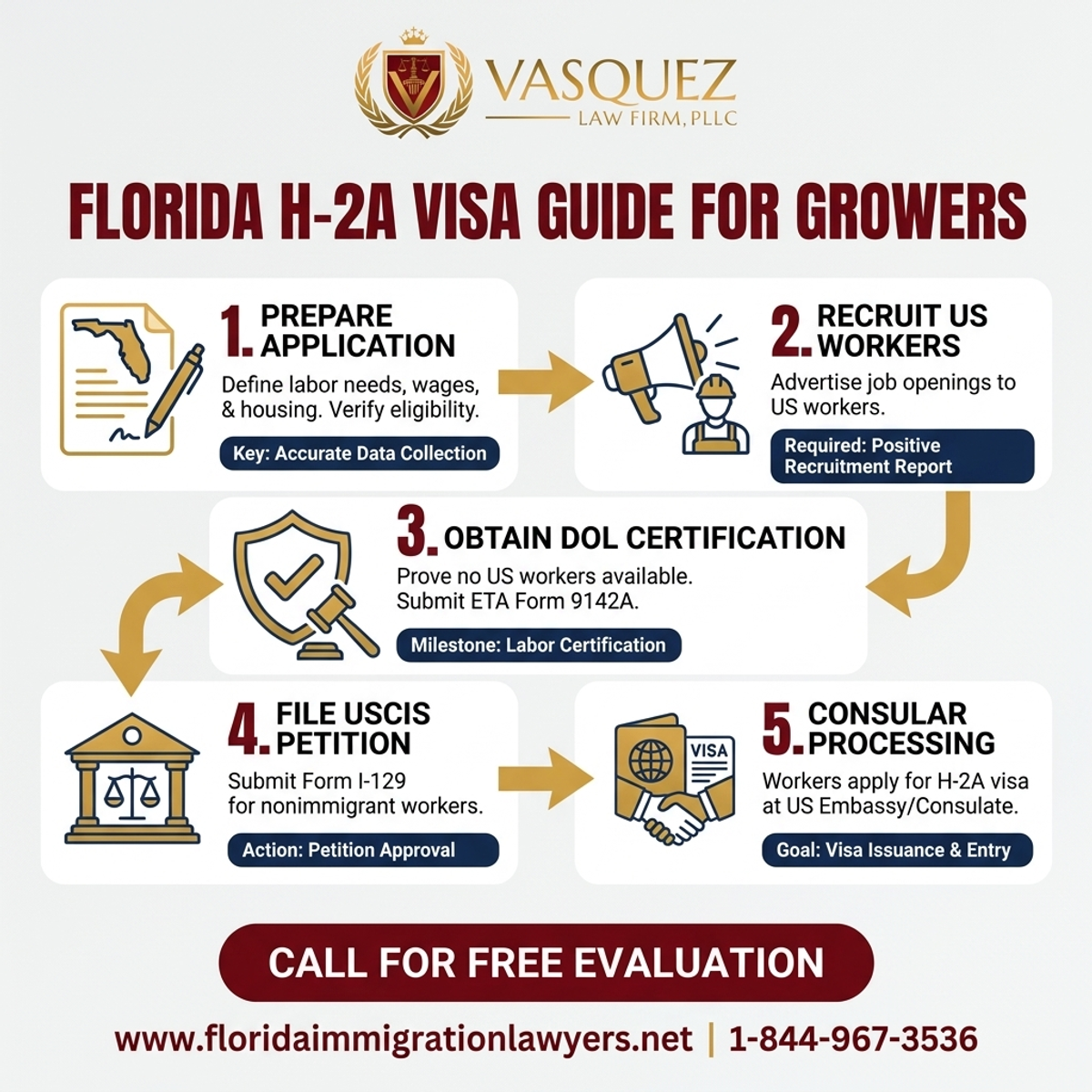
Step-by-Step H-2A Visa Application Process for Workers
- Employer Files for Temporary Labor Certification: Your prospective Florida employer first applies to the Department of Labor (DOL) for a Temporary Labor Certification (TLC) (Form ETA-9142A). This verifies the temporary need for workers and that U.S. workers are unavailable.
- Employer Files Form I-129 Petition: Once the TLC is approved, the employer files Form I-129, Petition for a Nonimmigrant Worker, with U.S. Citizenship and Immigration Services (USCIS). This petition requests H-2A classification for you and other named workers.
- USCIS Approves Petition: USCIS reviews the I-129 petition. If approved, they send an approval notice (Form I-797) to the employer.
- Visa Application at U.S. Embassy/Consulate: You, as the prospective worker, will then apply for the H-2A visa at a U.S. embassy or consulate in your home country. This involves completing Form DS-160, Online Nonimmigrant Visa Application, and scheduling an interview.
- Attend Visa Interview: During the interview, a consular officer will determine your eligibility, intent to return home, and ability to perform the work. You must bring all required documents.
- Visa Issuance and Travel to U.S.: If the interview is successful, your visa will be issued. You can then travel to Florida to begin your agricultural work.
Document Checklist for H-2A Visa Applicants
- Valid passport (must be valid for at least six months beyond your intended period of stay in the U.S.).
- Nonimmigrant Visa Application, Form DS-160 confirmation page.
- Appointment confirmation page for your visa interview.
- One (1) 2x2 inch photograph (meeting U.S. visa photo requirements).
- Receipt for visa application fee payment.
- Original or copy of your Form I-797, Petition Approval Notice (from your employer).
- Letter from your employer confirming your job offer and terms of employment.
- Documents demonstrating your intent to return to your home country (e.g., property deeds, family ties, bank statements).
- Any educational or experience certificates relevant to agricultural work (if applicable).
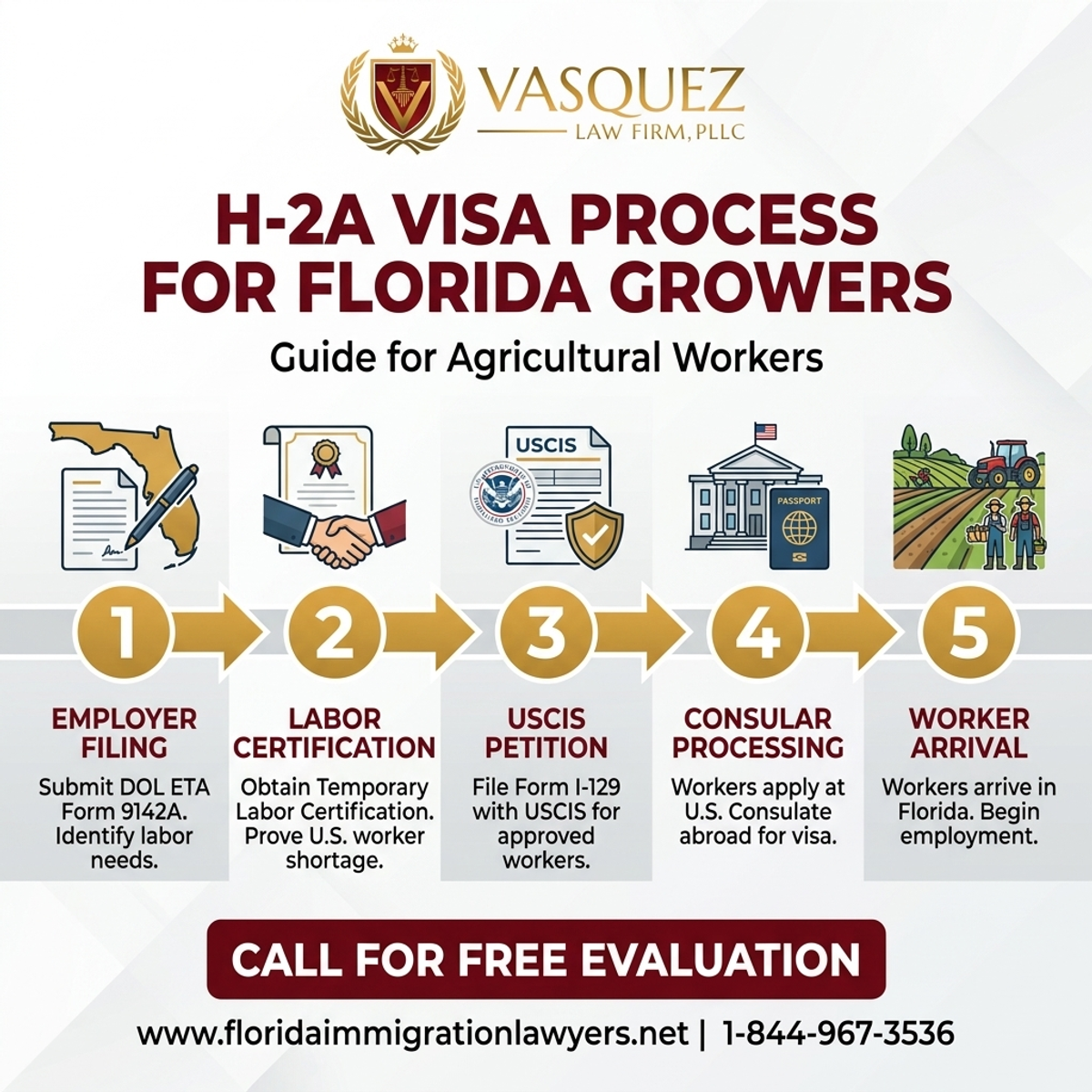
Step-by-Step Process — H-2A Visa for Florida Growers: Guide for Agricultural Workers
Timeline and Processing Expectations (As of 2026)
The H-2A visa process can vary in duration based on several factors, including the time of year, government agency backlogs, and the completeness of the application. Employers should plan well in advance of their labor needs. Workers should be prepared for potential administrative processing delays after their interview.
| Stage | Typical Timeframe | Notes |
|---|---|---|
| DOL Temporary Labor Certification | 45-75 days | Employer's initial step; includes recruitment period. |
| USCIS Form I-129 Processing | 2-5 months | Can be expedited with premium processing for an additional fee. |
| Visa Interview Scheduling | 2-6 weeks | Varies by embassy/consulate capacity and country. |
| Visa Issuance & Administrative Processing | 1-3 weeks | Some cases may require additional security checks. |
| Total End-to-End Process | 5-9 months | Highly variable; early application is always recommended. |
Do not navigate this complex process alone. The success of your H-2A petition, whether you are an employer or a worker, often hinges on precise documentation and adherence to strict deadlines. Contact Florida Immigration Lawyers today at 1-844-967-3536 for experienced legal guidance tailored to your specific situation. Our team is ready to assist you through every step.
What are the costs associated with the H-2A visa process in Florida?
The H-2A visa process involves several fees and costs, primarily borne by the petitioning employer rather than the agricultural worker. These expenses cover government filing fees, recruitment efforts, and other mandatory provisions. Employers in Florida must budget for these costs, which are part of their obligation to ensure fair and legal employment. Workers typically do not pay for these fees, though they may incur minor personal travel expenses to attend their visa interview. Understanding these financial aspects is crucial for planning and compliance.
For employers, the costs include filing fees for both the Department of Labor and USCIS, as well as expenses related to advertising job openings to U.S. workers. Additionally, employers are responsible for providing free housing, inbound and outbound transportation, and covering certain visa-related fees for their H-2A workers. These financial commitments are stipulated by federal regulations, such as 20 CFR Part 655, to protect workers and prevent employers from passing these essential costs onto them. As of 2026, these costs are subject to change, so always verify current fee schedules on official government websites.
H-2A Visa Fee Breakdown (As of 2026, estimates)
It is important to note that government fees can change, and legal fees vary based on the complexity of the case. The following table provides typical fee estimates.
| Item | Typical Fee | Notes |
|---|---|---|
| DOL Temporary Labor Certification | No fee | Employer pays for advertising costs (variable). |
| USCIS Form I-129 Filing Fee | Varies (e.g., $460-$510) | Paid by employer per petition. Check USCIS for current rates. |
| USCIS Premium Processing Fee (Optional) | Approx. $2,805 | Expedites I-129 processing to 15 calendar days. |
| DS-160 Visa Application Fee | Approx. $190 | Generally paid by the employer or reimbursed to the worker. |
| Travel Costs (Worker's home country to Florida) | Variable | Employer must provide or reimburse transportation. |
| Legal Fees for Attorney Assistance | $3,000 - $8,000+ | Highly variable based on complexity and firm. |
Challenges and Protections for H-2A Workers in Florida
While the H-2A program offers significant opportunities for agricultural workers in Florida, it also presents unique challenges. Workers, often arriving from different cultural and linguistic backgrounds, can face difficulties adapting to new environments, understanding their rights, and navigating potential workplace issues. Common challenges include isolation, language barriers, and a lack of awareness regarding legal protections. It is crucial for H-2A workers to understand that they are entitled to specific rights and protections under U.S. law, designed to ensure their safety, fair treatment, and overall well-being during their employment in Florida.
Federal regulations provide robust safeguards for H-2A workers. Employers are legally obligated to provide safe and healthy working conditions, pay the agreed-upon wage, and adhere to specific housing and transportation standards. Workers are protected against discrimination, retaliation, and exploitative practices. If issues arise, workers have the right to report concerns without fear of reprisal. Resources are available through the Department of Labor, worker advocacy groups, and legal aid services. Understanding these protections is the first step toward asserting your rights and seeking redress if necessary while working in Florida's agricultural sector.
Key Statistics — H-2A Visa for Florida Growers: Guide for Agricultural Workers
Worker Rights and Resources
H-2A workers in Florida are guaranteed several fundamental rights. These include the right to receive wages at or above the Adverse Effect Wage Rate, to live in free, safe, and sanitary housing, and to have transportation provided or reimbursed by the employer. They also have the right to a written job contract in a language they understand, outlining the terms and conditions of employment. If workers experience issues such as wage theft, unsafe conditions, or unfair treatment, they can report these to the Department of Labor Wage and Hour Division or seek assistance from organizations that provide support to migrant workers. Consulting an immigration attorney is also a critical step to understand and enforce these rights effectively.
The Impact of H-2A Workers on Florida's Agricultural Economy
H-2A workers are indispensable to Florida's agricultural economy, filling critical labor gaps that U.S. workers are often unwilling or unable to fill. The state's reliance on seasonal labor for crops like citrus, tomatoes, and berries means that without the H-2A program, many Florida growers, including those near Kissimmee and other farming communities, would struggle to bring their produce to market. This program ensures that crops are harvested efficiently, preventing significant economic losses for farmers and maintaining the stability of the state's food supply chain. Their contribution extends beyond just labor, supporting the entire ecosystem of agricultural businesses.
In 2026, the demand for H-2A workers in Florida remains strong, reflecting the continued growth and challenges within the agricultural sector. These temporary workers contribute billions of dollars to Florida's economy indirectly through their labor, which allows farms to remain productive and competitive. The program helps preserve Florida's agricultural heritage and supports rural communities by maintaining employment both on farms and in related industries, such as packing, processing, and transportation. The presence of H-2A workers helps ensure that consumers nationwide have access to fresh, Florida-grown produce year-round, underscoring their profound economic importance.
Common H-2A Visa Mistakes to Avoid
- Failing to Prove Temporary Need: Employers sometimes struggle to clearly demonstrate that their need for labor is truly temporary or seasonal, leading to DOL certification denials. Ensure your job description and operational plan explicitly show the seasonal nature of the work.
- Inadequate Recruitment of U.S. Workers: Not conducting sufficient or properly documented recruitment efforts for U.S. workers is a common error. Employers must strictly follow DOL guidelines for advertising and interviewing U.S. applicants.
- Incorrect Wage Rate Calculation: Paying less than the Adverse Effect Wage Rate (AEWR) or the prevailing wage for the specific job in Florida can result in severe penalties. Always verify the current AEWR for your region and crop.
- Substandard Housing or Transportation: Employers must provide free, safe, and compliant housing and transportation. Failure to meet federal and state standards can lead to program debarment and legal issues.
- Late Filing of Petitions: Missing critical deadlines for filing with DOL and USCIS can cause significant delays, potentially resulting in workers not arriving in time for harvest. Plan your application well in advance.
- Incomplete or Inaccurate Documentation: Any missing or incorrect information on forms (ETA-9142A, I-129, DS-160) can lead to requests for evidence (RFEs) or outright denials, prolonging the process.
- Lack of Written Job Contract: Employers must provide a written job contract to workers in a language they understand, detailing wages, hours, housing, and other terms. Omitting this is a compliance violation.
- Not Understanding Worker Rights: Employers who fail to educate themselves or their H-2A workers about their rights risk exploitation allegations and legal action. Workers should also proactively learn their rights.
- Failure to Update USCIS on Changes: Changes in employment terms, worksite locations, or worker departures must be reported to USCIS. Non-reporting can lead to compliance issues for the employer.
- Mismanaging Visa Interview Preparation: Workers failing to adequately prepare for their consular interview, particularly regarding their intent to return home, can face visa denials. Practice responses and gather supporting documents.
- Assuming Automatic Extension or Re-entry: H-2A visas are for specific periods. Workers cannot overstay or assume they can easily re-enter without a new, approved petition.
- Attempting to Self-Manage Complex Cases: Both employers and workers often underestimate the complexity of the H-2A process. Attempting to handle intricate legal matters without experienced legal counsel can lead to costly errors and denials.
When to Call a Florida Immigration Lawyer for H-2A Visa Assistance
The H-2A visa process is fraught with complex regulations and strict requirements, making legal guidance invaluable for both Florida growers and prospective agricultural workers. You should seriously consider contacting an experienced immigration lawyer if you encounter any of the following scenarios. If you are an employer and receive a Notice of Intent to Deny from the Department of Labor or USCIS, immediate legal intervention is critical to address deficiencies and prevent a full denial. Similarly, if your farm has previously faced audits or compliance issues related to temporary foreign workers, a lawyer can help ensure future adherence to regulations and mitigate risks.
For agricultural workers, legal assistance becomes essential if your visa application is denied, if you face issues during your consular interview, or if you experience exploitation or unfair treatment by an employer in Florida. This could include wage disputes, unsafe working conditions, or problems with housing or transportation. An attorney can help you understand your rights, file complaints with appropriate agencies like the Department of Justice's Executive Office for Immigration Review (EOIR), and advocate on your behalf. Do not wait for problems to escalate; proactive legal advice from Florida Immigration Lawyers can safeguard your interests and ensure a smoother H-2A experience.
About Florida Immigration Lawyers
Florida Immigration Lawyers is a leading law firm dedicated to providing comprehensive immigration solutions across the entire state of Florida. With a deep understanding of U.S. immigration law and its specific applications within Florida's unique economic landscape, we are uniquely positioned to assist both agricultural employers and H-2A workers. Our experienced attorneys specialize in a wide range of immigration matters, including business immigration, family immigration, asylum, and deportation defense, always approaching each case with empathy and dedication.
We pride ourselves on offering personalized, strategic legal advice to help our clients navigate the complexities of the immigration system. From initial consultations to detailed application preparation and representation, we are committed to achieving the best possible outcomes. Our firm offers free consultations and is available 24/7, ensuring that you can access expert legal support whenever you need it. We serve all of Florida, including Kissimmee and surrounding agricultural communities, and our bilingual team is ready to assist you. Call us today at 1-844-967-3536 or visit floridaimmigrationlawyers.net to learn how we can help.
Sources and References
- U.S. Citizenship and Immigration Services (USCIS) - H-2A Temporary Agricultural Workers
- U.S. Department of State - Temporary Worker Visas
- Executive Office for Immigration Review (EOIR)
- Immigration and Nationality Act (INA) Section 101(a)(15)(H)(ii)(a) (8 U.S.C. § 1101 et seq.)
- 20 Code of Federal Regulations (CFR) Part 655 - Temporary Employment of H-2A Agricultural Workers in the United States
Related services: immigration practice areas, family immigration services.
This article provides general legal information and is not intended as legal advice. Every case is unique, and outcomes depend on specific facts and circumstances. Contact an attorney for advice about your particular situation. Immigration laws are subject to change, and the information provided here may not reflect the most current legal developments.
Navigating the H-2A visa process successfully requires meticulous attention to detail and a thorough understanding of immigration and labor laws. Do not risk delays or denials by attempting to manage your case without expert assistance. Whether you are a Florida grower or an agricultural worker, our team at Florida Immigration Lawyers is here to provide the dedicated support you need. Take the first step towards a successful H-2A experience. Call Florida Immigration Lawyers today at 1-844-967-3536 for a free consultation. Se Habla Español - Estamos aquí para ayudarle.
If you need legal assistance, learn more about Florida immigration legal team, or call us at 1-844-967-3536 for a free consultation.
Do Not Navigate This Process Alone
Our experienced immigration attorneys are ready to fight for you. Get a free, confidential consultation today.
Se Habla Español
Frequently Asked Questions
Harold Estrada-Rodriguez
Florida Immigration Attorney · FL Bar No. 1041171
Florida Bar attorney handling Florida-jurisdiction immigration matters. Bilingual representation, free consultations.
Available 24/7 - Free Evaluations
Related Legal Services
Our Florida immigration attorneys can help you with asylum protection, deportation defense and citizenship and naturalization. Call today at 1-844-967-3536 for a free consultation.
Related Links
Related Topics
Free Legal Consultation
Discuss your case with our experienced attorneys. We're available 24/7.
Se Habla Español - Estamos aquí para ayudarle.
Related Articles
RFE Response in Florida: How to Handle USCIS Requests
Learn how to handle an RFE in Florida, including steps to respond and common mistakes to avoid. Contact Florida Immigration Lawyers for a free consultation.
Immigration Services in Jacksonville, Florida | VLF Florida
Explore immigration services in Jacksonville, Florida, and understand the processes involved in visa applications, asylum support, and more. Our experienced immigration lawyers are here to help you navigate complex legal requirements for a successful outcome.
Understanding Immigration Court Proceedings in Florida
Facing immigration court in Florida can be complex. Learn about the process, required documents, and when to seek legal help. Contact Florida Immigration Lawyers for support.
Deportation Defense Lawyer: Orlando & Florida Removal Help
Facing deportation in Orlando, St. Petersburg, or anywhere in Florida is a daunting prospect that requires immediate and expert legal intervention. Our comprehensive guide to deportation defense outlines the intricate process of removal proceedings, from receiving a Notice to Appear (NTA) to navigating immigration court hearings and potential appeals. We detail essential documents, typical timelines as of 2026, and cost factors involved in building a robust defense. Understanding common mistakes and knowing when to call an experienced immigration lawyer are crucial for protecting your rights and securing your future in the U.S. Florida Immigration Lawyers offers compassionate, strategic representation for complex deportation cases across the state, ensuring you have the best possible chance to remain with your family.
