Advance Parole Travel Document in Florida
Learn how to obtain an advance parole travel document in Florida, focusing on Hialeah. Understand application steps, required documents, and common pitfalls. Contact Florida Immigration Lawyers at 1-844-967-3536 for guidance.

An advance parole travel document allows certain immigrants in the U.S. to travel abroad and return without jeopardizing their pending status. As of 2026, it's crucial for those with pending adjustment applications in Florida to understand how to apply and use Form I-131 effectively.
- Essential for travel without abandoning a pending adjustment application
- Requires careful completion of Form I-131
- Consult with legal experts to avoid common pitfalls
Introduction
Living in Florida as an immigrant with a pending adjustment can be challenging, especially when travel becomes necessary. Imagine needing to visit family abroad but fearing the loss of your application status. This is where an advance parole document comes into play. In this blog, we'll explore how to obtain and use an advance parole travel document in Florida, focusing on the Hialeah area. Call Florida Immigration Lawyers at 1-844-967-3536 for a free consultation.
For many immigrants residing in Florida, the thought of international travel can be fraught with anxiety. Whether it's to attend a family emergency, visit ailing relatives, or fulfill professional obligations, the fear of jeopardizing a pending adjustment of status application is a significant concern. An advance parole document acts as a safeguard, providing a crucial bridge between your life in the U.S. and your international responsibilities without risking your immigration journey.
Understanding the intricacies of advance parole is vital for anyone with a pending green card application, particularly in a diverse state like Florida, where international ties are strong. This document is not merely a travel permit; it's an assurance that your commitment to legal residency in the U.S. remains intact even as you step outside its borders. Navigating this process correctly is key to a smooth and successful immigration experience.
What is an Advance Parole Travel Document?
An advance parole document is a permit for certain immigrants to travel abroad and return to the U.S. without abandoning their pending status. As of 2026, it is especially important for those with pending adjustment of status applications who wish to travel outside the U.S. without losing their application.
This document is critical because traveling without it can lead to the denial of your adjustment of status application. It's issued by USCIS and requires careful planning and execution.
Specifically, an advance parole document allows individuals who have applied for adjustment of status (Form I-485) to re-enter the U.S. after international travel. Without it, departing the U.S. could be interpreted by immigration authorities as abandoning your pending green card application, potentially leading to its denial and making re-entry difficult or impossible. This is particularly relevant for those who are not in certain nonimmigrant statuses, such as H-1B or L-1, which offer dual intent protection.
Consider a scenario: Maria, who has a pending I-485 application based on her marriage to a U.S. citizen, receives news that her mother in Colombia is seriously ill. Without an advance parole document, Maria would face a heartbreaking dilemma: stay in the U.S. and risk not seeing her mother, or travel and risk her entire immigration future. Advance parole provides the legal authorization for her to travel, attend to her family, and return to continue her path to permanent residency.
How to Apply for Advance Parole in Florida?
To apply for advance parole, you must file Form I-131, Application for Travel Document. This form is essential for those with pending adjustment applications in Florida. The process involves several steps:
- Complete Form I-131 accurately, ensuring all sections are filled out.
- Gather required documents, such as proof of pending adjustment, identification, and travel itinerary.
- Submit the application to the appropriate USCIS office serving Florida residents.
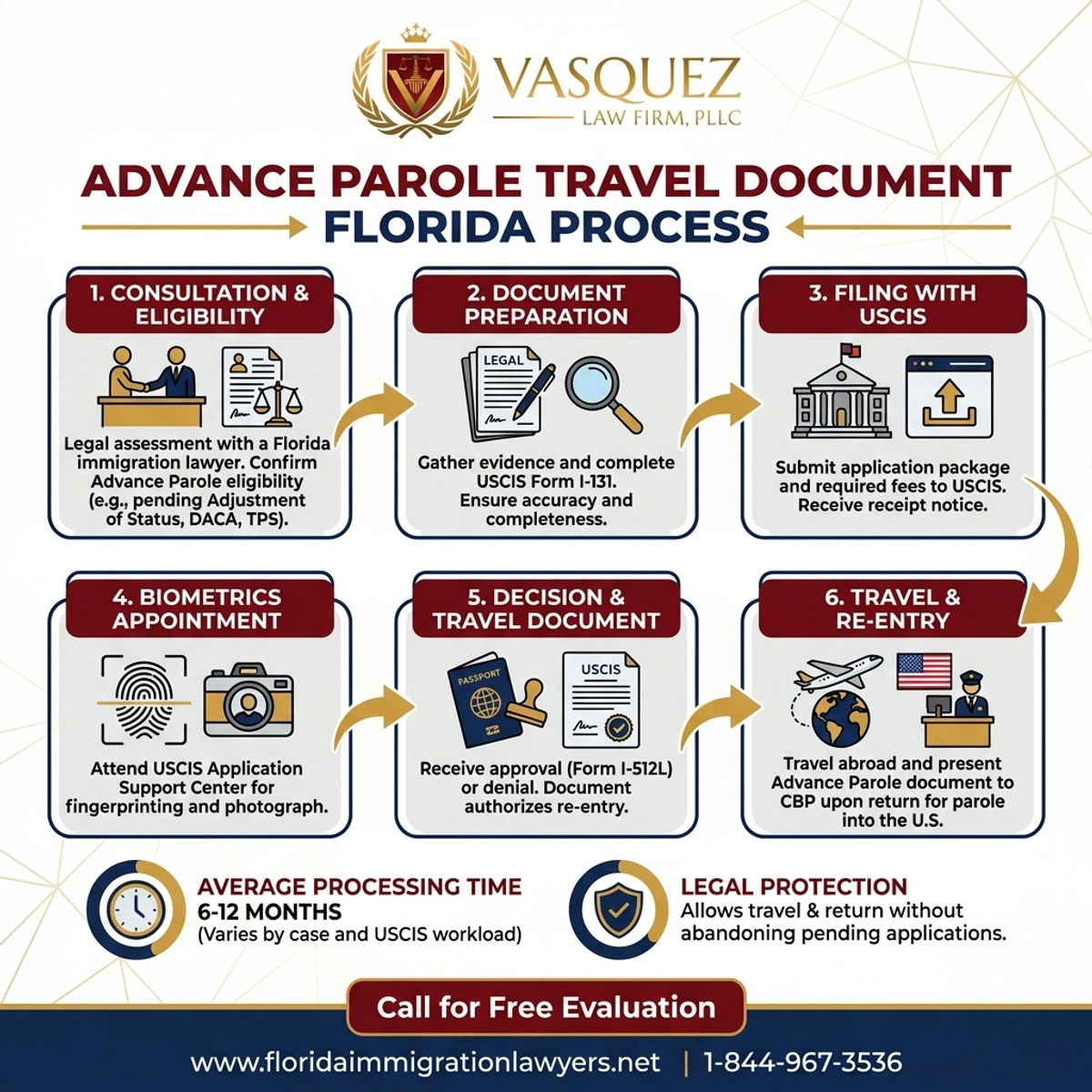
Step-by-Step Process — Advance Parole Travel Document in Florida
It's recommended to consult with an immigration lawyer to ensure the application is complete and accurate.
When completing Form I-131, precision is paramount. Any discrepancies, missing information, or incorrect answers can lead to Requests for Evidence (RFEs) or even outright denial, significantly delaying your travel plans. Pay close attention to the specific type of travel document you are requesting, as Form I-131 is also used for re-entry permits and refugee travel documents. For advance parole, you will typically select Part 2, Application Type 1.d. for those with a pending I-485.
Beyond the form itself, the supporting documentation tells your story to USCIS. Proof of your pending adjustment of status, usually a Form I-797C Notice of Action for your I-485 receipt, is non-negotiable. Additionally, while not always strictly required, providing a detailed travel itinerary, even a tentative one, can help USCIS understand the purpose and urgency of your request. Always make copies of your entire application package before submission for your records. For personalized guidance and to ensure your application is flawless, contact Florida Immigration Lawyers at 1-844-967-3536.
Documents Required for Advance Parole
When applying for advance parole, specific documents are needed to support your application:
- Copy of your current immigration status document (e.g., Form I-797, Notice of Action for your pending adjustment)
- Two passport-style photos
- Evidence of an urgent need to travel (if applicable)
- Copy of any government-issued ID
These documents help USCIS verify your eligibility and the necessity of your travel.
Each document plays a crucial role in validating your application. The two passport-style photos must meet USCIS specifications, typically taken within 30 days of filing, with a white background and no glasses or hats. These photos are essential for the physical advance parole document you will receive. Your government-issued ID, such as a driver's license or passport, confirms your identity and the accuracy of the personal information provided on Form I-131.
While advance parole can be granted for general travel, providing evidence of an urgent need can sometimes expedite the process or strengthen your case, especially if you have a tight travel deadline. Examples of urgent needs include medical emergencies involving a family member abroad (supported by a doctor's letter), attending a funeral (with a death certificate or obituary), or critical business travel (with an employer's letter explaining the necessity). Even without an urgent need, a well-organized set of supporting documents is key to a smooth process.
Typical Processing Time for Advance Parole
As of 2026, the processing time for advance parole can vary. Here's what to expect:
| Stage | Typical Timeframe | Notes |
|---|---|---|
| Application Submission | 1-2 weeks | Ensure all documents are complete |
| USCIS Review | 2-5 months | Varies based on case complexity |
| Approval and Issuance | 1-2 weeks | Receive travel document |
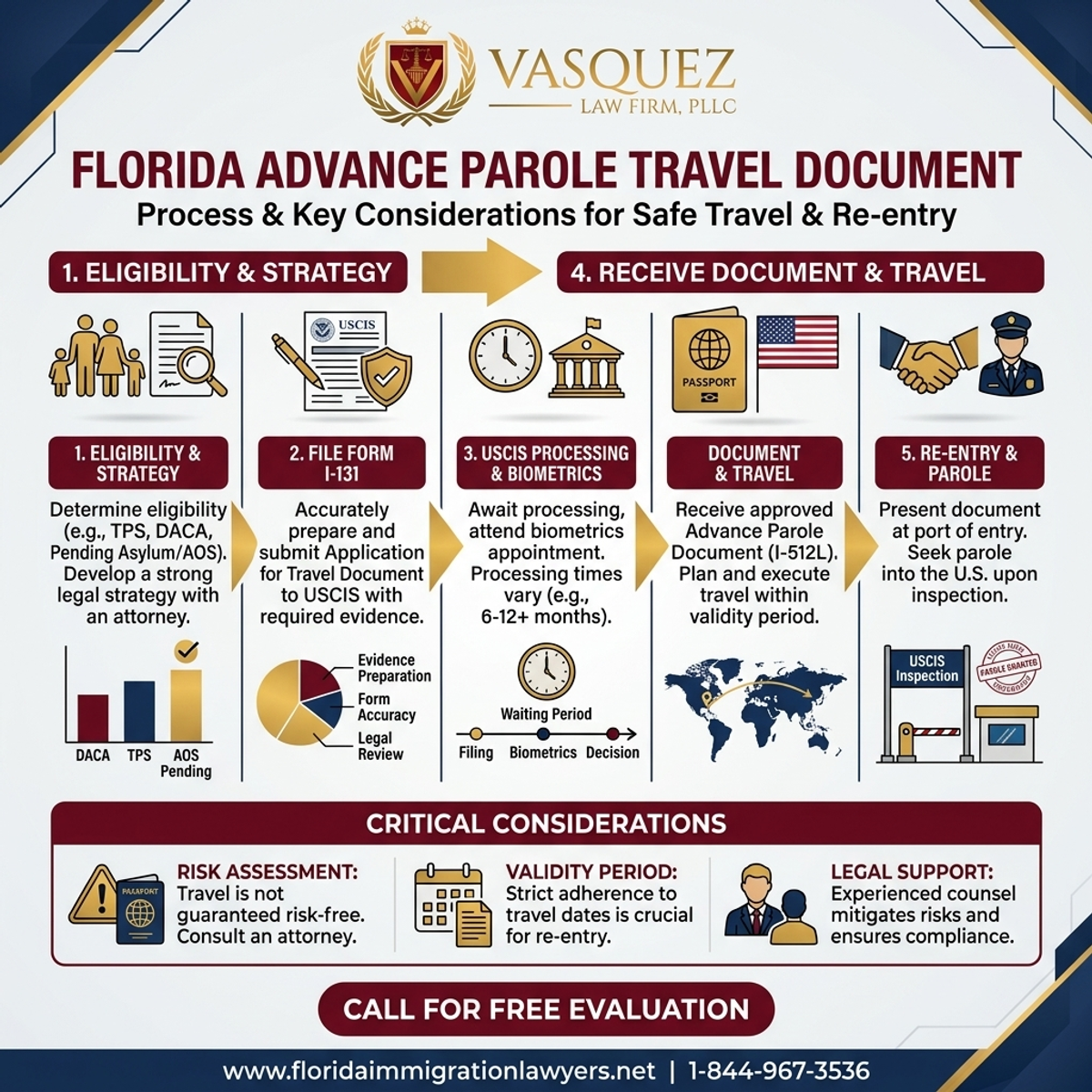
Key Statistics — Advance Parole Travel Document in Florida
Checking the status regularly on the USCIS website is advisable.
It's crucial to understand that the listed timeframes are estimates and can fluctuate significantly based on USCIS workload, policy changes, and the specific service center handling your application. Factors such as the completeness of your application, whether an RFE is issued, or if you request expedited processing due to an emergency can all impact the actual time it takes to receive your document. USCIS does not guarantee processing times, so planning well in advance of any anticipated travel is always the safest approach.
Given these variable processing times, it is highly recommended to apply for advance parole several months before your intended travel date. For instance, if you plan to travel in December, submitting your application in June or July would provide a comfortable buffer. If an urgent, unforeseen need to travel arises, you may be eligible to request expedited processing. This typically requires compelling evidence of the emergency, such as a letter from a doctor or a death certificate. Consulting with an immigration attorney from Florida Immigration Lawyers can help you assess if your situation qualifies for expedited processing and guide you through the necessary steps.
Cost Factors and Fees for Advance Parole
While filing fees are subject to change, here's a general breakdown:
| Item | Typical Fee | Notes |
|---|---|---|
| Form I-131 Filing Fee | Varies | Check USCIS for current fees |
| Biometrics Fee | Additional | Required for some applicants |
Consult the USCIS website for the latest fee schedule.
Do not navigate this process alone. Contact Florida Immigration Lawyers today.
The fee structure for Form I-131 can sometimes be complex. For applicants filing Form I-131 concurrently with or after filing Form I-485, there is typically no separate filing fee for the advance parole document, provided you have already paid the I-485 filing fee, which usually includes biometrics. However, if you are filing Form I-131 as a standalone application without a pending I-485 (which is rare for advance parole specific to adjustment of status), or if you did not pay the biometrics fee with your I-485, you may incur additional costs.
It is absolutely essential to verify the most current fees directly on the USCIS website or by consulting with an immigration attorney. Fees can change without much notice, and submitting an incorrect fee will lead to your application being rejected and returned, causing significant delays. When submitting payment, always use a check or money order payable to the U.S. Department of Homeland Security, ensuring the amount is correct and clearly written. Never send cash through the mail to USCIS.
Common Mistakes to Avoid
Navigating the advance parole application process requires meticulous attention to detail. Overlooking even a minor step can lead to significant setbacks, from processing delays to outright denial of your application or, worse, jeopardizing your pending adjustment of status. Being aware of these common pitfalls is your first line of defense.
- Failing to apply for advance parole before travel, risking status abandonment.
- Incorrectly filling out Form I-131, leading to application denial.
- Not providing sufficient evidence for urgent travel if applicable.
- Traveling before receiving approval, resulting in denial of re-entry.
- Submitting incomplete documentation, causing processing delays.
- Not checking for the latest filing fees on the USCIS website.
- Ignoring the necessity of biometrics if required.
- Overlooking the need to maintain a valid status during the application process.
- Misunderstanding eligibility criteria, leading to ineligibility.
- Assuming travel is allowed immediately upon application submission.
These mistakes can have severe consequences for your immigration journey. The most critical error is traveling without the approved document in hand. Remember, applying for advance parole does not grant you immediate permission to travel; you must wait for the physical document to be issued. If you find yourself unsure about any aspect of the process, it's always best to seek professional legal advice to safeguard your future.
When to Call a Lawyer
If you're unsure about the application process or face complications, it's wise to consult a lawyer. Situations such as denied applications, complex immigration histories, or urgent travel needs require professional guidance. Florida Immigration Lawyers can assist with detailed case reviews, ensuring all paperwork is correctly filed. Our team can help navigate complex legal scenarios and mitigate risks.
The complexities of immigration law can be overwhelming, and an experienced immigration attorney can provide invaluable support. For instance, if you have any past immigration violations, a criminal record, or previous denials of immigration benefits, your advance parole application could be more complicated. A lawyer can assess your specific situation, identify potential red flags, and advise on the best strategy to present your case to USCIS, significantly increasing your chances of approval.
Furthermore, an attorney can act as your advocate throughout the process. Should USCIS issue a Request for Evidence (RFE) or a Notice of Intent to Deny (NOID), a lawyer from Florida Immigration Lawyers can help you formulate a comprehensive and timely response, ensuring all necessary documentation and legal arguments are presented effectively. Don't leave your immigration future to chance; call us at 1-844-967-3536 for a free consultation to discuss your advance parole needs.
About Florida Immigration Lawyers
Florida Immigration Lawyers is a dedicated firm specializing in a wide array of immigration services. We offer assistance with adjustment of status, family-based immigration, deportation defense, and more. Our experienced attorneys are ready to help you understand and navigate the complexities of U.S. immigration law. Call us at 1-844-967-3536 or visit our website for more information. Available 24/7, we offer free consultations and serve residents throughout Florida.
Our commitment at Florida Immigration Lawyers extends beyond simply filling out forms. We understand the profound impact immigration matters have on individuals and families, and we approach each case with compassion, diligence, and a personalized strategy. Our team is well-versed in the latest immigration laws and policies, ensuring that our clients receive accurate, up-to-date advice tailored to their unique circumstances. We pride ourselves on clear communication and transparency throughout the legal process.
Whether you are in Hialeah, Miami, Orlando, or any other part of Florida, our firm is equipped to provide comprehensive legal support. We assist clients in preparing robust applications, responding to USCIS inquiries, and representing them in various immigration proceedings. Our goal is to alleviate the stress associated with immigration challenges and guide you toward a successful outcome. Reach out today for a free consultation and let us put our expertise to work for you.
Sources and References
- U.S. Citizenship and Immigration Services (USCIS)
- Executive Office for Immigration Review (EOIR)
- 8 U.S.C. Chapter 12 - Immigration and Nationality Act
Related services: immigration practice areas, family immigration services, citizenship and naturalization.
This article provides general legal information and is not intended as legal advice. Every case is unique, and outcomes depend on specific facts and circumstances. Contact an attorney for advice about your particular situation.
Contact Florida Immigration Lawyers today at 1-844-967-3536 for a free consultation. Se Habla Espanol - Estamos aqui para ayudarle.
If you need legal assistance, learn more about our immigration legal services, or call us at 1-844-967-3536 for a free consultation.
Do Not Navigate This Process Alone
Our experienced immigration attorneys are ready to fight for you. Get a free, confidential consultation today.
Se Habla Español
Frequently Asked Questions
Harold Estrada-Rodriguez
Florida Immigration Attorney · FL Bar No. 1041171
Florida Bar attorney handling Florida-jurisdiction immigration matters. Bilingual representation, free consultations.
Available 24/7 - Free Evaluations
Related Legal Services
Our Florida immigration attorneys can help you with deportation defense, citizenship and naturalization and family immigration services. Call today at 1-844-967-3536 for a free consultation.
Related Links
Related Topics
Free Legal Consultation
Discuss your case with our experienced attorneys. We're available 24/7.
Se Habla Español - Estamos aquí para ayudarle.
Related Articles
T Visa for Trafficking Victims in Florida | VLF Florida
Learn about T visas for trafficking victims in Florida. Discover eligibility, application steps, and common mistakes to avoid. Call us for a free consultation.
Military Naturalization Florida: Expedited Path to Citizenship
For military personnel stationed in Florida, achieving U.S. citizenship through military naturalization is an expedited and often fee-exempt process. This guide details the unique benefits available under INA Sections 328 and 329, providing a step-by-step overview of the N-400 application for service members at bases like MacDill AFB. Learn about the specific eligibility requirements, the crucial documents needed, and what to expect regarding timelines for expedited processing as of 2026. We also cover potential costs, common mistakes to avoid, and when legal assistance from Florida Immigration Lawyers is essential to navigate complex cases. Secure your future in the nation you serve with expert guidance.
RFE Response in Florida: How to Handle USCIS Requests
Learn how to handle an RFE in Florida, including steps to respond and common mistakes to avoid. Contact Florida Immigration Lawyers for a free consultation.
H-2A Visa for Florida Growers: Guide for Agricultural Workers
The H-2A visa program is vital for Florida's agricultural industry, enabling growers to address seasonal labor shortages by bringing in temporary agricultural workers. This comprehensive guide, updated for 2026, details the H-2A requirements for both employers and workers, outlining the application process, associated costs, and critical deadlines. Learn about worker protections, common mistakes to avoid, and the significant economic impact of H-2A workers on Florida's farms. Florida Immigration Lawyers offers expert guidance to ensure compliance and a smooth process for all parties, supporting Kissimmee and other agricultural communities throughout the state. Contact us for a free consultation to navigate this complex immigration pathway.
