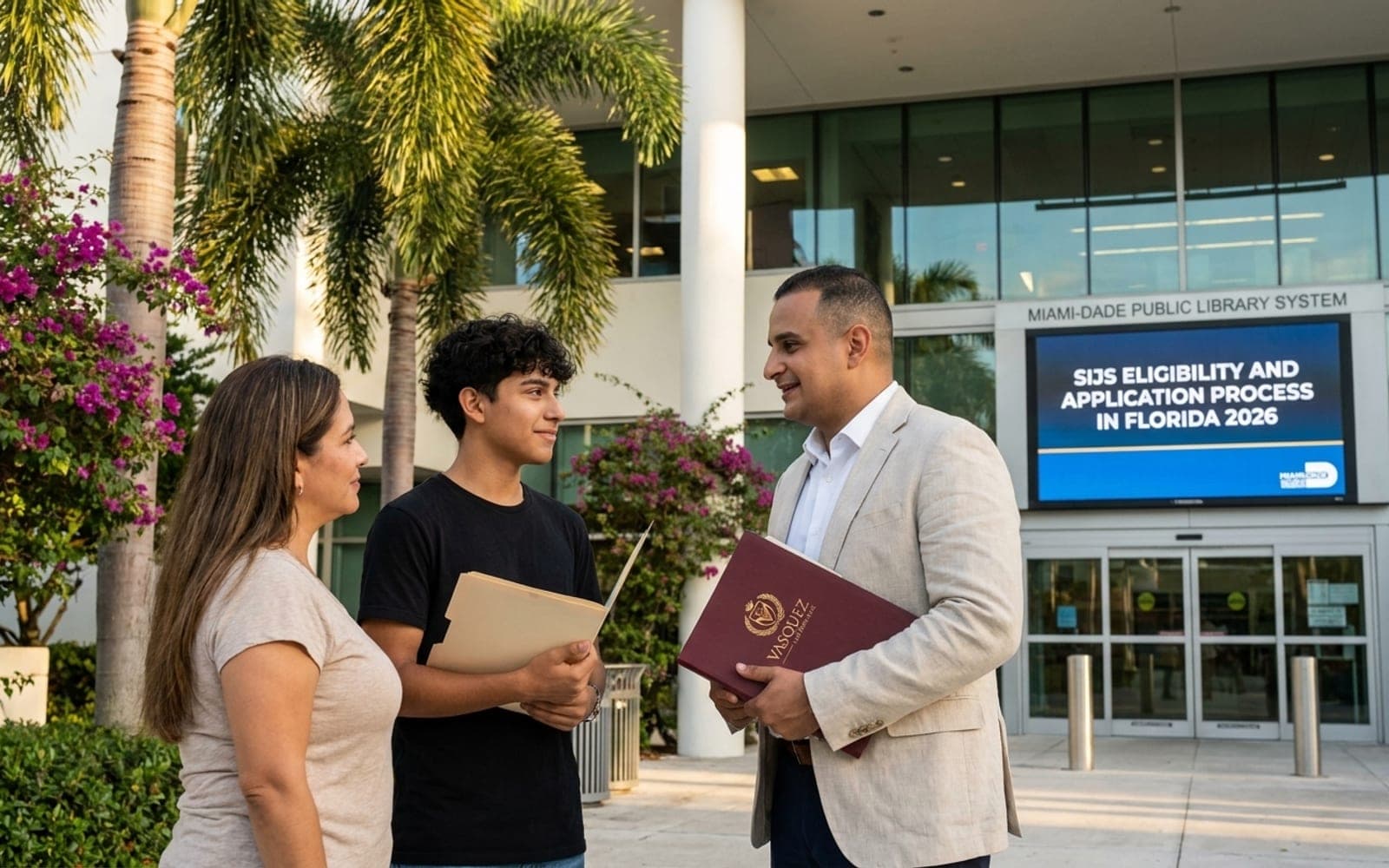
Special Immigrant Juvenile Status is a federal immigration route for young people who were abused, abandoned or neglected. It involves both a state court and federal agencies, and the order of steps matters because a birthday passing before a court order is issued can close a door. A SIJS lawyer helps with the immigration side and works with the state court findings. Our Orlando firm assists families and guardians across Florida and encourages an early review.
- SIJS involves state court findings and federal immigration filings.
- Timing errors, such as a birthday passing, can close options.
- Review the case early with a lawyer, before any deadlines pass.
- The guide lists documents to gather for a consultation.
Introduction
Special Immigrant Juvenile Status, usually called SIJS, is a path to a green card for certain young people who were abused, abandoned or neglected and cannot safely be reunited with a parent. This page explains who may qualify, what a lawyer does on the immigration side, how the process works in Florida, and what documents to gather. It is written for young people, guardians, relatives and the professionals who support them. To talk about a specific situation, call 1-844-YO-PELEO or contact us.
SIJS involves both a state court and federal immigration agencies, and the order of the steps matters. A mistake in timing, such as a birthday that passes before a court order is issued, can close a door that was open a few weeks earlier. That is why a case should be reviewed early.
Vasquez Law Firm assists families and guardians in Florida from Orlando and by video. This guide is general information, not legal advice, and every young person's case turns on its own facts and on the current rules of the courts and USCIS.
What SIJS Is and Who May Qualify
SIJS is a federal immigration classification. In general, it is available to a person who is under 21, unmarried, physically in the United States, and who has obtained a qualifying order from a state juvenile court. That court order must find, under state law, that the young person cannot be reunited with one or both parents because of abuse, abandonment, neglect or a similar basis, and that returning to the home country would not serve the young person's interests under the standard the court applies.
The state court order is not an immigration benefit by itself. It is the first piece of the case, and USCIS then decides whether to approve the SIJS petition. Eligibility turns on facts such as age on the filing date, the type of order, and whether the order was issued while the young person was still within the age limit set by the state. These details are why a case should be reviewed early, before a birthday or a court date passes.
What a Special Immigrant Juvenile Attorney Does
A lawyer focuses on the immigration portion of the case. That generally includes:
- Screening whether the young person might qualify and identifying age or status problems.
- Explaining to the guardian or family what the state court must find, so the court case is prepared with immigration requirements in mind.
- Preparing Form I-360, the petition for Special Immigrant Juvenile classification, with the court order and supporting documents.
- Preparing the application for a green card (adjustment of status) when it becomes available, or advising on other options while waiting.
- Representing the young person if there is a removal case in immigration court.
Vasquez Law Firm handles immigration law only. The dependency, custody or guardianship case in state court is a separate legal matter, and we coordinate with the lawyer handling it so the findings match what USCIS requires.
How the SIJS Process Works in Florida
- Screen the case. We look at age, family history, immigration history and any removal case.
- State court order. A Florida court with authority over the child makes the required findings. The type of court proceeding depends on the child's situation, and the family court lawyer or guardian leads this step.
- File the I-360. The petition is filed with USCIS with the court order and evidence of identity and age.
- Wait for a decision. USCIS reviews the petition and may ask for more information. Timelines vary and we do not predict them.
- Apply for permanent residence. A young person with an approved petition can apply for a green card only when a visa number is available, and this wait can differ depending on the country of birth.
Some young people are also in removal proceedings. In that situation, the immigration judge and the timing of the state and federal steps both affect strategy, and the young person's lawyer should be involved from the beginning. See our page on deportation defense for how those proceedings work.
The State Court Findings and Why They Matter
The state court order is the foundation of the immigration case, and USCIS reviews it closely. In general, the order should show that the court had jurisdiction over the young person, that the court found reunification with a parent is not viable because of abuse, abandonment, neglect or a similar basis under state law, and that returning to the home country would not serve the young person's interests. The wording of the order and the record behind it matter, so the lawyer in the state court case and the immigration lawyer should talk before the hearing, not after.
The guardian or the young person's advocate is often asked to provide facts for the court, such as a history of the family, where the parents are, whether they supported the child and what the young person's life was like. These facts must be accurate and consistent with what the young person later tells the immigration agency. Inconsistencies can cause trouble, so statements should be prepared with care and reviewed for accuracy.
Families often ask who qualifies as a guardian for this purpose. It depends on the facts and on the type of state court case, and it can be a parent who did not cause the harm, a relative, a family friend or a person the court appoints. The immigration lawyer and the family court lawyer should talk early about which kind of case fits the young person's situation, because different court proceedings lead to different kinds of findings and orders.
Young people who are already adults under state law but not yet 21 should not assume that SIJS is closed to them. Some states allow courts to act for older youth under certain programs, while others do not, and the rules and the case law change. This is one of the reasons a case should be reviewed by a lawyer who can check the current law.
When to Talk With a Lawyer About SIJS
Consider a consultation if:
- A teenager or young adult lives with a relative or guardian because a parent abused, abandoned or neglected them.
- The young person is approaching 18 or 21 and has no lawful status.
- A school counselor, social worker or court has mentioned SIJS.
- The young person received a Notice to Appear.
- A previous application, such as asylum, was denied or abandoned.
SIJS is only one option. A review may show that asylum, a U visa, a family petition or another route fits better, or that several can be pursued together. Our humanitarian protection page covers some of these.
Document Checklist for a SIJS Consultation
- The young person's birth certificate and passport, or any identity document available.
- Any court orders, petitions or case numbers from a dependency, custody or guardianship case.
- Proof of age and the date and place of entry into the United States, if known.
- Any immigration papers, including notices from immigration court or ICE.
- School records, medical records or reports from agencies that show the history of abuse, abandonment or neglect.
- Contact information for the guardian or the lawyer in the state court case.
- Information about the parents, including where they live and whether they have been in contact.
The young person's sensitive history is protected by confidentiality rules, and we ask only for the information needed to evaluate the case. If some documents cannot be found, bring what is available and explain why the others are missing.
Timeline and Processing Expectations for SIJS cases
SIJS cases usually have two tracks that run in order. The first is the state court, where the calendar depends on the court and on the other cases it has. The second is the federal process, where USCIS reviews the petition, and then, if the petition is approved, the young person waits for a visa number before applying for a green card. USCIS and the State Department publish current information, and the waiting periods change, so check the current sources instead of relying on a general estimate.
Age is the most time-sensitive part of the case. The young person must meet the age requirements at the stage where the law requires, and the court must act within the limits of state law. If a birthday is near, say so at the first call. The table below shows the usual stages.
| Stage | What happens | Who acts |
|---|
| Screening | Age, history and immigration status are reviewed | Lawyer, guardian and young person |
| State court order | The court makes the required findings | State court, with the family court lawyer |
| Form I-360 | The SIJS petition is filed and reviewed | Immigration lawyer, then USCIS |
| Visa number wait | The young person waits for a number if one is required | State Department sets availability |
| Green card application | Adjustment of status is filed and decided | Young person, lawyer and USCIS |
Choosing SIJS Representation
Families sometimes search for different names for the same kind of help. The names vary, but the questions to ask are the same: Does the lawyer practice immigration law and handle I-360 filings? Will the lawyer coordinate with the state court lawyer? Is the lawyer comfortable speaking with a minor, and with a guardian who may not speak English? Will fees and the scope of work be written down before you hire anyone? A trustworthy lawyer will also tell you when SIJS is not the right route.
Be cautious about any lawyer who guarantees an outcome. The state court and USCIS make their own decisions, and no lawyer controls either one. Be careful with anyone who offers to arrange a court order for a fee without a real review of the facts.
Other Options and Protections to Consider
Because SIJS depends on a court finding, it is not right for everyone. A young person who fears returning home because of persecution may have an asylum claim, and the one-year deadline for asylum can matter. A young person who was the victim of certain crimes in the United States may be able to seek a U visa, and one who was trafficked may qualify for a T visa. A young person who is a child of a U.S. citizen or permanent resident may be eligible through a family petition. A lawyer can compare these options and explain how they interact.
For a young person in removal proceedings, a pending SIJS petition may affect what the immigration judge can do, but it does not automatically stop the case. Anyone in this situation should speak with a lawyer immediately and bring every notice and hearing date.
Cost Factors and Fee Breakdown for SIJS cases
The cost of a SIJS case involves the immigration filings, the state court case and legal fees. The table lists the items to ask about.
| Item | Amount | Notes |
|---|
| Form I-360 filing | Check USCIS for the current fee | Confirm the current fee and any exceptions on the form page |
| Green card application | Check USCIS for the current fee | Filed after the petition is approved and a visa number is available |
| Immigration court filings | Check the court or agency for current fees | Apply only if the young person is in removal proceedings |
| State court costs | Varies by case | Depend on the court and the type of case |
| Attorney fees | Varies by case | Set in a written agreement |
Government fees can change, so check the current fee schedule and the form instructions before sending payment. Some filings have rules about fee exceptions that a lawyer can explain.
Legal fees depend on the type of case and the work involved, including whether the firm is only handling the immigration side. Ask for the scope of the work and the billing terms in writing, and ask who will handle the state court case.
Common Mistakes to Avoid for SIJS cases
- Waiting until a birthday is close before looking for a lawyer.
- Assuming that the state court order alone gives the young person a green card.
- Giving different accounts of the family history to the court and to USCIS.
- Ignoring a Notice to Appear or missing an immigration court hearing.
- Using an unlicensed helper to prepare the court papers or the I-360.
- Overlooking other options, such as asylum or a U visa, that may fit the facts better.
- Assuming that a visa number will be available right away after approval.
When to Call a Lawyer for SIJS cases
Call as soon as you suspect a young person may qualify, and before any birthday that could affect eligibility. Call right away if the young person has received a Notice to Appear, a hearing date or a request for evidence, or if a state court hearing is being scheduled. A short consultation can tell you whether SIJS may fit, what the state court must find and what to do next.
Related guides for a different focus: SIJS Process for Minors in Florida: What You Need to Know.
About Vasquez Law Firm
Vasquez Law Firm practices immigration law only. Our only office is at 1111 E Amelia Street in Orlando. Families in other parts of Florida can meet us by phone or secure video, and in person in Orlando. William J. Vásquez is the founding attorney. Consultations are available in English and Spanish. Call 1-844-YO-PELEO or contact us and tell us the young person's age and whether any court case exists. Details about related programs are on our special programs page.
Sources and References
Related services: deportation defense, immigration lawyers in Florida
Other ways people search for this
People look for this help under different names. Related searches include sij visa lawyers; special immigrant juvenile visa lawyer; special immigrant juvenile status lawyer; special immigrant juvenile visa attorney; sijs attorney; sijs lawyer; special immigrant juvenile status immigration lawyer; juvenile immigration lawyer; special immigrant juvenile lawyer; special immigrant juvenile status attorney; special immigrant juveniles attorneys; lawyer for special immigrant juvenile status; sijs attorneys; sijs immigration attorney; sijs immigration lawyer; sijs lawyers.
This article is general information, not legal advice. Every case is different; speak with an immigration lawyer about your situation.