Special Immigrant Juvenile Status Florida: Your 2026 Guide
Special Immigrant Juvenile Status (SIJS) offers a crucial pathway to lawful permanent residency for vulnerable children in Florida who have experienced abuse, neglect, or abandonment. This 2026 guide explains the eligibility criteria, highlighting the vital role of a Florida state court order, which must find the child dependent and unable to reunite with their parents due to the aforementioned hardships. The article details the multi-step application process, from obtaining the predicate order to filing federal petitions with USCIS and ultimately adjusting status to a Green Card. It also covers typical timelines, potential costs, and the life-changing benefits SIJS provides, such as protection from deportation and access to education. For families and guardians navigating this complex process, understanding the requirements and avoiding common pitfalls is essential. Florida Immigration Lawyers stands ready to provide expert legal guidance.
Special Immigrant Juvenile Status (SIJS) in Florida offers a vital pathway to lawful permanent residency for children who have been abused, neglected, or abandoned by a parent. As of 2026, eligible minors must first obtain a specific order from a Florida state court, typically a dependency or family court, finding them dependent on the court or a state agency, declaring them unable to reunite with one or both parents due to abuse, neglect, or abandonment, and determining that it is not in their best interest to return to their country of origin. This state court order is a critical prerequisite for filing the I-360 petition with USCIS, ultimately leading to potential adjustment of status to a Green Card.
- SIJS provides a path to a Green Card for vulnerable children in Florida.
- Requires a specific order from a Florida state court finding abuse, neglect, or abandonment.
- Minors must be under 21 and unmarried when the I-360 petition is filed.
- Protects children from deportation and offers stability.
- Legal guidance from a Florida immigration lawyer is crucial for success.
Navigating the complex landscape of immigration law can be particularly challenging, especially when it involves the protection of vulnerable children. In Florida, many young individuals face difficult circumstances, often arriving in the U.S. without proper parental care, having experienced severe abuse, neglect, or abandonment. For these children, Special Immigrant Juvenile Status (SIJS) offers a beacon of hope – a unique pathway to lawful permanent residency and a chance for a stable future.
This comprehensive guide, updated for 2026, aims to demystify SIJS in Florida, providing essential information on eligibility requirements, the intricate application process, potential timelines, and the critical role of state court involvement. We will delve into specific scenarios, common pitfalls, and offer practical advice for families and guardians seeking to secure this crucial protection for a minor. Understanding SIJS is the first step toward safeguarding a child's well-being and legal status in the United States.
If you are caring for a child who may qualify for this vital protection, or if you have questions about the process, do not hesitate. Call Florida Immigration Lawyers at 1-844-YO-PELEO for a free case review. Our dedicated team is here to help you understand your options and guide you through every step.
What is Special Immigrant Juvenile Status (SIJS) and Who Does It Help in Florida?
Special Immigrant Juvenile Status (SIJS) is a provision under U.S. immigration law designed to protect undocumented immigrant children in the United States who have been abused, neglected, or abandoned by one or both parents. It provides a pathway for these vulnerable minors to obtain a Green Card, offering them safety, stability, and a lawful presence in the country. The legal basis for SIJS is found in Section 101(a)(27)(J) of the Immigration and Nationality Act (INA), codified at 8 U.S.C. § 1101(a)(27)(J), and further detailed in 8 CFR § 204.11.
In Florida, SIJS is particularly relevant due to the state's diverse population and the presence of many children who have experienced trauma. These children often find themselves in the care of relatives, foster parents, or state agencies after suffering profound hardships in their home countries or upon arrival in the U.S. SIJS helps these minors by recognizing the severe harm they have endured and providing a legal remedy that prevents their deportation and allows them to rebuild their lives free from fear. It is a humanitarian measure, acknowledging that certain children cannot safely return to their parents or countries of origin.
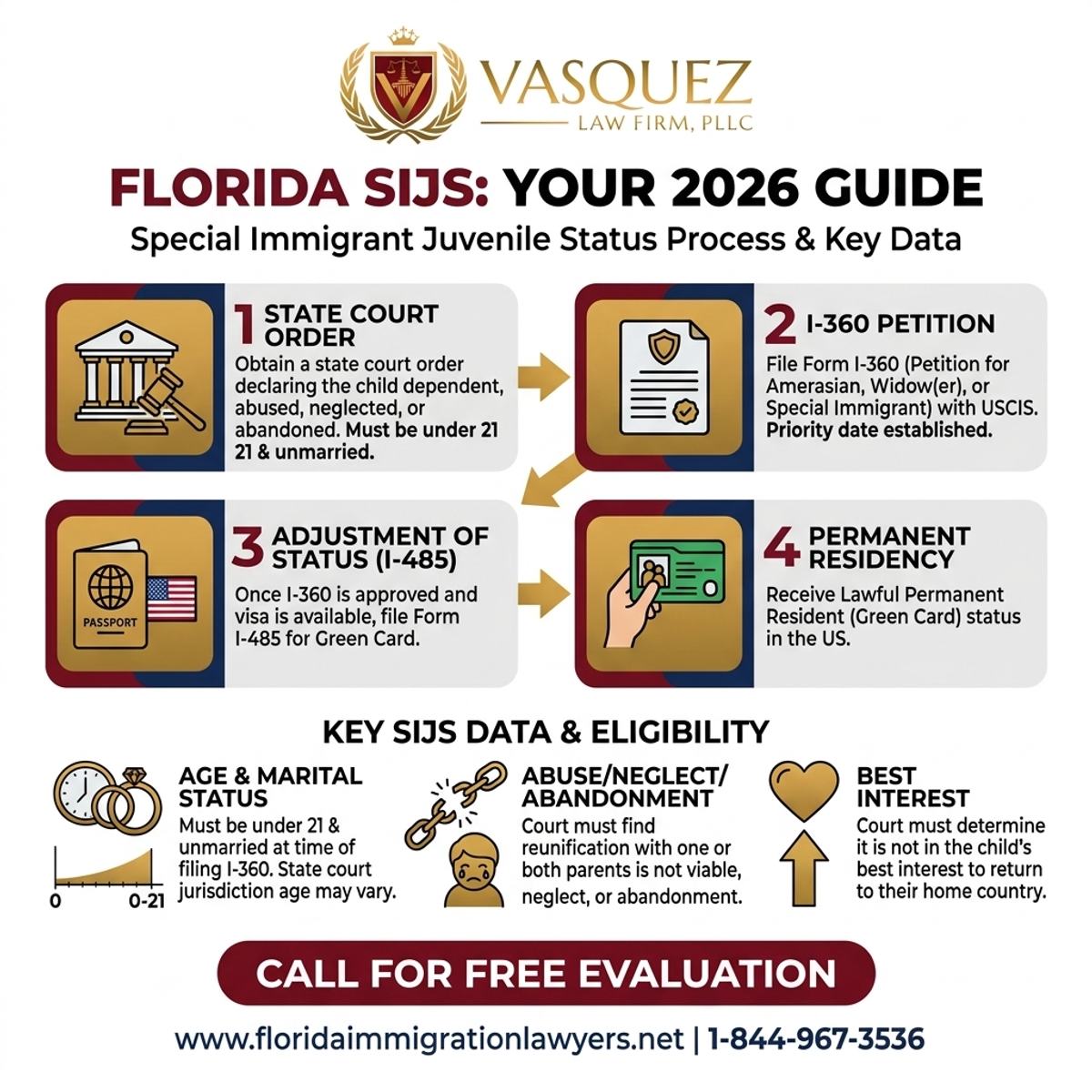
The status is generally available to children under 21 years old who are unmarried. A critical component for SIJS in Florida involves obtaining a specific order from a state court – typically a dependency court or family court. This court order, known as a 'predicate order,' must make specific findings about the child's dependency, the impossibility of reunification with a parent due to abuse, neglect, or abandonment, and that it is not in the child's best interest to return to their country of origin. Without this foundational state court order, a child cannot qualify for SIJS. This two-step process, involving both state and federal agencies, underscores the complexity and the need for skilled legal representation.
What are the Eligibility Requirements for SIJS in Florida in 2026?
To be eligible for Special Immigrant Juvenile Status (SIJS) in Florida as of 2026, a child must meet several specific criteria, which involve both their personal circumstances and judicial findings. Understanding these requirements is crucial for determining if a child qualifies for this protective status. The process begins with securing a state court order, which serves as the predicate for the federal immigration application.
First, the child must be under 21 years of age at the time the Form I-360, Petition for Amerasian, Widow(er), or Special Immigrant, is filed with USCIS. They must also be unmarried. These are strict age and marital status requirements that must be continuously met until the I-360 is approved. Second, a juvenile court in Florida, such as a dependency court or a family court, must have issued an order making specific findings. This court must have jurisdiction over the child under state law, often through a dependency proceeding initiated by a state agency like the Department of Children and Families (DCF) or a private petition for guardianship.
The state court order must establish that:
- The child has been declared dependent on a juvenile court located in the United States, or committed to the custody of a state agency or a department of a state, or an individual or entity appointed by a state or juvenile court.
- Reunification with one or both of the child's parents is not possible due to abuse, neglect, abandonment, or a similar basis found under state law. This finding is critical and requires detailed evidence presented to the state court.
- It is not in the child's best interest to return to their or their parent's previous country of nationality or last habitual residence. This finding ensures that the child's safety and well-being are prioritized above all else.
Furthermore, the child must be physically present in the United States when the I-360 petition is filed and when it is approved. It's important to note that the SIJS classification provides certain waivers for inadmissibility grounds, making it accessible to children who might otherwise be barred from obtaining a Green Card. However, careful legal analysis is required to identify and address any potential inadmissibility issues. The complexities of coordinating between Florida state courts and federal immigration agencies make experienced legal counsel indispensable.
How Does the SIJS Application Process Work in Florida? A Step-by-Step Guide
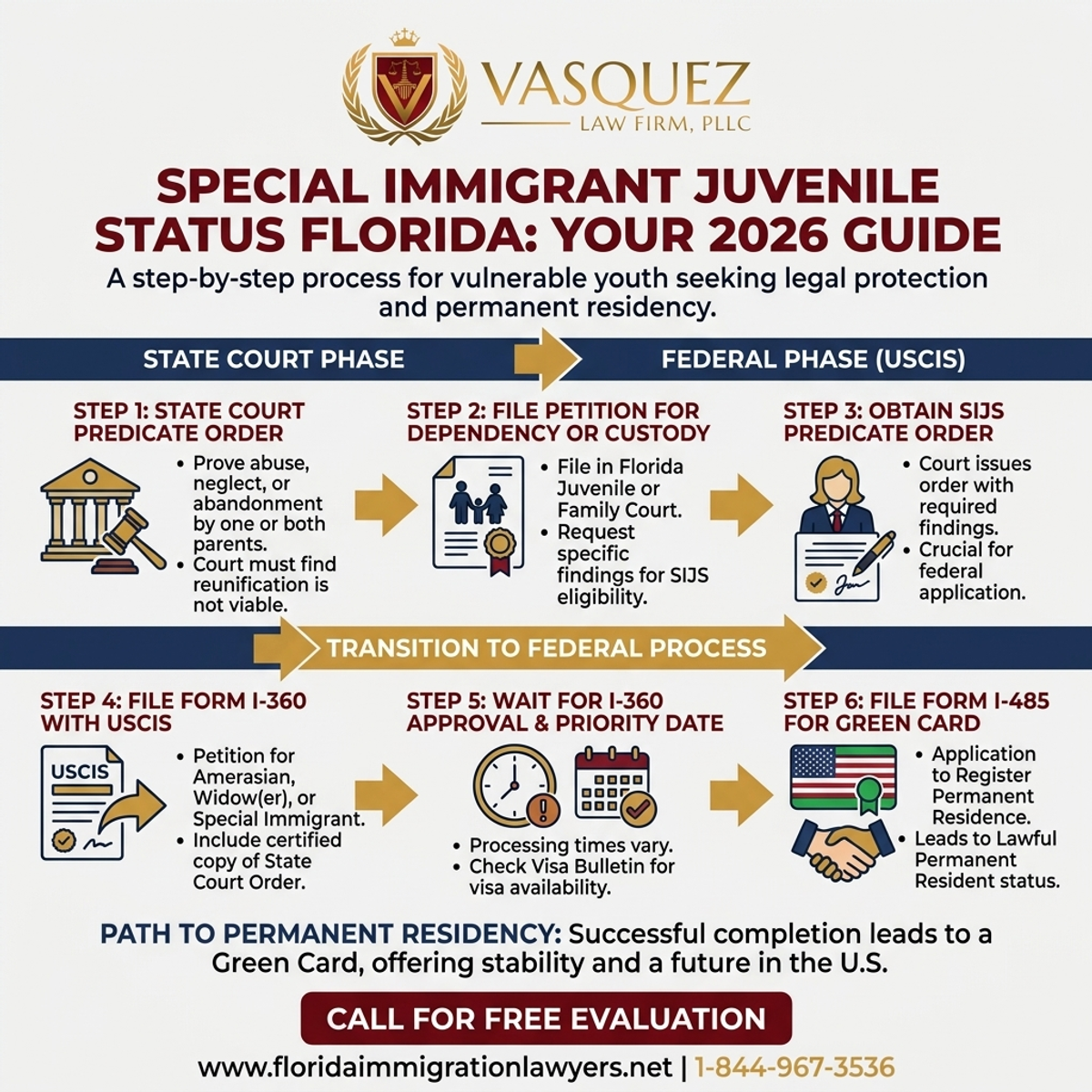
The Special Immigrant Juvenile Status (SIJS) application process in Florida is a multi-stage journey involving both state and federal authorities. It typically begins with securing a predicate order from a Florida state court and culminates in applying for a Green Card. This guide outlines the key steps involved, as of 2026.
-
Step 1: Obtain a Predicate Order from a Florida State Court
This is the foundational step. An attorney, often working with the child's guardian or a state agency like DCF, will file a petition in a Florida dependency court or family court. The goal is to obtain a court order that makes the specific findings required for SIJS: that the child is dependent on the court or a state agency, that reunification with one or both parents is not possible due to abuse, neglect, or abandonment, and that it is not in the child's best interest to return to their country of origin. This step often involves presenting evidence, witness testimony, and legal arguments to the state court judge. In Central Florida, these cases would typically go through Orange County, Seminole County, or Osceola County family courts.
-
Step 2: File Form I-360, Petition for Amerasian, Widow(er), or Special Immigrant, with USCIS
Once the predicate order is secured, the next step is to file Form I-360 with U.S. Citizenship and Immigration Services (USCIS). This petition formally requests SIJS classification. The I-360 package must include the certified state court order, the child's birth certificate, evidence of their age and unmarried status, and a detailed statement explaining how the child meets all SIJS eligibility criteria. USCIS will review the petition to determine if the child qualifies as a Special Immigrant Juvenile. Upon approval, the child receives SIJS classification, making them eligible to apply for lawful permanent residency.
-
Step 3: Apply for Adjustment of Status (Form I-485) or Consular Processing
After the I-360 petition is approved, the child can apply for a Green Card. Most children in Florida will file Form I-485, Application to Register Permanent Residence or Adjust Status, if they are physically present in the U.S. and their visa number is immediately available. This application includes a medical examination, biometric appointments, and an interview at a USCIS field office (e.g., Orlando, Tampa, or Miami). In some rare cases, if the child is outside the U.S. or needs to depart and re-enter, consular processing through a U.S. embassy or consulate abroad via Form DS-260 may be necessary, coordinated with the Department of State. However, most SIJS cases are processed domestically.
Step-by-Step Process — Special Immigrant Juvenile Status Florida: Your 2026 Guide
-
Step 4: Attend the Interview and Receive Green Card
For those adjusting status in the U.S., a final interview with a USCIS officer will be scheduled. During this interview, the officer will review the application, verify information, and ask questions about the child's background and eligibility. If all requirements are met and the officer is satisfied, the application will be approved, and the child will be granted lawful permanent residency. The Green Card is typically mailed to the child's address a few weeks after approval.
What is the Timeline and Processing Expectations for SIJS Cases in 2026?
The timeline for Special Immigrant Juvenile Status (SIJS) cases in Florida can vary significantly depending on several factors, including the specific state court's caseload, USCIS processing times, and whether any Request for Evidence (RFE) is issued. As of 2026, applicants should anticipate a multi-stage process that can take several years from the initial state court filing to receiving a Green Card.
The initial state court process to obtain the predicate order is often the first variable. This can range from a few months to over a year, depending on the complexity of the child's case, the court's schedule, and the cooperation of involved parties. For example, a contested dependency case may take longer than an uncontested guardianship petition. Once the predicate order is secured, the federal immigration process begins.
USCIS processing times for Form I-360 can fluctuate. Historically, these petitions have taken anywhere from 6 to 18 months, but current processing times should always be checked on the USCIS website. After the I-360 is approved, the child typically waits for a visa number to become available before filing Form I-485. While SIJS applicants generally have an advantage in visa availability, there can still be some wait times, especially for certain nationalities. The I-485 processing, including biometrics, medical exam, and interview, can add another 12-24 months. It's important to remember that these are general estimates, and individual cases may differ.
| Stage | Typical Timeframe (As of 2026) | Notes |
|---|---|---|
| Florida State Court Predicate Order | 3-12 months | Varies by court caseload, complexity, and whether case is contested. |
| Form I-360 Filing & Approval | 6-18 months | Check current USCIS processing times for specific service centers. |
| Visa Number Availability | 0-12 months | SIJS applicants often have immediate availability, but check the Visa Bulletin. |
| Form I-485 Filing & Approval (Adjustment of Status) | 12-24 months | Includes biometrics, medical exam, and interview at a Florida USCIS office. |
| Total Estimated Process | 2-5 years | From initial state court filing to Green Card receipt. |
What Does SIJS Cost in Florida? A Breakdown of Fees and Expenses
Understanding the financial aspects of pursuing Special Immigrant Juvenile Status (SIJS) in Florida is essential for planning. The total cost typically involves various fees for government filings, medical examinations, and, most significantly, legal representation. While SIJS itself is designed to protect vulnerable children, the process is not entirely free, and these expenses can accumulate.
As of 2026, USCIS generally waives filing fees for Form I-360 for SIJS applicants, which is a significant relief for many families. However, other government fees may still apply, particularly for the adjustment of status (Form I-485). The I-485 fee, if not waived, can be substantial. Additionally, there are fees for biometrics (fingerprinting), which are typically included in the I-485 fee but can sometimes be separate. A mandatory medical examination performed by a USCIS-approved civil surgeon is also required for the I-485, and the cost for this can range from several hundred dollars, varying by provider in Florida.
Beyond government fees, the most substantial expense for many SIJS applicants will be attorney fees. Given the dual nature of the process – requiring expertise in both Florida state family/dependency law and federal immigration law – legal representation is highly recommended. Attorneys charge for their time and expertise in preparing the state court petition, representing the child in state court, drafting and filing the I-360 and I-485 petitions, responding to RFEs, and preparing for interviews. While some non-profit organizations offer pro bono or low-cost services, many families opt for private counsel to ensure thorough and specialized guidance. The overall cost can vary widely depending on the complexity of the case and the attorney's fee structure.
| Item | Typical Fee (As of 2026) | Notes |
|---|---|---|
| Form I-360 Filing Fee | $0 | Typically waived for SIJS applicants. |
| Biometrics Fee | Included in I-485 fee (if applicable) | May be separate if only I-360 is filed, but often waived for SIJS. |
| Form I-485 Filing Fee | $0 - ~$1,225 | Can be waived for SIJS applicants if a fee waiver (Form I-912) is approved. |
| Medical Examination (I-693) | $200 - $600+ | Required by a USCIS-approved civil surgeon; varies by provider in Florida. |
| Attorney Fees | Highly Variable | Depends on case complexity, attorney experience, and services rendered (state court, I-360, I-485). |
| Translation & Document Costs | Variable | For birth certificates, court documents, etc., if not in English. |
Key Statistics — Special Immigrant Juvenile Status Florida: Your 2026 Guide
Do not navigate this process alone. Contact Florida Immigration Lawyers today for a free case review to discuss the specific costs and legal strategies for your SIJS case in Florida. Our team is ready to provide the compassionate and expert guidance you need.
What are the Benefits of Obtaining SIJS for Children in Florida?
Securing Special Immigrant Juvenile Status (SIJS) for a child in Florida offers profound and life-changing benefits, providing a stable foundation for their future that extends far beyond just legal residency. The primary and most significant benefit is the pathway to obtaining a Green Card, which grants lawful permanent residency in the United States. This status eliminates the constant fear of deportation and allows children to live openly and securely, pursuing educational and personal opportunities without the looming threat of removal.
With a Green Card, children can legally attend public schools and later, colleges and universities, often qualifying for in-state tuition rates in Florida and federal financial aid, which might otherwise be inaccessible. This opens doors to higher education and better career prospects, empowering them to become contributing members of society. Furthermore, lawful permanent residency allows children to obtain work authorization, enabling them to secure legal employment once they reach working age, without needing separate work permits. This financial independence is crucial for their long-term stability and integration into American society.
Beyond education and employment, SIJS provides critical protection from further abuse or exploitation. By granting legal status, it removes children from vulnerable situations where they might be susceptible to trafficking or other forms of harm due to their undocumented status. It also allows them to travel internationally, albeit with certain restrictions, and eventually, after meeting specific criteria, to apply for U.S. citizenship, typically after five years as a lawful permanent resident. For children who have experienced immense hardship, SIJS represents a chance for a fresh start, a safe haven, and the opportunity to build a fulfilling life in Florida.
Common Mistakes to Avoid in SIJS Applications in Florida
The Special Immigrant Juvenile Status (SIJS) application process is complex, and even minor errors can lead to significant delays or outright denials. Avoiding these common mistakes is crucial for a successful outcome for children in Florida.
-
Failing to Obtain a Proper Predicate Order: The state court order is the cornerstone of an SIJS petition. A common mistake is obtaining an order that does not contain all the specific findings required by immigration law (dependency, inability to reunify due to abuse/neglect/abandonment, and not in best interest to return). Florida courts must explicitly state these findings. Without them, USCIS will deny the I-360.
-
Missing Age or Marital Status Deadlines: The child must be under 21 and unmarried when the I-360 is filed. Delaying the filing can result in the child aging out or marrying, making them ineligible. It's critical to file the I-360 before the child's 21st birthday, even if the predicate order is still pending.
-
Insufficient Documentation: SIJS petitions require extensive documentation, including birth certificates, court orders, evidence of abuse/neglect/abandonment, and proof of identity. Submitting incomplete or poorly organized packets can lead to Requests for Evidence (RFEs) and delays. All foreign language documents must be translated into English by a certified translator.
-
Incorrectly Identifying the Qualifying Parent: The predicate order must clearly state that reunification with *one or both* parents is not possible due to abuse, neglect, or abandonment. Sometimes, petitioners mistakenly focus on only one parent when both are relevant, or mischaracterize the relationship, leading to issues with USCIS.
-
Not Addressing Inadmissibility Grounds: While SIJS offers waivers for many inadmissibility grounds, not all are waived automatically. Failing to identify and properly address any potential inadmissibility issues (e.g., criminal history, unlawful entry) can result in a denial of the adjustment of status application. A thorough legal review is essential.
-
Lack of Coordination Between State and Federal Processes: The SIJS process requires seamless coordination between the state court proceedings and the federal immigration applications. A lack of understanding of how these two systems interact, or failing to follow up on one aspect while focusing on the other, can cause critical delays or missed deadlines.
-
Attempting the Process Without Legal Counsel: This is arguably the biggest mistake. The legal complexities of SIJS, involving both Florida state court procedures and federal immigration law, are overwhelming for non-attorneys. Without experienced legal guidance, applicants are far more likely to make critical errors that jeopardize the child's future.
When to Call a Florida Immigration Lawyer for SIJS Assistance
Given the intricate nature of Special Immigrant Juvenile Status (SIJS) cases, knowing when to seek legal assistance is paramount. The best time to contact a Florida immigration lawyer is as early as possible, ideally at the very first sign that a child may be eligible for this protection. Early intervention can prevent critical mistakes, streamline the process, and significantly improve the chances of a successful outcome.
You should immediately consider calling Florida Immigration Lawyers if any of the following scenarios apply:
- You are caring for a child in Florida who has experienced abuse, neglect, or abandonment by one or both parents, and they are under 21 and unmarried.
- A child in your care is currently involved in a Florida dependency court proceeding, or you are considering initiating one, and you believe they may qualify for SIJS.
- You have obtained a state court order related to a child's dependency or guardianship, but you are unsure if it contains the specific findings required for SIJS.
- USCIS has issued a Request for Evidence (RFE) for an I-360 or I-485 petition, or a Notice of Intent to Deny (NOID).
- The child has any criminal history, prior immigration violations, or other factors that might raise inadmissibility concerns.
- You are confused by the forms, deadlines, or the interplay between Florida state court procedures and federal immigration law.
Our experienced family immigration attorneys at Florida Immigration Lawyers specialize in navigating these dual legal systems. We can help you secure the necessary predicate order from a Florida state court, meticulously prepare and file your I-360 and I-485 petitions, respond to any challenges from USCIS, and represent you throughout the entire process. Protecting vulnerable children is our priority, and we offer compassionate, expert legal guidance every step of the way.
About Florida Immigration Lawyers
Florida Immigration Lawyers is a leading immigration law firm dedicated to serving individuals and families across the entire state of Florida. With a deep understanding of the complexities of U.S. immigration law and a compassionate approach, our experienced attorneys are committed to providing exceptional legal representation. We specialize in a wide range of immigration matters, including family-based immigration, asylum, deportation defense, citizenship, and, critically, Special Immigrant Juvenile Status (SIJS). Our Orlando-based team is available 24/7 to offer support and guidance.
We pride ourselves on our client-focused service, offering free case reviews to assess your unique situation and provide clear, actionable advice. Our firm understands the challenges faced by immigrants and their families, especially vulnerable children, and we are dedicated to fighting for their rights and securing their future in the U.S. With a proven track record of success and a commitment to excellence, Florida Immigration Lawyers is your trusted partner for all your immigration needs. Schedule a free consultation today to learn how we can help you.
Sources and References
- U.S. Citizenship and Immigration Services (USCIS)
- Executive Office for Immigration Review (EOIR)
- U.S. Department of State
- 8 U.S.C. § 1101(a)(27)(J) - Immigration and Nationality Act (INA) Section 101(a)(27)(J)
- 8 CFR § 204.11 - Special Immigrant Juveniles
- USCIS Policy Manual, Volume 6, Part J - Special Immigrant Juveniles
Related services: immigration practice areas, business immigration, experienced immigration attorneys, immigration lawyer cost in Florida.
This article provides general legal information and is not intended as legal advice. Every case is unique, and outcomes depend on specific facts and circumstances. Contact an attorney for advice about your particular situation. Immigration laws are subject to change.
Protecting a child's future is a responsibility we take seriously. If a child in your care in Florida may be eligible for Special Immigrant Juvenile Status, do not delay in seeking expert legal assistance. The path to a Green Card for these vulnerable minors is complex, but with the right guidance, it is achievable.
Contact Florida Immigration Lawyers today for a free, confidential case review. Call us at 1-844-YO-PELEO. Se Habla Espanol - Estamos aqui para ayudarle.
Do Not Navigate This Process Alone
Our experienced immigration attorneys are ready to fight for you. Get a free, confidential case review today.
Se Habla Español
Or leave your details and we’ll call you:
Free Evaluation in 24 Hours
Or talk to us right now

AI voice assistant — available 24/7
FreeFrequently Asked Questions

William J. Vásquez
Founding Attorney · Vasquez Law Firm
U.S. Air Force veteran and immigration attorney with years of hands-on U.S. immigration experience. J.D., NCCU School of Law. AILA member. Admitted to the 4th, 5th, and 11th Circuit Courts.
Available 24/7 - Free Evaluations
Reviewed for legal accuracy by William J. Vásquez
Licensed in North Carolina; U.S. immigration is federal practice.
Related Legal Services
Our Florida immigration attorneys can help you with business immigration, deportation defense and family immigration services. Call today at 1-844-YO-PELEO for a free case review.
Related Links
Related Topics
Free Legal Case Review
Discuss your case with our experienced attorneys. We're available 24/7.
Se Habla Español - Estamos aquí para ayudarle.
Related Articles
Immigration Lawyer Orlando Free Consultation in Florida
For individuals and families in Orlando, Florida, navigating the complexities of U.S. immigration law requires expert guidance. An immigration lawyer in Orlando offers crucial support for everything from visa applications and green card processes to naturalization and deportation defense. This comprehensive guide details what a free consultation covers, providing a step-by-step overview of immigration pathways, essential document checklists, and expected timelines in 2026. We also highlight common mistakes to avoid, discuss the critical role of legal counsel in deportation and asylum cases, and explain why choosing a local Orlando immigration attorney is beneficial. Florida Immigration Lawyers is dedicated to serving the diverse community of Orlando with compassionate, effective legal solutions, ensuring you receive personalized advice and robust representation for a successful immigration journey.
EAD Advance Parole Combo Card in Florida 2026
For individuals with a pending Form I-485, Application to Register Permanent Residence or Adjust Status, the EAD Advance Parole Combo Card is an essential document. This single card combines the authorization to work legally in the U.S. (Employment Authorization Document - EAD) with permission to travel internationally and re-enter without abandoning your green card application (Advance Parole). This guide from Florida Immigration Lawyers provides a comprehensive overview for applicants in Florida in 2026, covering eligibility, the step-by-step application process, required documents, expected processing times, and associated costs. We also highlight common mistakes to avoid and when to seek legal counsel to ensure a smooth and successful immigration journey. Understanding this vital card is key to maintaining stability while awaiting your permanent residency approval.
Fiance Visa Lawyer in Florida 2026: Your K-1 Guide
For U.S. citizens in Florida, the K-1 fiance visa is the primary path to bring their foreign partners to the U.S. to marry. This comprehensive guide from Florida Immigration Lawyers details the intricate K-1 process, from initial petition to adjustment of status, for 2026. We cover eligibility, a step-by-step application guide, essential document checklists, typical timelines, and associated costs. Learn about common pitfalls to avoid and crucial scenarios when legal counsel is indispensable. Our firm focuses on family-based immigration, offering guidance to navigate USCIS and Department of State requirements. Ensure a smooth and successful journey to reunite with your loved one in Florida with the help of a dedicated immigration attorney.
I-601 Waiver Lawyer Florida: Your Guide
Facing inadmissibility issues in Florida? Learn how an I-601 waiver can help you overcome these challenges with the guidance of an experienced lawyer. This guide provides a detailed overview of the process, eligibility requirements, and common pitfalls to avoid. Call Florida Immigration Lawyers at 1-844-YO-PELEO for assistance today.