SIJS Eligibility and Application Process in Florida 2026
Special Immigrant Juvenile Status (SIJS) offers a critical pathway to legal residency for vulnerable children in Florida who have been abused, neglected, or abandoned. This comprehensive guide, updated for 2026, details SIJS eligibility, the multi-step application process involving both Florida state courts and USCIS, required documentation, typical processing timelines, and associated costs. We emphasize the crucial role of a state court order and explain how SIJS provides protection from deportation and a path to a Green Card. Learn about common mistakes to avoid and when it's essential to seek legal assistance from experienced Florida immigration attorneys to secure a child's future.
Special Immigrant Juvenile Status (SIJS) provides a pathway to lawful permanent residency for children in Florida who have been abused, neglected, or abandoned by one or both parents. To qualify for SIJS, a minor must first obtain a state court order finding that reunification with a parent is not viable due to abuse, neglect, or abandonment, and that it is not in the child's best interest to return to their home country. The process involves both state family court proceedings and federal immigration applications with USCIS, often requiring careful coordination and legal expertise to navigate successfully.
- SIJS helps abused, neglected, or abandoned children in Florida gain legal status.
- A state court order is the crucial first step for SIJS eligibility.
- The process involves both state court and USCIS applications.
- SIJS can lead to lawful permanent residency (Green Card) for eligible minors.
- Legal assistance is highly recommended due to the complexity of SIJS cases.
Special Immigrant Juvenile Status (SIJS) in Florida: A Path to Protection for Minors
For children in Florida who have faced the unimaginable pain of abuse, neglect, or abandonment, the journey towards safety and stability can seem overwhelming. Special Immigrant Juvenile Status (SIJS) offers a critical lifeline, providing a pathway to protection and legal residency in the United States. This vital immigration classification is designed for vulnerable minors who cannot be reunited with their parents due to severe mistreatment, offering them a chance at a new, secure life in Florida.
Navigating the complex legal landscape of SIJS requires a deep understanding of both state family law and federal immigration regulations. From obtaining the necessary state court findings in a Florida family court to filing petitions with U.S. Citizenship and Immigration Services (USCIS), each step demands precision and expertise. This comprehensive guide will explore the intricacies of SIJS in Florida, including eligibility requirements, the application process, necessary documentation, timelines, and potential costs, specifically for the year 2026. If you are a minor or a guardian seeking to understand SIJS, this information is crucial for your journey.
Understanding your options is the first step towards securing a brighter future. Do not attempt to navigate these sensitive and complex legal matters alone. For personalized guidance and dedicated representation, call Florida Immigration Lawyers at 1-844-YO-PELEO for a free consultation. Our experienced team is ready to help protect the rights and futures of vulnerable children across Florida, including in Hialeah and surrounding communities.
What is Special Immigrant Juvenile Status (SIJS) in Florida?
Special Immigrant Juvenile Status (SIJS) is a unique immigration classification that allows certain undocumented children who have been abused, neglected, or abandoned by one or both parents to obtain lawful permanent residency in the United States. This protection is specifically for minors who are present in the U.S. and for whom a state court has made specific findings regarding their welfare. The primary goal of SIJS is to safeguard vulnerable children who cannot safely return to their home country to be reunited with their parents.
In Florida, the SIJS process involves a two-pronged approach. First, a state court, typically a family or juvenile court, must issue an order determining that the child is dependent on the court or has been committed to a state agency, that reunification with one or both parents is not possible due to abuse, neglect, or abandonment, and that it is not in the child's best interest to return to their home country. This state court order is foundational for the SIJS petition. Once this order is secured, the minor can then apply to USCIS for the SIJS classification and eventually for a Green Card. This intricate interplay between state and federal law underscores the necessity of experienced legal counsel. Our firm has extensive experience working with Florida courts in areas like Orlando to secure these critical state court orders for SIJ applicants.
Key Components of SIJS Protection
SIJS offers several critical protections for eligible minors. It provides a direct path to obtaining a Green Card, which grants lawful permanent residency and the ability to live and work legally in the U.S. without fear of deportation. Importantly, SIJS applicants are generally exempt from certain grounds of inadmissibility, such as public charge, unlawful presence, and unauthorized employment, which can be significant hurdles for other immigration pathways. As of 2026, the public charge rule changes under previous administrations do not negatively impact SIJS applicants, as they are specifically excluded from its provisions. This ensures that children who have suffered severe trauma are not penalized for circumstances beyond their control. The status also allows these children to access educational opportunities and various social services, fostering their integration and well-being within their new communities in Florida.
How do I qualify for SIJS in Florida in 2026?
To qualify for Special Immigrant Juvenile Status (SIJS) in Florida in 2026, a minor must meet several specific criteria, which are primarily established through a state court order and then confirmed by USCIS. The core requirements revolve around the child's age, marital status, dependency on a juvenile court or commitment to a state agency, and findings of parental abuse, neglect, or abandonment. Understanding these conditions is crucial for anyone considering an SIJS petition.
Specifically, the minor must be under 21 years old at the time of filing Form I-360, Petition for Amerasian, Widow(er), or Special Immigrant. They must also be unmarried. A critical step for SIJS eligibility is obtaining a specific order from a Florida state court that has jurisdiction over the child. This court must find that the child is dependent on the court or has been placed in the custody of a state agency or an individual appointed by the court. Furthermore, the court must explicitly determine that reunification with one or both of the child’s parents is not possible due to abuse, neglect, abandonment, or a similar basis under state law. Finally, the court must conclude that it is not in the child’s best interest to return to their or their parent's previous country of nationality or last habitual residence. These findings are often made in dependency, guardianship, or dissolution of marriage proceedings in Florida's circuit courts, which handle family law matters. For instance, in Miami-Dade County, cases are heard in the Eleventh Judicial Circuit Court, while in Hillsborough County, it's the Thirteenth Judicial Circuit. Each step requires meticulous documentation and legal strategy.
Eligibility Requirements Checklist for SIJS
- Age: Must be under 21 years old at the time Form I-360 is filed.
- Marital Status: Must be unmarried.
- Dependency/Commitment: A Florida state juvenile court must have found the child to be dependent on the court or committed to a state agency (e.g., Florida Department of Children and Families) or an individual appointed by the court.
- Parental Unfitness: The state court must have made findings that reunification with one or both parents is not possible due to abuse, neglect, abandonment, or a similar basis under Florida law (e.g., parental unfitness).
- Best Interest: The state court must have determined that it is not in the child's best interest to return to their country of origin or last habitual residence.
- Presence in U.S.: The child must be physically present in the United States.
Meeting these criteria demands a comprehensive understanding of both Florida's family law statutes and federal immigration law, specifically Section 101(a)(27)(J) of the Immigration and Nationality Act (INA). An experienced immigration attorney in Florida can help assess eligibility and guide you through the complex process of obtaining the necessary state court order, which is the cornerstone of any successful SIJS petition. This is particularly important in diverse communities like Hialeah, where many vulnerable children may benefit from this protection.
What is the SIJS application process in Florida?
The SIJS application process in Florida is a multi-step journey that integrates state family law proceedings with federal immigration filings. It typically begins with securing a crucial state court order and culminates in the application for lawful permanent residency. Understanding each phase is vital for navigating this complex pathway.
The process generally starts with filing a petition in a Florida state court, such as a dependency petition, a guardianship petition, or a petition for dissolution of marriage with child custody issues. The goal here is to obtain an order from a Florida judge that makes the specific findings required for SIJS: that the child is dependent on the court or committed to a state agency or individual, that reunification with one or both parents is not viable due to abuse, neglect, or abandonment, and that it is not in the child's best interest to return to their home country. Once this state court order is issued, the minor, through a guardian or attorney, files Form I-360, Petition for Amerasian, Widow(er), or Special Immigrant, with USCIS. If the I-360 is approved, and an immigrant visa is immediately available, the minor can then file Form I-485, Application to Register Permanent Residence or Adjust Status, to obtain a Green Card. This final step is often referred to as Adjustment of Status. Each stage requires careful preparation and adherence to specific legal requirements.
Step-by-Step SIJS Application Guide in Florida
- Obtain a State Court Order: The first and most critical step is to secure an order from a Florida state court (e.g., Circuit Court in Miami-Dade, Broward, or Palm Beach County) that makes the specific SIJS findings. This typically involves filing a dependency petition, guardianship petition, or a similar family court action. The court must determine that the child is dependent, reunification with a parent is not possible due to abuse, neglect, or abandonment, and it's not in the child's best interest to return to their home country. This can be a lengthy process, often involving investigations by state agencies like the Florida Department of Children and Families (DCF).
- File Form I-360, Petition for Amerasian, Widow(er), or Special Immigrant: Once the state court order is obtained, the SIJ applicant (or their attorney/guardian) files Form I-360 with USCIS. This petition formally requests SIJS classification. It must include the certified state court order and other supporting documentation demonstrating eligibility. As of 2026, there is no filing fee for Form I-360 for SIJ applicants.
- Respond to Requests for Evidence (RFE): USCIS may issue an RFE if they require additional information or clarification regarding the I-360 petition. Prompt and thorough responses are essential to avoid delays or denials.
- I-360 Approval: If USCIS determines that the applicant meets all SIJS requirements, they will approve the Form I-360. This grants the child SIJS classification, making them eligible to apply for a Green Card.
- File Form I-485, Application to Register Permanent Residence or Adjust Status: After the I-360 is approved, and if an immigrant visa is immediately available (which is often the case for SIJS applicants due to special visa categories), the minor files Form I-485 with USCIS. This is the application for a Green Card. This step also typically involves a biometrics appointment and may include an interview at a USCIS field office, such as the one in Hialeah or Orlando.
- Attend Biometrics Appointment: USCIS will schedule an appointment for the applicant to have their fingerprints, photograph, and signature taken for background checks.
- Attend Interview (if required): While not always required for SIJS applicants, USCIS may schedule an interview to verify information provided in the I-485 application. An attorney can accompany the applicant to this interview.
- Green Card Approval: Upon successful completion of all steps and review, USCIS will approve the I-485 application and issue a Green Card, granting the minor lawful permanent residency in the United States.
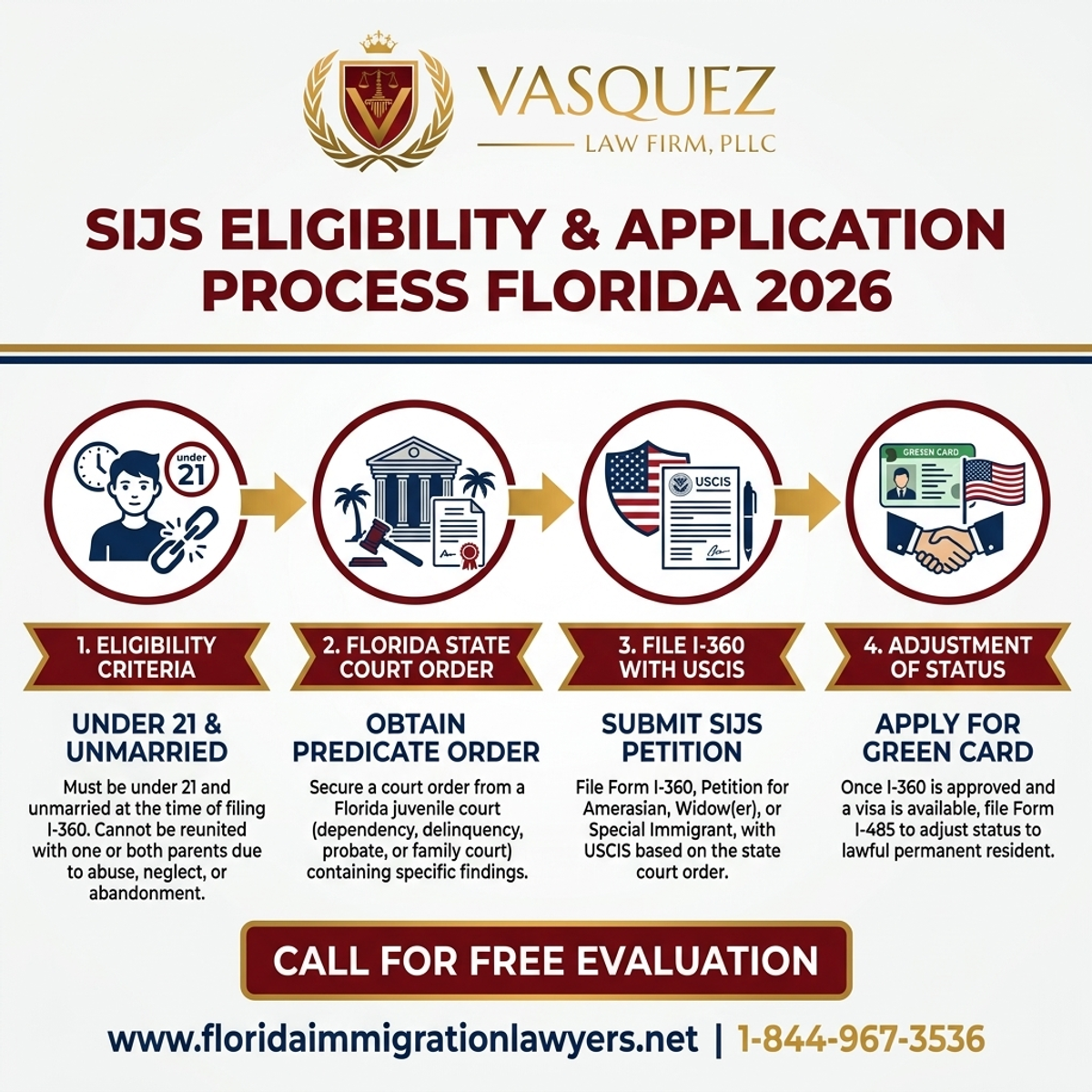
Step-by-Step Process — SIJS Eligibility and Application Process in Florida 2026
Each step in this journey is critical and can present unique challenges. The specialized nature of SIJS cases means that working with a knowledgeable immigration attorney is not just beneficial, but often indispensable for a successful outcome. They can help ensure all forms are correctly filed, deadlines are met, and all necessary evidence is submitted, particularly given the specific requirements of Florida's state courts.
What documents are needed for an SIJS petition?
A successful SIJS petition hinges on providing comprehensive and accurate documentation to both the Florida state court and U.S. Citizenship and Immigration Services (USCIS). Gathering all required documents can be challenging, but it is a critical component of demonstrating eligibility and strengthening the case for Special Immigrant Juvenile Status.
For the state court proceedings in Florida, documents typically include the child's birth certificate, school records, medical records, and any evidence related to the abuse, neglect, or abandonment, such as police reports, social worker reports from agencies like the Florida Department of Children and Families, or testimonies. Once the state court order is obtained, the federal immigration application, Form I-360, requires a certified copy of this order along with the child's birth certificate, identity documents, and sometimes additional affidavits. Subsequently, the Green Card application, Form I-485, will require further identity documents, medical examination results, and proof of SIJS approval. Maintaining organized records and understanding the purpose of each document is essential for a smooth process.
Essential Document Checklist for SIJS Applications
- Child's Birth Certificate: Original or certified copy, showing the child's name, date of birth, and parents' names. This is crucial for verifying age and identity.
- Proof of Identity: Passport, national identity document, or other government-issued identification.
- State Court Order: A certified copy of the Florida state court order (e.g., from a Circuit Court in Broward County or Miami-Dade County) containing all the specific findings required for SIJS eligibility (dependency, non-reunification due to abuse/neglect/abandonment, and not in best interest to return to home country). This is the most vital document.
- Form I-360, Petition for Amerasian, Widow(er), or Special Immigrant: The completed and signed petition.
- Form G-28, Notice of Entry of Appearance as Attorney or Accredited Representative (if applicable): If represented by an attorney.
- Form I-485, Application to Register Permanent Residence or Adjust Status: The completed and signed application (filed after I-360 approval).
- Form I-765, Application for Employment Authorization (optional): Can be filed concurrently with I-485.
- Form I-864, Affidavit of Support (not typically required for SIJS): SIJS applicants are generally exempt from the public charge ground of inadmissibility, so Form I-864 is usually not required.
- Form I-693, Report of Medical Examination and Vaccination Record: Completed by a USCIS-approved civil surgeon.
- Photos: Passport-style photographs for I-485 and I-765.
- Fingerprint Fee: Applicable for I-485 and I-765.
- Affidavits/Declarations: Statements from individuals with personal knowledge of the child's circumstances, abuse, neglect, or abandonment, if relevant and available.
- Police Reports/Social Worker Records: Any official documentation supporting the claims of abuse, neglect, or abandonment, particularly from Florida agencies like DCF.
- School Records: Proof of enrollment and attendance in Florida schools.
- Any other supporting evidence: Depending on the specifics of the case, additional documents may be required to substantiate claims.
It is important to provide English translations for any documents not in English, certified by a competent translator. Missing or incorrect documentation is a common reason for delays and denials in SIJS cases. An experienced Florida immigration attorney can assist in identifying and preparing all necessary documents, ensuring that your SIJS petition is as strong and complete as possible. This meticulous approach is especially crucial for children seeking protection in Florida's diverse communities, from Hialeah to Jacksonville.
How long does SIJS processing take in Florida?
The processing time for Special Immigrant Juvenile Status (SIJS) in Florida can vary significantly, depending on several factors including the specific state court involved, the complexity of the case, and the current USCIS caseload. As of 2026, applicants should anticipate a multi-stage process, with each stage having its own timeframe. Patience and consistent follow-up are key.
Generally, the initial state court process to obtain the necessary SIJS findings can take anywhere from a few months to over a year, depending on the court's schedule and the specifics of the child's situation. Once the state court order is secured, USCIS processing of Form I-360, Petition for Amerasian, Widow(er), or Special Immigrant, typically ranges from 6 to 12 months. After the I-360 is approved, the Form I-485, Application to Register Permanent Residence or Adjust Status, can take another 8 to 24 months, including biometrics and potential interviews. These are general estimates, and individual cases in Florida may experience longer or shorter processing times. For instance, a complex dependency case in a busy court like Miami-Dade's Eleventh Judicial Circuit might take longer than a simpler guardianship case in a less populated county.
Typical SIJS Processing Timeline in Florida (As of 2026)
| Stage | Typical Timeframe | Notes |
|---|---|---|
| State Court Proceedings (Obtaining SIJS Order) | 6 - 18 months | Varies greatly based on court docket, case complexity, and agency involvement (e.g., Florida DCF). This is the initial, critical step in Florida. |
| Form I-360 (Petition for SIJ Classification) | 6 - 12 months | Processed by USCIS Service Centers. Times can fluctuate. No fee for SIJ petitioners. |
| Form I-485 (Adjustment of Status / Green Card) | 8 - 24 months | Includes biometrics appointment, background checks, and potentially an interview at a local USCIS office in Florida (e.g., Hialeah, Orlando, Tampa). |
| Receipt of Green Card | 1 - 2 months after I-485 approval | Physical card mailed after final approval. |
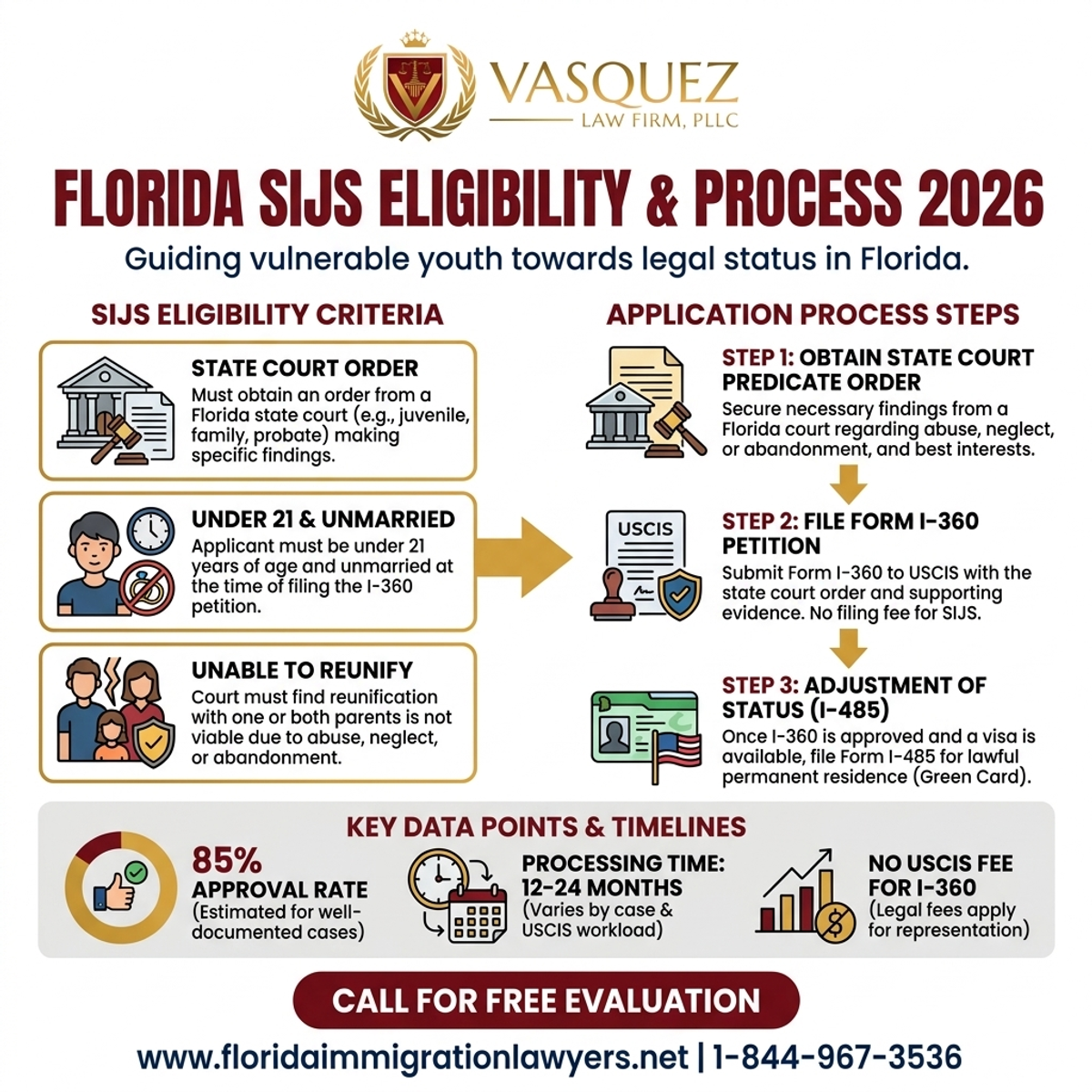
Key Statistics — SIJS Eligibility and Application Process in Florida 2026
It is important to note that these are estimated processing times. USCIS provides online tools to check current processing times, but individual case factors, such as requests for evidence (RFEs) or transfers between service centers, can extend these durations. Throughout this entire process, an immigration attorney can provide updates, respond to USCIS inquiries, and help manage expectations, ensuring that the SIJS application progresses as efficiently as possible for children in Florida.
What are the costs associated with SIJS applications?
The costs associated with Special Immigrant Juvenile Status (SIJS) applications in Florida involve various fees, though some are waived for SIJ petitioners, alongside potential legal fees. While the federal government waives certain filing fees for SIJS applicants, other expenses are still incurred. Understanding the financial aspects from the outset helps in planning and budgeting for this critical immigration process.
For the federal immigration filings with USCIS, the filing fee for Form I-360, Petition for Amerasian, Widow(er), or Special Immigrant, is waived for SIJ applicants. Similarly, the filing fee for Form I-485, Application to Register Permanent Residence or Adjust Status, is also waived for SIJ applicants, as is the biometrics services fee. However, applicants must still pay for the required medical examination (Form I-693) by a USCIS-approved civil surgeon, which can range from a few hundred dollars. The most significant cost for many SIJS applicants will be attorney's fees, covering representation in both the Florida state court proceedings and the federal immigration applications. These fees vary based on the complexity of the case and the attorney's experience, but they represent an investment in professional guidance through a highly intricate legal process.
Typical SIJS Cost Factors in Florida (As of 2026)
| Item | Typical Fee | Notes |
|---|---|---|
| Form I-360 Filing Fee | $0 | Waived for SIJS applicants. |
| Form I-485 Filing Fee | $0 | Waived for SIJS applicants. |
| Biometrics Services Fee | $0 | Waived for SIJS applicants. |
| Medical Examination (Form I-693) | Variable ($200 - $600+) | Required by a USCIS-approved civil surgeon. Costs vary by provider and location in Florida. |
| Attorney's Fees (State Court) | Variable | Covers legal representation for obtaining the necessary SIJS order from a Florida state court. Highly recommended due to complexity. |
| Attorney's Fees (USCIS Filings) | Variable | Covers legal representation for filing Form I-360 and Form I-485 with USCIS. |
| Translation Costs | Variable | If any documents are not in English, certified translations are required. |
| Travel Expenses | Variable | For court appearances, biometrics appointments, medical exams, and potential interviews at USCIS offices (e.g., in Hialeah or Orlando). |
While the waived USCIS fees significantly reduce the financial burden for SIJS applicants, the legal fees for experienced counsel are often a necessary investment. Given the dual nature of SIJS cases (state and federal), having an attorney who understands both Florida family law and federal immigration law is invaluable. Many firms, including Florida Immigration Lawyers, offer payment plans to make legal assistance more accessible. It is important to discuss all potential costs and fee structures during your initial consultation to ensure full transparency and avoid surprises.
Do not navigate this complex process alone. The future of a vulnerable child is too important to leave to chance. Contact Florida Immigration Lawyers today for experienced legal representation in your SIJS case. We are committed to helping children in Florida find safety and stability.
Common Mistakes to Avoid in SIJS Cases
Navigating the Special Immigrant Juvenile Status process is fraught with potential pitfalls. Avoiding common mistakes can significantly improve the chances of a successful outcome for a minor in Florida. Awareness of these errors can help you prepare more effectively.
- Failing to Obtain a Proper State Court Order: This is the most critical mistake. The Florida state court order must contain all specific findings required by immigration law (dependency, non-reunification due to abuse/neglect/abandonment, best interest not to return). An order missing even one finding will lead to USCIS denial.
- Missing Filing Deadlines: Strict age and marital status requirements apply. Filing Form I-360 after the minor turns 21, or if they marry, will result in denial. Timeliness is paramount.
- Inconsistent Information: Providing conflicting information between state court documents and federal immigration forms can raise red flags and lead to USCIS questioning the credibility of the petition.
- Incomplete Documentation: Submitting an I-360 or I-485 package without all required supporting documents, certified translations, or proper forms will result in Requests for Evidence (RFEs) or outright denial, causing significant delays.
- Not Disclosing All Immigration History: Any prior encounters with immigration officials, even minor ones, must be disclosed accurately. Failure to do so can be considered misrepresentation and lead to severe consequences.
- Attempting to Self-Represent in State Court: Florida family law and juvenile dependency proceedings are highly specialized. Attempting to navigate these complex court systems without legal counsel is extremely risky and often results in failure to obtain the necessary SIJS findings.
- Not Attending All Scheduled Appointments: Missing biometrics appointments, interviews, or court hearings can lead to the abandonment or denial of the application without further review.
- Incorrectly Addressing Abuse/Neglect/Abandonment: Simply stating abuse is not enough; specific facts and evidence, as found by the state court, must be clearly presented to USCIS.
- Failing to Respond to RFEs in Time: USCIS provides a specific deadline for responding to Requests for Evidence. Missing this deadline will almost certainly lead to a denial of the petition.
- Ignoring Changes in Law or Policy: Immigration law is dynamic. Staying updated on changes, such as those to processing times or specific requirements, is crucial. An attorney will monitor these changes for you.
- Assuming SIJS is an Automatic Green Card: SIJS classification is a pathway, not a guarantee. There are still further steps and requirements (like the I-485 application) that must be met to obtain lawful permanent residency.
When to Call a Lawyer for Your SIJS Case in Florida
Given the intricate nature of Special Immigrant Juvenile Status (SIJS) cases, involving both Florida state family law and complex federal immigration regulations, seeking legal counsel is almost always advisable. There are specific scenarios where contacting an experienced immigration attorney, like those at Florida Immigration Lawyers, becomes not just helpful, but absolutely essential for the success of a minor's petition.
You should call a lawyer immediately if you are a minor or a guardian considering SIJS, especially if the child has recently arrived in the U.S. or is facing deportation proceedings. If the child has any criminal history, even minor infractions, or prior immigration violations, legal expertise is critical to assess eligibility and address potential inadmissibility issues. Furthermore, if you are struggling to obtain the necessary state court order in Florida, or if a state court has already denied a petition related to the child's welfare, an attorney can help strategize the next steps, including appeals or alternative legal avenues. Any Request for Evidence (RFE) from USCIS or a notice for an interview also warrants immediate legal consultation to ensure a proper and timely response. Our firm specializes in protecting vulnerable children and understands the unique challenges faced by immigrant families in Florida, including those in Orlando. We can help you navigate the system effectively and advocate for the child's best interests.
About Florida Immigration Lawyers
Florida Immigration Lawyers is a leading immigration law firm dedicated to serving individuals and families across the entire state of Florida. Our mission is to provide compassionate, knowledgeable, and effective legal representation to those navigating the complexities of U.S. immigration law. We understand that immigration matters are often life-changing and can be incredibly stressful, especially for vulnerable populations like minor children seeking Special Immigrant Juvenile Status (SIJS).
Our experienced attorneys offer a comprehensive range of immigration services, including family-based immigration, business immigration, asylum claims, deportation defense, and naturalization. We are particularly skilled in handling sensitive cases like SIJS, where the well-being of a child is at stake. We pride ourselves on our client-focused approach, ensuring that every individual receives personalized attention and strategic legal advice tailored to their unique circumstances. From our Orlando office, serving communities across Florida, we are accessible to clients throughout Florida. We offer free consultations and are available 24/7 to address your urgent legal needs. Our team is fluent in both English and Spanish, ensuring clear and effective communication with our diverse clientele.
Sources and References
- U.S. Citizenship and Immigration Services (USCIS)
- USCIS - Special Immigrant Juveniles
- Executive Office for Immigration Review (EOIR)
- 8 U.S.C. Chapter 12 - Immigration and Nationality Act (INA), specifically Section 101(a)(27)(J)
- 8 CFR § 204.11 - Special immigrant juveniles
- Florida Statutes, Chapter 39 (Proceedings Relating to Children) and Chapter 744 (Guardianship)
Related services: immigration practice areas, family immigration services.
This article provides general legal information and is not intended as legal advice. Every case is unique, and outcomes depend on specific facts and circumstances. Contact an attorney for advice about your particular situation. Immigration laws are subject to change and should be verified with official government sources.
Your child's future is too important to navigate alone. If you are seeking Special Immigrant Juvenile Status (SIJS) in Florida, let our dedicated legal team guide you through every step. Contact Florida Immigration Lawyers today for a free consultation. Call us at 1-844-YO-PELEO. Se Habla Espanol - Estamos aqui para ayudarle.
If you need legal assistance, learn more about get immigration legal help today, or call us at 1-844-YO-PELEO for a free consultation.
Do Not Navigate This Process Alone
Our experienced immigration attorneys are ready to fight for you. Get a free, confidential case review today.
Se Habla Español
Or leave your details and we’ll call you:
Free Evaluation in 24 Hours
Or talk to us right now

AI voice assistant — available 24/7
FreeFrequently Asked Questions

William J. Vásquez
Founding Attorney · Vasquez Law Firm
U.S. Air Force veteran and immigration attorney with years of hands-on U.S. immigration experience. J.D., NCCU School of Law. AILA member. Admitted to the 4th, 5th, and 11th Circuit Courts.
Available 24/7 - Free Evaluations
Reviewed for legal accuracy by William J. Vásquez
Licensed in North Carolina; U.S. immigration is federal practice.
Related Legal Services
Our Florida immigration attorneys can help you with deportation defense, family immigration services and immigration lawyer cost in Florida. Call today at 1-844-YO-PELEO for a free case review.
Related Links
Related Topics
Free Legal Case Review
Discuss your case with our experienced attorneys. We're available 24/7.
Se Habla Español - Estamos aquí para ayudarle.
Related Articles
Immigration Lawyer Orlando Free Consultation in Florida
For individuals and families in Orlando, Florida, navigating the complexities of U.S. immigration law requires expert guidance. An immigration lawyer in Orlando offers crucial support for everything from visa applications and green card processes to naturalization and deportation defense. This comprehensive guide details what a free consultation covers, providing a step-by-step overview of immigration pathways, essential document checklists, and expected timelines in 2026. We also highlight common mistakes to avoid, discuss the critical role of legal counsel in deportation and asylum cases, and explain why choosing a local Orlando immigration attorney is beneficial. Florida Immigration Lawyers is dedicated to serving the diverse community of Orlando with compassionate, effective legal solutions, ensuring you receive personalized advice and robust representation for a successful immigration journey.
Dual Citizenship Lawyer: Interview Tips in Florida
Navigating the citizenship interview process in Florida can be challenging. Learn essential tips and common pitfalls to ensure a successful naturalization process. Whether you're in Orlando or elsewhere, preparing effectively can make a significant difference. Florida Immigration Lawyers offers expert guidance and support to help you achieve your citizenship goals. Call us at 1-844-YO-PELEO for a free consultation.
Immigration Rights: Know Your Protections in Florida 2026
Understanding your immigration rights in Florida is paramount for your protection and peace of mind. This comprehensive guide details your core constitutional protections, including the right to remain silent and the right to an attorney, regardless of your immigration status. Learn essential strategies for interacting with ICE, what vital documents to carry, and a step-by-step overview of the immigration detention and removal process in Florida. We also cover common mistakes to avoid and when it's crucial to seek expert legal counsel. Florida Immigration Lawyers are dedicated to empowering you with the knowledge and support needed to navigate complex immigration challenges. Our firm offers free case reviews and serves clients across the entire state, ensuring you have access to experienced legal representation when you need it most.
EAD Advance Parole Combo Card: A Guide for Military
For military families in Florida, the EAD Advance Parole Combo Card is a pivotal document, combining work authorization and travel permission for non-citizen family members applying for a green card. This guide from Florida Immigration Lawyers explores how Parole in Place (PIP) paves the way for this card, detailing eligibility, required documents, and processing timelines. We cover the financial aspects, including potential fee waivers for military families, and highlight the critical importance of avoiding common mistakes like traveling without approved advance parole. Understanding these complex immigration benefits is crucial for maintaining family unity and stability while a loved one serves our nation. Our firm is dedicated to providing expert legal assistance to ensure a smooth and successful immigration journey for military families across Florida, from Orlando to every corner of the state. Learn how this essential card can provide peace of mind and flexibility during the adjustment of status process.