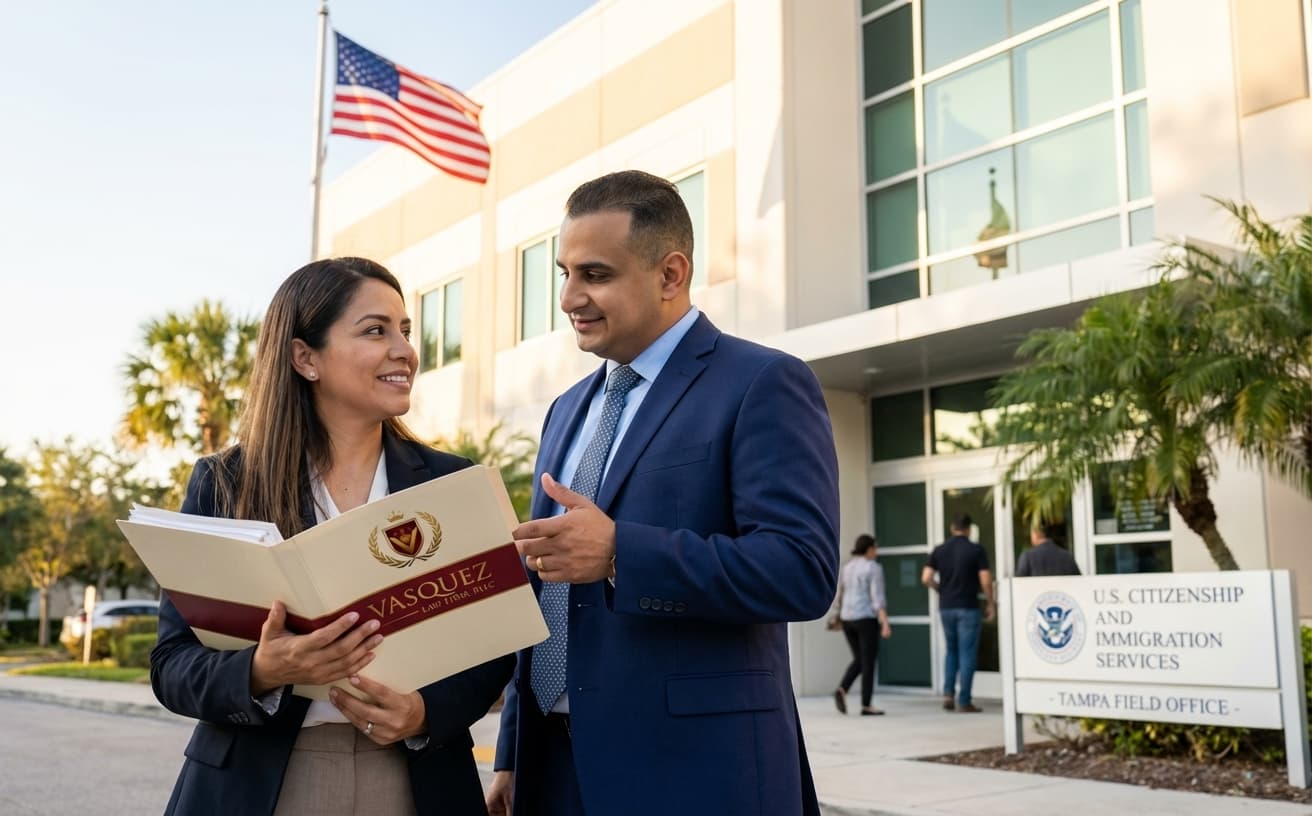
Many applicants ask whether they need a lawyer at the naturalization interview. The guide explains what happens at the interview, which situations call for a lawyer at your side, and why filing with a lawyer from the start can help. It also covers a question Indian nationals should answer before applying, a document checklist and what to do if a problem comes up. Our Orlando office prepares applicants across Florida in person and by secure video.
- Learn what happens at the naturalization interview before you attend.
- Certain situations make a lawyer at the interview more important.
- Retaining counsel before the interview is better than waiting until afterward.
- Bring the documents listed in the interview checklist to your appointment.
Introduction
Many applicants handle their naturalization interview alone, but some should not. If your history includes arrests, long trips abroad, tax problems, a prior immigration violation or a question about how you got your green card, it is wise to have a lawyer prepare you and attend with you. This page explains what happens at the interview, when to retain a lawyer, how a lawyer can help from the start of the application, and what to bring. It is written for permanent residents in Florida who are preparing to apply or who already have an interview notice. To talk about your case, call 1-844-YO-PELEO or contact us.
Vasquez Law Firm prepares applicants across Florida from our Orlando office and by secure video. We practice immigration law only, and our consultations are in English and Spanish. People who search for a way to retain a lawyer for a citizenship interview usually have one of the concerns listed below, and they are right to ask before the interview rather than after.
This guide is general information, not legal advice. Naturalization rules, forms and procedures change, so confirm current requirements with USCIS and speak with a lawyer about your own history.
What Happens at the Naturalization Interview
After you file Form N-400 and attend a biometrics appointment, USCIS schedules an interview at the field office that serves your address. An officer places you under oath and reviews your application line by line. The officer also gives the English test (reading, writing and speaking) and the civics test, unless you qualify for an exception based on age and years as a permanent resident, or a medical disability exception supported by Form N-648.
The officer is checking whether you meet each requirement: generally five years as a permanent resident (or three years if you have been married to and living with a U.S. citizen spouse for that time), continuous residence, physical presence, residence in your state or USCIS district for the required period, good moral character, and attachment to the principles of the Constitution. The officer also may look back at how you obtained permanent residence. If the green card was granted in error, applying for citizenship can expose that problem.
When You Need a Lawyer on Interview Day
A lawyer can attend with you, object to improper questions, help clarify answers and follow up on any documents the officer requests. Situations where we recommend having counsel include:
- Any arrest, charge, citation or conviction anywhere, even if it was dismissed, sealed or expunged.
- Trips outside the United States of six months or more, or many long trips.
- Unfiled tax returns, unpaid taxes or claiming nonresident status on a tax return.
- Past false claims to U.S. citizenship, voting or registering to vote.
- A green card obtained through marriage that ended soon after.
- Failure to register with Selective Service when required.
- Unpaid child support or past immigration fraud questions.
In these cases, a lawyer reviews the risk before you even file, because filing can lead USCIS to examine your whole history. Sometimes waiting longer before applying is the safer choice. Our naturalization services page explains how we help with each stage.
How the Citizenship Process Works in Florida
The naturalization steps are federal, so they are the same for an applicant in Orlando, Miami or the Panhandle. The usual sequence is as follows:
- Check eligibility. Review your time as a resident, your travel, your residence and your history before filing.
- File Form N-400. Complete the application and submit the evidence, with the current fee and instructions.
- Attend biometrics. USCIS takes your fingerprints and photograph at an appointment it schedules.
- Prepare for the interview. Study the civics questions, review your application and gather your documents.
- Attend the interview. The officer reviews the application and gives the English and civics tests.
- Receive a decision and take the oath. If approved, you attend an oath ceremony and become a citizen when you take the oath.
Some applicants are asked to return with more evidence or to retake a part of the test. A lawyer can help you prepare for those possibilities.
Filing for Citizenship With a Lawyer From the Start
Hiring an immigration lawyer to file for citizenship, rather than only for the interview, lets the lawyer catch problems on the N-400 itself. The application asks dozens of yes-or-no questions, and an incorrect answer can be treated as a lack of candor even if the underlying issue would not have disqualified you. Getting a lawyer's help can also include checking whether your children may have already acquired or derived citizenship through you, which is a separate process. If your application is denied, a lawyer can review whether to request a hearing with Form N-336 or to refile later.
Preparation for the tests is something a lawyer can support but not replace. The civics test draws from a published list of questions, and the applicant is asked a number of them aloud. The English test checks speaking during the interview, plus short reading and writing tasks. USCIS publishes study materials, and applicants should use the current versions, since the test format and question list can be updated. Practicing out loud with a family member or a teacher is often more useful than reading the list silently.
Indian Nationals: A Question to Answer Before You Apply
Applicants born in India often ask about a specific issue: India does not allow dual citizenship. Under Indian law, an Indian citizen who voluntarily acquires another citizenship generally loses Indian citizenship. Many people then apply for an Overseas Citizen of India (OCI) card, which allows travel to and long-term stay in India, and they may need to complete Indian consular procedures related to the old passport. Those steps are handled with the Indian government, not USCIS, so check the current requirements with the Indian consulate. On the U.S. side, we can help you plan travel around the interview and oath and make sure your N-400 trip history is accurate.
Clients in Venice and the Gulf Coast
We do not have an office in Venice or Sarasota County. People who look for a Venice citizenship attorney can work with us by video and phone for preparation, with in-person meetings at our Orlando office. Your interview will be at the USCIS field office that serves Sarasota County, as shown on your notice. Many Venice-area applicants are retirees who became permanent residents decades ago, and for them the interview often turns on long trips abroad, the age-based English exceptions and medical disability waivers.
Applicants who cannot attend an interview on the scheduled date should contact USCIS as soon as possible, following the instructions on the notice, and tell their lawyer. A missed interview with no explanation can lead to a denial for failure to appear, so rescheduling needs to be handled quickly and in writing where possible. Keep proof of anything you send, including the date and the method.
Document Checklist for the Interview
- Your interview notice, green card, passports (current and expired) and state ID.
- Marriage and divorce records, if your eligibility depends on marriage.
- Tax transcripts for the statutory period.
- Official court dispositions for any arrest, even if dismissed.
- Proof of Selective Service registration or a status information letter, if it applies.
- Records of travel outside the United States during the statutory period.
- Any documents listed in your appointment notice.
Read the notice carefully, since it lists what USCIS wants you to bring. If you cannot get a document before the interview, tell your lawyer so a plan can be made rather than appearing without it.
Timeline and Processing Expectations
Naturalization usually involves several waiting periods: the time between filing and biometrics, the time until the interview is scheduled and the time between the interview and the oath ceremony. USCIS publishes current processing times on its website, and those times change from office to office, so check them before you plan travel or anything that depends on the date.
After a successful interview, some applicants are sworn in the same day, while others receive a notice for a later ceremony. If you are asked to provide more evidence, the timeline can extend. Do not travel abroad close to an interview or an oath date without checking, because missing an appointment can delay the case.
| Stage | What happens | Who acts |
|---|
| Eligibility review | History, travel and records are checked before filing | Applicant and lawyer |
| Filing and biometrics | Form N-400 is submitted; fingerprints are taken | Applicant, then USCIS |
| Interview | Officer reviews the form and gives the English and civics tests | USCIS officer, applicant and lawyer |
| Decision | Approval, denial or a request for more evidence | USCIS |
| Oath ceremony | The applicant takes the oath and receives a certificate | Applicant and USCIS |
Choosing a Citizenship Lawyer
The better question is not who has the biggest reputation but which lawyer will look carefully at your history. Ask whether the lawyer will review your entire immigration file, including how you got your green card, and whether they attend interviews. Confirm the lawyer is licensed and in good standing with a state bar. Florida Bar rules do not allow lawyers to claim they are better than others, so be wary of claims of rank. Be cautious about any lawyer who guarantees an outcome, since only USCIS decides. Some people describe what they want as a naturalization law attorney or a lawyer for citizenship; the titles differ, but the work is the same.
What If a Problem Comes Up at the Interview?
Sometimes an officer raises an issue the applicant did not expect, such as an old arrest, a gap in the travel record or a difference between the application and a prior filing. Answer truthfully and ask for clarification if you do not understand the question. If a lawyer is with you, the lawyer can ask for a break to confer or clarify the facts. Do not guess or give an answer you are unsure of, because an answer given under oath that turns out to be wrong can be treated as a lack of candor.
If USCIS needs more information, it may issue a request for evidence or schedule a second interview. If the application is denied, the notice will explain the reasons and the next steps, including the deadline to request a hearing. A lawyer can compare the reasons with your record and tell you whether to challenge the decision, refile later or explore other options.
Some applicants also ask whether a lawyer is worth the cost when the application looks simple. For a clean record, many people complete the process without one. A consultation can still be useful as a check on eligibility, since a short review can confirm that nothing in your history needs attention before you file. If something does, the cost of preparation is often small compared with the cost of a denial, a lost fee and a delay in your plans.
Cost Factors and Fee Breakdown
The cost of naturalization includes the government fee and, if you hire a lawyer, the legal fee. The table lists the usual items.
| Item | Amount | Notes |
|---|
| Form N-400 filing fee | Check USCIS for the current fee | Confirm the fee and any reduced-fee rules on the form page |
| Medical disability exception, Form N-648 | Varies by case | Depends on the doctor who completes it |
| Hearing request, Form N-336 | Check USCIS for the current fee | Only if an application is denied |
| Records, such as court dispositions | Varies by case | Depend on the court or agency |
| Attorney fees | Varies by case | Set in a written agreement |
Government fees change, so check the current fee schedule and the form instructions before sending payment. A wrong payment can cause the filing to be rejected.
Legal fees depend on how complicated your history is. A straightforward case needs less work than one with arrests, long absences or tax issues, and you should ask for the scope of the work and the billing terms in writing.
Common Mistakes to Avoid
- Filing without checking whether an old arrest or past problem could affect eligibility.
- Giving an incorrect answer on the N-400 because a question seemed confusing.
- Forgetting a long trip abroad, or listing travel dates inaccurately.
- Leaving out unfiled or unpaid tax issues.
- Skipping the civics and English study because the interview seems easy.
- Traveling around the interview or oath date without checking the schedule.
- Believing anyone who promises approval.
When to Call a Lawyer
Call before you file if your history includes any of the issues above, or if you have doubts about how you obtained your green card. Call right away if you receive an interview notice and you are worried about a particular question, a request for evidence or a denial. A consultation can tell you whether to file now, wait or take another step first, and what to expect at the interview.
About Vasquez Law Firm
Vasquez Law Firm practices immigration law only. Our only office is at 1111 E Amelia Street in Orlando. We serve clients throughout Florida by phone and secure video, with in-person meetings in Orlando. William J. Vásquez is the founding attorney. Consultations are available in English and Spanish. Call 1-844-YO-PELEO or contact us to prepare for your interview.
Sources and References
Related services: naturalization services, immigration lawyers in Florida
Other ways people search for this
People look for this help under different names. Related searches include credible fear interview lawyer; retain lawyer for citizenship interview; venice citizenship lawyer; best citizenship attorney; citizenship & naturalization attorney; citizenship interview lawyer; citizenship lawyer for indians; immigration naturalization law attorney; lawyer for citizenship interview; lawyer help with citizenship.
This article is general information, not legal advice. Every case is different; speak with an immigration lawyer about your situation.