J-1 Waiver Physician Placement in Florida
Explore how the J-1 waiver helps foreign physicians work in Florida's underserved areas, focusing on Orlando's opportunities through the Conrad 30 program. Learn about application steps, timelines, and common mistakes. Contact Florida Immigration Lawyers for expert guidance.

J-1 Waiver Physician Placement in Florida: Your Path to Permanent Residency
For international medical graduates (IMGs) who have completed their residency or fellowship training in the United States on a J-1 visa, the two-year home residency requirement (212(e)) can be a significant hurdle to continuing their careers in the U.S. However, the J-1 waiver offers a vital pathway, particularly for physicians committed to serving in medically underserved areas. In Florida, this opportunity is not only available but actively encouraged, allowing dedicated physicians to contribute their skills where they are needed most. At VLF Florida, we specialize in guiding physicians through the complex J-1 waiver process, helping them secure placement in Florida and navigate their journey towards permanent residency.
Understanding the J-1 Visa and the Two-Year Home Residency Requirement
The J-1 visa program is designed for individuals participating in exchange visitor programs, including medical training. While invaluable for fostering international exchange, it often comes with a significant stipulation: the two-year home residency requirement, also known as Section 212(e) of the Immigration and Nationality Act. This requirement mandates that J-1 visa holders return to their home country for at least two years after their program ends before they can apply for certain other U.S. visas, such as an H-1B, L-1, or permanent residency.
This requirement applies if the exchange visitor's program was government-funded, involved skills deemed in short supply in their home country (as listed on the Exchange Visitor Skills List), or if they received graduate medical education or training. For many foreign physicians, this means a forced interruption in their U.S. medical careers, often at a critical juncture. Understanding whether you are subject to this requirement is the first crucial step in planning your post-residency future. Our experienced team at VLF Florida can help you assess your specific situation and determine the best course of action.
The J-1 Waiver: A Lifeline for Physicians in Underserved Areas
Fortunately, several waiver options exist to bypass the two-year home residency requirement. For physicians, the most common and impactful waiver is granted in exchange for working in a medically underserved area (MUA) or a health professional shortage area (HPSA) for a minimum of three years. This mechanism not only addresses the physician's immigration needs but also serves a critical public health objective: bringing essential medical services to communities that desperately need them.
There are several categories of J-1 waivers available to physicians, each with specific requirements and application processes. The primary categories include the Conrad 30 Program and various Federal Agency Waivers. Each state participates in the Conrad 30 program, allowing up to 30 waivers per year for physicians who commit to working in underserved areas within that state. Federal agencies, such as the Department of Health and Human Services (HHS) or the Department of Veterans Affairs (VA), also sponsor waivers for physicians who agree to work in facilities they oversee or fund. Navigating these options requires a deep understanding of immigration law and state-specific regulations, which is where our expertise becomes invaluable.
Deep Dive into the Conrad 30 Program in Florida
Florida actively participates in the Conrad 30 Waiver Program, providing a crucial avenue for J-1 physicians to remain in the U.S. and serve its diverse communities. The Florida Department of Health (FDOH) administers this program, setting specific criteria and priorities for applicants. Each year, Florida receives a quota of 30 waivers, making the application process competitive. Physicians must secure a full-time employment contract for at least three years in a designated HPSA or MUA within Florida. The employing facility must demonstrate a genuine need for the physician's services and commit to sponsoring their H-1B visa once the waiver is approved.
The application to the FDOH typically requires a comprehensive package including the physician's CV, a copy of their J-1 visa and DS-2019 forms, a signed employment contract, a letter of support from the employing facility, and evidence that the facility is located in an underserved area. It is vital to ensure all documentation is meticulously prepared and submitted within the state's specific application window, which often opens in the fall. Our firm works closely with physicians and healthcare facilities across Florida to prepare robust applications, increasing the chances of securing one of these coveted waivers. We understand the nuances of Florida's program and can help identify suitable placement opportunities that meet both the physician's career goals and the state's needs.
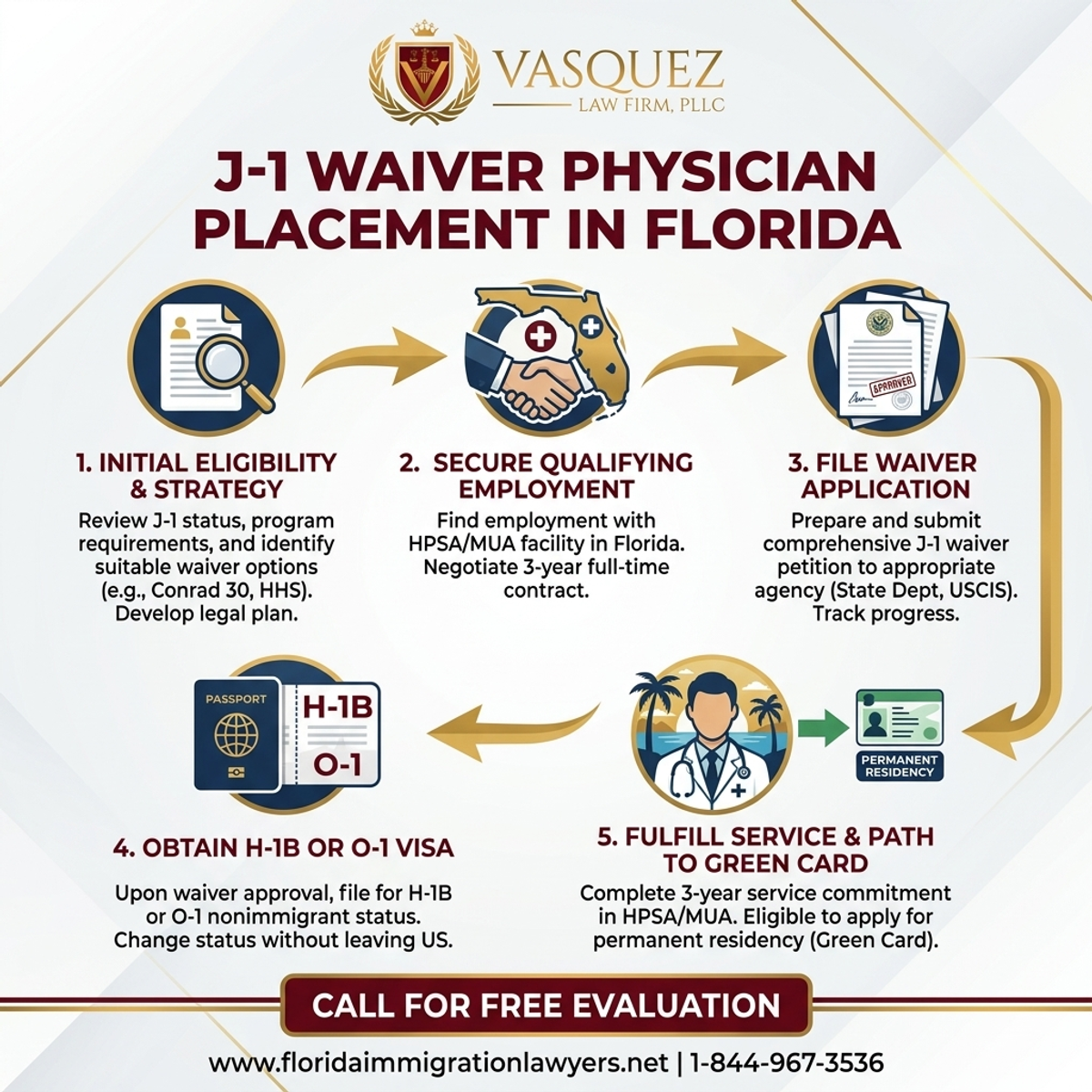
Step-by-Step Process — J-1 Waiver Physician Placement in Florida | VLF Florida
Exploring Federal Agency J-1 Waivers for Physicians
Beyond the state-specific Conrad 30 program, several federal agencies offer J-1 waivers, providing additional avenues for physicians to fulfill their service requirement. These waivers are often less geographically restrictive than Conrad 30, allowing physicians to serve in facilities funded or operated by the respective agency, regardless of the state's Conrad 30 cap. Understanding the distinct requirements and benefits of each federal agency waiver is crucial for physicians seeking alternatives or additional options.
The Department of Health and Human Services (HHS) waiver is one of the most common federal options. It typically requires physicians to work in HPSAs or MUAs for three years, often focusing on primary care specialties. The application involves a review by HHS, which assesses the public interest and the physician's commitment to underserved communities. Another significant option is the Department of Veterans Affairs (VA) waiver. Physicians who commit to working full-time for three years in a VA medical center or clinic are eligible. This waiver is particularly attractive as VA facilities are inherently considered to serve a federal interest, simplifying some aspects of the application. The Appalachian Regional Commission (ARC) and the Delta Regional Authority (DRA) also sponsor waivers for physicians serving in specific economically distressed regions within their jurisdictions. These regional waivers target specific geographic areas that often overlap with HPSAs and MUAs, providing critical support to rural and underserved communities.
Each federal agency has its own unique application process, documentation requirements, and submission deadlines. While they all share the core principle of service in exchange for a waiver, the specifics can vary significantly. For instance, some agencies may prioritize certain medical specialties, while others may have more flexible start dates. Successfully navigating these federal programs requires a thorough understanding of each agency's guidelines and a meticulously prepared application. Our team has extensive experience with all types of J-1 waivers and can help you determine which federal agency waiver best aligns with your qualifications and career aspirations, ensuring a smooth and efficient application process.
The H-1B Visa: The Next Step After Your J-1 Waiver
Once a J-1 waiver is approved, the next critical step for most physicians is to obtain an H-1B nonimmigrant visa. The H-1B visa allows U.S. employers to temporarily employ foreign workers in specialty occupations. For J-1 waiver physicians, the H-1B petition is typically filed by the sponsoring healthcare facility. Crucially, physicians working under a J-1 waiver in a clinical setting are generally exempt from the annual H-1B cap, meaning their petitions can be filed and processed at any time of the year, without being subject to the lottery system that affects many other H-1B applicants.
The H-1B petition requires the employer to demonstrate that the position is a specialty occupation, the physician is qualified for the role, and that the employer will pay the prevailing wage. It also involves submitting various documents, including the approved J-1 waiver recommendation, the employment contract, and evidence of the physician's medical licenses and qualifications. The H-1B visa is typically granted for three years, aligning with the minimum service requirement of the J-1 waiver, and can be extended for a total of six years. This period provides stability and allows physicians to fulfill their service obligation while planning their long-term immigration strategy. Our firm assists both physicians and their sponsoring employers in preparing and filing robust H-1B petitions, ensuring compliance with all USCIS regulations.
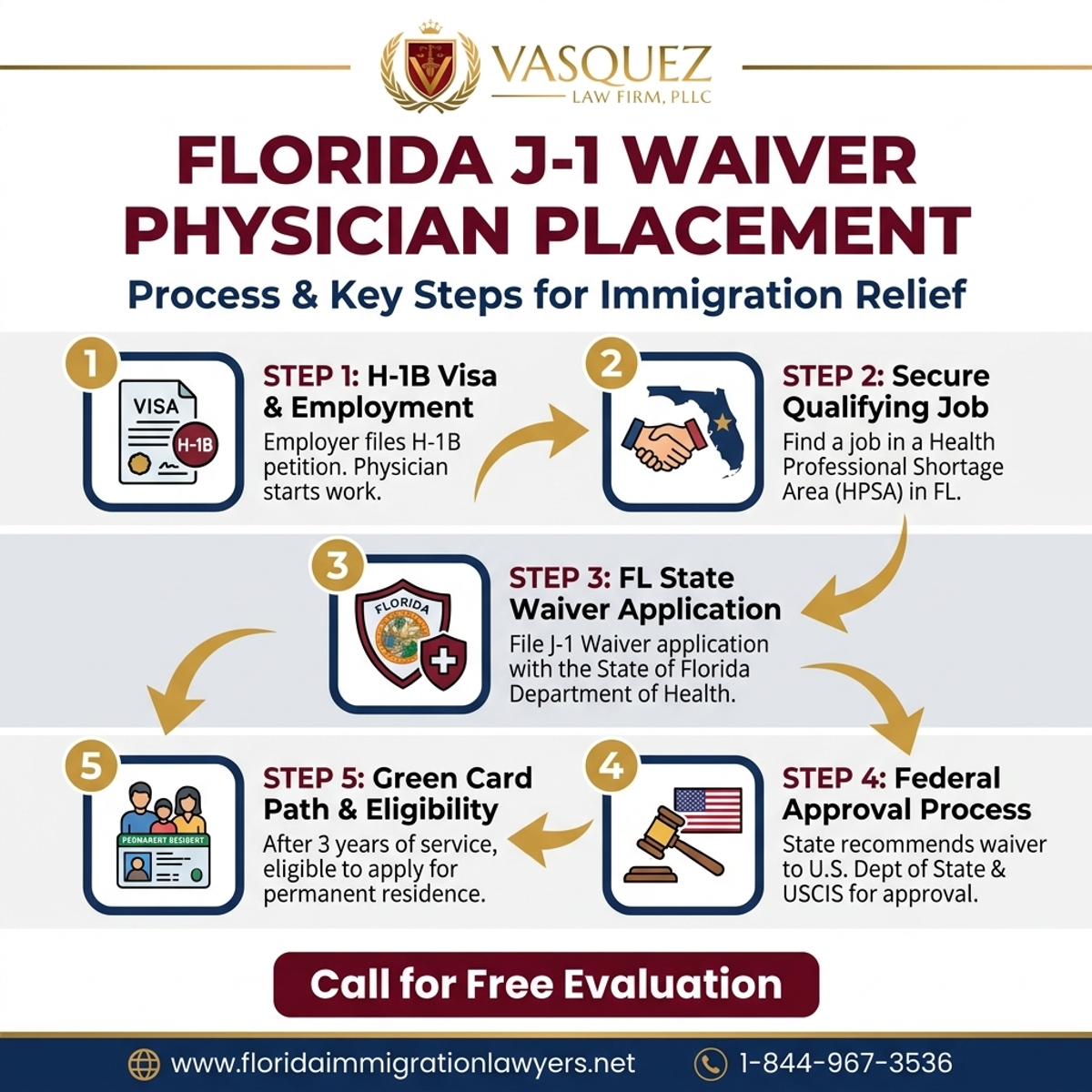
Key Statistics — J-1 Waiver Physician Placement in Florida | VLF Florida
Pathways to Green Card (Permanent Residency) for J-1 Waiver Physicians
After successfully completing the three-year service requirement and maintaining H-1B status, J-1 waiver physicians can pursue various pathways to obtain lawful permanent residency (a Green Card). The most common options include employer-sponsored petitions and the National Interest Waiver (NIW).
- Employer-Sponsored Green Card (PERM Labor Certification): Many physicians transition to permanent residency through an employer-sponsored petition, typically involving the Program Electronic Review Management (PERM) labor certification process. This requires the employer to demonstrate that there are no qualified U.S. workers available for the position.
- National Interest Waiver (NIW): The NIW is particularly attractive for physicians who have fulfilled their J-1 waiver service. Physicians who commit to working full-time in a clinical practice for five years in a designated HPSA, MUA, or VA facility can often qualify for an NIW. This waiver from the labor certification process significantly streamlines the Green Card application, as it recognizes the physician's work as being in the national interest.
Choosing the right Green Card pathway depends on individual circumstances, specialty, and long-term career goals. Our attorneys provide comprehensive guidance on these options, helping physicians strategize their path to permanent residency well in advance.
Challenges and Common Pitfalls in the J-1 Waiver Process
While the J-1 waiver offers an invaluable opportunity, the process is intricate and fraught with potential challenges. Strict deadlines, extensive documentation requirements, and the need for seamless coordination between the physician, the employer, and various government agencies can make it overwhelming. Common pitfalls include:
- Missing Deadlines: State Conrad 30 programs and federal agencies often have specific application windows and strict deadlines for submission. Missing these can result in a year-long delay.
- Incomplete or Incorrect Documentation: Even minor errors or omissions in forms, contracts, or supporting letters can lead to Requests for Evidence (RFEs) or outright denials.
- Employer Sponsorship Issues: Ensuring the sponsoring facility meets all requirements, including being in a designated underserved area and committing to H-1B sponsorship, is crucial.
- Compliance with Service Requirements: Physicians must strictly adhere to the three-year service agreement, including working full-time in the designated area. Any breach can jeopardize their immigration status.
Proactive planning and expert legal assistance are essential to navigate these complexities successfully. Our firm is dedicated to anticipating and mitigating these challenges, providing peace of mind throughout your J-1 waiver journey.
Why Choose VLF Florida for Your J-1 Waiver Journey
At VLF Florida, we understand the unique challenges and aspirations of international physicians. Our dedicated team of immigration lawyers possesses extensive experience in J-1 waivers, H-1B visas, and Green Card processes for medical professionals. We offer:
- Specialized Expertise: Deep knowledge of Florida's Conrad 30 program and all federal agency waivers.
- Personalized Guidance: Tailored strategies based on your unique qualifications, specialty, and career goals.
- Comprehensive Support: From initial eligibility assessment to Green Card application, we are with you every step of the way. We also assist clients with other complex immigration matters, including asylum claims and deportation defense.
- Proven Track Record: A history of successful outcomes for physicians seeking to build their lives and careers in the U.S.
Meet our highly skilled and compassionate attorneys who are committed to achieving the best possible results for our clients.
Frequently Asked Questions (FAQs)
Here are answers to some common questions about the J-1 waiver for physicians:
- What is the primary purpose of the J-1 waiver for physicians?
The primary purpose is to allow foreign physicians who completed their medical training in the U.S. on a J-1 visa to bypass the two-year home residency requirement (212(e)) by committing to work in a medically underserved area in the U.S. for at least three years. - What is the Conrad 30 Program?
The Conrad 30 Program allows each state to recommend up to 30 J-1 waivers annually for physicians who agree to practice in designated Health Professional Shortage Areas (HPSAs) or Medically Underserved Areas (MUAs) within that state. - How long do I need to work in an underserved area after getting a J-1 waiver?
Generally, you are required to work full-time for a minimum of three years in a designated underserved area. - Can I apply for a J-1 waiver in any medical specialty?
While primary care specialties (Family Medicine, Internal Medicine, Pediatrics, OB/GYN, Psychiatry) are often prioritized, some states and federal agencies may consider specialists if there's a demonstrated need in a specific underserved area. - What happens after my J-1 waiver is approved?
Once your J-1 waiver is approved, your employer can typically file an H-1B visa petition on your behalf. You will then transition from J-1 to H-1B status to begin your three-year service obligation. - Are J-1 waiver physicians subject to the H-1B cap?
No, physicians working under a J-1 waiver in a clinical setting are generally exempt from the annual H-1B cap, allowing their petitions to be filed at any time. - Can I change employers during my three-year service period?
Changing employers during the three-year service period is complex and generally requires a new J-1 waiver application or an amendment, which must be approved by USCIS and the sponsoring agency. It is crucial to consult with an immigration attorney before making any changes. - What is the National Interest Waiver (NIW) for physicians?
The NIW is a pathway to permanent residency that waives the labor certification requirement for physicians who commit to working full-time for five years in a designated HPSA, MUA, or VA facility, as their work is deemed to be in the national interest. - How long does the J-1 waiver process take?
The processing time can vary significantly depending on the state or federal agency involved, the completeness of the application, and current government backlogs. It can range from several months to over a year. - What are the main documents required for a J-1 waiver application?
Key documents typically include your CV, J-1 visa and DS-2019 forms, a signed employment contract, a letter of support from the employing facility, and evidence that the facility is in an underserved area. Specific requirements vary by program.
Contact Us Today for a Consultation
Your journey as a J-1 physician in Florida can lead to a fulfilling career and permanent residency. Don't navigate the complexities of immigration law alone. Contact VLF Florida today for a free consultation. Our dedicated attorneys are ready to provide the expert guidance and support you need to achieve your goals. Speak with Florida immigration lawyers — call (844) 967-3536.
Sources and References
- U.S. Citizenship and Immigration Services (USCIS)
- Executive Office for Immigration Review (EOIR)
- U.S. Department of State - Bureau of Consular Affairs
- Immigration and Nationality Act (INA), 8 U.S.C. Chapter 12
Do Not Navigate This Process Alone
Our experienced immigration attorneys are ready to fight for you. Get a free, confidential consultation today.
Se Habla Español
Frequently Asked Questions
Harold Estrada-Rodriguez
Florida Immigration Attorney · FL Bar No. 1041171
Florida Bar attorney handling Florida-jurisdiction immigration matters. Bilingual representation, free consultations.
Available 24/7 - Free Evaluations
Related Legal Services
Our Florida immigration attorneys can help you with asylum protection, deportation defense and citizenship and naturalization. Call today at 1-844-967-3536 for a free consultation.
Related Links
Related Topics
Free Legal Consultation
Discuss your case with our experienced attorneys. We're available 24/7.
Se Habla Español - Estamos aquí para ayudarle.
Related Articles
Citizenship Interview Tips Florida: Your 2026 Guide
Securing U.S. citizenship is a pivotal step for many Florida residents, including those in Homestead. This 2026 guide offers comprehensive tips for the naturalization interview, covering the USCIS process, essential preparation steps, and crucial documents. Learn how to effectively study for the English and civics tests, understand timelines, and budget for associated costs. We also highlight common mistakes to avoid and identify when professional legal assistance is indispensable. Florida Immigration Lawyers provides expert guidance, ensuring you approach your citizenship interview with confidence and clarity. Call us for a free consultation to navigate this vital journey successfully.
DED Venezuela Haiti Eligibility in Florida | VLF Florida
Deferred Enforced Departure (DED) offers temporary protection for Venezuelans and Haitians in Florida. Discover eligibility, application steps, and common pitfalls in our comprehensive guide. Contact Florida Immigration Lawyers at 1-844-967-3536 for assistance.
H-4 EAD Rules for Florida Spouses | FL Immigration Lawyers
Discover the rules for obtaining an H-4 EAD in Florida, allowing spouses of H-1B visa holders to work legally. Our detailed guide covers eligibility, timelines, costs, and common mistakes. Contact Florida Immigration Lawyers for assistance.
H-2A Visa for Agricultural Workers in Florida | VLF Florida
Discover how the H-2A visa helps Florida growers meet seasonal labor needs. Learn about the application process, common pitfalls, and how Florida Immigration Lawyers can assist you.
